FACTORS
AFFECTING
ENZYME
ACTIVITY
- By Sahil Bansal
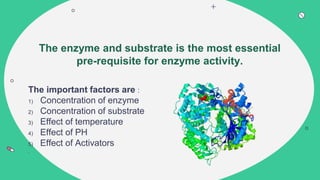
The enzyme and substrate is the most essential
pre-requisite for enzyme activity.
The important factors are :
1) Concentration of enzyme
2) Concentration of substrate
3) Effect of temperature
4) Effect of PH
5) Effect of Activators
.
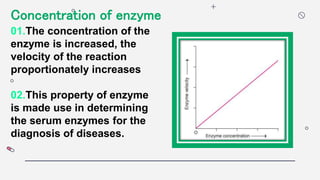
Concentration of enzyme
01.The concentration of the
enzyme is increased, the
velocity of the reaction
proportionately increases
02.This property of enzyme
is made use in determining
the serum enzymes for the
diagnosis of diseases.
Concentration of Substrate
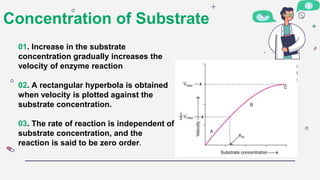
01. Increase in the substrate
concentration gradually increases the
velocity of enzyme reaction
02. A rectangular hyperbola is obtained
when velocity is plotted against the
substrate concentration.
03. The rate of reaction is independent of
substrate concentration, and the
reaction is said to be zero order.
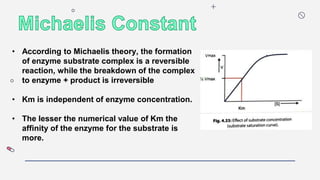
• According to Michaelis theory, the formation
of enzyme substrate complex is a reversible
reaction, while the breakdown of the complex
to enzyme + product is irreversible
• Km is independent of enzyme concentration.
• The lesser the numerical value of Km the
affinity of the enzyme for the substrate is
more.
Effect of temperature
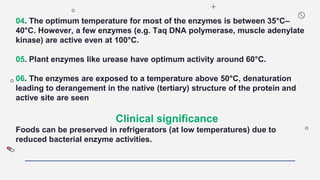
01. Velocity of an enzyme reaction
increases with increase in temperature up
to a maximum and then declines. A bell-
shaped curve is usually observed
02. Temperature coefficient or Q10 is
defined as increase in enzyme velocity
when the temperature is increased by 10°C.
03. Increase in temperature results in
higher activation energy of the molecules
and more molecular (enzyme and
substrate) collision and interaction for the
reaction to proceed faster.
04. The optimum temperature for most of the enzymes is between 35°C–
40°C. However, a few enzymes (e.g. Taq DNA polymerase, muscle adenylate
kinase) are active even at 100°C.
05. Plant enzymes like urease have optimum activity around 60°C.
06. The enzymes are exposed to a temperature above 50°C, denaturation
leading to derangement in the native (tertiary) structure of the protein and
active site are seen
Clinical significance
Foods can be preserved in refrigerators (at low temperatures) due to
reduced bacterial enzyme activities.
Effect of pH
Increase in the hydrogen ion concentration (pH)
considerably influences the enzyme activity and a bell-
shaped curve is normally obtained
Most of the enzymes of higher organisms show optimum
activity around neutral pH (6-8).
. Each enzyme has an optimum pH at which the velocity is
maximum
many exceptions like pepsin (1-2), acid phosphatase (4-5)
and alkaline phosphatase (10-11).
Enzymes from fungi and plants are most active in acidic pH
(4-6).
Effect of activators
01. Some of the enzymes require certain inorganic metallic cations like
Mg2+, Mn2+, Zn2+, Ca2+, Co2+, Cu2+, Na+, K+ etc. for their optimum
activity.
02. Anions are also needed for enzyme activity e.g. chloride ion (Cl–) for
amylase.
03. Metals function as activators of enzyme velocity through various
mechanisms— combining with the substrate, formation of ES-metal
complex, direct participation in the reaction and bringing a
conformational change in the enzyme.
04. Two categories of enzymes requiring metals for their
activity are distinguished
Metal-activated enzymes : The metal is not tightly held by
the enzyme and can be exchanged easily with other ions e.g.
ATPase (Mg2+ and Ca2+) Enolase (Mg2+)
Metalloenzymes : These enzymes hold the metals rather
tightly which are not readily exchanged. e.g. alcohol
dehydrogenase, carbonic anhydrase, alkaline phosphatase,
carboxypeptidase and aldolase contain zinc.
Effect of product concentration
The accumulation of reaction products generally
decreases the enzyme velocity.
For certain enzymes, the products combine with the
active site of enzyme and form a loose complex and,
thus, inhibit the enzyme activity. In the living system, this
type of inhibition is generally prevented by a quick
removal of products formed. The end product inhibition
by feedback mechanism is discussed later.
FactorsOfEnzymeActivity.pptx

FactorsOfEnzymeActivity.pptx

  • 1.
  • 2.
    The enzyme andsubstrate is the most essential pre-requisite for enzyme activity. The important factors are : 1) Concentration of enzyme 2) Concentration of substrate 3) Effect of temperature 4) Effect of PH 5) Effect of Activators .
  • 3.
    Concentration of enzyme 01.Theconcentration of the enzyme is increased, the velocity of the reaction proportionately increases 02.This property of enzyme is made use in determining the serum enzymes for the diagnosis of diseases.
  • 4.
    Concentration of Substrate 01.Increase in the substrate concentration gradually increases the velocity of enzyme reaction 02. A rectangular hyperbola is obtained when velocity is plotted against the substrate concentration. 03. The rate of reaction is independent of substrate concentration, and the reaction is said to be zero order.
  • 5.
    • According toMichaelis theory, the formation of enzyme substrate complex is a reversible reaction, while the breakdown of the complex to enzyme + product is irreversible • Km is independent of enzyme concentration. • The lesser the numerical value of Km the affinity of the enzyme for the substrate is more.
  • 6.
    Effect of temperature 01.Velocity of an enzyme reaction increases with increase in temperature up to a maximum and then declines. A bell- shaped curve is usually observed 02. Temperature coefficient or Q10 is defined as increase in enzyme velocity when the temperature is increased by 10°C. 03. Increase in temperature results in higher activation energy of the molecules and more molecular (enzyme and substrate) collision and interaction for the reaction to proceed faster.
  • 7.
    04. The optimumtemperature for most of the enzymes is between 35°C– 40°C. However, a few enzymes (e.g. Taq DNA polymerase, muscle adenylate kinase) are active even at 100°C. 05. Plant enzymes like urease have optimum activity around 60°C. 06. The enzymes are exposed to a temperature above 50°C, denaturation leading to derangement in the native (tertiary) structure of the protein and active site are seen Clinical significance Foods can be preserved in refrigerators (at low temperatures) due to reduced bacterial enzyme activities.
  • 8.
    Effect of pH Increasein the hydrogen ion concentration (pH) considerably influences the enzyme activity and a bell- shaped curve is normally obtained Most of the enzymes of higher organisms show optimum activity around neutral pH (6-8). . Each enzyme has an optimum pH at which the velocity is maximum many exceptions like pepsin (1-2), acid phosphatase (4-5) and alkaline phosphatase (10-11). Enzymes from fungi and plants are most active in acidic pH (4-6).
  • 9.
    Effect of activators 01.Some of the enzymes require certain inorganic metallic cations like Mg2+, Mn2+, Zn2+, Ca2+, Co2+, Cu2+, Na+, K+ etc. for their optimum activity. 02. Anions are also needed for enzyme activity e.g. chloride ion (Cl–) for amylase. 03. Metals function as activators of enzyme velocity through various mechanisms— combining with the substrate, formation of ES-metal complex, direct participation in the reaction and bringing a conformational change in the enzyme.
  • 10.
    04. Two categoriesof enzymes requiring metals for their activity are distinguished Metal-activated enzymes : The metal is not tightly held by the enzyme and can be exchanged easily with other ions e.g. ATPase (Mg2+ and Ca2+) Enolase (Mg2+) Metalloenzymes : These enzymes hold the metals rather tightly which are not readily exchanged. e.g. alcohol dehydrogenase, carbonic anhydrase, alkaline phosphatase, carboxypeptidase and aldolase contain zinc.
  • 11.
    Effect of productconcentration The accumulation of reaction products generally decreases the enzyme velocity. For certain enzymes, the products combine with the active site of enzyme and form a loose complex and, thus, inhibit the enzyme activity. In the living system, this type of inhibition is generally prevented by a quick removal of products formed. The end product inhibition by feedback mechanism is discussed later.