Menon Lakshmi Suresh
1st MSC BPS
OBJECTIVES:
• Define enzyme, substrate, active site
• Explain enzyme substrate specificity (Lock and Key
Model, Induced-Fit Model)
• Describe the effects of temperature, pH, and substrate
concentration on enzyme activity
• Define co-enzymes and co-factors, give examples and
describe their role in enzymatic activity.
• Uses of Enzymes
• Enzymes are organic catalysts
• All enzymes are composed of
Proteins (tertiary and
quaternary structures)
• Because enzymes are
composed of proteins, their
shape is important to their
function.
(If you change the shape of
the protein that composes
the enzyme you alter or
destroy the enzyme.)
• Enzymes are specific to which molecules they act
upon. The substances they act upon are called
substrates.
• Most enzymes end with the suffix –ase.
Sucrase, Lactase, Maltase
• For example the enzyme found in saliva which
begins the chemical hydrolysis of amylose is
called amylase.
• Enzymes are not used up or destroyed in the
reaction process and at the end of their reaction
will bind with more substrate molecules and
repeat the same chemical process. Therefore,
small numbers of these molecules can have a
great effect.
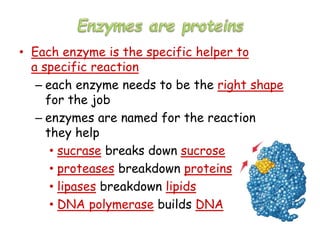
• Each enzyme is the specific helper to
a specific reaction
– each enzyme needs to be the right shape
for the job
– enzymes are named for the reaction
they help
• sucrase breaks down sucrose
• proteases breakdown proteins
• lipases breakdown lipids
• DNA polymerase builds DNA
• Enzymes affect the
rates of reactions by
lowering the amount of
energy of activation
required for the
reactions to begin.
Therefore processes
can occur in living
systems at lower
temperatures or energy
levels than it would
require for these same
reactions to occur
without the enzymes
present.
• Enzymes work by weakening bonds
which lowers activation energy
8
Free
Energy
Progress of the reaction
Reactants
Products
Free energy of activation
Without Enzyme
With Enzyme
Enzymes aren’t used up
• Enzymes are not changed by the reaction
– used only temporarily
– re-used again for the same reaction with other
molecules
– very little enzyme needed to help in many
reactions
enzyme
substrate product
active site
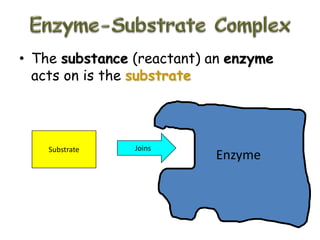
• The substance (reactant) an enzyme
acts on is the substrate
Enzyme
Substrate Joins
• A restricted region of an enzyme
molecule which binds to the substrate.
EnzymeSubstrate
Active
Site
How Enzymes Bind to Substrates
• There are two proposed methods by
which enzymes bind to their substrate
molecules:
a. Lock and Key Model
b. Induced-Fit Model
Enzymes
• Lock and Key Analogy: lock = enzyme, key =
substrate.
It’s shape that matters!
• Lock & Key model
– shape of protein
allows enzyme &
substrate to fit
– specific enzyme for
each specific
reaction
1
2
3
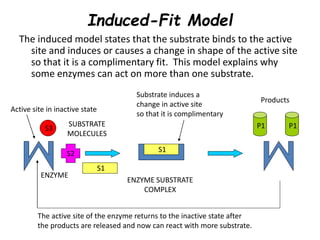
Induced-Fit Model
The induced model states that the substrate binds to the active
site and induces or causes a change in shape of the active site
so that it is a complimentary fit. This model explains why
some enzymes can act on more than one substrate.
S1
S2
S3 P1 P1SUBSTRATE
MOLECULES
ENZYME SUBSTRATE
COMPLEX
Products
Active site in inactive state
Substrate induces a
change in active site
so that it is complimentary
The active site of the enzyme returns to the inactive state after
the products are released and now can react with more substrate.
ENZYME
S1
Induced Fit
18
Induced Fit
• A change in the configuration of an
enzyme’s active site (H+ and ionic
bonds are involved).
• Induced by the substrate.
Enzyme
Active Site
substrate
induced fit
19
What Affects Enzyme Activity?
• Three factors:
1. Environmental Conditions
2. Cofactors and Coenzymes
3. Enzyme Inhibitors
1. Environmental Conditions
1. Extreme Temperature are the most
dangerous
- high temps may denature (unfold)
the enzyme.
2.pH (most like 6 - 8 pH near
neutral)
3.Ionic concentration (salt ions)
Environmental Factors Which Affect
Enzyme Activity: Temperature
All enzymes have an optimum
temperature at which they
work best. If you observe
the enzyme’s activity below
the specific temperature it
will steadily increase until it
reaches the optimum. After
the optimum temperature
is reached the enzymes
activity drops dramatically
due to denaturing.
Depending on the species, the
range of optimum activity is very
broad. Above is a comparison of
human enzyme activity with that of
bacteria found in hot springs and
oceanic vents.
Environmental Factors Which
Affect Enzyme Activity: pH
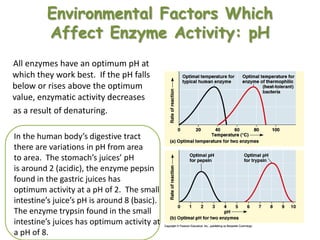
All enzymes have an optimum pH at
which they work best. If the pH falls
below or rises above the optimum
value, enzymatic activity decreases
as a result of denaturing.
In the human body’s digestive tract
there are variations in pH from area
to area. The stomach’s juices’ pH
is around 2 (acidic), the enzyme pepsin
found in the gastric juices has
optimum activity at a pH of 2. The small
intestine’s juice’s pH is around 8 (basic).
The enzyme trypsin found in the small
intestine’s juices has optimum activity at
a pH of 8.
Environmental Factors Which Affect
Enzyme Activity: Substrate Concentration
The concentration of substrate also has an affect on the rate of enzyme
activity. If the concentration of substrate is increased while the
concentration of enzyme is constant, the level of enzyme activity will
increase until a point of saturation is reached. At this point there are no
enzymes available to react with excess substrate and the rate of the
reaction stabilizes. No matter if you continue to add substrate, the
reaction rate will not increase!
Increasing Substrate Concentration
Rate of Reaction
Point of Saturation, all active
sites are filled with substrate.
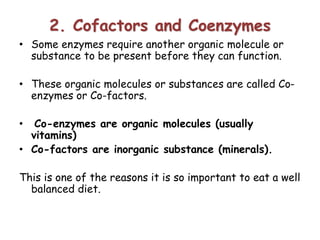
2. Cofactors and Coenzymes
• Some enzymes require another organic molecule or
substance to be present before they can function.
• These organic molecules or substances are called Co-
enzymes or Co-factors.
• Co-enzymes are organic molecules (usually
vitamins)
• Co-factors are inorganic substance (minerals).
This is one of the reasons it is so important to eat a well
balanced diet.
• For example, Vitamin K is necessary for the
enzyme responsible for blood clot formation.
A lack of vitamin K leads to easy bruising and
prolonged bleeding when injuries occur.
• Calcium is a co-factor which is required by
several enzymes for their activation.
3. Enzymatic inhibition.
To regulate enzyme activity, there must be
some form of prevention of binding of
substrate with active site. There are two
forms of inhibition:
1. Competitive inhibition
2. Noncompetitive inhibition
27
Two examples of Enzyme Inhibitors
a. Competitive inhibitors: are
chemicals that resemble an enzyme’s
normal substrate and compete with
it for the active site.
Enzyme
Competitive inhibitor
Substrate
28
b.Noncompetitive inhibitors:
Inhibitors that do not enter the active
site, but bind to another part of the
enzyme causing the enzyme to change its
shape, which in turn alters the active
site.
Enzyme
active site
altered
Noncompetitive
Inhibitor
Substrate
 ENZYMES IN INDUSTRY
 ENZYMES IN CLOTHES/DISHWASHER
DETERGENTS
 ENZYMES IN SLIMMING AIDS
 ENZYMES IN BABY FOOD
 STARCH(HFCS)
 ENZYMES TO DIAGNOSE AND
CONTROL DISEASE
 ENZYMES TO DIAGNOSE DISEASE
Enzymes

Enzymes

  • 1.
  • 2.
    OBJECTIVES: • Define enzyme,substrate, active site • Explain enzyme substrate specificity (Lock and Key Model, Induced-Fit Model) • Describe the effects of temperature, pH, and substrate concentration on enzyme activity • Define co-enzymes and co-factors, give examples and describe their role in enzymatic activity. • Uses of Enzymes
  • 3.
    • Enzymes areorganic catalysts • All enzymes are composed of Proteins (tertiary and quaternary structures) • Because enzymes are composed of proteins, their shape is important to their function. (If you change the shape of the protein that composes the enzyme you alter or destroy the enzyme.)
  • 4.
    • Enzymes arespecific to which molecules they act upon. The substances they act upon are called substrates. • Most enzymes end with the suffix –ase. Sucrase, Lactase, Maltase • For example the enzyme found in saliva which begins the chemical hydrolysis of amylose is called amylase. • Enzymes are not used up or destroyed in the reaction process and at the end of their reaction will bind with more substrate molecules and repeat the same chemical process. Therefore, small numbers of these molecules can have a great effect.
  • 5.
    • Each enzymeis the specific helper to a specific reaction – each enzyme needs to be the right shape for the job – enzymes are named for the reaction they help • sucrase breaks down sucrose • proteases breakdown proteins • lipases breakdown lipids • DNA polymerase builds DNA
  • 6.
    • Enzymes affectthe rates of reactions by lowering the amount of energy of activation required for the reactions to begin. Therefore processes can occur in living systems at lower temperatures or energy levels than it would require for these same reactions to occur without the enzymes present.
  • 7.
    • Enzymes workby weakening bonds which lowers activation energy
  • 8.
    8 Free Energy Progress of thereaction Reactants Products Free energy of activation Without Enzyme With Enzyme
  • 9.
    Enzymes aren’t usedup • Enzymes are not changed by the reaction – used only temporarily – re-used again for the same reaction with other molecules – very little enzyme needed to help in many reactions enzyme substrate product active site
  • 10.
    • The substance(reactant) an enzyme acts on is the substrate Enzyme Substrate Joins
  • 11.
    • A restrictedregion of an enzyme molecule which binds to the substrate. EnzymeSubstrate Active Site
  • 12.
    How Enzymes Bindto Substrates • There are two proposed methods by which enzymes bind to their substrate molecules: a. Lock and Key Model b. Induced-Fit Model
  • 13.
    Enzymes • Lock andKey Analogy: lock = enzyme, key = substrate.
  • 14.
    It’s shape thatmatters! • Lock & Key model – shape of protein allows enzyme & substrate to fit – specific enzyme for each specific reaction
  • 15.
  • 16.
    Induced-Fit Model The inducedmodel states that the substrate binds to the active site and induces or causes a change in shape of the active site so that it is a complimentary fit. This model explains why some enzymes can act on more than one substrate. S1 S2 S3 P1 P1SUBSTRATE MOLECULES ENZYME SUBSTRATE COMPLEX Products Active site in inactive state Substrate induces a change in active site so that it is complimentary The active site of the enzyme returns to the inactive state after the products are released and now can react with more substrate. ENZYME S1
  • 17.
  • 18.
    18 Induced Fit • Achange in the configuration of an enzyme’s active site (H+ and ionic bonds are involved). • Induced by the substrate. Enzyme Active Site substrate induced fit
  • 19.
    19 What Affects EnzymeActivity? • Three factors: 1. Environmental Conditions 2. Cofactors and Coenzymes 3. Enzyme Inhibitors
  • 20.
    1. Environmental Conditions 1.Extreme Temperature are the most dangerous - high temps may denature (unfold) the enzyme. 2.pH (most like 6 - 8 pH near neutral) 3.Ionic concentration (salt ions)
  • 21.
    Environmental Factors WhichAffect Enzyme Activity: Temperature All enzymes have an optimum temperature at which they work best. If you observe the enzyme’s activity below the specific temperature it will steadily increase until it reaches the optimum. After the optimum temperature is reached the enzymes activity drops dramatically due to denaturing. Depending on the species, the range of optimum activity is very broad. Above is a comparison of human enzyme activity with that of bacteria found in hot springs and oceanic vents.
  • 22.
    Environmental Factors Which AffectEnzyme Activity: pH All enzymes have an optimum pH at which they work best. If the pH falls below or rises above the optimum value, enzymatic activity decreases as a result of denaturing. In the human body’s digestive tract there are variations in pH from area to area. The stomach’s juices’ pH is around 2 (acidic), the enzyme pepsin found in the gastric juices has optimum activity at a pH of 2. The small intestine’s juice’s pH is around 8 (basic). The enzyme trypsin found in the small intestine’s juices has optimum activity at a pH of 8.
  • 23.
    Environmental Factors WhichAffect Enzyme Activity: Substrate Concentration The concentration of substrate also has an affect on the rate of enzyme activity. If the concentration of substrate is increased while the concentration of enzyme is constant, the level of enzyme activity will increase until a point of saturation is reached. At this point there are no enzymes available to react with excess substrate and the rate of the reaction stabilizes. No matter if you continue to add substrate, the reaction rate will not increase! Increasing Substrate Concentration Rate of Reaction Point of Saturation, all active sites are filled with substrate.
  • 24.
    2. Cofactors andCoenzymes • Some enzymes require another organic molecule or substance to be present before they can function. • These organic molecules or substances are called Co- enzymes or Co-factors. • Co-enzymes are organic molecules (usually vitamins) • Co-factors are inorganic substance (minerals). This is one of the reasons it is so important to eat a well balanced diet.
  • 25.
    • For example,Vitamin K is necessary for the enzyme responsible for blood clot formation. A lack of vitamin K leads to easy bruising and prolonged bleeding when injuries occur. • Calcium is a co-factor which is required by several enzymes for their activation.
  • 26.
    3. Enzymatic inhibition. Toregulate enzyme activity, there must be some form of prevention of binding of substrate with active site. There are two forms of inhibition: 1. Competitive inhibition 2. Noncompetitive inhibition
  • 27.
    27 Two examples ofEnzyme Inhibitors a. Competitive inhibitors: are chemicals that resemble an enzyme’s normal substrate and compete with it for the active site. Enzyme Competitive inhibitor Substrate
  • 28.
    28 b.Noncompetitive inhibitors: Inhibitors thatdo not enter the active site, but bind to another part of the enzyme causing the enzyme to change its shape, which in turn alters the active site. Enzyme active site altered Noncompetitive Inhibitor Substrate
  • 29.
     ENZYMES ININDUSTRY  ENZYMES IN CLOTHES/DISHWASHER DETERGENTS  ENZYMES IN SLIMMING AIDS  ENZYMES IN BABY FOOD  STARCH(HFCS)  ENZYMES TO DIAGNOSE AND CONTROL DISEASE  ENZYMES TO DIAGNOSE DISEASE