ENZYMES AND FACTORS AFFECTING
ENZYMES
BIPINA B
1ST MSc FTQA
INTRODUCTION
• Enzymes are catalysts or chemical agents that speed up chemical reactions without being
consumed.
• Most enzymes are proteins that function to reduce energy of activation in chemical reactions.
• They work on reactants called substrate; the enzyme attaches to the substrate and then the
enzyme converts the substrate into a product, while the enzyme remains unaffected.
• Enzyme activity affected by several factors that will be discussed below.
ENZYME CATALYZED REACTIONS
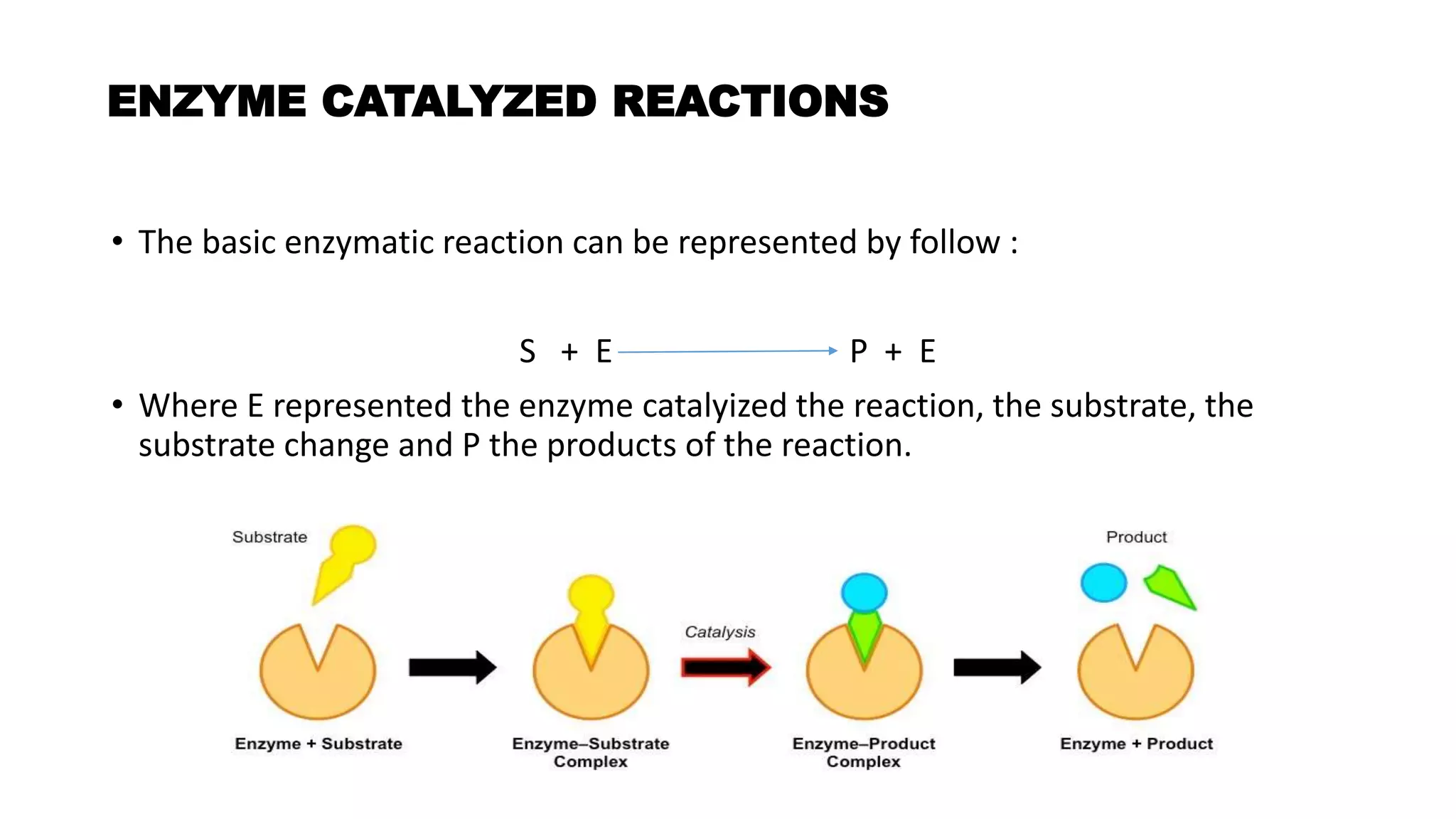
• The basic enzymatic reaction can be represented by follow :
S + E P + E
• Where E represented the enzyme catalyized the reaction, the substrate, the
substrate change and P the products of the reaction.
FACTORS AFFECTING ENZYME ACTIVITY
• The contact between the enzyme and substrate is the most essential pre-
requisite for enzyme activity.
The important factors that influence the velocity of the enzyme reaction are :
 Concentration of enzyme
 Concentration of substrate
 Effect of Ph
 Effect of temperature
 Effect of product concentration
 Effect of activators
 Effect of time
 Effect of light and radiation
1. Concentration of enzyme
• As the concentration of the enzyme is increased, the velocity of the reaction proportionately increases.
2. CONCENTRATION OF SUBSTRATE
• Increase in the substrate concentration gradually increases the velocity of enzyme reaction within the
limited range of substrate levels.
• A rectangular hyperbola is obtained when velocity is plotted against the substrate concentration.
• Within in limited range of substrate as their concentration increase velocity also increase
• Graph has 3 phase
 A – Linear phase
 B – Curved Portion of graph
 C – Almost unchanged phase
ENZYME KINETICS AND Km VALUE
• The enzyme (E) and substrate (S) combine with each other to form an unstable enzymesubstrate
complex (ES) for the formation of product (P).
• K1,K2,K3 are velocity constant
• Another constant , Km - the Michaelis - Menten constant.
• Km or the Michaelis - Menten constant is defined as the substrate concentration (expressed in
moles/l) to produce half-maximum velocity in an enzyme catalysed reaction
• The following equation is obtained after suitable algebraic manipulation
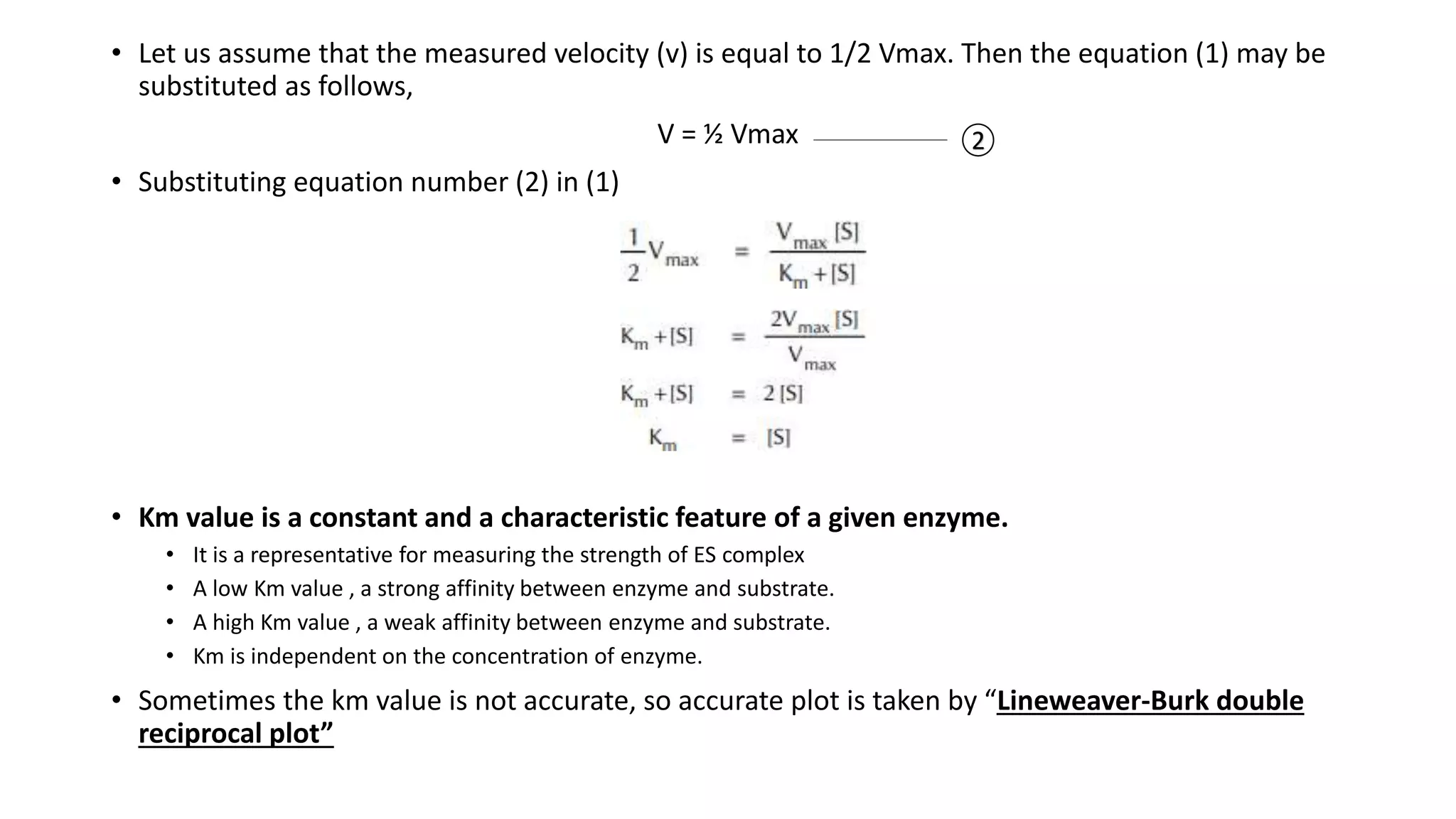
• Let us assume that the measured velocity (v) is equal to 1/2 Vmax. Then the equation (1) may be
substituted as follows,
V = ½ Vmax
• Substituting equation number (2) in (1)
• Km value is a constant and a characteristic feature of a given enzyme.
• It is a representative for measuring the strength of ES complex
• A low Km value , a strong affinity between enzyme and substrate.
• A high Km value , a weak affinity between enzyme and substrate.
• Km is independent on the concentration of enzyme.
• Sometimes the km value is not accurate, so accurate plot is taken by “Lineweaver-Burk double
reciprocal plot”
2
• By taking the reciprocals of the equation (1), a straight line graphic representation is obtained.
V = Vmax [s]
Km +[s]
• The above equation is similar to y = ax + b
• KM and Vmax is achieved from intercepts and slope of the straight line from graph.
4. EFFECT OF TEMPERATURE
• Enzyme reaction increases with increase in temperature up to a maximum and then declines.
• A bell-shaped curve is usually observed.
• Each enzyme shows a the highest activity at particular temperature called optimum temperature.
• Temperature coefficient or Q10 is defined as increase in enzyme velocity when the temperature is increased by
10°C. For a majority of enzymes, Q10 is 2 between 0°C and 40°C.
• The optimum temperature for most of the enzymes is between 35°C–40°C
• Taq DNA polymerase – are active 100°C
• Plant enzymes – urease - are active around 60°C.
• This may be due to very stable structure and conformation of these enzymes.
5. EFFECT OF pH
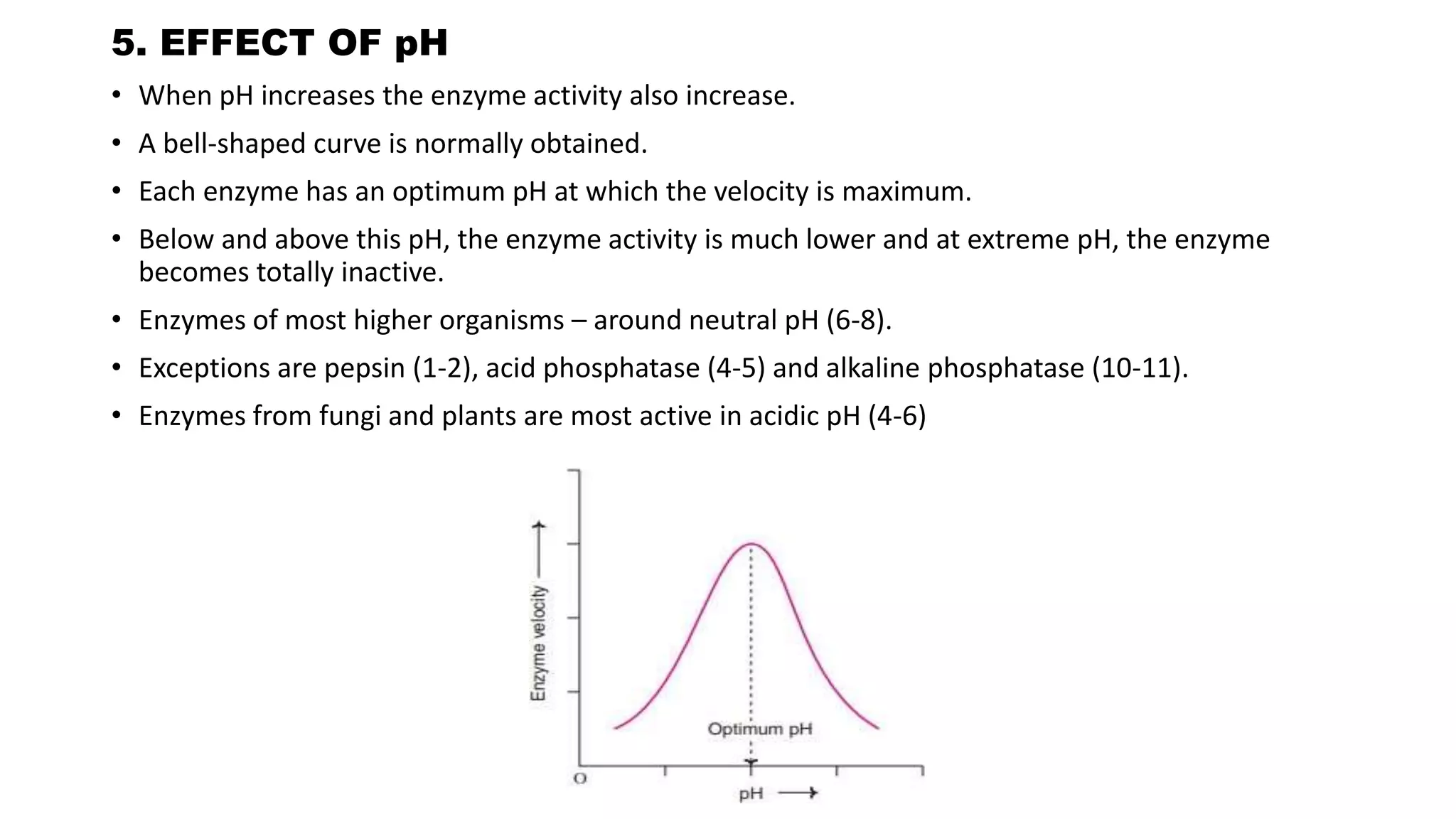
• When pH increases the enzyme activity also increase.
• A bell-shaped curve is normally obtained.
• Each enzyme has an optimum pH at which the velocity is maximum.
• Below and above this pH, the enzyme activity is much lower and at extreme pH, the enzyme
becomes totally inactive.
• Enzymes of most higher organisms – around neutral pH (6-8).
• Exceptions are pepsin (1-2), acid phosphatase (4-5) and alkaline phosphatase (10-11).
• Enzymes from fungi and plants are most active in acidic pH (4-6)
6. EFFECT OF PRODUCT CONCENTRATION
• As the accumulation of reaction products increase, enzyme velocity decrease.
• For certain enzymes, the products combine with the active site of enzyme and form a loose
complex and, thus, inhibit the enzyme activity.
7. EFFECT OF ACTIVATORS
• When enzymes have to exhibit optimum activity they seek the help of an inorganic metallic
cation/anion, they called activators.
• Metallic cations used are Mg2+, Mn2+, Zn2+, Ca2+, Co2+, Cu2+, Na+, K+ etc.
• Rarely, anions are also needed for enzyme activity e.g. chloride ion (Cl–) for amylase.
• Metals function as activators of enzyme velocity through various mechanisms— combining with
the substrate, formation of ES-metal complex, direct participation in the reaction and bringing a
conformational change in the enzyme.
• Two categories of enzymes requiring metals for their activity are distinguished :
a) Metal-activated enzymes : The metal is not tightly held by the enzyme and can be exchanged easily with other ions
e.g. ATPase (Mg2+ and Ca2+) Enolase (Mg2+)
b) Metalloenzymes : These enzymes hold the metals rather tightly which are not readily exchanged. e.g. alcohol
dehydrogenase , carboxypeptidase etc
8. EFFECT OF TIME
• Under ideal and optimal conditions (like pH, temperature etc.), the time required for an enzyme
reaction is less. Variations in the time of the reaction are generally related to the alterations in pH
and temperature.
9. EFFECT OF LIGHT AND RADIATION
• Exposure of enzymes to ultraviolet, beta, gamma and X-rays inactivates certain enzymes due to
the formation of peroxides. e.g. UV rays inhibit salivary amylase activity.
ENZYMES AND FACTORS AFFECTING ENZYMES.pptx

ENZYMES AND FACTORS AFFECTING ENZYMES.pptx

  • 1.
    ENZYMES AND FACTORSAFFECTING ENZYMES BIPINA B 1ST MSc FTQA
  • 2.
    INTRODUCTION • Enzymes arecatalysts or chemical agents that speed up chemical reactions without being consumed. • Most enzymes are proteins that function to reduce energy of activation in chemical reactions. • They work on reactants called substrate; the enzyme attaches to the substrate and then the enzyme converts the substrate into a product, while the enzyme remains unaffected. • Enzyme activity affected by several factors that will be discussed below.
  • 3.
    ENZYME CATALYZED REACTIONS •The basic enzymatic reaction can be represented by follow : S + E P + E • Where E represented the enzyme catalyized the reaction, the substrate, the substrate change and P the products of the reaction.
  • 4.
    FACTORS AFFECTING ENZYMEACTIVITY • The contact between the enzyme and substrate is the most essential pre- requisite for enzyme activity. The important factors that influence the velocity of the enzyme reaction are :  Concentration of enzyme  Concentration of substrate  Effect of Ph  Effect of temperature  Effect of product concentration  Effect of activators  Effect of time  Effect of light and radiation
  • 5.
    1. Concentration ofenzyme • As the concentration of the enzyme is increased, the velocity of the reaction proportionately increases.
  • 6.
    2. CONCENTRATION OFSUBSTRATE • Increase in the substrate concentration gradually increases the velocity of enzyme reaction within the limited range of substrate levels. • A rectangular hyperbola is obtained when velocity is plotted against the substrate concentration. • Within in limited range of substrate as their concentration increase velocity also increase • Graph has 3 phase  A – Linear phase  B – Curved Portion of graph  C – Almost unchanged phase
  • 7.
    ENZYME KINETICS ANDKm VALUE • The enzyme (E) and substrate (S) combine with each other to form an unstable enzymesubstrate complex (ES) for the formation of product (P). • K1,K2,K3 are velocity constant • Another constant , Km - the Michaelis - Menten constant. • Km or the Michaelis - Menten constant is defined as the substrate concentration (expressed in moles/l) to produce half-maximum velocity in an enzyme catalysed reaction • The following equation is obtained after suitable algebraic manipulation
  • 8.
    • Let usassume that the measured velocity (v) is equal to 1/2 Vmax. Then the equation (1) may be substituted as follows, V = ½ Vmax • Substituting equation number (2) in (1) • Km value is a constant and a characteristic feature of a given enzyme. • It is a representative for measuring the strength of ES complex • A low Km value , a strong affinity between enzyme and substrate. • A high Km value , a weak affinity between enzyme and substrate. • Km is independent on the concentration of enzyme. • Sometimes the km value is not accurate, so accurate plot is taken by “Lineweaver-Burk double reciprocal plot” 2
  • 9.
    • By takingthe reciprocals of the equation (1), a straight line graphic representation is obtained. V = Vmax [s] Km +[s] • The above equation is similar to y = ax + b • KM and Vmax is achieved from intercepts and slope of the straight line from graph.
  • 10.
    4. EFFECT OFTEMPERATURE • Enzyme reaction increases with increase in temperature up to a maximum and then declines. • A bell-shaped curve is usually observed. • Each enzyme shows a the highest activity at particular temperature called optimum temperature. • Temperature coefficient or Q10 is defined as increase in enzyme velocity when the temperature is increased by 10°C. For a majority of enzymes, Q10 is 2 between 0°C and 40°C. • The optimum temperature for most of the enzymes is between 35°C–40°C • Taq DNA polymerase – are active 100°C • Plant enzymes – urease - are active around 60°C. • This may be due to very stable structure and conformation of these enzymes.
  • 11.
    5. EFFECT OFpH • When pH increases the enzyme activity also increase. • A bell-shaped curve is normally obtained. • Each enzyme has an optimum pH at which the velocity is maximum. • Below and above this pH, the enzyme activity is much lower and at extreme pH, the enzyme becomes totally inactive. • Enzymes of most higher organisms – around neutral pH (6-8). • Exceptions are pepsin (1-2), acid phosphatase (4-5) and alkaline phosphatase (10-11). • Enzymes from fungi and plants are most active in acidic pH (4-6)
  • 12.
    6. EFFECT OFPRODUCT CONCENTRATION • As the accumulation of reaction products increase, enzyme velocity decrease. • For certain enzymes, the products combine with the active site of enzyme and form a loose complex and, thus, inhibit the enzyme activity. 7. EFFECT OF ACTIVATORS • When enzymes have to exhibit optimum activity they seek the help of an inorganic metallic cation/anion, they called activators. • Metallic cations used are Mg2+, Mn2+, Zn2+, Ca2+, Co2+, Cu2+, Na+, K+ etc. • Rarely, anions are also needed for enzyme activity e.g. chloride ion (Cl–) for amylase. • Metals function as activators of enzyme velocity through various mechanisms— combining with the substrate, formation of ES-metal complex, direct participation in the reaction and bringing a conformational change in the enzyme. • Two categories of enzymes requiring metals for their activity are distinguished : a) Metal-activated enzymes : The metal is not tightly held by the enzyme and can be exchanged easily with other ions e.g. ATPase (Mg2+ and Ca2+) Enolase (Mg2+) b) Metalloenzymes : These enzymes hold the metals rather tightly which are not readily exchanged. e.g. alcohol dehydrogenase , carboxypeptidase etc
  • 13.
    8. EFFECT OFTIME • Under ideal and optimal conditions (like pH, temperature etc.), the time required for an enzyme reaction is less. Variations in the time of the reaction are generally related to the alterations in pH and temperature. 9. EFFECT OF LIGHT AND RADIATION • Exposure of enzymes to ultraviolet, beta, gamma and X-rays inactivates certain enzymes due to the formation of peroxides. e.g. UV rays inhibit salivary amylase activity.