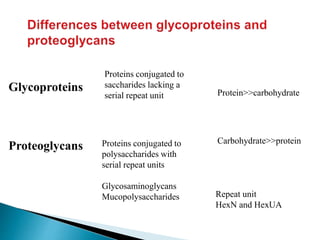
Glycoproteins
Proteoglycans
Proteins conjugated to
saccharides lacking a
serial repeat unit
Proteins conjugated to
polysaccharides with
serial repeat units
Glycosaminoglycans
Mucopolysaccharides
Protein>>carbohydrate
Carbohydrate>>protein
Repeat unit
HexN and HexUA
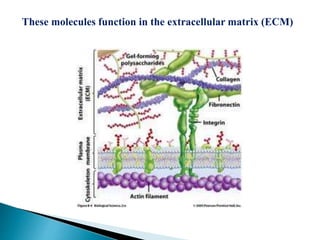
These molecules function in the extracellular matrix (ECM)
Overview of glycoproteins:
--carbohydrate chain short
--no serial repeats
--often branched, not linear
--variable amounts of carbs
--wide range of functions
Some Functions of Glycoproteins
_________________________________________________
Function Glycoprotein
_________________________________________________
1. Structural molecule Collagens
2. Lubricant Mucins
3. Transport molecule e.g. Transferrin,
Ceruloplasmin
4. Immune system Immunoglobulins,
Histocompatibility antigens,
Blood group determinants
5. Hormone e.g. HCG, TSH
6. Enzymes e.g. Alkaline phosphatase
7. Blood clotting e.g. Fibrinogen
8. Cell surface recognition Lectins
__________________________________________________
One or more carbohydrate chains--covalently linked to a protein.
The chains may be neutral or negatively charged. They are
frequently branched.
There are two types of glycosidic links:
1. O-glycosidic link
O-glycosidic link between galactose or glucose and the hydroxyl
group of hydroxylysine (i.e. collagen).
Other O-linked glycoproteins have a glycosidic link between N-acetyl
galactosamine and either serine or threonine (i.e. blood group
substances and salivary mucins).
2. N-glycosidic link
N-glycosidic links exist between N-acetylglucosamine and
asparagine. There are two types:
A. High mannose
B. Complex. For example, in addition to mannose they may contain
N-acetylglucosamine, galactose, fucose and N-acetylneuraminic acid
(sialic acid)
Lippincott
SYNTHESIS OF GLYCOPROTEINS
Synthesized on ribosomes attached to the RER, then
transported via vesicles to the Golgi for sorting
The units in the saccharide chains are added from
UDP-glucuronic acid, UDP-N-acetylgalactosamine and GDP-
mannose.
Sialic acid in glycoproteins is added from CMP-NANA.
These additions are catalyzed by specific
glycosyltransferases.
For synthesis of O-linked glycoproteins, addition is direct.
For N-linked glycoproteins, the chain is formed on dolichol
pyrophosphate and then transferred to the protein.
DEGRADATION OF GLYCOPROTEINS
Degradation of the saccharide chains is achieved
by hydrolytic enzymes present in lysosomes.
The enzymes act on the ends of the chains on a
last-on-first-off basis.
Defects can lead to a number of
diseases/disorders
 I-cell disease results from an enzyme
deficiency so that lysosomal enzymes do not
aquire the targeting signal, mannose 6-
phosphate.
 Fibroblasts in this disease have dense
inclusion bodies (I-cells) and are deficient in
many lysosomal enzymes.
 The lysosomes become engorged with
indigestible substrates, leading to death in
infancy.
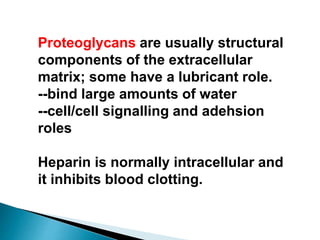
Proteoglycans are usually structural
components of the extracellular
matrix; some have a lubricant role.
--bind large amounts of water
--cell/cell signalling and adehsion
roles
Heparin is normally intracellular and
it inhibits blood clotting.
SYNTHESIS OF PROTEOGLYCANS
Synthesized in Golgi
The units in the saccharide chains are elongated in
alternating acidic/amino sugars, donated from UDP
derivatives. Last step is sulfation of some amino sugars.
For glycosaminoglycan synthesis and synthesis of O-linked
glycoproteins, the addition is direct.
For N-linked glycoproteins, the chain is formed on dolichol
pyrophosphate and then transferred to the protein.
DEGRADATION OF PROTEOGLYCANS
Some proteoglycans must be phagocytosized first
Degradation of the saccharide chains is achieved
by hydrolytic enzymes present in lysosomes.
The enzymes act on the ends of the chains on a
last-on-first-off basis.
Defects can lead to a number of
diseases/disorders
Rare inborn errors in the degradation of glycosaminoglycans result in
a series of diseases called mucopolysaccharidoses;
characterized by mental retardation and/or structural defects.
MPS Type I
Hurler’s syndrome results from a deficiency of alpha-L-iduronidase.
Heparan sulfate and dermatan sulfate accumulate. There is growth
and mental retardation with characteristic facial changes.
MPS Type II
Hunters syndrome is similar to Hurler’s syndrome but the enzyme
deficiency is for iduronate sulfatase and the inheritance is X-linked.
MPS Type III
Sanfilipo’s syndrome is caused by a deficiency of one of four
enzymes of which three are hydrolases and one is an N-
acetyltransferase. There is severe mental retardation but only mild
structural features.
Other MPS Types are IV, VI and VII. There is no MPS Type V.
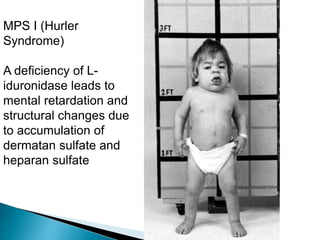
MPS I (Hurler
Syndrome)
A deficiency of L-
iduronidase leads to
mental retardation and
structural changes due
to accumulation of
dermatan sulfate and
heparan sulfate
MPS II (Hunter Syndrome)
X-linked disease due to a
deficiency of iduronate
sulfatase
MPS III (Sanfilippo Syndrome)
Deficiency in one of four
degradative enzymes leads to
severe mental retardation but
little structural change
MPS IV (Morquio Syndrome)
Deficiency of a galactose-6-sulfatase or a beta-
galactosidase leads to accumulation of keratan sulfate
with normal intelligence but severe deformity
Summary
Glycoproteins and proteoglycans are distinct:
--functions/structures
--synthesis/degradation
--associated pathologies

Proteoglycans

  • 1.
    Glycoproteins Proteoglycans Proteins conjugated to saccharideslacking a serial repeat unit Proteins conjugated to polysaccharides with serial repeat units Glycosaminoglycans Mucopolysaccharides Protein>>carbohydrate Carbohydrate>>protein Repeat unit HexN and HexUA
  • 2.
    These molecules functionin the extracellular matrix (ECM)
  • 3.
    Overview of glycoproteins: --carbohydratechain short --no serial repeats --often branched, not linear --variable amounts of carbs --wide range of functions
  • 4.
    Some Functions ofGlycoproteins _________________________________________________ Function Glycoprotein _________________________________________________ 1. Structural molecule Collagens 2. Lubricant Mucins 3. Transport molecule e.g. Transferrin, Ceruloplasmin 4. Immune system Immunoglobulins, Histocompatibility antigens, Blood group determinants 5. Hormone e.g. HCG, TSH 6. Enzymes e.g. Alkaline phosphatase 7. Blood clotting e.g. Fibrinogen 8. Cell surface recognition Lectins __________________________________________________
  • 5.
    One or morecarbohydrate chains--covalently linked to a protein. The chains may be neutral or negatively charged. They are frequently branched. There are two types of glycosidic links: 1. O-glycosidic link O-glycosidic link between galactose or glucose and the hydroxyl group of hydroxylysine (i.e. collagen). Other O-linked glycoproteins have a glycosidic link between N-acetyl galactosamine and either serine or threonine (i.e. blood group substances and salivary mucins). 2. N-glycosidic link N-glycosidic links exist between N-acetylglucosamine and asparagine. There are two types: A. High mannose B. Complex. For example, in addition to mannose they may contain N-acetylglucosamine, galactose, fucose and N-acetylneuraminic acid (sialic acid)
  • 6.
  • 7.
    SYNTHESIS OF GLYCOPROTEINS Synthesizedon ribosomes attached to the RER, then transported via vesicles to the Golgi for sorting The units in the saccharide chains are added from UDP-glucuronic acid, UDP-N-acetylgalactosamine and GDP- mannose. Sialic acid in glycoproteins is added from CMP-NANA. These additions are catalyzed by specific glycosyltransferases. For synthesis of O-linked glycoproteins, addition is direct. For N-linked glycoproteins, the chain is formed on dolichol pyrophosphate and then transferred to the protein.
  • 8.
    DEGRADATION OF GLYCOPROTEINS Degradationof the saccharide chains is achieved by hydrolytic enzymes present in lysosomes. The enzymes act on the ends of the chains on a last-on-first-off basis. Defects can lead to a number of diseases/disorders
  • 9.
     I-cell diseaseresults from an enzyme deficiency so that lysosomal enzymes do not aquire the targeting signal, mannose 6- phosphate.  Fibroblasts in this disease have dense inclusion bodies (I-cells) and are deficient in many lysosomal enzymes.  The lysosomes become engorged with indigestible substrates, leading to death in infancy.
  • 11.
    Proteoglycans are usuallystructural components of the extracellular matrix; some have a lubricant role. --bind large amounts of water --cell/cell signalling and adehsion roles Heparin is normally intracellular and it inhibits blood clotting.
  • 18.
    SYNTHESIS OF PROTEOGLYCANS Synthesizedin Golgi The units in the saccharide chains are elongated in alternating acidic/amino sugars, donated from UDP derivatives. Last step is sulfation of some amino sugars. For glycosaminoglycan synthesis and synthesis of O-linked glycoproteins, the addition is direct. For N-linked glycoproteins, the chain is formed on dolichol pyrophosphate and then transferred to the protein.
  • 20.
    DEGRADATION OF PROTEOGLYCANS Someproteoglycans must be phagocytosized first Degradation of the saccharide chains is achieved by hydrolytic enzymes present in lysosomes. The enzymes act on the ends of the chains on a last-on-first-off basis. Defects can lead to a number of diseases/disorders
  • 21.
    Rare inborn errorsin the degradation of glycosaminoglycans result in a series of diseases called mucopolysaccharidoses; characterized by mental retardation and/or structural defects. MPS Type I Hurler’s syndrome results from a deficiency of alpha-L-iduronidase. Heparan sulfate and dermatan sulfate accumulate. There is growth and mental retardation with characteristic facial changes. MPS Type II Hunters syndrome is similar to Hurler’s syndrome but the enzyme deficiency is for iduronate sulfatase and the inheritance is X-linked. MPS Type III Sanfilipo’s syndrome is caused by a deficiency of one of four enzymes of which three are hydrolases and one is an N- acetyltransferase. There is severe mental retardation but only mild structural features. Other MPS Types are IV, VI and VII. There is no MPS Type V.
  • 23.
    MPS I (Hurler Syndrome) Adeficiency of L- iduronidase leads to mental retardation and structural changes due to accumulation of dermatan sulfate and heparan sulfate
  • 24.
    MPS II (HunterSyndrome) X-linked disease due to a deficiency of iduronate sulfatase
  • 25.
    MPS III (SanfilippoSyndrome) Deficiency in one of four degradative enzymes leads to severe mental retardation but little structural change
  • 26.
    MPS IV (MorquioSyndrome) Deficiency of a galactose-6-sulfatase or a beta- galactosidase leads to accumulation of keratan sulfate with normal intelligence but severe deformity
  • 27.
    Summary Glycoproteins and proteoglycansare distinct: --functions/structures --synthesis/degradation --associated pathologies