ENZYME INHIBITORS, REVERSIBLE AND
IRREVERSIBLE
BY
ANSARI MUHAMMAD NAJEEF
ABDUL HAQUE
M. PHARM First Year
R.C. Patel Institute Of Pharmaceutical Education
& Research, SHIRPUR
1
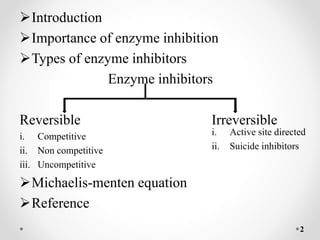
Introduction
Importance of enzyme inhibition
Types of enzyme inhibitors
Enzyme inhibitors
Reversible Irreversible
i. Competitive
ii. Non competitive
iii. Uncompetitive
Michaelis-menten equation
Reference
i. Active site directed
ii. Suicide inhibitors
2
Introduction
• Any chemical entity (or compound) which either
critically retards or specially blocks the phenomenon
of enzyme catalysis.
• Inhibitors are the chemicals that reduce the rate of
enzymatic reactions.
• They block the enzyme but they do not usually
destroy it.
3
Importance of enzyme inhibition
• For understanding the regulation of enzyme activity
within the living cells.
• To elucidate the kinetic mechanism of an enzyme
catalyzing in a multi substrate reaction.
• Useful in elucidating the cellular metabolic
pathways by causing accumulation of intermediates.
• Identification of the catalytic groups at the active
site.
• Provide information about substrate specificity of
the enzyme.
4
Types of inhibitors
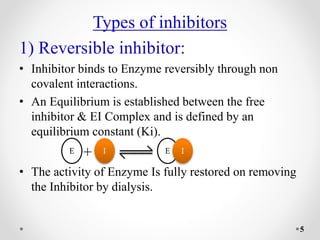
1) Reversible inhibitor:
• Inhibitor binds to Enzyme reversibly through non
covalent interactions.
• An Equilibrium is established between the free
inhibitor & EI Complex and is defined by an
equilibrium constant (Ki).
+
• The activity of Enzyme Is fully restored on removing
the Inhibitor by dialysis.
E I E I
5
a) Competitive inhibitors
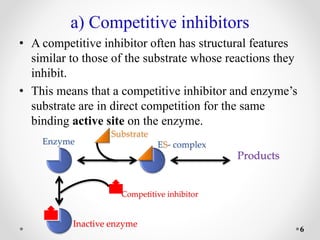
• A competitive inhibitor often has structural features
similar to those of the substrate whose reactions they
inhibit.
• This means that a competitive inhibitor and enzyme’s
substrate are in direct competition for the same
binding active site on the enzyme.
Enzyme
Substrate
ES- complex
Products
Inactive enzyme
Competitive inhibitor
6
7
Example:
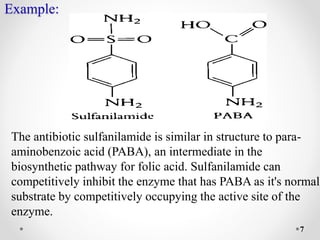
The antibiotic sulfanilamide is similar in structure to para-
aminobenzoic acid (PABA), an intermediate in the
biosynthetic pathway for folic acid. Sulfanilamide can
competitively inhibit the enzyme that has PABA as it's normal
substrate by competitively occupying the active site of the
enzyme.
b) Non competitive inhibitor
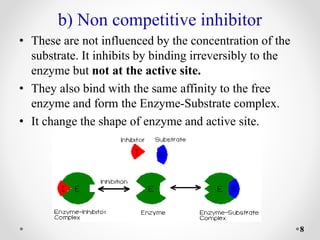
• These are not influenced by the concentration of the
substrate. It inhibits by binding irreversibly to the
enzyme but not at the active site.
• They also bind with the same affinity to the free
enzyme and form the Enzyme-Substrate complex.
• It change the shape of enzyme and active site.
8
Example:
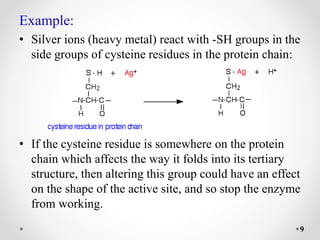
• Silver ions (heavy metal) react with -SH groups in the
side groups of cysteine residues in the protein chain:
• If the cysteine residue is somewhere on the protein
chain which affects the way it folds into its tertiary
structure, then altering this group could have an effect
on the shape of the active site, and so stop the enzyme
from working.
9
c) Uncompetitive inhibitor
• Uncompetitive inhibitors do not bind to the free
enzyme. They bind only to the enzyme-substrate
complex to yield an inactive E. S. I complex.
• Uncompetitive inhibitors frequently observed in multi
substrate reaction.
• Inhibition can’t be reversed by increasing the [S]
since I doesn't compete with S for the same binding
site.
Enzyme
Enzyme
S
Enzyme
I
S
10
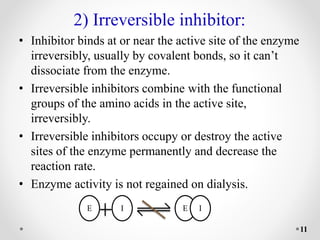
2) Irreversible inhibitor:
• Inhibitor binds at or near the active site of the enzyme
irreversibly, usually by covalent bonds, so it can’t
dissociate from the enzyme.
• Irreversible inhibitors combine with the functional
groups of the amino acids in the active site,
irreversibly.
• Irreversible inhibitors occupy or destroy the active
sites of the enzyme permanently and decrease the
reaction rate.
• Enzyme activity is not regained on dialysis.
E I E I
11
a) Active site directed inhibitor
• Active site directed inhibitor is also called as affinity
label. It is a chemically reactive compound that is
designed to resemble the substrate of an enzyme so
that it binds at the active site and forms a stable
covalent bond with a susceptible group of the nearby
residue in the enzyme protein.
• Affinity labels are very useful for identifying
catalytically important residues.
12
b) Suicide inhibitor
• A suicide inhibitor is a relatively inert molecule that
is transformed by an enzyme at its active site into a
reactive compound that irreversibly inactivates the
enzyme
• They are substrate analogs designed so that via
normal catalytic action of the enzyme, a very reactive
group is generated.
• The latter forms a covalent bond with a nearby
functional group within the active site of the enzyme
causing irreversible inhibition.
13
Michaelis-menten equation
The michaelis-menten equation arises from the
general equation for an enzymatic reaction.
E+S ES E+P
The michaelis menten equation is:
V˳=
Where=
V˳= velocity of the reaction
Vmax= maximal rate of the reaction
[substrate]= conc. Of the subcstrate
Km= michaelis-menten constant
Vmax [S]
km+[S]
14
References
• Ashutosh Kar. Medicinal Chemistry (Fifth revised &
Expandded edition), New Age International
Publishers. 2010: 917-972
• Burger’s. Medicinal Chemistry & Drug Discovery.
Sixth Edition (Volume 1). A john wiley and sond,
Inc., Publiction, new jersey. 2003: 715-774
• Albert L. Lehninger. Biochemistry (Second edition),
Worth Publishers, Inc. New York. 1979: 189-195
15
16

Enzyme inhibitors, reversible_and_irreversible

  • 1.
    ENZYME INHIBITORS, REVERSIBLEAND IRREVERSIBLE BY ANSARI MUHAMMAD NAJEEF ABDUL HAQUE M. PHARM First Year R.C. Patel Institute Of Pharmaceutical Education & Research, SHIRPUR 1
  • 2.
    Introduction Importance of enzymeinhibition Types of enzyme inhibitors Enzyme inhibitors Reversible Irreversible i. Competitive ii. Non competitive iii. Uncompetitive Michaelis-menten equation Reference i. Active site directed ii. Suicide inhibitors 2
  • 3.
    Introduction • Any chemicalentity (or compound) which either critically retards or specially blocks the phenomenon of enzyme catalysis. • Inhibitors are the chemicals that reduce the rate of enzymatic reactions. • They block the enzyme but they do not usually destroy it. 3
  • 4.
    Importance of enzymeinhibition • For understanding the regulation of enzyme activity within the living cells. • To elucidate the kinetic mechanism of an enzyme catalyzing in a multi substrate reaction. • Useful in elucidating the cellular metabolic pathways by causing accumulation of intermediates. • Identification of the catalytic groups at the active site. • Provide information about substrate specificity of the enzyme. 4
  • 5.
    Types of inhibitors 1)Reversible inhibitor: • Inhibitor binds to Enzyme reversibly through non covalent interactions. • An Equilibrium is established between the free inhibitor & EI Complex and is defined by an equilibrium constant (Ki). + • The activity of Enzyme Is fully restored on removing the Inhibitor by dialysis. E I E I 5
  • 6.
    a) Competitive inhibitors •A competitive inhibitor often has structural features similar to those of the substrate whose reactions they inhibit. • This means that a competitive inhibitor and enzyme’s substrate are in direct competition for the same binding active site on the enzyme. Enzyme Substrate ES- complex Products Inactive enzyme Competitive inhibitor 6
  • 7.
    7 Example: The antibiotic sulfanilamideis similar in structure to para- aminobenzoic acid (PABA), an intermediate in the biosynthetic pathway for folic acid. Sulfanilamide can competitively inhibit the enzyme that has PABA as it's normal substrate by competitively occupying the active site of the enzyme.
  • 8.
    b) Non competitiveinhibitor • These are not influenced by the concentration of the substrate. It inhibits by binding irreversibly to the enzyme but not at the active site. • They also bind with the same affinity to the free enzyme and form the Enzyme-Substrate complex. • It change the shape of enzyme and active site. 8
  • 9.
    Example: • Silver ions(heavy metal) react with -SH groups in the side groups of cysteine residues in the protein chain: • If the cysteine residue is somewhere on the protein chain which affects the way it folds into its tertiary structure, then altering this group could have an effect on the shape of the active site, and so stop the enzyme from working. 9
  • 10.
    c) Uncompetitive inhibitor •Uncompetitive inhibitors do not bind to the free enzyme. They bind only to the enzyme-substrate complex to yield an inactive E. S. I complex. • Uncompetitive inhibitors frequently observed in multi substrate reaction. • Inhibition can’t be reversed by increasing the [S] since I doesn't compete with S for the same binding site. Enzyme Enzyme S Enzyme I S 10
  • 11.
    2) Irreversible inhibitor: •Inhibitor binds at or near the active site of the enzyme irreversibly, usually by covalent bonds, so it can’t dissociate from the enzyme. • Irreversible inhibitors combine with the functional groups of the amino acids in the active site, irreversibly. • Irreversible inhibitors occupy or destroy the active sites of the enzyme permanently and decrease the reaction rate. • Enzyme activity is not regained on dialysis. E I E I 11
  • 12.
    a) Active sitedirected inhibitor • Active site directed inhibitor is also called as affinity label. It is a chemically reactive compound that is designed to resemble the substrate of an enzyme so that it binds at the active site and forms a stable covalent bond with a susceptible group of the nearby residue in the enzyme protein. • Affinity labels are very useful for identifying catalytically important residues. 12
  • 13.
    b) Suicide inhibitor •A suicide inhibitor is a relatively inert molecule that is transformed by an enzyme at its active site into a reactive compound that irreversibly inactivates the enzyme • They are substrate analogs designed so that via normal catalytic action of the enzyme, a very reactive group is generated. • The latter forms a covalent bond with a nearby functional group within the active site of the enzyme causing irreversible inhibition. 13
  • 14.
    Michaelis-menten equation The michaelis-mentenequation arises from the general equation for an enzymatic reaction. E+S ES E+P The michaelis menten equation is: V˳= Where= V˳= velocity of the reaction Vmax= maximal rate of the reaction [substrate]= conc. Of the subcstrate Km= michaelis-menten constant Vmax [S] km+[S] 14
  • 15.
    References • Ashutosh Kar.Medicinal Chemistry (Fifth revised & Expandded edition), New Age International Publishers. 2010: 917-972 • Burger’s. Medicinal Chemistry & Drug Discovery. Sixth Edition (Volume 1). A john wiley and sond, Inc., Publiction, new jersey. 2003: 715-774 • Albert L. Lehninger. Biochemistry (Second edition), Worth Publishers, Inc. New York. 1979: 189-195 15
  • 16.