COCLIA Laryngology: PHONOSURGERY Samuel Ostrower January 14, 2008
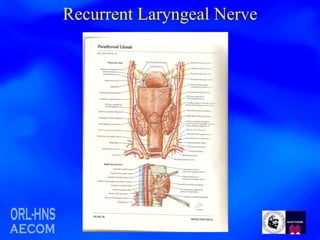
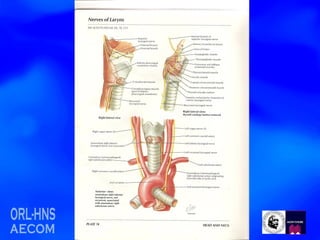
Recurrent Laryngeal Nerve
 
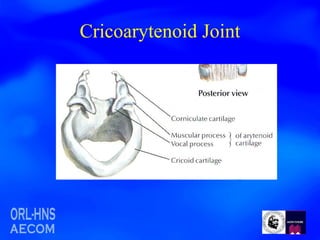
Cricoarytenoid Joint
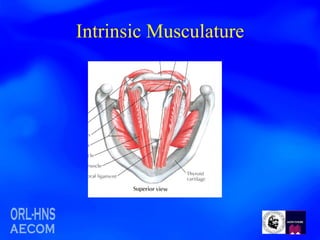
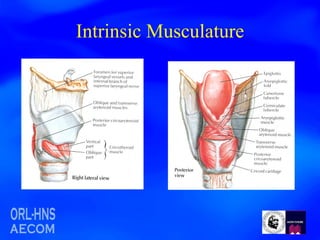
Intrinsic Musculature
1.  A patient is referred from your favorite thoracic surgeon for hoarseness after aortic aneurysm repair. On exam, you find an immobile vocal fold. How can you determine the etiology?
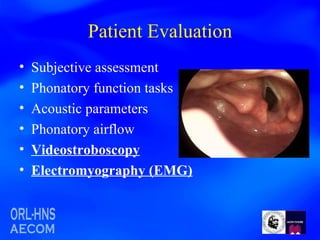
Patient Evaluation Subjective assessment Phonatory function tasks Acoustic parameters Phonatory airflow Videostroboscopy Electromyography (EMG)
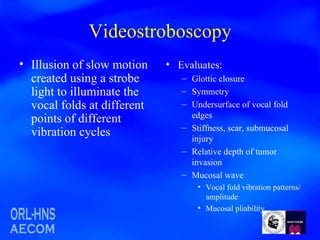
Videostroboscopy Illusion of slow motion created using a strobe light to illuminate the vocal folds at different points of different vibration cycles Evaluates: Glottic closure Symmetry Undersurface of vocal fold edges Stiffness, scar, submucosal injury Relative depth of tumor invasion Mucosal wave Vocal fold vibration patterns/amplitude Mucosal pliability
Laryngeal Electromyography (EMG) Only test available for evaluating integrity of laryngeal motor unit. Voluntary action potentials, fibrillation potentials, electrical silence Percutaneous or transoral placement of concentric bipolar needles Thyroarytenoid m.  Posterior cricoarytenoid m. Cricothyroid m.
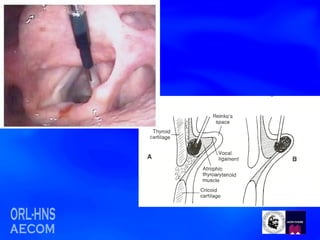
2.  Vocal fold injectional medialization Vs. Intrachordal injection.  What is the difference?
 
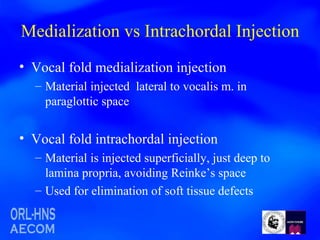
Medialization vs Intrachordal Injection Vocal fold medialization injection Material injected  lateral to vocalis m. in paraglottic space Vocal fold intrachordal injection Material is injected superficially, just deep to lamina propria, avoiding Reinke’s space Used for elimination of soft tissue defects
3.  Unilateral vocal fold medialization by injection – what materials are available?  Indications and advantages?
Injection Materials Teflon (Polytef) Human micronized alloderm (Cymetra) Autologous fat Gelfoam Collagen Hydroxyapatite Hyaluronic acid formulations/Hylan B (Hylaform)
Teflon Paste (Polytef ® ) Permanent, non-reabsorbable material Viscous Poor vibratory/phonatory results Must be injected laterally Migration, extrusion, progressive inflammatory response Granuloma formation
Human Micronized Dermis/AlloDerm (Cymetra ® ) Most commonly used injectable Excellent phonatory results  Low viscosity Temporary (effects last 6-12 months) Acellular, non-antigenic material causing minimal inflammatory response
Autologous Fat No inflammatory response Excellent phonatory results Requires additional incision Viscous, requiring Bruening syringe
Bovine Collagen Effective for management of vocal fold paralysis, sulcus vocalis and soft tissue deficits Temporary material Low viscosity Delayed hypersensitivity possible Skin testing recommended May lead to inflammatory changes leading to increased vocal fold stiffness, but unlikely permanent sequelae
Cross-Linked Hyaluronic Acid Gel (Hylaform ® ) Temporary Low viscosity Good phonatory results
Calcium Hydroxyapatite Gel (Radiance FN ® ) Permanent, non-reabsorbable material Phonatory results less well studied Relatively large particles not taken up by macrophages (no granuloma formation)
4.  Discuss the management of Teflon granulomas.
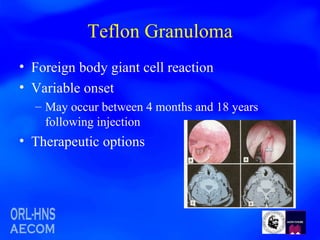
Teflon Granuloma Foreign body giant cell reaction Variable onset May occur between 4 months and 18 years following injection Therapeutic options
Teflon Granuloma Therapeutic Options Endoscopic with superior fold wedge resection/suction technique (Dedo, 1992)  Midline thyrotomy/”hemilaryngectomy” technique (Russell, et al. 1995) Endoscopic with CO2 laser and superior VF microflap reconstruction (Ossoff, et al. 2003)
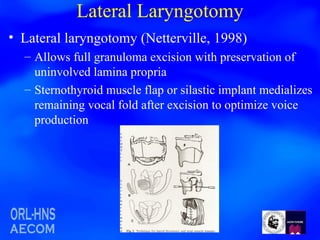
Lateral Laryngotomy Lateral laryngotomy (Netterville, 1998) Allows full granuloma excision with preservation of uninvolved lamina propria Sternothyroid muscle flap or silastic implant medializes remaining vocal fold after excision to optimize voice production
5.  Describe transcutaneous vs. laryngoscopic injection in vocal fold medialization
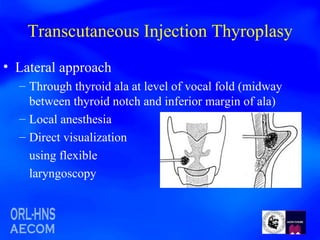
Transcutaneous Injection Thyroplasy Lateral approach Through thyroid ala at level of vocal fold (midway between thyroid notch and inferior margin of ala) Local anesthesia Direct visualization using flexible laryngoscopy
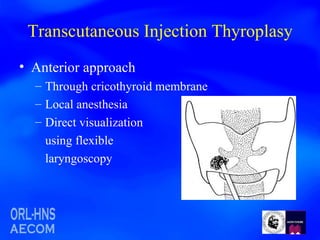
Transcutaneous Injection Thyroplasy Anterior approach  Through cricothyroid membrane Local anesthesia Direct visualization using flexible laryngoscopy
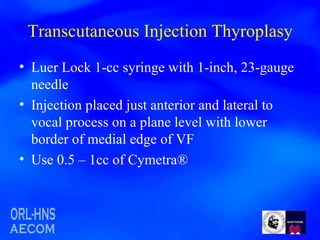
Transcutaneous Injection Thyroplasy Luer Lock 1-cc syringe with 1-inch, 23-gauge needle Injection placed just anterior and lateral to vocal process on a plane level with lower border of medial edge of VF Use 0.5 – 1cc of Cymetra ®
Laryngoscopic Injection Thyroplasty Patients who do not tolerate flexible fiberoptic exam with percutaneous approach Used during ablative procedures when RLN or vagus sacrifice anticipated Performed under general anesthesia with spontaneous ventilation, apnea or jet ventilation
6.  Discuss the management of overinjection during vocal fold medialization
Overinjection Teflon overinjection Immediate mucosal incision and suctioning of excess material Delayed removal is problematic due to migration, scar and granuloma
7.  Medialization thyroplasty–indications, advantages.  Otolaryngol Head Neck Surg 1997;116:349
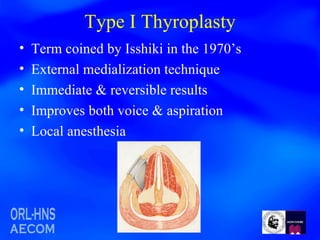
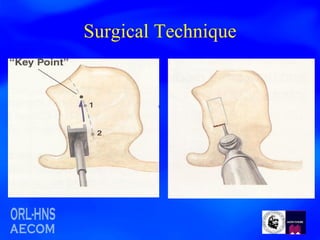
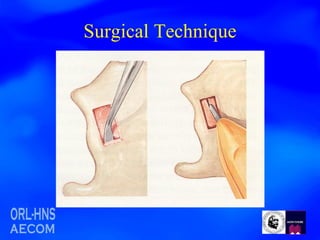
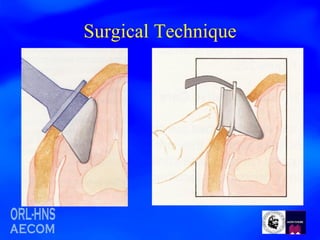
Type I Thyroplasty Term coined by Isshiki in the 1970’s External medialization technique Immediate & reversible results Improves both voice & aspiration Local anesthesia
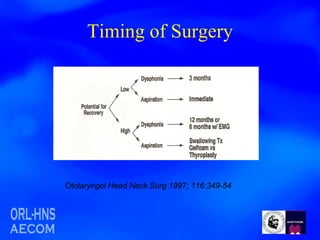
Indications Procedure of choice for the paralyzed vocal fold when recovery unlikely Vocal fold bowing from aging or cricothyroid joint fixation Sulcus vocalis Soft tissue defects from excision of pathologic tissue
Timing of Surgery Otolaryngol Head Neck Surg 1997; 116:349-54
Medialization Thyroplasty Materials Silastic Carved Prefabricated (Montgomery) Hydroxyapatite VoCom Gore-Tex Composed of Teflon
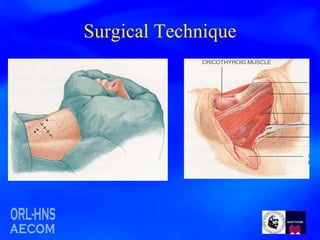
Surgical Technique
Surgical Technique
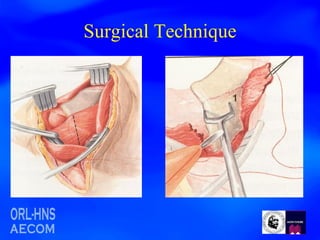
Surgical Technique
Surgical Technique
Surgical Technique
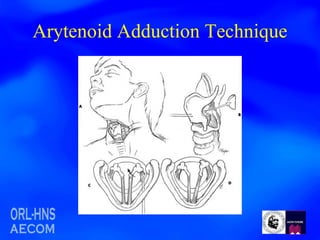
9.  Goal of Arytenoid Adduction.  Indications
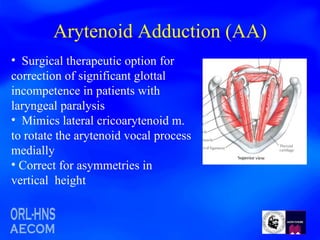
Arytenoid Adduction (AA) Surgical therapeutic option for correction of significant glottal incompetence in patients with laryngeal paralysis Mimics lateral cricoarytenoid m. to rotate the arytenoid vocal process medially Correct for asymmetries in  vertical  height
10.  Would you perform an arytenoid adduction without medialization procedure?  Otolaryngol Head Neck Surg 2003;129:305-310
Arytenoid adduction combined with medialization thyroplasty: an evidence-based review ( Otolaryngol Head Neck Surg 2003;129:305-310) 219 articles Majority of articles discussed the benefits of MT or AA as a single intervention  Only 3 articles directly evaluated the voice outcomes of MT plus AA versus MT alone There was no clear benefit in subjective or objective outcomes for AA plus MT
11.  How do you do an arytenoid adduction?
Arytenoid Adduction Technique
12.  What is the success of reinnervation procedures?
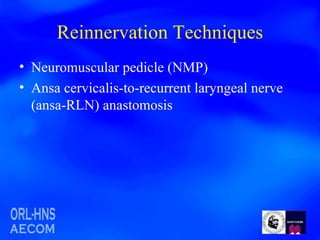
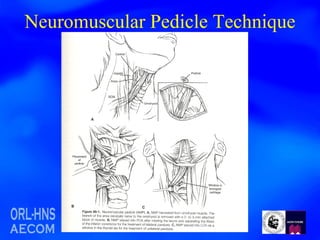
Reinnervation Techniques Neuromuscular pedicle (NMP) Ansa cervicalis-to-recurrent laryngeal nerve (ansa-RLN) anastomosis
Neuromuscular Pedicle Technique
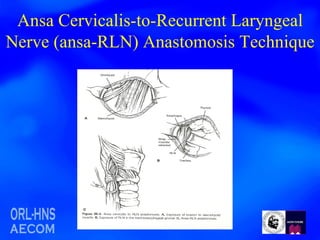
Ansa Cervicalis-to-Recurrent Laryngeal Nerve (ansa-RLN) Anastomosis Technique
13.  Bilateral vocal fold paralysis in midline position.  Patient refuses tracheostomy.  What other surgical options can you offer?  Ann Otol Rhinol Laryngol 1991; 100:717
Bilateral Vocal Fold Paralysis - Surgical Options Arytenoidectomy Arytenoidopexy Cordotomy Cordopexy Nerve-muscle transposition

F081 Coclia 75 Phonosurgery

  • 1.
    COCLIA Laryngology: PHONOSURGERYSamuel Ostrower January 14, 2008
  • 2.
  • 3.
  • 4.
  • 5.
  • 6.
  • 7.
    1. Apatient is referred from your favorite thoracic surgeon for hoarseness after aortic aneurysm repair. On exam, you find an immobile vocal fold. How can you determine the etiology?
  • 8.
    Patient Evaluation Subjectiveassessment Phonatory function tasks Acoustic parameters Phonatory airflow Videostroboscopy Electromyography (EMG)
  • 9.
    Videostroboscopy Illusion ofslow motion created using a strobe light to illuminate the vocal folds at different points of different vibration cycles Evaluates: Glottic closure Symmetry Undersurface of vocal fold edges Stiffness, scar, submucosal injury Relative depth of tumor invasion Mucosal wave Vocal fold vibration patterns/amplitude Mucosal pliability
  • 10.
    Laryngeal Electromyography (EMG)Only test available for evaluating integrity of laryngeal motor unit. Voluntary action potentials, fibrillation potentials, electrical silence Percutaneous or transoral placement of concentric bipolar needles Thyroarytenoid m. Posterior cricoarytenoid m. Cricothyroid m.
  • 11.
    2. Vocalfold injectional medialization Vs. Intrachordal injection. What is the difference?
  • 12.
  • 13.
    Medialization vs IntrachordalInjection Vocal fold medialization injection Material injected lateral to vocalis m. in paraglottic space Vocal fold intrachordal injection Material is injected superficially, just deep to lamina propria, avoiding Reinke’s space Used for elimination of soft tissue defects
  • 14.
    3. Unilateralvocal fold medialization by injection – what materials are available? Indications and advantages?
  • 15.
    Injection Materials Teflon(Polytef) Human micronized alloderm (Cymetra) Autologous fat Gelfoam Collagen Hydroxyapatite Hyaluronic acid formulations/Hylan B (Hylaform)
  • 16.
    Teflon Paste (Polytef® ) Permanent, non-reabsorbable material Viscous Poor vibratory/phonatory results Must be injected laterally Migration, extrusion, progressive inflammatory response Granuloma formation
  • 17.
    Human Micronized Dermis/AlloDerm(Cymetra ® ) Most commonly used injectable Excellent phonatory results Low viscosity Temporary (effects last 6-12 months) Acellular, non-antigenic material causing minimal inflammatory response
  • 18.
    Autologous Fat Noinflammatory response Excellent phonatory results Requires additional incision Viscous, requiring Bruening syringe
  • 19.
    Bovine Collagen Effectivefor management of vocal fold paralysis, sulcus vocalis and soft tissue deficits Temporary material Low viscosity Delayed hypersensitivity possible Skin testing recommended May lead to inflammatory changes leading to increased vocal fold stiffness, but unlikely permanent sequelae
  • 20.
    Cross-Linked Hyaluronic AcidGel (Hylaform ® ) Temporary Low viscosity Good phonatory results
  • 21.
    Calcium Hydroxyapatite Gel(Radiance FN ® ) Permanent, non-reabsorbable material Phonatory results less well studied Relatively large particles not taken up by macrophages (no granuloma formation)
  • 22.
    4. Discussthe management of Teflon granulomas.
  • 23.
    Teflon Granuloma Foreignbody giant cell reaction Variable onset May occur between 4 months and 18 years following injection Therapeutic options
  • 24.
    Teflon Granuloma TherapeuticOptions Endoscopic with superior fold wedge resection/suction technique (Dedo, 1992) Midline thyrotomy/”hemilaryngectomy” technique (Russell, et al. 1995) Endoscopic with CO2 laser and superior VF microflap reconstruction (Ossoff, et al. 2003)
  • 25.
    Lateral Laryngotomy Laterallaryngotomy (Netterville, 1998) Allows full granuloma excision with preservation of uninvolved lamina propria Sternothyroid muscle flap or silastic implant medializes remaining vocal fold after excision to optimize voice production
  • 26.
    5. Describetranscutaneous vs. laryngoscopic injection in vocal fold medialization
  • 27.
    Transcutaneous Injection ThyroplasyLateral approach Through thyroid ala at level of vocal fold (midway between thyroid notch and inferior margin of ala) Local anesthesia Direct visualization using flexible laryngoscopy
  • 28.
    Transcutaneous Injection ThyroplasyAnterior approach Through cricothyroid membrane Local anesthesia Direct visualization using flexible laryngoscopy
  • 29.
    Transcutaneous Injection ThyroplasyLuer Lock 1-cc syringe with 1-inch, 23-gauge needle Injection placed just anterior and lateral to vocal process on a plane level with lower border of medial edge of VF Use 0.5 – 1cc of Cymetra ®
  • 30.
    Laryngoscopic Injection ThyroplastyPatients who do not tolerate flexible fiberoptic exam with percutaneous approach Used during ablative procedures when RLN or vagus sacrifice anticipated Performed under general anesthesia with spontaneous ventilation, apnea or jet ventilation
  • 31.
    6. Discussthe management of overinjection during vocal fold medialization
  • 32.
    Overinjection Teflon overinjectionImmediate mucosal incision and suctioning of excess material Delayed removal is problematic due to migration, scar and granuloma
  • 33.
    7. Medializationthyroplasty–indications, advantages. Otolaryngol Head Neck Surg 1997;116:349
  • 34.
    Type I ThyroplastyTerm coined by Isshiki in the 1970’s External medialization technique Immediate & reversible results Improves both voice & aspiration Local anesthesia
  • 35.
    Indications Procedure ofchoice for the paralyzed vocal fold when recovery unlikely Vocal fold bowing from aging or cricothyroid joint fixation Sulcus vocalis Soft tissue defects from excision of pathologic tissue
  • 36.
    Timing of SurgeryOtolaryngol Head Neck Surg 1997; 116:349-54
  • 37.
    Medialization Thyroplasty MaterialsSilastic Carved Prefabricated (Montgomery) Hydroxyapatite VoCom Gore-Tex Composed of Teflon
  • 38.
  • 39.
  • 40.
  • 41.
  • 42.
  • 43.
    9. Goalof Arytenoid Adduction. Indications
  • 44.
    Arytenoid Adduction (AA)Surgical therapeutic option for correction of significant glottal incompetence in patients with laryngeal paralysis Mimics lateral cricoarytenoid m. to rotate the arytenoid vocal process medially Correct for asymmetries in vertical height
  • 45.
    10. Wouldyou perform an arytenoid adduction without medialization procedure? Otolaryngol Head Neck Surg 2003;129:305-310
  • 46.
    Arytenoid adduction combinedwith medialization thyroplasty: an evidence-based review ( Otolaryngol Head Neck Surg 2003;129:305-310) 219 articles Majority of articles discussed the benefits of MT or AA as a single intervention Only 3 articles directly evaluated the voice outcomes of MT plus AA versus MT alone There was no clear benefit in subjective or objective outcomes for AA plus MT
  • 47.
    11. Howdo you do an arytenoid adduction?
  • 48.
  • 49.
    12. Whatis the success of reinnervation procedures?
  • 50.
    Reinnervation Techniques Neuromuscularpedicle (NMP) Ansa cervicalis-to-recurrent laryngeal nerve (ansa-RLN) anastomosis
  • 51.
  • 52.
    Ansa Cervicalis-to-Recurrent LaryngealNerve (ansa-RLN) Anastomosis Technique
  • 53.
    13. Bilateralvocal fold paralysis in midline position. Patient refuses tracheostomy. What other surgical options can you offer? Ann Otol Rhinol Laryngol 1991; 100:717
  • 54.
    Bilateral Vocal FoldParalysis - Surgical Options Arytenoidectomy Arytenoidopexy Cordotomy Cordopexy Nerve-muscle transposition