Vocal cord paralysis
Dr Vishnu Premraj
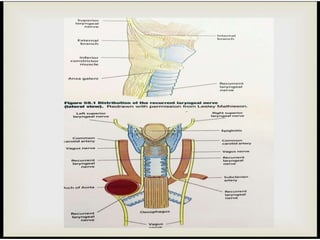
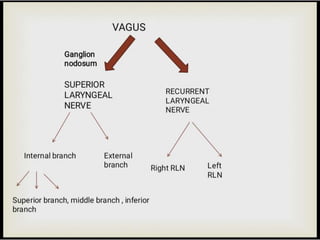
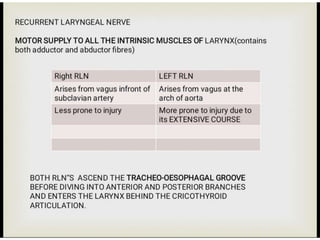
Nerve supply of larynx
Paralysis of one or both vocal folds may impair the
important physiologic functions of the larynx:
-breathing
-swallowing
-Voicing
The most prominent of these are breathy dysphonia and
dysphagia-particularly to liquids.
INTRODUCTION
PATHOPHYSIOLOGY
-Most cases of laryngeal paralysis result from peripheral
nerve damage
-larynx has a strong propensity for re-innervation
-Re-innervation is often dysfunctional and does not
yield physiological function.
Laryngeal paralysis may be unilateral or bilateral
and many involve
1. Recurrent laryngeal nerve
2. Superior laryngeal nerve
3.Both recurrent and superior laryngeal nerve
AETIOLOGY OF LARYNGEAL PARALYSIS
- More common in Men
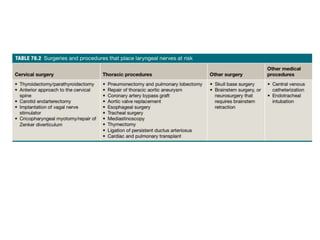
- Trauma
- Functional compromise from a range of medical
conditions
-Mechanical damage from surgery
-The left vocal fold is affected more often than the
right
Due to the greater length and more profound descent into the thorax and its greater
vulnerability to disease and surgery
Causes of recurrent laryngeal nerve paralysis
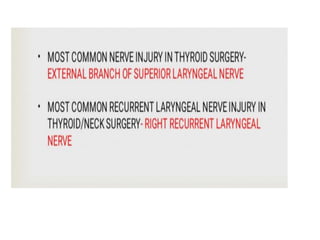
Right recurrent laryngeal nerve
 Thyroid disease
 Neck trauma
 malignancy
 Iatrogenic
 Cervical lymphadenopathy
 Aneurysm of subclavian artery
 Carcinoma right lung
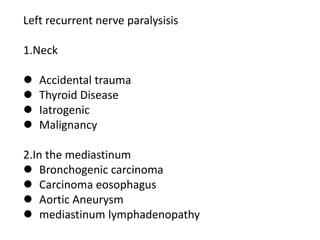
Left recurrent nerve paralysisis
1.Neck
 Accidental trauma
 Thyroid Disease
 Iatrogenic
 Malignancy
2.In the mediastinum
 Bronchogenic carcinoma
 Carcinoma eosophagus
 Aortic Aneurysm
 mediastinum lymphadenopathy
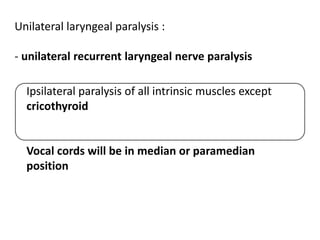
Unilateral laryngeal paralysis :
- unilateral recurrent laryngeal nerve paralysis
Ipsilateral paralysis of all intrinsic muscles except
cricothyroid
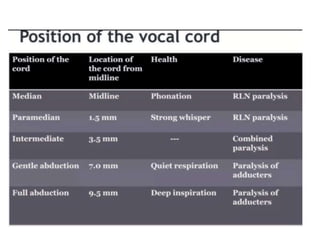
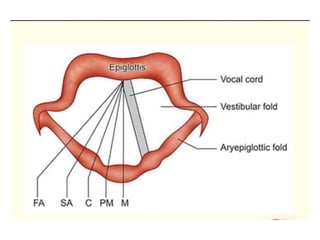
Vocal cords will be in median or paramedian
position
Theories on vocal cord in vocal cords paralysis
1. Semons law
In all Progressive organic lesions ,abductor fibres
[phylogenetically newer] are more susceptible and
thus first to be paralysed
2. Wagner and Grossman law
Total paralysis of recurrent laryngeal nerve immobilises
vocal fold in paramedian position because of intact
cricothyroid muscle
- Combined paralysis of RLN and SLN causes folds to be
in intermediate position
Symptoms
 hoarseness
 hypophonia.
 Dysphagia with possible frank aspiration .
PHYSICAL EXAMINATION
-neck examination
-cranial nerve examination[To rule out jugular
foramen syndromes, after stroke and
after skull base surgeries ]
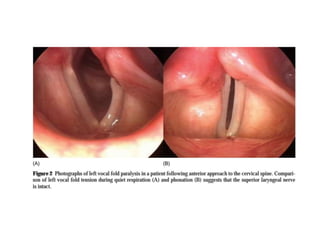
-Flexible nasolaryngoscopy -
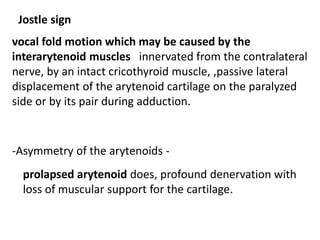
Jostle sign
vocal fold motion which may be caused by the
interarytenoid muscles innervated from the contralateral
nerve, by an intact cricothyroid muscle, ,passive lateral
displacement of the arytenoid cartilage on the paralyzed
side or by its pair during adduction.
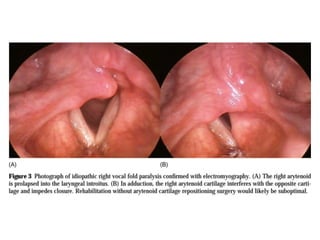
-Asymmetry of the arytenoids -
prolapsed arytenoid does, profound denervation with
loss of muscular support for the cartilage.
Investigations
Laryngeal Electromyography
 measures the integrity of laryngeal innervation
with percutaneous needle electrodes.
 It can provide unambiguous evidence of
denervation and reinnervation.
 offers a reliable way to distinguish neurogenic
from mechanical vocal fold immobility .
Suspected high vagal paralysis
MRI may offer a more reliable means of imaging the
skull base or central nervous system
Treatment
1)Observation.
Factors favoring observation include
1. no evidence of aspiration
2. certainty that the injured laryngeal
nerve is intact structurally.
3. minimal vocal disability and/or
minimal vocal demand
4. good functional prognosis
5. comorbidites or other medical
factors which discourage or prevent
intervention
Injection Augmentation
 temporary relief of their symptoms
accomplished by injection of an absorbable bulking
substance into the paralyzed fold to improve the
glottic insufficiency.
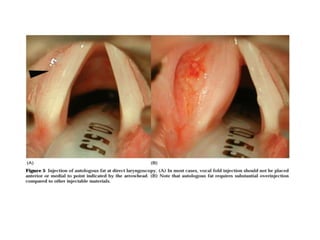
Substances include
collagen and hyaluronic acid preparations, micronized
human dermis, autologous fat,carboxymethylcellulose-
glycerine gel.
Factors favouring injection augmentation include
1. Dysphagia,
2. high degree of vocal disability or high vocal demand
3. functional prognosis is good or indeterminate,
4. relatively small glottic gap (<2 to 3 mm),
5. no posterior glottic gap,
6. short life expectancy (less than the expected duration of
the injectate).
Technique
- Via direct laryngoscope in operating room
- Peroral / transcutaneously under topical anaesthetic
or superior laryngeal nerve block in the office.
Disadvantages
-Does not effectively reposition the arytenoid cartilage
to rectify posterior glottal gap.
- not ideal for large glottic gaps.
Framework Surgery.
Reserved for treatment of glottic insufficiency from
unilateral paralysis which is not expected to improve.
Factors favoring a framework approach are
following-
1. dysphagia,
2. high degree of vocal disability or high
vocal demand,
3. poor functional prognosis,
4. relatively large glottic gap (>2 to 3 mm
5. posterior glottic gap,
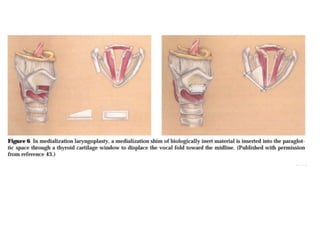
Medialization thyroplasty.
Consist of insertion of an implant -silicone, formed
polytetrafluoroethylene (formed calcium hydroxylapatite,
or other biologically inert material, into the paraglottic
space to displace the paralyzed vocal fold medially.
- Done under local anaesthesia
Complications
 Airway obstruction
 Perforation into laryngeal lumen
 Postoperative edema and hematoma
 The most common “complication,” however, is
suboptimal voice outcome.
Arytenoid cartilage repositioning procedures
-designed to internally rotate and/or suspend the
arytenoid cartilage in physiologic phonatory position
- can be done along with thyroplasty
Technique
Muscular process of the arytenoid cartilage is
approached through the inferior constrictor muscle
and around the back of the thyroid lamina.
nonabsorbable suture is passed through the muscular
process and secured to the thyroid lamina so
as to exert anterolateral traction on the muscular
process and thus rotate the vocal process medially
and slightly caudally
Reinnervation.
Using nearby nerves [both the ansa cervicalis and the
hypoglossal nerve]
reinnervation generally improves the bulk and
tone of vocal fold muscle but will not restore
physiologic motion
Reinnervation is ideally suited when the vocal fold is
known to be completely denervated.
Bilateral recurrent laryngeal berne palsy
- thyroid surgery
- carcinoma thyroid
- Carcinoma eosophagus
-Cervical lymphadenopathy
-Charcot–Marie–Tooth disease is a hereditary motor
and sensory neuropathies that may involve the laryngeal
nerves.
-Amyotrophic lateral sclerosis
- postpolio syndrome
- Arnold Chiari malformation
-Gullain- barre syndrome
Symptoms
-dyspnea,
- noisy breathing,
- exercise intolerance.
The severity of these respiratory symptoms is inversely
proportional to the size of the glottic aperture between the
two immobile vocal folds.
Acute bilateral vocal cords paralysis
- life threatening condition
The typical situation is unexpected respiratory
distress after extubation from thyroid surgery- securing
airway is consideration
Treatment
Treatment is guided by the degree of airway limitation
 Tracheostomy performed emergently .
It provides an adequate airway with
minimal compromise of phonation and deglutition
Other treatment option include
lateralization of one vocal fold or removal of one arytenoid
cartilageor vocal fold tissue to enlarge the glottic aperture
VOCAL FOLD PARESIS
Paresis or incomplete paralysis in which some
gross vocal fold mobility is preserved.
Symptoms
 voice difficulty only after speaking for some time or at
high intensity.
 exercise tolerance.
Thankyou

vocal cord paralysis presentation larynx

  • 1.
  • 2.
  • 5.
    Paralysis of oneor both vocal folds may impair the important physiologic functions of the larynx: -breathing -swallowing -Voicing The most prominent of these are breathy dysphonia and dysphagia-particularly to liquids. INTRODUCTION
  • 6.
    PATHOPHYSIOLOGY -Most cases oflaryngeal paralysis result from peripheral nerve damage -larynx has a strong propensity for re-innervation -Re-innervation is often dysfunctional and does not yield physiological function.
  • 7.
    Laryngeal paralysis maybe unilateral or bilateral and many involve 1. Recurrent laryngeal nerve 2. Superior laryngeal nerve 3.Both recurrent and superior laryngeal nerve
  • 8.
    AETIOLOGY OF LARYNGEALPARALYSIS - More common in Men - Trauma - Functional compromise from a range of medical conditions -Mechanical damage from surgery -The left vocal fold is affected more often than the right Due to the greater length and more profound descent into the thorax and its greater vulnerability to disease and surgery
  • 10.
    Causes of recurrentlaryngeal nerve paralysis Right recurrent laryngeal nerve  Thyroid disease  Neck trauma  malignancy  Iatrogenic  Cervical lymphadenopathy  Aneurysm of subclavian artery  Carcinoma right lung
  • 11.
    Left recurrent nerveparalysisis 1.Neck  Accidental trauma  Thyroid Disease  Iatrogenic  Malignancy 2.In the mediastinum  Bronchogenic carcinoma  Carcinoma eosophagus  Aortic Aneurysm  mediastinum lymphadenopathy
  • 17.
    Unilateral laryngeal paralysis: - unilateral recurrent laryngeal nerve paralysis Ipsilateral paralysis of all intrinsic muscles except cricothyroid Vocal cords will be in median or paramedian position
  • 18.
    Theories on vocalcord in vocal cords paralysis 1. Semons law In all Progressive organic lesions ,abductor fibres [phylogenetically newer] are more susceptible and thus first to be paralysed 2. Wagner and Grossman law Total paralysis of recurrent laryngeal nerve immobilises vocal fold in paramedian position because of intact cricothyroid muscle - Combined paralysis of RLN and SLN causes folds to be in intermediate position
  • 19.
    Symptoms  hoarseness  hypophonia. Dysphagia with possible frank aspiration . PHYSICAL EXAMINATION -neck examination -cranial nerve examination[To rule out jugular foramen syndromes, after stroke and after skull base surgeries ] -Flexible nasolaryngoscopy -
  • 20.
    Jostle sign vocal foldmotion which may be caused by the interarytenoid muscles innervated from the contralateral nerve, by an intact cricothyroid muscle, ,passive lateral displacement of the arytenoid cartilage on the paralyzed side or by its pair during adduction. -Asymmetry of the arytenoids - prolapsed arytenoid does, profound denervation with loss of muscular support for the cartilage.
  • 22.
    Investigations Laryngeal Electromyography  measuresthe integrity of laryngeal innervation with percutaneous needle electrodes.  It can provide unambiguous evidence of denervation and reinnervation.  offers a reliable way to distinguish neurogenic from mechanical vocal fold immobility .
  • 23.
    Suspected high vagalparalysis MRI may offer a more reliable means of imaging the skull base or central nervous system
  • 24.
    Treatment 1)Observation. Factors favoring observationinclude 1. no evidence of aspiration 2. certainty that the injured laryngeal nerve is intact structurally. 3. minimal vocal disability and/or minimal vocal demand 4. good functional prognosis 5. comorbidites or other medical factors which discourage or prevent intervention
  • 25.
    Injection Augmentation  temporaryrelief of their symptoms accomplished by injection of an absorbable bulking substance into the paralyzed fold to improve the glottic insufficiency. Substances include collagen and hyaluronic acid preparations, micronized human dermis, autologous fat,carboxymethylcellulose- glycerine gel.
  • 26.
    Factors favouring injectionaugmentation include 1. Dysphagia, 2. high degree of vocal disability or high vocal demand 3. functional prognosis is good or indeterminate, 4. relatively small glottic gap (<2 to 3 mm), 5. no posterior glottic gap, 6. short life expectancy (less than the expected duration of the injectate).
  • 27.
    Technique - Via directlaryngoscope in operating room - Peroral / transcutaneously under topical anaesthetic or superior laryngeal nerve block in the office. Disadvantages -Does not effectively reposition the arytenoid cartilage to rectify posterior glottal gap. - not ideal for large glottic gaps.
  • 29.
    Framework Surgery. Reserved fortreatment of glottic insufficiency from unilateral paralysis which is not expected to improve. Factors favoring a framework approach are following- 1. dysphagia, 2. high degree of vocal disability or high vocal demand, 3. poor functional prognosis, 4. relatively large glottic gap (>2 to 3 mm 5. posterior glottic gap,
  • 30.
    Medialization thyroplasty. Consist ofinsertion of an implant -silicone, formed polytetrafluoroethylene (formed calcium hydroxylapatite, or other biologically inert material, into the paraglottic space to displace the paralyzed vocal fold medially. - Done under local anaesthesia
  • 32.
    Complications  Airway obstruction Perforation into laryngeal lumen  Postoperative edema and hematoma  The most common “complication,” however, is suboptimal voice outcome. Arytenoid cartilage repositioning procedures -designed to internally rotate and/or suspend the arytenoid cartilage in physiologic phonatory position - can be done along with thyroplasty
  • 33.
    Technique Muscular process ofthe arytenoid cartilage is approached through the inferior constrictor muscle and around the back of the thyroid lamina. nonabsorbable suture is passed through the muscular process and secured to the thyroid lamina so as to exert anterolateral traction on the muscular process and thus rotate the vocal process medially and slightly caudally
  • 34.
    Reinnervation. Using nearby nerves[both the ansa cervicalis and the hypoglossal nerve] reinnervation generally improves the bulk and tone of vocal fold muscle but will not restore physiologic motion Reinnervation is ideally suited when the vocal fold is known to be completely denervated.
  • 35.
    Bilateral recurrent laryngealberne palsy - thyroid surgery - carcinoma thyroid - Carcinoma eosophagus -Cervical lymphadenopathy -Charcot–Marie–Tooth disease is a hereditary motor and sensory neuropathies that may involve the laryngeal nerves. -Amyotrophic lateral sclerosis - postpolio syndrome - Arnold Chiari malformation -Gullain- barre syndrome
  • 36.
    Symptoms -dyspnea, - noisy breathing, -exercise intolerance. The severity of these respiratory symptoms is inversely proportional to the size of the glottic aperture between the two immobile vocal folds.
  • 37.
    Acute bilateral vocalcords paralysis - life threatening condition The typical situation is unexpected respiratory distress after extubation from thyroid surgery- securing airway is consideration
  • 38.
    Treatment Treatment is guidedby the degree of airway limitation  Tracheostomy performed emergently . It provides an adequate airway with minimal compromise of phonation and deglutition Other treatment option include lateralization of one vocal fold or removal of one arytenoid cartilageor vocal fold tissue to enlarge the glottic aperture
  • 39.
    VOCAL FOLD PARESIS Paresisor incomplete paralysis in which some gross vocal fold mobility is preserved. Symptoms  voice difficulty only after speaking for some time or at high intensity.  exercise tolerance.
  • 40.