DR ROOHIA
SDB
 The SDB treatment is based in three types:
 Type 1: Behavioral
 Type 2: Devices to be worn
 Type 3: Surgery
PEDIATRIC OSA -SEVERITY
OSA
SEVERITY
LEVEL
AHI
MILD 1-4
MODERATE 5-10
SEVERE >10
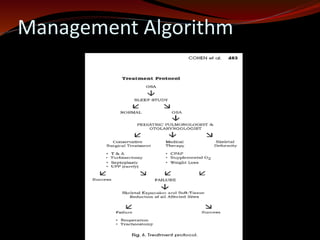
Management Algorithm
MANAGEMENT
 Any child with AHI> 5
intervention is necessary.
Surgical
 Adenotonsillectomy – First Line of therapy
 Turbinate reduction
 Craniofacial surgery-
Mandibular advancement
Lefort osteotomies and maxillary distraction.
 Uvulopalatopharyngoplasty- Not a good idea !
 Tracheostomy
Medical
 Weight loss
 Continuous positive airway pressure
 Intranasal steroids (modest effect)-Mild patients
 Leukotriene antagonist- Mild patients
 Oral appliances
 Positional therapy
 Snore aids
Nonsurgical management
 Pharmacotherapy considered in less severe cases of
obstructive apnea.
 neonatal rhinitis, allergic rhinitis, and acute tonsillitis
 In cases of chronic upper airway obstruction,
mechanical correction by prostheses, positive airway
pressure, or weight loss may be worth consideration.
 In most patients, those with obesity or neuromuscular
disorders in which airway dynamics are affected,
surgical management is generally considered.
SURGICAL MANAGEMENT
 Patients at greatest risk include
 with severe obstructive sleep apnea syndrome;
 diminished neuromuscular tone (ie, cerebral palsy);
 morbid obesity;
 skeletal and craniofacial abnormalities, such as
hypoplasia of the midface or mandible or
nasopharyngeal vault; and
 very young children (younger than age 2–3 years
 Surgery is often considered to be the first-line
treatment for simple snoring and mild/moderate OSA.
 Surgery is considered successful when the AHI drops
at least 50% and is below 20 per hour in patients
whose presurgical AHI was greater than 20 per hour.
Nasal and nasopharyngeal
obstruction
 simple as a transoral, retropalatal approach for
adenoidectomy .
 marsupialization of nasolacrimal duct cysts,
 as complex as an anterior craniofacial approach for
encephalocele.
 may require aggressive resection
 Bilateral choanal atresia
and stenosis of the
pyriform aperture are
causes of obstructive
apnea in neonates and
require early
intervention
 early repair with
avoidance of
tracheotomy is always
desirable
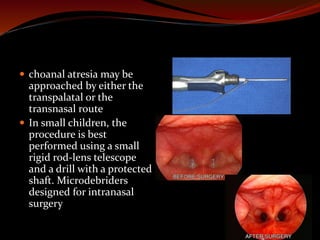
 choanal atresia may be
approached by either the
transpalatal or the
transnasal route
 In small children, the
procedure is best
performed using a small
rigid rod-lens telescope
and a drill with a protected
shaft. Microdebriders
designed for intranasal
surgery
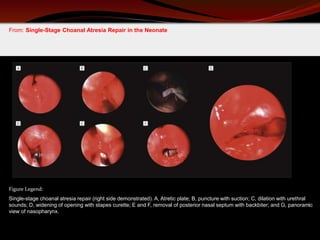
From: Single-Stage Choanal Atresia Repair in the Neonate
Single-stage choanal atresia repair (right side demonstrated). A, Atretic plate; B, puncture with suction; C, dilation with urethral
sounds; D, widening of opening with stapes curette; E and F, removal of posterior nasal septum with backbiter; and G, panoramic
view of nasopharynx.
Figure Legend:
 A 120-degree telescope placed in the
mouth with the palate retracted
affords the surgeon a view of the
nasopharynx so that a urethral
sound may be safely passed through
the atretic plate
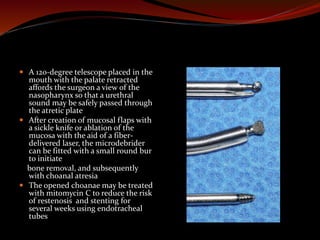
 After creation of mucosal flaps with
a sickle knife or ablation of the
mucosa with the aid of a fiber-
delivered laser, the microdebrider
can be fitted with a small round bur
to initiate
bone removal, and subsequently
with choanal atresia
 The opened choanae may be treated
with mitomycin C to reduce the risk
of restenosis and stenting for
several weeks using endotracheal
tubes
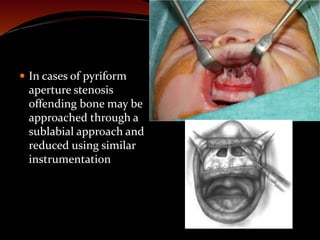
 In cases of pyriform
aperture stenosis
offending bone may be
approached through a
sublabial approach and
reduced using similar
instrumentation
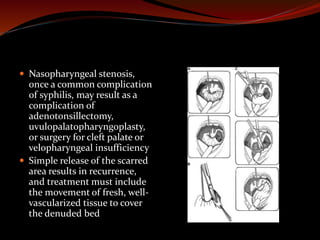
 Nasopharyngeal stenosis,
once a common complication
of syphilis, may result as a
complication of
adenotonsillectomy,
uvulopalatopharyngoplasty,
or surgery for cleft palate or
velopharyngeal insufficiency
 Simple release of the scarred
area results in recurrence,
and treatment must include
the movement of fresh, well-
vascularized tissue to cover
the denuded bed
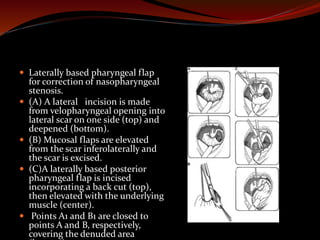
 Laterally based pharyngeal flap
for correction of nasopharyngeal
stenosis.
 (A) A lateral incision is made
from velopharyngeal opening into
lateral scar on one side (top) and
deepened (bottom).
 (B) Mucosal flaps are elevated
from the scar inferolaterally and
the scar is excised.
 (C)A laterally based posterior
pharyngeal flap is incised
incorporating a back cut (top),
then elevated with the underlying
muscle (center).
 Points A1 and B1 are closed to
points A and B, respectively,
covering the denuded area
 Z-plasty laterally based pharyngeal flaps other
advancement and rotation flaps and radial forearm
and jejunal free flaps.
 the use of intralesional steroids and topical application
of mitomycin C to the surgical site to reduce the risk of
recurrence.
 Postoperative stenting with nasopharyngeal airways or
oropharyngeal prostheses
is mandatory
Adenotonsillar hyperplasia and
oropharyngeal obstruction
 Exclusion Criteria
 Children with BMI > 95th percentile.
 Children with developmental delay or neuromuscular
disease.
 Children with craniofacial syndromes or asthma.
 All children showed improvement in respiratory
parameters after surgery.
 82% of children had resolution of OSA (to AHI <5).
 Improvement in all fields of OSA.
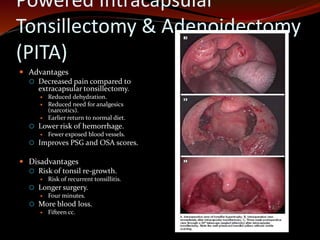
Powered Intracapsular
Tonsillectomy & Adenoidectomy
(PITA)
 Advantages
 Decreased pain compared to
extracapsular tonsillectomy.
 Reduced dehydration.
 Reduced need for analgesics
(narcotics).
 Earlier return to normal diet.
 Lower risk of hemorrhage.
 Fewer exposed blood vessels.
 Improves PSG and OSA scores.
 Disadvantages
 Risk of tonsil re-growth.
 Risk of recurrent tonsillitis.
 Longer surgery.
 Four minutes.
 More blood loss.
 Fifteen cc.
 Risk Factors for Postoperative Respiratory Complications in Children with
OSAS undergoing Adenotonsillectomy
 Age Younger than 3 years
 Severe OSAS on PSG
 Obesity
 Prematurity
 Recent URI
 Craniofacial abnormalities
 Neuromuscular disorders
Macroglossia and the ptotic tongue
 Children with
macroglossia generally
have Beckwith-
Wiedemann
syndrome(macroglossia,
omphalocele,
visceromegaly, cytomegaly
of the adrenalcortex);
 Down syndrome; or
 vascular malformation of
the tongue
 Complications of macroglossia include aberrant dental
eruption and malocclusion, maldevelopment of the
maxilla and mandible, excessive drying of the tongue
with ulceration, and airway obstruction
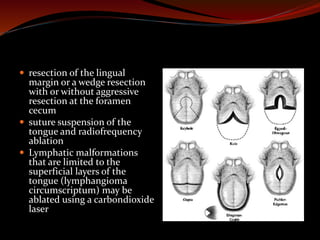
 resection of the lingual
margin or a wedge resection
with or without aggressive
resection at the foramen
cecum
 suture suspension of the
tongue and radiofrequency
ablation
 Lymphatic malformations
that are limited to the
superficial layers of the
tongue (lymphangioma
circumscriptum) may be
ablated using a carbondioxide
laser
 venous malformations of the tongue may be reduced
considerably using a combination of superficial and
intralesional neodymium:yttrium-aluminum-garnet
laser therapy, alcohol sclerosis, or excision
 Ductal cysts of the vallecula may present with sleep-
disordered breathing in neonates
 Lateral radiograph of the upper airway may be useful
when the diagnosis is suspected. The lesion is
managed by marsupialization using cold steel, laser, or
microdebrider; laser applied to the base helps to
control hemorrhage
Hypoplasia of the midface and
mandible
 Upper airway obstruction caused by hypoplasia of the
midface and mandible is usually associated with
craniofacial syndromes
 Micrognathia caused by Pierre Robin syndrome often
improves within the first 2 years of life without
surgical intervention for the mandible
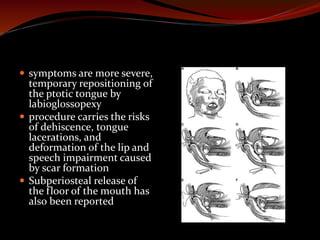
 symptoms are more severe,
temporary repositioning of
the ptotic tongue by
labioglossopexy
 procedure carries the risks
of dehiscence, tongue
lacerations, and
deformation of the lip and
speech impairment caused
by scar formation
 Subperiosteal release of
the floor of the mouth has
also been reported
Distraction osteogenesis
 First described in 1969 by Ilizarov and Lediaev [116] in
the treatment of limb length discrepancies, osteotomy
with distraction of bone is now widely accepted as the
procedure of choice in the early management of airway
obstruction caused by craniofacial disproportion
Distraction osteogenesis
 advantage of the rapid healing and capacity for growth
in the pediatric Skeleton
 PREOP -undergo airway endoscopy and craniofacial
assessment by three-dimensional CT scanning.
 Airway patency is estimated in relaxed and jaw-thrust
positions, and precise bony measurements are taken
from the scan.
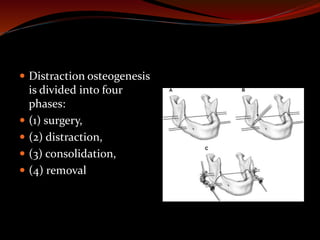
 Distraction osteogenesis
is divided into four
phases:
 (1) surgery,
 (2) distraction,
 (3) consolidation,
 (4) removal
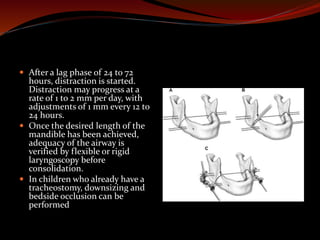
 After a lag phase of 24 to 72
hours, distraction is started.
Distraction may progress at a
rate of 1 to 2 mm per day, with
adjustments of 1 mm every 12 to
24 hours.
 Once the desired length of the
mandible has been achieved,
adequacy of the airway is
verified by flexible or rigid
laryngoscopy before
consolidation.
 In children who already have a
tracheostomy, downsizing and
bedside occlusion can be
performed
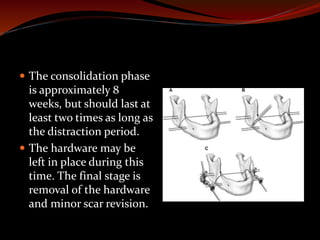
 The consolidation phase
is approximately 8
weeks, but should last at
least two times as long as
the distraction period.
 The hardware may be
left in place during this
time. The final stage is
removal of the hardware
and minor scar revision.
 Patients with Pierre Robin sequence or mandibular
hypoplasia have shown significant improvement in flow
limitation with mandibular advancement.
 Large meta-analysis of 1185 patients included 88
tracheotomized patients for poor airways.
 78.4% decannulation rate after distraction.
 97% of children and 100% of adults with OSA were cured of
symptoms.
 Patients with high-arched palates or craniofacial
abnormalities resulting in maxillary narrowing benefit
from Lefort osteotomies and maxillary distraction.
 Can be curative.
 Enlarges nasal cavity.
 Enlarges lateral diameter of palate and oropharynx.
Tracheostomy
 Tracheostomy is an effective for upper airway obstruction.
 Often avoids a difficult postoperative course.
 Provides an immediate improvement in symptoms.
 Can be used as a temporizing measure in patients until skeletal
expansion and soft-tissue reduction can be performed.
 Syndromic patients
 Craniosynostosis patients
 Not perfect.
 Complications
 Stoma narrowing
 Plugging
 Accidental decannulation
 Deleterious effect on psychosocial function of patients and families
AAP GUIDELINES
Screening of all children for snoring
Specialty referral of complex high-risk patients
Urgent evaluation of cardio-respiratory failure
PSG as Gold Standard for diagnosis
Adenotonsillectomy as first-line treatment
Inpatient monitoring of high-risk patients
Post-operative reevaluation to determine if additional
treatment is required
THANK YOU

Surgery for paediatric sleep apnea

  • 1.
  • 2.
    SDB  The SDBtreatment is based in three types:  Type 1: Behavioral  Type 2: Devices to be worn  Type 3: Surgery
  • 3.
  • 4.
  • 5.
    MANAGEMENT  Any childwith AHI> 5 intervention is necessary. Surgical  Adenotonsillectomy – First Line of therapy  Turbinate reduction  Craniofacial surgery- Mandibular advancement Lefort osteotomies and maxillary distraction.  Uvulopalatopharyngoplasty- Not a good idea !  Tracheostomy Medical  Weight loss  Continuous positive airway pressure  Intranasal steroids (modest effect)-Mild patients  Leukotriene antagonist- Mild patients  Oral appliances  Positional therapy  Snore aids
  • 6.
    Nonsurgical management  Pharmacotherapyconsidered in less severe cases of obstructive apnea.  neonatal rhinitis, allergic rhinitis, and acute tonsillitis  In cases of chronic upper airway obstruction, mechanical correction by prostheses, positive airway pressure, or weight loss may be worth consideration.  In most patients, those with obesity or neuromuscular disorders in which airway dynamics are affected, surgical management is generally considered.
  • 7.
    SURGICAL MANAGEMENT  Patientsat greatest risk include  with severe obstructive sleep apnea syndrome;  diminished neuromuscular tone (ie, cerebral palsy);  morbid obesity;  skeletal and craniofacial abnormalities, such as hypoplasia of the midface or mandible or nasopharyngeal vault; and  very young children (younger than age 2–3 years
  • 8.
     Surgery isoften considered to be the first-line treatment for simple snoring and mild/moderate OSA.  Surgery is considered successful when the AHI drops at least 50% and is below 20 per hour in patients whose presurgical AHI was greater than 20 per hour.
  • 9.
    Nasal and nasopharyngeal obstruction simple as a transoral, retropalatal approach for adenoidectomy .  marsupialization of nasolacrimal duct cysts,  as complex as an anterior craniofacial approach for encephalocele.  may require aggressive resection
  • 10.
     Bilateral choanalatresia and stenosis of the pyriform aperture are causes of obstructive apnea in neonates and require early intervention  early repair with avoidance of tracheotomy is always desirable
  • 11.
     choanal atresiamay be approached by either the transpalatal or the transnasal route  In small children, the procedure is best performed using a small rigid rod-lens telescope and a drill with a protected shaft. Microdebriders designed for intranasal surgery
  • 12.
    From: Single-Stage ChoanalAtresia Repair in the Neonate Single-stage choanal atresia repair (right side demonstrated). A, Atretic plate; B, puncture with suction; C, dilation with urethral sounds; D, widening of opening with stapes curette; E and F, removal of posterior nasal septum with backbiter; and G, panoramic view of nasopharynx. Figure Legend:
  • 13.
     A 120-degreetelescope placed in the mouth with the palate retracted affords the surgeon a view of the nasopharynx so that a urethral sound may be safely passed through the atretic plate  After creation of mucosal flaps with a sickle knife or ablation of the mucosa with the aid of a fiber- delivered laser, the microdebrider can be fitted with a small round bur to initiate bone removal, and subsequently with choanal atresia  The opened choanae may be treated with mitomycin C to reduce the risk of restenosis and stenting for several weeks using endotracheal tubes
  • 14.
     In casesof pyriform aperture stenosis offending bone may be approached through a sublabial approach and reduced using similar instrumentation
  • 15.
     Nasopharyngeal stenosis, oncea common complication of syphilis, may result as a complication of adenotonsillectomy, uvulopalatopharyngoplasty, or surgery for cleft palate or velopharyngeal insufficiency  Simple release of the scarred area results in recurrence, and treatment must include the movement of fresh, well- vascularized tissue to cover the denuded bed
  • 16.
     Laterally basedpharyngeal flap for correction of nasopharyngeal stenosis.  (A) A lateral incision is made from velopharyngeal opening into lateral scar on one side (top) and deepened (bottom).  (B) Mucosal flaps are elevated from the scar inferolaterally and the scar is excised.  (C)A laterally based posterior pharyngeal flap is incised incorporating a back cut (top), then elevated with the underlying muscle (center).  Points A1 and B1 are closed to points A and B, respectively, covering the denuded area
  • 17.
     Z-plasty laterallybased pharyngeal flaps other advancement and rotation flaps and radial forearm and jejunal free flaps.  the use of intralesional steroids and topical application of mitomycin C to the surgical site to reduce the risk of recurrence.  Postoperative stenting with nasopharyngeal airways or oropharyngeal prostheses is mandatory
  • 18.
    Adenotonsillar hyperplasia and oropharyngealobstruction  Exclusion Criteria  Children with BMI > 95th percentile.  Children with developmental delay or neuromuscular disease.  Children with craniofacial syndromes or asthma.  All children showed improvement in respiratory parameters after surgery.  82% of children had resolution of OSA (to AHI <5).  Improvement in all fields of OSA.
  • 19.
    Powered Intracapsular Tonsillectomy &Adenoidectomy (PITA)  Advantages  Decreased pain compared to extracapsular tonsillectomy.  Reduced dehydration.  Reduced need for analgesics (narcotics).  Earlier return to normal diet.  Lower risk of hemorrhage.  Fewer exposed blood vessels.  Improves PSG and OSA scores.  Disadvantages  Risk of tonsil re-growth.  Risk of recurrent tonsillitis.  Longer surgery.  Four minutes.  More blood loss.  Fifteen cc.
  • 20.
     Risk Factorsfor Postoperative Respiratory Complications in Children with OSAS undergoing Adenotonsillectomy  Age Younger than 3 years  Severe OSAS on PSG  Obesity  Prematurity  Recent URI  Craniofacial abnormalities  Neuromuscular disorders
  • 21.
    Macroglossia and theptotic tongue  Children with macroglossia generally have Beckwith- Wiedemann syndrome(macroglossia, omphalocele, visceromegaly, cytomegaly of the adrenalcortex);  Down syndrome; or  vascular malformation of the tongue
  • 22.
     Complications ofmacroglossia include aberrant dental eruption and malocclusion, maldevelopment of the maxilla and mandible, excessive drying of the tongue with ulceration, and airway obstruction
  • 23.
     resection ofthe lingual margin or a wedge resection with or without aggressive resection at the foramen cecum  suture suspension of the tongue and radiofrequency ablation  Lymphatic malformations that are limited to the superficial layers of the tongue (lymphangioma circumscriptum) may be ablated using a carbondioxide laser
  • 24.
     venous malformationsof the tongue may be reduced considerably using a combination of superficial and intralesional neodymium:yttrium-aluminum-garnet laser therapy, alcohol sclerosis, or excision
  • 25.
     Ductal cystsof the vallecula may present with sleep- disordered breathing in neonates  Lateral radiograph of the upper airway may be useful when the diagnosis is suspected. The lesion is managed by marsupialization using cold steel, laser, or microdebrider; laser applied to the base helps to control hemorrhage
  • 26.
    Hypoplasia of themidface and mandible  Upper airway obstruction caused by hypoplasia of the midface and mandible is usually associated with craniofacial syndromes  Micrognathia caused by Pierre Robin syndrome often improves within the first 2 years of life without surgical intervention for the mandible
  • 27.
     symptoms aremore severe, temporary repositioning of the ptotic tongue by labioglossopexy  procedure carries the risks of dehiscence, tongue lacerations, and deformation of the lip and speech impairment caused by scar formation  Subperiosteal release of the floor of the mouth has also been reported
  • 28.
    Distraction osteogenesis  Firstdescribed in 1969 by Ilizarov and Lediaev [116] in the treatment of limb length discrepancies, osteotomy with distraction of bone is now widely accepted as the procedure of choice in the early management of airway obstruction caused by craniofacial disproportion
  • 29.
    Distraction osteogenesis  advantageof the rapid healing and capacity for growth in the pediatric Skeleton  PREOP -undergo airway endoscopy and craniofacial assessment by three-dimensional CT scanning.  Airway patency is estimated in relaxed and jaw-thrust positions, and precise bony measurements are taken from the scan.
  • 30.
     Distraction osteogenesis isdivided into four phases:  (1) surgery,  (2) distraction,  (3) consolidation,  (4) removal
  • 31.
     After alag phase of 24 to 72 hours, distraction is started. Distraction may progress at a rate of 1 to 2 mm per day, with adjustments of 1 mm every 12 to 24 hours.  Once the desired length of the mandible has been achieved, adequacy of the airway is verified by flexible or rigid laryngoscopy before consolidation.  In children who already have a tracheostomy, downsizing and bedside occlusion can be performed
  • 32.
     The consolidationphase is approximately 8 weeks, but should last at least two times as long as the distraction period.  The hardware may be left in place during this time. The final stage is removal of the hardware and minor scar revision.
  • 33.
     Patients withPierre Robin sequence or mandibular hypoplasia have shown significant improvement in flow limitation with mandibular advancement.  Large meta-analysis of 1185 patients included 88 tracheotomized patients for poor airways.  78.4% decannulation rate after distraction.  97% of children and 100% of adults with OSA were cured of symptoms.  Patients with high-arched palates or craniofacial abnormalities resulting in maxillary narrowing benefit from Lefort osteotomies and maxillary distraction.  Can be curative.  Enlarges nasal cavity.  Enlarges lateral diameter of palate and oropharynx.
  • 34.
    Tracheostomy  Tracheostomy isan effective for upper airway obstruction.  Often avoids a difficult postoperative course.  Provides an immediate improvement in symptoms.  Can be used as a temporizing measure in patients until skeletal expansion and soft-tissue reduction can be performed.  Syndromic patients  Craniosynostosis patients  Not perfect.  Complications  Stoma narrowing  Plugging  Accidental decannulation  Deleterious effect on psychosocial function of patients and families
  • 35.
    AAP GUIDELINES Screening ofall children for snoring Specialty referral of complex high-risk patients Urgent evaluation of cardio-respiratory failure PSG as Gold Standard for diagnosis Adenotonsillectomy as first-line treatment Inpatient monitoring of high-risk patients Post-operative reevaluation to determine if additional treatment is required
  • 36.

Editor's Notes

  • #4 ADOPTED FROM MARCUS ET AL-DIAGNOSIS OF OSA IN CHILDREN IN PRNCIPLES AND PRACTICE OF SLEEP MEDICINE.
  • #26 Uvulopalatopharyngoplasty is not commonly performed in children, perhaps because most children with sleep apnea do not demonstrate the redundant tissue found in adults with similar symptoms