Linda McCaig and David Woodwell Ambulatory Care Statistics Branch Division of Health Care Statistics National Center for Health Statistics/CDC Using NAMCS and  NHAMCS Data
Overview Background Data uses Survey methodology Current and proposed survey items User considerations Methodological studies Data dissemination NCHS Research Data Center
 
National probability sample surveys National Ambulatory Medical Care Survey (NAMCS) Patient visits to non-federal office-based physicians National Hospital Ambulatory Medical Care Survey (NHAMCS) Patient visits to EDs  and OPDs of non-federal short-stay hospitals
Original NAMCS survey goals National statistics Professional education Health policy formulation Medical practice management Quality assurance
NAMCS history Survey began in 1973  Annual data collection through 1981 (NORC) Conducted in 1985 (NORC) Annual began again in 1989   (Census)
NHAMCS history Survey began in 1992  Annual data collection  (Census)
How are NAMCS and NHAMCS data used?
Data uses To understand health care practice and find inequities To track certain conditions To establish national priorities To serve as comparison points for states To measure Healthy People objectives
Data users Over 100 journal publications in last 2 years Medical associations Government agencies Health services researchers University and medical schools Broadcast and print media
Setting government policy ED as a “safety net” for the uninsured Development of the Resource-Based Relative Value Scale (RBRVS)
 
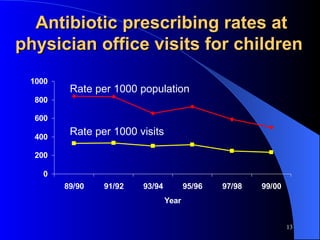
Antibiotic prescribing rates at physician office visits for children  Rate per 1000 population Rate per 1000 visits
 
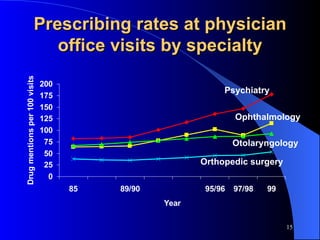
Prescribing rates at physician office visits by specialty Psychiatry Ophthalmology Otolaryngology Orthopedic surgery
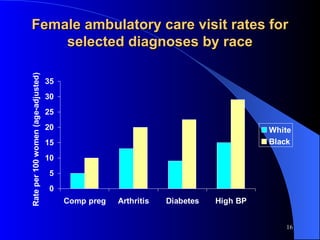
Female ambulatory care visit rates for selected diagnoses by race
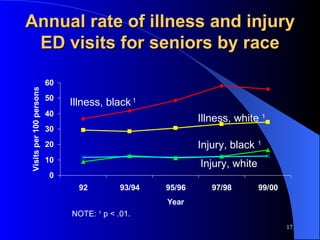
Annual rate of illness and injury ED visits for seniors by race Illness, black   1 Illness, white  1 Injury, black  1 NOTE:  1  p < .01. Injury, white
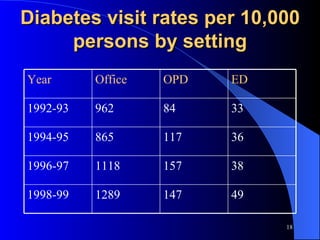
Diabetes visit rates per 10,000 persons by setting 49 147 1289 1998-99 38 157 1118 1996-97 36 117 865 1994-95 33 84 962 1992-93 ED OPD Office Year
NAMCS and NHAMCS Methodology
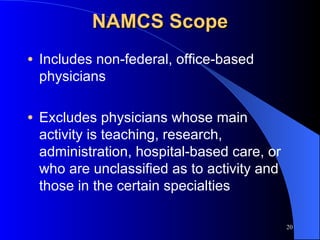
NAMCS Scope Includes non-federal, office-based physicians Excludes physicians whose main activity is teaching, research, administration, hospital-based care, or who are unclassified as to activity and those in the certain specialties
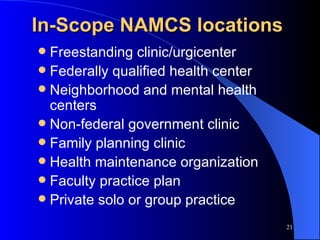
In-Scope NAMCS locations  Freestanding clinic/urgicenter Federally qualified health center Neighborhood and mental health centers Non-federal government clinic Family planning clinic Health maintenance organization Faculty practice plan Private solo or group practice
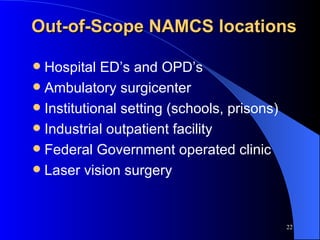
Out-of-Scope NAMCS locations Hospital ED’s and OPD’s Ambulatory surgicenter Institutional setting (schools, prisons) Industrial outpatient facility Federal Government operated clinic Laser vision surgery
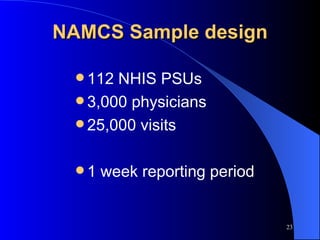
NAMCS Sample design 112 NHIS PSUs 3,000 physicians 25,000 visits 1 week reporting period
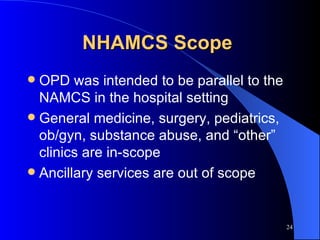
NHAMCS Scope  OPD was intended to be parallel to the NAMCS in the hospital setting General medicine, surgery, pediatrics, ob/gyn, substance abuse, and “other” clinics are in-scope Ancillary services are out of scope
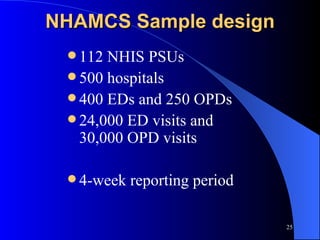
NHAMCS Sample design 112 NHIS PSUs 500 hospitals 400 EDs and 250 OPDs 24,000 ED visits and 30,000 OPD visits 4-week reporting period
Gaining cooperation Advance letters Endorsement letters Public relations materials Conversion of refusal
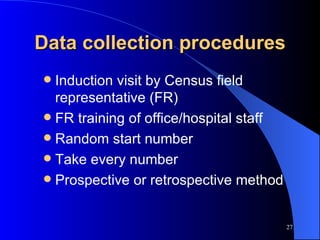
Data collection procedures Induction visit by Census field representative (FR)  FR training of office/hospital staff Random start number Take every number Prospective or retrospective method
Items collected Patient characteristics age, race, sex Visit characteristics Reason for visit, diagnosis, medication Provider characteristics physician specialty, hospital ownership
Repeating fields Reason for visit (3) Cause of injury (3) Diagnosis (3) Ambulatory surgical procedures (2) Medications (6)
Data processing Data are coded and keyed by Analytical Sciences Inc. (ASI) Quality control procedures Edit checks by NCHS
Coding systems used A Reason for Visit Classification (NCHS) ICD-9-CM Drug coding classification system (NCHS) National Drug Code Directory
NAMCS and NHAMCS 1999-2000 PRFs
Patient record form  - common items Patient’s zip code Date of visit Date of birth Sex Ethnicity
Patient record form - common items Race Source of payment HMO status Reason for visit
Patient record form – common items Diagnosis Diagnostic/screening services Medications Providers seen Visit disposition
Injury items External cause – narrative text since 1997 Place of injury Work related injury Intent
Office and OPD PRF - unique items Was patient referred for visit Patient’s primary care physician Patient seen before Major reason for visit
Office and OPD PRF - unique items Ambulatory surgical procedures Therapeutic and preventive services Time spent with physician (NAMCS only)
ED Patient record form - unique items Arrival time Discharge time Immediacy Presenting level of pain Procedures
NAMCS and NHAMCS PRF revisions 2001-02 – emphasis on the continuity of care
Office and OPD PRF  - new items for 2001-02   How many visits in last 12 months Initial or follow-up visit Do other physicians share care Total number of medications
ED PRF - new items for 2001-02 Discharge time Visit related to alcohol use Patient seen in last 72 hours Initial or follow-up visit Visit related to adverse drug event Initial vital signs Total number of medications
NAMCS and NHAMCS PRF revisions 2003-04
ED PRF- revisions for 2003-04 New oriented X 3  is visit work related  list up to 8 medications   Recycled mode of arrival presenting level of pain time seen by physician
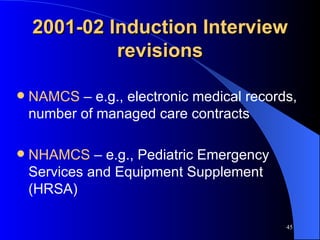
2001-02 Induction Interview revisions NAMCS  – e.g., electronic medical records, number of managed care contracts NHAMCS  – e.g., Pediatric Emergency Services and Equipment Supplement (HRSA)
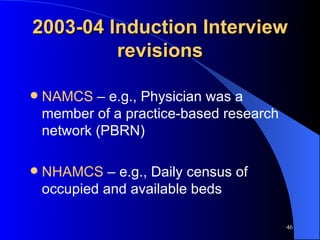
2003-04 Induction Interview revisions NAMCS  – e.g., Physician was a member of a practice-based research network (PBRN) NHAMCS  – e.g., Daily census of occupied and available beds
ED Overcrowding Physician coverage hours Log of ambulance diversion
Analysis of Facility Level Data
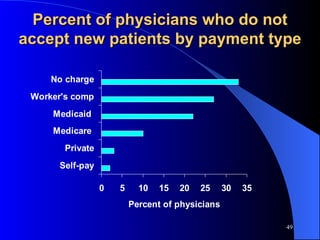
Percent of physicians who do not accept new patients by payment type
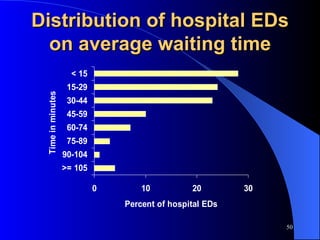
Distribution of hospital EDs on average waiting time
Overview User considerations Encounter vs. person data Sampling error Nonsampling error Methodological studies Data dissemination NCHS Research Data Center
Encounter vs. person data NAMCS and NHAMCS are record-based surveys Not population-based surveys (NHIS) Estimates are in terms of visits and not persons Can not calculate incidence or prevalence rates from our estimates
Sample weight Sample data  MUST  be weighted to produce national estimates Estimation process Adjusts for survey and item nonresponse Makes several ratio adjustments within and across physician specialties and hospitals
Sampling error NAMCS and NHAMCS are not simple random samples Clustering effects of visits within the physician’s practice and also physician practices within PSUs Must use generalized variance curve or SUDAAN to calculate SEs for all estimates, percents, and rates.
Reliability criteria Estimates based on at least 30 raw cases are reliable Estimates with a relative standard error (RSE) less than 30 percent are reliable Both conditions must be met
Ways to improve reliability of estimates Combine NAMCS, ED and OPD data to produce ambulatory care visit estimates Combine multiple years of data
Nonsampling error Frame coverage Reporting and processing errors Biases due to survey and item nonresponse Incomplete responses
Minimizing nonsampling error Improve sample frame for better coverage Encourage uniform reporting and eliminate ambiguities Pretest survey items and procedures Perform quality control procedures – consistency and edit checks Train Census field representatives
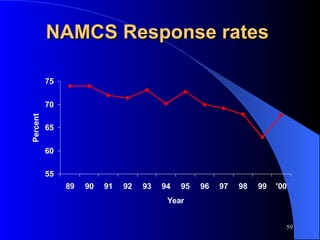
NAMCS Response rates
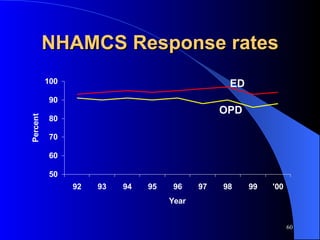
NHAMCS Response rates ED OPD
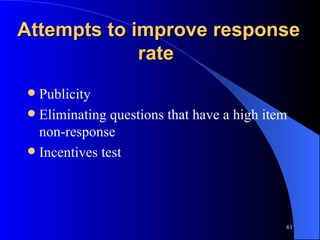
Attempts to improve response rate  Publicity  Eliminating questions that have a high item non-response Incentives test
Methodological studies Nonresponse study Complement study Motivational insert Form length Incentive test
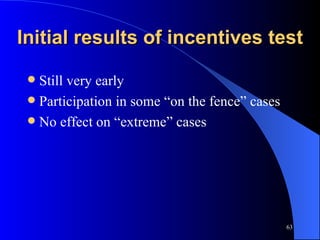
Initial results of incentives test Still very early  Participation in some “on the fence” cases No effect on “extreme” cases
Data dissemination
 
Outside research Journal articles List on Ambulatory Care web site Text books Department level publications Health US
Microdata files Downloadable files NAMCS, 1973-2000 NHAMCS, 1992-2000 CD-ROMs NAMCS, 1990-2000 NHAMCS, 1992-2000 Tapes/cartridges (NTIS) NAMCS, 1973-1997 NHAMCS, 1992-1997
Enhanced public-use files SAS variable labels, value labels, and format assignments (1997-2000) Sample design variables Allow use of SUDAAN and STATA 1997-2000 NAMCS and NHAMCS Files prior to 2000 have been updated on web site
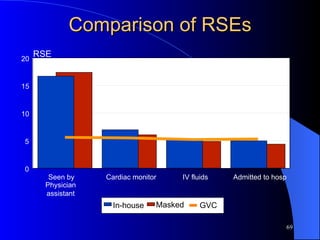
Comparison of RSEs Physician assistant Seen by Cardiac monitor IV fluids Admitted to hosp 0 5 10 15 20 RSE In-house Masked GVC
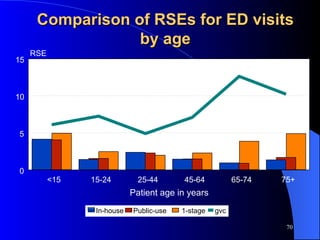
Comparison of RSEs for ED visits by age Patient age in years In-house Public-use 1-stage gvc <15 15-24 25-44 45-64 65-74 75+ 0 5 10 15 RSE
Future release NAMCS Trend file  1980-81, 1985, 1990-91, 1995-96, and 1999-2000 2001 NAMCS and NHAMCS data
Where to get more information Ambulatory Care information booth Ambulatory Care website Call Ambulatory Care Statistics Branch at (301) 458-4600 Academy for Health Services Research and Health Policy seminar Fall, 2002
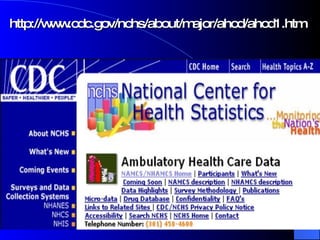
http://www.cdc.gov/nchs/about/major/ahcd/ahcd1.htm
NCHS Research Data Center
Why the Research Data Center? Have access to information not available on public use files Patient: zip code linked income, education, or urbanicity status Provider: physician sex and age, board certification, teaching hospital Geographic: state and county codes
Data Center- cont. Can merge with contextual variables (e.g., ARF, NHIS, Census, NHDS) Health status level HMO penetration Physician and specialist supply Medicaid reimbursement Air quality Percent in poverty
Data Center rules Submit a proposal Cannot use data to identify patients or providers or geographic location of providers Cannot remove data files Fee – onsite / remote / file construction
I need more information ! Visit the Research Data Center booth E-mail:  [email_address] Website:  www.cdc.gov/nchs/r&d/rdc.htm Call (301) 458-4277
Thank You Linda McCaig  – NHAMCS data  [email_address] David Woodwell  – NAMCS data  [email_address]
 

Mccaig Woodwell2

  • 1.
    Linda McCaig andDavid Woodwell Ambulatory Care Statistics Branch Division of Health Care Statistics National Center for Health Statistics/CDC Using NAMCS and NHAMCS Data
  • 2.
    Overview Background Datauses Survey methodology Current and proposed survey items User considerations Methodological studies Data dissemination NCHS Research Data Center
  • 3.
  • 4.
    National probability samplesurveys National Ambulatory Medical Care Survey (NAMCS) Patient visits to non-federal office-based physicians National Hospital Ambulatory Medical Care Survey (NHAMCS) Patient visits to EDs and OPDs of non-federal short-stay hospitals
  • 5.
    Original NAMCS surveygoals National statistics Professional education Health policy formulation Medical practice management Quality assurance
  • 6.
    NAMCS history Surveybegan in 1973 Annual data collection through 1981 (NORC) Conducted in 1985 (NORC) Annual began again in 1989 (Census)
  • 7.
    NHAMCS history Surveybegan in 1992 Annual data collection (Census)
  • 8.
    How are NAMCSand NHAMCS data used?
  • 9.
    Data uses Tounderstand health care practice and find inequities To track certain conditions To establish national priorities To serve as comparison points for states To measure Healthy People objectives
  • 10.
    Data users Over100 journal publications in last 2 years Medical associations Government agencies Health services researchers University and medical schools Broadcast and print media
  • 11.
    Setting government policyED as a “safety net” for the uninsured Development of the Resource-Based Relative Value Scale (RBRVS)
  • 12.
  • 13.
    Antibiotic prescribing ratesat physician office visits for children Rate per 1000 population Rate per 1000 visits
  • 14.
  • 15.
    Prescribing rates atphysician office visits by specialty Psychiatry Ophthalmology Otolaryngology Orthopedic surgery
  • 16.
    Female ambulatory carevisit rates for selected diagnoses by race
  • 17.
    Annual rate ofillness and injury ED visits for seniors by race Illness, black 1 Illness, white 1 Injury, black 1 NOTE: 1 p < .01. Injury, white
  • 18.
    Diabetes visit ratesper 10,000 persons by setting 49 147 1289 1998-99 38 157 1118 1996-97 36 117 865 1994-95 33 84 962 1992-93 ED OPD Office Year
  • 19.
    NAMCS and NHAMCSMethodology
  • 20.
    NAMCS Scope Includesnon-federal, office-based physicians Excludes physicians whose main activity is teaching, research, administration, hospital-based care, or who are unclassified as to activity and those in the certain specialties
  • 21.
    In-Scope NAMCS locations Freestanding clinic/urgicenter Federally qualified health center Neighborhood and mental health centers Non-federal government clinic Family planning clinic Health maintenance organization Faculty practice plan Private solo or group practice
  • 22.
    Out-of-Scope NAMCS locationsHospital ED’s and OPD’s Ambulatory surgicenter Institutional setting (schools, prisons) Industrial outpatient facility Federal Government operated clinic Laser vision surgery
  • 23.
    NAMCS Sample design112 NHIS PSUs 3,000 physicians 25,000 visits 1 week reporting period
  • 24.
    NHAMCS Scope OPD was intended to be parallel to the NAMCS in the hospital setting General medicine, surgery, pediatrics, ob/gyn, substance abuse, and “other” clinics are in-scope Ancillary services are out of scope
  • 25.
    NHAMCS Sample design112 NHIS PSUs 500 hospitals 400 EDs and 250 OPDs 24,000 ED visits and 30,000 OPD visits 4-week reporting period
  • 26.
    Gaining cooperation Advanceletters Endorsement letters Public relations materials Conversion of refusal
  • 27.
    Data collection proceduresInduction visit by Census field representative (FR) FR training of office/hospital staff Random start number Take every number Prospective or retrospective method
  • 28.
    Items collected Patientcharacteristics age, race, sex Visit characteristics Reason for visit, diagnosis, medication Provider characteristics physician specialty, hospital ownership
  • 29.
    Repeating fields Reasonfor visit (3) Cause of injury (3) Diagnosis (3) Ambulatory surgical procedures (2) Medications (6)
  • 30.
    Data processing Dataare coded and keyed by Analytical Sciences Inc. (ASI) Quality control procedures Edit checks by NCHS
  • 31.
    Coding systems usedA Reason for Visit Classification (NCHS) ICD-9-CM Drug coding classification system (NCHS) National Drug Code Directory
  • 32.
    NAMCS and NHAMCS1999-2000 PRFs
  • 33.
    Patient record form - common items Patient’s zip code Date of visit Date of birth Sex Ethnicity
  • 34.
    Patient record form- common items Race Source of payment HMO status Reason for visit
  • 35.
    Patient record form– common items Diagnosis Diagnostic/screening services Medications Providers seen Visit disposition
  • 36.
    Injury items Externalcause – narrative text since 1997 Place of injury Work related injury Intent
  • 37.
    Office and OPDPRF - unique items Was patient referred for visit Patient’s primary care physician Patient seen before Major reason for visit
  • 38.
    Office and OPDPRF - unique items Ambulatory surgical procedures Therapeutic and preventive services Time spent with physician (NAMCS only)
  • 39.
    ED Patient recordform - unique items Arrival time Discharge time Immediacy Presenting level of pain Procedures
  • 40.
    NAMCS and NHAMCSPRF revisions 2001-02 – emphasis on the continuity of care
  • 41.
    Office and OPDPRF - new items for 2001-02 How many visits in last 12 months Initial or follow-up visit Do other physicians share care Total number of medications
  • 42.
    ED PRF -new items for 2001-02 Discharge time Visit related to alcohol use Patient seen in last 72 hours Initial or follow-up visit Visit related to adverse drug event Initial vital signs Total number of medications
  • 43.
    NAMCS and NHAMCSPRF revisions 2003-04
  • 44.
    ED PRF- revisionsfor 2003-04 New oriented X 3 is visit work related list up to 8 medications Recycled mode of arrival presenting level of pain time seen by physician
  • 45.
    2001-02 Induction Interviewrevisions NAMCS – e.g., electronic medical records, number of managed care contracts NHAMCS – e.g., Pediatric Emergency Services and Equipment Supplement (HRSA)
  • 46.
    2003-04 Induction Interviewrevisions NAMCS – e.g., Physician was a member of a practice-based research network (PBRN) NHAMCS – e.g., Daily census of occupied and available beds
  • 47.
    ED Overcrowding Physiciancoverage hours Log of ambulance diversion
  • 48.
  • 49.
    Percent of physicianswho do not accept new patients by payment type
  • 50.
    Distribution of hospitalEDs on average waiting time
  • 51.
    Overview User considerationsEncounter vs. person data Sampling error Nonsampling error Methodological studies Data dissemination NCHS Research Data Center
  • 52.
    Encounter vs. persondata NAMCS and NHAMCS are record-based surveys Not population-based surveys (NHIS) Estimates are in terms of visits and not persons Can not calculate incidence or prevalence rates from our estimates
  • 53.
    Sample weight Sampledata MUST be weighted to produce national estimates Estimation process Adjusts for survey and item nonresponse Makes several ratio adjustments within and across physician specialties and hospitals
  • 54.
    Sampling error NAMCSand NHAMCS are not simple random samples Clustering effects of visits within the physician’s practice and also physician practices within PSUs Must use generalized variance curve or SUDAAN to calculate SEs for all estimates, percents, and rates.
  • 55.
    Reliability criteria Estimatesbased on at least 30 raw cases are reliable Estimates with a relative standard error (RSE) less than 30 percent are reliable Both conditions must be met
  • 56.
    Ways to improvereliability of estimates Combine NAMCS, ED and OPD data to produce ambulatory care visit estimates Combine multiple years of data
  • 57.
    Nonsampling error Framecoverage Reporting and processing errors Biases due to survey and item nonresponse Incomplete responses
  • 58.
    Minimizing nonsampling errorImprove sample frame for better coverage Encourage uniform reporting and eliminate ambiguities Pretest survey items and procedures Perform quality control procedures – consistency and edit checks Train Census field representatives
  • 59.
  • 60.
  • 61.
    Attempts to improveresponse rate Publicity Eliminating questions that have a high item non-response Incentives test
  • 62.
    Methodological studies Nonresponsestudy Complement study Motivational insert Form length Incentive test
  • 63.
    Initial results ofincentives test Still very early Participation in some “on the fence” cases No effect on “extreme” cases
  • 64.
  • 65.
  • 66.
    Outside research Journalarticles List on Ambulatory Care web site Text books Department level publications Health US
  • 67.
    Microdata files Downloadablefiles NAMCS, 1973-2000 NHAMCS, 1992-2000 CD-ROMs NAMCS, 1990-2000 NHAMCS, 1992-2000 Tapes/cartridges (NTIS) NAMCS, 1973-1997 NHAMCS, 1992-1997
  • 68.
    Enhanced public-use filesSAS variable labels, value labels, and format assignments (1997-2000) Sample design variables Allow use of SUDAAN and STATA 1997-2000 NAMCS and NHAMCS Files prior to 2000 have been updated on web site
  • 69.
    Comparison of RSEsPhysician assistant Seen by Cardiac monitor IV fluids Admitted to hosp 0 5 10 15 20 RSE In-house Masked GVC
  • 70.
    Comparison of RSEsfor ED visits by age Patient age in years In-house Public-use 1-stage gvc <15 15-24 25-44 45-64 65-74 75+ 0 5 10 15 RSE
  • 71.
    Future release NAMCSTrend file 1980-81, 1985, 1990-91, 1995-96, and 1999-2000 2001 NAMCS and NHAMCS data
  • 72.
    Where to getmore information Ambulatory Care information booth Ambulatory Care website Call Ambulatory Care Statistics Branch at (301) 458-4600 Academy for Health Services Research and Health Policy seminar Fall, 2002
  • 73.
  • 74.
  • 75.
    Why the ResearchData Center? Have access to information not available on public use files Patient: zip code linked income, education, or urbanicity status Provider: physician sex and age, board certification, teaching hospital Geographic: state and county codes
  • 76.
    Data Center- cont.Can merge with contextual variables (e.g., ARF, NHIS, Census, NHDS) Health status level HMO penetration Physician and specialist supply Medicaid reimbursement Air quality Percent in poverty
  • 77.
    Data Center rulesSubmit a proposal Cannot use data to identify patients or providers or geographic location of providers Cannot remove data files Fee – onsite / remote / file construction
  • 78.
    I need moreinformation ! Visit the Research Data Center booth E-mail: [email_address] Website: www.cdc.gov/nchs/r&d/rdc.htm Call (301) 458-4277
  • 79.
    Thank You LindaMcCaig – NHAMCS data [email_address] David Woodwell – NAMCS data [email_address]
  • 80.