By Dr. Yousuf F. Choudhury
Post Graduate Trainee, ENT Dept.
Silchar Medical College
Moderated by Prof. Dr. Shamsuddin, M.S
Head of Department, ENT Dept.
Silchar Medical College
Embryology of larynx :
 Larynx develops from laryngotracheal groove,
a midline diverticulum of foregut.
 Development starts in the 4th week of
embryonic life.
 Most of the anatomical structures develop by
the 3rd month of fetal life.
Development of cartilages Developed from
Thyroid cartilage 4th Branchial Arch
Arytenoids 6th Branchial Arch
Corniculate 6th Branchial Arch
Epiglottis Hypobranchial eminence
Cricoid and tracheal cartilages 6th Branchial Arch
Location of the larynx :
Larynx is situated at the cranial end of the
trachea. It extends from the 3rd to the 6th cervical
vertebra. This level may be somewhat higher in
women and children.
Dimension of the larynx :
The size of the larynx is almost the same in boys
and girls till puberty. After puberty the antero
posterior diameter of the larynx virtually doubles
in males.
Dimension of Adult Larynx
Sexes Length Anterior
posterior
diameter
Transverse
diameter
Male 44 mm 36 mm 43 mm
Female 36 mm 21 mm 41 mm
Larynx has 9 cartilages.
Paired Unpaired
Arytenoid Thyroid
Corniculate Cricoid
Cuneiform Epiglottis
Laryngeal Joints
Cricothyroid Joint
Cricoarytenoid Joint
Larynx has 2 joints
Ligaments and Membranes of Larynx
Name of Extrinsic
Muscle and functions
Origin Insertion Innervation
Infrahyoid group
Thyrohyoid
Elevates the larynx on
a fixed hyoid or
depresses the hyoid on
a fixed Larynx
Oblique line of thyroid
lamina
Inferior border of the
greater cornu of the
hyoid
Hypoglossal (C1 root)
Sternothyroid
Depresses the larynx
Posterior surface of
manubrium and
edge of the first
costal cartilage
Oblique line of the
thyroid lamina
Ansa cervicalis (C2, 3
roots)
Sternohyoid
Depresses the larynx
by lowering the hyoid
Clavicle and posterior
surface of the
manubrium
Lower edge of the
body
of the hyoid
Ansa cervicalis (C1, 2,
3
roots)
Suprahyoid group
Mylohyoid
Raises and pulls the
hyoid anteriorly
Mylohyoid line on
inner aspect of the
mandible
Midline raphe and
body
of the hyoid
Nerve to mylohyoid
(inferior alveolar
branch
of V3)
Geniohyoid
Raises and pulls the
hyoid forwards
Genial tubercle on
mandible
Upper border of the
body
of the hyoid
Hypoglossal (C1 root)
Name of the Extrinsic
Muscle and functions
Origin Insertion Innervation
Stylohyoid
Retractor and elevator of
the hyoid for swallowing
Back of the styloid
process (splits
around the
digastric tendon)
Base of greater cornu of
the hyoid
Facial nerve
Digastric
Anterior belly pulls the hyoid
anteriorly and up
Posterior belly pulls the hyoid
posteriorly and up
Digastric notch on
the
medial surface of
the mastoid
Process
Lower border of the
mandible (fibrous
sling holds the
tendon to the lesser
cornu of the hyoid)
Anterior belly –
nerve to
mylohyoid
Posterior belly –
facial
nerve
Stylopharyngeus
Elevates the larynx
Medial aspect of the
styloid process
Posterior border of the
lamina of the thyroid
cartilage (side wall of
the pharynx)
Glossopharyngeal
nerve
Palatopharyngeus
Helps tilts the larynx
forwards
Palatine aponeurosis
and posterior
margin of hard
palate
Posterior border of
thyroid alar and
cornua
Accessory nerve
(pharyngeal plexus
Salpingopharyngeus
Elevates the larynx
Eustachian tube Posterior border of the
thyroid cartilage
Pharyngeal plexus
Name of the Intrinsic Muscle
and function
Origin Insertion
Open and close the glottis
Posterior cricoarytenoid
Lower and medial surface of
the back
of the cricoid lamina
It fans out to be inserted into
the back
of the muscular process of the
arytenoid
Lateral cricoarytenoid Superior border of lateral part
of the
arch of the cricoid
Muscular process of arytenoid
Transverse arytenoids – unpaired Posterior surface of
the muscular
process and outer edge of the
arytenoid
Crosses over and attaches to
the same
point on the other arytenoid
Oblique arytenoids – paired Posterior aspect of the
muscular
process (superficial to the
transverse arytenoid)
Apex of the other arytenoid
Name of the intrinsic muscle
and function
Origin Insertion
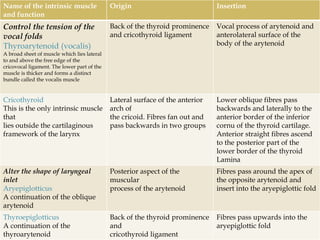
Control the tension of the
vocal folds
Thyroarytenoid (vocalis)
A broad sheet of muscle which lies lateral
to and above the free edge of the
cricovocal ligament. The lower part of the
muscle is thicker and forms a distinct
bundle called the vocalis muscle
Back of the thyroid prominence
and cricothyroid ligament
Vocal process of arytenoid and
anterolateral surface of the
body of the arytenoid
Cricothyroid
This is the only intrinsic muscle
that
lies outside the cartilaginous
framework of the larynx
Lateral surface of the anterior
arch of
the cricoid. Fibres fan out and
pass backwards in two groups
Lower oblique fibres pass
backwards and laterally to the
anterior border of the inferior
cornu of the thyroid cartilage.
Anterior straight fibres ascend
to the posterior part of the
lower border of the thyroid
Lamina
Alter the shape of laryngeal
inlet
Aryepiglotticus
A continuation of the oblique
arytenoid
Posterior aspect of the
muscular
process of the arytenoid
Fibres pass around the apex of
the opposite arytenoid and
insert into the aryepiglottic fold
Thyroepiglotticus
A continuation of the
thyroarytenoid
Back of the thyroid prominence
and
cricothyroid ligament
Fibres pass upwards into the
aryepiglottic fold
Action Muscle Responsible
Abductor Posterior Cricoarytenoid
Adductor Lateral Cricoarytenoid
Interarytenoid (transverse arytenoids )
Thyroarytenoid ( external part )
Tensor Cricothyroid
Vocal Cord relaxation Thyroarytenoid ( internal part)
Vocalis
Opener of the laryngeal inlet Thyroepiglotticus
Closure of the laryngeal inlet Aryepiglotticus
Inter arytenoids ( oblique part )
Nerve (CN X)
- Superior laryngeal nerve
- Internal branch:
sensation to supraglottis
- External branch: motor
innervation to
cricothyroid muscle
- Recurrent laryngeal nerve
- Loops around
subclavian artery on
right/aorta on left and
back up in neck in
tracheoesophageal
groove
- Motor innervation of all
intrinsic muscles of
larynx (except
cricothyroid)
- Sensation to subglottis
Superior laryngeal nerve
Internal branch
External branch
Recurrent laryngeal
nerve
Arterial supply :
 Up to vocal folds : By superior laryngeal artery , a
branch of superior thyroid artery. ( Cricothyroid artery is
a branch of superior laryngeal artery )
 Below vocal folds : By inferior laryngeal artery, a branch
of inferior thyroid artery
Venous supply :
 Superior laryngeal veins drains to internal jugular vein
 Inferior laryngeal veins drains to inferior thyroid vein
Lymphatic Drainage :
 Above the vocal cords : Lymphatics here drains to upper
deep cervical nodes.
 Below the vocal cords : The lymphatics drains to the pre-
tracheal and pre-laryngeal nodes, enter the lower deep
cervical nodes.
 Histologically the vocal fold is said to contain 5 layers:
 Layer 1: Squamous epithelial lining. It is very thin and
helps to hold the shape of the vocal fold. This layer
doesnot contain any mucous glands, and hence the
mucoid secretions lining the cord must travel from the
glands located anteriorly, superiorly and posteriorly to
the edges of the vocal fold.
 Layer 2: Superfical layer of the lamina propria. It is
composed of loose fibers and matrix. In clinical
parlance it is also referred to as the Reinke's space. This
layer contains only minimal elastic and collagenous
fibers and offers least resistance to vibration. The
integrity of this layer is vital for proper phonatory
function.
 Layer 3: Intermediate layer of lamina propria. It
contains a higher concentration of elastic and
collagenous fibers when compared to layer 2. This
layer is thickened at the anterior and posterior ends
of the vocal folds. These thickened regions are
known as anterior and posterior macula flava. These
structures provide protection to the vocal folds from
mechanical damage.
 Layer 4: Deep layer of lamina propria. It contains a
dense collection of elastic and collagenous fibers.
This layer along with the intermediate layer
constitute the vocal ligament. The vocal ligament is
considered to be the upper most portion of conus
elasticus (cricothryoid ligament). Some of the
collagenous fibers present here gets inserted into the
vocalis muscle. The intermediate and the deep layers
of lamina propria cannot be easily separated.
 Layer 5: Vocalis muscle. The fibers of this muscle run
parallel to the direction of the vocal fold. Vocalis
muscle is infact a portion of thyro arytenoid muscle.
•The cover is composed of the overlying
epithelium combined with the superficial
layer of the lamina propria.
•The intermediate and deep layers of the
lamina propria, known as the vocal
ligament, form a transition zone.
•The body is composed primarily of the
thyroarytenoidmuscle.
•The contrasting masses and physical
properties of the vocal fold coverand the
bodycauses them to move at different
rates as air passes between the vocal
folds.
•Glotticwave driven by the Bernoulli effect
Physiology of the larynx:
1. Respiration.
2. Protection of the lower air passages.
3. Phonation.
4. Fixation of the chest.
5. Sphincteric action.
Definition : phonation is the process by which the vocal fords
produce certain sounds through quasi-periodic vibration
Theories of Phonation :
 Myoelastic theory
The myoelastic theory states that when the vocal cords are
brought together and breath pressure is applied to them, the
cords remain closed until the pressure beneath them—the
subglottic pressure—is sufficient to push them apart,
allowing air to escape and reducing the pressure enough for
the muscle tension recoil to pull the folds back together
again. Pressure builds up once again until the cords are
pushed apart, and the whole cycle keeps repeating itself.
The rate at which the cords open and close—the number of
cycles per second—determines the pitch of the phonation
Aerodynamic theory
The aerodynamic theory is based on the Bernouille
Theory. The theory states that when a stream of breath
is flowing through the glottis while the arytenoid
cartilages are held together by the action of the
interarytenoid muscles, a push-pull effect is created on
the vocal fold tissues that maintains self-sustained
oscillation. The push occurs during glottal opening,
when the glottis is convergent, whereas the pull occurs
during glottal closing, when the glottis is
divergent. Such an effect causes a transfer of energy
from the airflow to the vocal fold tissues which
overcomes losses by dissipation and sustain the
oscillation. During glottal closure, the air flow is cut off
until breath pressure pushes the folds apart and the
flow starts up again, causing the cycles to repeat
 As per Scott-Brown textbook of
otolaryngology, phonosurgery is defined as
“any surgery designed primarily for the
improvement or restoration of the voice”.
 The term is firstly adopted by Godfrey Arnold
and Hans von Leden in 1971.
For evaluation of voice disorders, a thorough
assessment is essential both subjective and
objective measures as well as pre and
postoperative settings.
I. Elementary Diagnostic Procedures
II. Clinical Diagnostic Aids.
III. Additional Instrumental Measures.
Elementary Diagnostic Procedures
 Patient’s interview.
 Auditory Perceptual Assessment. (APA)
 Visual assessment of the vocal tract.
 External laryngeal examination
Clinical Diagnostic Aids.
 Indirect laryngoscoy & Videostroboscopy.
 Rigid telescope or nasofibroscope.
Additional Instrumental Measures.
 Acoustic analysis.
 Aerodynamic analysis.
 Electromyography.
 Glottal wave studies:
 Electroglottography (EGG). Photoglottography
(PGG).
 Inverse filtering technique. videokymography.
 Radiological Studies
-Plain X-ray,
-CT scanning
-MRI.
 Videofluroscopy.
Goals :
 Aetiological categoriztion of the pathology.
 Determine the nature and severity of the
disorder.
 Choice the type and sequence of intervention.
 Drawing prognostic anticipation.
 Monitoring the effect of intervention.
(Kotby et al., 1989)
Kotby's classification (1995)
 1. Extirpation endolaryngeal microsurgery.
 2. Vocal fold augmentation.
 3. Vocal fold repositioning.
 4. Neurophonosurgery.
 5. Glottal reconstruction after partial
laryngectomy.
 6. Postlaryngectomy surgery.
 Prof. Rosemarie Albrecht - Germany (1954)
described the first microscopic visualization of
the Vocal Folds.
 Prof. Oskar Kleinsassar - Germany (1962)
introduced the modern state of the art method of
microlaryngosurgery.
 Dr. Geza Jako – USA (1962)
designed a series of microlaryngeal instruments.
Instrumentations : Conventional microsurgery/ Laser
Indications :
Congenital Lesions:
 Sulcus vocalis
 Laryngeal web
 Epidermoid cysts & laryngoceles.
 Laryngeal stenosis
Acquired lesions
 Granulomata.
 VF hemorrhage.
 Papillomatosis.
 Dysplasia of VF. & Carcinoma in situ.
 Benign neoplasm
Conventional Microlaryngeal surgery
 Proper instrumentations with a wide range of
laryngoscopes and micro-instruments is required.
 Instruments need to be fine, sharp and well
maintained to allow precise removal of lesion with
less scaring and without injuring of vocal ligament.
 A selection of endoscopes with a wide proximal
end and distal illumination is desirable and
internal distension of the larynx by using largest
laryngoscope possible is recommended.
 Cheap and easily available. Gives similar result in
expert hands in comparison to Laser microsurgery.
Laser Microsurgery
 CO2 Laser is most commonly used laser in laryngeal
microsurgery.
 Best used in vascular lesions or lesions that bleeds on
removal such as papillomatosis or granulomas, removal of
cartilage and excising large areas of tissue.
 Laser plume in the management of papillomas can be
considered potential risk of infection.
Laryngeal Microdebrider
 Power instruments such as microdebrider eliminates the risk
of lasers listed above.
 Microdebrider has been used for various laryngeal lesions
including papillomas and there is report that patients have
less post-operative pain and quicker return to a usable
speaking voice.
Laryngeal Microdebrider
 Wilhelm Brunings (1911) developed the first
technique by injecting paraffin using a special
syringe.
 Autologous and alloplastic materials.
 Transoral or percutaneous approaches
Indications:
o Vocal fold paralysis
o Vocal fold paresis
o Vocal fold atrophy
o Vocal fold scar
o Adjunctive augmentation after prior surgery
o Trial basis
Contraindication:
o Mobile or potentially mobile VF.
o Cricoarytenoid joint fixation.
o Post-hemilaryngectomy.
o Inflammatory diseases and medical conditions.
 Note: Done when there is absence of arytenoid fixation
and there is adequate residual vocal fold structure to
allow for needle placement.
The ideal injectable material :
 Readily available
 Inexpensive
 Inert
 Easy to use
 Completely biocompatible
 Injectable materials are broadly classified into
temporary and permanent types.
Material Length of effect Advantage Disadvantage
Gel Foam 4-6 wks Long track record Short duration
Carboxymethylcel
lulose
2-3 months FDA approved Not long lasting
Bovine collagen 3-4 months Long track record Allergy test
2-4 wk delay
Human derived
collagen
3-4 months No allergy test Limited
experience
Micronized
Alloderm
(Cymetra)
{ Most commonly
used }
2-3 months No allergy test
Little/no
inflammatory
response.
More preparation
time
Hyaluronic acid
gel
4-6 months No allergy test Limited
experience
Material Length of effect Advanatge Disadvantage
Calcium hydroxyapatite 2-5 years FDA approved Associated with foreign
body granulomatous
reaction. l/t dysphonia,
pain and VC erythema.
Teflon Permanent Long lasting Irreversible
Vocal stiffness
Granuloma
Autologous fat
(harvested more commonly
from lower abdomen and
inner thigh.)
{ Most commonly used }
Permanent Own tissue Time, morbidity from fat
harvest
Silicon – polydimethyl
sialoxane
Permanent Long lasting Should be placed deep
inside body of vocal fold
to prevent migration
 Arnold (1961) used teflon.
 Fukuda (1970) used silicon.
 Schramm et al. (1978) used gelfoam/glycerin
paste.
 Ford and Bless (1986) used bovin collagen.
 Brandenburg et al. (1992) used autologous fat
injection.
 Ford et al (1995) used autologous collagen.
 Tsunoda et al. (2001) implant harvested
temporalis fascia.
Vocal Cord Injection techniques
It may be done under GA or LA through following routes:
 Peroral : performed in selected patients.
topical 4% LA applied on laryngeal and pharyngeal mucosa.
• Curved inj. device in clinical setting; under indirect visualization of larynx
by holding the tongue forward.
Bevelled end directed away from midline to minimize risk of
intramucosal injection.
Injection techniques
 Percutaneous : can be performed under sedation or LA
visualization is with a flexible fibreoptic
nasopharyngoscope with digital imaging system.
For optimum results needle placed just anterior
and lateral to vocal process on a plane level with the lower border of
medial edge.
47
Routes of administration:
1. Transthyroid – through inferior half
of thyroid cartilage.
It’s performed through lateral
approach , level of vocal fold is
determined by palapting thyroid
notch and inferior border of
thyroid cartilage.
2. Transcricothyroid membrane puncture
– becoming popular method.
It’s performed through anterior
approach, vocal folds approached
from below.
3. Transthyrohyoid membrane puncture -
usually not done routinely because
there is danger of injection into
Reinke’s space.
Laryngoscopic Injection(telescopic visualization):
 Indications:
1. Patients who do not tolerate flexible fibreoptic examination.
2. During ablative procedures where RLN or Vagal nerve resection is
anticipated. This provides temporary medialization decreasing
immediate post operative symptoms.
 Position: Supine
 Anaesthesia: GA or LA
 Instruments:
1. 0/30 degree 5mm laryngeal telescope
2. Digital video system
3. 23-gauge butterfly needle for Cymetra
Injection gun ( Bruning’s syringe) for Autologus fat
Needle is inserted anterior and lateral to vocal process appr. 2 mm deep
or at the plane level with the lower margin of the true folds. After
injection massage is done over vocal fold to distribute the material.
Precautions - Vocal Cord Injection
• Avoid unnecessary tension at the anterior commissure.
• Superior laryngeal nerve block should be avoided as it alters vocal
fold tension by paralyzing cricothyroid muscle.
• The appropriate amount of overcorrection used for most injectables
(15–30%, or an additional 0.1–0.2 ml of material).
• Injection into the superficial lamina propria (Reinke’s space) is to be
avoided – l/t granuloma formation in space hampering mobility.
• For vocal fold medialization materils is placed in paraglottic space
lateral to vocalis muscle and For intra-cordal injection , site is
superficial , just deep to lamina propria avoiding Reinke’s space.
Complications of vocal fold injection
1. Under injection requiring repeat procedures
2. Over injection causing airway compromise –
Immediate management  incise mucosa and remove
excess material with suction
Late management  CO2 laser or cupped forcep removal or
thyrotomy.
3. Improper placement causing subglottal extension and
stenosis.
4. If given in Reinke’s space – cause granuloma formation
leading to impaired Vocal Cord vibrations.
Medialization surgeries (Mediopexy)
 1. Surgical augmentation
 2. Arytenoid adduction
Lateralization (Lateropexy)
 1. Arytenoid repositioning. (Ejnell, 1984)
 2. Arytenoidectomy with posterior partial
cordectomy.
 Sharp dissection (Kleinsasser, 1968)
 Laser excision. (Ossff et al. 1984)
Medialization surgeries (Mediopexy)
1- Surgical augmentation
 Materials: autograft cartilage or alloplastic
implant.
 Techniques:
 Anterior approach. (Meurman, 1952)
 Anteroinferior approach. (Hiroto, 1976)
 Window technique. (Isshiki, 1977, Kaufman, 1986)
2- Arytenoid adduction(Isshiki, 1978)
 Traction of the muscular process of the arytenoid
antero-medio-inferiorly.
 It can be augmented by simultaneous thyroplasty
IV.
History
 Payr (1915) reported the first medialization procedure by
anteriorly based cartilage flap.
 Meurman (1952) implanted free rib grafts beneath the inner
thyroid perichondrium.
 Opheim (1955) placed thyroid cartilage medial to the inner
perichondrium.
 Montgomery (1966) repositioned the arytenoid and fixed it
to the cricoid cartilage with a pin.
 Isshiki et al (1975) achieved medialization by displacing and
stabilizing a rectangular window at the level of VF.
 Kaufman (1986) derived a formula for calculating the
appropriate size of the window.
 Laryngeal framework surgery is altering vocal fold
position, shape and tension by manipulating the
cartilagenous framework.
 Isshiki’s functional classification of Thyroplasty :
 Type I - Medialization.
 Type II – Lateralization.
II a – Lateral approach
II b – Medial approach
 Type III - Relaxation (shortening).
 Type IV – Tensioning (lengthening).
IV a – Cricoid approximation
IV b – Tensioning by lateral approach
Type I Thyroplasty
Indications:
- Symptomatic glottic insufficiency (dysphonia, aspiration).
- U/L vocal fold paralysis.
- Vocal fold atrophy, including age related atrophy.
- Vocal fold bowing d/t ageing and cricothyroid joint
fixation.
- Sulcus vocalis
- Soft tissue defect resulting from excision of pathological
masses.
Contraindications:
- Malignant disease overlying laryngotracheal complex.
- Poor abduction of Contralateral vocal fold.
- h/o radiation therapy to larynx.
Manual Compression Test
This test results in a preoperative improvement in voice suggest that
surgery will be successful
 In paralyzed or atrophic vocal fold, the
medial bulge from the Thyroarytenoid
(TA) muscle contraction is inadequate.
 The thyroplasty implant medializes the
midmembranous vocal fold to mimic the
activity of the TA muscle.
 Goals: To improve voice quality and
prevent aspiration.
Pre- Operative
– Surgery done under local anaesthesia with
patient AWAKE
-patient need to phonate
-Use 1% lignocaine with Epinephrine
1:100,000 with an amp of bicarbonate as
bicarbonate makes it hurt less.
-Inject broadly EVERYWHERE you are going
to dissect!
• Positioning: Shoulder roll with neck
extended
Technique
• A para-median
horizontal incision
over the middle
aspect of thyroid
lamina.
• Superior and
inferior flaps
elevated in
subplatysmal plane
• Sternohyoid
muscle is
elevated off the
thyroid cartilage.
• The muscle is
retracted posterior
to thyroid lamina.
• A cautery
template marks
the fenestra (6 x
10 mm), and the
superior aspect of
the window is at
the vocal fold
level.
Type I Thyroplasty:
Window
• Outline before cutting.
• Goal: Window at the level of the True
VF, to medialize only the True VF.
• If carving the implant, or using Gore-
Tex can be free-hand.
• If using pre-formed implant (i.e.
Montgomery or titanium), use
window sizer to mark window.
Type I Thyroplasty:
Window
• Superior edge of
window most
important (because
if too high will
medialize false VF)
• Half way between
the thyroid notch
and the inferior
border of the
thyroid cartilage,
parallel to the
inferior border
-The size of the window is
dependent on the size of the
larynx, men > women
- Anterior border should be
about 5-7mm posterior to
midline in female and 8-10mm in
male.
- Posterior border should be
just anterior to the oblique line
(width usually about 10-13mm)
- Inferior border should be
about 2-3 mm superior to the
inferior border to prevent
fracturing (height usually 4-
6mm)
• Cutting the window
- Marks are made
with electrocautery
and gentian violet
• If cartilage is soft use #15
blade
– If calcified:
• use oscillating saw.
• or use otologic drill
2mm burr to
outline window
and then a Kerrison
bone punch to
remove remaining
cartilage.
• - inner perichondrium
elevated in
circumferential fashion
Type I Thyroplasty: Implant
• Pre-formed
Montgomery,
Titanium
Calcium Hydroxylapatite
• Hand carved
silicone.
layered Gore-Tex.
• Originally, after the
window was cut, the
cartilage of the window
was pushed in by a
cartilage shim or later an
implant.
• Ita was later found that
the cartilage migrated or
degraded over time
causing the voice to
worsen as it gets
smaller.
• Now, we remove the
cartilage before placing
an implant.
• Place implant external to
inner perichondrium.
• Rotate implant into four
orientation to determine
the optimal position.
• Most common position :
inferior posterior
quadrant in vertical
orientation.
• Before placement,
perform valsalva
maneuver. If air bubble
present, procedure is
terminated.
Type I Thyroplasty
• Advantages
- under local anesthesia.
- positioning is more anatomic, better assessment of voice
- Reversible.
- prosthesis is placed lateral to the inner perichondrium of
the thyroid lamina.
- structural integrity of the vocal fold is preserved, allowing
medialization with effective closure of the prephonatory gap .
• Disadvantages
- open procedure.
- technically more difficult.
- closure of the posterior glottis may be limited.
Factors affecting outcome of surgery
• Size and shape of the implant
• Position of the implant
• Maintaining proper position of the implant
• Limiting the duration of surgical procedure
• Deterioration of voice quality after thyroplasty with
implant in place –
- resolving oedema in postoperative period
- surgery performed early after paralysis - d/t
muscle atrophy
• Penetration of endolaryngeal mucosa - assess air
leak before placement of implant in window. If air
leak is present , then terminate the procedure.
• Wound infection
• Chondritis
• Airway obstruction – most danger – overnight
monitoring is required.
• Implant extrusion
– Can become displaced and even extrude into the airway,
more commonly with Gore-Tex and with implants
without outer phalanges
Type I Thyroplasty:
Complications
Type I Thyroplasty
Pitfalls
• Window is too high.
– Then implant is too high, false VF is medialized and voice is
poor.
• Implant is too big or too small.
– Makes voice either pressed or breathy.
• Voice is still poor after Procedure because of posterior glottal
insufficiency. (Arytenoid adduction can correct this.)
Limitations of medialization
• Mechanical nature of the procedure.
• Imparts only static change to laryngeal framework with no effect on
dynamic function.
• No effect on vocal fold muscle mass, innervation and mobility.
• Closure of posterior glottis limited.
• No effect on vocal fold level in vertical plane.
Incomplete glottal closure after type I thyroplasty
Occurs in patients undergoing acute implantation after
paralysis of vocal cords due to atrophy of muscles with
time.
Management include :
• Revision thyroplasty
• Vocal fold injection with cymetra and autologous fat
• Re-innervation procedure
• Arytenoid adduction
Revision thyroplasty is surgically feasible and result in high
rate of improvement over the pre existing condition.
Modification of medialization thyroplasty
Modified techinque done by Nishiyama and colleagues
in 1999.
Implant used: autologus temporalis fascia .
Procedure: implant harvested, dehydrated, rolled and
inserted into vocal fold under microlaryngoscopy
guidence.
Indications: 1.Large glottic gaps.
2.Unilateral vocal fold palsy.
3.Atrophic vocal fold.
4.Post RT scar tissue.
Arytenoid Adduction
• First described by
Ishiki with
modifications by
Zeitels and others.
• Addresses posterior
glottic gap by pulling
arytenoid into
adducted position.
• Most advocate use in
combination with
anterior medialization.
• Traction on muscular
process of the
arytenoid antero-
Arytenoid Adduction –
Modifications
• Suture Placed to Cricoid Cartilage
Simulates action of lateral
cricoarytenoid.
• Zeitels Modification – Arytenopexy
More physiologic positioning of the
arytenoid.
Involves suturing the arytenoid in a
more posterior and medial position to
allow more tension on flaccid cord.
 Type II - Lateralization
Release the tight closure of the glottis.
 Approaches:
• Two paramedian vertical incisions and
interpose the lateral segments beneath the
anterior segment. ( Thyroplasty type Ia )
• A vertical incision in the thyroid cartilage and
lateralizing the posterior segment over the
anterior one ( Thyroplasty type IIa )
Indication:
Spastic dysphonia.
 Advantages:
 Optimal glottal closure can be adjusted and readjusted
 No damage of physiologic function
 Reversible
 Disadvantages:
 Technically difficult
 Shim displacement
 Does not relieve cause of Spasmodic Dysphonia
(neuromuscular , parkinson’s , MND , MS)
1. Suture Method-
Arytenoidopexy:
Displacing the vocal fold
and arytenoid without
surgical removal of any
tissue.
Suture passed around the
vocal process of the
arytenoid and secured
laterally.
Relatively high
failure rate.
 2.Resection Method (Arytenoidectomy)-
Removal of some or all of the arytenoid
cartilage.
- Endoscopically by Microsurgical technique
(Thornell procedure)
- with Laser surgery (Jako’s procedure)
- With Thyrotomy approach (Scheer’s
approach)
- By lateral neck approach (Woodman’s) –
Most popular approach.
 Dennis and Kashima (1989)
 Posterior partial cordectomy by carbon dioxide
laser.
 Excising a C-shaped wedge from the posterior
edge of one vocal cord.
 If this posterior opening is not adequate, after 6-8
weeks, procedure can be repeated or a small
cordectomy can be performed on the other vocal
cord.
 Relief of airway obstruction with preservation of
voice quality.
 Type I: Subepithelial cordectomy,
 Type II: Subligamental cordectomy, which is resection
of epithelium, or Reinke’s space and vocal ligament.
 Type III: Transmuscular cordectomy, which proceeds
through vocalis muscle.
 Type IV: Total cordectomy, which extends from vocal
process to the anterior commissure.
 Type Va: Extended cordectomy encompassing the
contralateral vocal fold.
 Type Vb: Extended cordectomy encompassing the
arytenoids.
 Type Vc: Extended cordectomy encompassing the
ventricular fold.
 Type Vd: Extended cordectomy encompassing the
subglottis.
• Right posterior
cordectomy in
cases of bilateral
abductor paralysis.
 Type III - Relaxation (shortening)
Aimed at lowering the vocal pitch.
The VF is relaxed by A-P shortening of the
thyroid ala.
Indications:
• Males with high pitch voice, resistant to voice
therapy.
• Stiff VF with high pitched breathy voice.
• Spastic dysphonia
Type III Thyroplasty
• Lateral approach
: ( Type III)
Thyroid ala is
incised at about
junction of
anterior and
middle one
third, and 2-5
mm cartilage
strip is excised.
• Medial approach ( Anterior
commissure retrusion ):
- Retrusion of the middle
portion of the thyroid
cartilage and leads to
reduction in the length of
vocal folds results in
normal adult voice
- Vertical incision was
made either side of the
midline of the thyroid
cartilage.
• Middle portion of the
cartilage pushed
posteriorly
• Free edges of the thyroid
cartilage reapproximated
with 2-0 vicryl
 Type IV - Stretching (lengthening)
 Increases the vocal pitch.
 It increases the distance between the vocal fold
attachments and thus raise the tension of vocal
fold.
Indications:
• Abnormallly lax or bowed vocal folds (as in
presbyphonia)
• Androphonias &
Male to female transexualism
• Cricothyroid
Approximation :
- increases vocal pitch
by simulating the
contraction of
cricothyroid muscle with
sutures.
- The cricoid and
thyroid cartilage is
approximated as closely
as possible because
postoperative reversion
towards a lower pitch to
some extent is inevitable.
- 4 nonabsorbable
monophilic sutures
are placed to draw
the cricoid and
thyroid cartilages
together.
- In thyroid cartilage,
bolsters should be
used to prevent
cutting through
sutures.
• Advantages:
No surgery on the vocal cords themselves.
Theoretically reversible if the patient is
dissatisfied.
• Disadvantages:
Requires neck incision.
prolonged healing process.
long-term results are inconsistent.
Techniques to elevate the pitch:
 Inferiorly based anterior cartilage flap.
(LeJeune et al., 1983)
 Superiorly based cartilage flap. (Tucker, 1985)
 Anterior commissure advancement. (LeJeune
et al., 1987)
• Cricothyroid Subluxation : By Steve Zeitels
• Indications :
U/L vocal fold paralysis with vocal fold
shortening with resultant reduced pitch range.
Poor pitch range after adequate implant
positioning in medialization laryngoplasty.
• Contraindications :
Present or impending laryngeal fracture of
thyroid ala from associated medialization
laryngoplasty.
• To lengthen the vocal fold by increasing
the distance from the cricoarytenoid joint
(cricoid ) to the anterior commissure (thyroid
cartilage) by subluxating the cricothyroid
joint.
- Results in rotation of anterior commissure
away from midline in a direction C/L to
unilateral vocal fold paralysis.
• Separation of cricothyroid jt
with scissors
• Placement of cricothyroid
subluxation suture
submucosally at the midline
of anterior cricoid cartilage.
• Elongation Thyroplasty:
- Lateral Approach (Type IV
b)
Vertical incision is taken at
the junction of anterior and
middle one-third of ala and
silastic implant is fixed
between cartilage edges by
two mattress sutures.
- If pitch elevation is
insufficient, the same
procedure may also be
performed on the
contralateral side.
• Medial Approach:
- By Le Jeune as “springboard
advancement”
- Indication : Breathy voice due
to bowed vocal folds.
- After exposure of anterior
portion of thyroid cartilage, an
inferiorly based carilage flap is
formed so as to include the
anterior commissure. The
upper end of flap is held in
position by a tantalum shim.
- Tucker modified this technique
by reversing the pedicle and
called it “anterior commissure
advancement”.
 Reinnervating the PCA muscle
 Nerve anastomosis. Phrenic nerve /ansa
cervicalis.
 Phrenic nerve implantation. (Crumley, 1983)
 Neuromuscular pedicle Transplantation. (Tucker,
1977)
 Reinnervating the TA muscle
 Ansa cervicalis to RLN anastomosis. (Crumley,
1991)
Infrathyroid - suprathyroid techniques
 Neuromuscular pedicle Transplantation.
(Crumley, 1985)
Reconstruct the resected VF after partial or
hemilaryngectomy.
 Hirano et al. (1976) used the sternothyroid
muscle
covered by an island flap of the overlying neck
muscle.
 Friedman et al. (1985) utilized the contralateral
superior thyroid cornu.
 El Kahky et al. (1989) used the ipsilateral
pyriform
sinus mucosal flap with intact superior laryngeal
neurovascular bundle.
Shunting the tracheal air to the pharynx or
esophagus.
 Neoglottis. TE mucosal lined canal. (Conley
et al., 1958; Asia, 1972; Staffieri and Serafini,
1976 ; Roka et al., 1985)
 Voice Prothesis in TE puncture.
- Blom-Singer voice prothesis. (Blom et al.,
1982)
- Panje voice button prothesis. (Panje et al.,
1981)
 Drtbalu.com
 Textbook of Scott Brown’s otolaryngology:
Head and Neck surgery 7th edition
 Anatomy and physiology of Larynx ppt by Dr.
Hiwa As’ad
 Phonosurgery ppt by ENT dept, Alexandria
University
 Phonosurgery ppt by SUSAN NGUYEN, MD
and JAMES DENNENY, MD
 Phonosurgery ppt by Dr. Vaibhav

Phonosurgery

  • 1.
    By Dr. YousufF. Choudhury Post Graduate Trainee, ENT Dept. Silchar Medical College Moderated by Prof. Dr. Shamsuddin, M.S Head of Department, ENT Dept. Silchar Medical College
  • 2.
    Embryology of larynx:  Larynx develops from laryngotracheal groove, a midline diverticulum of foregut.  Development starts in the 4th week of embryonic life.  Most of the anatomical structures develop by the 3rd month of fetal life. Development of cartilages Developed from Thyroid cartilage 4th Branchial Arch Arytenoids 6th Branchial Arch Corniculate 6th Branchial Arch Epiglottis Hypobranchial eminence Cricoid and tracheal cartilages 6th Branchial Arch
  • 3.
    Location of thelarynx : Larynx is situated at the cranial end of the trachea. It extends from the 3rd to the 6th cervical vertebra. This level may be somewhat higher in women and children. Dimension of the larynx : The size of the larynx is almost the same in boys and girls till puberty. After puberty the antero posterior diameter of the larynx virtually doubles in males. Dimension of Adult Larynx Sexes Length Anterior posterior diameter Transverse diameter Male 44 mm 36 mm 43 mm Female 36 mm 21 mm 41 mm
  • 4.
    Larynx has 9cartilages. Paired Unpaired Arytenoid Thyroid Corniculate Cricoid Cuneiform Epiglottis Laryngeal Joints Cricothyroid Joint Cricoarytenoid Joint Larynx has 2 joints
  • 7.
  • 9.
    Name of Extrinsic Muscleand functions Origin Insertion Innervation Infrahyoid group Thyrohyoid Elevates the larynx on a fixed hyoid or depresses the hyoid on a fixed Larynx Oblique line of thyroid lamina Inferior border of the greater cornu of the hyoid Hypoglossal (C1 root) Sternothyroid Depresses the larynx Posterior surface of manubrium and edge of the first costal cartilage Oblique line of the thyroid lamina Ansa cervicalis (C2, 3 roots) Sternohyoid Depresses the larynx by lowering the hyoid Clavicle and posterior surface of the manubrium Lower edge of the body of the hyoid Ansa cervicalis (C1, 2, 3 roots) Suprahyoid group Mylohyoid Raises and pulls the hyoid anteriorly Mylohyoid line on inner aspect of the mandible Midline raphe and body of the hyoid Nerve to mylohyoid (inferior alveolar branch of V3) Geniohyoid Raises and pulls the hyoid forwards Genial tubercle on mandible Upper border of the body of the hyoid Hypoglossal (C1 root)
  • 10.
    Name of theExtrinsic Muscle and functions Origin Insertion Innervation Stylohyoid Retractor and elevator of the hyoid for swallowing Back of the styloid process (splits around the digastric tendon) Base of greater cornu of the hyoid Facial nerve Digastric Anterior belly pulls the hyoid anteriorly and up Posterior belly pulls the hyoid posteriorly and up Digastric notch on the medial surface of the mastoid Process Lower border of the mandible (fibrous sling holds the tendon to the lesser cornu of the hyoid) Anterior belly – nerve to mylohyoid Posterior belly – facial nerve Stylopharyngeus Elevates the larynx Medial aspect of the styloid process Posterior border of the lamina of the thyroid cartilage (side wall of the pharynx) Glossopharyngeal nerve Palatopharyngeus Helps tilts the larynx forwards Palatine aponeurosis and posterior margin of hard palate Posterior border of thyroid alar and cornua Accessory nerve (pharyngeal plexus Salpingopharyngeus Elevates the larynx Eustachian tube Posterior border of the thyroid cartilage Pharyngeal plexus
  • 11.
    Name of theIntrinsic Muscle and function Origin Insertion Open and close the glottis Posterior cricoarytenoid Lower and medial surface of the back of the cricoid lamina It fans out to be inserted into the back of the muscular process of the arytenoid Lateral cricoarytenoid Superior border of lateral part of the arch of the cricoid Muscular process of arytenoid Transverse arytenoids – unpaired Posterior surface of the muscular process and outer edge of the arytenoid Crosses over and attaches to the same point on the other arytenoid Oblique arytenoids – paired Posterior aspect of the muscular process (superficial to the transverse arytenoid) Apex of the other arytenoid
  • 12.
    Name of theintrinsic muscle and function Origin Insertion Control the tension of the vocal folds Thyroarytenoid (vocalis) A broad sheet of muscle which lies lateral to and above the free edge of the cricovocal ligament. The lower part of the muscle is thicker and forms a distinct bundle called the vocalis muscle Back of the thyroid prominence and cricothyroid ligament Vocal process of arytenoid and anterolateral surface of the body of the arytenoid Cricothyroid This is the only intrinsic muscle that lies outside the cartilaginous framework of the larynx Lateral surface of the anterior arch of the cricoid. Fibres fan out and pass backwards in two groups Lower oblique fibres pass backwards and laterally to the anterior border of the inferior cornu of the thyroid cartilage. Anterior straight fibres ascend to the posterior part of the lower border of the thyroid Lamina Alter the shape of laryngeal inlet Aryepiglotticus A continuation of the oblique arytenoid Posterior aspect of the muscular process of the arytenoid Fibres pass around the apex of the opposite arytenoid and insert into the aryepiglottic fold Thyroepiglotticus A continuation of the thyroarytenoid Back of the thyroid prominence and cricothyroid ligament Fibres pass upwards into the aryepiglottic fold
  • 15.
    Action Muscle Responsible AbductorPosterior Cricoarytenoid Adductor Lateral Cricoarytenoid Interarytenoid (transverse arytenoids ) Thyroarytenoid ( external part ) Tensor Cricothyroid Vocal Cord relaxation Thyroarytenoid ( internal part) Vocalis Opener of the laryngeal inlet Thyroepiglotticus Closure of the laryngeal inlet Aryepiglotticus Inter arytenoids ( oblique part )
  • 20.
    Nerve (CN X) -Superior laryngeal nerve - Internal branch: sensation to supraglottis - External branch: motor innervation to cricothyroid muscle - Recurrent laryngeal nerve - Loops around subclavian artery on right/aorta on left and back up in neck in tracheoesophageal groove - Motor innervation of all intrinsic muscles of larynx (except cricothyroid) - Sensation to subglottis Superior laryngeal nerve Internal branch External branch Recurrent laryngeal nerve
  • 21.
    Arterial supply : Up to vocal folds : By superior laryngeal artery , a branch of superior thyroid artery. ( Cricothyroid artery is a branch of superior laryngeal artery )  Below vocal folds : By inferior laryngeal artery, a branch of inferior thyroid artery Venous supply :  Superior laryngeal veins drains to internal jugular vein  Inferior laryngeal veins drains to inferior thyroid vein Lymphatic Drainage :  Above the vocal cords : Lymphatics here drains to upper deep cervical nodes.  Below the vocal cords : The lymphatics drains to the pre- tracheal and pre-laryngeal nodes, enter the lower deep cervical nodes.
  • 22.
     Histologically thevocal fold is said to contain 5 layers:  Layer 1: Squamous epithelial lining. It is very thin and helps to hold the shape of the vocal fold. This layer doesnot contain any mucous glands, and hence the mucoid secretions lining the cord must travel from the glands located anteriorly, superiorly and posteriorly to the edges of the vocal fold.  Layer 2: Superfical layer of the lamina propria. It is composed of loose fibers and matrix. In clinical parlance it is also referred to as the Reinke's space. This layer contains only minimal elastic and collagenous fibers and offers least resistance to vibration. The integrity of this layer is vital for proper phonatory function.
  • 23.
     Layer 3:Intermediate layer of lamina propria. It contains a higher concentration of elastic and collagenous fibers when compared to layer 2. This layer is thickened at the anterior and posterior ends of the vocal folds. These thickened regions are known as anterior and posterior macula flava. These structures provide protection to the vocal folds from mechanical damage.  Layer 4: Deep layer of lamina propria. It contains a dense collection of elastic and collagenous fibers. This layer along with the intermediate layer constitute the vocal ligament. The vocal ligament is considered to be the upper most portion of conus elasticus (cricothryoid ligament). Some of the collagenous fibers present here gets inserted into the vocalis muscle. The intermediate and the deep layers of lamina propria cannot be easily separated.  Layer 5: Vocalis muscle. The fibers of this muscle run parallel to the direction of the vocal fold. Vocalis muscle is infact a portion of thyro arytenoid muscle.
  • 24.
    •The cover iscomposed of the overlying epithelium combined with the superficial layer of the lamina propria. •The intermediate and deep layers of the lamina propria, known as the vocal ligament, form a transition zone. •The body is composed primarily of the thyroarytenoidmuscle. •The contrasting masses and physical properties of the vocal fold coverand the bodycauses them to move at different rates as air passes between the vocal folds. •Glotticwave driven by the Bernoulli effect
  • 25.
    Physiology of thelarynx: 1. Respiration. 2. Protection of the lower air passages. 3. Phonation. 4. Fixation of the chest. 5. Sphincteric action.
  • 26.
    Definition : phonationis the process by which the vocal fords produce certain sounds through quasi-periodic vibration Theories of Phonation :  Myoelastic theory The myoelastic theory states that when the vocal cords are brought together and breath pressure is applied to them, the cords remain closed until the pressure beneath them—the subglottic pressure—is sufficient to push them apart, allowing air to escape and reducing the pressure enough for the muscle tension recoil to pull the folds back together again. Pressure builds up once again until the cords are pushed apart, and the whole cycle keeps repeating itself. The rate at which the cords open and close—the number of cycles per second—determines the pitch of the phonation
  • 27.
    Aerodynamic theory The aerodynamictheory is based on the Bernouille Theory. The theory states that when a stream of breath is flowing through the glottis while the arytenoid cartilages are held together by the action of the interarytenoid muscles, a push-pull effect is created on the vocal fold tissues that maintains self-sustained oscillation. The push occurs during glottal opening, when the glottis is convergent, whereas the pull occurs during glottal closing, when the glottis is divergent. Such an effect causes a transfer of energy from the airflow to the vocal fold tissues which overcomes losses by dissipation and sustain the oscillation. During glottal closure, the air flow is cut off until breath pressure pushes the folds apart and the flow starts up again, causing the cycles to repeat
  • 29.
     As perScott-Brown textbook of otolaryngology, phonosurgery is defined as “any surgery designed primarily for the improvement or restoration of the voice”.  The term is firstly adopted by Godfrey Arnold and Hans von Leden in 1971.
  • 30.
    For evaluation ofvoice disorders, a thorough assessment is essential both subjective and objective measures as well as pre and postoperative settings. I. Elementary Diagnostic Procedures II. Clinical Diagnostic Aids. III. Additional Instrumental Measures.
  • 31.
    Elementary Diagnostic Procedures Patient’s interview.  Auditory Perceptual Assessment. (APA)  Visual assessment of the vocal tract.  External laryngeal examination Clinical Diagnostic Aids.  Indirect laryngoscoy & Videostroboscopy.  Rigid telescope or nasofibroscope.
  • 32.
    Additional Instrumental Measures. Acoustic analysis.  Aerodynamic analysis.  Electromyography.  Glottal wave studies:  Electroglottography (EGG). Photoglottography (PGG).  Inverse filtering technique. videokymography.  Radiological Studies -Plain X-ray, -CT scanning -MRI.  Videofluroscopy.
  • 33.
    Goals :  Aetiologicalcategoriztion of the pathology.  Determine the nature and severity of the disorder.  Choice the type and sequence of intervention.  Drawing prognostic anticipation.  Monitoring the effect of intervention. (Kotby et al., 1989)
  • 34.
    Kotby's classification (1995) 1. Extirpation endolaryngeal microsurgery.  2. Vocal fold augmentation.  3. Vocal fold repositioning.  4. Neurophonosurgery.  5. Glottal reconstruction after partial laryngectomy.  6. Postlaryngectomy surgery.
  • 35.
     Prof. RosemarieAlbrecht - Germany (1954) described the first microscopic visualization of the Vocal Folds.  Prof. Oskar Kleinsassar - Germany (1962) introduced the modern state of the art method of microlaryngosurgery.  Dr. Geza Jako – USA (1962) designed a series of microlaryngeal instruments.
  • 36.
    Instrumentations : Conventionalmicrosurgery/ Laser Indications : Congenital Lesions:  Sulcus vocalis  Laryngeal web  Epidermoid cysts & laryngoceles.  Laryngeal stenosis Acquired lesions  Granulomata.  VF hemorrhage.  Papillomatosis.  Dysplasia of VF. & Carcinoma in situ.  Benign neoplasm
  • 37.
    Conventional Microlaryngeal surgery Proper instrumentations with a wide range of laryngoscopes and micro-instruments is required.  Instruments need to be fine, sharp and well maintained to allow precise removal of lesion with less scaring and without injuring of vocal ligament.  A selection of endoscopes with a wide proximal end and distal illumination is desirable and internal distension of the larynx by using largest laryngoscope possible is recommended.  Cheap and easily available. Gives similar result in expert hands in comparison to Laser microsurgery.
  • 38.
    Laser Microsurgery  CO2Laser is most commonly used laser in laryngeal microsurgery.  Best used in vascular lesions or lesions that bleeds on removal such as papillomatosis or granulomas, removal of cartilage and excising large areas of tissue.  Laser plume in the management of papillomas can be considered potential risk of infection. Laryngeal Microdebrider  Power instruments such as microdebrider eliminates the risk of lasers listed above.  Microdebrider has been used for various laryngeal lesions including papillomas and there is report that patients have less post-operative pain and quicker return to a usable speaking voice.
  • 39.
  • 40.
     Wilhelm Brunings(1911) developed the first technique by injecting paraffin using a special syringe.  Autologous and alloplastic materials.  Transoral or percutaneous approaches
  • 41.
    Indications: o Vocal foldparalysis o Vocal fold paresis o Vocal fold atrophy o Vocal fold scar o Adjunctive augmentation after prior surgery o Trial basis Contraindication: o Mobile or potentially mobile VF. o Cricoarytenoid joint fixation. o Post-hemilaryngectomy. o Inflammatory diseases and medical conditions.  Note: Done when there is absence of arytenoid fixation and there is adequate residual vocal fold structure to allow for needle placement.
  • 42.
    The ideal injectablematerial :  Readily available  Inexpensive  Inert  Easy to use  Completely biocompatible  Injectable materials are broadly classified into temporary and permanent types.
  • 43.
    Material Length ofeffect Advantage Disadvantage Gel Foam 4-6 wks Long track record Short duration Carboxymethylcel lulose 2-3 months FDA approved Not long lasting Bovine collagen 3-4 months Long track record Allergy test 2-4 wk delay Human derived collagen 3-4 months No allergy test Limited experience Micronized Alloderm (Cymetra) { Most commonly used } 2-3 months No allergy test Little/no inflammatory response. More preparation time Hyaluronic acid gel 4-6 months No allergy test Limited experience
  • 44.
    Material Length ofeffect Advanatge Disadvantage Calcium hydroxyapatite 2-5 years FDA approved Associated with foreign body granulomatous reaction. l/t dysphonia, pain and VC erythema. Teflon Permanent Long lasting Irreversible Vocal stiffness Granuloma Autologous fat (harvested more commonly from lower abdomen and inner thigh.) { Most commonly used } Permanent Own tissue Time, morbidity from fat harvest Silicon – polydimethyl sialoxane Permanent Long lasting Should be placed deep inside body of vocal fold to prevent migration
  • 45.
     Arnold (1961)used teflon.  Fukuda (1970) used silicon.  Schramm et al. (1978) used gelfoam/glycerin paste.  Ford and Bless (1986) used bovin collagen.  Brandenburg et al. (1992) used autologous fat injection.  Ford et al (1995) used autologous collagen.  Tsunoda et al. (2001) implant harvested temporalis fascia.
  • 46.
    Vocal Cord Injectiontechniques It may be done under GA or LA through following routes:  Peroral : performed in selected patients. topical 4% LA applied on laryngeal and pharyngeal mucosa. • Curved inj. device in clinical setting; under indirect visualization of larynx by holding the tongue forward. Bevelled end directed away from midline to minimize risk of intramucosal injection.
  • 47.
    Injection techniques  Percutaneous: can be performed under sedation or LA visualization is with a flexible fibreoptic nasopharyngoscope with digital imaging system. For optimum results needle placed just anterior and lateral to vocal process on a plane level with the lower border of medial edge. 47
  • 48.
    Routes of administration: 1.Transthyroid – through inferior half of thyroid cartilage. It’s performed through lateral approach , level of vocal fold is determined by palapting thyroid notch and inferior border of thyroid cartilage. 2. Transcricothyroid membrane puncture – becoming popular method. It’s performed through anterior approach, vocal folds approached from below. 3. Transthyrohyoid membrane puncture - usually not done routinely because there is danger of injection into Reinke’s space.
  • 49.
    Laryngoscopic Injection(telescopic visualization): Indications: 1. Patients who do not tolerate flexible fibreoptic examination. 2. During ablative procedures where RLN or Vagal nerve resection is anticipated. This provides temporary medialization decreasing immediate post operative symptoms.  Position: Supine  Anaesthesia: GA or LA  Instruments: 1. 0/30 degree 5mm laryngeal telescope 2. Digital video system 3. 23-gauge butterfly needle for Cymetra Injection gun ( Bruning’s syringe) for Autologus fat Needle is inserted anterior and lateral to vocal process appr. 2 mm deep or at the plane level with the lower margin of the true folds. After injection massage is done over vocal fold to distribute the material.
  • 50.
    Precautions - VocalCord Injection • Avoid unnecessary tension at the anterior commissure. • Superior laryngeal nerve block should be avoided as it alters vocal fold tension by paralyzing cricothyroid muscle. • The appropriate amount of overcorrection used for most injectables (15–30%, or an additional 0.1–0.2 ml of material). • Injection into the superficial lamina propria (Reinke’s space) is to be avoided – l/t granuloma formation in space hampering mobility. • For vocal fold medialization materils is placed in paraglottic space lateral to vocalis muscle and For intra-cordal injection , site is superficial , just deep to lamina propria avoiding Reinke’s space.
  • 51.
    Complications of vocalfold injection 1. Under injection requiring repeat procedures 2. Over injection causing airway compromise – Immediate management  incise mucosa and remove excess material with suction Late management  CO2 laser or cupped forcep removal or thyrotomy. 3. Improper placement causing subglottal extension and stenosis. 4. If given in Reinke’s space – cause granuloma formation leading to impaired Vocal Cord vibrations.
  • 52.
    Medialization surgeries (Mediopexy) 1. Surgical augmentation  2. Arytenoid adduction Lateralization (Lateropexy)  1. Arytenoid repositioning. (Ejnell, 1984)  2. Arytenoidectomy with posterior partial cordectomy.  Sharp dissection (Kleinsasser, 1968)  Laser excision. (Ossff et al. 1984)
  • 53.
    Medialization surgeries (Mediopexy) 1-Surgical augmentation  Materials: autograft cartilage or alloplastic implant.  Techniques:  Anterior approach. (Meurman, 1952)  Anteroinferior approach. (Hiroto, 1976)  Window technique. (Isshiki, 1977, Kaufman, 1986) 2- Arytenoid adduction(Isshiki, 1978)  Traction of the muscular process of the arytenoid antero-medio-inferiorly.  It can be augmented by simultaneous thyroplasty IV.
  • 54.
    History  Payr (1915)reported the first medialization procedure by anteriorly based cartilage flap.  Meurman (1952) implanted free rib grafts beneath the inner thyroid perichondrium.  Opheim (1955) placed thyroid cartilage medial to the inner perichondrium.  Montgomery (1966) repositioned the arytenoid and fixed it to the cricoid cartilage with a pin.  Isshiki et al (1975) achieved medialization by displacing and stabilizing a rectangular window at the level of VF.  Kaufman (1986) derived a formula for calculating the appropriate size of the window.
  • 55.
     Laryngeal frameworksurgery is altering vocal fold position, shape and tension by manipulating the cartilagenous framework.  Isshiki’s functional classification of Thyroplasty :  Type I - Medialization.  Type II – Lateralization. II a – Lateral approach II b – Medial approach  Type III - Relaxation (shortening).  Type IV – Tensioning (lengthening). IV a – Cricoid approximation IV b – Tensioning by lateral approach
  • 56.
    Type I Thyroplasty Indications: -Symptomatic glottic insufficiency (dysphonia, aspiration). - U/L vocal fold paralysis. - Vocal fold atrophy, including age related atrophy. - Vocal fold bowing d/t ageing and cricothyroid joint fixation. - Sulcus vocalis - Soft tissue defect resulting from excision of pathological masses. Contraindications: - Malignant disease overlying laryngotracheal complex. - Poor abduction of Contralateral vocal fold. - h/o radiation therapy to larynx.
  • 57.
    Manual Compression Test Thistest results in a preoperative improvement in voice suggest that surgery will be successful
  • 58.
     In paralyzedor atrophic vocal fold, the medial bulge from the Thyroarytenoid (TA) muscle contraction is inadequate.  The thyroplasty implant medializes the midmembranous vocal fold to mimic the activity of the TA muscle.  Goals: To improve voice quality and prevent aspiration.
  • 59.
    Pre- Operative – Surgerydone under local anaesthesia with patient AWAKE -patient need to phonate -Use 1% lignocaine with Epinephrine 1:100,000 with an amp of bicarbonate as bicarbonate makes it hurt less. -Inject broadly EVERYWHERE you are going to dissect! • Positioning: Shoulder roll with neck extended
  • 60.
    Technique • A para-median horizontalincision over the middle aspect of thyroid lamina. • Superior and inferior flaps elevated in subplatysmal plane
  • 61.
    • Sternohyoid muscle is elevatedoff the thyroid cartilage.
  • 62.
    • The muscleis retracted posterior to thyroid lamina. • A cautery template marks the fenestra (6 x 10 mm), and the superior aspect of the window is at the vocal fold level.
  • 63.
    Type I Thyroplasty: Window •Outline before cutting. • Goal: Window at the level of the True VF, to medialize only the True VF. • If carving the implant, or using Gore- Tex can be free-hand. • If using pre-formed implant (i.e. Montgomery or titanium), use window sizer to mark window.
  • 64.
    Type I Thyroplasty: Window •Superior edge of window most important (because if too high will medialize false VF) • Half way between the thyroid notch and the inferior border of the thyroid cartilage, parallel to the inferior border
  • 65.
    -The size ofthe window is dependent on the size of the larynx, men > women - Anterior border should be about 5-7mm posterior to midline in female and 8-10mm in male. - Posterior border should be just anterior to the oblique line (width usually about 10-13mm) - Inferior border should be about 2-3 mm superior to the inferior border to prevent fracturing (height usually 4- 6mm)
  • 66.
    • Cutting thewindow - Marks are made with electrocautery and gentian violet
  • 67.
    • If cartilageis soft use #15 blade – If calcified: • use oscillating saw. • or use otologic drill 2mm burr to outline window and then a Kerrison bone punch to remove remaining cartilage. • - inner perichondrium elevated in circumferential fashion
  • 68.
    Type I Thyroplasty:Implant • Pre-formed Montgomery, Titanium Calcium Hydroxylapatite • Hand carved silicone. layered Gore-Tex.
  • 69.
    • Originally, afterthe window was cut, the cartilage of the window was pushed in by a cartilage shim or later an implant. • Ita was later found that the cartilage migrated or degraded over time causing the voice to worsen as it gets smaller. • Now, we remove the cartilage before placing an implant.
  • 70.
    • Place implantexternal to inner perichondrium. • Rotate implant into four orientation to determine the optimal position. • Most common position : inferior posterior quadrant in vertical orientation. • Before placement, perform valsalva maneuver. If air bubble present, procedure is terminated.
  • 71.
    Type I Thyroplasty •Advantages - under local anesthesia. - positioning is more anatomic, better assessment of voice - Reversible. - prosthesis is placed lateral to the inner perichondrium of the thyroid lamina. - structural integrity of the vocal fold is preserved, allowing medialization with effective closure of the prephonatory gap . • Disadvantages - open procedure. - technically more difficult. - closure of the posterior glottis may be limited.
  • 72.
    Factors affecting outcomeof surgery • Size and shape of the implant • Position of the implant • Maintaining proper position of the implant • Limiting the duration of surgical procedure • Deterioration of voice quality after thyroplasty with implant in place – - resolving oedema in postoperative period - surgery performed early after paralysis - d/t muscle atrophy
  • 73.
    • Penetration ofendolaryngeal mucosa - assess air leak before placement of implant in window. If air leak is present , then terminate the procedure. • Wound infection • Chondritis • Airway obstruction – most danger – overnight monitoring is required. • Implant extrusion – Can become displaced and even extrude into the airway, more commonly with Gore-Tex and with implants without outer phalanges Type I Thyroplasty: Complications
  • 74.
    Type I Thyroplasty Pitfalls •Window is too high. – Then implant is too high, false VF is medialized and voice is poor. • Implant is too big or too small. – Makes voice either pressed or breathy. • Voice is still poor after Procedure because of posterior glottal insufficiency. (Arytenoid adduction can correct this.) Limitations of medialization • Mechanical nature of the procedure. • Imparts only static change to laryngeal framework with no effect on dynamic function. • No effect on vocal fold muscle mass, innervation and mobility. • Closure of posterior glottis limited. • No effect on vocal fold level in vertical plane.
  • 75.
    Incomplete glottal closureafter type I thyroplasty Occurs in patients undergoing acute implantation after paralysis of vocal cords due to atrophy of muscles with time. Management include : • Revision thyroplasty • Vocal fold injection with cymetra and autologous fat • Re-innervation procedure • Arytenoid adduction Revision thyroplasty is surgically feasible and result in high rate of improvement over the pre existing condition.
  • 76.
    Modification of medializationthyroplasty Modified techinque done by Nishiyama and colleagues in 1999. Implant used: autologus temporalis fascia . Procedure: implant harvested, dehydrated, rolled and inserted into vocal fold under microlaryngoscopy guidence. Indications: 1.Large glottic gaps. 2.Unilateral vocal fold palsy. 3.Atrophic vocal fold. 4.Post RT scar tissue.
  • 77.
    Arytenoid Adduction • Firstdescribed by Ishiki with modifications by Zeitels and others. • Addresses posterior glottic gap by pulling arytenoid into adducted position. • Most advocate use in combination with anterior medialization. • Traction on muscular process of the arytenoid antero-
  • 78.
    Arytenoid Adduction – Modifications •Suture Placed to Cricoid Cartilage Simulates action of lateral cricoarytenoid. • Zeitels Modification – Arytenopexy More physiologic positioning of the arytenoid. Involves suturing the arytenoid in a more posterior and medial position to allow more tension on flaccid cord.
  • 79.
     Type II- Lateralization Release the tight closure of the glottis.  Approaches: • Two paramedian vertical incisions and interpose the lateral segments beneath the anterior segment. ( Thyroplasty type Ia ) • A vertical incision in the thyroid cartilage and lateralizing the posterior segment over the anterior one ( Thyroplasty type IIa ) Indication: Spastic dysphonia.
  • 81.
     Advantages:  Optimalglottal closure can be adjusted and readjusted  No damage of physiologic function  Reversible  Disadvantages:  Technically difficult  Shim displacement  Does not relieve cause of Spasmodic Dysphonia (neuromuscular , parkinson’s , MND , MS)
  • 82.
    1. Suture Method- Arytenoidopexy: Displacingthe vocal fold and arytenoid without surgical removal of any tissue. Suture passed around the vocal process of the arytenoid and secured laterally. Relatively high failure rate.
  • 83.
     2.Resection Method(Arytenoidectomy)- Removal of some or all of the arytenoid cartilage. - Endoscopically by Microsurgical technique (Thornell procedure) - with Laser surgery (Jako’s procedure) - With Thyrotomy approach (Scheer’s approach) - By lateral neck approach (Woodman’s) – Most popular approach.
  • 84.
     Dennis andKashima (1989)  Posterior partial cordectomy by carbon dioxide laser.  Excising a C-shaped wedge from the posterior edge of one vocal cord.  If this posterior opening is not adequate, after 6-8 weeks, procedure can be repeated or a small cordectomy can be performed on the other vocal cord.  Relief of airway obstruction with preservation of voice quality.
  • 85.
     Type I:Subepithelial cordectomy,  Type II: Subligamental cordectomy, which is resection of epithelium, or Reinke’s space and vocal ligament.  Type III: Transmuscular cordectomy, which proceeds through vocalis muscle.  Type IV: Total cordectomy, which extends from vocal process to the anterior commissure.  Type Va: Extended cordectomy encompassing the contralateral vocal fold.  Type Vb: Extended cordectomy encompassing the arytenoids.  Type Vc: Extended cordectomy encompassing the ventricular fold.  Type Vd: Extended cordectomy encompassing the subglottis.
  • 86.
    • Right posterior cordectomyin cases of bilateral abductor paralysis.
  • 87.
     Type III- Relaxation (shortening) Aimed at lowering the vocal pitch. The VF is relaxed by A-P shortening of the thyroid ala. Indications: • Males with high pitch voice, resistant to voice therapy. • Stiff VF with high pitched breathy voice. • Spastic dysphonia
  • 88.
    Type III Thyroplasty •Lateral approach : ( Type III) Thyroid ala is incised at about junction of anterior and middle one third, and 2-5 mm cartilage strip is excised.
  • 89.
    • Medial approach( Anterior commissure retrusion ): - Retrusion of the middle portion of the thyroid cartilage and leads to reduction in the length of vocal folds results in normal adult voice - Vertical incision was made either side of the midline of the thyroid cartilage.
  • 90.
    • Middle portionof the cartilage pushed posteriorly • Free edges of the thyroid cartilage reapproximated with 2-0 vicryl
  • 91.
     Type IV- Stretching (lengthening)  Increases the vocal pitch.  It increases the distance between the vocal fold attachments and thus raise the tension of vocal fold. Indications: • Abnormallly lax or bowed vocal folds (as in presbyphonia) • Androphonias & Male to female transexualism
  • 92.
    • Cricothyroid Approximation : -increases vocal pitch by simulating the contraction of cricothyroid muscle with sutures. - The cricoid and thyroid cartilage is approximated as closely as possible because postoperative reversion towards a lower pitch to some extent is inevitable.
  • 93.
    - 4 nonabsorbable monophilicsutures are placed to draw the cricoid and thyroid cartilages together. - In thyroid cartilage, bolsters should be used to prevent cutting through sutures.
  • 94.
    • Advantages: No surgeryon the vocal cords themselves. Theoretically reversible if the patient is dissatisfied. • Disadvantages: Requires neck incision. prolonged healing process. long-term results are inconsistent.
  • 95.
    Techniques to elevatethe pitch:  Inferiorly based anterior cartilage flap. (LeJeune et al., 1983)  Superiorly based cartilage flap. (Tucker, 1985)  Anterior commissure advancement. (LeJeune et al., 1987)
  • 96.
    • Cricothyroid Subluxation: By Steve Zeitels • Indications : U/L vocal fold paralysis with vocal fold shortening with resultant reduced pitch range. Poor pitch range after adequate implant positioning in medialization laryngoplasty. • Contraindications : Present or impending laryngeal fracture of thyroid ala from associated medialization laryngoplasty.
  • 97.
    • To lengthenthe vocal fold by increasing the distance from the cricoarytenoid joint (cricoid ) to the anterior commissure (thyroid cartilage) by subluxating the cricothyroid joint. - Results in rotation of anterior commissure away from midline in a direction C/L to unilateral vocal fold paralysis.
  • 98.
    • Separation ofcricothyroid jt with scissors • Placement of cricothyroid subluxation suture submucosally at the midline of anterior cricoid cartilage.
  • 99.
    • Elongation Thyroplasty: -Lateral Approach (Type IV b) Vertical incision is taken at the junction of anterior and middle one-third of ala and silastic implant is fixed between cartilage edges by two mattress sutures. - If pitch elevation is insufficient, the same procedure may also be performed on the contralateral side.
  • 100.
    • Medial Approach: -By Le Jeune as “springboard advancement” - Indication : Breathy voice due to bowed vocal folds. - After exposure of anterior portion of thyroid cartilage, an inferiorly based carilage flap is formed so as to include the anterior commissure. The upper end of flap is held in position by a tantalum shim. - Tucker modified this technique by reversing the pedicle and called it “anterior commissure advancement”.
  • 101.
     Reinnervating thePCA muscle  Nerve anastomosis. Phrenic nerve /ansa cervicalis.  Phrenic nerve implantation. (Crumley, 1983)  Neuromuscular pedicle Transplantation. (Tucker, 1977)  Reinnervating the TA muscle  Ansa cervicalis to RLN anastomosis. (Crumley, 1991) Infrathyroid - suprathyroid techniques  Neuromuscular pedicle Transplantation. (Crumley, 1985)
  • 102.
    Reconstruct the resectedVF after partial or hemilaryngectomy.  Hirano et al. (1976) used the sternothyroid muscle covered by an island flap of the overlying neck muscle.  Friedman et al. (1985) utilized the contralateral superior thyroid cornu.  El Kahky et al. (1989) used the ipsilateral pyriform sinus mucosal flap with intact superior laryngeal neurovascular bundle.
  • 103.
    Shunting the trachealair to the pharynx or esophagus.  Neoglottis. TE mucosal lined canal. (Conley et al., 1958; Asia, 1972; Staffieri and Serafini, 1976 ; Roka et al., 1985)  Voice Prothesis in TE puncture. - Blom-Singer voice prothesis. (Blom et al., 1982) - Panje voice button prothesis. (Panje et al., 1981)
  • 105.
     Drtbalu.com  Textbookof Scott Brown’s otolaryngology: Head and Neck surgery 7th edition  Anatomy and physiology of Larynx ppt by Dr. Hiwa As’ad  Phonosurgery ppt by ENT dept, Alexandria University  Phonosurgery ppt by SUSAN NGUYEN, MD and JAMES DENNENY, MD  Phonosurgery ppt by Dr. Vaibhav