Vocal Cord Palsy
1 2
3
Add + Abd
Add
SLN
External
Motor to Cricothyroid
Internal
Sensory + Secretomotor
(Glands Above VC)
Superior
Lingual Surface
Epiglottic Foramen
Laryngeal Surface
Middle
Aryepiglottic Fold
Ventricular Fold
Inferior
Pyriform Fossa
&
Post Cricoid
Sensory = Protection
Laryngeal > Lingual
Anterior VC > Posterior VC
RLN Left VCP >>>>Right VCP
1)Extensive Course
2)Pressure [Aortic Aneurism,
Intra thoracic Mass]
Purely Motor ?
Purely Sensory ?
Mixed ?
Safety Nerve?
Causes Of VCP
Any Pathology Of Larynx
Adductors Abductors
Last to paralysed
First to be recovered
First to paralysed
Last to be recovered
Respiration
Voice
SEMONS’s LAW
1) Adductors -- > embryologically old fibres --> strong --> last to be
paralysed
2) Abductors -- > embryologically new -- > weak --> early paralysed
WEGNER GROSSMAN LAW
In case of RLN Palsy -- > VC will be in media or para median position
because of normal cricothyroid muscle
Pathophysiology
Series Of Process
• Segmental Demyelination
• Impaired Axonal Transport
• Conduction Block
Midline
1.5mm
3.5mm
7mm
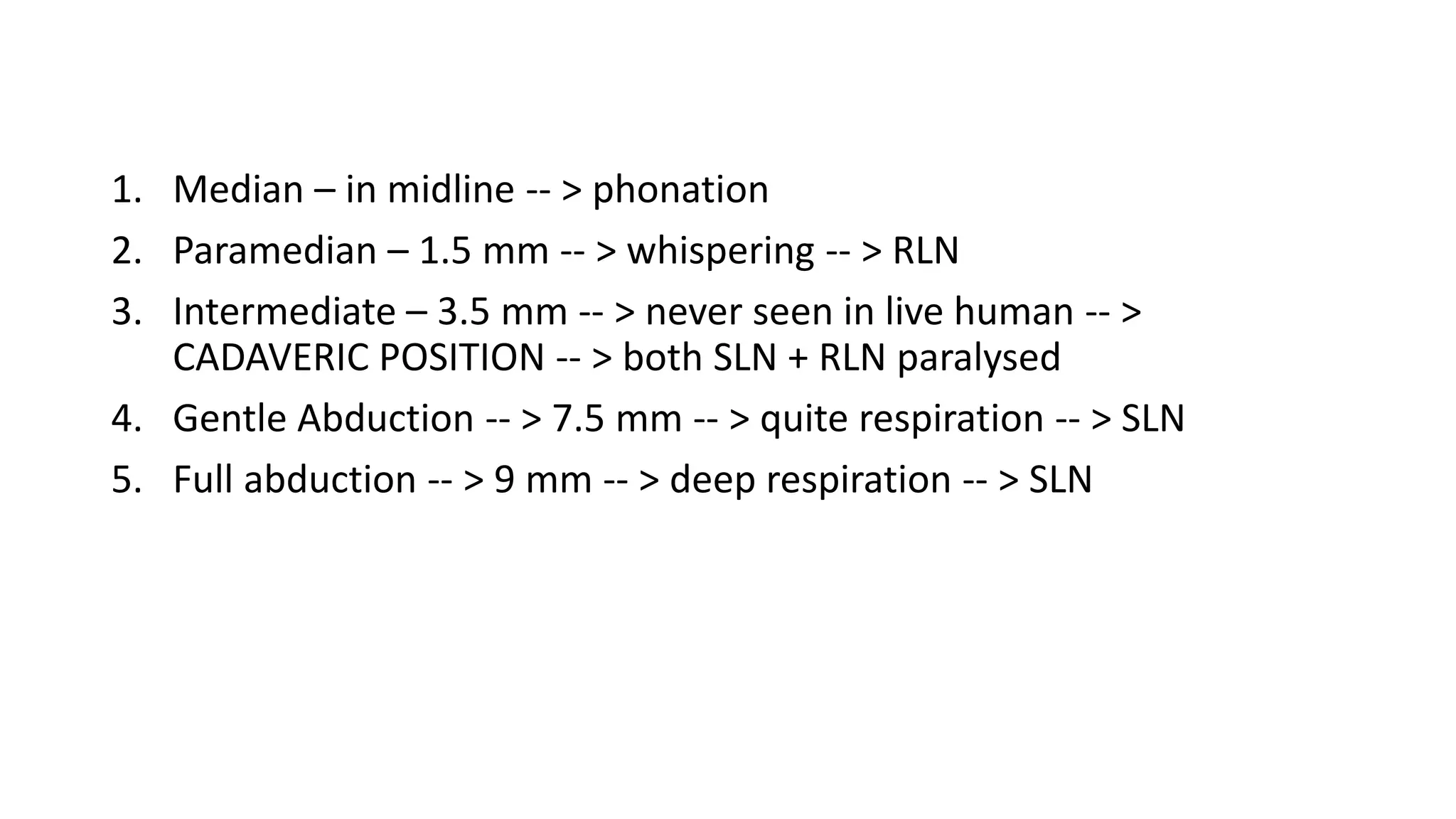
1. Median – in midline -- > phonation
2. Paramedian – 1.5 mm -- > whispering -- > RLN
3. Intermediate – 3.5 mm -- > never seen in live human -- >
CADAVERIC POSITION -- > both SLN + RLN paralysed
4. Gentle Abduction -- > 7.5 mm -- > quite respiration -- > SLN
5. Full abduction -- > 9 mm -- > deep respiration -- > SLN
Evaluation
• Change Of Voice – Vocal Fatigue to Near total aphonia
• Dysphagia Related – indicate high vagal lesion -- > hemi laryngeal anaesthesia, pharyngeal constrictor atony
• Respiration – stridor to dyspnoea
• Speech Dyspnea, Difficulty in speaking in Noisy Environment
• Neck – Lymphadenopathy, thyroid
• Cranial Nerves Examination – XI, IX(jugular foramen) ; ipsilateral tongue deviation, palate
droop or Horner syndrome
• 70/90 degree Hopkin’s >>>>> Trans nasal flexible laryngoscopy
• Examination under GA (if above two fails)
• Ask patientto cough, sniff and whistle --> confirm neurological disorder
If you find paresis or doubting the compensation --- > ask patient to do speak “i”
(Compensation by cricothyroid, interarytenoid, extra laryngeal muscle)
• It will cause repetitive vocal fold motion and we can decide accurately.
• Ask patient to raise the pitch of voice --- > if yes then intact SLN
1) VC movement before giving relaxant
2) Palate and pharynx
3) Supraglottic(Vestibule) region (if hyperfunction -- > glottic insufficiency)
4) Arytenoid palpation – prolapse antero medially -- > profound
denervation
5) Posterior Glottic Scar – if post commissure moves with vocal process
then its PG stenosis
6) Vocal fold – Abduction (cephalded) and adduction (caudaly)
7) Glottal Gap – Increased -- > Decreased maximum phonatory time
Further Study
• Vagal Nerve Imaging
From brain to mediastinum -- > Contrast CT = MRI
• LEMG -- > costly , invasive , other studies are non
diagnostic, 1 month to 6 months after onset of VFP
• Lyme Disease titer – Ach receptor antibody level
Recurrent Laryngeal Nerve(Abductor)
• Asymptomatic / Mild
Change of voice
• No airway Problem
• Hopkins – Ipsilateral Vocal
Cord In Median or
Paramedian Position
• Voice – Good
• Dyspnoea and Stridor
• Hopkins – B/L Vocal Cords
median or paramedian
position
Unilateral Bilateral
Wait & Watch 6 months to 1 year Tracheostomy
Superior Laryngeal Nerve
(Usually a part of combined)
• Hoarseness/Change of
voice +
• No breathing Problem
• Aspiration rare(anaesthesia
of larynx)
• Hopkins – Shortening of VC
with loss of tension
• Voice – Aphonia
• Aspiration +++
• Hopkins – B/L Vocal Cords
median or paramedian
position
Unilateral Bilateral
Wait and Watch Surgery
Side Nerve Palsy Clinical Features Management
U/L RLN Hoarseness Wait and Watch
B/L RLN Dyspnoea Tracheostomy
U/L SLN Hoarseness Wait and Watch
B/L SLN Aspiration +
Aphonia
Surgery
Combined Paralysis
• m/c/c – Thyroid Surgery
• Hoarseness +
• Aspiration for liquid +
• Hopkins – Intermediate
Position
• Voice – Aphonia
• Aspiration +++
• Hopkins – Intermediate
Position
Unilateral Bilateral
Speech Therapy &
Medialisation of VC Surgery
Interarytenoid
• Observation
• Normal or near normal
function within one year
without VF Motion
• Injection Augmentation
• Laryngeal Framework Surgery
• Re-innervation Of Larynx
• Voice Therapy
• May relief symptoms
Rx of U/L VF Palsy
Rx of U/L VF Palsy
Injection Augmentation
• Adding bulk to the free edge of VF
• Temporary Solution
• Absorbable material
• Transcutaneous(transthyroid / cricothyroid approach) under Local
• Per-oral approach under GA
• Short term 2 months– Gelfoam , Carboxymethylecellulose
• Intermediate 2-12 months – Hyaluronic Acid Derivaties, Collagen
Derivatives
• Long term 1-2 years – Calcium Hydroxylapatite , Autologous Facia(Facia
lata >> temporalis sheath > Rectus sheath)
• Permanent – Teflon , Silicon, Autologous Fat(thigh > periumbilical)
• Laryngospasm , Laryngeal oedema , allergy to material
• Other Use -Sulcus vocalis,Vocal fold scar, phonatory gap due to NM disease
• Pressure applied at the level of vocal cord
• If speech improves from the compression then patient will benefit from
the medialization.
• Limitation of test – older patient, scar over vocal cord.
Laryngeal Framework Surgery
Medialization Thyroplasty
• Type I thyroplasty
• Long term solution for glottic insufficiency, dysphonia & aspiration risk due
to U/L VFP
• Insertion of an implant in Para glottic space
• Implant material – silastic, hydroxyl apatite, polytetrafluorethylene ribbon,
titanium
• Sedation, prefer propofol as it can be reversed easily
• Flexible nasolaryngoscopy with simultaneously + LA infiltration in skin
overlying thyroid cartilage
• Skin crease incision -- > subplatysmal flap and strap muscles divided
• External perichondrium flap incised and elevated.
• Identify the inferior border of the thyroid cartilage
• Make a window 5-7 mm posterior to the midline and 2-3 mm superior to
the inferior border of thyroid cartilage
Medialization Thyroplasty
• Incise internal perichondrium PARAGLOTTIC SPACE
• Ask anesthetist for reversal to check the voice
• Fix the implant with nonabsorbable suture.
• Drain as per requirement
• Overnight stay in hospital to avoid airway compromise
• Additional dose of injectable steroids
• Voice rest + Physical exercise avoid for 5-7 days.
• Complication-
1) Airway compromise
2) Implant extrusion – due to intraoperatively injured laryngeal
mucosa lead to infection and then extrusion
• Unsatisfactory result -- > malpositioning
1. Superior – most common – diplophonic
2. Anterior – strained voice
Arytenoid Repositioning
• If medialization alone will not improve the condition.
• In palsy , vocal process will remain lateralized and there will be posterior
gap with height mismatch.
• Arytenoid repositioning aims to mimic the arytenoid physiological
phonatary position – medial rotation of arytenoid, lower vocal process,
stabilize and medialize the vocal process.
• Arytenoid adduction is the most common procedure in this technique.
• Removal some part of posterior part of thyroid cartilage
• Suturing with nonabsorbable material in anterolateral direction.
• It will mimic the TA-LCA muscle complex.
• Risk – injury to the laryngeal mucosa.
Rx of B/L VF Palsy
No intervention with regular follow-up
• In initial stage of the palsy patient due to any neurological conditions.
• Rarely require surgical intervention.
Medical Treatment
• Systemic steroids can reduce edema. But short term benefit only.
Intubation
• Emergency
Tracheostomy
• Gold standard in Emergency, preventing aspiration, temporary till definitive
management
Surgery
• Aim – any static procedure which enlarge the laryngeal
airway
• There are multiple options but it will deteriorate the
quality of voice
• Resection of anatomical structure
1. Endoscopic transvers cordectomy
2. Medial arytenoidectomy
3. Total arytenoidectomy (external or
endoscopic LASER)
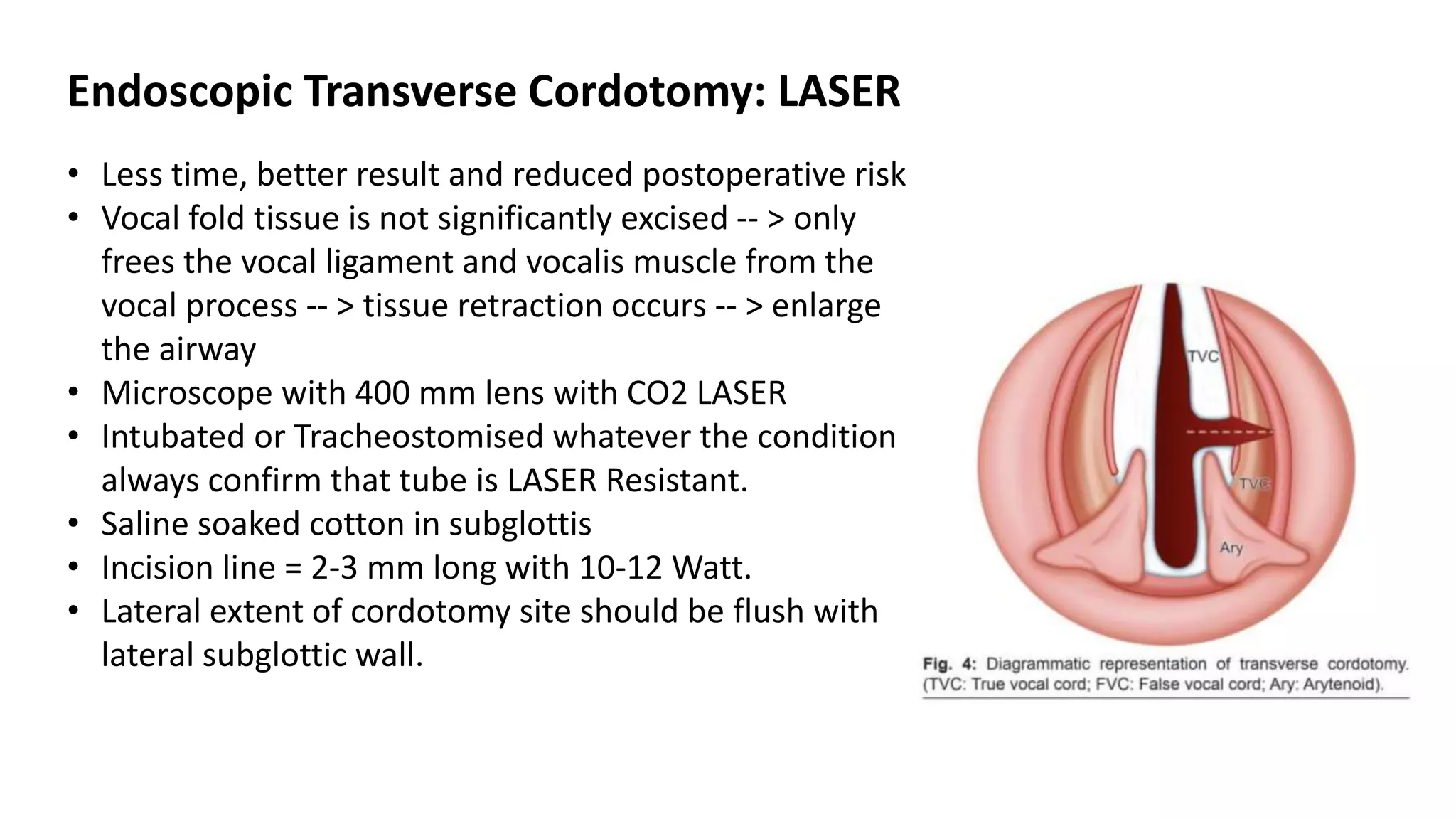
Endoscopic Transverse Cordotomy: LASER
• Less time, better result and reduced postoperative risk
• Vocal fold tissue is not significantly excised -- > only
frees the vocal ligament and vocalis muscle from the
vocal process -- > tissue retraction occurs -- > enlarge
the airway
• Microscope with 400 mm lens with CO2 LASER
• Intubated or Tracheostomised whatever the condition
always confirm that tube is LASER Resistant.
• Saline soaked cotton in subglottis
• Incision line = 2-3 mm long with 10-12 Watt.
• Lateral extent of cordotomy site should be flush with
lateral subglottic wall.
Endoscopic Medial Arytenoidectomy: LASER
• Medial Part of arytenoid body resection.
• Preservation of lateral, posterior part and vocal process
also.
• Allows the posterior third of glottis widened and keep
phonatory glottis(membranous) preserved.
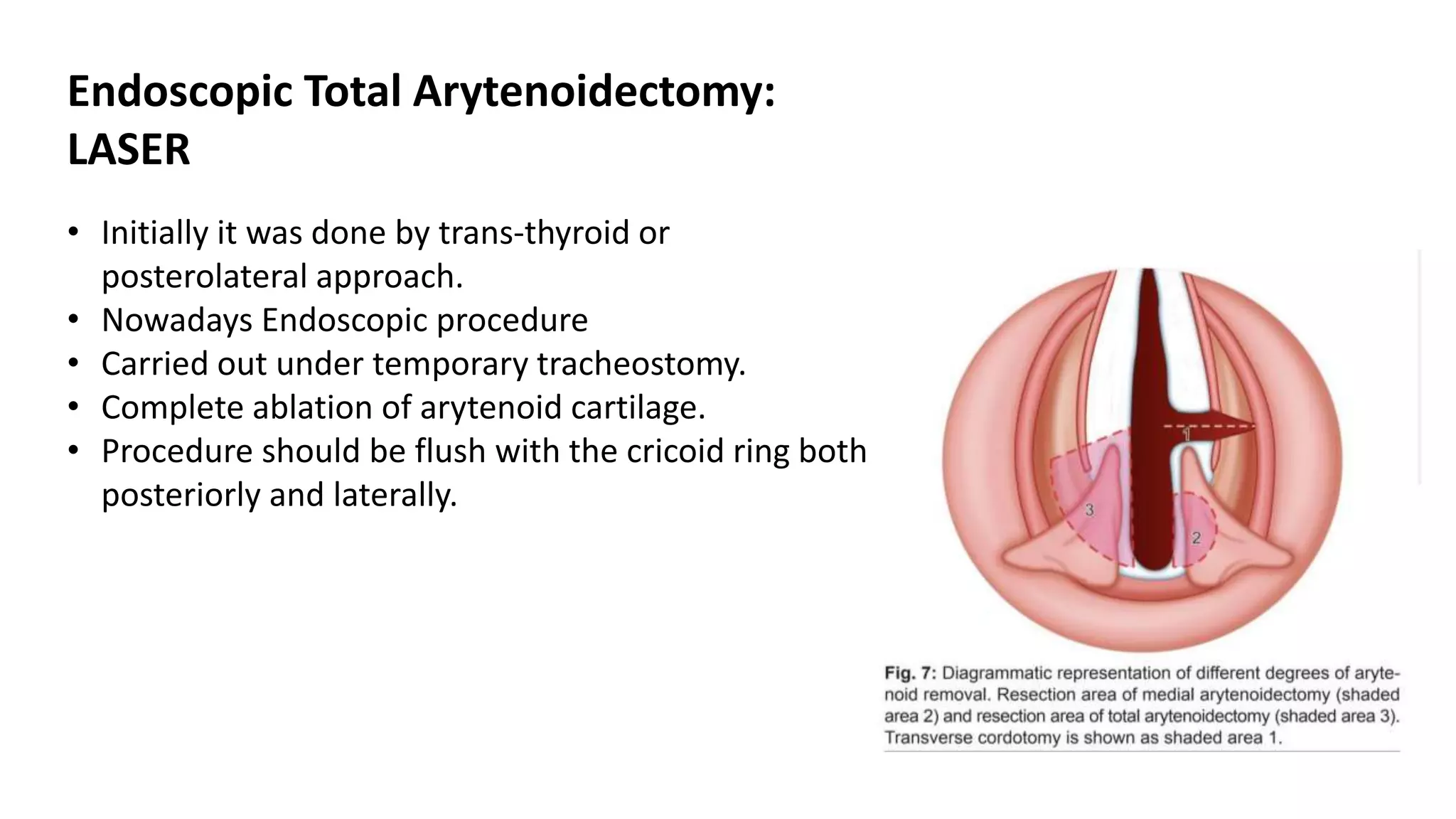
Endoscopic Total Arytenoidectomy:
LASER
• Initially it was done by trans-thyroid or
posterolateral approach.
• Nowadays Endoscopic procedure
• Carried out under temporary tracheostomy.
• Complete ablation of arytenoid cartilage.
• Procedure should be flush with the cricoid ring both
posteriorly and laterally.
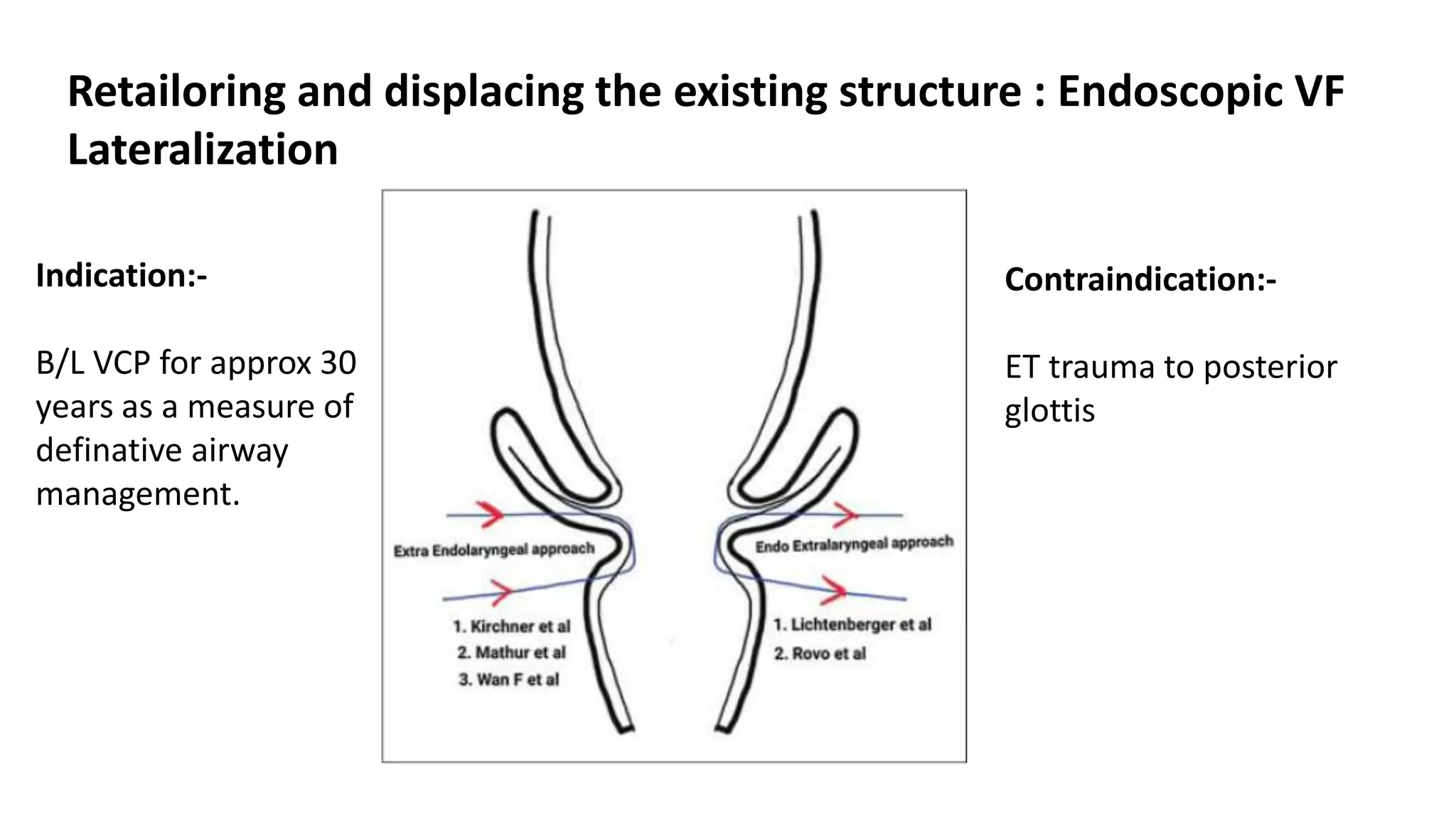
Retailoring and displacing the existing structure : Endoscopic VF
Lateralization
Indication:-
B/L VCP for approx 30
years as a measure of
definative airway
management.
Contraindication:-
ET trauma to posterior
glottis
Reinnervation of Laryngeal Musculature
• Posterior Cricoarytenoid
• Ansa hypoglossi with omohyoid or sternohyoid
Botulinum Toxin
• Injecting into adductor muscle -thyroarytenoid and lateral
cricoarytenoid.
• It will eliminate the synkinsis.
• Permit unopposed action of PCA to abduct VF.
Laryngeal Innervation Surgery
• Neuromuscular Pedicle
• Ansa cervicalis RLN anastomosis.
Thyroplasty
Repair of thyroid cartilage to change the position of vocal cord
Type Isshiki Classification Indication Contraindication
I Medialistion U/L VF Palsy -Malignancy
-h/o Radiation
-Poor Abduction Of
C/L VF
II Lateralistion RLN Palsy
III Shortening/Pushing/Relax Decrease Pitch:
Puberphonia,
Spastic Dysphonia
IV Lengthening/Pull
Anteriorly/Tensoning
Increase Pitch:-
Androphonia,
Presbyphonia,
Transsexualism(M to F)
Vocal cord palsy

Vocal cord palsy

  • 1.
  • 5.
    1 2 3 Add +Abd Add
  • 6.
    SLN External Motor to Cricothyroid Internal Sensory+ Secretomotor (Glands Above VC) Superior Lingual Surface Epiglottic Foramen Laryngeal Surface Middle Aryepiglottic Fold Ventricular Fold Inferior Pyriform Fossa & Post Cricoid Sensory = Protection Laryngeal > Lingual Anterior VC > Posterior VC
  • 7.
    RLN Left VCP>>>>Right VCP 1)Extensive Course 2)Pressure [Aortic Aneurism, Intra thoracic Mass]
  • 8.
    Purely Motor ? PurelySensory ? Mixed ? Safety Nerve?
  • 9.
  • 11.
    Any Pathology OfLarynx Adductors Abductors Last to paralysed First to be recovered First to paralysed Last to be recovered Respiration Voice
  • 12.
    SEMONS’s LAW 1) Adductors-- > embryologically old fibres --> strong --> last to be paralysed 2) Abductors -- > embryologically new -- > weak --> early paralysed WEGNER GROSSMAN LAW In case of RLN Palsy -- > VC will be in media or para median position because of normal cricothyroid muscle
  • 13.
    Pathophysiology Series Of Process •Segmental Demyelination • Impaired Axonal Transport • Conduction Block Midline 1.5mm 3.5mm 7mm
  • 14.
    1. Median –in midline -- > phonation 2. Paramedian – 1.5 mm -- > whispering -- > RLN 3. Intermediate – 3.5 mm -- > never seen in live human -- > CADAVERIC POSITION -- > both SLN + RLN paralysed 4. Gentle Abduction -- > 7.5 mm -- > quite respiration -- > SLN 5. Full abduction -- > 9 mm -- > deep respiration -- > SLN
  • 15.
    Evaluation • Change OfVoice – Vocal Fatigue to Near total aphonia • Dysphagia Related – indicate high vagal lesion -- > hemi laryngeal anaesthesia, pharyngeal constrictor atony • Respiration – stridor to dyspnoea • Speech Dyspnea, Difficulty in speaking in Noisy Environment • Neck – Lymphadenopathy, thyroid • Cranial Nerves Examination – XI, IX(jugular foramen) ; ipsilateral tongue deviation, palate droop or Horner syndrome • 70/90 degree Hopkin’s >>>>> Trans nasal flexible laryngoscopy • Examination under GA (if above two fails) • Ask patientto cough, sniff and whistle --> confirm neurological disorder
  • 16.
    If you findparesis or doubting the compensation --- > ask patient to do speak “i” (Compensation by cricothyroid, interarytenoid, extra laryngeal muscle) • It will cause repetitive vocal fold motion and we can decide accurately. • Ask patient to raise the pitch of voice --- > if yes then intact SLN 1) VC movement before giving relaxant 2) Palate and pharynx 3) Supraglottic(Vestibule) region (if hyperfunction -- > glottic insufficiency) 4) Arytenoid palpation – prolapse antero medially -- > profound denervation 5) Posterior Glottic Scar – if post commissure moves with vocal process then its PG stenosis 6) Vocal fold – Abduction (cephalded) and adduction (caudaly) 7) Glottal Gap – Increased -- > Decreased maximum phonatory time
  • 17.
    Further Study • VagalNerve Imaging From brain to mediastinum -- > Contrast CT = MRI • LEMG -- > costly , invasive , other studies are non diagnostic, 1 month to 6 months after onset of VFP • Lyme Disease titer – Ach receptor antibody level
  • 18.
    Recurrent Laryngeal Nerve(Abductor) •Asymptomatic / Mild Change of voice • No airway Problem • Hopkins – Ipsilateral Vocal Cord In Median or Paramedian Position • Voice – Good • Dyspnoea and Stridor • Hopkins – B/L Vocal Cords median or paramedian position Unilateral Bilateral Wait & Watch 6 months to 1 year Tracheostomy
  • 21.
    Superior Laryngeal Nerve (Usuallya part of combined) • Hoarseness/Change of voice + • No breathing Problem • Aspiration rare(anaesthesia of larynx) • Hopkins – Shortening of VC with loss of tension • Voice – Aphonia • Aspiration +++ • Hopkins – B/L Vocal Cords median or paramedian position Unilateral Bilateral Wait and Watch Surgery
  • 22.
    Side Nerve PalsyClinical Features Management U/L RLN Hoarseness Wait and Watch B/L RLN Dyspnoea Tracheostomy U/L SLN Hoarseness Wait and Watch B/L SLN Aspiration + Aphonia Surgery
  • 23.
    Combined Paralysis • m/c/c– Thyroid Surgery • Hoarseness + • Aspiration for liquid + • Hopkins – Intermediate Position • Voice – Aphonia • Aspiration +++ • Hopkins – Intermediate Position Unilateral Bilateral Speech Therapy & Medialisation of VC Surgery Interarytenoid
  • 24.
    • Observation • Normalor near normal function within one year without VF Motion • Injection Augmentation • Laryngeal Framework Surgery • Re-innervation Of Larynx • Voice Therapy • May relief symptoms Rx of U/L VF Palsy
  • 25.
    Rx of U/LVF Palsy Injection Augmentation • Adding bulk to the free edge of VF • Temporary Solution • Absorbable material • Transcutaneous(transthyroid / cricothyroid approach) under Local • Per-oral approach under GA • Short term 2 months– Gelfoam , Carboxymethylecellulose • Intermediate 2-12 months – Hyaluronic Acid Derivaties, Collagen Derivatives • Long term 1-2 years – Calcium Hydroxylapatite , Autologous Facia(Facia lata >> temporalis sheath > Rectus sheath) • Permanent – Teflon , Silicon, Autologous Fat(thigh > periumbilical) • Laryngospasm , Laryngeal oedema , allergy to material • Other Use -Sulcus vocalis,Vocal fold scar, phonatory gap due to NM disease
  • 26.
    • Pressure appliedat the level of vocal cord • If speech improves from the compression then patient will benefit from the medialization. • Limitation of test – older patient, scar over vocal cord.
  • 27.
    Laryngeal Framework Surgery MedializationThyroplasty • Type I thyroplasty • Long term solution for glottic insufficiency, dysphonia & aspiration risk due to U/L VFP • Insertion of an implant in Para glottic space • Implant material – silastic, hydroxyl apatite, polytetrafluorethylene ribbon, titanium • Sedation, prefer propofol as it can be reversed easily • Flexible nasolaryngoscopy with simultaneously + LA infiltration in skin overlying thyroid cartilage • Skin crease incision -- > subplatysmal flap and strap muscles divided • External perichondrium flap incised and elevated. • Identify the inferior border of the thyroid cartilage • Make a window 5-7 mm posterior to the midline and 2-3 mm superior to the inferior border of thyroid cartilage
  • 29.
    Medialization Thyroplasty • Inciseinternal perichondrium PARAGLOTTIC SPACE • Ask anesthetist for reversal to check the voice • Fix the implant with nonabsorbable suture. • Drain as per requirement • Overnight stay in hospital to avoid airway compromise • Additional dose of injectable steroids • Voice rest + Physical exercise avoid for 5-7 days. • Complication- 1) Airway compromise 2) Implant extrusion – due to intraoperatively injured laryngeal mucosa lead to infection and then extrusion • Unsatisfactory result -- > malpositioning 1. Superior – most common – diplophonic 2. Anterior – strained voice
  • 30.
    Arytenoid Repositioning • Ifmedialization alone will not improve the condition. • In palsy , vocal process will remain lateralized and there will be posterior gap with height mismatch. • Arytenoid repositioning aims to mimic the arytenoid physiological phonatary position – medial rotation of arytenoid, lower vocal process, stabilize and medialize the vocal process. • Arytenoid adduction is the most common procedure in this technique. • Removal some part of posterior part of thyroid cartilage • Suturing with nonabsorbable material in anterolateral direction. • It will mimic the TA-LCA muscle complex. • Risk – injury to the laryngeal mucosa.
  • 33.
    Rx of B/LVF Palsy No intervention with regular follow-up • In initial stage of the palsy patient due to any neurological conditions. • Rarely require surgical intervention. Medical Treatment • Systemic steroids can reduce edema. But short term benefit only. Intubation • Emergency Tracheostomy • Gold standard in Emergency, preventing aspiration, temporary till definitive management
  • 34.
    Surgery • Aim –any static procedure which enlarge the laryngeal airway • There are multiple options but it will deteriorate the quality of voice • Resection of anatomical structure 1. Endoscopic transvers cordectomy 2. Medial arytenoidectomy 3. Total arytenoidectomy (external or endoscopic LASER)
  • 35.
    Endoscopic Transverse Cordotomy:LASER • Less time, better result and reduced postoperative risk • Vocal fold tissue is not significantly excised -- > only frees the vocal ligament and vocalis muscle from the vocal process -- > tissue retraction occurs -- > enlarge the airway • Microscope with 400 mm lens with CO2 LASER • Intubated or Tracheostomised whatever the condition always confirm that tube is LASER Resistant. • Saline soaked cotton in subglottis • Incision line = 2-3 mm long with 10-12 Watt. • Lateral extent of cordotomy site should be flush with lateral subglottic wall.
  • 36.
    Endoscopic Medial Arytenoidectomy:LASER • Medial Part of arytenoid body resection. • Preservation of lateral, posterior part and vocal process also. • Allows the posterior third of glottis widened and keep phonatory glottis(membranous) preserved.
  • 37.
    Endoscopic Total Arytenoidectomy: LASER •Initially it was done by trans-thyroid or posterolateral approach. • Nowadays Endoscopic procedure • Carried out under temporary tracheostomy. • Complete ablation of arytenoid cartilage. • Procedure should be flush with the cricoid ring both posteriorly and laterally.
  • 38.
    Retailoring and displacingthe existing structure : Endoscopic VF Lateralization Indication:- B/L VCP for approx 30 years as a measure of definative airway management. Contraindication:- ET trauma to posterior glottis
  • 39.
    Reinnervation of LaryngealMusculature • Posterior Cricoarytenoid • Ansa hypoglossi with omohyoid or sternohyoid Botulinum Toxin • Injecting into adductor muscle -thyroarytenoid and lateral cricoarytenoid. • It will eliminate the synkinsis. • Permit unopposed action of PCA to abduct VF.
  • 40.
    Laryngeal Innervation Surgery •Neuromuscular Pedicle • Ansa cervicalis RLN anastomosis.
  • 41.
    Thyroplasty Repair of thyroidcartilage to change the position of vocal cord Type Isshiki Classification Indication Contraindication I Medialistion U/L VF Palsy -Malignancy -h/o Radiation -Poor Abduction Of C/L VF II Lateralistion RLN Palsy III Shortening/Pushing/Relax Decrease Pitch: Puberphonia, Spastic Dysphonia IV Lengthening/Pull Anteriorly/Tensoning Increase Pitch:- Androphonia, Presbyphonia, Transsexualism(M to F)