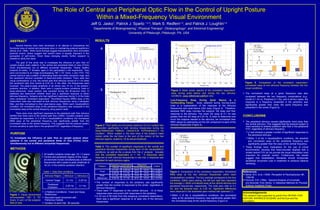
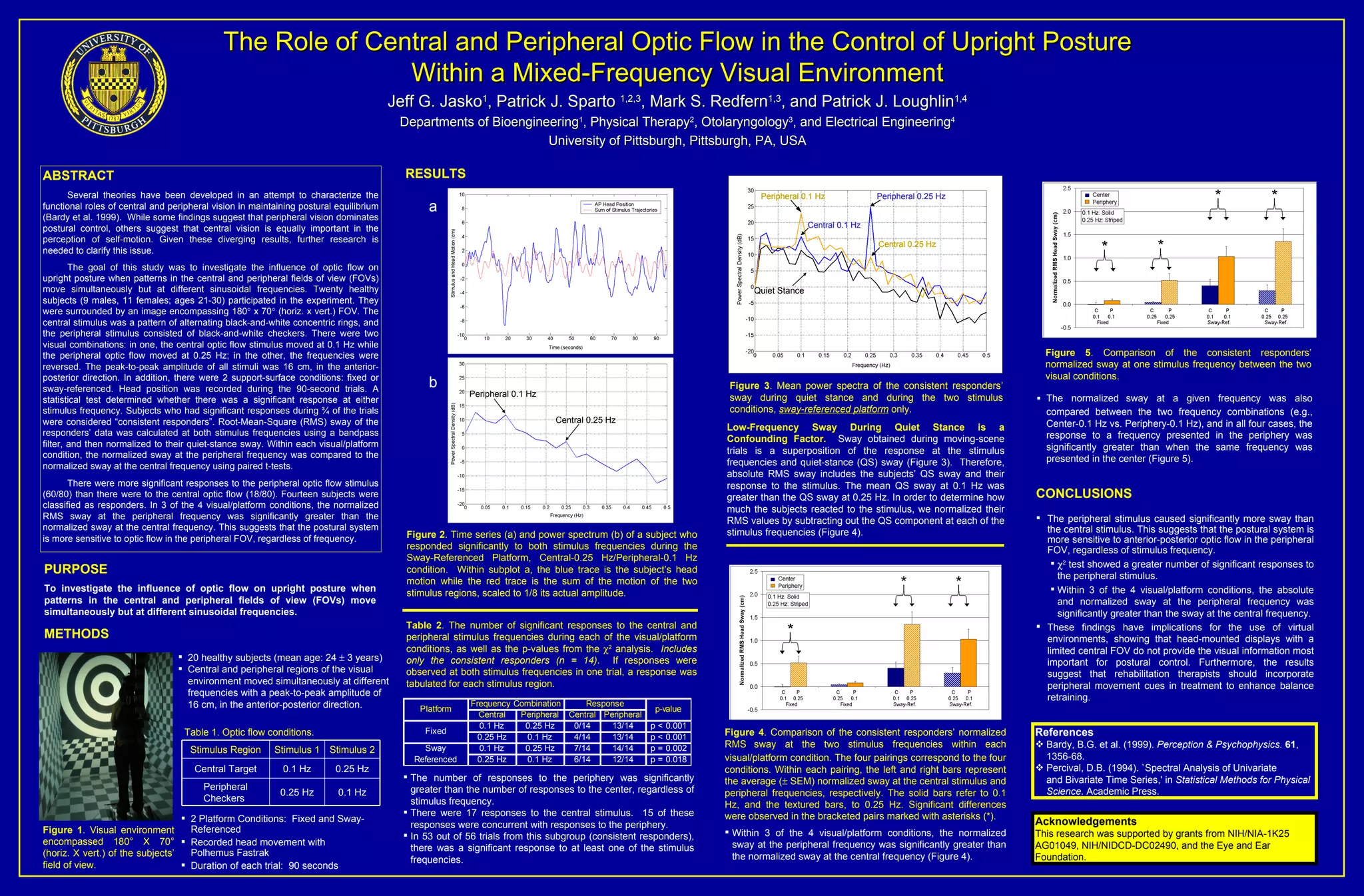
The study investigated how optic flow in the central and peripheral visual fields influences upright posture. Twenty subjects were exposed to visual stimuli moving at different frequencies in the central and peripheral regions. There was significantly more sway in response to the peripheral stimulus compared to the central stimulus, suggesting the postural system is more sensitive to motion in the peripheral visual field. Within most test conditions, sway normalized to quiet stance was also greater for the peripheral frequency compared to the central frequency. The findings indicate that peripheral visual cues have a stronger influence on postural control than central cues.


![784cdysphonia[1]](https://cdn.slidesharecdn.com/ss_thumbnails/784cdysphonia1-1234158878157310-2-thumbnail.jpg?width=640&height=640&fit=bounds)


![CASE_PRESENTATION_ON_subdural_hematoma(SDH)[1 FINAL PPT]-1.pptx](https://cdn.slidesharecdn.com/ss_thumbnails/casepresentationonsubduralhematomasdh1finalppt-1-260129172522-d405d375-thumbnail.jpg?width=640&height=640&fit=bounds)


