Dr.ASHLY ALEXANDER
ENT PG RESIDENT
GMC,BHOPAL
 Nerve supply of larynx
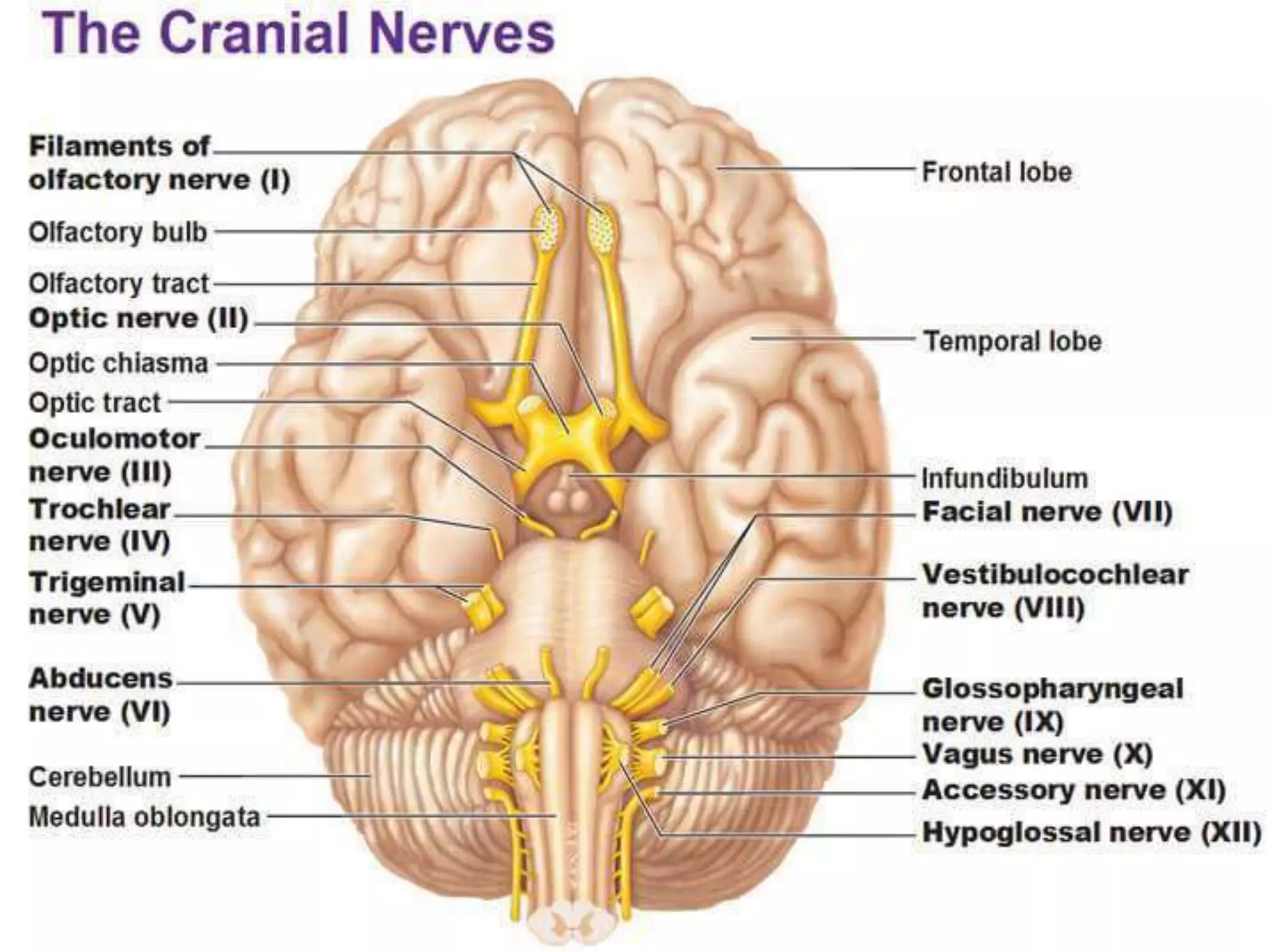
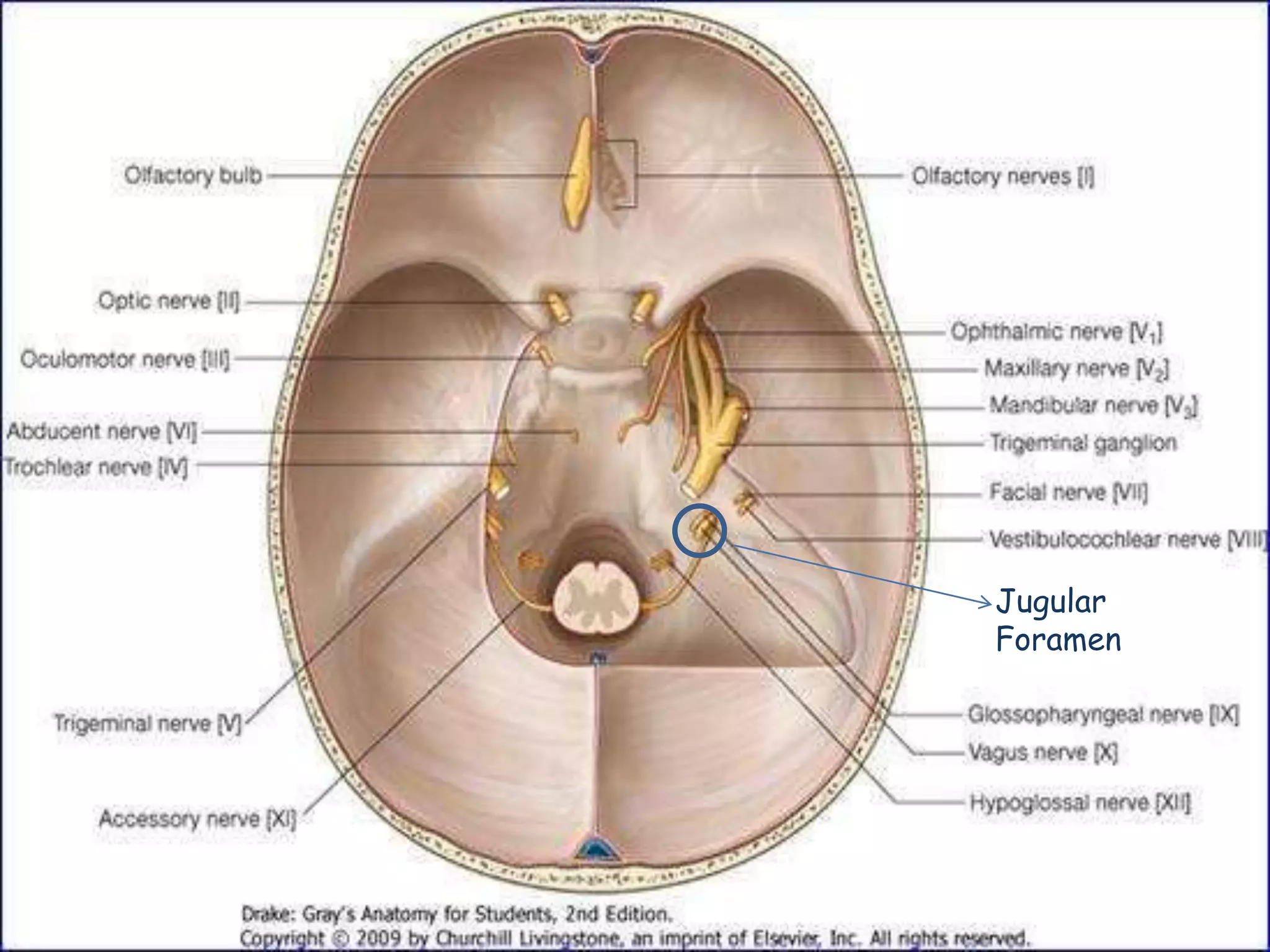
 10th cranial nerve
 So called due to its vague course through the
head, neck, thorax and the abdomen.
 Longest nerve of the autonomic nervous
system in the body
 MIXED NERVE: sensory, motor and
parasympathetic
Jugular
Foramen
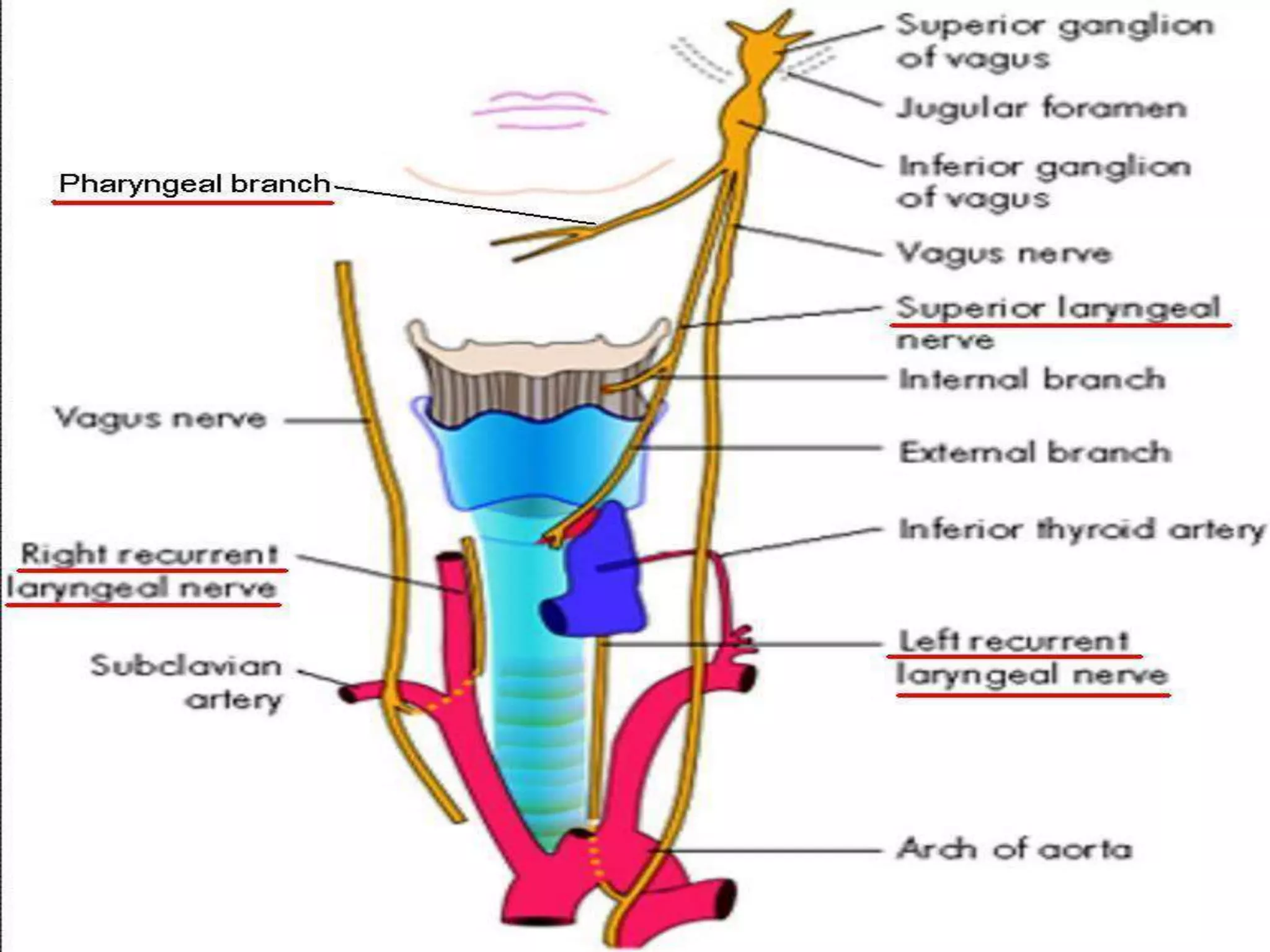
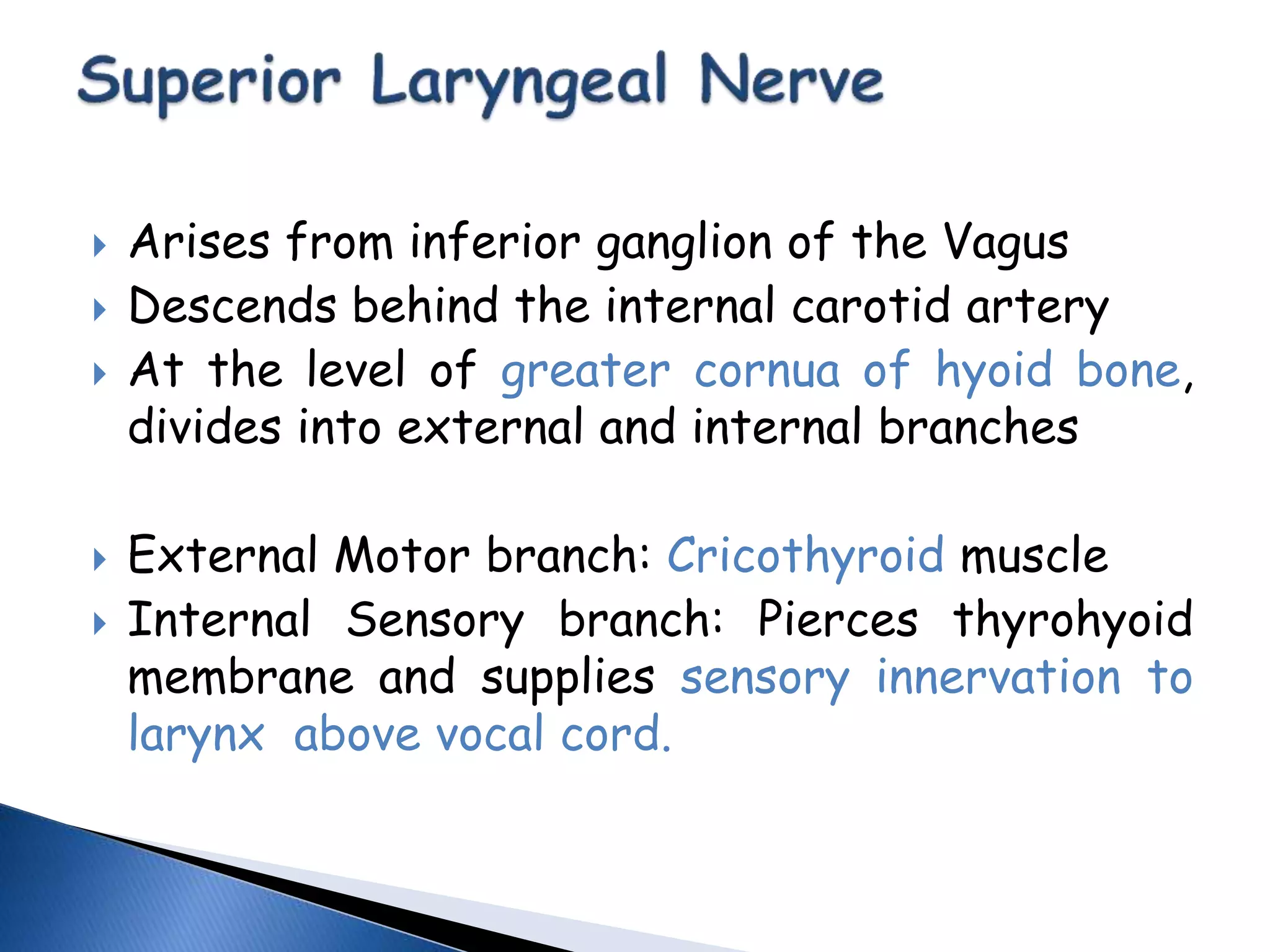
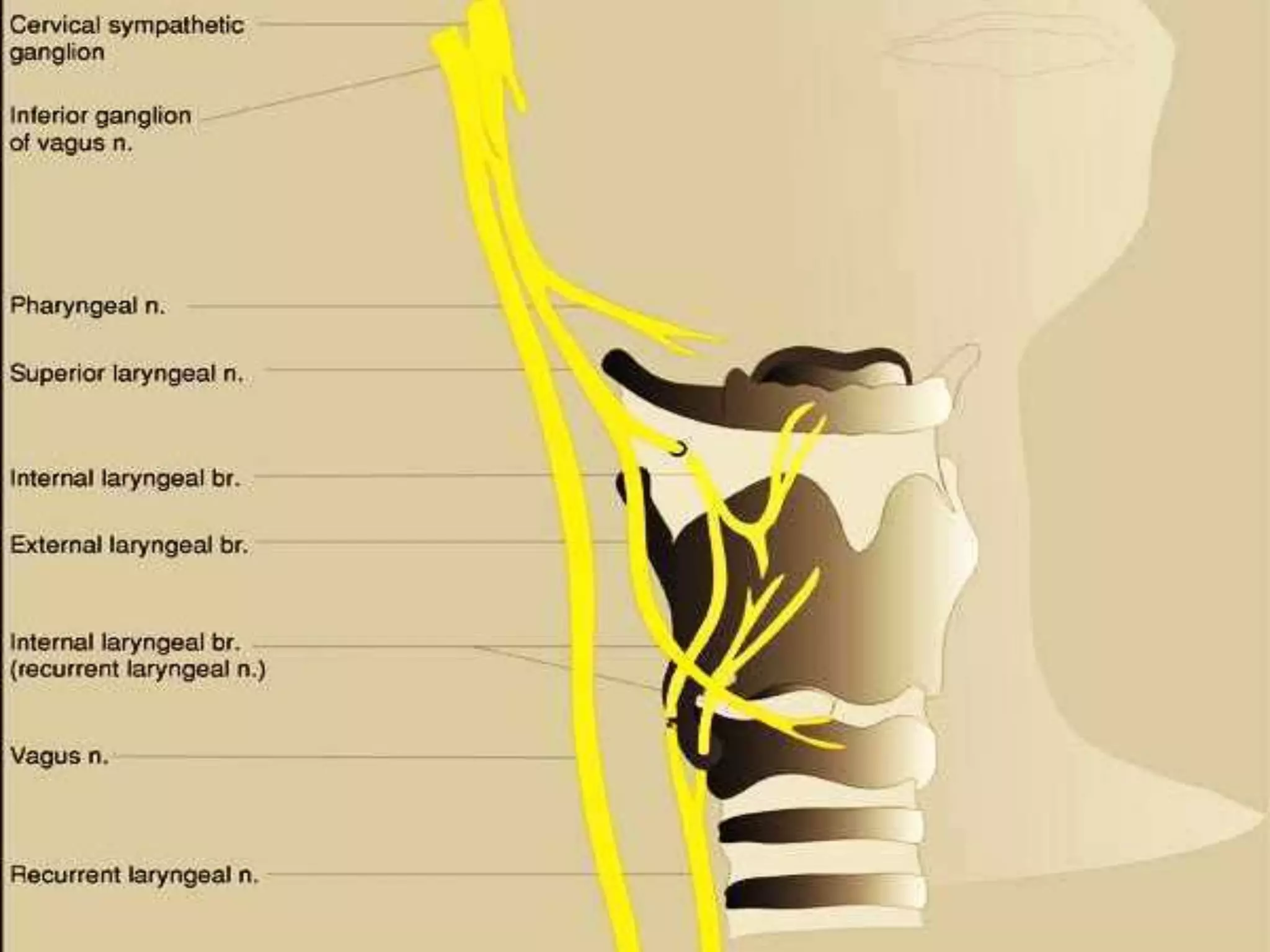
 Arises from inferior ganglion of the Vagus
 Descends behind the internal carotid artery
 At the level of greater cornua of hyoid bone,
divides into external and internal branches
 External Motor branch: Cricothyroid muscle
 Internal Sensory branch: Pierces thyrohyoid
membrane and supplies sensory innervation to
larynx above vocal cord.
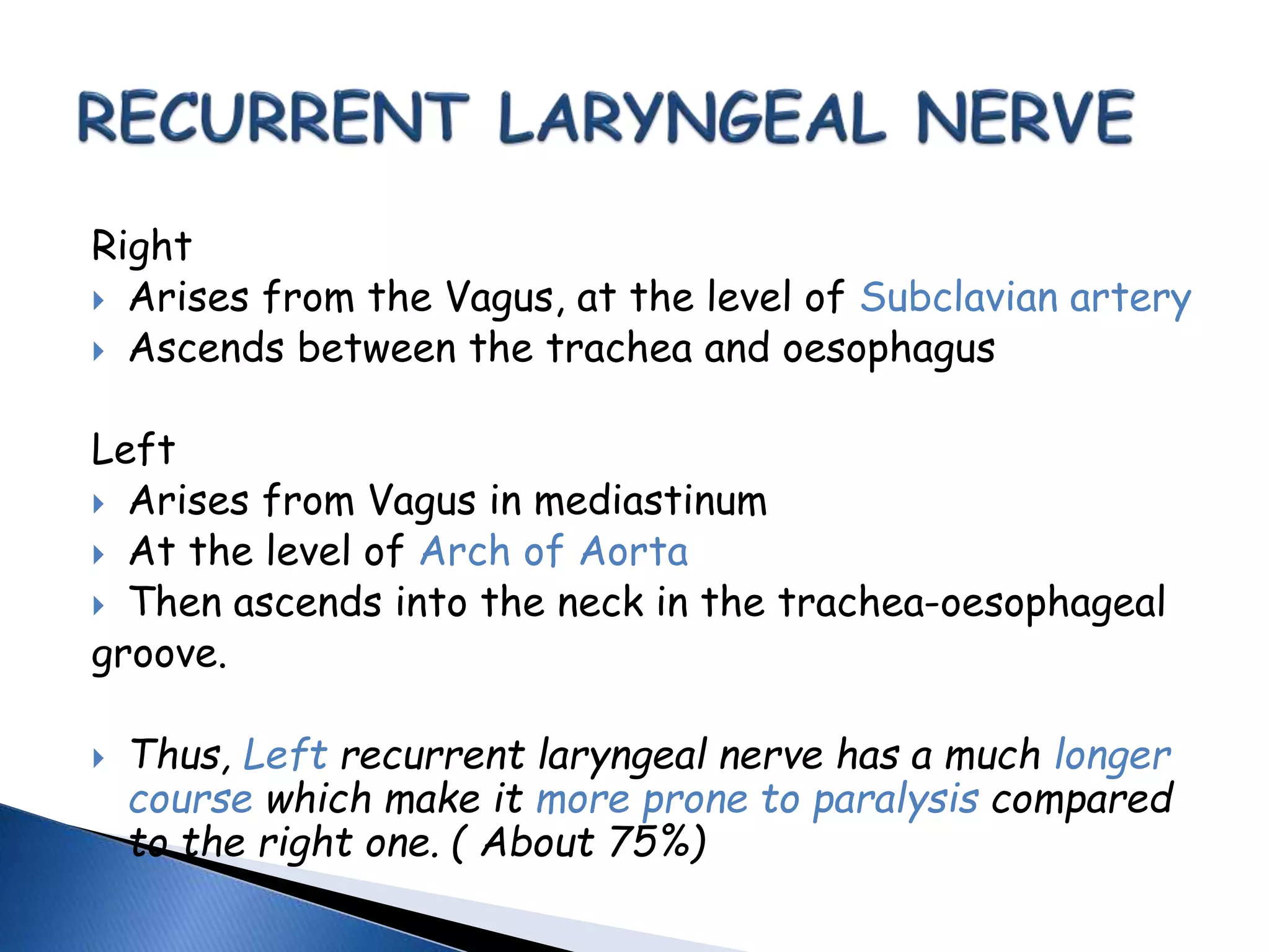
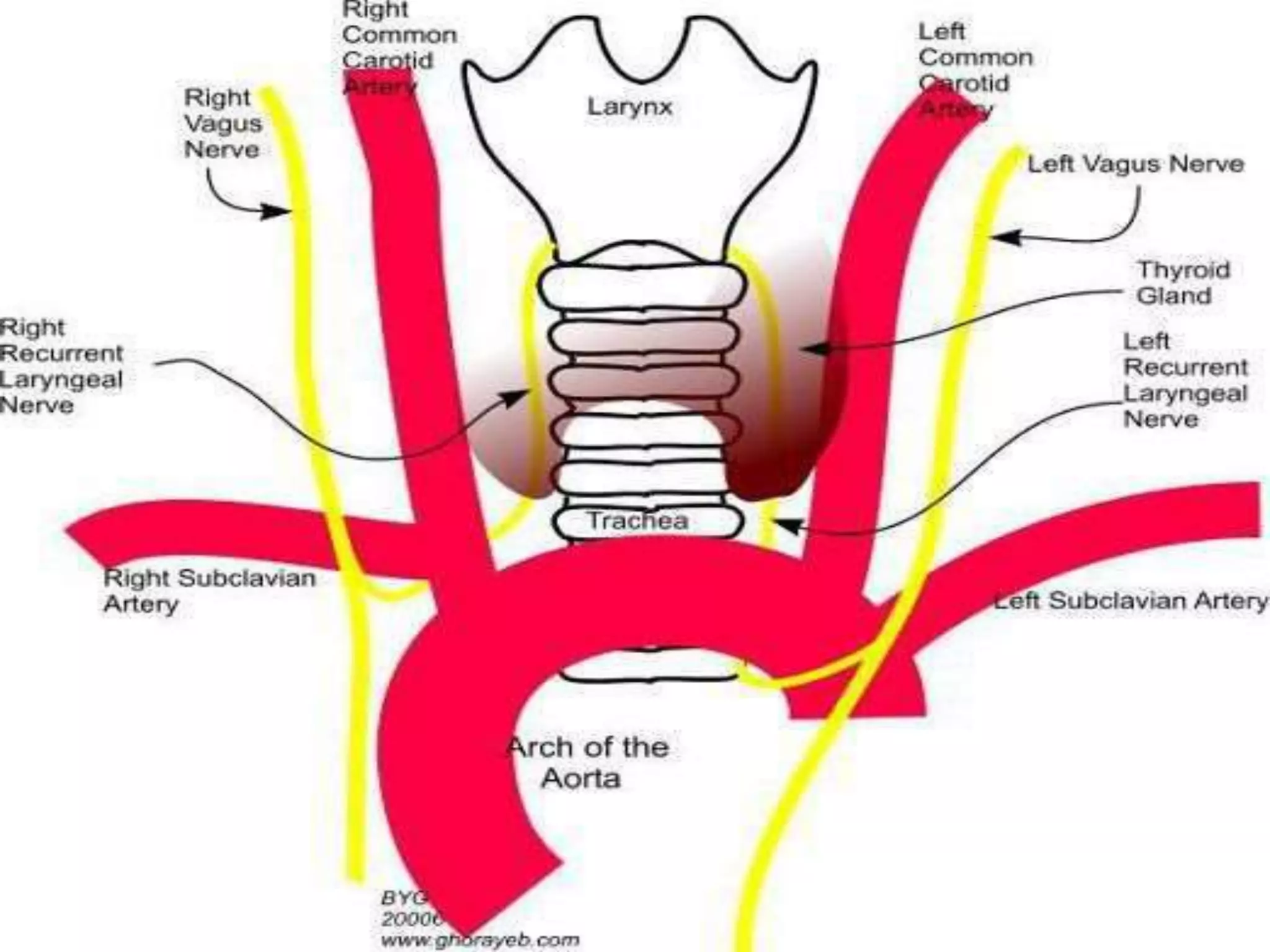
Right
 Arises from the Vagus, at the level of Subclavian artery
 Ascends between the trachea and oesophagus
Left
 Arises from Vagus in mediastinum
 At the level of Arch of Aorta
 Then ascends into the neck in the trachea-oesophageal
groove.
 Thus, Left recurrent laryngeal nerve has a much longer
course which make it more prone to paralysis compared
to the right one. ( About 75%)
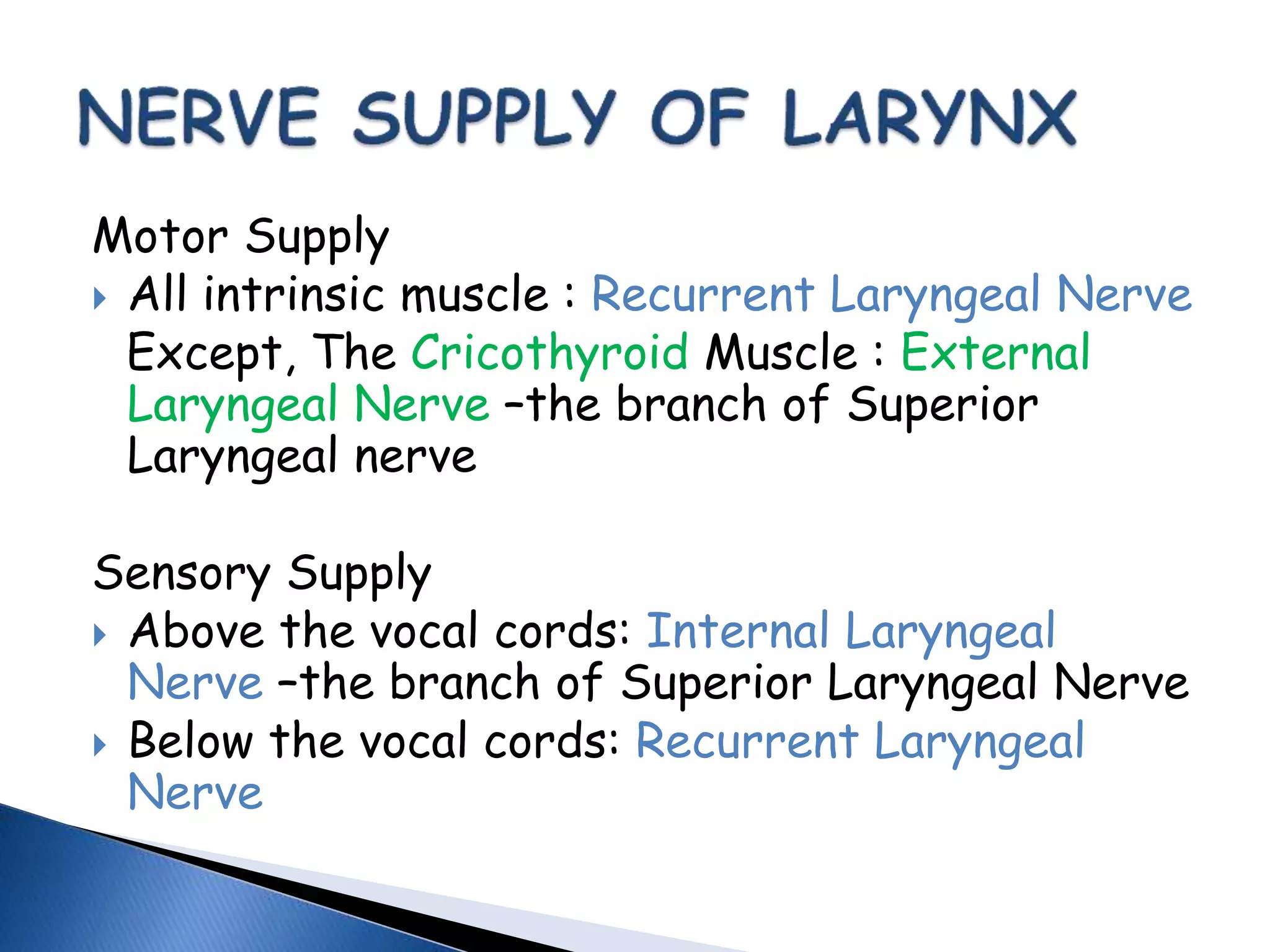
Motor Supply
 All intrinsic muscle : Recurrent Laryngeal Nerve
Except, The Cricothyroid Muscle : External
Laryngeal Nerve –the branch of Superior
Laryngeal nerve
Sensory Supply
 Above the vocal cords: Internal Laryngeal
Nerve –the branch of Superior Laryngeal Nerve
 Below the vocal cords: Recurrent Laryngeal
Nerve
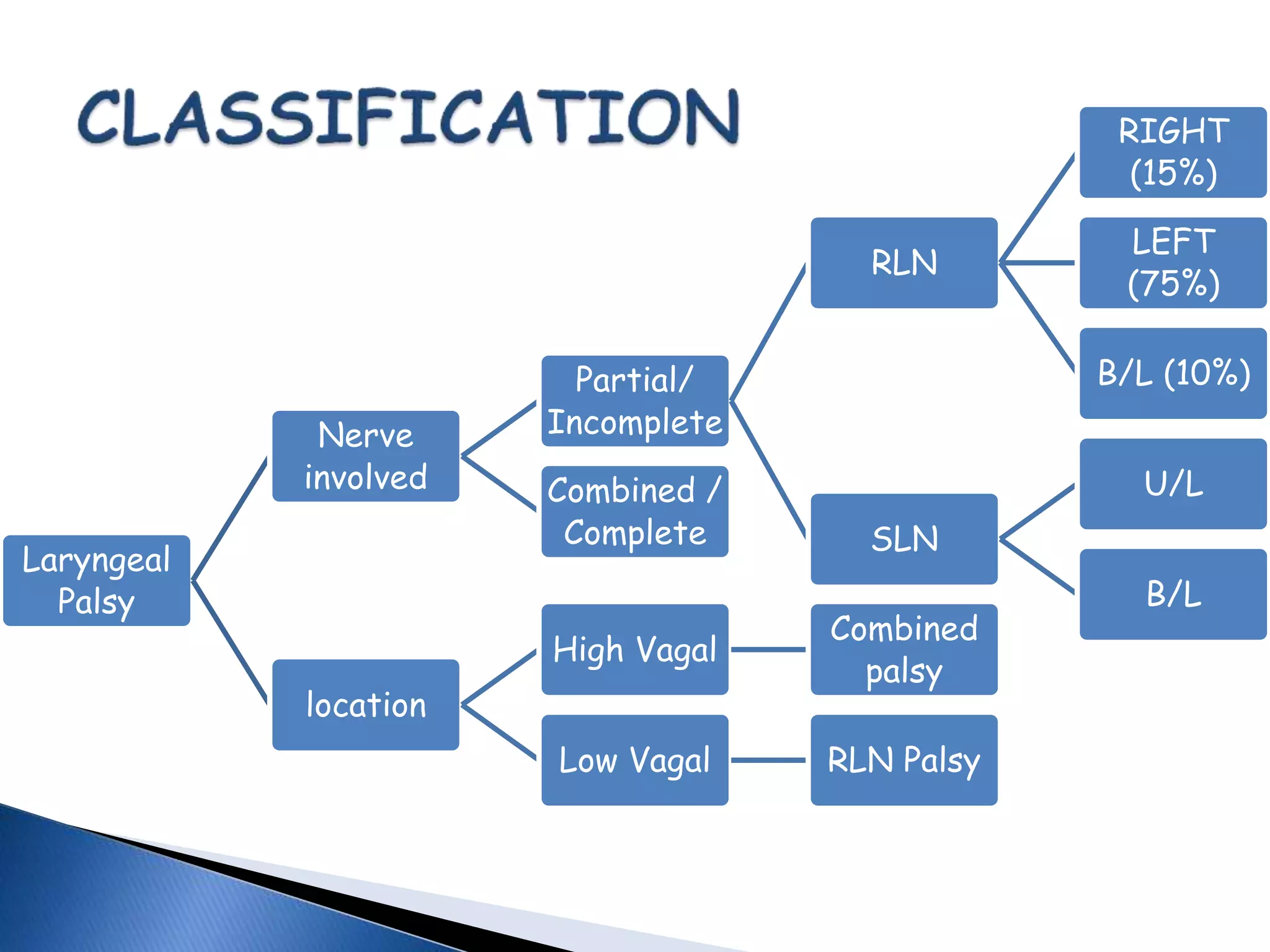
Laryngeal
Palsy
Nerve
involved
Partial/
Incomplete
RLN
RIGHT
(15%)
LEFT
(75%)
B/L (10%)
SLN
U/L
B/L
Combined /
Complete
location
High Vagal
Combined
palsy
Low Vagal RLN Palsy
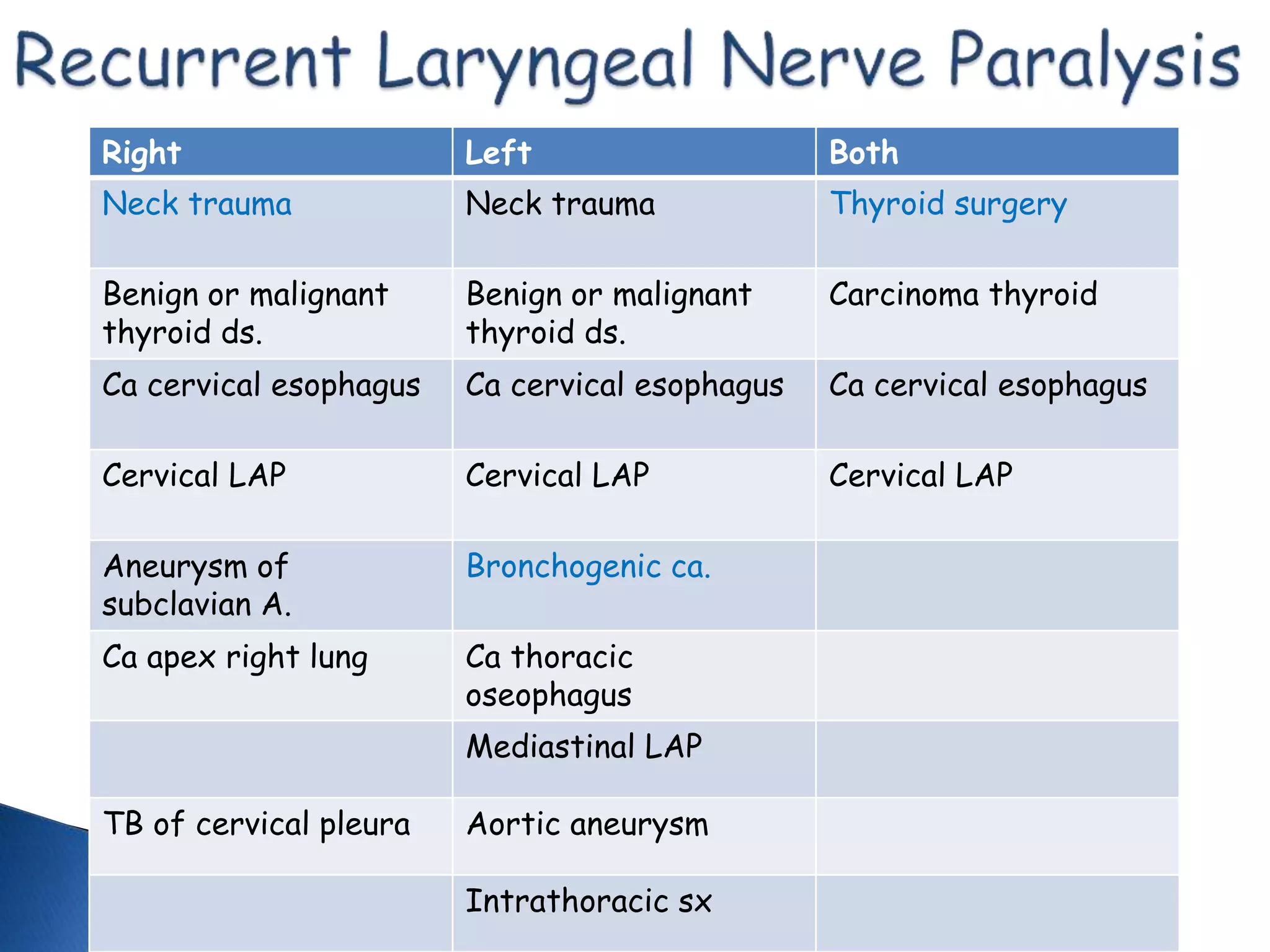
Right Left Both
Neck trauma Neck trauma Thyroid surgery
Benign or malignant
thyroid ds.
Benign or malignant
thyroid ds.
Carcinoma thyroid
Ca cervical esophagus Ca cervical esophagus Ca cervical esophagus
Cervical LAP Cervical LAP Cervical LAP
Aneurysm of
subclavian A.
Bronchogenic ca.
Ca apex right lung Ca thoracic
oseophagus
Mediastinal LAP
TB of cervical pleura Aortic aneurysm
Intrathoracic sx
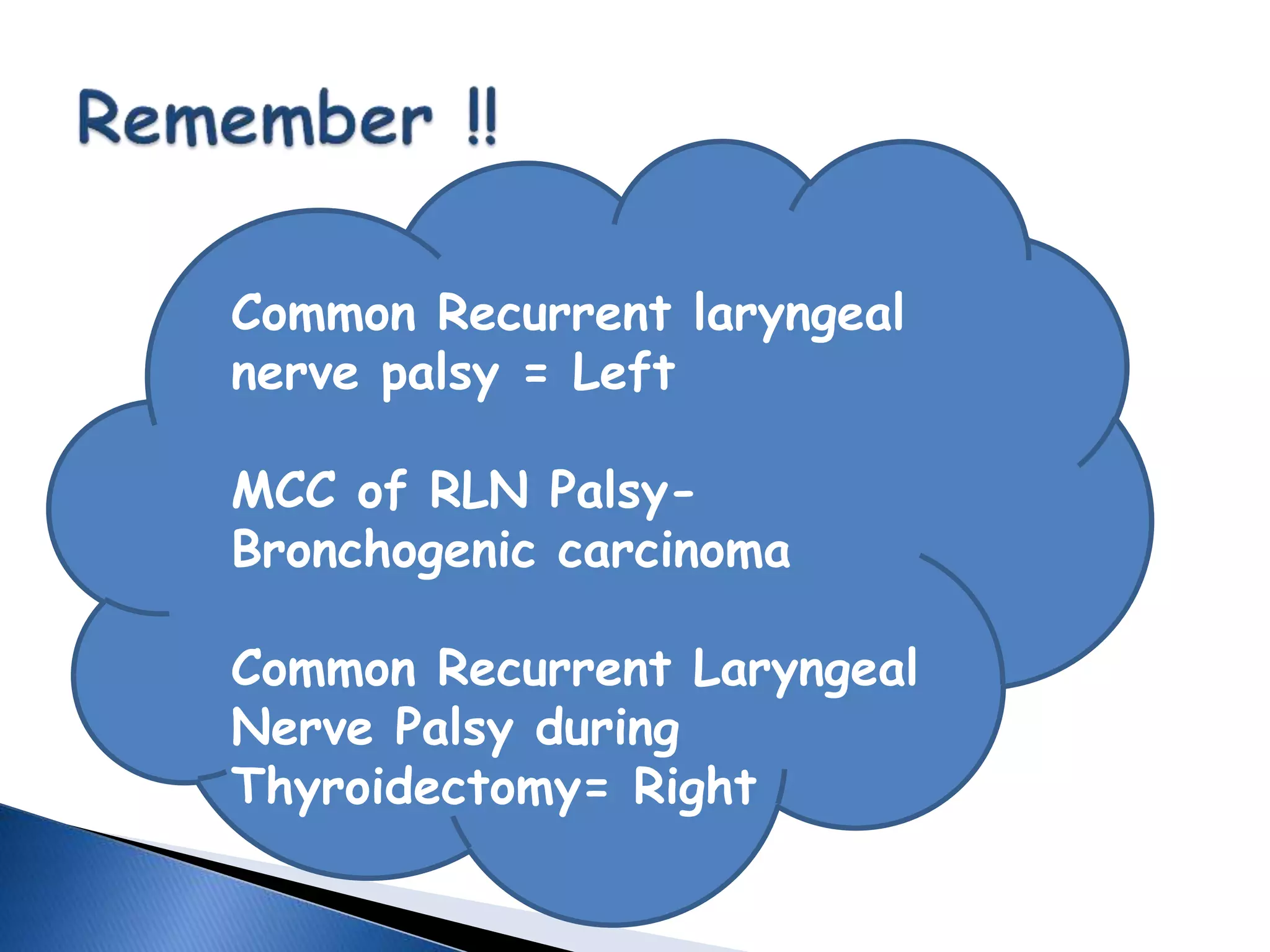
Common Recurrent laryngeal
nerve palsy = Left
MCC of RLN Palsy-
Bronchogenic carcinoma
Common Recurrent Laryngeal
Nerve Palsy during
Thyroidectomy= Right
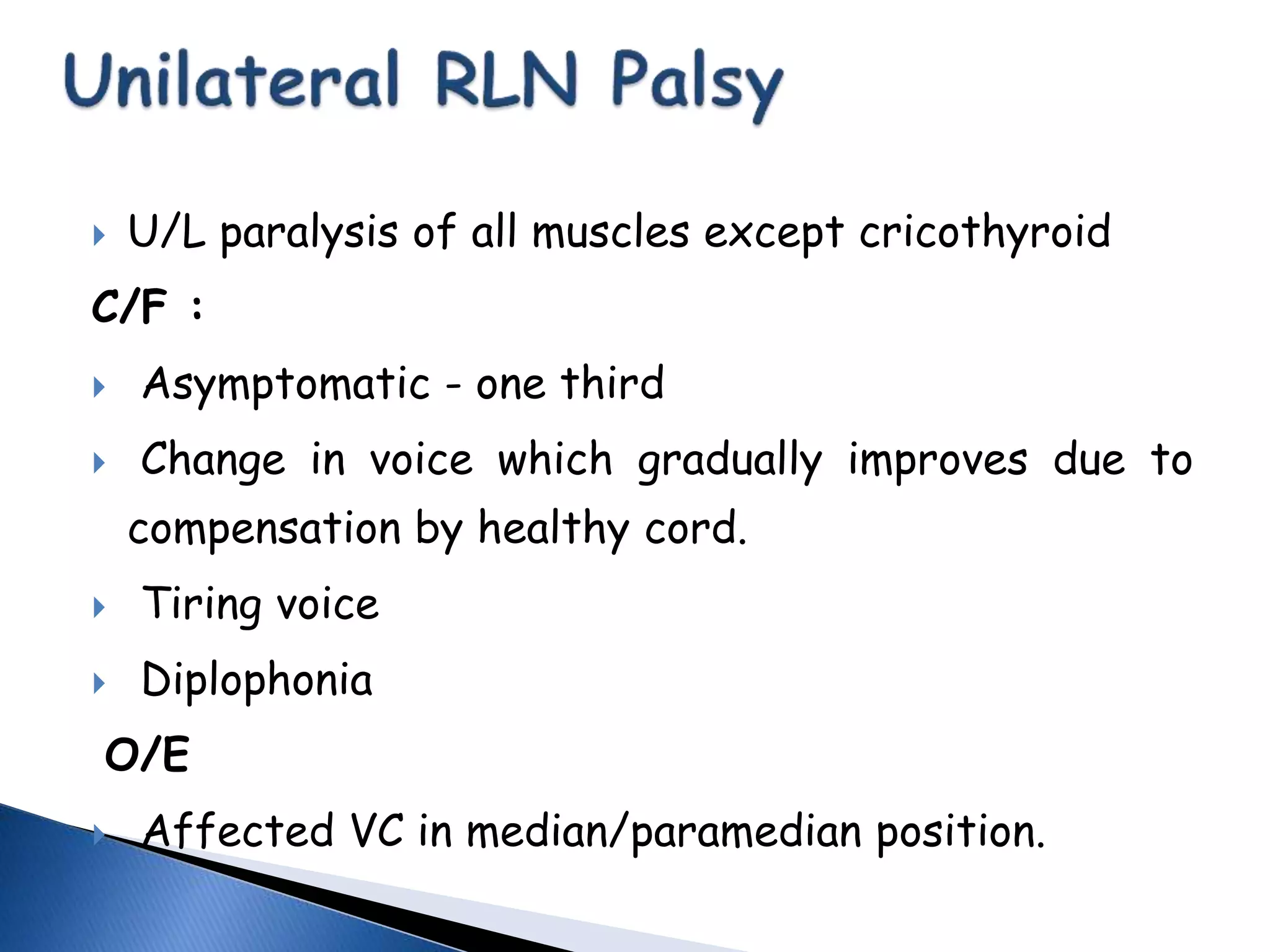
 U/L paralysis of all muscles except cricothyroid
C/F :
 Asymptomatic - one third
 Change in voice which gradually improves due to
compensation by healthy cord.
 Tiring voice
 Diplophonia
O/E
 Affected VC in median/paramedian position.
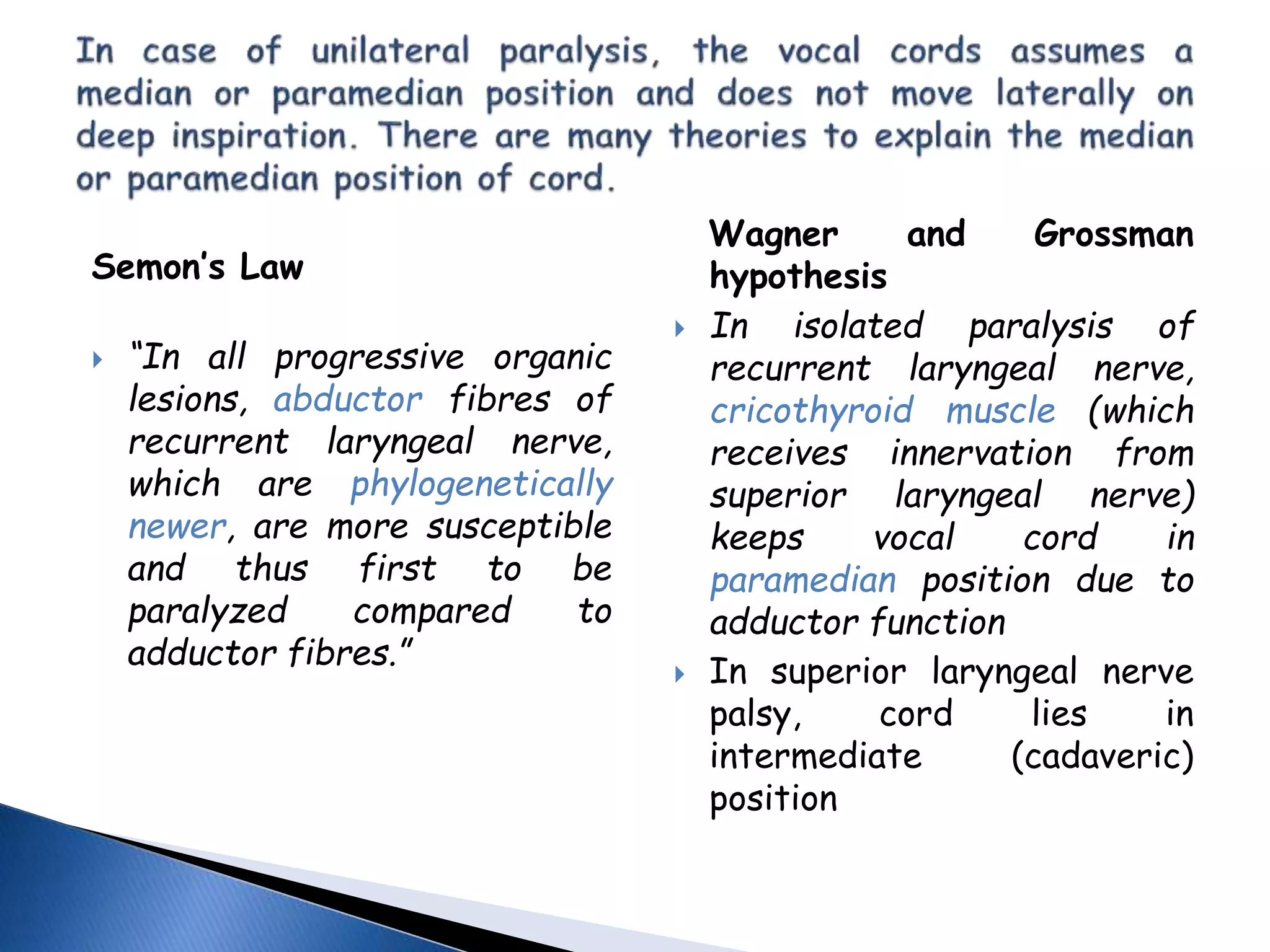
Semon’s Law
 “In all progressive organic
lesions, abductor fibres of
recurrent laryngeal nerve,
which are phylogenetically
newer, are more susceptible
and thus first to be
paralyzed compared to
adductor fibres.”
Wagner and Grossman
hypothesis
 In isolated paralysis of
recurrent laryngeal nerve,
cricothyroid muscle (which
receives innervation from
superior laryngeal nerve)
keeps vocal cord in
paramedian position due to
adductor function
 In superior laryngeal nerve
palsy, cord lies in
intermediate (cadaveric)
position
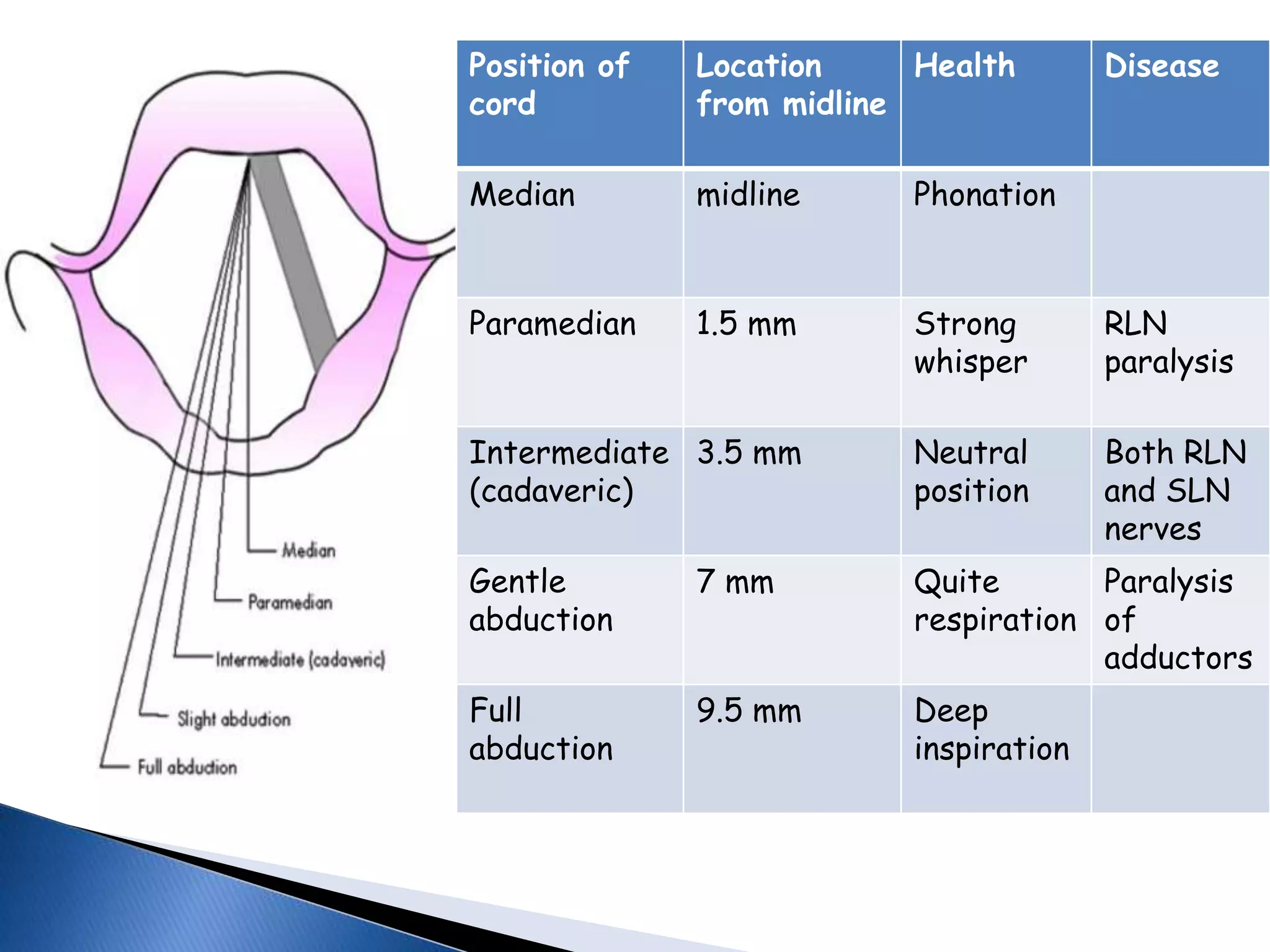
Position of
cord
Location
from midline
Health Disease
Median midline Phonation
Paramedian 1.5 mm Strong
whisper
RLN
paralysis
Intermediate
(cadaveric)
3.5 mm Neutral
position
Both RLN
and SLN
nerves
Gentle
abduction
7 mm Quite
respiration
Paralysis
of
adductors
Full
abduction
9.5 mm Deep
inspiration
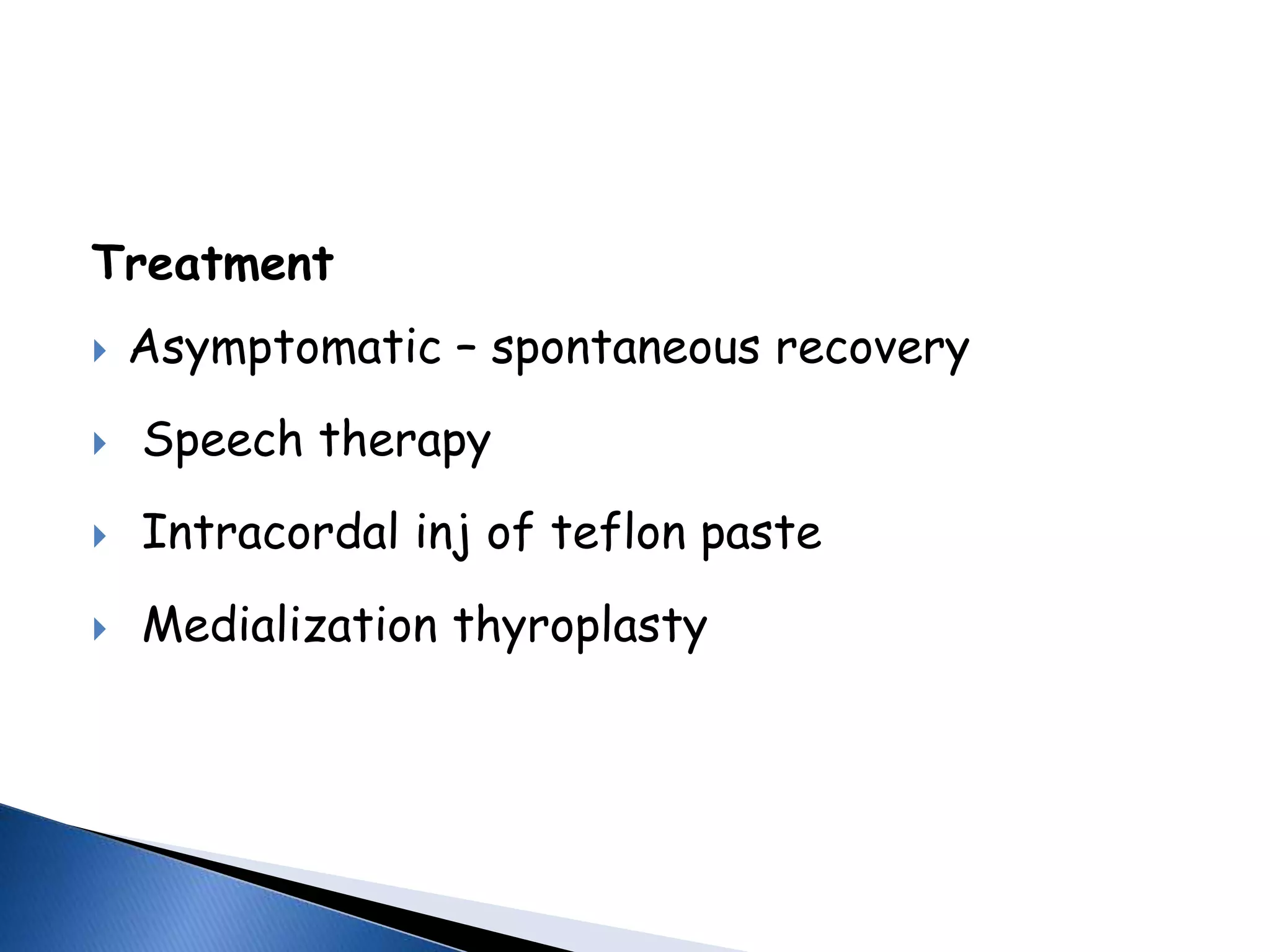
Treatment
 Asymptomatic – spontaneous recovery
 Speech therapy
 Intracordal inj of teflon paste
 Medialization thyroplasty
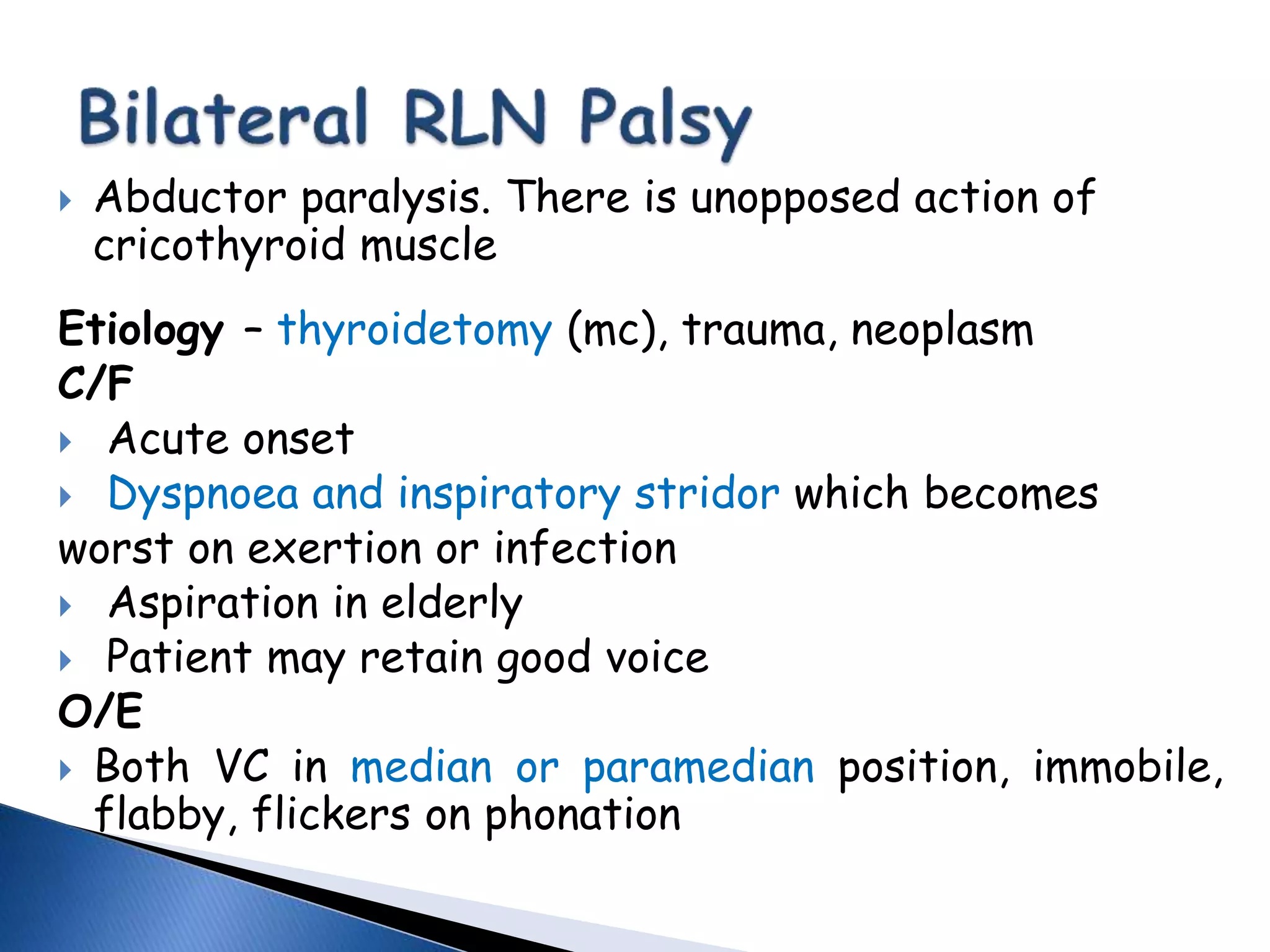
 Abductor paralysis. There is unopposed action of
cricothyroid muscle
Etiology – thyroidetomy (mc), trauma, neoplasm
C/F
 Acute onset
 Dyspnoea and inspiratory stridor which becomes
worst on exertion or infection
 Aspiration in elderly
 Patient may retain good voice
O/E
 Both VC in median or paramedian position, immobile,
flabby, flickers on phonation
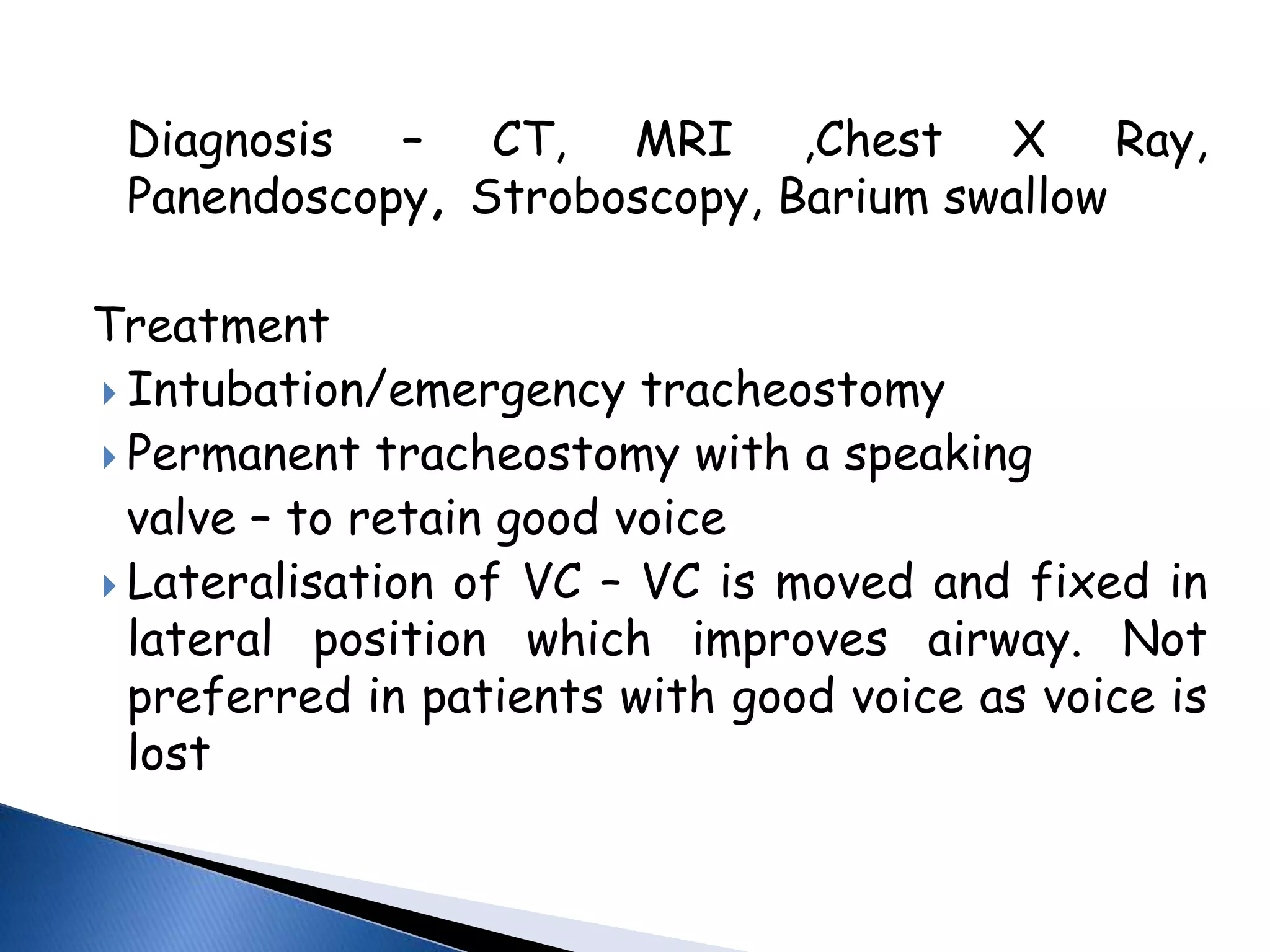
Diagnosis – CT, MRI ,Chest X Ray,
Panendoscopy, Stroboscopy, Barium swallow
Treatment
 Intubation/emergency tracheostomy
 Permanent tracheostomy with a speaking
valve – to retain good voice
 Lateralisation of VC – VC is moved and fixed in
lateral position which improves airway. Not
preferred in patients with good voice as voice is
lost
Partial arytenoidectomy
 Medial part of arytenoid is excised with laser.
Sometimes only the vocal process of arytenoid
is ablated
 Arytenoidectomy – removal of arytenoid by external
approach (woodman’s operation), by endoscopic approach
(thornell operation)
 Endoscopic CO2 LASER cordotomy ( Kashima Operation)
Soft tissue at the junction of membranous cord and vocal
process of arytenoid is excised laterally with laser, which
provides good airway.
 Endoscopic CO2 LASER cordectomy
 Laterialisation thyroplasty Type 2
 Nerve muscle implant – sternohyoid muscle with nerve
supply is transplanted into post cricoarytenoid
 Arytenoidopexy ( fixing the arytenoid in lateral position)
 Rare
 Paralysis of unilateral cricothyroid muscle
 Unilateral supraglottic anaesthesia
Etiology – thyroid surgery, tumours, trauma, neuritis
C/F
 Weak and low pitch voice (loss of tension)
 Occasional aspiration (anaesthesia)
O/E
 I/L VC flabby and bowed, wavy appearance
 Oblique laryngeal inlet
 Post commissure deviated medially towards
affected side
Prognosis
 Voice recovered by compensation from healthy
cord
 Singers cant produce high pitch voice
Treatment
 Speech therapy
During ligation of Superior thyroid vessels in thyroid
surgeries, the dissection should stay close to the
thyroid to avoid nerve damage.
External branch of superior laryngeal nerve lies
posteromedial to the thyroid vessels and should be
identified and preserved.
 Least common
 Both cricothyroid paralysed
 Anaesthesia of supraglottic larynx
Etiology – surgical trauma, RTA, neoplasm
C/F
 Coughing and choking during swallowing due to
aspiration
 Weak and husky/breathy voice
 Short phonation time
O/E
 B/L flaccid and bowed VC
Electromyography
of the cricoithyroid
muscle helps to
diagnose the
condition.
Treatment
 Ryle’s/NG tube feed
 Tracheostomy with cuffed tube
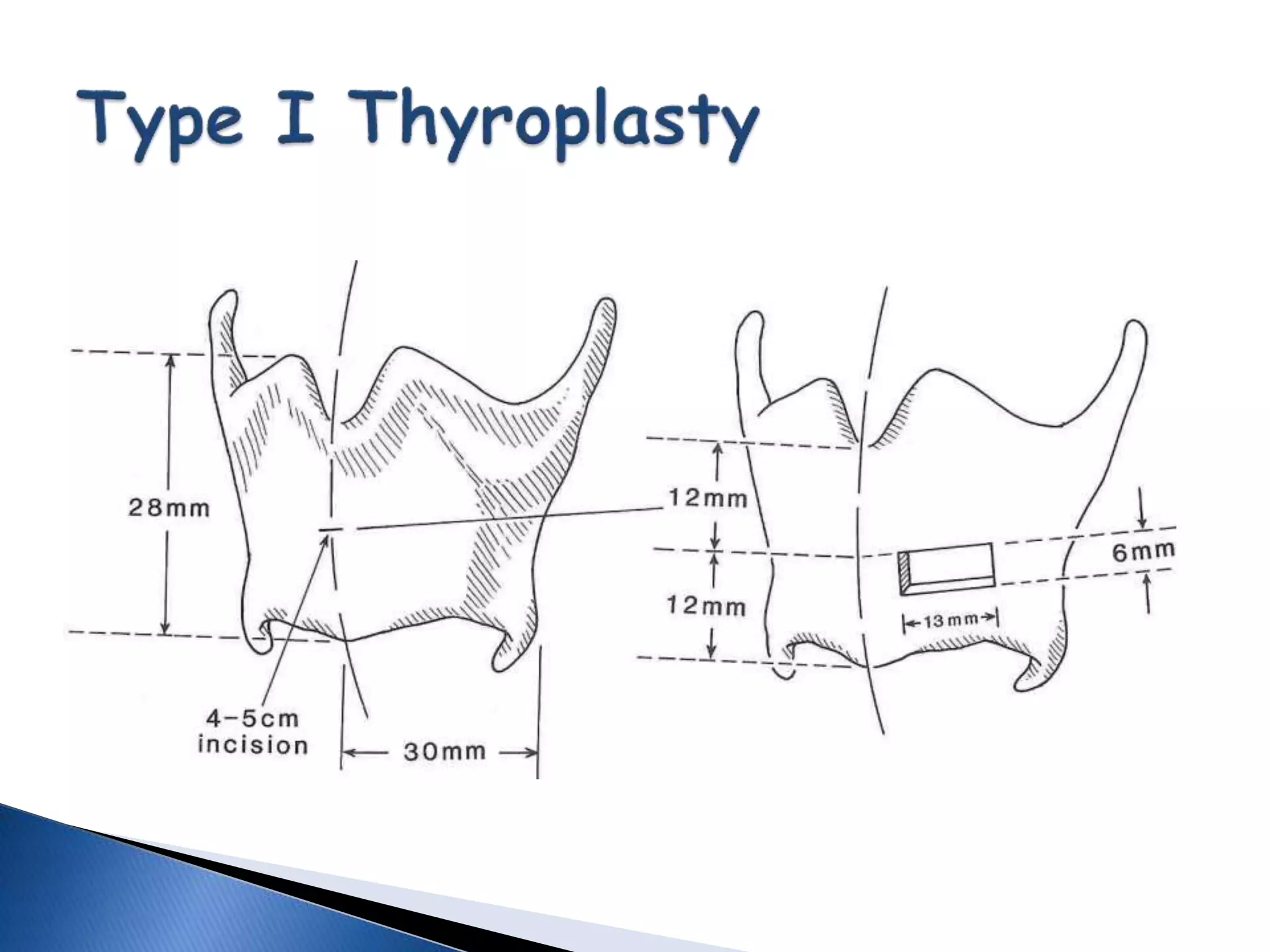
 Thyroplasty Type 1
 Injection teflon/collagen for medialization
 Epiglottoplexy – reversible procedure where
in laryngeal inlet is closed to protect the lungs
from aspiration. Epiglottis is fixed to
arytenoids
Intracranial :
 Intracranial Tumors of posterior fossa
 Basal meningitis(tubercular)
 Skull base Fractures
Skull base:
 Nasopharyngeal cancer
 Glomus tumour
 Neck Penetrating injury
Neck :
 Parapharyngeal tumours
 Metastatic nodes
 Lymphoma
 Paralysis of all unilateral muscles except interarytenoid
which receive innervation from other side
Etiology – high vagal lesions, thyroid surgery
C/F
 Hoarseness of voice
 Aspiration of fluids
 Inadequate cough (d/t air wastage)
O/E
 Unilateral paralysed VC in cadaveric position
Prognosis
 No compensation by healthy cord
Treatment
 Speech therapy
 Medialisation of paralysed vc by teflon
injection or thyroplasty
 Rare
 Total anaesthesia of larynx
 All laryngeal muscles paralysed
Etiology
 Neoplasm in skull base, medulla, upper neck
 CNS disorder
C/F
 Aphonia – VC dont approximate
 Aspiration – laryngeal anaesthesia
 Inability to cough leading to collection of secretions
 Bronchopneumonia due to aspiration and secretions
O/E
 Both VC in cadaveric position
Treatment
 Ryle’s tube feed
 Reversible
 Tracheostomy with cuffed tube
 Epiglottoplexy
 VC plication – approximation of VC with sutures
 Irreversible
 Total laryngectomy – for progessive and irreversible
disease, when voice is lost- to protect lungs
 Second mc cause of stridor in neonates (1st laryngomalacia)
 Unilateral mc, Right VC
Etiology
 Idiopathic
 U/L – birth trauma, congenital anomaly of heart or vessel
 B/L – anomalies of CNS, hydrocephalus, meningitis
C/F
 Weak or hoarse cry
 Inspiratory or biphasic stridor
 Difficulty in feeding
Prognosis – 70% U/L and 50% B/L recover
spontaneously within six months
Diagnosis
 Awake flexible laryngoscopy
 MRI
 X Ray Neck/Chest
Treatment-
 NG tube feed
 U/L (if severe aspiration or dyspnoea)
 Inj teflon/thyroplasty
 B/L (after 5 yrs of age if recovery has not
happened)
 Arytenoidectomy (endoscopic/external)
 Endoscopic lateral cordotomy
“any surgery designed primarily for the
improvement or restoration of the voice”
 Microlaryngoscopic Surgery
 Vocal Fold Injection
 Laryngeal Framework Surgery
 Nerve Grafting / Rennervation Surgery
 Manual Compression Test
Type of Anesthesia
Local - allows patient to phonate
 Careful administration of IV sedation
 Internal br. of superior laryngeal nerve is blocked
at the thyrohyoid membrane
 Glossopharyngeal nerve block at the inferior pole
of the tonsils
 Flexible endoscope allows visualization
 Pt sitting and injecting through cricothyroid
membrane
General
 Visualizaation problems d/t ETT
 Abnormal anatomical position of neck
 Lack of pt feedback
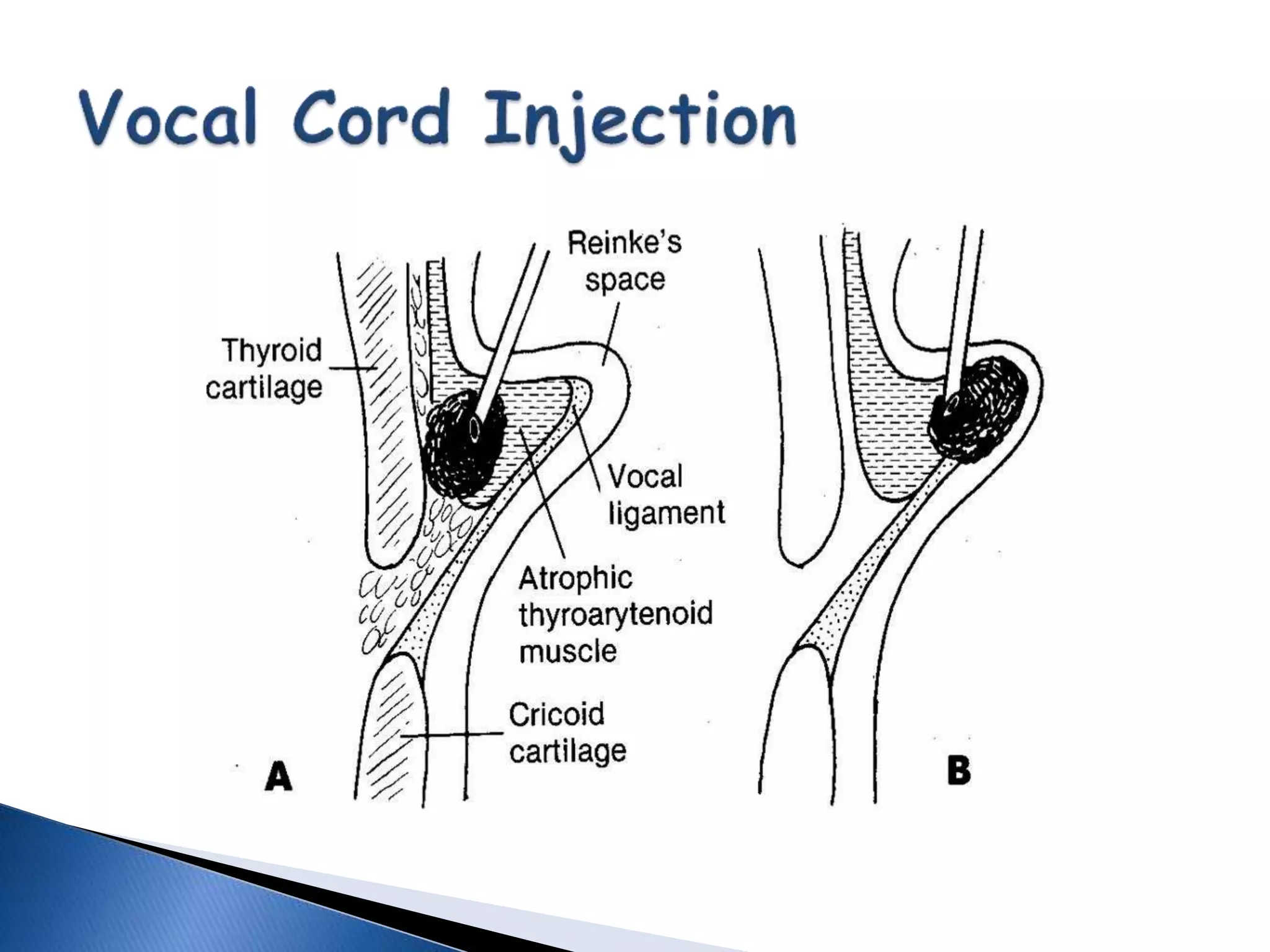
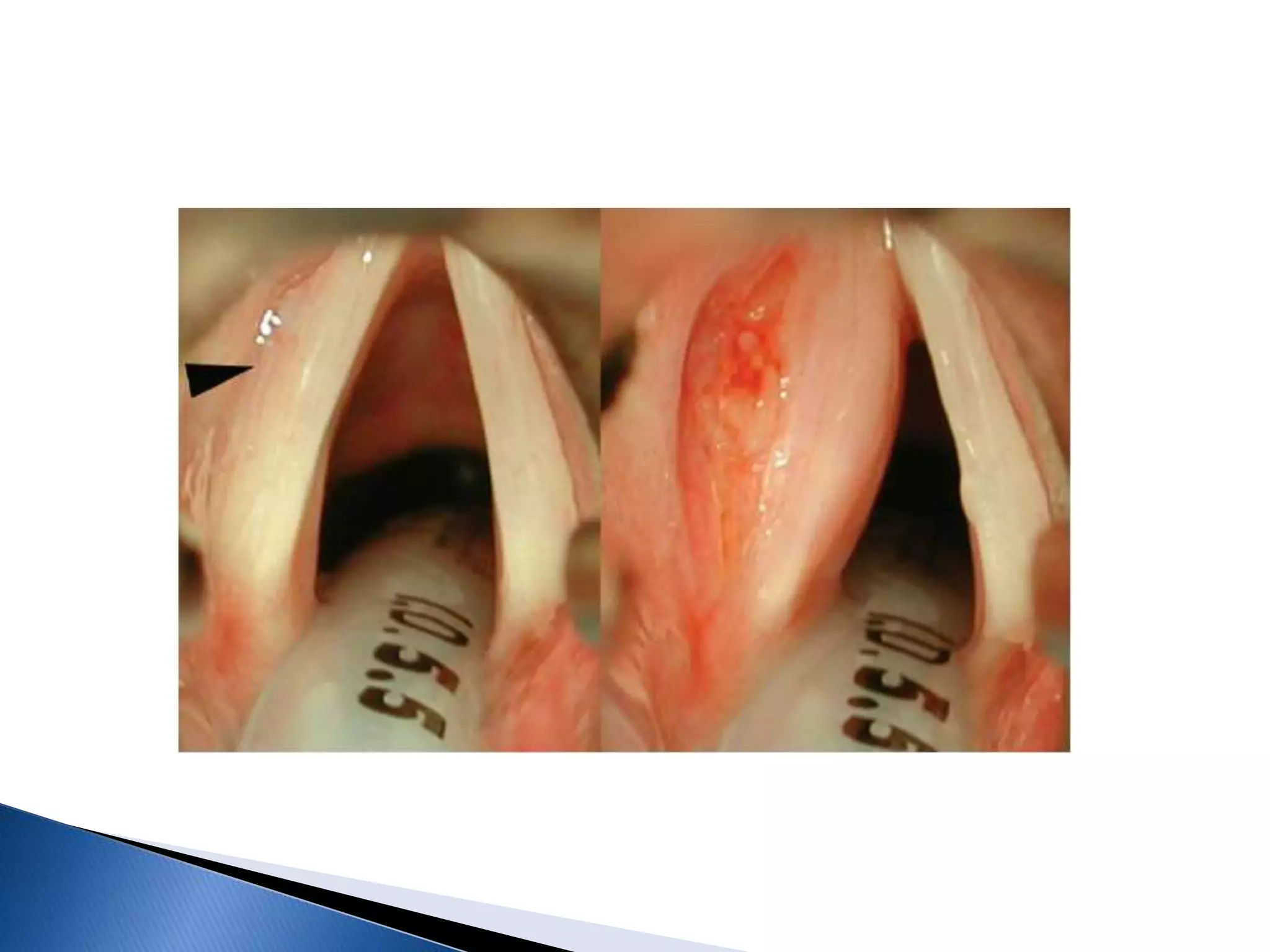
 Adds fullness to the vocal cord to help it
better oppose the other side
 Injection technique is similar regardless of
material used
 Injection into thyroarytenoid/vocalis
 Injection can be done endoscopically or
percutaneously
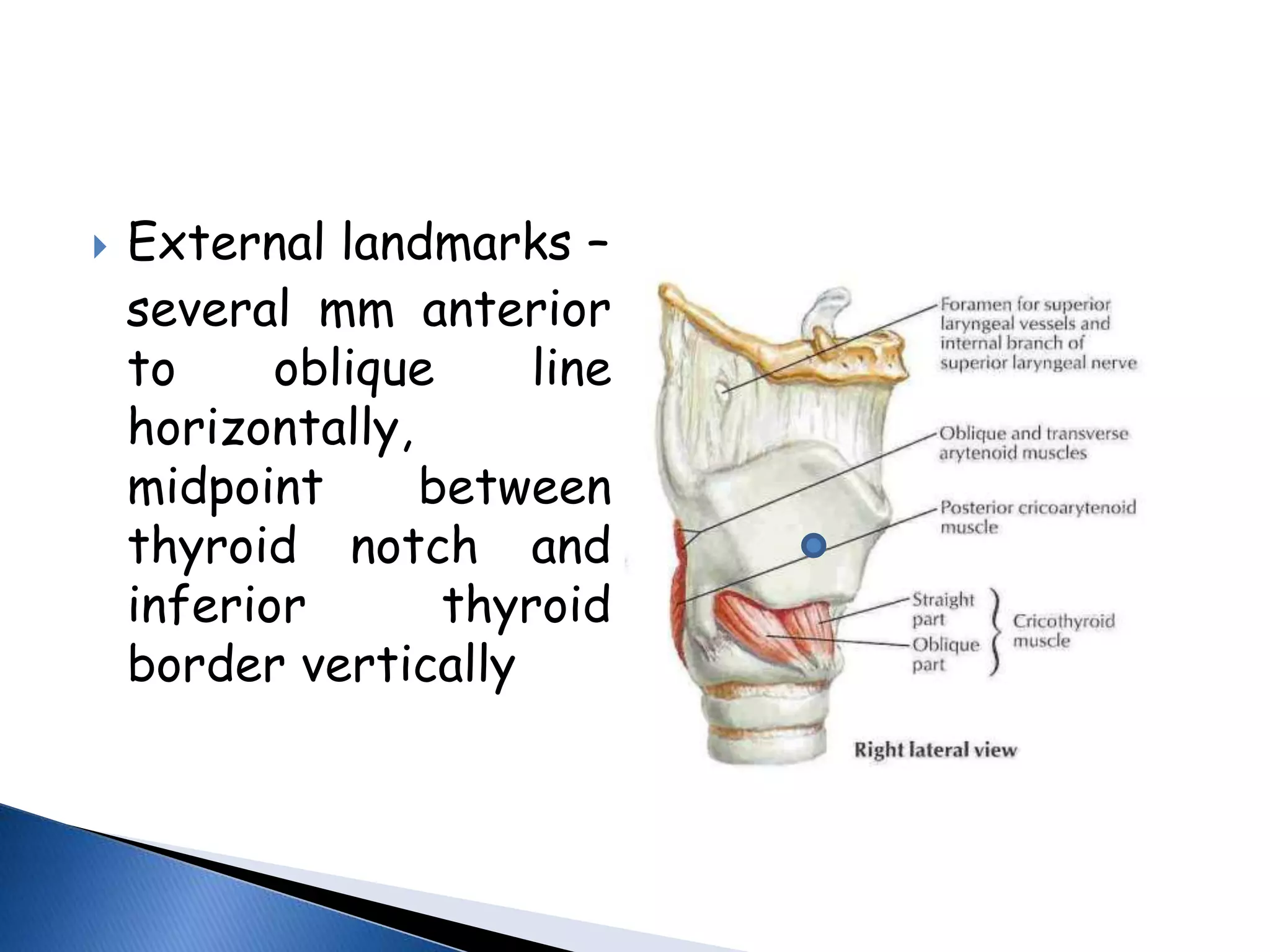
 External landmarks –
several mm anterior
to oblique line
horizontally,
midpoint between
thyroid notch and
inferior thyroid
border vertically
 Teflon
 Fat
 Glycerine
 Collagen
 Silicone gel
 Hyaluronic Acid
 Calcium Hydroxyapatite gel
Teflon
 Polymer of Tetrafluroethylene
 Produces localised inflammmatory response
 Irreversible
 Used in persons with short life expentency
 Poor long term voice results
 High density & injected deep into
thyroarytenoid muscle
 Risk of granuloma formation
Fat
 Autogenous material
 Easily harvested, readily available, no FB reaction
 Overcorrection is necessary – about 50%
 Resorption in months to years
Glycerine
 Completely reversible
 Absorbed in 2-6 wks
 Injected deep within vocal fold
Collagen
 Natural constituent of lamina propria
 Bovine collage used
 Skin testing required
 Over injection
 Airway compromise
 Under injection
 Misplacement & migration (silicon)
 Granuloma (teflon)
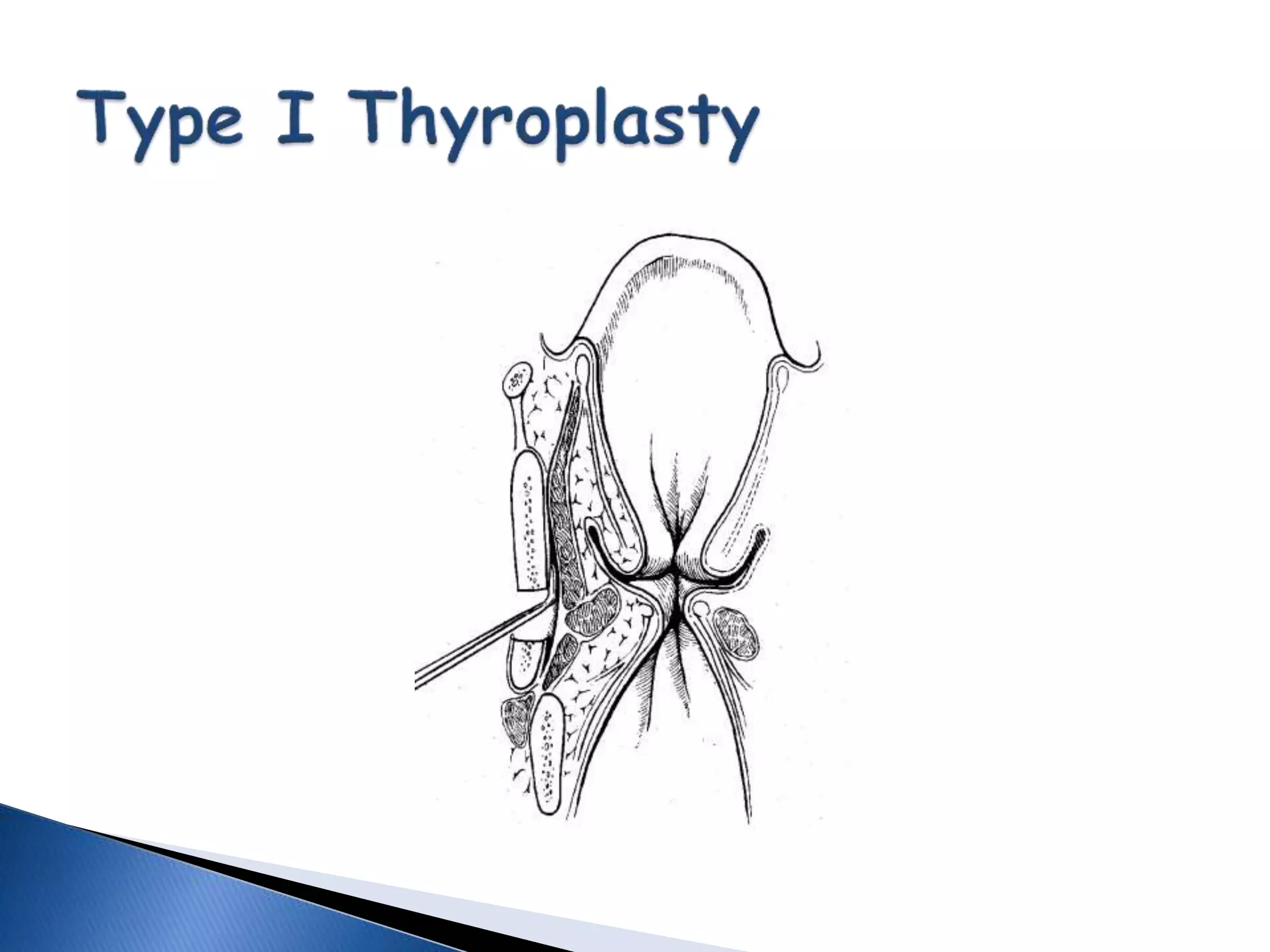
First described by Payr and reintroduced by Ishiki
in 1974
Variety of materials used for implants:
 Autologous Cartilage
 Silastic
 Hydroxyapatite
 Gortex
 Titanium
Useful for anterior glottic gap
 Type I thyroplasty- medialization of VC.
 Type II thyroplasty- lateralization of VC.
 Type III thyroplasty- shortening or relaxation of VC.
It lowers pitch of voice, done in mutational falsetto or
in those who have gone gender transformation from
female to male
 Type IV thyroplasty- lengthening of VC to elevate
pitch. It is also used when vocal cord is lax and bowing
due to aging process on trauma.
Advantages:
 Permanent, but surgically reversible
 No need to remove implant if vocal function
returns
 Excellent at closing anterior gap
Disadvantages:
 More invasive
 Poor closure of posterior glottic gap
Complications
 Extrusion/Displacement (Intraoperative or Postop)
 Misplacement – most often superior
 Infection
 Undercorrection – important to overcorrect by 1-2mm
Controversies
 Location of graft placement
 Status of inner perichondrium
 Many series have shown low extrusion rate with
sacrificed perichondrium
 First described by Ishiki with modifications by
Zeitels and others
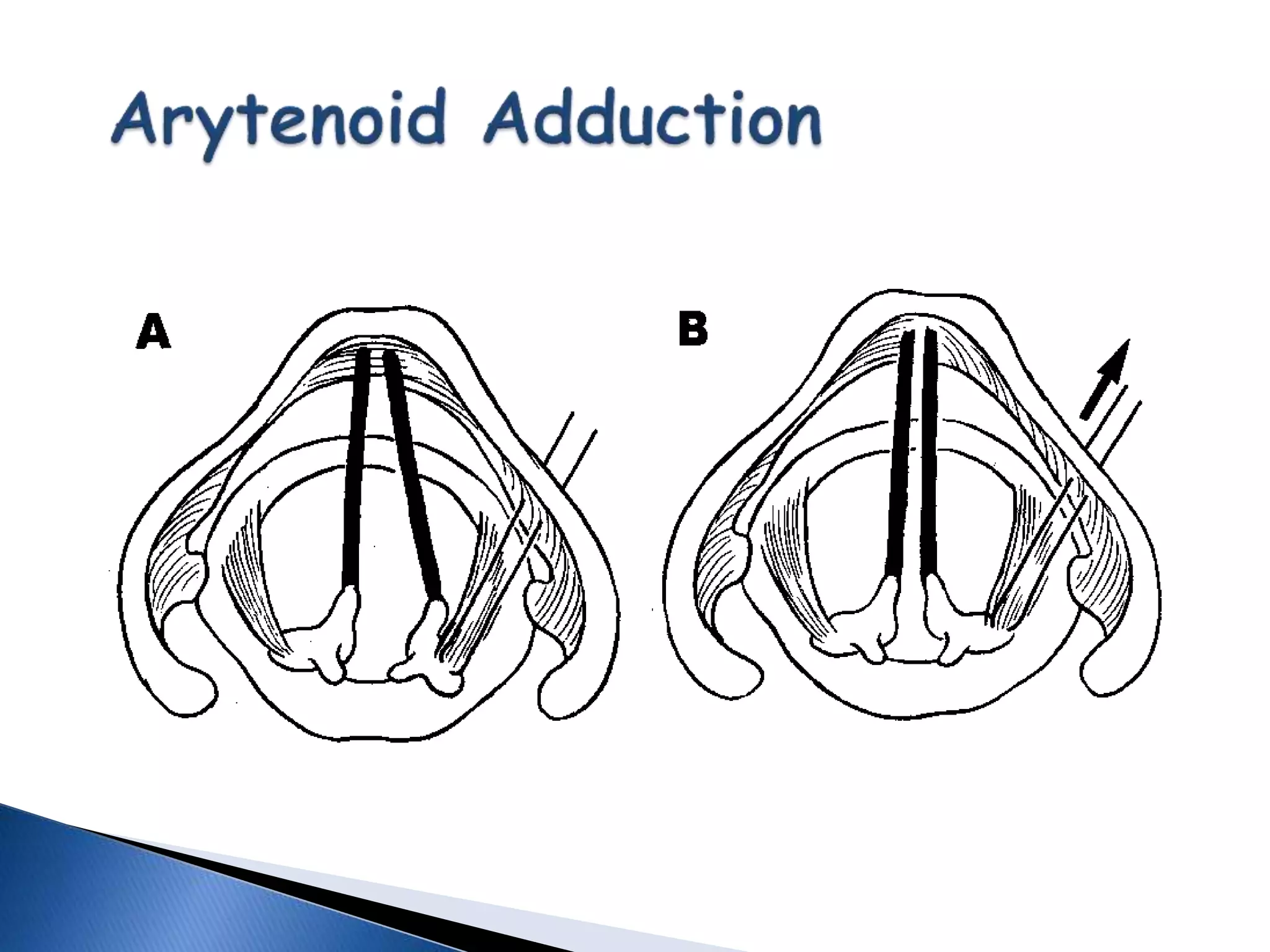
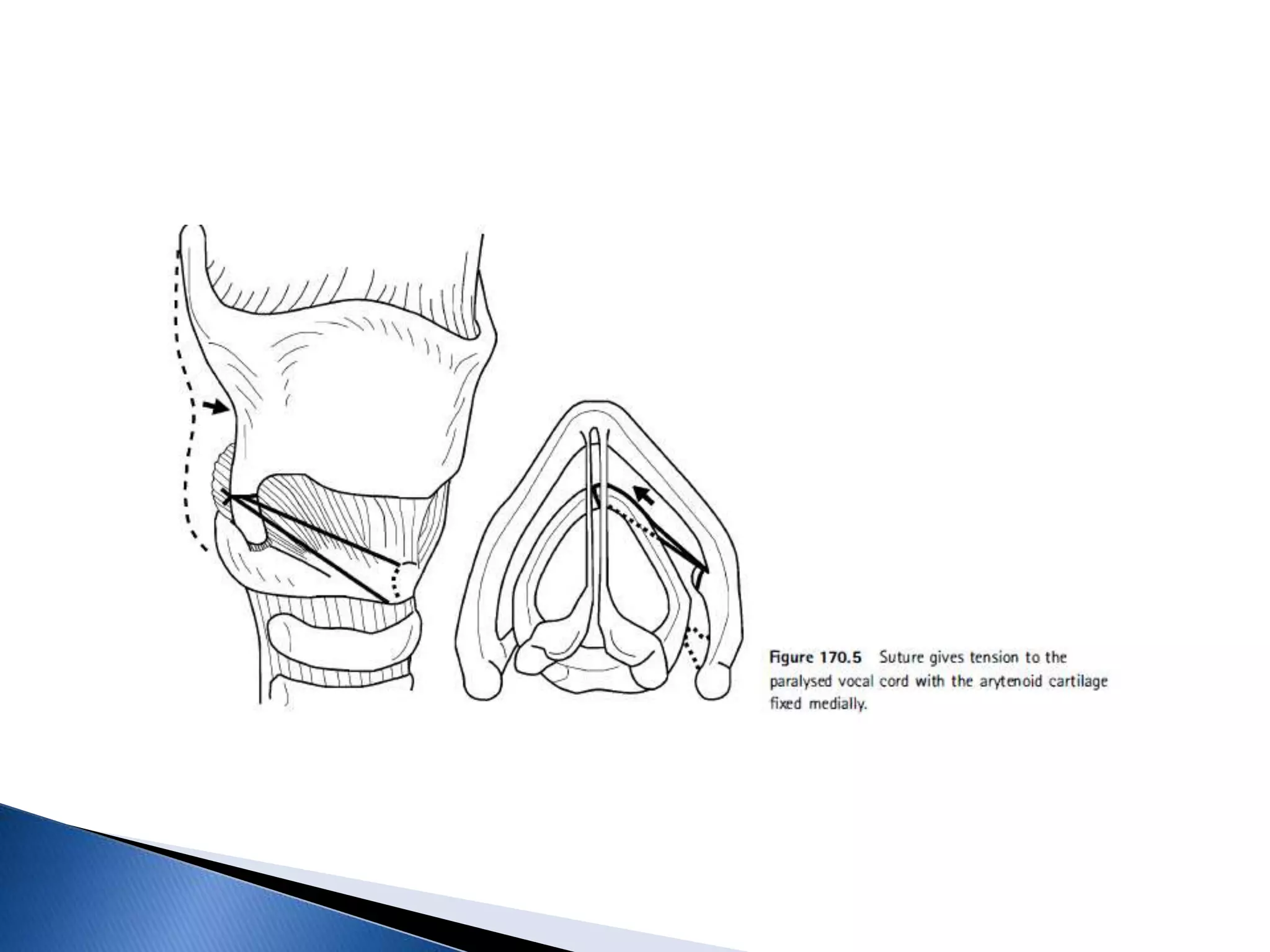
 Addresses posterior glottic gap by pulling
arytenoid into adducted position
 Difficult to predict which patients will benefit
preoperatively.
 Most advocate use in combination with anterior
medialization
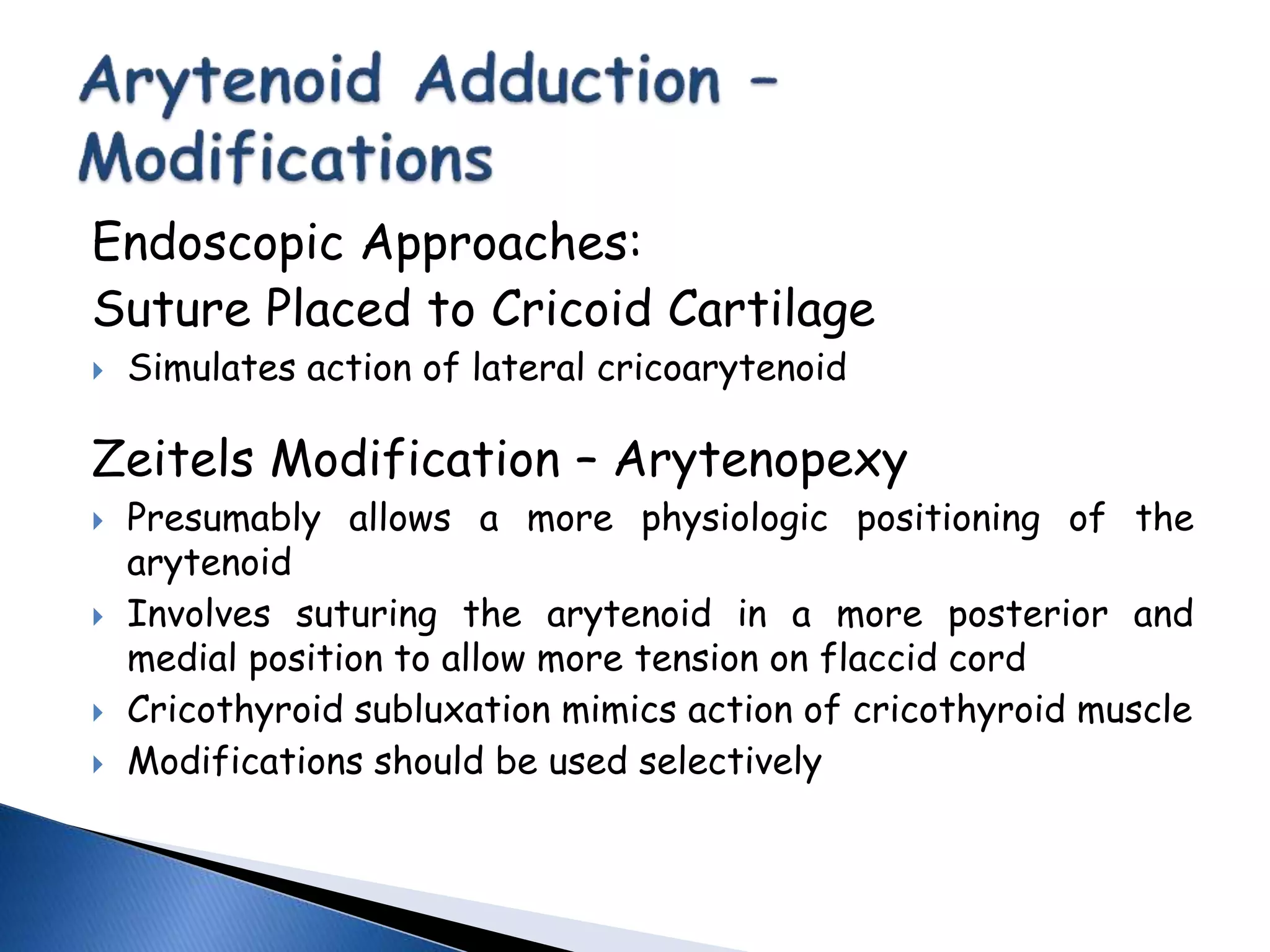
Endoscopic Approaches:
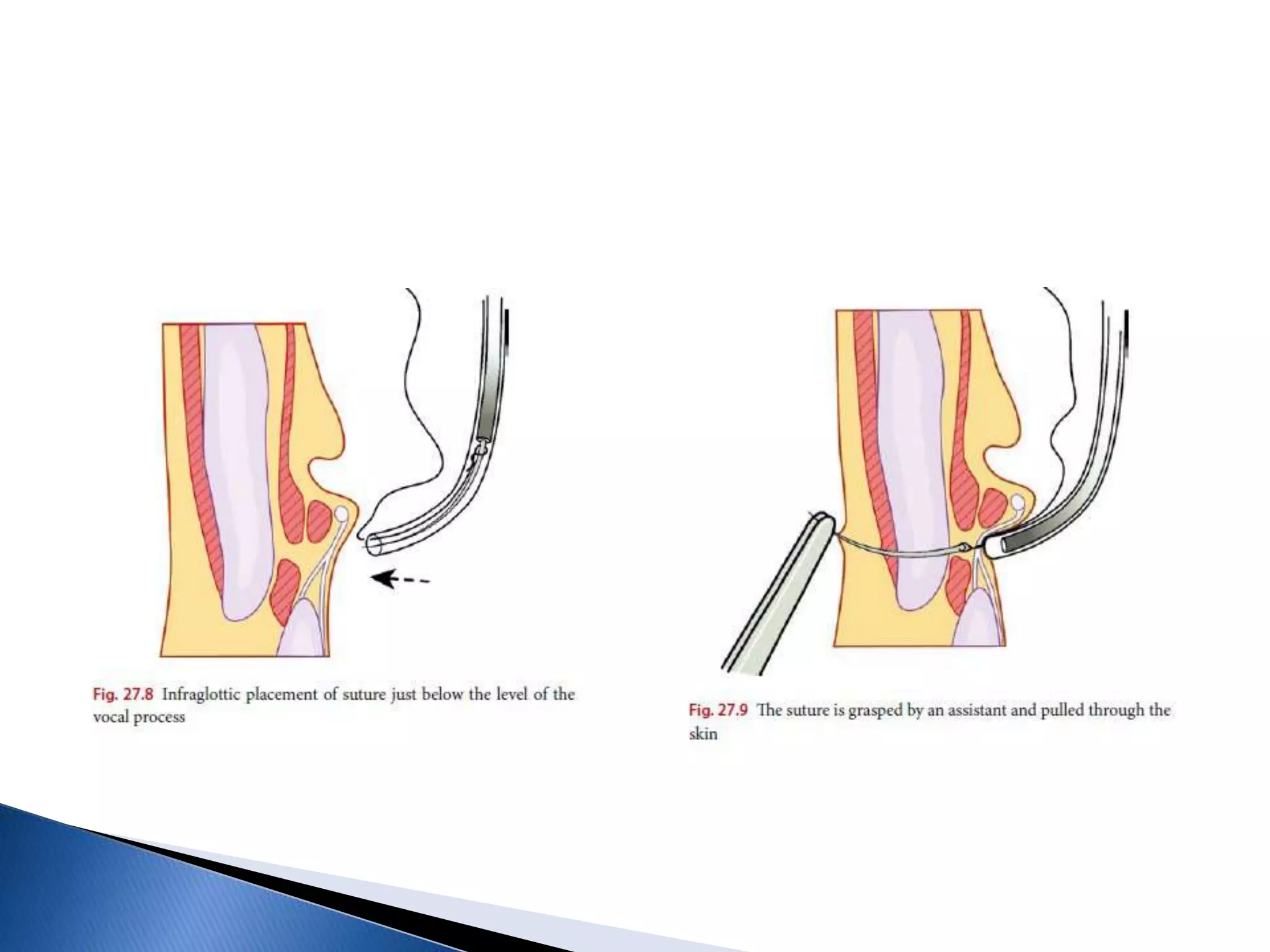
Suture Placed to Cricoid Cartilage
 Simulates action of lateral cricoarytenoid
Zeitels Modification – Arytenopexy
 Presumably allows a more physiologic positioning of the
arytenoid
 Involves suturing the arytenoid in a more posterior and
medial position to allow more tension on flaccid cord
 Cricothyroid subluxation mimics action of cricothyroid muscle
 Modifications should be used selectively
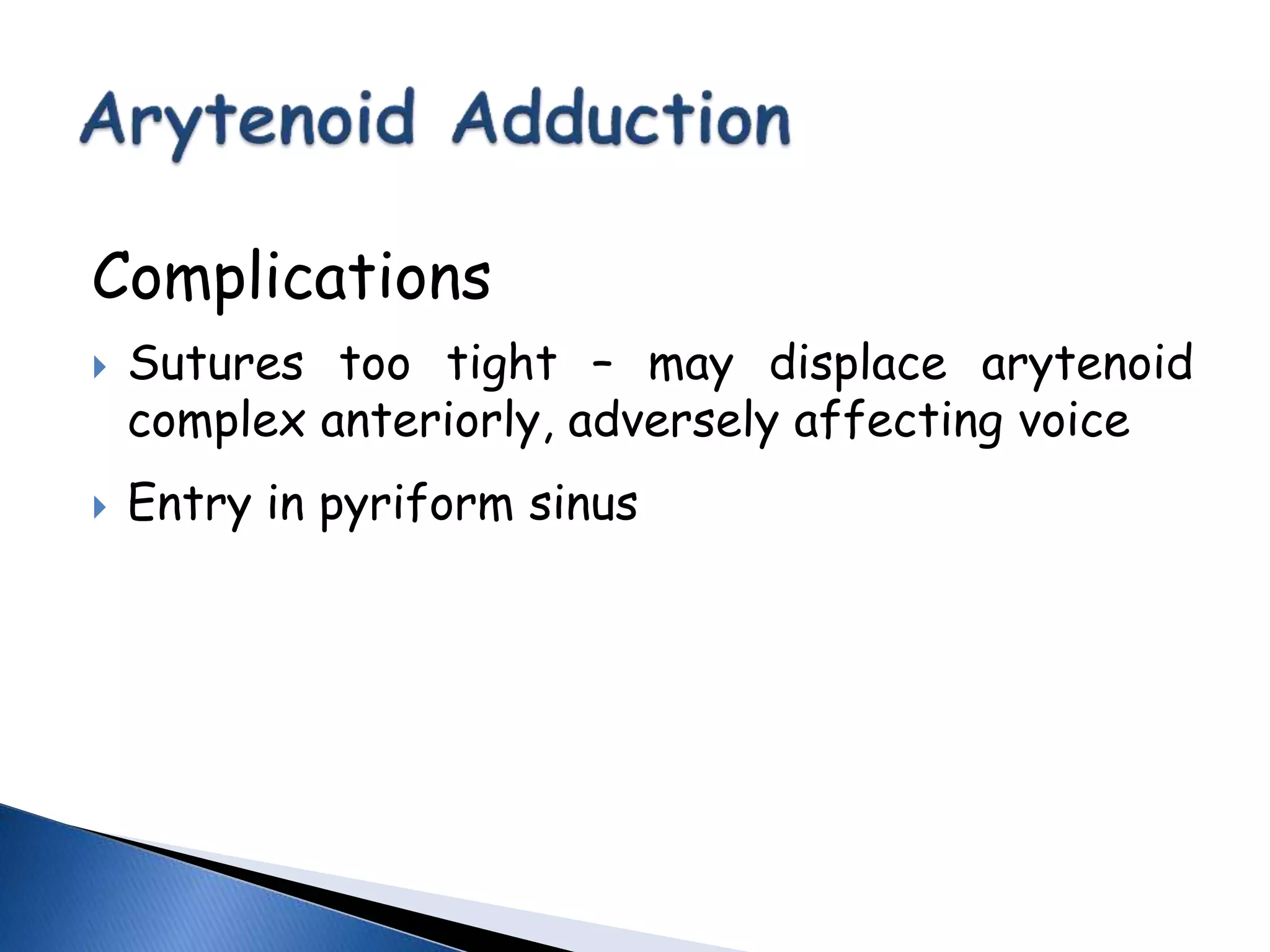
Complications
 Sutures too tight – may displace arytenoid
complex anteriorly, adversely affecting voice
 Entry in pyriform sinus
 Open method – lateral / Median approach
 Vocal fold abduction
- Suture technique
- Thyroarytenoid myectomy
 RLN anastomosis first described by Horsely in
1909
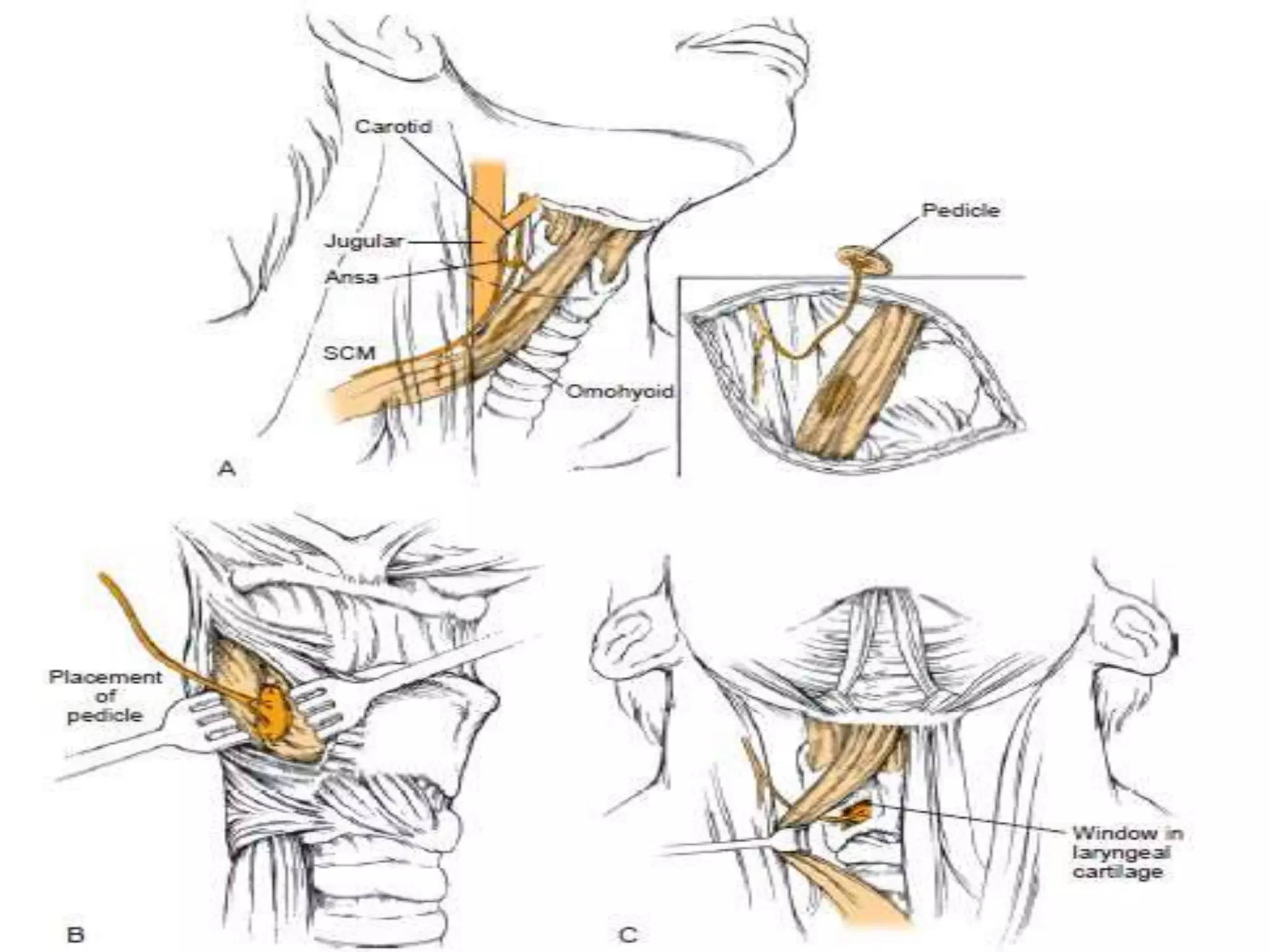
 Crumly showed Ansa cervicalis to RLN
anastomosis
 Results in synkynetic
tone of vocal cord
 Ansa to Recurrent
Laryngeal Nerve
 Ansa to Omohyoid to
Thyroarytenoid
 Hypoglossal to recurrent laryngeal nerve
 Crossed nerve grafts or wire conduction
prostheses from one muscle to its paralyzed
counterpart are being researched
THANK YOU

Neurological conditions of larynx ashly

  • 1.
    Dr.ASHLY ALEXANDER ENT PGRESIDENT GMC,BHOPAL
  • 2.
  • 3.
     10th cranialnerve  So called due to its vague course through the head, neck, thorax and the abdomen.  Longest nerve of the autonomic nervous system in the body  MIXED NERVE: sensory, motor and parasympathetic
  • 5.
  • 7.
     Arises frominferior ganglion of the Vagus  Descends behind the internal carotid artery  At the level of greater cornua of hyoid bone, divides into external and internal branches  External Motor branch: Cricothyroid muscle  Internal Sensory branch: Pierces thyrohyoid membrane and supplies sensory innervation to larynx above vocal cord.
  • 8.
    Right  Arises fromthe Vagus, at the level of Subclavian artery  Ascends between the trachea and oesophagus Left  Arises from Vagus in mediastinum  At the level of Arch of Aorta  Then ascends into the neck in the trachea-oesophageal groove.  Thus, Left recurrent laryngeal nerve has a much longer course which make it more prone to paralysis compared to the right one. ( About 75%)
  • 11.
    Motor Supply  Allintrinsic muscle : Recurrent Laryngeal Nerve Except, The Cricothyroid Muscle : External Laryngeal Nerve –the branch of Superior Laryngeal nerve Sensory Supply  Above the vocal cords: Internal Laryngeal Nerve –the branch of Superior Laryngeal Nerve  Below the vocal cords: Recurrent Laryngeal Nerve
  • 12.
  • 13.
    Right Left Both Necktrauma Neck trauma Thyroid surgery Benign or malignant thyroid ds. Benign or malignant thyroid ds. Carcinoma thyroid Ca cervical esophagus Ca cervical esophagus Ca cervical esophagus Cervical LAP Cervical LAP Cervical LAP Aneurysm of subclavian A. Bronchogenic ca. Ca apex right lung Ca thoracic oseophagus Mediastinal LAP TB of cervical pleura Aortic aneurysm Intrathoracic sx
  • 14.
    Common Recurrent laryngeal nervepalsy = Left MCC of RLN Palsy- Bronchogenic carcinoma Common Recurrent Laryngeal Nerve Palsy during Thyroidectomy= Right
  • 15.
     U/L paralysisof all muscles except cricothyroid C/F :  Asymptomatic - one third  Change in voice which gradually improves due to compensation by healthy cord.  Tiring voice  Diplophonia O/E  Affected VC in median/paramedian position.
  • 16.
    Semon’s Law  “Inall progressive organic lesions, abductor fibres of recurrent laryngeal nerve, which are phylogenetically newer, are more susceptible and thus first to be paralyzed compared to adductor fibres.” Wagner and Grossman hypothesis  In isolated paralysis of recurrent laryngeal nerve, cricothyroid muscle (which receives innervation from superior laryngeal nerve) keeps vocal cord in paramedian position due to adductor function  In superior laryngeal nerve palsy, cord lies in intermediate (cadaveric) position
  • 17.
    Position of cord Location from midline HealthDisease Median midline Phonation Paramedian 1.5 mm Strong whisper RLN paralysis Intermediate (cadaveric) 3.5 mm Neutral position Both RLN and SLN nerves Gentle abduction 7 mm Quite respiration Paralysis of adductors Full abduction 9.5 mm Deep inspiration
  • 18.
    Treatment  Asymptomatic –spontaneous recovery  Speech therapy  Intracordal inj of teflon paste  Medialization thyroplasty
  • 20.
     Abductor paralysis.There is unopposed action of cricothyroid muscle Etiology – thyroidetomy (mc), trauma, neoplasm C/F  Acute onset  Dyspnoea and inspiratory stridor which becomes worst on exertion or infection  Aspiration in elderly  Patient may retain good voice O/E  Both VC in median or paramedian position, immobile, flabby, flickers on phonation
  • 22.
    Diagnosis – CT,MRI ,Chest X Ray, Panendoscopy, Stroboscopy, Barium swallow Treatment  Intubation/emergency tracheostomy  Permanent tracheostomy with a speaking valve – to retain good voice  Lateralisation of VC – VC is moved and fixed in lateral position which improves airway. Not preferred in patients with good voice as voice is lost
  • 23.
    Partial arytenoidectomy  Medialpart of arytenoid is excised with laser. Sometimes only the vocal process of arytenoid is ablated
  • 24.
     Arytenoidectomy –removal of arytenoid by external approach (woodman’s operation), by endoscopic approach (thornell operation)  Endoscopic CO2 LASER cordotomy ( Kashima Operation) Soft tissue at the junction of membranous cord and vocal process of arytenoid is excised laterally with laser, which provides good airway.  Endoscopic CO2 LASER cordectomy  Laterialisation thyroplasty Type 2  Nerve muscle implant – sternohyoid muscle with nerve supply is transplanted into post cricoarytenoid  Arytenoidopexy ( fixing the arytenoid in lateral position)
  • 26.
     Rare  Paralysisof unilateral cricothyroid muscle  Unilateral supraglottic anaesthesia Etiology – thyroid surgery, tumours, trauma, neuritis C/F  Weak and low pitch voice (loss of tension)  Occasional aspiration (anaesthesia) O/E  I/L VC flabby and bowed, wavy appearance  Oblique laryngeal inlet  Post commissure deviated medially towards affected side
  • 27.
    Prognosis  Voice recoveredby compensation from healthy cord  Singers cant produce high pitch voice Treatment  Speech therapy During ligation of Superior thyroid vessels in thyroid surgeries, the dissection should stay close to the thyroid to avoid nerve damage. External branch of superior laryngeal nerve lies posteromedial to the thyroid vessels and should be identified and preserved.
  • 28.
     Least common Both cricothyroid paralysed  Anaesthesia of supraglottic larynx Etiology – surgical trauma, RTA, neoplasm C/F  Coughing and choking during swallowing due to aspiration  Weak and husky/breathy voice  Short phonation time O/E  B/L flaccid and bowed VC Electromyography of the cricoithyroid muscle helps to diagnose the condition.
  • 29.
    Treatment  Ryle’s/NG tubefeed  Tracheostomy with cuffed tube  Thyroplasty Type 1  Injection teflon/collagen for medialization  Epiglottoplexy – reversible procedure where in laryngeal inlet is closed to protect the lungs from aspiration. Epiglottis is fixed to arytenoids
  • 31.
    Intracranial :  IntracranialTumors of posterior fossa  Basal meningitis(tubercular)  Skull base Fractures Skull base:  Nasopharyngeal cancer  Glomus tumour  Neck Penetrating injury Neck :  Parapharyngeal tumours  Metastatic nodes  Lymphoma
  • 32.
     Paralysis ofall unilateral muscles except interarytenoid which receive innervation from other side Etiology – high vagal lesions, thyroid surgery C/F  Hoarseness of voice  Aspiration of fluids  Inadequate cough (d/t air wastage) O/E  Unilateral paralysed VC in cadaveric position
  • 33.
    Prognosis  No compensationby healthy cord Treatment  Speech therapy  Medialisation of paralysed vc by teflon injection or thyroplasty
  • 34.
     Rare  Totalanaesthesia of larynx  All laryngeal muscles paralysed Etiology  Neoplasm in skull base, medulla, upper neck  CNS disorder C/F  Aphonia – VC dont approximate  Aspiration – laryngeal anaesthesia  Inability to cough leading to collection of secretions  Bronchopneumonia due to aspiration and secretions
  • 35.
    O/E  Both VCin cadaveric position Treatment  Ryle’s tube feed  Reversible  Tracheostomy with cuffed tube  Epiglottoplexy  VC plication – approximation of VC with sutures  Irreversible  Total laryngectomy – for progessive and irreversible disease, when voice is lost- to protect lungs
  • 36.
     Second mccause of stridor in neonates (1st laryngomalacia)  Unilateral mc, Right VC Etiology  Idiopathic  U/L – birth trauma, congenital anomaly of heart or vessel  B/L – anomalies of CNS, hydrocephalus, meningitis C/F  Weak or hoarse cry  Inspiratory or biphasic stridor  Difficulty in feeding Prognosis – 70% U/L and 50% B/L recover spontaneously within six months
  • 37.
    Diagnosis  Awake flexiblelaryngoscopy  MRI  X Ray Neck/Chest Treatment-  NG tube feed  U/L (if severe aspiration or dyspnoea)  Inj teflon/thyroplasty  B/L (after 5 yrs of age if recovery has not happened)  Arytenoidectomy (endoscopic/external)  Endoscopic lateral cordotomy
  • 38.
    “any surgery designedprimarily for the improvement or restoration of the voice”
  • 39.
     Microlaryngoscopic Surgery Vocal Fold Injection  Laryngeal Framework Surgery  Nerve Grafting / Rennervation Surgery
  • 40.
  • 41.
    Type of Anesthesia Local- allows patient to phonate  Careful administration of IV sedation  Internal br. of superior laryngeal nerve is blocked at the thyrohyoid membrane  Glossopharyngeal nerve block at the inferior pole of the tonsils  Flexible endoscope allows visualization  Pt sitting and injecting through cricothyroid membrane
  • 42.
    General  Visualizaation problemsd/t ETT  Abnormal anatomical position of neck  Lack of pt feedback
  • 43.
     Adds fullnessto the vocal cord to help it better oppose the other side  Injection technique is similar regardless of material used  Injection into thyroarytenoid/vocalis  Injection can be done endoscopically or percutaneously
  • 44.
     External landmarks– several mm anterior to oblique line horizontally, midpoint between thyroid notch and inferior thyroid border vertically
  • 48.
     Teflon  Fat Glycerine  Collagen  Silicone gel  Hyaluronic Acid  Calcium Hydroxyapatite gel
  • 49.
    Teflon  Polymer ofTetrafluroethylene  Produces localised inflammmatory response  Irreversible  Used in persons with short life expentency  Poor long term voice results  High density & injected deep into thyroarytenoid muscle  Risk of granuloma formation
  • 50.
    Fat  Autogenous material Easily harvested, readily available, no FB reaction  Overcorrection is necessary – about 50%  Resorption in months to years
  • 51.
    Glycerine  Completely reversible Absorbed in 2-6 wks  Injected deep within vocal fold Collagen  Natural constituent of lamina propria  Bovine collage used  Skin testing required
  • 52.
     Over injection Airway compromise  Under injection  Misplacement & migration (silicon)  Granuloma (teflon)
  • 56.
    First described byPayr and reintroduced by Ishiki in 1974 Variety of materials used for implants:  Autologous Cartilage  Silastic  Hydroxyapatite  Gortex  Titanium Useful for anterior glottic gap
  • 57.
     Type Ithyroplasty- medialization of VC.  Type II thyroplasty- lateralization of VC.  Type III thyroplasty- shortening or relaxation of VC. It lowers pitch of voice, done in mutational falsetto or in those who have gone gender transformation from female to male  Type IV thyroplasty- lengthening of VC to elevate pitch. It is also used when vocal cord is lax and bowing due to aging process on trauma.
  • 64.
    Advantages:  Permanent, butsurgically reversible  No need to remove implant if vocal function returns  Excellent at closing anterior gap Disadvantages:  More invasive  Poor closure of posterior glottic gap
  • 65.
    Complications  Extrusion/Displacement (Intraoperativeor Postop)  Misplacement – most often superior  Infection  Undercorrection – important to overcorrect by 1-2mm Controversies  Location of graft placement  Status of inner perichondrium  Many series have shown low extrusion rate with sacrificed perichondrium
  • 67.
     First describedby Ishiki with modifications by Zeitels and others  Addresses posterior glottic gap by pulling arytenoid into adducted position  Difficult to predict which patients will benefit preoperatively.  Most advocate use in combination with anterior medialization
  • 71.
    Endoscopic Approaches: Suture Placedto Cricoid Cartilage  Simulates action of lateral cricoarytenoid Zeitels Modification – Arytenopexy  Presumably allows a more physiologic positioning of the arytenoid  Involves suturing the arytenoid in a more posterior and medial position to allow more tension on flaccid cord  Cricothyroid subluxation mimics action of cricothyroid muscle  Modifications should be used selectively
  • 72.
    Complications  Sutures tootight – may displace arytenoid complex anteriorly, adversely affecting voice  Entry in pyriform sinus
  • 73.
     Open method– lateral / Median approach  Vocal fold abduction - Suture technique - Thyroarytenoid myectomy
  • 77.
     RLN anastomosisfirst described by Horsely in 1909  Crumly showed Ansa cervicalis to RLN anastomosis
  • 78.
     Results insynkynetic tone of vocal cord  Ansa to Recurrent Laryngeal Nerve  Ansa to Omohyoid to Thyroarytenoid
  • 79.
     Hypoglossal torecurrent laryngeal nerve  Crossed nerve grafts or wire conduction prostheses from one muscle to its paralyzed counterpart are being researched
  • 81.