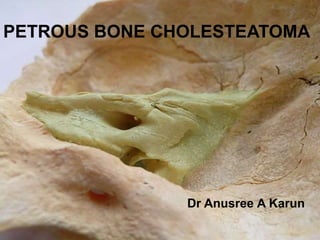
PETROUS
CHOLESTEA
TOMA
DR ANUSREE A KARUN
PETROUS BONE CHOLESTEATOMA
Dr Anusree A Karun
PETROUS BONE CHOLESTEATOMA
Uncommon pathologic
condition(4-6% of all temporal
bone lesions)used to define an
epidermoid cyst of the petrous
portion of the temporal bone
A surgical challenge
considering the complex
anatomic relationship with vital
intracranial structures and the
risk of csf leak .
Two cases of petrous bone
cholesteatoma are entailed here.
CASE REPORT
CASE1
A 49 yr old male pt
came with H/O left ear
discharge-since 10yrs
H/O head ache-4
months
Patient also had left
facial palsy hard of
hearing & following
previous surgery for
cholesteatoma
k/c/o DM,HTN-1yr on
treatment
CASE 2
24 yr old male
presented with chief
complaints of
Left sided headache
-4mnths
And Giddiness *3
mnths
No h/o any
comorbidities
PAST HISTORY
CASE1
Pt underwent modified
radical mastoidectomy in
2014 (for extensive
cholesteatoma)
Radical mastoidectomy in
2015(for recurrent
cholesteatoma )
Craniotomies twice for
extradural abscess and
zygoma excision for
zygomatic abscess in 2016
CASE2
H/O MRM 8 yrsback
GENERAL PHYSICAL EXAMINATION
General examination:
Pt GC fair
Afebrile
Nopallor/icterus/cyanosis/lymphadenopathy/clubbing/pedal edema
CVS-s1,s2+
RS-B/L AE+
P/A-soft,no organomegaly
CNS-NFND
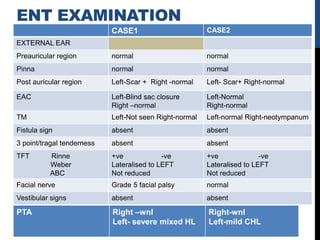
ENT EXAMINATION
PTA Right –wnl
Left- severe mixed HL
Right-wnl
Left-mild CHL
CASE1 CASE2
EXTERNAL EAR
Preauricular region normal normal
Pinna normal normal
Post auricular region Left-Scar + Right -normal Left- Scar+ Right-normal
EAC Left-Blind sac closure
Right –normal
Left-Normal
Right-normal
TM Left-Not seen Right-normal Left-normal Right-neotympanum
Fistula sign absent absent
3 point/tragal tenderness absent absent
TFT Rinne
Weber
ABC
+ve -ve
Lateralised to LEFT
Not reduced
+ve -ve
Lateralised to LEFT
Not reduced
Facial nerve Grade 5 facial palsy normal
Vestibular signs absent absent
CASE1- HRCT-craniotomy
defect + large cystic
destructive lesion noted in
left EAC,ME
cavity,squamous,temporal,m
astoid and PETROUS
portion and facial canal
F/s/o ? recurrent
cholesteatoma –with petrous
bone involvement
CASE2 HRCT-soft tissue
opacity note in the left
mastoid and extending into
petrous temporal bone
Middle ear appears
normal,with intact ossicles
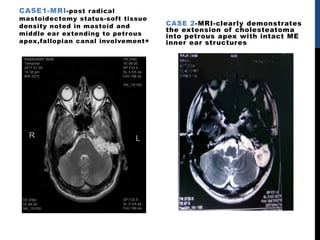
CASE 2-MRI-clearly demonstrates
the extension of cholesteatoma
into petrous apex with intact ME
inner ear structures
CASE1-MRI-post radical
mastoidectomy status-soft tissue
density noted in mastoid and
middle ear extending to petrous
apex,fallopian canal involvement+
RAMASAMY 49/M
Temporal
2017 01 05
16 38 pm
BIR 3372
R
R L
TR 3760
TE 89.00
‘KK_15/150
TR 3760
TE 89.00
SP F33 5
SL 5 0/5 44
FeV 186 4s
‘KK_15/150
SP F33 5
SL 5 0/5 44
FeV 186 4s
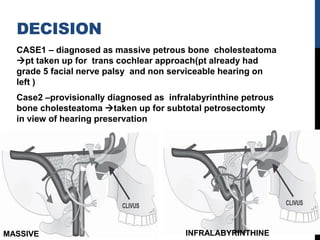
DECISION
CASE1 – diagnosed as massive petrous bone cholesteatoma
pt taken up for trans cochlear approach(pt already had
grade 5 facial nerve palsy and non serviceable hearing on
left )
Case2 –provisionally diagnosed as infralabyrinthine petrous
bone cholesteatoma taken up for subtotal petrosectomty
in view of hearing preservation
MASSIVE INFRALABYRINTHINE
SURGERY VIDEO
PETROUS BONE-RELEVANT
ANATOMY
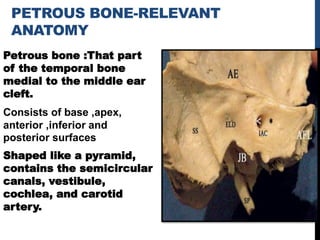
Petrous bone :That part
of the temporal bone
medial to the middle ear
cleft.
Consists of base ,apex,
anterior ,inferior and
posterior surfaces
Shaped like a pyramid,
contains the semicircular
canals, vestibule,
cochlea, and carotid
artery.
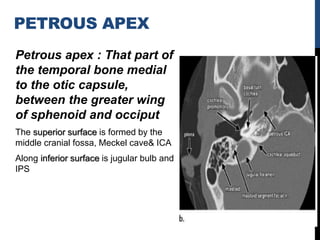
PETROUS APEX
Petrous apex : That part of
the temporal bone medial
to the otic capsule,
between the greater wing
of sphenoid and occiput
The superior surface is formed by the
middle cranial fossa, Meckel cave& ICA
Along inferior surface is jugular bulb and
IPS
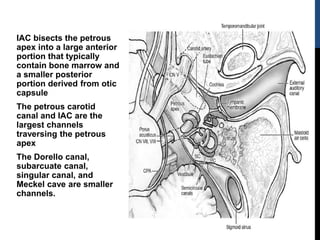
IAC bisects the petrous
apex into a large anterior
portion that typically
contain bone marrow and
a smaller posterior
portion derived from otic
capsule
The petrous carotid
canal and IAC are the
largest channels
traversing the petrous
apex
The Dorello canal,
subarcuate canal,
singular canal, and
Meckel cave are smaller
channels.
PBC-CLASSIFICATION
According to Sanna et al. [1993] PBCs can be classified into
five groups:
 supralabyrinthine-geniculate ganglion
 infralabyrinthine-hypotympanic and infralabyrinthine cells
infralabyrinthine-apical-infralabyrinthine compartment
extending to petrous apex
Massive-otic capsule
Apical-petrous apex
These terms describe both the location and the extent of the
lesion.
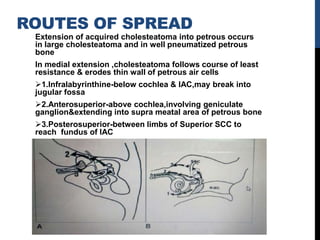
ROUTES OF SPREAD
Extension of acquired cholesteatoma into petrous occurs
in large cholesteatoma and in well pneumatized petrous
bone
In medial extension ,cholesteatoma follows course of least
resistance & erodes thin wall of petrous air cells
1.Infralabyrinthine-below cochlea & IAC,may break into
jugular fossa
2.Anterosuperior-above cochlea,involving geniculate
ganglion&extending into supra meatal area of petrous bone
3.Posterosuperior-between limbs of Superior SCC to
reach fundus of IAC
1.Subaarcuate
via arch of scc-FRECKNER
2.Retrolabyrinthine
Superior to lscc & posterior to superior
scc-THORNWALDT
3.Infralabyrinthine(hearing preserving)
inferior to posterior scc
posterior to VII nerve and superior to
jugular bulb[DEARMIN &FARRIOR]
4.Subcochlear/infracochlear-(hearing
preserving)hypotympanic air cell tract
between ica,jugular bulb and
cochlea[FARRIOR]
5/6.peritubal–
b/w ica,cochlea and tegmen
5-Ramdier/lempert
6-Kopetsky/Almoor
7.Middle cranial fossa (hearing
preserving) EAGLETON
TREATMENT PROTOCOL
Main factors to be considered are
(1) complete eradication of the disease
(2) preservation of facial nerve function,
(3) prevention of CSF leak and meningitis,
(4) Cavity obliteration
(5) hearing preservation whenever feasible
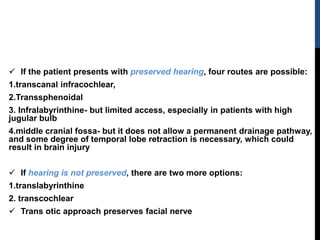
 If the patient presents with preserved hearing, four routes are possible:
1.transcanal infracochlear,
2.Transsphenoidal
3. Infralabyrinthine- but limited access, especially in patients with high
jugular bulb
4.middle cranial fossa- but it does not allow a permanent drainage pathway,
and some degree of temporal lobe retraction is necessary, which could
result in brain injury
 If hearing is not preserved, there are two more options:
1.translabyrinthine
2. transcochlear
 Trans otic approach preserves facial nerve
TREATMENT PROTOCOL
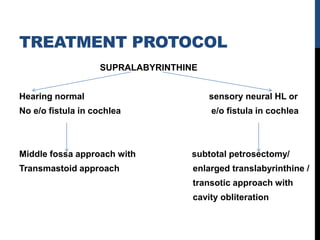
SUPRALABYRINTHINE
Hearing normal sensory neural HL or
No e/o fistula in cochlea e/o fistula in cochlea
Middle fossa approach with subtotal petrosectomy/
Transmastoid approach enlarged translabyrinthine /
transotic approach with
cavity obliteration
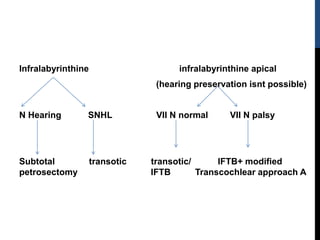
Infralabyrinthine infralabyrinthine apical
(hearing preservation isnt possible)
N Hearing SNHL VII N normal VII N palsy
Subtotal transotic transotic/ IFTB+ modified
petrosectomy IFTB Transcochlear approach A
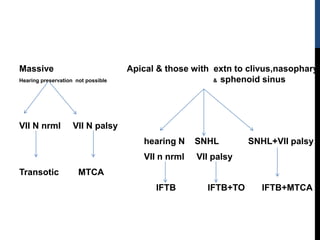
Massive Apical & those with extn to clivus,nasopharyn
Hearing preservation not possible & sphenoid sinus
VII N nrml VII N palsy
hearing N SNHL SNHL+VII palsy
VII n nrml VII palsy
Transotic MTCA
IFTB IFTB+TO IFTB+MTCA
CONCLUSION
• With thorough pretreatment evaluation of location and extent of lesion ,
meticulous radiological assessment, planning and execution, the difficult
terrain of petrous apex can be approached and dealt with successful
results
• Unlike any other lesion of the petrous apex ,cholesteatoma has the
advantage of total removal and disease clearance in the hands of an
experienced surgeon with meticuluos dissection ,by simply foolowing the
lesion
• Classification is important to decide the appropriate surgical approach.
• The facial nerve requires special consideration as it gets involved in
almost all the cases and is a cornerstone of management.
• Radical removal takes priority over hearing preservation even in only
hearing ears with the possibility of hearing rehabilitation (CI, BAHA and
Soundbridge).
• Regular follow-up is mandatory

Petrous cholesteatoma sample

  • 1.
    PETROUS CHOLESTEA TOMA DR ANUSREE AKARUN PETROUS BONE CHOLESTEATOMA Dr Anusree A Karun
  • 2.
    PETROUS BONE CHOLESTEATOMA Uncommonpathologic condition(4-6% of all temporal bone lesions)used to define an epidermoid cyst of the petrous portion of the temporal bone A surgical challenge considering the complex anatomic relationship with vital intracranial structures and the risk of csf leak . Two cases of petrous bone cholesteatoma are entailed here.
  • 3.
    CASE REPORT CASE1 A 49yr old male pt came with H/O left ear discharge-since 10yrs H/O head ache-4 months Patient also had left facial palsy hard of hearing & following previous surgery for cholesteatoma k/c/o DM,HTN-1yr on treatment CASE 2 24 yr old male presented with chief complaints of Left sided headache -4mnths And Giddiness *3 mnths No h/o any comorbidities
  • 4.
    PAST HISTORY CASE1 Pt underwentmodified radical mastoidectomy in 2014 (for extensive cholesteatoma) Radical mastoidectomy in 2015(for recurrent cholesteatoma ) Craniotomies twice for extradural abscess and zygoma excision for zygomatic abscess in 2016 CASE2 H/O MRM 8 yrsback
  • 5.
    GENERAL PHYSICAL EXAMINATION Generalexamination: Pt GC fair Afebrile Nopallor/icterus/cyanosis/lymphadenopathy/clubbing/pedal edema CVS-s1,s2+ RS-B/L AE+ P/A-soft,no organomegaly CNS-NFND
  • 6.
    ENT EXAMINATION PTA Right–wnl Left- severe mixed HL Right-wnl Left-mild CHL CASE1 CASE2 EXTERNAL EAR Preauricular region normal normal Pinna normal normal Post auricular region Left-Scar + Right -normal Left- Scar+ Right-normal EAC Left-Blind sac closure Right –normal Left-Normal Right-normal TM Left-Not seen Right-normal Left-normal Right-neotympanum Fistula sign absent absent 3 point/tragal tenderness absent absent TFT Rinne Weber ABC +ve -ve Lateralised to LEFT Not reduced +ve -ve Lateralised to LEFT Not reduced Facial nerve Grade 5 facial palsy normal Vestibular signs absent absent
  • 7.
    CASE1- HRCT-craniotomy defect +large cystic destructive lesion noted in left EAC,ME cavity,squamous,temporal,m astoid and PETROUS portion and facial canal F/s/o ? recurrent cholesteatoma –with petrous bone involvement CASE2 HRCT-soft tissue opacity note in the left mastoid and extending into petrous temporal bone Middle ear appears normal,with intact ossicles
  • 8.
    CASE 2-MRI-clearly demonstrates theextension of cholesteatoma into petrous apex with intact ME inner ear structures CASE1-MRI-post radical mastoidectomy status-soft tissue density noted in mastoid and middle ear extending to petrous apex,fallopian canal involvement+ RAMASAMY 49/M Temporal 2017 01 05 16 38 pm BIR 3372 R R L TR 3760 TE 89.00 ‘KK_15/150 TR 3760 TE 89.00 SP F33 5 SL 5 0/5 44 FeV 186 4s ‘KK_15/150 SP F33 5 SL 5 0/5 44 FeV 186 4s
  • 9.
    DECISION CASE1 – diagnosedas massive petrous bone cholesteatoma pt taken up for trans cochlear approach(pt already had grade 5 facial nerve palsy and non serviceable hearing on left ) Case2 –provisionally diagnosed as infralabyrinthine petrous bone cholesteatoma taken up for subtotal petrosectomty in view of hearing preservation MASSIVE INFRALABYRINTHINE
  • 10.
  • 11.
    PETROUS BONE-RELEVANT ANATOMY Petrous bone:That part of the temporal bone medial to the middle ear cleft. Consists of base ,apex, anterior ,inferior and posterior surfaces Shaped like a pyramid, contains the semicircular canals, vestibule, cochlea, and carotid artery.
  • 12.
    PETROUS APEX Petrous apex: That part of the temporal bone medial to the otic capsule, between the greater wing of sphenoid and occiput The superior surface is formed by the middle cranial fossa, Meckel cave& ICA Along inferior surface is jugular bulb and IPS
  • 13.
    IAC bisects thepetrous apex into a large anterior portion that typically contain bone marrow and a smaller posterior portion derived from otic capsule The petrous carotid canal and IAC are the largest channels traversing the petrous apex The Dorello canal, subarcuate canal, singular canal, and Meckel cave are smaller channels.
  • 14.
    PBC-CLASSIFICATION According to Sannaet al. [1993] PBCs can be classified into five groups:  supralabyrinthine-geniculate ganglion  infralabyrinthine-hypotympanic and infralabyrinthine cells infralabyrinthine-apical-infralabyrinthine compartment extending to petrous apex Massive-otic capsule Apical-petrous apex These terms describe both the location and the extent of the lesion.
  • 15.
    ROUTES OF SPREAD Extensionof acquired cholesteatoma into petrous occurs in large cholesteatoma and in well pneumatized petrous bone In medial extension ,cholesteatoma follows course of least resistance & erodes thin wall of petrous air cells 1.Infralabyrinthine-below cochlea & IAC,may break into jugular fossa 2.Anterosuperior-above cochlea,involving geniculate ganglion&extending into supra meatal area of petrous bone 3.Posterosuperior-between limbs of Superior SCC to reach fundus of IAC
  • 16.
    1.Subaarcuate via arch ofscc-FRECKNER 2.Retrolabyrinthine Superior to lscc & posterior to superior scc-THORNWALDT 3.Infralabyrinthine(hearing preserving) inferior to posterior scc posterior to VII nerve and superior to jugular bulb[DEARMIN &FARRIOR] 4.Subcochlear/infracochlear-(hearing preserving)hypotympanic air cell tract between ica,jugular bulb and cochlea[FARRIOR] 5/6.peritubal– b/w ica,cochlea and tegmen 5-Ramdier/lempert 6-Kopetsky/Almoor 7.Middle cranial fossa (hearing preserving) EAGLETON
  • 17.
    TREATMENT PROTOCOL Main factorsto be considered are (1) complete eradication of the disease (2) preservation of facial nerve function, (3) prevention of CSF leak and meningitis, (4) Cavity obliteration (5) hearing preservation whenever feasible
  • 18.
     If thepatient presents with preserved hearing, four routes are possible: 1.transcanal infracochlear, 2.Transsphenoidal 3. Infralabyrinthine- but limited access, especially in patients with high jugular bulb 4.middle cranial fossa- but it does not allow a permanent drainage pathway, and some degree of temporal lobe retraction is necessary, which could result in brain injury  If hearing is not preserved, there are two more options: 1.translabyrinthine 2. transcochlear  Trans otic approach preserves facial nerve
  • 19.
    TREATMENT PROTOCOL SUPRALABYRINTHINE Hearing normalsensory neural HL or No e/o fistula in cochlea e/o fistula in cochlea Middle fossa approach with subtotal petrosectomy/ Transmastoid approach enlarged translabyrinthine / transotic approach with cavity obliteration
  • 20.
    Infralabyrinthine infralabyrinthine apical (hearingpreservation isnt possible) N Hearing SNHL VII N normal VII N palsy Subtotal transotic transotic/ IFTB+ modified petrosectomy IFTB Transcochlear approach A
  • 21.
    Massive Apical &those with extn to clivus,nasopharyn Hearing preservation not possible & sphenoid sinus VII N nrml VII N palsy hearing N SNHL SNHL+VII palsy VII n nrml VII palsy Transotic MTCA IFTB IFTB+TO IFTB+MTCA
  • 22.
    CONCLUSION • With thoroughpretreatment evaluation of location and extent of lesion , meticulous radiological assessment, planning and execution, the difficult terrain of petrous apex can be approached and dealt with successful results • Unlike any other lesion of the petrous apex ,cholesteatoma has the advantage of total removal and disease clearance in the hands of an experienced surgeon with meticuluos dissection ,by simply foolowing the lesion • Classification is important to decide the appropriate surgical approach. • The facial nerve requires special consideration as it gets involved in almost all the cases and is a cornerstone of management. • Radical removal takes priority over hearing preservation even in only hearing ears with the possibility of hearing rehabilitation (CI, BAHA and Soundbridge). • Regular follow-up is mandatory