Tonsillitis, Tonsillectomy and
Adenoidectomy
Steven T. Wright, M.D.Steven T. Wright, M.D.
Ronald Deskin, M.D.Ronald Deskin, M.D.
November 5, 2003November 5, 2003
Adenotonsillectomy
 Most commonly performed procedure in theMost commonly performed procedure in the
history of surgeryhistory of surgery
 $500 million annually in healthcare$500 million annually in healthcare
expendituresexpenditures
History
 Almost exclusively by OtolaryngologistsAlmost exclusively by Otolaryngologists
 Celsus in 50 A.D.Celsus in 50 A.D.
 Caque of RheimsCaque of Rheims
 Phillip Syng developed the tonsillotomePhillip Syng developed the tonsillotome
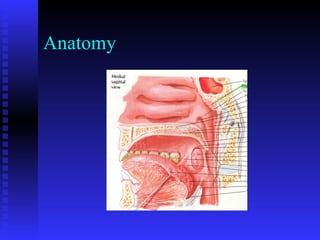
Anatomy
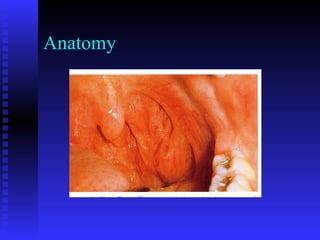
Anatomy
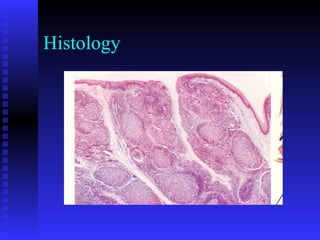
Histology
Clinical Evaluation
 Acute TonsillitisAcute Tonsillitis
 Chronic TonsillitisChronic Tonsillitis
 Obstructive Tonsillar HyperplasiaObstructive Tonsillar Hyperplasia
Clinical Evaluation
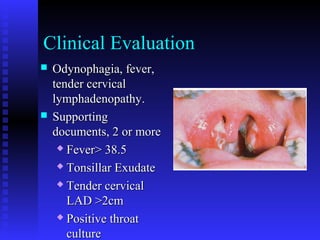
 Odynophagia, fever,Odynophagia, fever,
tender cervicaltender cervical
lymphadenopathy.lymphadenopathy.
 SupportingSupporting
documents, 2 or moredocuments, 2 or more
 Fever> 38.5Fever> 38.5
 Tonsillar ExudateTonsillar Exudate
 Tender cervicalTender cervical
LAD >2cmLAD >2cm
 Positive throatPositive throat
cultureculture
Clinical evaluation
 ViralViral
 Lower grade feverLower grade fever
 Lower WBC, Lymphocytic shiftLower WBC, Lymphocytic shift
 Less tonsillar exudateLess tonsillar exudate
 BacterialBacterial
 Higher WBC, Granulocytic shiftHigher WBC, Granulocytic shift
 More exudativeMore exudative
Recurrent Acute Tonsillitis
 Seven episodes in a single yearSeven episodes in a single year
 Five or more episodes in 2 yearsFive or more episodes in 2 years
 Three or more episodes in 3 yearsThree or more episodes in 3 years
Chronic Tonsillitis
 No true consensus on the definition.No true consensus on the definition.
 Symptoms greater than 4 weeksSymptoms greater than 4 weeks
Differential Diagnosis
 Infectious MononucleosisInfectious Mononucleosis
 EBVEBV
 Scarlet FeverScarlet Fever
 Corynebacterium diptheriaeCorynebacterium diptheriae
 MalignancyMalignancy
Complications of Tonsillitis
 Cervical AdenitisCervical Adenitis
 Neck AbscessNeck Abscess
 Peritonsillar abscessPeritonsillar abscess
 Intratonsillar abscessIntratonsillar abscess
 Lemierre’s syndromeLemierre’s syndrome
Post Streptococcal
Glomerulonephritis
 Joint Pain and oliguric renal failure 10 daysJoint Pain and oliguric renal failure 10 days
after the pharyngitis.after the pharyngitis.
 Treatment aimed at eliminating theTreatment aimed at eliminating the
infection and supportive therapy for renalinfection and supportive therapy for renal
failure.failure.
 Excellent prognosis in children.Excellent prognosis in children.
Adenoid Hyperplasia
 TriadTriad
 HyponasalityHyponasality
 SnoringSnoring
 Open mouth breathingOpen mouth breathing
 Purulent rhinorrhea, post nasal drip, chronicPurulent rhinorrhea, post nasal drip, chronic
cough, and headachecough, and headache
Obstructive Airway Symptoms
 SnoringSnoring
 Apneic episodes with gasping or chokingApneic episodes with gasping or choking
 Daytime hypersomnolenceDaytime hypersomnolence
 Nocturnal enuresisNocturnal enuresis
 Behavioral disturbancesBehavioral disturbances
 Heart failure and Failure to thriveHeart failure and Failure to thrive
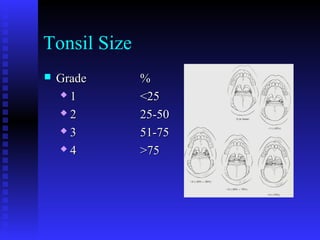
Tonsil Size
 GradeGrade %%
 11 <25<25
 22 25-5025-50
 33 51-7551-75
 44 >75>75
Obstructive Sleep Apnea
 Polysomnography is the gold standard ofPolysomnography is the gold standard of
diagnosis.diagnosis.
 Imperative in AdultsImperative in Adults
 In children, a convincing history isIn children, a convincing history is
adequateadequate
 OSA: RDI > 5, SpO2<90%OSA: RDI > 5, SpO2<90%
 UARS: RDI <5, SpO2 >90%UARS: RDI <5, SpO2 >90%
 Primary Snoring: RDI <1, SpO2>90%Primary Snoring: RDI <1, SpO2>90%
Medical Therapy
 TCHP recommends confirming bacterialTCHP recommends confirming bacterial
pharyngitis before beginning antibiotics.pharyngitis before beginning antibiotics.
 Rapid Strep TestRapid Strep Test
 Throat CultureThroat Culture
Medical Therapy
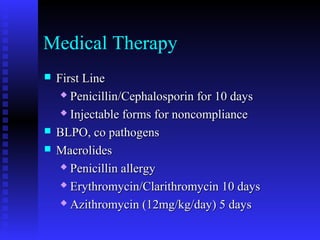
 First LineFirst Line
 Penicillin/Cephalosporin for 10 daysPenicillin/Cephalosporin for 10 days
 Injectable forms for noncomplianceInjectable forms for noncompliance
 BLPO, co pathogensBLPO, co pathogens
 MacrolidesMacrolides
 Penicillin allergyPenicillin allergy
 Erythromycin/Clarithromycin 10 daysErythromycin/Clarithromycin 10 days
 Azithromycin (12mg/kg/day) 5 daysAzithromycin (12mg/kg/day) 5 days
Medical Therapy
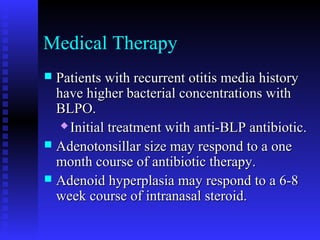
 Patients with recurrent otitis media historyPatients with recurrent otitis media history
have higher bacterial concentrations withhave higher bacterial concentrations with
BLPO.BLPO.
 Initial treatment with anti-BLP antibiotic.Initial treatment with anti-BLP antibiotic.
 Adenotonsillar size may respond to a oneAdenotonsillar size may respond to a one
month course of antibiotic therapy.month course of antibiotic therapy.
 Adenoid hyperplasia may respond to a 6-8Adenoid hyperplasia may respond to a 6-8
week course of intranasal steroid.week course of intranasal steroid.
Surgical Indications
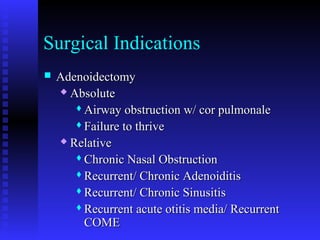
 AdenoidectomyAdenoidectomy
 AbsoluteAbsolute
Airway obstruction w/ cor pulmonaleAirway obstruction w/ cor pulmonale
Failure to thriveFailure to thrive
 RelativeRelative
Chronic Nasal ObstructionChronic Nasal Obstruction
Recurrent/ Chronic AdenoiditisRecurrent/ Chronic Adenoiditis
Recurrent/ Chronic SinusitisRecurrent/ Chronic Sinusitis
Recurrent acute otitis media/ RecurrentRecurrent acute otitis media/ Recurrent
COMECOME
Surgical Indications
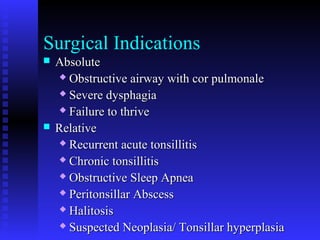
 AbsoluteAbsolute
 Obstructive airway with cor pulmonaleObstructive airway with cor pulmonale
 Severe dysphagiaSevere dysphagia
 Failure to thriveFailure to thrive
 RelativeRelative
 Recurrent acute tonsillitisRecurrent acute tonsillitis
 Chronic tonsillitisChronic tonsillitis
 Obstructive Sleep ApneaObstructive Sleep Apnea
 Peritonsillar AbscessPeritonsillar Abscess
 HalitosisHalitosis
 Suspected Neoplasia/ Tonsillar hyperplasiaSuspected Neoplasia/ Tonsillar hyperplasia
Preoperative evaluation
 Most common lab test is a CBCMost common lab test is a CBC
 Coagulation studies when the history orCoagulation studies when the history or
physical examination suggests a bleedingphysical examination suggests a bleeding
disorder.disorder.
 Lateral Neck/Adenoid filmsLateral Neck/Adenoid films
Von Willebrand’s Disease
 Autosomal dominant bleeding disorderAutosomal dominant bleeding disorder
 Increased bleeding time and prolongedIncreased bleeding time and prolonged
aPTT.aPTT.
 Perioperative managementPerioperative management
 IV Desmopressin (0.3ugm/kg)IV Desmopressin (0.3ugm/kg)
 Serum SodiumSerum Sodium
Idiopathic Thrombocytopenic
Purpura
 Most common thrombocytopenia ofMost common thrombocytopenia of
childhood.childhood.
 90% resolution by 9-12 months90% resolution by 9-12 months
 SplenectomySplenectomy
 IVIG preoperativelyIVIG preoperatively
Innovative Surgical Techniques
 Cold DissectionCold Dissection
 ElectrosurgeryElectrosurgery
 Intracapsular partial tonsillectomyIntracapsular partial tonsillectomy
 Harmonic ScalpelHarmonic Scalpel
 Radiofrequency tonsillar ablation andRadiofrequency tonsillar ablation and
coblation.coblation.
Electrosurgery
 Most popular technique for tonsillectomyMost popular technique for tonsillectomy
 Equivalent or superior to the other methodsEquivalent or superior to the other methods
of tonsillectomy.of tonsillectomy.
Intracapsular Partial
Tonsillectomy
 45 degree Microdebrider (1500rpm).45 degree Microdebrider (1500rpm).
 AdvantagesAdvantages
 As effective as standard tonsillectomy inAs effective as standard tonsillectomy in
relieving obstruction.relieving obstruction.
 Less pain, quicker return to normal dietLess pain, quicker return to normal diet
 Disadvantages:Disadvantages:
 Tonsillar regrowthTonsillar regrowth
 Greater intraoperative blood lossGreater intraoperative blood loss
Harmonic Scalpel
 Advantages:Advantages:
 Better visibilityBetter visibility
 Smaller risk of stray energy shocksSmaller risk of stray energy shocks
 Improved post operative painImproved post operative pain
 Disadvantages:Disadvantages:
 Must use alternate device for adenoidectomyMust use alternate device for adenoidectomy
 Similar intraoperative blood loss.Similar intraoperative blood loss.
Radiofrequency tonsillar
coblation
 Coblation is superior to ablation.Coblation is superior to ablation.
 Early elimination of pain and reduced painEarly elimination of pain and reduced pain
medicine usage.medicine usage.
 Early resumption of normal diet.Early resumption of normal diet.
 Currently inadequate for adenoidectomyCurrently inadequate for adenoidectomy
Adjuvant Therapies
Perioperative local anestheticPerioperative local anesthetic
0.25% bupivicaine w/ 1:100,0000.25% bupivicaine w/ 1:100,000
EpinephrineEpinephrine
Advantages:Advantages:
ease of dissection, postoperative painease of dissection, postoperative pain
Disadvantages:Disadvantages:
Airway obstruction, cardiac dysrrhythmias,Airway obstruction, cardiac dysrrhythmias,
seizuresseizures
Adjuvant Therapies
 Perioperative antibioticsPerioperative antibiotics
 Fewer episodes of fever, offensive odor,Fewer episodes of fever, offensive odor,
improved oral intake, less pain, fewerimproved oral intake, less pain, fewer
days to return to normal activitydays to return to normal activity
 Cardiac abnormalityCardiac abnormality
Adjuvant Therapies
 Perioperative SteroidsPerioperative Steroids
 Dexamethasone (0.15-1.0mg/kg)Dexamethasone (0.15-1.0mg/kg)
 Two times less likely to have an episodeTwo times less likely to have an episode
of postoperative emesis, and more likelyof postoperative emesis, and more likely
to advance to eating a soft diet.to advance to eating a soft diet.
 Reducing postoperative pulmonaryReducing postoperative pulmonary
distress, subglottic edema, paindistress, subglottic edema, pain
reduction.reduction.
Adjuvant Therapies
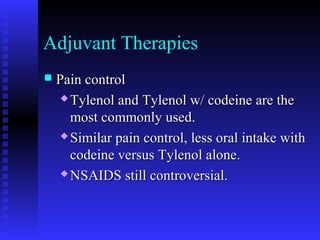
 Pain controlPain control
 Tylenol and Tylenol w/ codeine are theTylenol and Tylenol w/ codeine are the
most commonly used.most commonly used.
 Similar pain control, less oral intake withSimilar pain control, less oral intake with
codeine versus Tylenol alone.codeine versus Tylenol alone.
 NSAIDS still controversial.NSAIDS still controversial.
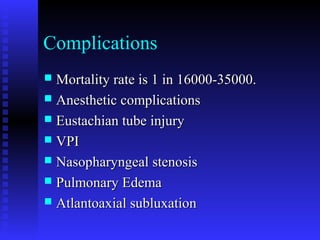
Complications
 Mortality rate is 1 in 16000-35000.Mortality rate is 1 in 16000-35000.
 Anesthetic complicationsAnesthetic complications
 Eustachian tube injuryEustachian tube injury
 VPIVPI
 Nasopharyngeal stenosisNasopharyngeal stenosis
 Pulmonary EdemaPulmonary Edema
 Atlantoaxial subluxationAtlantoaxial subluxation
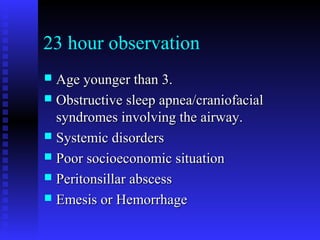
23 hour observation
 Age younger than 3.Age younger than 3.
 Obstructive sleep apnea/craniofacialObstructive sleep apnea/craniofacial
syndromes involving the airway.syndromes involving the airway.
 Systemic disordersSystemic disorders
 Poor socioeconomic situationPoor socioeconomic situation
 Peritonsillar abscessPeritonsillar abscess
 Emesis or HemorrhageEmesis or Hemorrhage
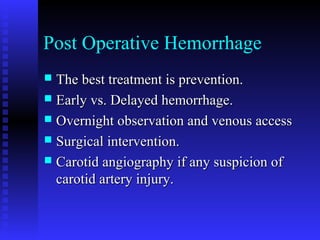
Post Operative Hemorrhage
 The best treatment is prevention.The best treatment is prevention.
 Early vs. Delayed hemorrhage.Early vs. Delayed hemorrhage.
 Overnight observation and venous accessOvernight observation and venous access
 Surgical intervention.Surgical intervention.
 Carotid angiography if any suspicion ofCarotid angiography if any suspicion of
carotid artery injury.carotid artery injury.
Case Study
 8yo male referred to the Pediatric clinic for8yo male referred to the Pediatric clinic for
evaluation and treatment of recurrentevaluation and treatment of recurrent
tonsillitis.tonsillitis.
History
 Only 2 episodes of documented pharyngitisOnly 2 episodes of documented pharyngitis
in the past 12 months, strep negative, onlyin the past 12 months, strep negative, only
missed 5 days of school total last year.missed 5 days of school total last year.
 Loud snoring, frequent pauses up to 5Loud snoring, frequent pauses up to 5
seconds terminated with gasps of breath.seconds terminated with gasps of breath.
Physical Examination
 Normal facies, open mouth breathing,Normal facies, open mouth breathing,
tonsils 3+, no cleft deformities.tonsils 3+, no cleft deformities.
 Remainder of exam is normal.Remainder of exam is normal.
Case Study
 Undergoes uneventful tonsillectomy andUndergoes uneventful tonsillectomy and
adenoidectomy with 23 hour observation.adenoidectomy with 23 hour observation.
 On follow up visit 2 weeks postoperatively,On follow up visit 2 weeks postoperatively,
his mom complains that he doesn’t likehis mom complains that he doesn’t like
some of his favorite foods. He says theysome of his favorite foods. He says they
taste “yucky”.taste “yucky”.
 Decreased perception of taste with no smellDecreased perception of taste with no smell
abnormalities.abnormalities.
Diagnosis
 DysgeusiaDysgeusia
 Unknown mechanism- thought to be due toUnknown mechanism- thought to be due to
prolonged pressure on the tongue by theprolonged pressure on the tongue by the
mouth retractor.mouth retractor.
 Treatment is reassurance.Treatment is reassurance.
 BibliographyBibliography
 Allen GC, et al. “Adenotonsillectomy in Children with von Willebrand Disease.” Archives of Otolaryngology 1999, May; 125(5) pp547-551.Allen GC, et al. “Adenotonsillectomy in Children with von Willebrand Disease.” Archives of Otolaryngology 1999, May; 125(5) pp547-551.
 Bailey BJ: Head and Neck Surgery- Otolaryngology, 3rd ed. Philadelphia, Lippincott-Raven, 2001, pp 979- 1006.Bailey BJ: Head and Neck Surgery- Otolaryngology, 3rd ed. Philadelphia, Lippincott-Raven, 2001, pp 979- 1006.
 Brook I, et al. “Microbiology of Healthy and Diseased Adenoids.” Laryngoscope 2000, June; 110(6): pp994-999.Brook I, et al. “Microbiology of Healthy and Diseased Adenoids.” Laryngoscope 2000, June; 110(6): pp994-999.
 Darrow D, Siemens C. “Indications for Tonsillectomy and Adenoidectomy.” Laryngoscope 2002, August; 112(8 part 2): pp6-10.Darrow D, Siemens C. “Indications for Tonsillectomy and Adenoidectomy.” Laryngoscope 2002, August; 112(8 part 2): pp6-10.
 Derkay C, Maddern B. “Innovative Techniques for Adenotonsillar Surgery in Children: Introduction and Commentary.” Laryngoscope 2002, August; 112(8Derkay C, Maddern B. “Innovative Techniques for Adenotonsillar Surgery in Children: Introduction and Commentary.” Laryngoscope 2002, August; 112(8
part 2): p2.part 2): p2.
 Friedman M, et al. “Radiofrequency Tonsil Reduction: Safety, Morbidity, and Efficacy.” Laryngoscope 2003, May; 113(5): pp882-887.Friedman M, et al. “Radiofrequency Tonsil Reduction: Safety, Morbidity, and Efficacy.” Laryngoscope 2003, May; 113(5): pp882-887.
 Goldstein N. “Child Behavior and Quality of Life Before and After Tonsillectomy and Adenoidectomy.” Archives of Otolaryngology 2002, July; 128(7):Goldstein N. “Child Behavior and Quality of Life Before and After Tonsillectomy and Adenoidectomy.” Archives of Otolaryngology 2002, July; 128(7):
pp770-775.pp770-775.
 Harley E. “Asymmetric Tonsil Size in Children.” Archives of Otolaryngology 2002, July; 128(7): pp767-769.Harley E. “Asymmetric Tonsil Size in Children.” Archives of Otolaryngology 2002, July; 128(7): pp767-769.
 Johnson L, et al. “Complications of Adenotonsillectomy.” Laryngoscope 2002, August; 112: pp35-36.Johnson L, et al. “Complications of Adenotonsillectomy.” Laryngoscope 2002, August; 112: pp35-36.
 Kay D, et al. “Perioperative Adenotonsillectomy Management in Children: Current practices.” Laryngoscope 2003, April: 113(4): pp 592-597.Kay D, et al. “Perioperative Adenotonsillectomy Management in Children: Current practices.” Laryngoscope 2003, April: 113(4): pp 592-597.
 Koempel J. “On the Origin of Tonsillectomy and the Dissection Method.” Laryngoscope 2002, September; 112(9): pp1583-1586.Koempel J. “On the Origin of Tonsillectomy and the Dissection Method.” Laryngoscope 2002, September; 112(9): pp1583-1586.
 Koltai P, et al. “Intracapsular Partial Tonsillectomy for Tonsillar Hypertrophy in Children.” Laryngoscope 2002, August; 112 (8 part 2): pp 17-19.Koltai P, et al. “Intracapsular Partial Tonsillectomy for Tonsillar Hypertrophy in Children.” Laryngoscope 2002, August; 112 (8 part 2): pp 17-19.
 Leinbach R, et al. “Hot versus Cold Tonsillectomy: A systematic review of the literature.” Otolaryngology-Head and Neck Surgery 2003, October; 129 (4):Leinbach R, et al. “Hot versus Cold Tonsillectomy: A systematic review of the literature.” Otolaryngology-Head and Neck Surgery 2003, October; 129 (4):
pp360-364.pp360-364.
 Maddern B. “Electrosurgery for tonsillectomy.” Laryngoscope 2002, August; 112(8 part 2): pp11-13.Maddern B. “Electrosurgery for tonsillectomy.” Laryngoscope 2002, August; 112(8 part 2): pp11-13.
 Mui S, et al. “Efficacy of Tonsillectomy for Recurrent Throat Infection in Adults.” Laryngoscope 1998, September; 108(9): pp1325-1328.Mui S, et al. “Efficacy of Tonsillectomy for Recurrent Throat Infection in Adults.” Laryngoscope 1998, September; 108(9): pp1325-1328.
 Plant R. “Radiofrequency Treatment of Tonsillar Hypertrophy.” Laryngoscope 2002, August; 112(8 part 2): pp20-22.Plant R. “Radiofrequency Treatment of Tonsillar Hypertrophy.” Laryngoscope 2002, August; 112(8 part 2): pp20-22.
 Steward D, et al. “Do Steroids Reduce Morbidity of Tonsillectomy? A Meta-analysis of Randomized Trials.” Laryngoscope 2001, October; 111(10):Steward D, et al. “Do Steroids Reduce Morbidity of Tonsillectomy? A Meta-analysis of Randomized Trials.” Laryngoscope 2001, October; 111(10):
pp1712-1718.pp1712-1718.
 Stewart R, et al. “Dexamethasone reduces pain after tonsillectomy in adults.” Clinical Otolaryngology and Allied Sciences 2002, October; 27(5): pp321-Stewart R, et al. “Dexamethasone reduces pain after tonsillectomy in adults.” Clinical Otolaryngology and Allied Sciences 2002, October; 27(5): pp321-
326.326.
 Thomsen J, Gower V. “Adjuvant Therapies in Children Undergoing Adenotonsillectomy.” Laryngoscope 2002, August; 112(8 part 2): pp32-34.Thomsen J, Gower V. “Adjuvant Therapies in Children Undergoing Adenotonsillectomy.” Laryngoscope 2002, August; 112(8 part 2): pp32-34.
 Warltier et al. “Effects of Non-Steroidal, Anti-inflammatory Drugs on Bleeding Risk after Tonsillectomy, Meta-analysis of Randomized Controlled Trails.”Warltier et al. “Effects of Non-Steroidal, Anti-inflammatory Drugs on Bleeding Risk after Tonsillectomy, Meta-analysis of Randomized Controlled Trails.”
Anesthesiology 2003, June; 98(6): pp1497-1502.Anesthesiology 2003, June; 98(6): pp1497-1502.
 Wiatrak B, Willging J. “Harmonic Scalpel for Tonsillectomy.” Laryngoscope 2002, August; 112(8 part 2): pp14-16.Wiatrak B, Willging J. “Harmonic Scalpel for Tonsillectomy.” Laryngoscope 2002, August; 112(8 part 2): pp14-16.
 Younis R, Lazar R. “History and Current Practice of Tonsillectomy.” Laryngoscope 2002, August; 112 (8 part 2): pp3-5.Younis R, Lazar R. “History and Current Practice of Tonsillectomy.” Laryngoscope 2002, August; 112 (8 part 2): pp3-5.

Tons slides-2003-1105

  • 1.
    Tonsillitis, Tonsillectomy and Adenoidectomy StevenT. Wright, M.D.Steven T. Wright, M.D. Ronald Deskin, M.D.Ronald Deskin, M.D. November 5, 2003November 5, 2003
  • 2.
    Adenotonsillectomy  Most commonlyperformed procedure in theMost commonly performed procedure in the history of surgeryhistory of surgery  $500 million annually in healthcare$500 million annually in healthcare expendituresexpenditures
  • 3.
    History  Almost exclusivelyby OtolaryngologistsAlmost exclusively by Otolaryngologists  Celsus in 50 A.D.Celsus in 50 A.D.  Caque of RheimsCaque of Rheims  Phillip Syng developed the tonsillotomePhillip Syng developed the tonsillotome
  • 4.
  • 5.
  • 6.
  • 7.
    Clinical Evaluation  AcuteTonsillitisAcute Tonsillitis  Chronic TonsillitisChronic Tonsillitis  Obstructive Tonsillar HyperplasiaObstructive Tonsillar Hyperplasia
  • 8.
    Clinical Evaluation  Odynophagia,fever,Odynophagia, fever, tender cervicaltender cervical lymphadenopathy.lymphadenopathy.  SupportingSupporting documents, 2 or moredocuments, 2 or more  Fever> 38.5Fever> 38.5  Tonsillar ExudateTonsillar Exudate  Tender cervicalTender cervical LAD >2cmLAD >2cm  Positive throatPositive throat cultureculture
  • 9.
    Clinical evaluation  ViralViral Lower grade feverLower grade fever  Lower WBC, Lymphocytic shiftLower WBC, Lymphocytic shift  Less tonsillar exudateLess tonsillar exudate  BacterialBacterial  Higher WBC, Granulocytic shiftHigher WBC, Granulocytic shift  More exudativeMore exudative
  • 10.
    Recurrent Acute Tonsillitis Seven episodes in a single yearSeven episodes in a single year  Five or more episodes in 2 yearsFive or more episodes in 2 years  Three or more episodes in 3 yearsThree or more episodes in 3 years
  • 11.
    Chronic Tonsillitis  Notrue consensus on the definition.No true consensus on the definition.  Symptoms greater than 4 weeksSymptoms greater than 4 weeks
  • 12.
    Differential Diagnosis  InfectiousMononucleosisInfectious Mononucleosis  EBVEBV  Scarlet FeverScarlet Fever  Corynebacterium diptheriaeCorynebacterium diptheriae  MalignancyMalignancy
  • 13.
    Complications of Tonsillitis Cervical AdenitisCervical Adenitis  Neck AbscessNeck Abscess  Peritonsillar abscessPeritonsillar abscess  Intratonsillar abscessIntratonsillar abscess  Lemierre’s syndromeLemierre’s syndrome
  • 14.
    Post Streptococcal Glomerulonephritis  JointPain and oliguric renal failure 10 daysJoint Pain and oliguric renal failure 10 days after the pharyngitis.after the pharyngitis.  Treatment aimed at eliminating theTreatment aimed at eliminating the infection and supportive therapy for renalinfection and supportive therapy for renal failure.failure.  Excellent prognosis in children.Excellent prognosis in children.
  • 15.
    Adenoid Hyperplasia  TriadTriad HyponasalityHyponasality  SnoringSnoring  Open mouth breathingOpen mouth breathing  Purulent rhinorrhea, post nasal drip, chronicPurulent rhinorrhea, post nasal drip, chronic cough, and headachecough, and headache
  • 16.
    Obstructive Airway Symptoms SnoringSnoring  Apneic episodes with gasping or chokingApneic episodes with gasping or choking  Daytime hypersomnolenceDaytime hypersomnolence  Nocturnal enuresisNocturnal enuresis  Behavioral disturbancesBehavioral disturbances  Heart failure and Failure to thriveHeart failure and Failure to thrive
  • 17.
    Tonsil Size  GradeGrade%%  11 <25<25  22 25-5025-50  33 51-7551-75  44 >75>75
  • 18.
    Obstructive Sleep Apnea Polysomnography is the gold standard ofPolysomnography is the gold standard of diagnosis.diagnosis.  Imperative in AdultsImperative in Adults  In children, a convincing history isIn children, a convincing history is adequateadequate  OSA: RDI > 5, SpO2<90%OSA: RDI > 5, SpO2<90%  UARS: RDI <5, SpO2 >90%UARS: RDI <5, SpO2 >90%  Primary Snoring: RDI <1, SpO2>90%Primary Snoring: RDI <1, SpO2>90%
  • 19.
    Medical Therapy  TCHPrecommends confirming bacterialTCHP recommends confirming bacterial pharyngitis before beginning antibiotics.pharyngitis before beginning antibiotics.  Rapid Strep TestRapid Strep Test  Throat CultureThroat Culture
  • 20.
    Medical Therapy  FirstLineFirst Line  Penicillin/Cephalosporin for 10 daysPenicillin/Cephalosporin for 10 days  Injectable forms for noncomplianceInjectable forms for noncompliance  BLPO, co pathogensBLPO, co pathogens  MacrolidesMacrolides  Penicillin allergyPenicillin allergy  Erythromycin/Clarithromycin 10 daysErythromycin/Clarithromycin 10 days  Azithromycin (12mg/kg/day) 5 daysAzithromycin (12mg/kg/day) 5 days
  • 21.
    Medical Therapy  Patientswith recurrent otitis media historyPatients with recurrent otitis media history have higher bacterial concentrations withhave higher bacterial concentrations with BLPO.BLPO.  Initial treatment with anti-BLP antibiotic.Initial treatment with anti-BLP antibiotic.  Adenotonsillar size may respond to a oneAdenotonsillar size may respond to a one month course of antibiotic therapy.month course of antibiotic therapy.  Adenoid hyperplasia may respond to a 6-8Adenoid hyperplasia may respond to a 6-8 week course of intranasal steroid.week course of intranasal steroid.
  • 22.
    Surgical Indications  AdenoidectomyAdenoidectomy AbsoluteAbsolute Airway obstruction w/ cor pulmonaleAirway obstruction w/ cor pulmonale Failure to thriveFailure to thrive  RelativeRelative Chronic Nasal ObstructionChronic Nasal Obstruction Recurrent/ Chronic AdenoiditisRecurrent/ Chronic Adenoiditis Recurrent/ Chronic SinusitisRecurrent/ Chronic Sinusitis Recurrent acute otitis media/ RecurrentRecurrent acute otitis media/ Recurrent COMECOME
  • 23.
    Surgical Indications  AbsoluteAbsolute Obstructive airway with cor pulmonaleObstructive airway with cor pulmonale  Severe dysphagiaSevere dysphagia  Failure to thriveFailure to thrive  RelativeRelative  Recurrent acute tonsillitisRecurrent acute tonsillitis  Chronic tonsillitisChronic tonsillitis  Obstructive Sleep ApneaObstructive Sleep Apnea  Peritonsillar AbscessPeritonsillar Abscess  HalitosisHalitosis  Suspected Neoplasia/ Tonsillar hyperplasiaSuspected Neoplasia/ Tonsillar hyperplasia
  • 24.
    Preoperative evaluation  Mostcommon lab test is a CBCMost common lab test is a CBC  Coagulation studies when the history orCoagulation studies when the history or physical examination suggests a bleedingphysical examination suggests a bleeding disorder.disorder.  Lateral Neck/Adenoid filmsLateral Neck/Adenoid films
  • 25.
    Von Willebrand’s Disease Autosomal dominant bleeding disorderAutosomal dominant bleeding disorder  Increased bleeding time and prolongedIncreased bleeding time and prolonged aPTT.aPTT.  Perioperative managementPerioperative management  IV Desmopressin (0.3ugm/kg)IV Desmopressin (0.3ugm/kg)  Serum SodiumSerum Sodium
  • 26.
    Idiopathic Thrombocytopenic Purpura  Mostcommon thrombocytopenia ofMost common thrombocytopenia of childhood.childhood.  90% resolution by 9-12 months90% resolution by 9-12 months  SplenectomySplenectomy  IVIG preoperativelyIVIG preoperatively
  • 27.
    Innovative Surgical Techniques Cold DissectionCold Dissection  ElectrosurgeryElectrosurgery  Intracapsular partial tonsillectomyIntracapsular partial tonsillectomy  Harmonic ScalpelHarmonic Scalpel  Radiofrequency tonsillar ablation andRadiofrequency tonsillar ablation and coblation.coblation.
  • 28.
    Electrosurgery  Most populartechnique for tonsillectomyMost popular technique for tonsillectomy  Equivalent or superior to the other methodsEquivalent or superior to the other methods of tonsillectomy.of tonsillectomy.
  • 29.
    Intracapsular Partial Tonsillectomy  45degree Microdebrider (1500rpm).45 degree Microdebrider (1500rpm).  AdvantagesAdvantages  As effective as standard tonsillectomy inAs effective as standard tonsillectomy in relieving obstruction.relieving obstruction.  Less pain, quicker return to normal dietLess pain, quicker return to normal diet  Disadvantages:Disadvantages:  Tonsillar regrowthTonsillar regrowth  Greater intraoperative blood lossGreater intraoperative blood loss
  • 30.
    Harmonic Scalpel  Advantages:Advantages: Better visibilityBetter visibility  Smaller risk of stray energy shocksSmaller risk of stray energy shocks  Improved post operative painImproved post operative pain  Disadvantages:Disadvantages:  Must use alternate device for adenoidectomyMust use alternate device for adenoidectomy  Similar intraoperative blood loss.Similar intraoperative blood loss.
  • 31.
    Radiofrequency tonsillar coblation  Coblationis superior to ablation.Coblation is superior to ablation.  Early elimination of pain and reduced painEarly elimination of pain and reduced pain medicine usage.medicine usage.  Early resumption of normal diet.Early resumption of normal diet.  Currently inadequate for adenoidectomyCurrently inadequate for adenoidectomy
  • 32.
    Adjuvant Therapies Perioperative localanestheticPerioperative local anesthetic 0.25% bupivicaine w/ 1:100,0000.25% bupivicaine w/ 1:100,000 EpinephrineEpinephrine Advantages:Advantages: ease of dissection, postoperative painease of dissection, postoperative pain Disadvantages:Disadvantages: Airway obstruction, cardiac dysrrhythmias,Airway obstruction, cardiac dysrrhythmias, seizuresseizures
  • 33.
    Adjuvant Therapies  PerioperativeantibioticsPerioperative antibiotics  Fewer episodes of fever, offensive odor,Fewer episodes of fever, offensive odor, improved oral intake, less pain, fewerimproved oral intake, less pain, fewer days to return to normal activitydays to return to normal activity  Cardiac abnormalityCardiac abnormality
  • 34.
    Adjuvant Therapies  PerioperativeSteroidsPerioperative Steroids  Dexamethasone (0.15-1.0mg/kg)Dexamethasone (0.15-1.0mg/kg)  Two times less likely to have an episodeTwo times less likely to have an episode of postoperative emesis, and more likelyof postoperative emesis, and more likely to advance to eating a soft diet.to advance to eating a soft diet.  Reducing postoperative pulmonaryReducing postoperative pulmonary distress, subglottic edema, paindistress, subglottic edema, pain reduction.reduction.
  • 35.
    Adjuvant Therapies  PaincontrolPain control  Tylenol and Tylenol w/ codeine are theTylenol and Tylenol w/ codeine are the most commonly used.most commonly used.  Similar pain control, less oral intake withSimilar pain control, less oral intake with codeine versus Tylenol alone.codeine versus Tylenol alone.  NSAIDS still controversial.NSAIDS still controversial.
  • 36.
    Complications  Mortality rateis 1 in 16000-35000.Mortality rate is 1 in 16000-35000.  Anesthetic complicationsAnesthetic complications  Eustachian tube injuryEustachian tube injury  VPIVPI  Nasopharyngeal stenosisNasopharyngeal stenosis  Pulmonary EdemaPulmonary Edema  Atlantoaxial subluxationAtlantoaxial subluxation
  • 37.
    23 hour observation Age younger than 3.Age younger than 3.  Obstructive sleep apnea/craniofacialObstructive sleep apnea/craniofacial syndromes involving the airway.syndromes involving the airway.  Systemic disordersSystemic disorders  Poor socioeconomic situationPoor socioeconomic situation  Peritonsillar abscessPeritonsillar abscess  Emesis or HemorrhageEmesis or Hemorrhage
  • 38.
    Post Operative Hemorrhage The best treatment is prevention.The best treatment is prevention.  Early vs. Delayed hemorrhage.Early vs. Delayed hemorrhage.  Overnight observation and venous accessOvernight observation and venous access  Surgical intervention.Surgical intervention.  Carotid angiography if any suspicion ofCarotid angiography if any suspicion of carotid artery injury.carotid artery injury.
  • 39.
    Case Study  8yomale referred to the Pediatric clinic for8yo male referred to the Pediatric clinic for evaluation and treatment of recurrentevaluation and treatment of recurrent tonsillitis.tonsillitis.
  • 40.
    History  Only 2episodes of documented pharyngitisOnly 2 episodes of documented pharyngitis in the past 12 months, strep negative, onlyin the past 12 months, strep negative, only missed 5 days of school total last year.missed 5 days of school total last year.  Loud snoring, frequent pauses up to 5Loud snoring, frequent pauses up to 5 seconds terminated with gasps of breath.seconds terminated with gasps of breath.
  • 41.
    Physical Examination  Normalfacies, open mouth breathing,Normal facies, open mouth breathing, tonsils 3+, no cleft deformities.tonsils 3+, no cleft deformities.  Remainder of exam is normal.Remainder of exam is normal.
  • 42.
    Case Study  Undergoesuneventful tonsillectomy andUndergoes uneventful tonsillectomy and adenoidectomy with 23 hour observation.adenoidectomy with 23 hour observation.  On follow up visit 2 weeks postoperatively,On follow up visit 2 weeks postoperatively, his mom complains that he doesn’t likehis mom complains that he doesn’t like some of his favorite foods. He says theysome of his favorite foods. He says they taste “yucky”.taste “yucky”.  Decreased perception of taste with no smellDecreased perception of taste with no smell abnormalities.abnormalities.
  • 43.
    Diagnosis  DysgeusiaDysgeusia  Unknownmechanism- thought to be due toUnknown mechanism- thought to be due to prolonged pressure on the tongue by theprolonged pressure on the tongue by the mouth retractor.mouth retractor.  Treatment is reassurance.Treatment is reassurance.
  • 44.
     BibliographyBibliography  AllenGC, et al. “Adenotonsillectomy in Children with von Willebrand Disease.” Archives of Otolaryngology 1999, May; 125(5) pp547-551.Allen GC, et al. “Adenotonsillectomy in Children with von Willebrand Disease.” Archives of Otolaryngology 1999, May; 125(5) pp547-551.  Bailey BJ: Head and Neck Surgery- Otolaryngology, 3rd ed. Philadelphia, Lippincott-Raven, 2001, pp 979- 1006.Bailey BJ: Head and Neck Surgery- Otolaryngology, 3rd ed. Philadelphia, Lippincott-Raven, 2001, pp 979- 1006.  Brook I, et al. “Microbiology of Healthy and Diseased Adenoids.” Laryngoscope 2000, June; 110(6): pp994-999.Brook I, et al. “Microbiology of Healthy and Diseased Adenoids.” Laryngoscope 2000, June; 110(6): pp994-999.  Darrow D, Siemens C. “Indications for Tonsillectomy and Adenoidectomy.” Laryngoscope 2002, August; 112(8 part 2): pp6-10.Darrow D, Siemens C. “Indications for Tonsillectomy and Adenoidectomy.” Laryngoscope 2002, August; 112(8 part 2): pp6-10.  Derkay C, Maddern B. “Innovative Techniques for Adenotonsillar Surgery in Children: Introduction and Commentary.” Laryngoscope 2002, August; 112(8Derkay C, Maddern B. “Innovative Techniques for Adenotonsillar Surgery in Children: Introduction and Commentary.” Laryngoscope 2002, August; 112(8 part 2): p2.part 2): p2.  Friedman M, et al. “Radiofrequency Tonsil Reduction: Safety, Morbidity, and Efficacy.” Laryngoscope 2003, May; 113(5): pp882-887.Friedman M, et al. “Radiofrequency Tonsil Reduction: Safety, Morbidity, and Efficacy.” Laryngoscope 2003, May; 113(5): pp882-887.  Goldstein N. “Child Behavior and Quality of Life Before and After Tonsillectomy and Adenoidectomy.” Archives of Otolaryngology 2002, July; 128(7):Goldstein N. “Child Behavior and Quality of Life Before and After Tonsillectomy and Adenoidectomy.” Archives of Otolaryngology 2002, July; 128(7): pp770-775.pp770-775.  Harley E. “Asymmetric Tonsil Size in Children.” Archives of Otolaryngology 2002, July; 128(7): pp767-769.Harley E. “Asymmetric Tonsil Size in Children.” Archives of Otolaryngology 2002, July; 128(7): pp767-769.  Johnson L, et al. “Complications of Adenotonsillectomy.” Laryngoscope 2002, August; 112: pp35-36.Johnson L, et al. “Complications of Adenotonsillectomy.” Laryngoscope 2002, August; 112: pp35-36.  Kay D, et al. “Perioperative Adenotonsillectomy Management in Children: Current practices.” Laryngoscope 2003, April: 113(4): pp 592-597.Kay D, et al. “Perioperative Adenotonsillectomy Management in Children: Current practices.” Laryngoscope 2003, April: 113(4): pp 592-597.  Koempel J. “On the Origin of Tonsillectomy and the Dissection Method.” Laryngoscope 2002, September; 112(9): pp1583-1586.Koempel J. “On the Origin of Tonsillectomy and the Dissection Method.” Laryngoscope 2002, September; 112(9): pp1583-1586.  Koltai P, et al. “Intracapsular Partial Tonsillectomy for Tonsillar Hypertrophy in Children.” Laryngoscope 2002, August; 112 (8 part 2): pp 17-19.Koltai P, et al. “Intracapsular Partial Tonsillectomy for Tonsillar Hypertrophy in Children.” Laryngoscope 2002, August; 112 (8 part 2): pp 17-19.  Leinbach R, et al. “Hot versus Cold Tonsillectomy: A systematic review of the literature.” Otolaryngology-Head and Neck Surgery 2003, October; 129 (4):Leinbach R, et al. “Hot versus Cold Tonsillectomy: A systematic review of the literature.” Otolaryngology-Head and Neck Surgery 2003, October; 129 (4): pp360-364.pp360-364.  Maddern B. “Electrosurgery for tonsillectomy.” Laryngoscope 2002, August; 112(8 part 2): pp11-13.Maddern B. “Electrosurgery for tonsillectomy.” Laryngoscope 2002, August; 112(8 part 2): pp11-13.  Mui S, et al. “Efficacy of Tonsillectomy for Recurrent Throat Infection in Adults.” Laryngoscope 1998, September; 108(9): pp1325-1328.Mui S, et al. “Efficacy of Tonsillectomy for Recurrent Throat Infection in Adults.” Laryngoscope 1998, September; 108(9): pp1325-1328.  Plant R. “Radiofrequency Treatment of Tonsillar Hypertrophy.” Laryngoscope 2002, August; 112(8 part 2): pp20-22.Plant R. “Radiofrequency Treatment of Tonsillar Hypertrophy.” Laryngoscope 2002, August; 112(8 part 2): pp20-22.  Steward D, et al. “Do Steroids Reduce Morbidity of Tonsillectomy? A Meta-analysis of Randomized Trials.” Laryngoscope 2001, October; 111(10):Steward D, et al. “Do Steroids Reduce Morbidity of Tonsillectomy? A Meta-analysis of Randomized Trials.” Laryngoscope 2001, October; 111(10): pp1712-1718.pp1712-1718.  Stewart R, et al. “Dexamethasone reduces pain after tonsillectomy in adults.” Clinical Otolaryngology and Allied Sciences 2002, October; 27(5): pp321-Stewart R, et al. “Dexamethasone reduces pain after tonsillectomy in adults.” Clinical Otolaryngology and Allied Sciences 2002, October; 27(5): pp321- 326.326.  Thomsen J, Gower V. “Adjuvant Therapies in Children Undergoing Adenotonsillectomy.” Laryngoscope 2002, August; 112(8 part 2): pp32-34.Thomsen J, Gower V. “Adjuvant Therapies in Children Undergoing Adenotonsillectomy.” Laryngoscope 2002, August; 112(8 part 2): pp32-34.  Warltier et al. “Effects of Non-Steroidal, Anti-inflammatory Drugs on Bleeding Risk after Tonsillectomy, Meta-analysis of Randomized Controlled Trails.”Warltier et al. “Effects of Non-Steroidal, Anti-inflammatory Drugs on Bleeding Risk after Tonsillectomy, Meta-analysis of Randomized Controlled Trails.” Anesthesiology 2003, June; 98(6): pp1497-1502.Anesthesiology 2003, June; 98(6): pp1497-1502.  Wiatrak B, Willging J. “Harmonic Scalpel for Tonsillectomy.” Laryngoscope 2002, August; 112(8 part 2): pp14-16.Wiatrak B, Willging J. “Harmonic Scalpel for Tonsillectomy.” Laryngoscope 2002, August; 112(8 part 2): pp14-16.  Younis R, Lazar R. “History and Current Practice of Tonsillectomy.” Laryngoscope 2002, August; 112 (8 part 2): pp3-5.Younis R, Lazar R. “History and Current Practice of Tonsillectomy.” Laryngoscope 2002, August; 112 (8 part 2): pp3-5.