Economics of Externalities from
Production and Consumption
EdExcel Economics 1.3.2
Externalities and Market Failure
• Externalities are spill-over effects
from production and consumption
for which no appropriate
compensation is paid / received.
• Externalities lie outside the initial
market transaction / price
• Externalities cause market failure
if the price mechanism does not
take account of the social costs
and benefits of production and
consumption
• Externalities can be positive
and/or negative
Externalities are a major cause of market failure and are likely in
every market – be clear on the effects for producers and consumers
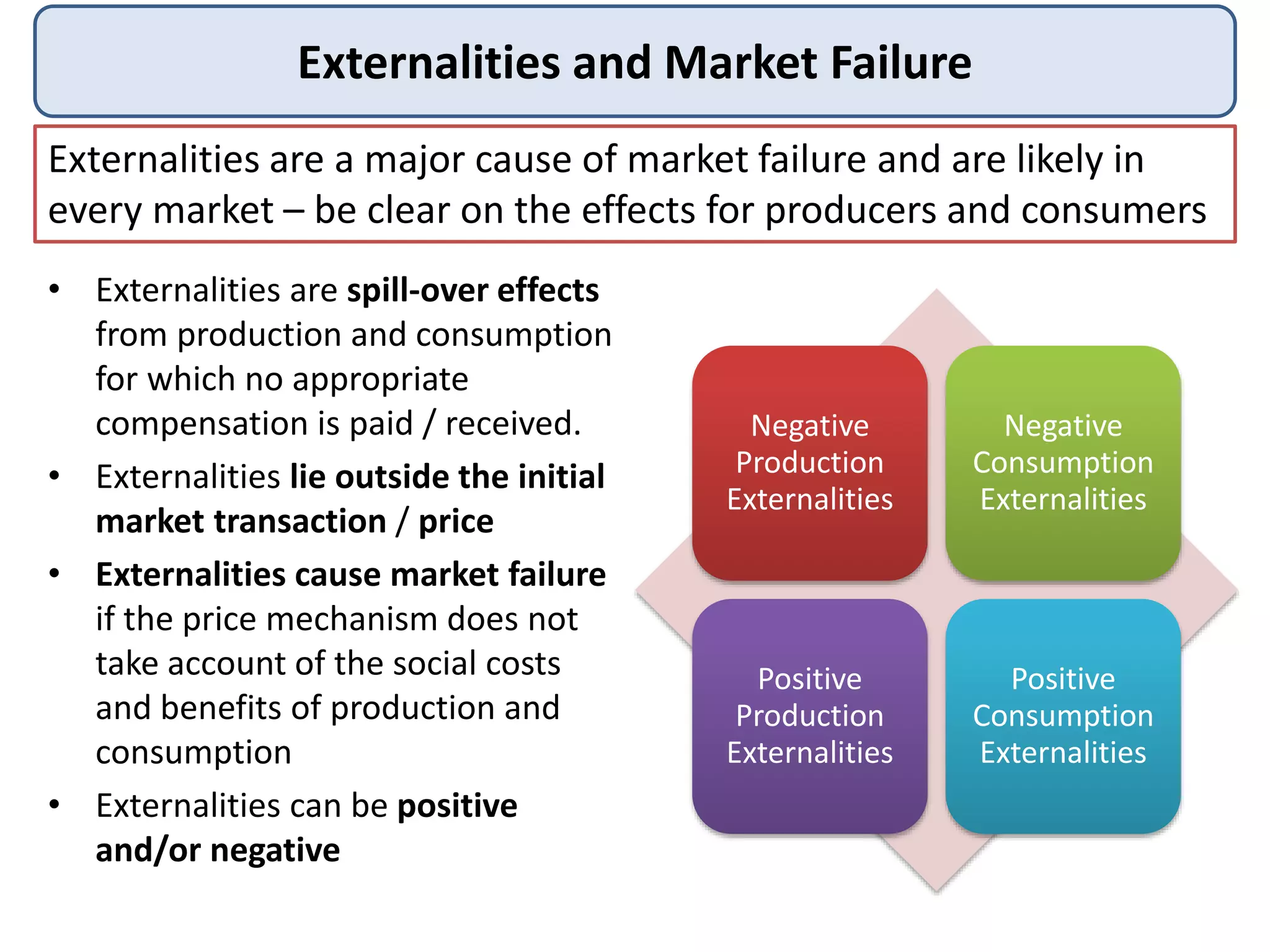
Negative
Production
Externalities
Negative
Consumption
Externalities
Positive
Production
Externalities
Positive
Consumption
Externalities
Private and External Costs and Benefits
• Private costs are the costs faced by the producer or consumer
directly involved in a transaction
• Private benefits are the benefits for producer and/or consumer
directly involved in an economic transaction
• The existence of externalities creates a divergence between
private and social costs of production and the private and social
benefits of consumption
• Social Cost = Private Cost + External Cost
• Social Benefit = Private Benefit + External Benefit
• When negative externalities exist, social costs exceed private
cost. This leads to over-production and market failure if
producers do not take into account the externalities
• When positive externalities occur, social benefits exceed private
benefit – this can also lead to market failure
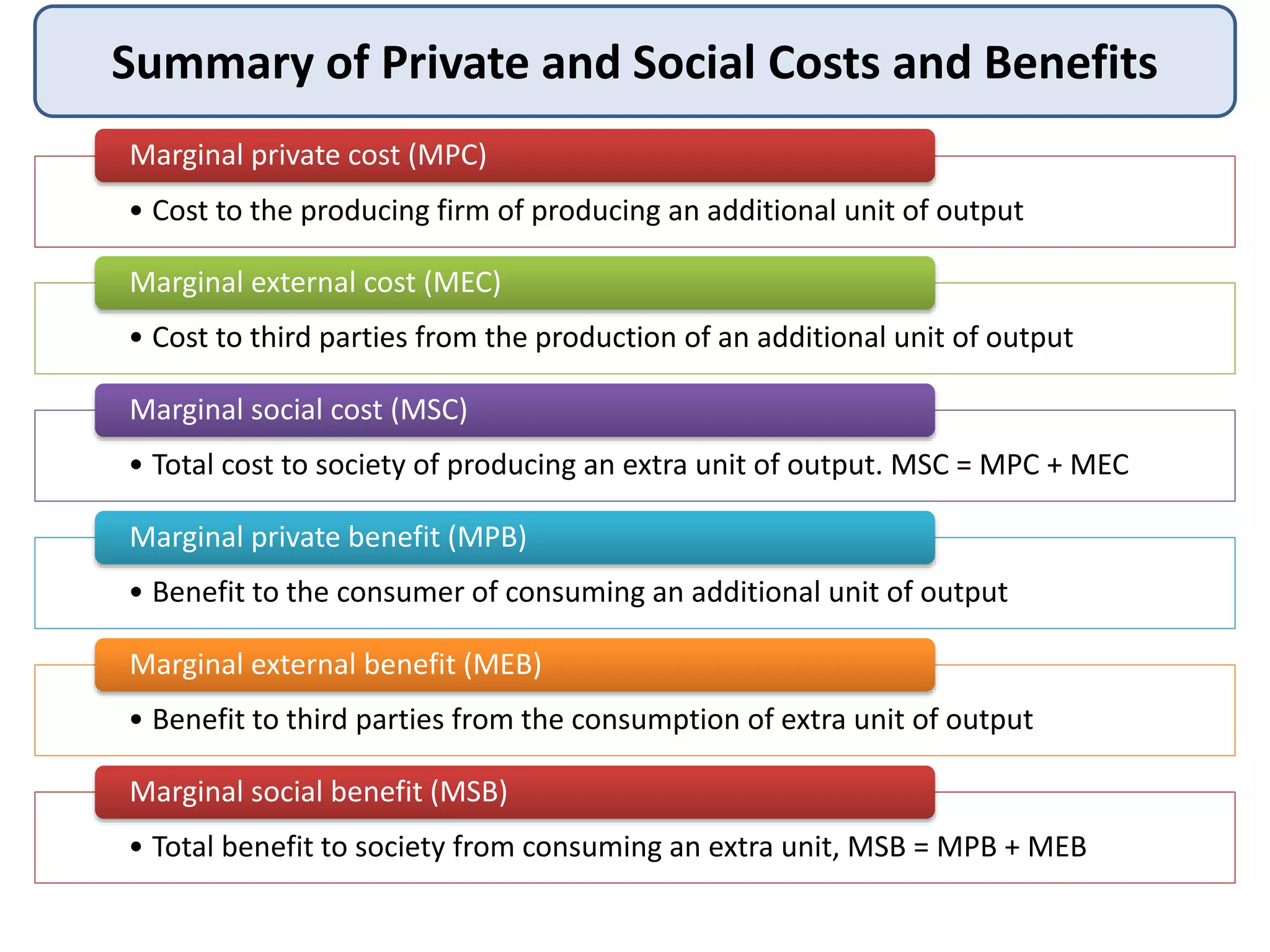
Summary of Private and Social Costs and Benefits
• Cost to the producing firm of producing an additional unit of output
Marginal private cost (MPC)
• Cost to third parties from the production of an additional unit of output
Marginal external cost (MEC)
• Total cost to society of producing an extra unit of output. MSC = MPC + MEC
Marginal social cost (MSC)
• Benefit to the consumer of consuming an additional unit of output
Marginal private benefit (MPB)
• Benefit to third parties from the consumption of extra unit of output
Marginal external benefit (MEB)
• Total benefit to society from consuming an extra unit, MSB = MPB + MEB
Marginal social benefit (MSB)
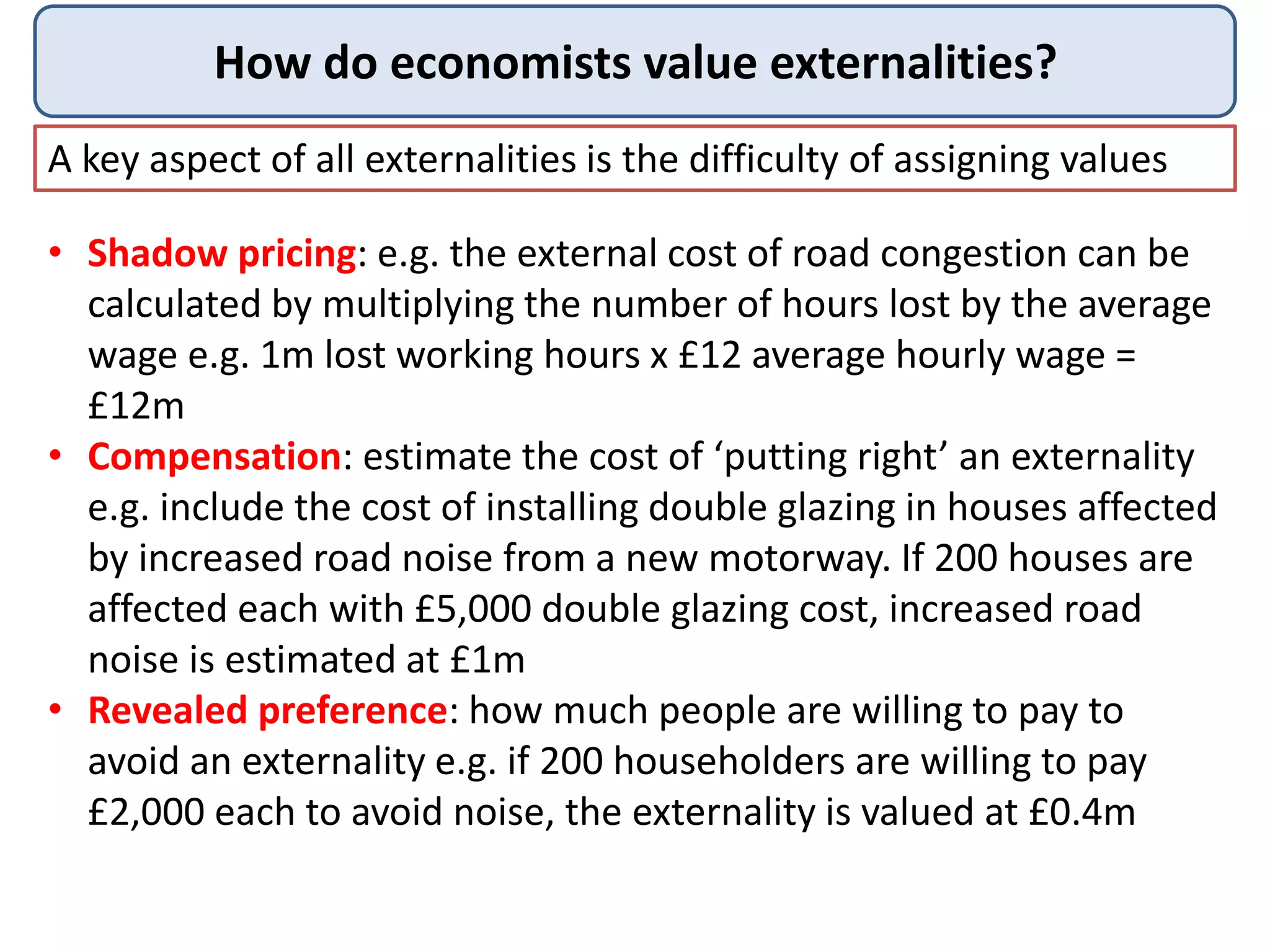
How do economists value externalities?
A key aspect of all externalities is the difficulty of assigning values
• Shadow pricing: e.g. the external cost of road congestion can be
calculated by multiplying the number of hours lost by the average
wage e.g. 1m lost working hours x £12 average hourly wage =
Ā£12m
• Compensation: estimate the cost of ā€˜putting right’ an externality
e.g. include the cost of installing double glazing in houses affected
by increased road noise from a new motorway. If 200 houses are
affected each with £5,000 double glazing cost, increased road
noise is estimated at £1m
• Revealed preference: how much people are willing to pay to
avoid an externality e.g. if 200 householders are willing to pay
£2,000 each to avoid noise, the externality is valued at £0.4m
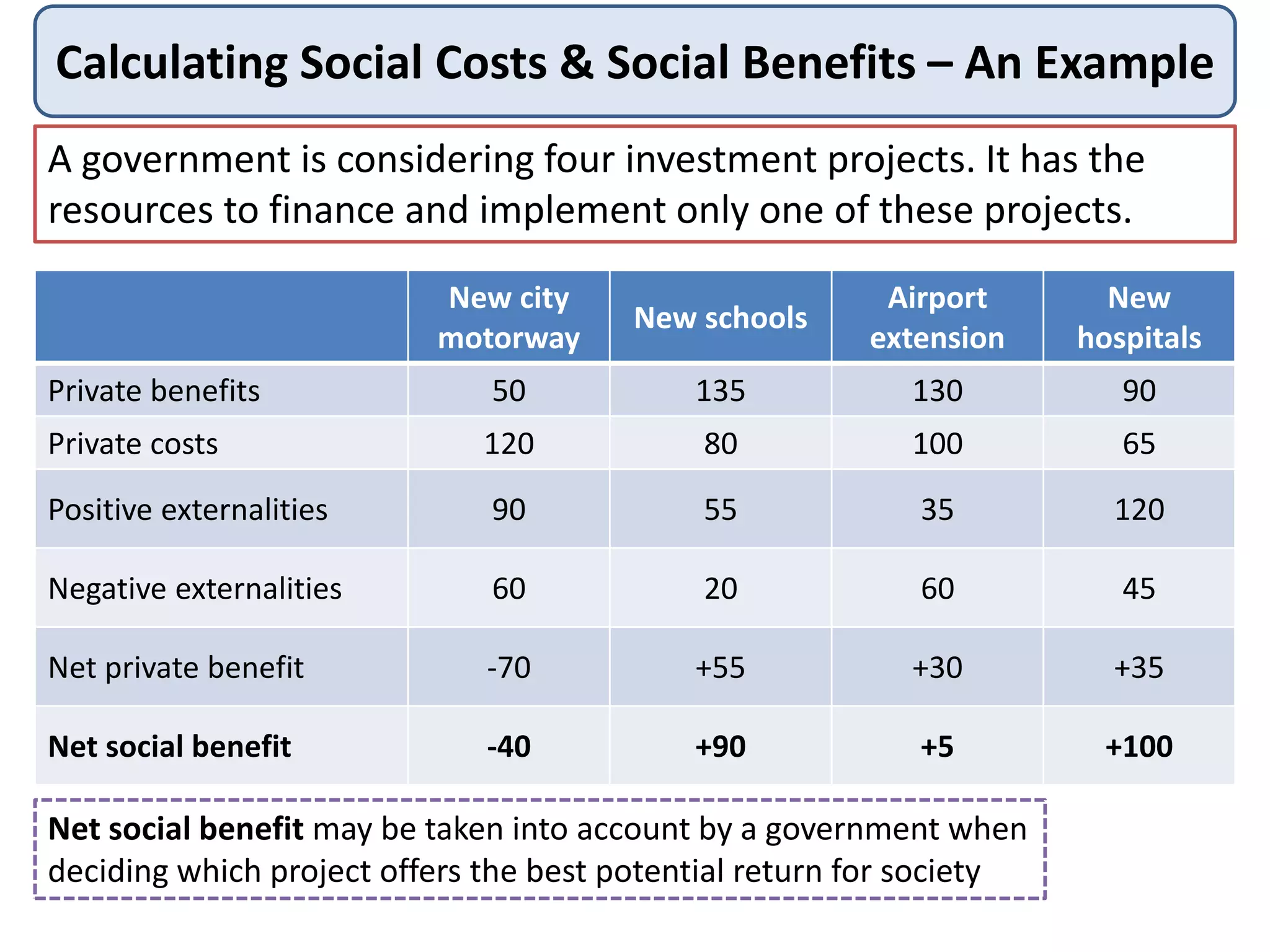
Calculating Social Costs & Social Benefits – An Example
New city
motorway
New schools
Airport
extension
New
hospitals
Private benefits 50 135 130 90
Private costs 120 80 100 65
Positive externalities 90 55 35 120
Negative externalities 60 20 60 45
Net private benefit -70 +55 +30 +35
Net social benefit -40 +90 +5 +100
A government is considering four investment projects. It has the
resources to finance and implement only one of these projects.
Net social benefit may be taken into account by a government when
deciding which project offers the best potential return for society
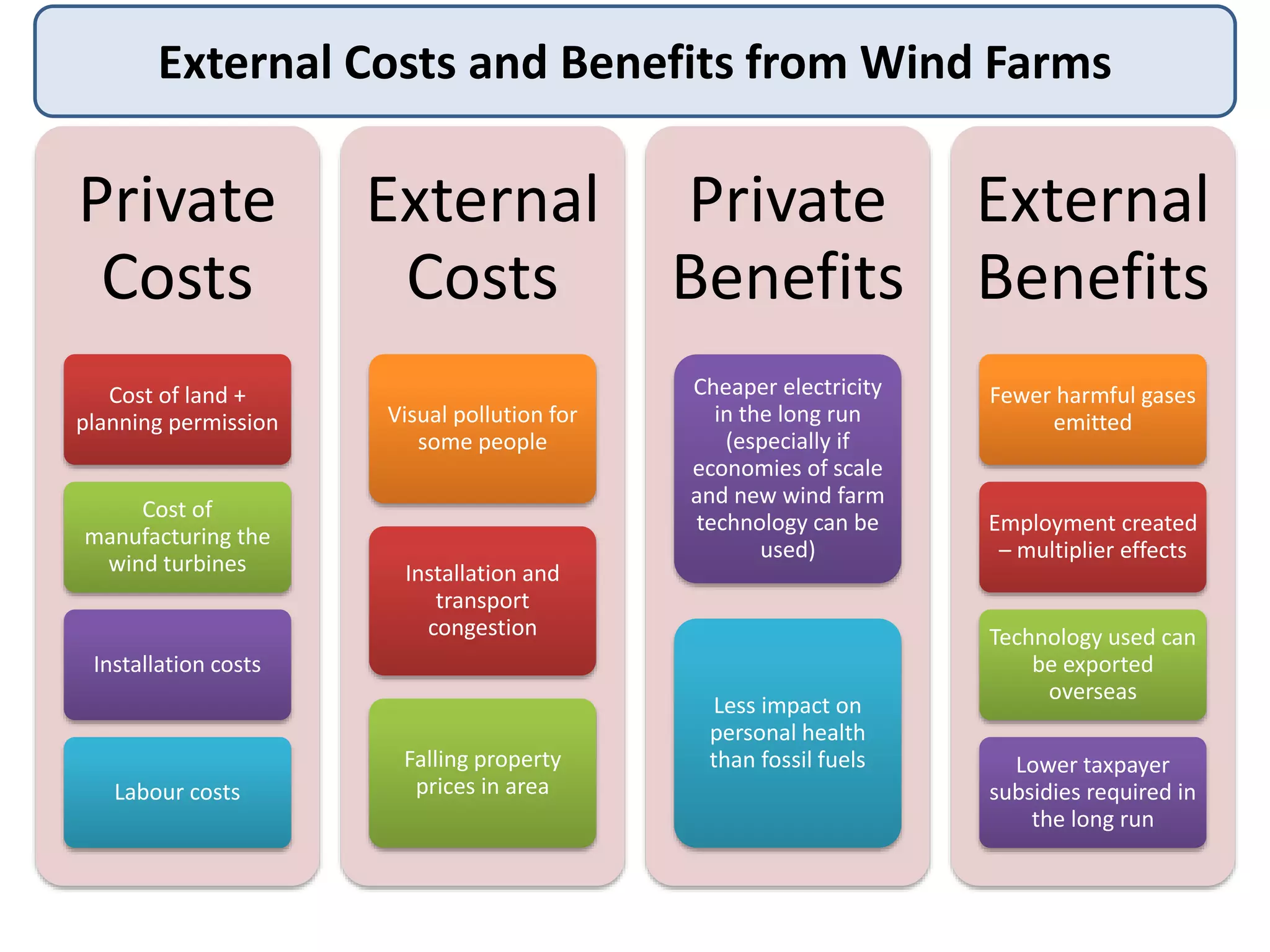
External Costs and Benefits from Wind Farms
Private
Costs
Cost of land +
planning permission
Cost of
manufacturing the
wind turbines
Installation costs
Labour costs
External
Costs
Visual pollution for
some people
Installation and
transport
congestion
Falling property
prices in area
Private
Benefits
Cheaper electricity
in the long run
(especially if
economies of scale
and new wind farm
technology can be
used)
Less impact on
personal health
than fossil fuels
External
Benefits
Fewer harmful gases
emitted
Employment created
– multiplier effects
Technology used can
be exported
overseas
Lower taxpayer
subsidies required in
the long run
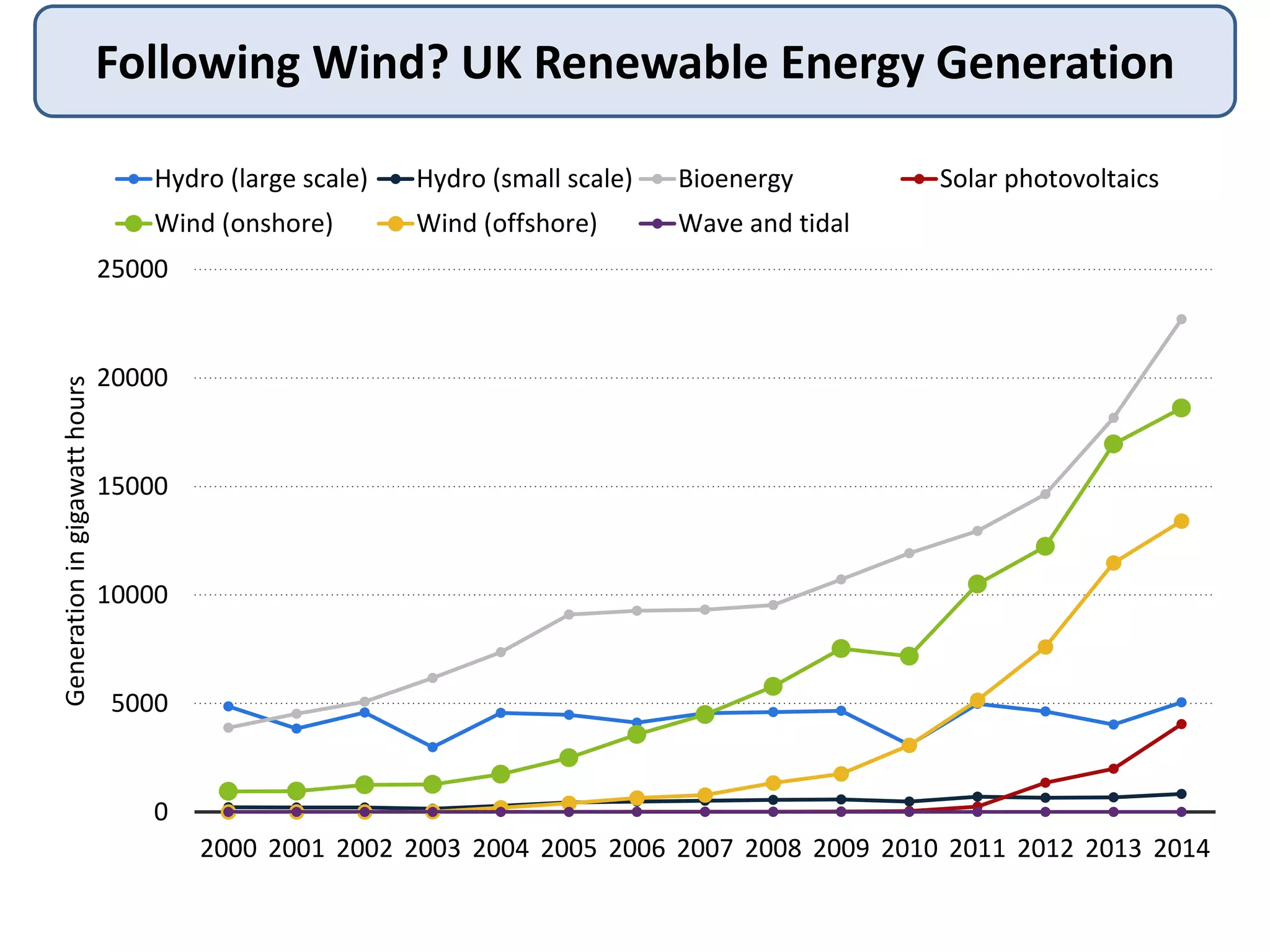
Following Wind? UK Renewable Energy Generation
0
5000
10000
15000
20000
25000
2000 2001 2002 2003 2004 2005 2006 2007 2008 2009 2010 2011 2012 2013 2014
Generationingigawatthours
Hydro (large scale) Hydro (small scale) Bioenergy Solar photovoltaics
Wind (onshore) Wind (offshore) Wave and tidal
Economics of Externalities from
Production and Consumption
EdExcel Economics 1.3.2

Externalities introduction

  • 1.
    Economics of Externalitiesfrom Production and Consumption EdExcel Economics 1.3.2
  • 2.
    Externalities and MarketFailure • Externalities are spill-over effects from production and consumption for which no appropriate compensation is paid / received. • Externalities lie outside the initial market transaction / price • Externalities cause market failure if the price mechanism does not take account of the social costs and benefits of production and consumption • Externalities can be positive and/or negative Externalities are a major cause of market failure and are likely in every market – be clear on the effects for producers and consumers Negative Production Externalities Negative Consumption Externalities Positive Production Externalities Positive Consumption Externalities
  • 3.
    Private and ExternalCosts and Benefits • Private costs are the costs faced by the producer or consumer directly involved in a transaction • Private benefits are the benefits for producer and/or consumer directly involved in an economic transaction • The existence of externalities creates a divergence between private and social costs of production and the private and social benefits of consumption • Social Cost = Private Cost + External Cost • Social Benefit = Private Benefit + External Benefit • When negative externalities exist, social costs exceed private cost. This leads to over-production and market failure if producers do not take into account the externalities • When positive externalities occur, social benefits exceed private benefit – this can also lead to market failure
  • 4.
    Summary of Privateand Social Costs and Benefits • Cost to the producing firm of producing an additional unit of output Marginal private cost (MPC) • Cost to third parties from the production of an additional unit of output Marginal external cost (MEC) • Total cost to society of producing an extra unit of output. MSC = MPC + MEC Marginal social cost (MSC) • Benefit to the consumer of consuming an additional unit of output Marginal private benefit (MPB) • Benefit to third parties from the consumption of extra unit of output Marginal external benefit (MEB) • Total benefit to society from consuming an extra unit, MSB = MPB + MEB Marginal social benefit (MSB)
  • 5.
    How do economistsvalue externalities? A key aspect of all externalities is the difficulty of assigning values • Shadow pricing: e.g. the external cost of road congestion can be calculated by multiplying the number of hours lost by the average wage e.g. 1m lost working hours x Ā£12 average hourly wage = Ā£12m • Compensation: estimate the cost of ā€˜putting right’ an externality e.g. include the cost of installing double glazing in houses affected by increased road noise from a new motorway. If 200 houses are affected each with Ā£5,000 double glazing cost, increased road noise is estimated at Ā£1m • Revealed preference: how much people are willing to pay to avoid an externality e.g. if 200 householders are willing to pay Ā£2,000 each to avoid noise, the externality is valued at Ā£0.4m
  • 6.
    Calculating Social Costs& Social Benefits – An Example New city motorway New schools Airport extension New hospitals Private benefits 50 135 130 90 Private costs 120 80 100 65 Positive externalities 90 55 35 120 Negative externalities 60 20 60 45 Net private benefit -70 +55 +30 +35 Net social benefit -40 +90 +5 +100 A government is considering four investment projects. It has the resources to finance and implement only one of these projects. Net social benefit may be taken into account by a government when deciding which project offers the best potential return for society
  • 7.
    External Costs andBenefits from Wind Farms Private Costs Cost of land + planning permission Cost of manufacturing the wind turbines Installation costs Labour costs External Costs Visual pollution for some people Installation and transport congestion Falling property prices in area Private Benefits Cheaper electricity in the long run (especially if economies of scale and new wind farm technology can be used) Less impact on personal health than fossil fuels External Benefits Fewer harmful gases emitted Employment created – multiplier effects Technology used can be exported overseas Lower taxpayer subsidies required in the long run
  • 8.
    Following Wind? UKRenewable Energy Generation 0 5000 10000 15000 20000 25000 2000 2001 2002 2003 2004 2005 2006 2007 2008 2009 2010 2011 2012 2013 2014 Generationingigawatthours Hydro (large scale) Hydro (small scale) Bioenergy Solar photovoltaics Wind (onshore) Wind (offshore) Wave and tidal
  • 9.
    Economics of Externalitiesfrom Production and Consumption EdExcel Economics 1.3.2