http://www.bized.co.uk
Copyright 2006 – Biz/ed
Positive Externalities
http://www.bized.co.uk
Copyright 2006 – Biz/ed
What is a positive externality
• A Positive externality occurs when the consumption or
production of a good causes a benefit to a third party. For
example:
• When you get a COVID-19 vaccine, you receive a private
benefit (you become less susceptible to catching it) but
there is also a social benefit, prevents the spread within
the community. (positive consumption externality)
• A farmer who grows apple trees provides a benefit to a
beekeeper. The beekeeper gets a good source of nectar to
help make more honey. (positive production externality)
http://www.bized.co.uk
Copyright 2006 – Biz/ed
Private & Social Benefit
• Private benefit: benefit to the person who buys
and consumes the good
• Social benefit: the total benefit to all of society
• A positive externality occurs when the Social
Benefit is > than The Private benefit.
• Remember Social Benefit = private benefit +
external benefit.
http://www.bized.co.uk
Copyright 2006 – Biz/ed
EXTERNALITIES AND MARKET INEFFICIENCY
• Positive Consumption Externalities
• Immunization
• Education
• Museums
• Public Transport
http://www.bized.co.uk
Copyright 2006 – Biz/ed
EXTERNALITIES AND MARKET INEFFICIENCY
• Positive Production Externalities
• Research and Development
• Training and Development of workers
• Renewable resources and energy
http://www.bized.co.uk
Copyright 2006 – Biz/ed
Positive externalities from education
and training
 Improved social skills and awareness of citizenship
 Greater long-term contribution to the economy
 Higher productivity
 Diffusion of knowledge and understanding
 Improved employability / reduced risk of structural unemployment
 Impact on international competitiveness from an
improvement in human capital
 All of the above should help to contribute to a higher trend rate of
growth
 Higher expected earnings might provide increased
tax revenues for the government
http://www.bized.co.uk
Copyright 2006 – Biz/ed
Private benefits & Social benefits
• Private benefit
• The utility derived from consumption (for a
consumer) The revenue accruing to a producer
• Social benefit
• Where there are positive externalities the social
benefit of production and/or consumption
exceeds the private benefit
http://www.bized.co.uk
Copyright 2006 – Biz/ed
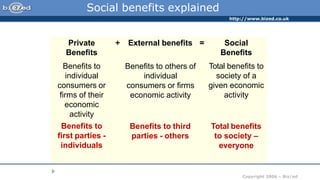
Social benefits explained
+ External benefits =
Benefits to others of
individual
consumers or firms
economic activity
Social
Benefits
Total benefits to
society of a
given economic
activity
Private
Benefits
Benefits to
individual
consumers or
firms of their
economic
activity
Benefits to
first parties -
individuals
Benefits to third
parties - others
Total benefits
to society –
everyone
http://www.bized.co.uk
Copyright 2006 – Biz/ed
Positive spill-overs
Flood protection schemes,
immunization and galleries and
museums all provide external
benefits
Left to itself, would the free-
market fail to provide sufficient
products that yield positive
externalities?
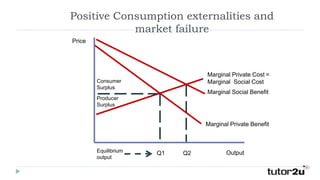
Positive Consumption externalities and
market failure
Output
Price
Marginal Private Cost =
Marginal Social Cost
Marginal Social Benefit
Marginal Private Benefit
Q2
Q1
Consumer
Surplus
Producer
Surplus
Equilibrium
output
Positive externalities and market failure
Output
Marginal Private
Benefit
Marginal Private Cost =
Marginal Social Cost
Q2
Q1
Consumer
Surplus
Producer
Surplus
Equilibrium
output
Gain to
other
people
Marginal Social Benefit
Price
Positive externalities and market failure
Output
Marginal Private
Benefit
Marginal Private Cost =
Marginal Social Cost
Marginal Social Benefit
Q2
Q1
In a free market
consumption will be at Q1
because Demand = Supply
(private benefit = private
cost )
Price
http://www.bized.co.uk
Copyright 2006 – Biz/ed
Positive externalities and
market failure
Marginal Private Benefit
Marginal Private Cost =
Marginal Social Cost
Marginal Social Benefit
Q1 Q2 Output
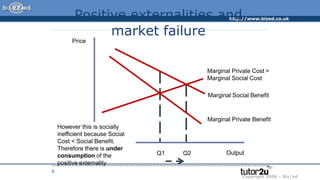
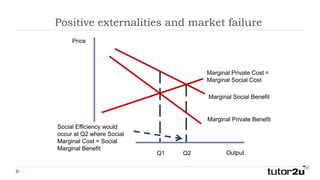
However this is socially
inefficient because Social
Cost < Social Benefit.
Therefore there is under
consumption of the
positive externality
Price
Positive externalities and market failure
Output
Marginal Private Benefit
Marginal Private Cost =
Marginal Social Cost
Marginal Social Benefit
Q2
Q1
Social Efficiency would
occur at Q2 where Social
Marginal Cost = Social
Marginal Benefit
Price
Positive externalities and market failure
Output
Marginal Private
Benefit
Marginal Private Cost =
Marginal Social Cost
Marginal Social Benefit
Q2
Q1
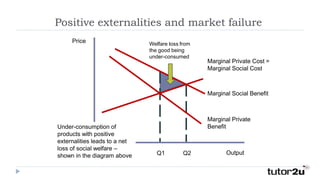
Welfare loss from
the good being
under-consumed
Under-consumption of
products with positive
externalities leads to a net
loss of social welfare –
shown in the diagram above
Price
Positive Consumption externalities and
market failure
Output
Price
Marginal Private Cost
Marginal Social Cost
Marginal Private Benefit =
Marginal Social benefit
Q2
Q1
Consumer
Surplus
Producer
Surplus
Equilibrium
output
Positive externalities and market failure
Output
Marginal Private Cost
Q2
Q1
Consumer
Surplus
Producer
Surplus
Equilibrium
output
Gain to
other
people
Marginal Social Cost
Price
Marginal Private benefit =
Marginal Social benefit
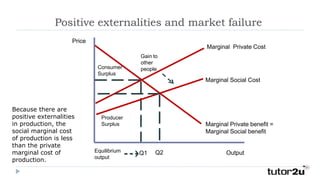
Because there are
positive externalities
in production, the
social marginal cost
of production is less
than the private
marginal cost of
production.
Positive externalities and market failure
Output
Marginal Private Benefit =
Marginal Social Benefit
Marginal Private Cost
Q2
Q1
Consumer
Surplus
Producer
Surplus
Equilibrium
output
Gain to
other
people
Marginal Social Cost
Price
In a free market, a firm will ignore
benefits to third parties and will
produce at Q1 (free market
outcome) (private benefit = private
cost )
Positive externalities and market failure
Output
Marginal Private Benefit =
Marginal Social Benefit
Marginal Private Cost
Q2
Q1
Consumer
Surplus
Producer
Surplus
Equilibrium
output
Gain to
other
people
Marginal Social Cost
Price
However this is socially inefficient
because Social Cost < Private
Costs. Therefore there is under
production
Positive externalities and market failure
Output
Marginal Private Benefit =
Marginal Social Benefit
Marginal Private Cost
Q2
Q1
Consumer
Surplus
Producer
Surplus
Equilibrium
output
Gain to
other
people
Marginal Social Cost
Price
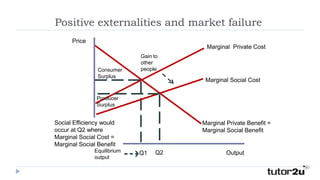
Social Efficiency would
occur at Q2 where
Marginal Social Cost =
Marginal Social Benefit
Positive externalities and market failure
Output
Marginal Private Benefit =
Marginal Social Benefit
Marginal Private Cost
Q2
Q1
Consumer
Surplus
Producer
Surplus
Equilibrium
output
Gain to
other
people
Marginal Social Cost
Price
Welfare loss from
the good being
under-Produced
However, the socially efficient
level will be at Q2 (where social
marginal cost = social marginal
benefit)
http://www.bized.co.uk
Copyright 2006 – Biz/ed
Summary
• Demand curves become marginal benefit curves. Marginal private benefit curves are labelled MPB and marginal social
benefit curves (when consumption externalities are included) are labelled MSB. .
• Supply curves become marginal cost curves. Marginal private cost curves are labelled MPC and marginal social cost
curves (when production externalities are included) are labelled MSC.
• The inefficient equilibrium position is P1 and private costs (supply) are equal and Q1 and is where private (demand)
• When the impact of a consumption externality is shown, the marginal benefits curve is moved - to the right for a
positive externality and to the left for a negative externality.
• When the impact of a production externality is shown the marginal cost curve is moved — upwards for a negative
externality and downwards for a positive externality.
• The efficient or socially correct equilibrium position is P2 and Q2 and is where social benefits (demand) and social
costs (supply) are equal.
• The deadweight loss is always the area of triangle pointing to the efficient or socially correct equilibrium.

Positive Externalities 2022.pptx

  • 1.
    http://www.bized.co.uk Copyright 2006 –Biz/ed Positive Externalities
  • 2.
    http://www.bized.co.uk Copyright 2006 –Biz/ed What is a positive externality • A Positive externality occurs when the consumption or production of a good causes a benefit to a third party. For example: • When you get a COVID-19 vaccine, you receive a private benefit (you become less susceptible to catching it) but there is also a social benefit, prevents the spread within the community. (positive consumption externality) • A farmer who grows apple trees provides a benefit to a beekeeper. The beekeeper gets a good source of nectar to help make more honey. (positive production externality)
  • 3.
    http://www.bized.co.uk Copyright 2006 –Biz/ed Private & Social Benefit • Private benefit: benefit to the person who buys and consumes the good • Social benefit: the total benefit to all of society • A positive externality occurs when the Social Benefit is > than The Private benefit. • Remember Social Benefit = private benefit + external benefit.
  • 4.
    http://www.bized.co.uk Copyright 2006 –Biz/ed EXTERNALITIES AND MARKET INEFFICIENCY • Positive Consumption Externalities • Immunization • Education • Museums • Public Transport
  • 5.
    http://www.bized.co.uk Copyright 2006 –Biz/ed EXTERNALITIES AND MARKET INEFFICIENCY • Positive Production Externalities • Research and Development • Training and Development of workers • Renewable resources and energy
  • 6.
    http://www.bized.co.uk Copyright 2006 –Biz/ed Positive externalities from education and training  Improved social skills and awareness of citizenship  Greater long-term contribution to the economy  Higher productivity  Diffusion of knowledge and understanding  Improved employability / reduced risk of structural unemployment  Impact on international competitiveness from an improvement in human capital  All of the above should help to contribute to a higher trend rate of growth  Higher expected earnings might provide increased tax revenues for the government
  • 7.
    http://www.bized.co.uk Copyright 2006 –Biz/ed Private benefits & Social benefits • Private benefit • The utility derived from consumption (for a consumer) The revenue accruing to a producer • Social benefit • Where there are positive externalities the social benefit of production and/or consumption exceeds the private benefit
  • 8.
    http://www.bized.co.uk Copyright 2006 –Biz/ed Social benefits explained + External benefits = Benefits to others of individual consumers or firms economic activity Social Benefits Total benefits to society of a given economic activity Private Benefits Benefits to individual consumers or firms of their economic activity Benefits to first parties - individuals Benefits to third parties - others Total benefits to society – everyone
  • 9.
    http://www.bized.co.uk Copyright 2006 –Biz/ed Positive spill-overs Flood protection schemes, immunization and galleries and museums all provide external benefits Left to itself, would the free- market fail to provide sufficient products that yield positive externalities?
  • 10.
    Positive Consumption externalitiesand market failure Output Price Marginal Private Cost = Marginal Social Cost Marginal Social Benefit Marginal Private Benefit Q2 Q1 Consumer Surplus Producer Surplus Equilibrium output
  • 11.
    Positive externalities andmarket failure Output Marginal Private Benefit Marginal Private Cost = Marginal Social Cost Q2 Q1 Consumer Surplus Producer Surplus Equilibrium output Gain to other people Marginal Social Benefit Price
  • 12.
    Positive externalities andmarket failure Output Marginal Private Benefit Marginal Private Cost = Marginal Social Cost Marginal Social Benefit Q2 Q1 In a free market consumption will be at Q1 because Demand = Supply (private benefit = private cost ) Price
  • 13.
    http://www.bized.co.uk Copyright 2006 –Biz/ed Positive externalities and market failure Marginal Private Benefit Marginal Private Cost = Marginal Social Cost Marginal Social Benefit Q1 Q2 Output However this is socially inefficient because Social Cost < Social Benefit. Therefore there is under consumption of the positive externality Price
  • 14.
    Positive externalities andmarket failure Output Marginal Private Benefit Marginal Private Cost = Marginal Social Cost Marginal Social Benefit Q2 Q1 Social Efficiency would occur at Q2 where Social Marginal Cost = Social Marginal Benefit Price
  • 15.
    Positive externalities andmarket failure Output Marginal Private Benefit Marginal Private Cost = Marginal Social Cost Marginal Social Benefit Q2 Q1 Welfare loss from the good being under-consumed Under-consumption of products with positive externalities leads to a net loss of social welfare – shown in the diagram above Price
  • 17.
    Positive Consumption externalitiesand market failure Output Price Marginal Private Cost Marginal Social Cost Marginal Private Benefit = Marginal Social benefit Q2 Q1 Consumer Surplus Producer Surplus Equilibrium output
  • 18.
    Positive externalities andmarket failure Output Marginal Private Cost Q2 Q1 Consumer Surplus Producer Surplus Equilibrium output Gain to other people Marginal Social Cost Price Marginal Private benefit = Marginal Social benefit Because there are positive externalities in production, the social marginal cost of production is less than the private marginal cost of production.
  • 19.
    Positive externalities andmarket failure Output Marginal Private Benefit = Marginal Social Benefit Marginal Private Cost Q2 Q1 Consumer Surplus Producer Surplus Equilibrium output Gain to other people Marginal Social Cost Price In a free market, a firm will ignore benefits to third parties and will produce at Q1 (free market outcome) (private benefit = private cost )
  • 20.
    Positive externalities andmarket failure Output Marginal Private Benefit = Marginal Social Benefit Marginal Private Cost Q2 Q1 Consumer Surplus Producer Surplus Equilibrium output Gain to other people Marginal Social Cost Price However this is socially inefficient because Social Cost < Private Costs. Therefore there is under production
  • 21.
    Positive externalities andmarket failure Output Marginal Private Benefit = Marginal Social Benefit Marginal Private Cost Q2 Q1 Consumer Surplus Producer Surplus Equilibrium output Gain to other people Marginal Social Cost Price Social Efficiency would occur at Q2 where Marginal Social Cost = Marginal Social Benefit
  • 22.
    Positive externalities andmarket failure Output Marginal Private Benefit = Marginal Social Benefit Marginal Private Cost Q2 Q1 Consumer Surplus Producer Surplus Equilibrium output Gain to other people Marginal Social Cost Price Welfare loss from the good being under-Produced However, the socially efficient level will be at Q2 (where social marginal cost = social marginal benefit)
  • 23.
    http://www.bized.co.uk Copyright 2006 –Biz/ed Summary • Demand curves become marginal benefit curves. Marginal private benefit curves are labelled MPB and marginal social benefit curves (when consumption externalities are included) are labelled MSB. . • Supply curves become marginal cost curves. Marginal private cost curves are labelled MPC and marginal social cost curves (when production externalities are included) are labelled MSC. • The inefficient equilibrium position is P1 and private costs (supply) are equal and Q1 and is where private (demand) • When the impact of a consumption externality is shown, the marginal benefits curve is moved - to the right for a positive externality and to the left for a negative externality. • When the impact of a production externality is shown the marginal cost curve is moved — upwards for a negative externality and downwards for a positive externality. • The efficient or socially correct equilibrium position is P2 and Q2 and is where social benefits (demand) and social costs (supply) are equal. • The deadweight loss is always the area of triangle pointing to the efficient or socially correct equilibrium.