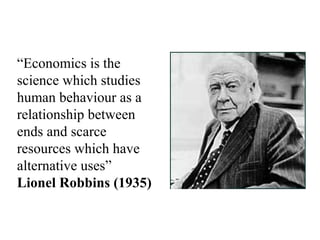
“Economics is the
science which studies
human behaviour as a
relationship between
ends and scarce
resources which have
alternative uses”
Lionel Robbins (1935)
IGCSE®
/O Level Economics
1.1 The basic economic
problem
S1
Factors of Production:
•Capital
•Enterprise
•Land
•Labour
Inputs
Turning the inputs into
the provision of services
or manufacturing of
goods. Adding ValueProcess
• Consumer Goods:
(tangible)
– Durable
– Non Durable
• Capital Goods or
Producer Goods
• Services (Intangible)
Outputs
1.1 The Basic Economic Problem
Wednesday 19 June 2019
Learning Objectives
Today I will:
•Define the nature of the economic problem.
•Identify needs and wants
TASK:
Survive!!!!!
•In groups of 4
discuss what you will
need (& want!)
•Any problems?
The basic economic problem
Human wants are unlimited but resources are scarce
Problem 1: Resources are Scarce
Resources (factors of production) are used up
in production of goods and services to satisfy
our wants.
Resources that are not scarce are called free
goods.
Task:
Activity 1.2 on page 7.
Discussion:
What do we all want?
List your top 5 wants
right now and then
we’ll discuss.
Problem 2: Human wants are
unlimited
Our wants are without limit and many of them
cannot be satisfied.
This is because there are simply not enough
resources to make all the goods and services
we want and need.
Consumption
Using up goods and services (products) to satisfy
consumers’ needs and wants
Task 1 : Goods/Services
MATCH THE TERMS
WITH THE DEFINTIONS.
Complete part 1 of
Worksheet 1.
Problem 3: Scare resources have
alternative uses
Wants unlimited but resources are scarce.
People, nations and the world must therefore
choose how scarce resources are to be used.
Opportunity cost!
There is a limited amount of resources such as raw materials,
machines, factories and skilled workers. But there are a number
of different ways in which they can be used.
Resource allocation therefore involves deciding how best to use
scarce resources to satisfy as many needs and wants as possible
CHOICE CHOICE
Problem 3: Scare resources
have alternative uses
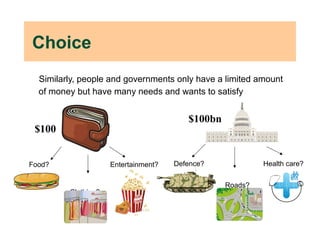
Choice
Similarly, people and governments only have a limited amount
of money but have many needs and wants to satisfy
$100
Food? Entertainment?
Clothing?
Defence? Health care?
Roads?
$100bn
Handout H5 – Dam and NHS
• What is the economic problem in each of
the articles?
• For each decision described in the articles,
what is being sacrificed and why?
• Who are the winners and who are the losers
from these decisions?
Put yourself in this man’s
shoes…
• You are the UK Chancellor of the Exchequer.
Last year he spent £710bn, now it is your turn,
will you spend it differently?
Task:
Activity 1.5 & 1.6
on page 12.
Opportunity Cost
Thursday 28th
September
Learning Intentions
Today I will:
•Understand the term ‘Opportunity cost’
•Apply it to real life situations
Problem 4: We must choose
which wants to satisfy
Defined:
The opportunity cost of a choice is the value
of the best alternative forgone.
= The value of what you have given up.
“If you spent the money on an original iPod
in 2001 on Apple stock ($499), you would have
$14,513.78 today” (2010).
Have you made a choice that had
an alternative recently?
Your Task: Debate
UAE is hosting the 2020
Expo.
Design a poster that’s divided
in two to indicate:
Positives (Group 1)
and
Negatives (Group 2).
Build the economic problem
and opportunity cost into your
design.
Opportunity cost
Opportunity cost is the cost of choice
• What would you buy with US$10?
• How should the government spend US$250 million?
(Or, should the government cut taxes by US$250 million?)
• What occupation will you choose when you finish your studies?
• How should a new business invest US$20 million?
• Should we conserve more natural resources?
… and what are the next best alternatives foregone?
Production possibility curves
• Production possibility curves (PPCs) show the maximum
combined output of two or more products a firm or an entire
economy can produce with its available resources
• Resources are being used efficiently if they are producing their
maximum output
• But, because resources are limited, producing more of one
product means producing less of another
• PPCs are therefore a useful way of showing the opportunity
cost of producing more of one product in terms of how much of
another must be given up
Production possibility curves
A firm producing cars and trucks
What is the opportunity cost of producing 20 more trucks?
An economy producing
consumer goods and capital
goods
What is the opportunity cost of
producing 15 more tonnes of
consumer goods?
Production possibility curves

Slide 1 1mm - the basic economic problem

  • 1.
    “Economics is the sciencewhich studies human behaviour as a relationship between ends and scarce resources which have alternative uses” Lionel Robbins (1935)
  • 2.
    IGCSE® /O Level Economics 1.1The basic economic problem S1
  • 4.
  • 5.
    Turning the inputsinto the provision of services or manufacturing of goods. Adding ValueProcess
  • 6.
    • Consumer Goods: (tangible) –Durable – Non Durable • Capital Goods or Producer Goods • Services (Intangible) Outputs
  • 7.
    1.1 The BasicEconomic Problem Wednesday 19 June 2019
  • 9.
    Learning Objectives Today Iwill: •Define the nature of the economic problem. •Identify needs and wants
  • 10.
    TASK: Survive!!!!! •In groups of4 discuss what you will need (& want!) •Any problems?
  • 11.
    The basic economicproblem Human wants are unlimited but resources are scarce
  • 12.
    Problem 1: Resourcesare Scarce Resources (factors of production) are used up in production of goods and services to satisfy our wants. Resources that are not scarce are called free goods.
  • 13.
  • 14.
    Discussion: What do weall want? List your top 5 wants right now and then we’ll discuss.
  • 15.
    Problem 2: Humanwants are unlimited Our wants are without limit and many of them cannot be satisfied. This is because there are simply not enough resources to make all the goods and services we want and need.
  • 16.
    Consumption Using up goodsand services (products) to satisfy consumers’ needs and wants
  • 17.
    Task 1 :Goods/Services MATCH THE TERMS WITH THE DEFINTIONS. Complete part 1 of Worksheet 1.
  • 18.
    Problem 3: Scareresources have alternative uses Wants unlimited but resources are scarce. People, nations and the world must therefore choose how scarce resources are to be used. Opportunity cost!
  • 19.
    There is alimited amount of resources such as raw materials, machines, factories and skilled workers. But there are a number of different ways in which they can be used. Resource allocation therefore involves deciding how best to use scarce resources to satisfy as many needs and wants as possible CHOICE CHOICE Problem 3: Scare resources have alternative uses
  • 20.
    Choice Similarly, people andgovernments only have a limited amount of money but have many needs and wants to satisfy $100 Food? Entertainment? Clothing? Defence? Health care? Roads? $100bn
  • 21.
    Handout H5 –Dam and NHS • What is the economic problem in each of the articles? • For each decision described in the articles, what is being sacrificed and why? • Who are the winners and who are the losers from these decisions?
  • 22.
    Put yourself inthis man’s shoes… • You are the UK Chancellor of the Exchequer. Last year he spent £710bn, now it is your turn, will you spend it differently?
  • 24.
    Task: Activity 1.5 &1.6 on page 12.
  • 25.
  • 26.
    Learning Intentions Today Iwill: •Understand the term ‘Opportunity cost’ •Apply it to real life situations
  • 27.
    Problem 4: Wemust choose which wants to satisfy
  • 28.
    Defined: The opportunity costof a choice is the value of the best alternative forgone. = The value of what you have given up. “If you spent the money on an original iPod in 2001 on Apple stock ($499), you would have $14,513.78 today” (2010).
  • 29.
    Have you madea choice that had an alternative recently?
  • 31.
    Your Task: Debate UAEis hosting the 2020 Expo. Design a poster that’s divided in two to indicate: Positives (Group 1) and Negatives (Group 2). Build the economic problem and opportunity cost into your design.
  • 32.
    Opportunity cost Opportunity costis the cost of choice • What would you buy with US$10? • How should the government spend US$250 million? (Or, should the government cut taxes by US$250 million?) • What occupation will you choose when you finish your studies? • How should a new business invest US$20 million? • Should we conserve more natural resources? … and what are the next best alternatives foregone?
  • 33.
    Production possibility curves •Production possibility curves (PPCs) show the maximum combined output of two or more products a firm or an entire economy can produce with its available resources • Resources are being used efficiently if they are producing their maximum output • But, because resources are limited, producing more of one product means producing less of another • PPCs are therefore a useful way of showing the opportunity cost of producing more of one product in terms of how much of another must be given up
  • 34.
    Production possibility curves Afirm producing cars and trucks What is the opportunity cost of producing 20 more trucks?
  • 35.
    An economy producing consumergoods and capital goods What is the opportunity cost of producing 15 more tonnes of consumer goods? Production possibility curves