http://www.bized.co.uk
Copyright 2006 – Biz/ed
Positive and Negative
Externalities
http://www.bized.co.uk
Copyright 2006 – Biz/ed
Positive and Negative
Externalities
• An externality is the
uncompensated impact of one
person’s actions on the well-being
of a third-party (bystander)
• Adverse impact Negative externality
• Beneficial impact Positive externality
• Buyers and sellers neglect external effects of
their actions therefore the market equilibrium
is not efficient when there are externalities
http://www.bized.co.uk
Copyright 2006 – Biz/ed
• Externalities cause markets to be
inefficient, and thus fail to
maximize total surplus.
http://www.bized.co.uk
Copyright 2006 – Biz/ed
Private & Social Cost
• Private cost: the cost producing
the good paid by the firm
• Social cost: the cost to everyone in
society, including people who do
not produce or consume.
• Social cost = private cost +
external cost
http://www.bized.co.uk
Copyright 2006 – Biz/ed
Private & Social Benefit
• Private benefit: benefit to the person
who buys and consumes the good
• Social benefit: the total benefit to all
of society
• An externality occurs when private
costs > or < social cost
• Or when Private Benefit is > or <
social benefit
http://www.bized.co.uk
Copyright 2006 – Biz/ed
• Costs and benefits in production:
• External costs in production: where MSC =
MSB – MPC
– e.g. air and water pollution, congestion, housing
development on green belt areas, destruction of
hedgerows and wildlife, noise, pollution, anti-social
behaviour, crime
• External benefits in production – where MSC <
MPC
– e.g. human resource development, research and
development in industry
Positive and Negative Externalities
http://www.bized.co.uk
Copyright 2006 – Biz/ed
EXTERNALITIES AND MARKET INEFFICIENCY
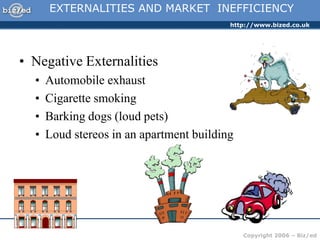
• Negative Externalities
• Automobile exhaust
• Cigarette smoking
• Barking dogs (loud pets)
• Loud stereos in an apartment building
http://www.bized.co.uk
Copyright 2006 – Biz/ed
EXTERNALITIES AND MARKET INEFFICIENCY
• Positive Externalities
• Immunizations
• Restored historic buildings
• Research into new technologies
http://www.bized.co.uk
Copyright 2006 – Biz/ed
Private and social costs
Private costs
Financial
Health
External costs
External benefits
Private benefits
A divergence between
private and social costs
and benefits?
http://www.bized.co.uk
Copyright 2006 – Biz/ed
Private and Social Costs
• Private Costs
• Are paid only by the producer or consumer
concerned
• They are internal costs of production or consumption
• Social Costs
• Social Cost = Private Cost + External Cost
• Negative externalities add to social costs or reduce
social benefits
• We assume that the consumer and/or producer does
not take external costs into account when making
decisions
• This can lead to a misallocation of resources
(causing a loss of allocative efficiency)
• This means that social welfare is not maximized - a
cause of market failure
http://www.bized.co.uk
Copyright 2006 – Biz/ed
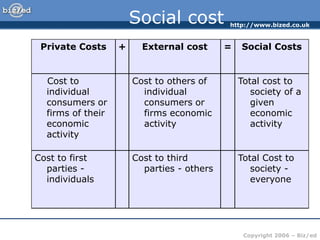
Social cost
Private Costs + External cost = Social Costs
Cost to
individual
consumers or
firms of their
economic
activity
Cost to others of
individual
consumers or
firms economic
activity
Total cost to
society of a
given
economic
activity
Cost to first
parties -
individuals
Cost to third
parties - others
Total Cost to
society -
everyone
http://www.bized.co.uk
Copyright 2006 – Biz/ed
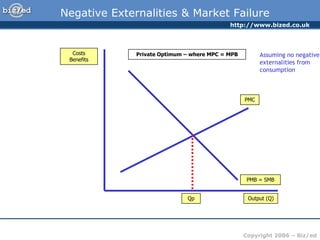
Negative Externalities & Market Failure
Private Optimum – where MPC = MPB
Costs
Benefits
Output (Q)
PMB = SMB
PMC
Qp
Assuming no negative
externalities from
consumption
http://www.bized.co.uk
Copyright 2006 – Biz/ed
Add in the External Cost
Costs
Benefits
Output (Q)
Private benefit =
social benefit
Private
Cost
Social
Cost
Qp
http://www.bized.co.uk
Copyright 2006 – Biz/ed
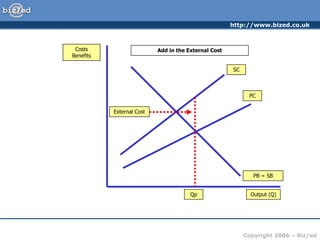
Add in the External Cost
Costs
Benefits
Output (Q)
PB = SB
PC
SC
Qp
External Cost
http://www.bized.co.uk
Copyright 2006 – Biz/ed
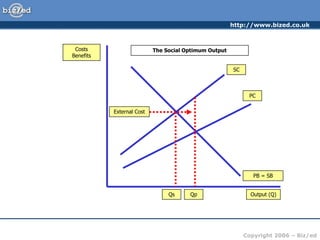
The Social Optimum Output
Costs
Benefits
Output (Q)
PB = SB
PC
SC
Qp
External Cost
Qs
http://www.bized.co.uk
Copyright 2006 – Biz/ed
Explaining the market failure
• The efficient allocation of resources
requires output to be increased up to the
point where social benefit equals social
cost.
• In a free market firms only take into
account the private costs of their
production.
• Given negative externalities - such as
pollution - private and social costs
diverge.
• An unregulated (free) market
consequentially overproduces the good.
http://www.bized.co.uk
Copyright 2006 – Biz/ed
Positive externalities from education
and training
 Improved social skills and awareness of citizenship
 Greater long-term contribution to the economy
 Higher productivity
 Diffusion of knowledge and understanding
 Improved employability / reduced risk of structural
unemployment
 Impact on international competitiveness from an
improvement in human capital
 All of the above should help to contribute to a higher
trend rate of growth
 Higher expected earnings might provide increased
tax revenues for the government
http://www.bized.co.uk
Copyright 2006 – Biz/ed
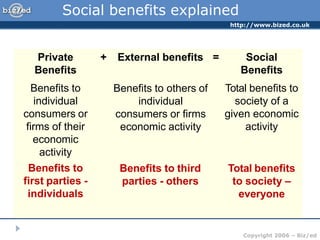
Private benefits & Social benefits
• Private benefit
• The utility derived from consumption (for a
consumer) The revenue accruing to a producer
• Social benefit
• Where there are positive externalities the social
benefit of production and/or consumption
exceeds the private benefit
http://www.bized.co.uk
Copyright 2006 – Biz/ed
Social benefits explained
+ External benefits =
Benefits to others of
individual
consumers or firms
economic activity
Social
Benefits
Total benefits to
society of a
given economic
activity
Private
Benefits
Benefits to
individual
consumers or
firms of their
economic
activity
Benefits to
first parties -
individuals
Benefits to third
parties - others
Total benefits
to society –
everyone
http://www.bized.co.uk
Copyright 2006 – Biz/ed
Positive spill-overs
Flood protection schemes,
immunization and galleries and
museums all provide external
benefits
Left to itself, would the free-
market fail to provide sufficient
products that yield positive
externalities?
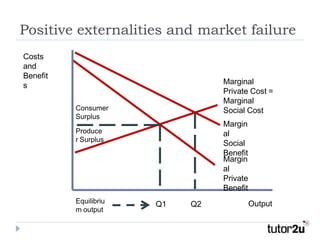
Positive externalities and market failure
Output
Costs
and
Benefit
s
Margin
al
Private
Benefit
Marginal
Private Cost =
Marginal
Social Cost
Margin
al
Social
Benefit
Q2
Q1
Consumer
Surplus
Produce
r Surplus
Equilibriu
m output
Positive externalities and market failure
Output
Costs and
Benefits
Marginal Private
Benefit
Marginal Private Cost =
Marginal Social Cost
Q2
Q1
Consumer
Surplus
Producer
Surplus
Equilibrium
output
Gain to
other
people
Marginal Social Benefit
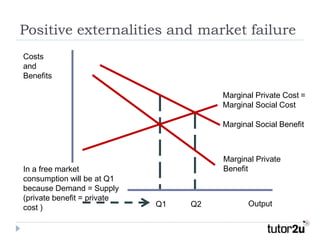
Positive externalities and market failure
Output
Costs
and
Benefits
Marginal Private
Benefit
Marginal Private Cost =
Marginal Social Cost
Marginal Social Benefit
Q2
Q1
In a free market
consumption will be at Q1
because Demand = Supply
(private benefit = private
cost )
http://www.bized.co.uk
Copyright 2006 – Biz/ed
Positive externalities and
market failure
Costs
and
Benefits
Marginal Private Benefit
Marginal Private Cost =
Marginal Social Cost
Marginal Social Benefit
Q1 Q2 Output
However this is socially
inefficient because Social
Cost < Social Benefit.
Therefore there is under
consumption of the
positive externality
Positive externalities and market failure
Output
Costs
and
Benefits
Marginal Private Benefit
Marginal Private Cost =
Marginal Social Cost
Marginal Social Benefit
Q2
Q1
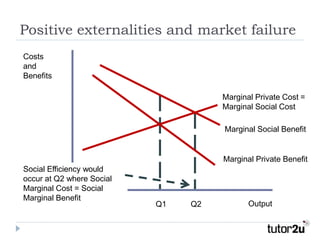
Social Efficiency would
occur at Q2 where Social
Marginal Cost = Social
Marginal Benefit
Positive externalities and market failure
Output
Costs
and
Benefits
Marginal Private
Benefit
Marginal Private Cost =
Marginal Social Cost
Marginal Social Benefit
Q2
Q1
Welfare loss from
the good being
under-consumed
Under-consumption of
products with positive
externalities leads to a net
loss of social welfare –
shown in the diagram above
http://www.bized.co.uk
Copyright 2006 – Biz/ed
• Costs and benefits in consumption:
• External costs in consumption –
where MSB < MPB
– e.g. passive smoking, litter, noise,
anti-social behaviour
• External benefits in consumption –
where MSB > MPB
– e.g. preventative health care –
vaccinations, public transport, attractive
gardens, bathing regularly!
Positive and Negative Externalities
http://www.bized.co.uk
Copyright 2006 – Biz/ed
• External costs – socially efficient
output is less than current output
• External benefits – socially
efficient output is greater than
current output
• Socially efficient output is where
MSC + MPC = MSB + MPB
Positive and Negative Externalities
http://www.bized.co.uk
Copyright 2006 – Biz/ed
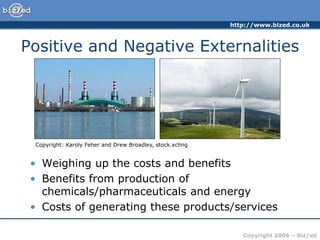
• Weighing up the costs and benefits
• Benefits from production of
chemicals/pharmaceuticals and energy
• Costs of generating these products/services
Copyright: Karoly Feher and Drew Broadley, stock.xchng
Positive and Negative Externalities

Positive & Negative Externalities 2022.pptx

  • 1.
    http://www.bized.co.uk Copyright 2006 –Biz/ed Positive and Negative Externalities
  • 2.
    http://www.bized.co.uk Copyright 2006 –Biz/ed Positive and Negative Externalities • An externality is the uncompensated impact of one person’s actions on the well-being of a third-party (bystander) • Adverse impact Negative externality • Beneficial impact Positive externality • Buyers and sellers neglect external effects of their actions therefore the market equilibrium is not efficient when there are externalities
  • 3.
    http://www.bized.co.uk Copyright 2006 –Biz/ed • Externalities cause markets to be inefficient, and thus fail to maximize total surplus.
  • 4.
    http://www.bized.co.uk Copyright 2006 –Biz/ed Private & Social Cost • Private cost: the cost producing the good paid by the firm • Social cost: the cost to everyone in society, including people who do not produce or consume. • Social cost = private cost + external cost
  • 5.
    http://www.bized.co.uk Copyright 2006 –Biz/ed Private & Social Benefit • Private benefit: benefit to the person who buys and consumes the good • Social benefit: the total benefit to all of society • An externality occurs when private costs > or < social cost • Or when Private Benefit is > or < social benefit
  • 6.
    http://www.bized.co.uk Copyright 2006 –Biz/ed • Costs and benefits in production: • External costs in production: where MSC = MSB – MPC – e.g. air and water pollution, congestion, housing development on green belt areas, destruction of hedgerows and wildlife, noise, pollution, anti-social behaviour, crime • External benefits in production – where MSC < MPC – e.g. human resource development, research and development in industry Positive and Negative Externalities
  • 7.
    http://www.bized.co.uk Copyright 2006 –Biz/ed EXTERNALITIES AND MARKET INEFFICIENCY • Negative Externalities • Automobile exhaust • Cigarette smoking • Barking dogs (loud pets) • Loud stereos in an apartment building
  • 8.
    http://www.bized.co.uk Copyright 2006 –Biz/ed EXTERNALITIES AND MARKET INEFFICIENCY • Positive Externalities • Immunizations • Restored historic buildings • Research into new technologies
  • 9.
    http://www.bized.co.uk Copyright 2006 –Biz/ed Private and social costs Private costs Financial Health External costs External benefits Private benefits A divergence between private and social costs and benefits?
  • 10.
    http://www.bized.co.uk Copyright 2006 –Biz/ed Private and Social Costs • Private Costs • Are paid only by the producer or consumer concerned • They are internal costs of production or consumption • Social Costs • Social Cost = Private Cost + External Cost • Negative externalities add to social costs or reduce social benefits • We assume that the consumer and/or producer does not take external costs into account when making decisions • This can lead to a misallocation of resources (causing a loss of allocative efficiency) • This means that social welfare is not maximized - a cause of market failure
  • 11.
    http://www.bized.co.uk Copyright 2006 –Biz/ed Social cost Private Costs + External cost = Social Costs Cost to individual consumers or firms of their economic activity Cost to others of individual consumers or firms economic activity Total cost to society of a given economic activity Cost to first parties - individuals Cost to third parties - others Total Cost to society - everyone
  • 12.
    http://www.bized.co.uk Copyright 2006 –Biz/ed Negative Externalities & Market Failure Private Optimum – where MPC = MPB Costs Benefits Output (Q) PMB = SMB PMC Qp Assuming no negative externalities from consumption
  • 13.
    http://www.bized.co.uk Copyright 2006 –Biz/ed Add in the External Cost Costs Benefits Output (Q) Private benefit = social benefit Private Cost Social Cost Qp
  • 14.
    http://www.bized.co.uk Copyright 2006 –Biz/ed Add in the External Cost Costs Benefits Output (Q) PB = SB PC SC Qp External Cost
  • 15.
    http://www.bized.co.uk Copyright 2006 –Biz/ed The Social Optimum Output Costs Benefits Output (Q) PB = SB PC SC Qp External Cost Qs
  • 16.
    http://www.bized.co.uk Copyright 2006 –Biz/ed Explaining the market failure • The efficient allocation of resources requires output to be increased up to the point where social benefit equals social cost. • In a free market firms only take into account the private costs of their production. • Given negative externalities - such as pollution - private and social costs diverge. • An unregulated (free) market consequentially overproduces the good.
  • 17.
    http://www.bized.co.uk Copyright 2006 –Biz/ed Positive externalities from education and training  Improved social skills and awareness of citizenship  Greater long-term contribution to the economy  Higher productivity  Diffusion of knowledge and understanding  Improved employability / reduced risk of structural unemployment  Impact on international competitiveness from an improvement in human capital  All of the above should help to contribute to a higher trend rate of growth  Higher expected earnings might provide increased tax revenues for the government
  • 18.
    http://www.bized.co.uk Copyright 2006 –Biz/ed Private benefits & Social benefits • Private benefit • The utility derived from consumption (for a consumer) The revenue accruing to a producer • Social benefit • Where there are positive externalities the social benefit of production and/or consumption exceeds the private benefit
  • 19.
    http://www.bized.co.uk Copyright 2006 –Biz/ed Social benefits explained + External benefits = Benefits to others of individual consumers or firms economic activity Social Benefits Total benefits to society of a given economic activity Private Benefits Benefits to individual consumers or firms of their economic activity Benefits to first parties - individuals Benefits to third parties - others Total benefits to society – everyone
  • 20.
    http://www.bized.co.uk Copyright 2006 –Biz/ed Positive spill-overs Flood protection schemes, immunization and galleries and museums all provide external benefits Left to itself, would the free- market fail to provide sufficient products that yield positive externalities?
  • 21.
    Positive externalities andmarket failure Output Costs and Benefit s Margin al Private Benefit Marginal Private Cost = Marginal Social Cost Margin al Social Benefit Q2 Q1 Consumer Surplus Produce r Surplus Equilibriu m output
  • 22.
    Positive externalities andmarket failure Output Costs and Benefits Marginal Private Benefit Marginal Private Cost = Marginal Social Cost Q2 Q1 Consumer Surplus Producer Surplus Equilibrium output Gain to other people Marginal Social Benefit
  • 23.
    Positive externalities andmarket failure Output Costs and Benefits Marginal Private Benefit Marginal Private Cost = Marginal Social Cost Marginal Social Benefit Q2 Q1 In a free market consumption will be at Q1 because Demand = Supply (private benefit = private cost )
  • 24.
    http://www.bized.co.uk Copyright 2006 –Biz/ed Positive externalities and market failure Costs and Benefits Marginal Private Benefit Marginal Private Cost = Marginal Social Cost Marginal Social Benefit Q1 Q2 Output However this is socially inefficient because Social Cost < Social Benefit. Therefore there is under consumption of the positive externality
  • 25.
    Positive externalities andmarket failure Output Costs and Benefits Marginal Private Benefit Marginal Private Cost = Marginal Social Cost Marginal Social Benefit Q2 Q1 Social Efficiency would occur at Q2 where Social Marginal Cost = Social Marginal Benefit
  • 26.
    Positive externalities andmarket failure Output Costs and Benefits Marginal Private Benefit Marginal Private Cost = Marginal Social Cost Marginal Social Benefit Q2 Q1 Welfare loss from the good being under-consumed Under-consumption of products with positive externalities leads to a net loss of social welfare – shown in the diagram above
  • 27.
    http://www.bized.co.uk Copyright 2006 –Biz/ed • Costs and benefits in consumption: • External costs in consumption – where MSB < MPB – e.g. passive smoking, litter, noise, anti-social behaviour • External benefits in consumption – where MSB > MPB – e.g. preventative health care – vaccinations, public transport, attractive gardens, bathing regularly! Positive and Negative Externalities
  • 28.
    http://www.bized.co.uk Copyright 2006 –Biz/ed • External costs – socially efficient output is less than current output • External benefits – socially efficient output is greater than current output • Socially efficient output is where MSC + MPC = MSB + MPB Positive and Negative Externalities
  • 29.
    http://www.bized.co.uk Copyright 2006 –Biz/ed • Weighing up the costs and benefits • Benefits from production of chemicals/pharmaceuticals and energy • Costs of generating these products/services Copyright: Karoly Feher and Drew Broadley, stock.xchng Positive and Negative Externalities