NO! RIGHT NOW. LETS MOVE ON OUR WORK
C.S ?
YOU KNOW
WHAT?
C.S = CONSUMER SURPLUS
THIS IS OUR PRESENTSION TOPIC
Two main things of consumer’s
surplus ::
 Willingness to pay
 Actual payment
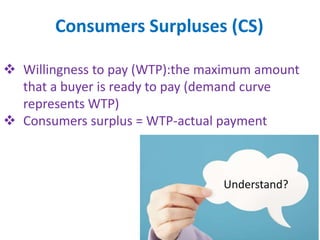
Consumers Surpluses (CS)
 Willingness to pay (WTP):the maximum amount
that a buyer is ready to pay (demand curve
represents WTP)
 Consumers surplus = WTP-actual payment
Understand?
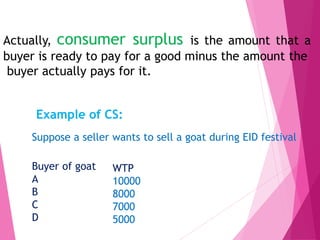
Actually, consumer surplus is the amount that a
buyer is ready to pay for a good minus the amount the
buyer actually pays for it.
Example of CS:
Suppose a seller wants to sell a goat during EID festival
Buyer of goat
A
B
C
D
WTP
10000
8000
7000
5000
Example (cont..)
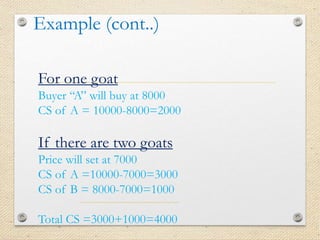
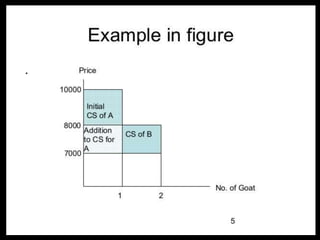
For one goat
Buyer “A” will buy at 8000
CS of A = 10000-8000=2000
If there are two goats
Price will set at 7000
CS of A =10000-7000=3000
CS of B = 8000-7000=1000
Total CS =3000+1000=4000
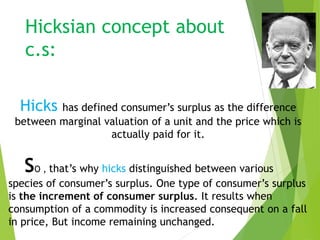
Hicksian concept about
c.s:
Hicks has defined consumer’s surplus as the difference
between marginal valuation of a unit and the price which is
actually paid for it.
SO , that’s why hicks distinguished between various
species of consumer’s surplus. One type of consumer’s surplus
is the increment of consumer surplus. It results when
consumption of a commodity is increased consequent on a fall
in price, But income remaining unchanged.
This increment is divided into two parts:
1.Increment of surplus on units consumed previously.
2.And new surplus from increase in consumption.
HERE, there is a change in what the consumer does pay
but no change in what he is prepared to pay.
And the second part arises from the difference between
the marginal valuation of the extra units and the price
which is paid for them.
PROFESSOR Hicks has developed the
concept of consumer surplus and has
Propounded four kinds of consumer surplus
which are:
1.price compensating variation
2.price equivalent variation
3.quantity compensating variation
4.quantity equivalent variation.

LAW OF DIMINISHING MARGNAL
UTILITY:
Utility: It is the capacity of a commodity through which
human wants are satisfied . Utility does not means
happiness and utility does not means joy or any things.
Marginal utility: marginal utility can be defined as the
change in the total utility Resulting from a one-unit
change in the consumption of a commodity per unit of
time .
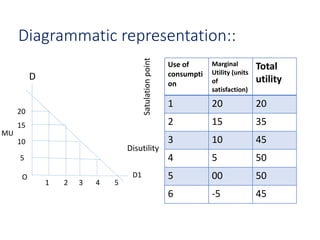
Diagrammatic representation::
D
1 2 3 4 5
20
15
10
5
O D1
MU
Use of
consumpti
on
Marginal
Utility (units
of
satisfaction)
Total
utility
1 20 20
2 15 35
3 10 45
4 5 50
5 00 50
6 -5 45
SatulationpointDisutility
Quality of goods or service should not be changed.
Consumption of goods should continuous.
Consumer mental outlook should not change.
Units of goods shouldn’t be few or less.
ALFRED MARSHALL: During the course of consumption as
more and more units of a commodity are used every
successive units uses utility with a diminishing rate provided
others things remain same, although total utility increases.
--
1
2
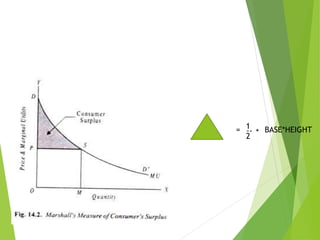
= * BASE*HEIGHT
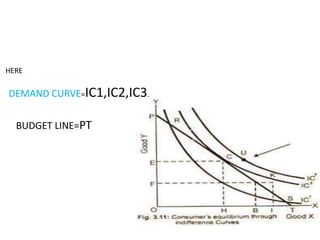
HERE
DEMAND CURVE=IC1,IC2,IC3.
BUDGET LINE=PT
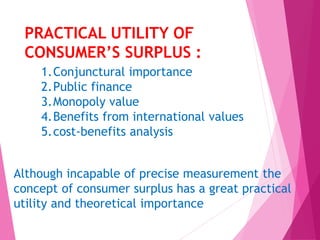
PRACTICAL UTILITY OF
CONSUMER’S SURPLUS :
1.Conjunctural importance
2.Public finance
3.Monopoly value
4.Benefits from international values
5.cost-benefits analysis
Although incapable of precise measurement the
concept of consumer surplus has a great practical
utility and theoretical importance
Conjunctural importance: It enables us to
compare the advantage of environment
and opportunities or conjunctural benefits .a person
getting Tk 500 in Dhaka can enjoy better amenities of
life than a person getting tk 1000 in a place more
remote from the centre of civilization.it also make us to
compare the economic conditions Of the people at
different times. The larger the consumer surplus the
better of are the people .
Public finance: The finance minister CONSIDERS
WHILE PROPOSING fresh taxation, how much are the people
are willing to pay for a thing and how they will affected by
the rise in price resulting from the imposition of a tax
where the consumer’s are enjoying a surplus there is scope
for taxation, for the people are willing to pay more .the rise
in the price will not affect the demand much.
Imposition of a tax or granting a bounty is
bound to affect consumers surplus. But the effect
will differ according as the industry is subject to
constant return , diminishing return or increasing
return.
In the case of constant return, the consumer’s surplus will
be diminishing by more that the gross receipts of the state
“on that part of the consumption which is maintained , the
consumer looses what the state receives ,and on the part
which is destroyed By the rise in prices, the consumers
surplus is destroyed and there is no payment to the state .”
conversely the gain of consumers surplus in the case of a
bounty is less then the bounty itself .
Monopoly value : similarly, businessman,
especially a monopolist, will find That he can easily
raise price of his product if the commodity is yielding
surplus of Satisfaction to the consumers . The
consumers are willing to pay more , if need be.as a
matter Of expediency , however , the businessman will
not raise the price so much as to absorb the whole of
the surplus . He will not drive a hard bargain. He will
like to cultivate and retain the goodwill of his
customers and follow, therefore, a policy of
compromise.
Benefits from international trade:
By entering into trade with another country , we
import With certain articles which happen to be
cheaper. Before we import them , we were
Paying more for similar commodities. They yield
a surplus of satisfaction which is measured By
the excess of what we would have paid for
them over what we have actually paid . The
larger this surplus, the more beneficial is
international Trade .
Cost-benefit analysis: The concept of
consumers surplus is found useful in working out cost
Benefit analysis of an investment. Cost-benefit
investment is consumed very essential For determining
the desirability or otherwise of an investment
expenditure in a particular Project. The extent of
consumer’s surplus expected form a project is a very
important determining factor in decision –making in such
cases. We have to weigh the costs and the benefits. The
large the consumers surplus more beneficial is considered
the investment thus ,the concept of consumers surplus is
a useful tool for the formulation of important economic
policies.
Difficulties of Measurement
consumer's surplus = Total Utility - Price *
Number of units purchased ( i.e., the total
amount spent)
How simple it looks!
The measurement of consumer's surplus, however,
is not so simple as that. There are numerous
difficulties which stand in the way of the precise
measurement of consumer's surplus :
A complete list of demand prices is not
available: we are aware of a part only of the
demand schedule.As we do not know what prices
we are prepared to pay for everyone of the units,
the whole of the consumer's surplus cannot be
ascertained.
Necessaries: Consumer's surplus, in the case of
necessaries of life and conventional necessaries is indefinite
and immeasurable. Incase of necessaries of life as well as
conventional necessaries, however, it is said that there is no
positive satisfaction.
Consumer's Circumstance::In economy there
has a large number of rich and poor consumers. The
rich prefer to pay high price and the poor prefer to pay
low price. That's why it's difficult to measure to
consumer surplus.
Consumer's Sensibilities::Every consumer
has his own tastes and sensibilities. Some desire a
commodity more ardently than others and are,
therefore, prepared to offer more.
Note: In case, consumer circumstance and consumer
sensibilities problems can be solved by the idea of
average.
Change in Marginal Utility of Money:: As we go
on buying a commodity, less amount of money with us .
Hence, the marginal utility of each unit of money
increases. But when we measure consumer's surplus, we
do not make any allowance for this change in the marginal
utility of money.
Change in Earlier Units:: There is the further
difficulty, that, with every increase in the purchase of a
commodity, the urgency of need for the earlier purchase
is diminished and their utility decreases. This decrease in
the utility of earlier units is not taken into account when
calculating the consumer's surplus.
Substitutes:: There is difficulty arising out of the
presence of substitutes. To meet this difficulty, the two
substitutes, say, tea and coffee, can be regarded as one
commodity, as suggested by Marshall.
Conclusion:: We may, therefore, conclude by
saving that the exact measurement of consumer's surplus is
impossible. Even so, the concept of consumer's surplus is
not a useless one. In practical life, whether in business or in
public finance, it is always possible to have a rough and
workable idea about the measurement of consumer's
surplus, and that is what matters.
Criticism of consumer
surplus:
 Imaginary concept:
 Potential price may be less
than actual price:
 Utility cant be measured in
numbers:
 Constant marginal utility of
money:
 Not Applicable to
Necessaries:
Imaginary concept:
• According to critics, it is an imaginary concept because a person
can only imagine that he/she is getting more satisfaction than the
payment has made. In reality no body is ready to pay than the
actual price.
Potential price may be less than actual
price:
• If the potential price is less than actual price at that time, there is
no possibility of consumer surplus. This is because there is no
guarantee that there will always be surplus
Utility cant be measured in numbers:
•Utility derived from the consumption of commodity cant
be expressed in terms of number.
Constant marginal utility of money:
•In consumer surplus, marginal utility of money is constant
but practically the utility of money depends on the
volume of money.
Not Applicable to Necessaries:
•The idea of consumers surplus does not apply to the
necessaries of life or conventional necessaries. In such
cases the surplus is immeasurable.
EX: What would not a man be prepared to pay for a glass
of water when he is dying of thirst!
T h a n k y o u
BE Happy & Spread Happyness

Consumer Surplus

  • 1.
    NO! RIGHT NOW.LETS MOVE ON OUR WORK
  • 2.
  • 3.
    C.S = CONSUMERSURPLUS THIS IS OUR PRESENTSION TOPIC
  • 4.
    Two main thingsof consumer’s surplus ::  Willingness to pay  Actual payment
  • 5.
    Consumers Surpluses (CS) Willingness to pay (WTP):the maximum amount that a buyer is ready to pay (demand curve represents WTP)  Consumers surplus = WTP-actual payment Understand?
  • 6.
    Actually, consumer surplusis the amount that a buyer is ready to pay for a good minus the amount the buyer actually pays for it. Example of CS: Suppose a seller wants to sell a goat during EID festival Buyer of goat A B C D WTP 10000 8000 7000 5000
  • 7.
    Example (cont..) For onegoat Buyer “A” will buy at 8000 CS of A = 10000-8000=2000 If there are two goats Price will set at 7000 CS of A =10000-7000=3000 CS of B = 8000-7000=1000 Total CS =3000+1000=4000
  • 9.
    Hicksian concept about c.s: Hickshas defined consumer’s surplus as the difference between marginal valuation of a unit and the price which is actually paid for it. SO , that’s why hicks distinguished between various species of consumer’s surplus. One type of consumer’s surplus is the increment of consumer surplus. It results when consumption of a commodity is increased consequent on a fall in price, But income remaining unchanged.
  • 10.
    This increment isdivided into two parts: 1.Increment of surplus on units consumed previously. 2.And new surplus from increase in consumption. HERE, there is a change in what the consumer does pay but no change in what he is prepared to pay. And the second part arises from the difference between the marginal valuation of the extra units and the price which is paid for them.
  • 11.
    PROFESSOR Hicks hasdeveloped the concept of consumer surplus and has Propounded four kinds of consumer surplus which are: 1.price compensating variation 2.price equivalent variation 3.quantity compensating variation 4.quantity equivalent variation.
  • 12.
    LAW OF DIMINISHINGMARGNAL UTILITY: Utility: It is the capacity of a commodity through which human wants are satisfied . Utility does not means happiness and utility does not means joy or any things. Marginal utility: marginal utility can be defined as the change in the total utility Resulting from a one-unit change in the consumption of a commodity per unit of time .
  • 13.
    Diagrammatic representation:: D 1 23 4 5 20 15 10 5 O D1 MU Use of consumpti on Marginal Utility (units of satisfaction) Total utility 1 20 20 2 15 35 3 10 45 4 5 50 5 00 50 6 -5 45 SatulationpointDisutility
  • 14.
    Quality of goodsor service should not be changed. Consumption of goods should continuous. Consumer mental outlook should not change. Units of goods shouldn’t be few or less. ALFRED MARSHALL: During the course of consumption as more and more units of a commodity are used every successive units uses utility with a diminishing rate provided others things remain same, although total utility increases.
  • 16.
  • 17.
  • 18.
    PRACTICAL UTILITY OF CONSUMER’SSURPLUS : 1.Conjunctural importance 2.Public finance 3.Monopoly value 4.Benefits from international values 5.cost-benefits analysis Although incapable of precise measurement the concept of consumer surplus has a great practical utility and theoretical importance
  • 19.
    Conjunctural importance: Itenables us to compare the advantage of environment and opportunities or conjunctural benefits .a person getting Tk 500 in Dhaka can enjoy better amenities of life than a person getting tk 1000 in a place more remote from the centre of civilization.it also make us to compare the economic conditions Of the people at different times. The larger the consumer surplus the better of are the people .
  • 20.
    Public finance: Thefinance minister CONSIDERS WHILE PROPOSING fresh taxation, how much are the people are willing to pay for a thing and how they will affected by the rise in price resulting from the imposition of a tax where the consumer’s are enjoying a surplus there is scope for taxation, for the people are willing to pay more .the rise in the price will not affect the demand much. Imposition of a tax or granting a bounty is bound to affect consumers surplus. But the effect will differ according as the industry is subject to constant return , diminishing return or increasing return.
  • 21.
    In the caseof constant return, the consumer’s surplus will be diminishing by more that the gross receipts of the state “on that part of the consumption which is maintained , the consumer looses what the state receives ,and on the part which is destroyed By the rise in prices, the consumers surplus is destroyed and there is no payment to the state .” conversely the gain of consumers surplus in the case of a bounty is less then the bounty itself .
  • 22.
    Monopoly value :similarly, businessman, especially a monopolist, will find That he can easily raise price of his product if the commodity is yielding surplus of Satisfaction to the consumers . The consumers are willing to pay more , if need be.as a matter Of expediency , however , the businessman will not raise the price so much as to absorb the whole of the surplus . He will not drive a hard bargain. He will like to cultivate and retain the goodwill of his customers and follow, therefore, a policy of compromise.
  • 23.
    Benefits from internationaltrade: By entering into trade with another country , we import With certain articles which happen to be cheaper. Before we import them , we were Paying more for similar commodities. They yield a surplus of satisfaction which is measured By the excess of what we would have paid for them over what we have actually paid . The larger this surplus, the more beneficial is international Trade .
  • 24.
    Cost-benefit analysis: Theconcept of consumers surplus is found useful in working out cost Benefit analysis of an investment. Cost-benefit investment is consumed very essential For determining the desirability or otherwise of an investment expenditure in a particular Project. The extent of consumer’s surplus expected form a project is a very important determining factor in decision –making in such cases. We have to weigh the costs and the benefits. The large the consumers surplus more beneficial is considered the investment thus ,the concept of consumers surplus is a useful tool for the formulation of important economic policies.
  • 25.
    Difficulties of Measurement consumer'ssurplus = Total Utility - Price * Number of units purchased ( i.e., the total amount spent) How simple it looks!
  • 26.
    The measurement ofconsumer's surplus, however, is not so simple as that. There are numerous difficulties which stand in the way of the precise measurement of consumer's surplus : A complete list of demand prices is not available: we are aware of a part only of the demand schedule.As we do not know what prices we are prepared to pay for everyone of the units, the whole of the consumer's surplus cannot be ascertained.
  • 27.
    Necessaries: Consumer's surplus,in the case of necessaries of life and conventional necessaries is indefinite and immeasurable. Incase of necessaries of life as well as conventional necessaries, however, it is said that there is no positive satisfaction.
  • 28.
    Consumer's Circumstance::In economythere has a large number of rich and poor consumers. The rich prefer to pay high price and the poor prefer to pay low price. That's why it's difficult to measure to consumer surplus. Consumer's Sensibilities::Every consumer has his own tastes and sensibilities. Some desire a commodity more ardently than others and are, therefore, prepared to offer more. Note: In case, consumer circumstance and consumer sensibilities problems can be solved by the idea of average.
  • 29.
    Change in MarginalUtility of Money:: As we go on buying a commodity, less amount of money with us . Hence, the marginal utility of each unit of money increases. But when we measure consumer's surplus, we do not make any allowance for this change in the marginal utility of money. Change in Earlier Units:: There is the further difficulty, that, with every increase in the purchase of a commodity, the urgency of need for the earlier purchase is diminished and their utility decreases. This decrease in the utility of earlier units is not taken into account when calculating the consumer's surplus.
  • 30.
    Substitutes:: There isdifficulty arising out of the presence of substitutes. To meet this difficulty, the two substitutes, say, tea and coffee, can be regarded as one commodity, as suggested by Marshall. Conclusion:: We may, therefore, conclude by saving that the exact measurement of consumer's surplus is impossible. Even so, the concept of consumer's surplus is not a useless one. In practical life, whether in business or in public finance, it is always possible to have a rough and workable idea about the measurement of consumer's surplus, and that is what matters.
  • 31.
    Criticism of consumer surplus: Imaginary concept:  Potential price may be less than actual price:  Utility cant be measured in numbers:  Constant marginal utility of money:  Not Applicable to Necessaries:
  • 32.
    Imaginary concept: • Accordingto critics, it is an imaginary concept because a person can only imagine that he/she is getting more satisfaction than the payment has made. In reality no body is ready to pay than the actual price. Potential price may be less than actual price: • If the potential price is less than actual price at that time, there is no possibility of consumer surplus. This is because there is no guarantee that there will always be surplus
  • 33.
    Utility cant bemeasured in numbers: •Utility derived from the consumption of commodity cant be expressed in terms of number. Constant marginal utility of money: •In consumer surplus, marginal utility of money is constant but practically the utility of money depends on the volume of money. Not Applicable to Necessaries: •The idea of consumers surplus does not apply to the necessaries of life or conventional necessaries. In such cases the surplus is immeasurable. EX: What would not a man be prepared to pay for a glass of water when he is dying of thirst!
  • 34.
    T h an k y o u BE Happy & Spread Happyness