COURNOT MODEL FOR
DUOPOLY MARKET
Presented by,
Yagnesh Sondarva
04-2664-2015
MSc. Agri.Extension
BACA, Anand
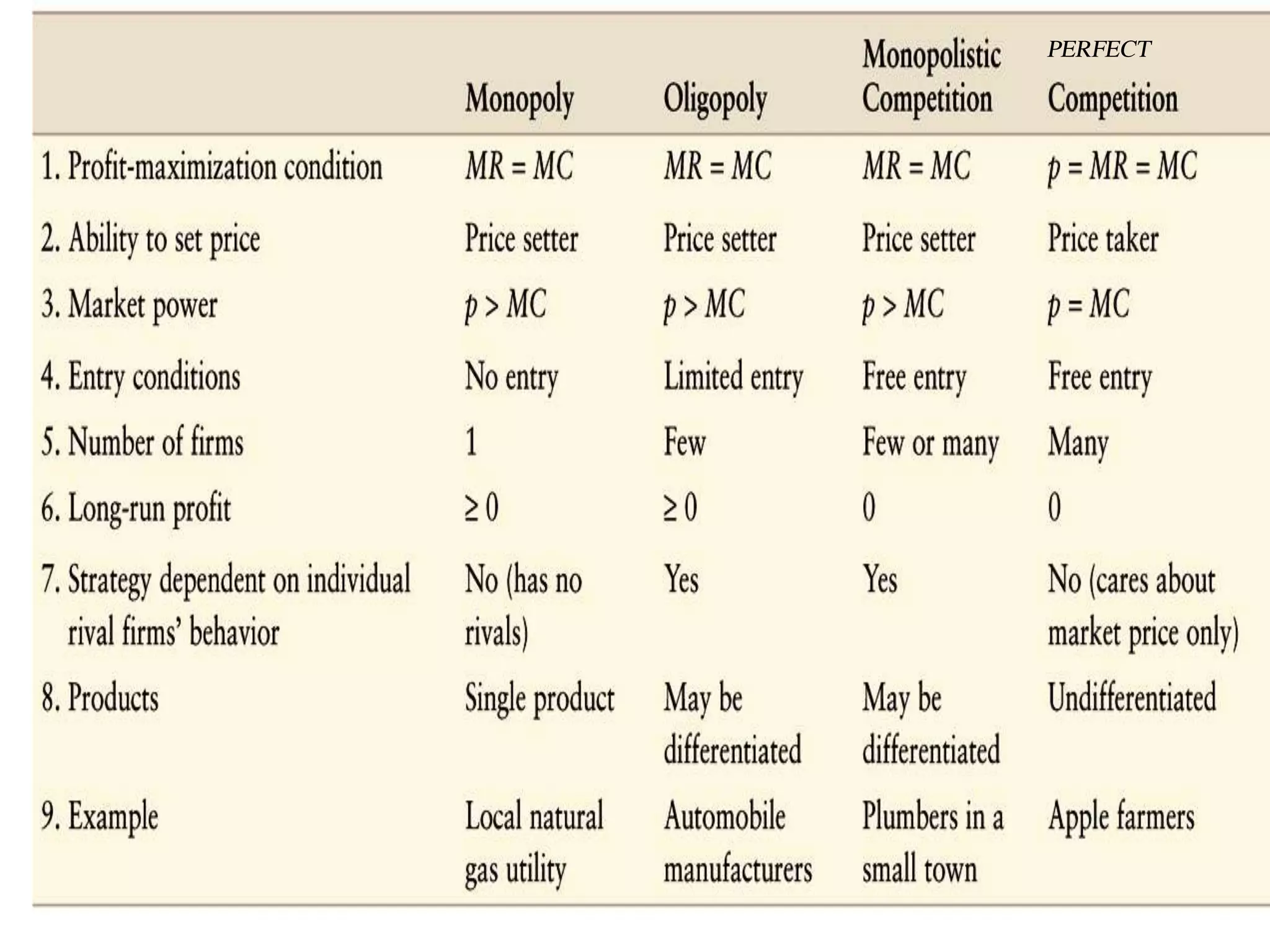
Market Structure
1) Number of firms in market
2) Product Differentiation
Markets are often described by the degree of concentration
Monopoly is one extreme with the highest concentration - one seller
Perfect competition is the other extreme with innumerable sellers
Oligopoly involves few sellers engaging in strategic competition
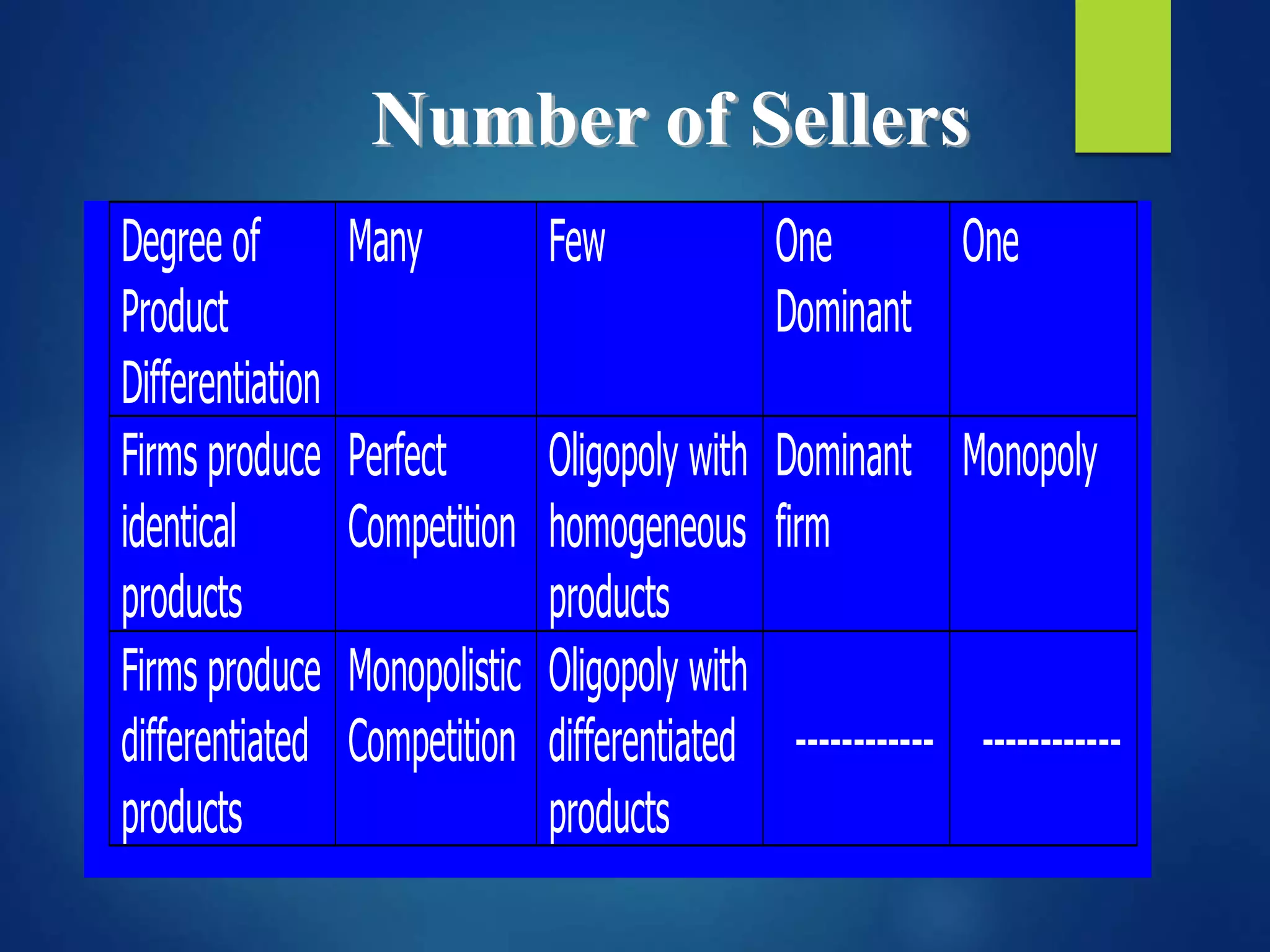
Number of Sellers
Degree of
Product
Differentiation
Many Few One
Dominant
One
Firms produce
identical
products
Perfect
Competition
Oligopoly with
homogeneous
products
Dominant
firm
Monopoly
Firms produce
differentiated
products
Monopolistic
Competition
Oligopoly with
differentiated
products
------------ ------------
PERFECT
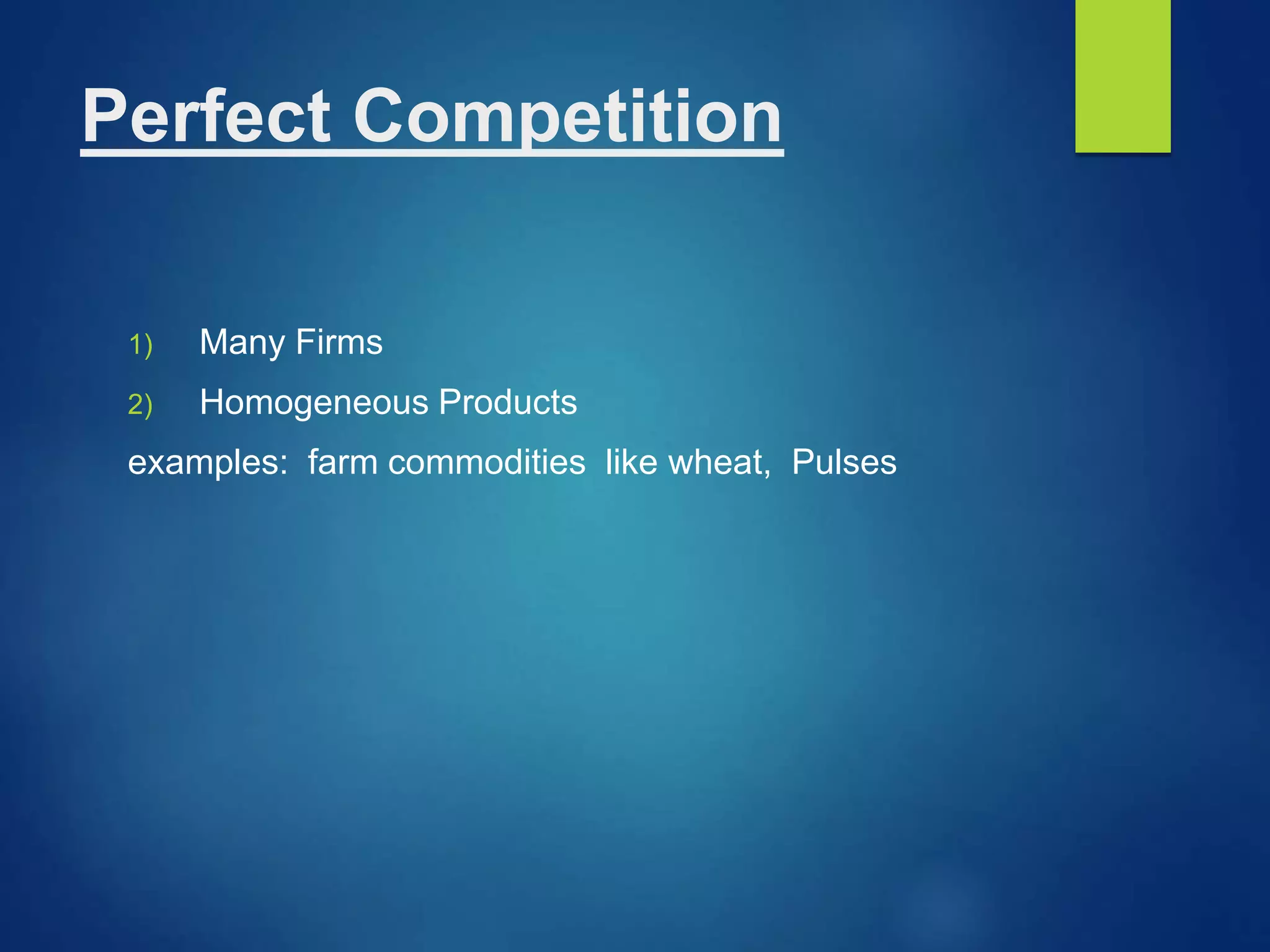
Perfect Competition
1) Many Firms
2) Homogeneous Products
examples: farm commodities like wheat, Pulses
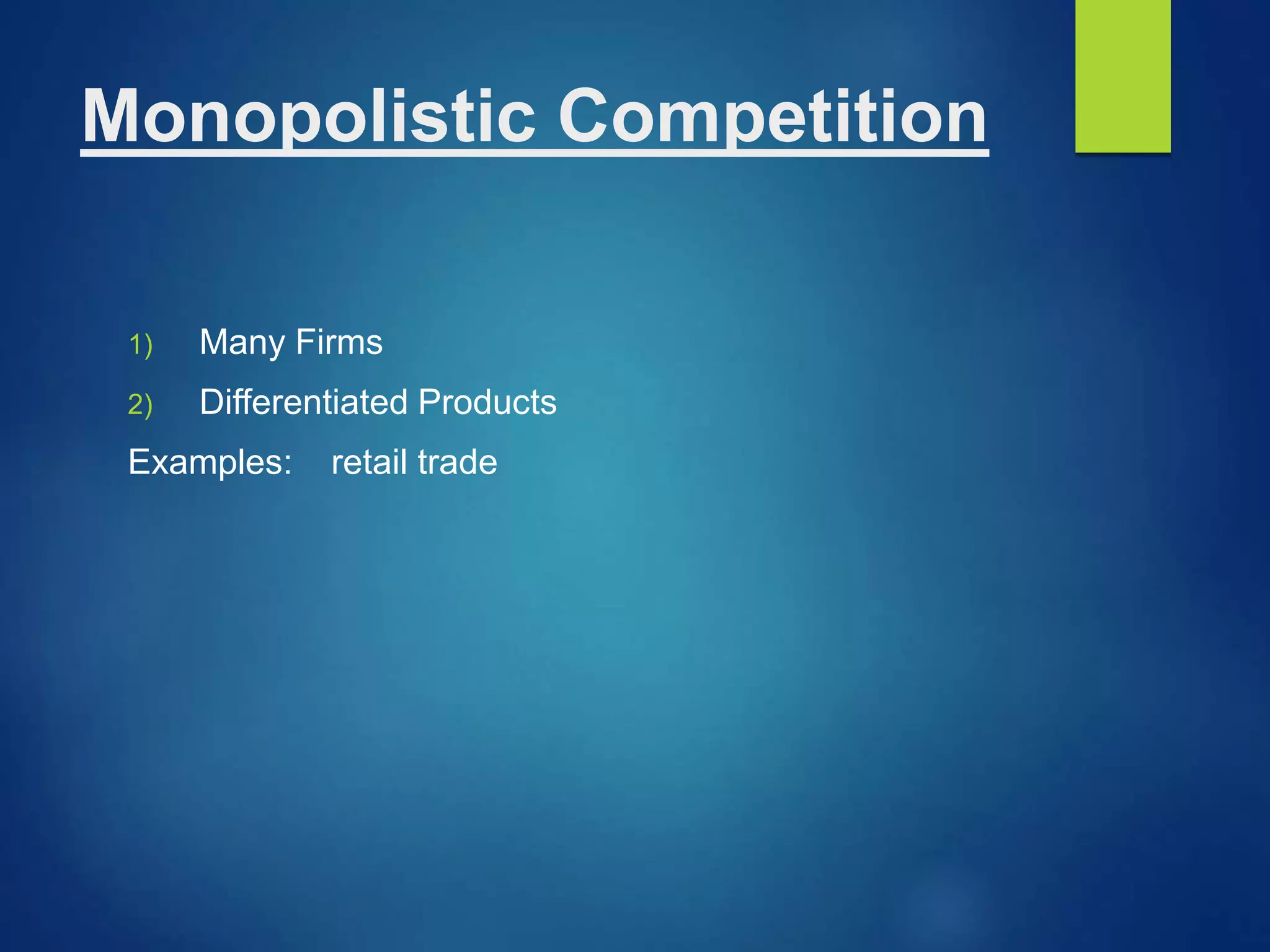
Monopolistic Competition
1) Many Firms
2) Differentiated Products
Examples: retail trade
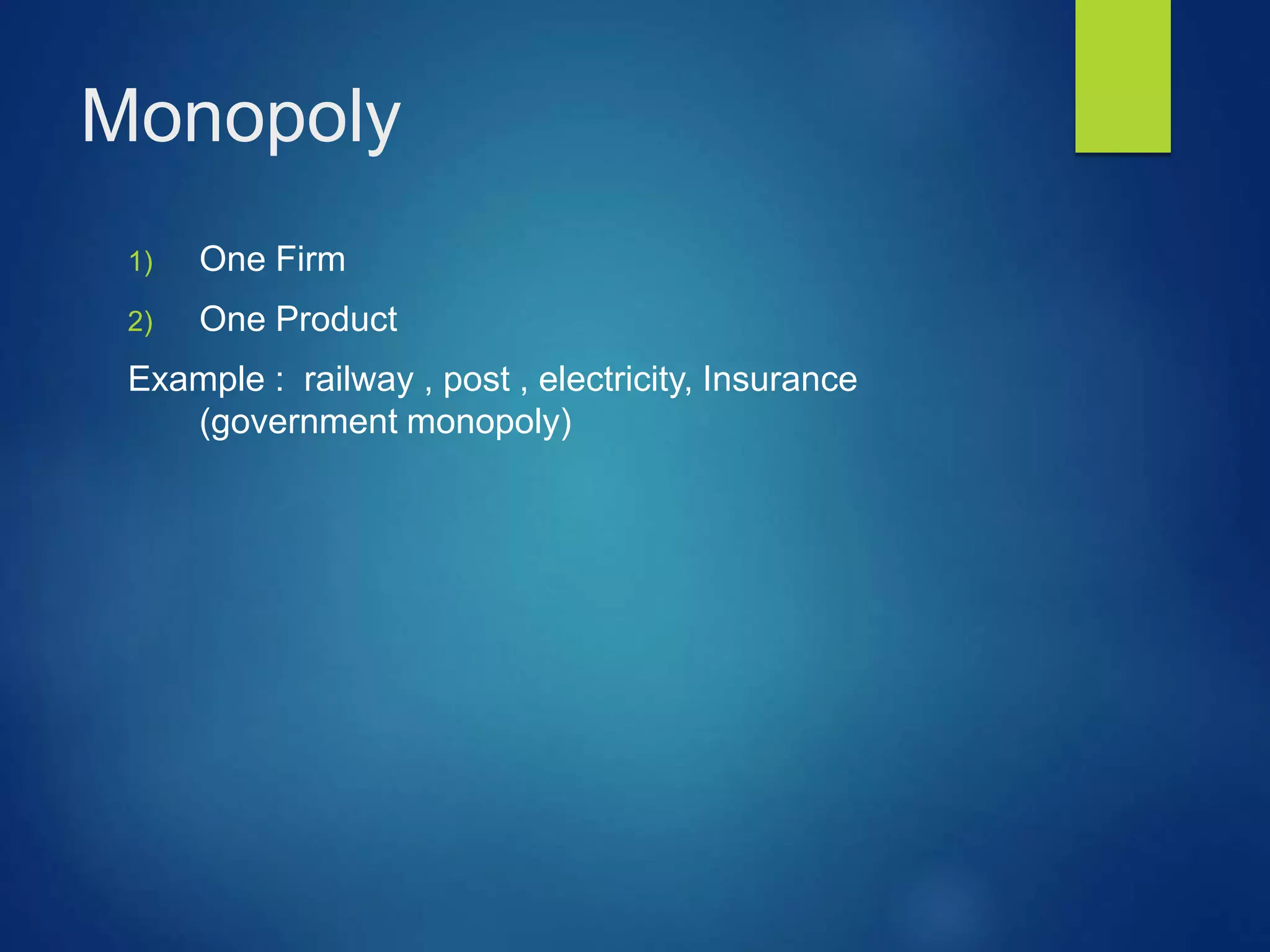
Monopoly
1) One Firm
2) One Product
Example : railway , post , electricity, Insurance
(government monopoly)
Oligopoly
A) Homogeneous Products Oligopoly
1) Few Firms
2) Homogeneous Products
Examples: steel ,chemical.
B) Differentiated Products Oligopoly
1) Few Firms
2) Differentiated Products
Examples: automobile , computer
Oligopoly
 Market has a small number of sellers
 Pricing and output decisions by each firm affects the
price and output in the industry
 Oligopoly models (Cournot, Bertrand) focus on how
firms react to each other’s moves
Oligopoly – Characteristics
 Product differentiation may or may not exist
 Barriers to entry
 Small number of firms
 Scale economies
 Patents
 Technology
 Name recognition
 Strategic action
Oligopoly
 Examples
 Automobiles
 Steel
 Aluminum
 Petrochemicals
 Electrical equipment
Management Challenges
 Strategic actions to deter entry
 Threaten to decrease price against new competitors by
keeping excess capacity
 Rival behavior
 Because only a few firms, each must consider how its
actions will affect its rivals and in turn how their rivals will
react
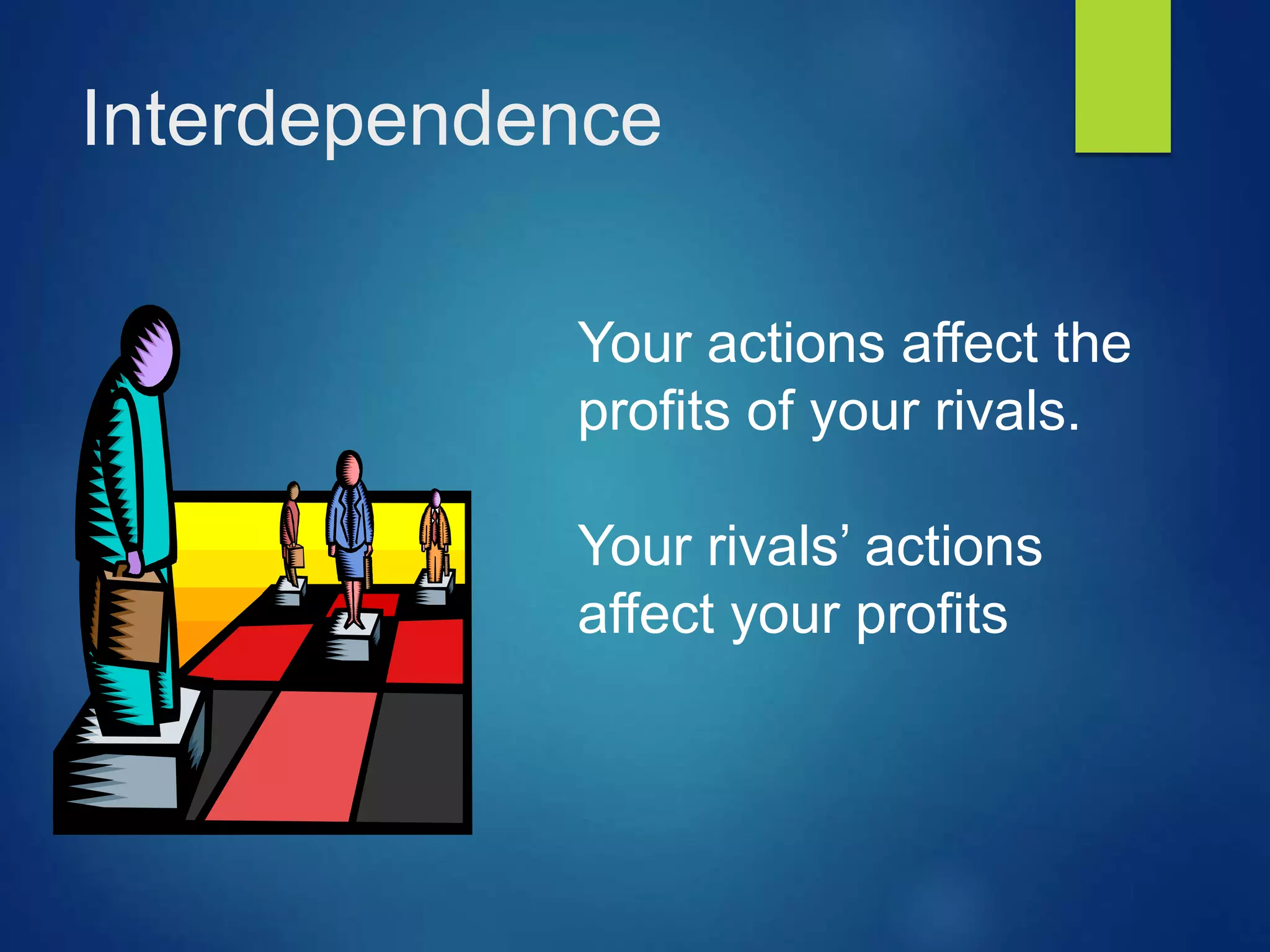
Interdependence
Your actions affect the
profits of your rivals.
Your rivals’ actions
affect your profits
An Example
 You and another firm sell
differentiated products such as
cars.
 How does the quantity demanded
for your cars change when you
change your price?
Oligopoly – Equilibrium
 If one firm decides to cut their price, they must
consider what the other firms in the industry will do
Could cut price some, the same amount, or more than firm
 Could lead to price war and drastic fall in profits for all
 Actions and reactions are dynamic, evolving over
time
Oligopoly – Equilibrium
 Defining Equilibrium
 Firms are doing the best they can and have no
incentive to change their output or price
 All firms assume competitors are taking rival
decisions into account
 Nash Equilibrium
 Each firm is doing the best it can given what its
competitors are doing
 We will focus on duopoly
 Markets in which two firms compete
Duopoly models
 Cournot model
 Edgeworth model
 Chamberlin model
 Price leadership model
 Bertrand model
 Kinked demand curve
 Centralized cartel model
 Market sharing cartel model
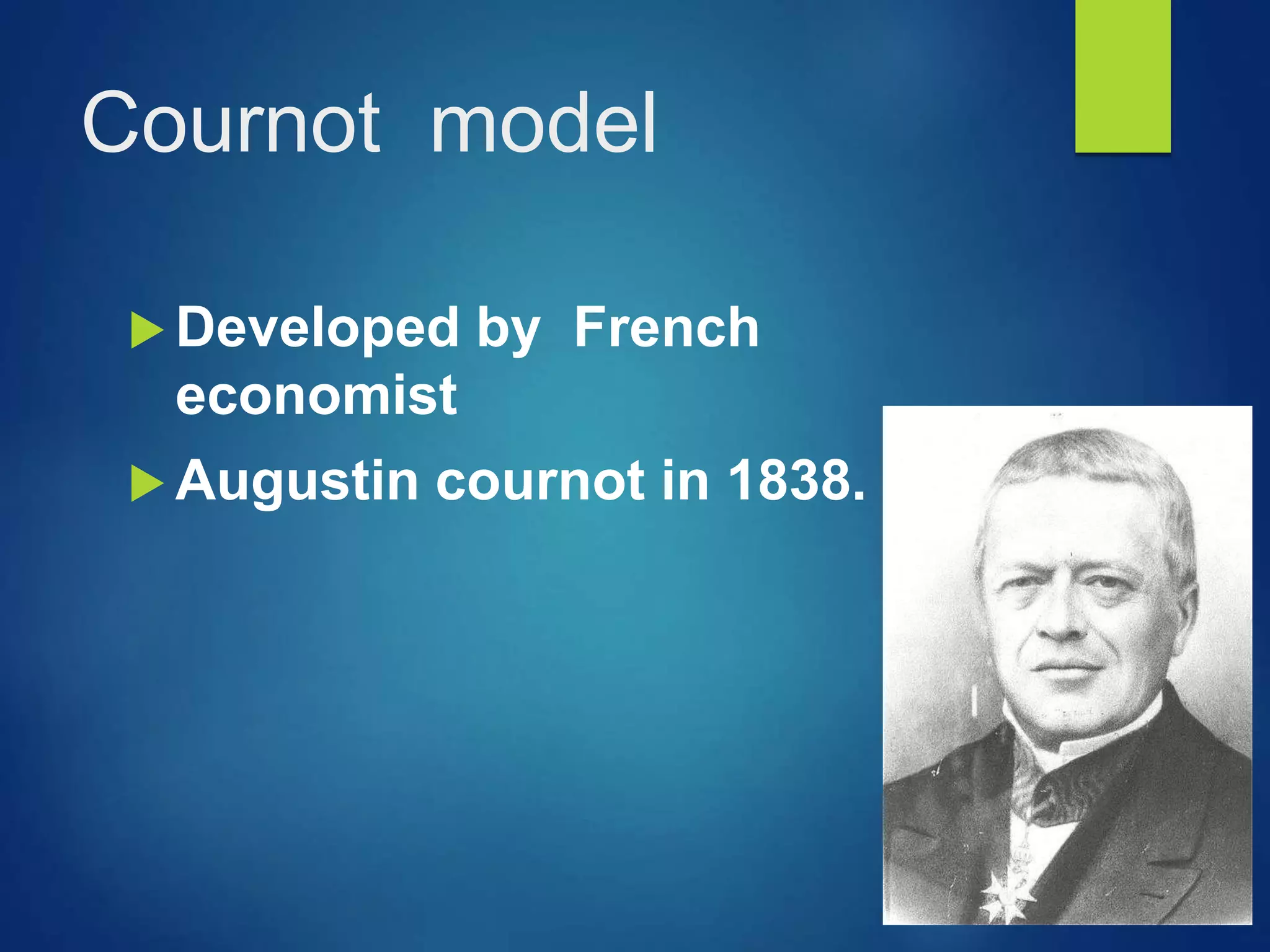
Cournot model
 Developed by French
economist
 Augustin cournot in 1838.
Cournot model
 Oligopoly model in which firms
produce a homogeneous good, each
firm treats the output of its competitors
as fixed, and all firms decide
simultaneously how much to produce
Assumptions of Cournot Model
Four assumptions:
1. there are two firms and no other firms can
enter in the market,
2. the firms have identical costs,
3. they sell identical products
4. the firms set their quantities
simultaneously.
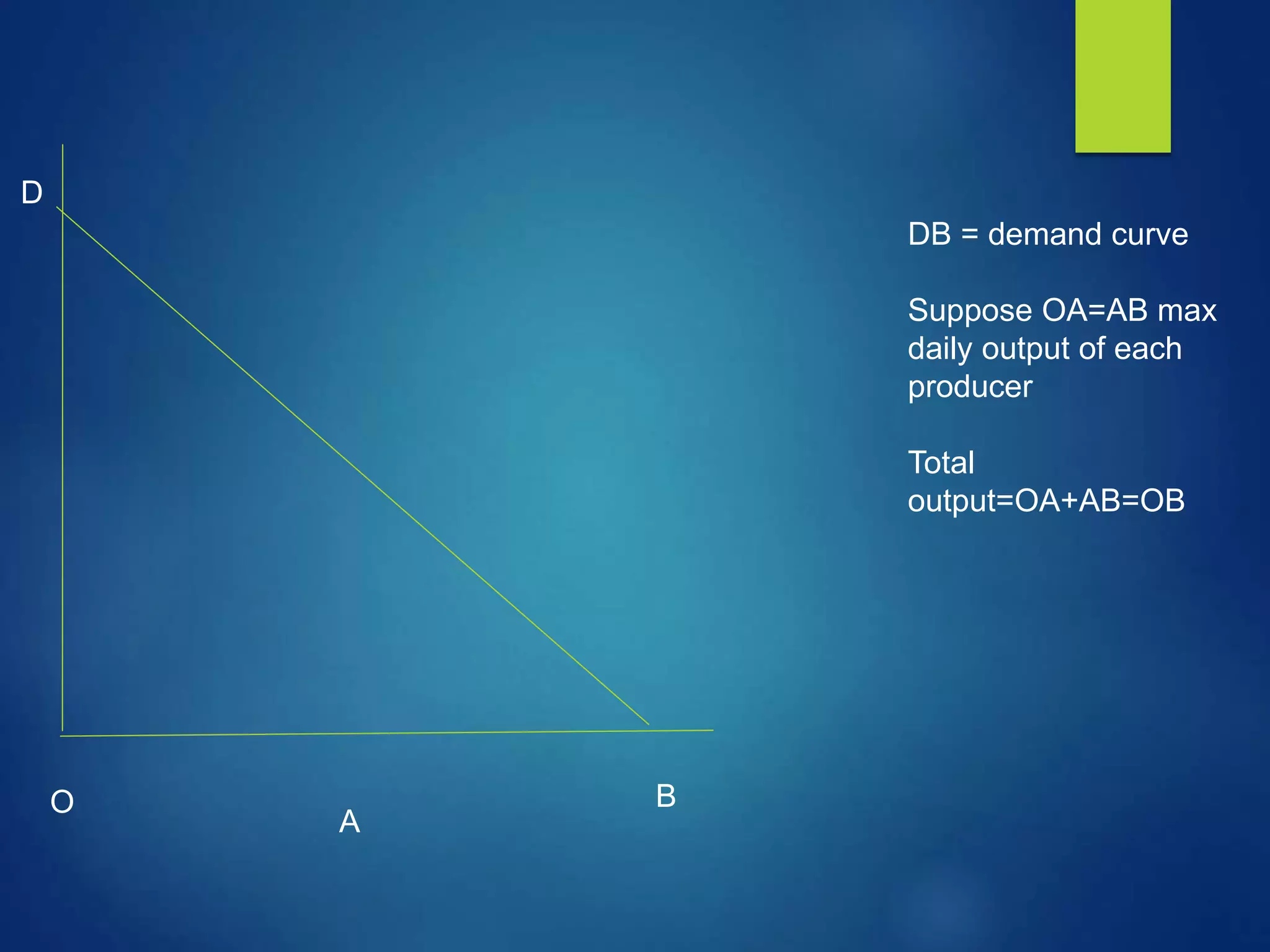
O
A
B
D
DB = demand curve
Suppose OA=AB max
daily output of each
producer
Total
output=OA+AB=OB
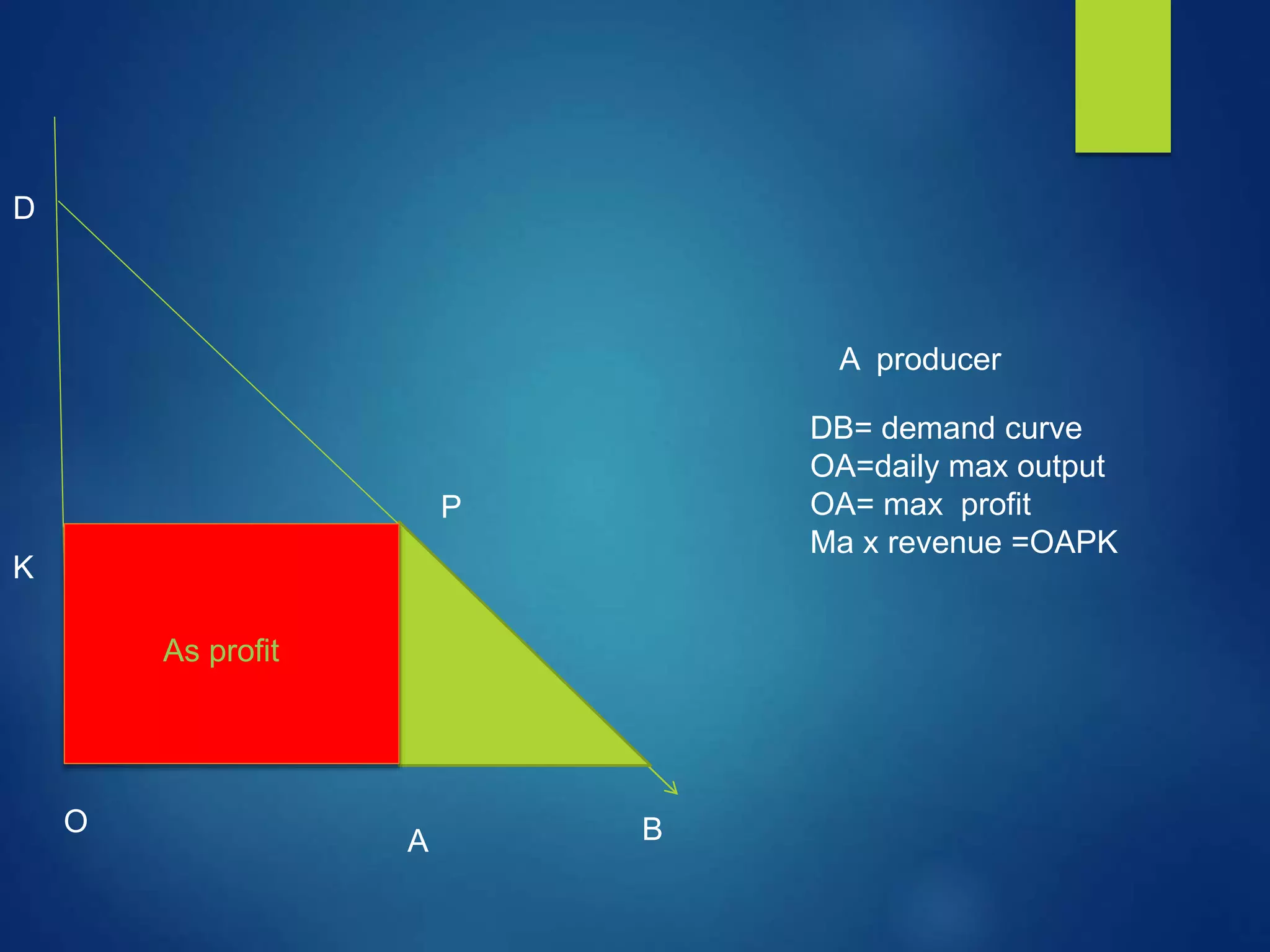
D
K
O
A B
P
DB= demand curve
OA=daily max output
OA= max profit
Ma x revenue =OAPK
Profit of AAs profit
A producer
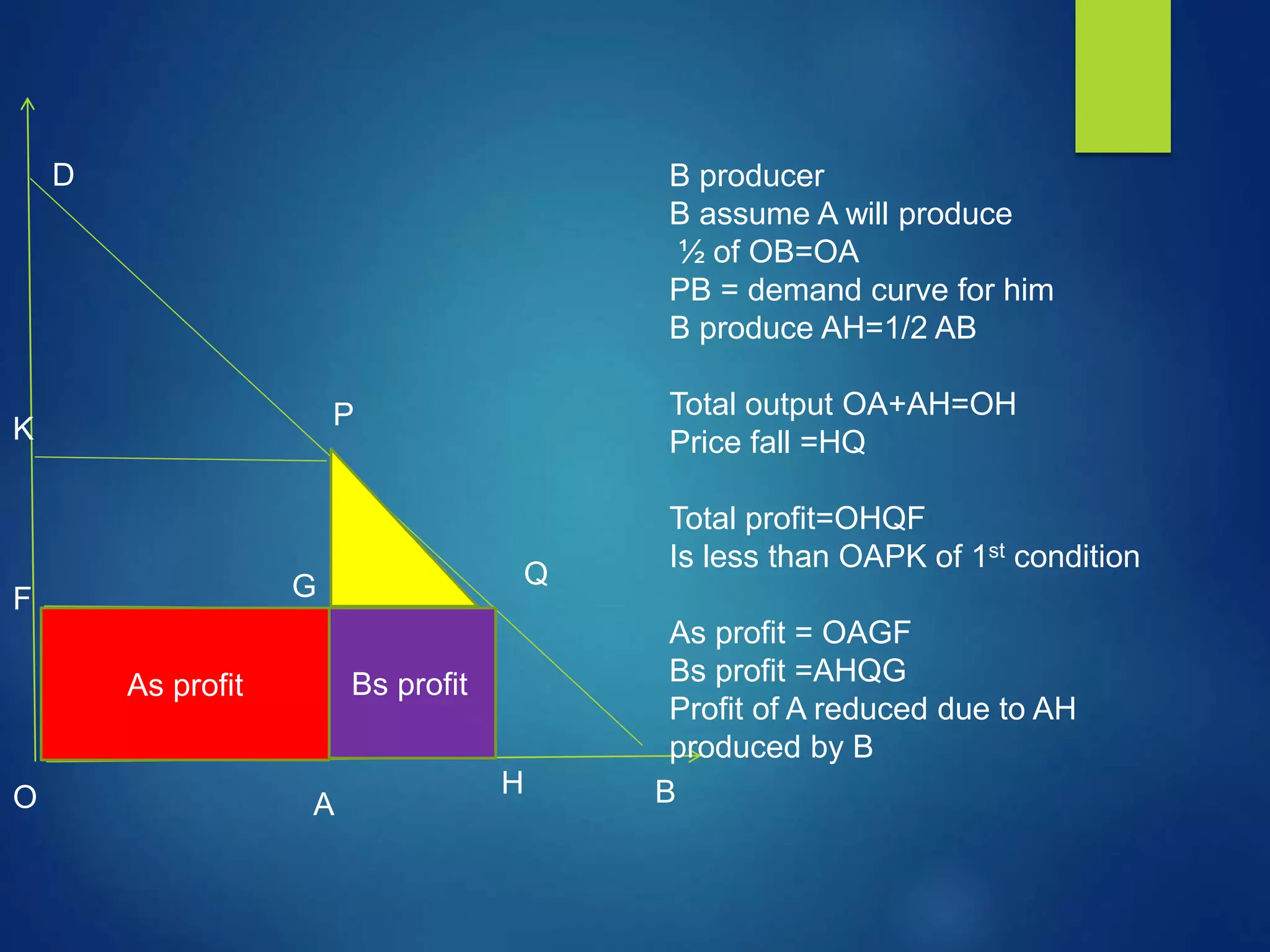
P
Q
D
O A
H B
B producer
B assume A will produce
½ of OB=OA
PB = demand curve for him
B produce AH=1/2 AB
Total output OA+AH=OH
Price fall =HQ
Total profit=OHQF
Is less than OAPK of 1st condition
As profit = OAGF
Bs profit =AHQG
Profit of A reduced due to AH
produced by B
Bs profit
G
K
F
As profit
As profit
P
Q
D
O A H B
G
K
F
As profit
As profit
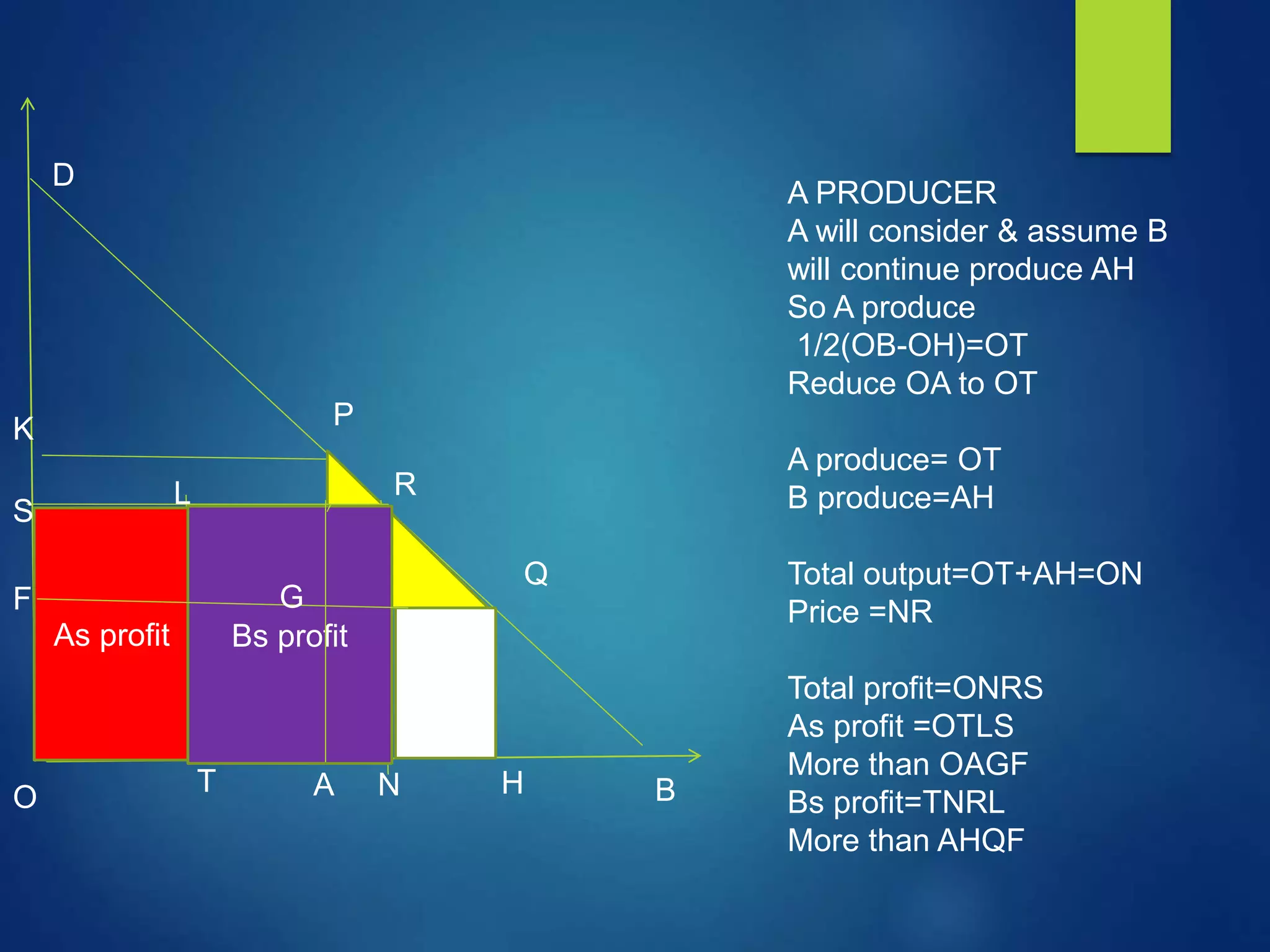
A PRODUCER
A will consider & assume B
will continue produce AH
So A produce
1/2(OB-OH)=OT
Reduce OA to OT
A produce= OT
B produce=AH
Total output=OT+AH=ON
Price =NR
Total profit=ONRS
As profit =OTLS
More than OAGF
Bs profit=TNRL
More than AHQF
T
R
N
S
L
As profit Bs profit
G
B surprised by reduction of output to OT by A and
Also find his share of total profit is less than A
So B assume A will continue produce OT
And B find his maximum profit by producing output=1/2(OB-O T)=1/2 TB
B increase output to ½ TB
Producer A consider and find that he can maximize his profit by producing
output=1/2 OB-output of B
This process of adjustment and readjustment by each producer will continue ,
A being forced gradually to reduce his output
B being able to increase his output gradually until total output OM is produced
OM=2/3 OF OB
And each producing same amount of output
A= OC
B=CM
OC=CM
P
Q
D
O A H B
G
K
F
As p
T
R
N
S
L
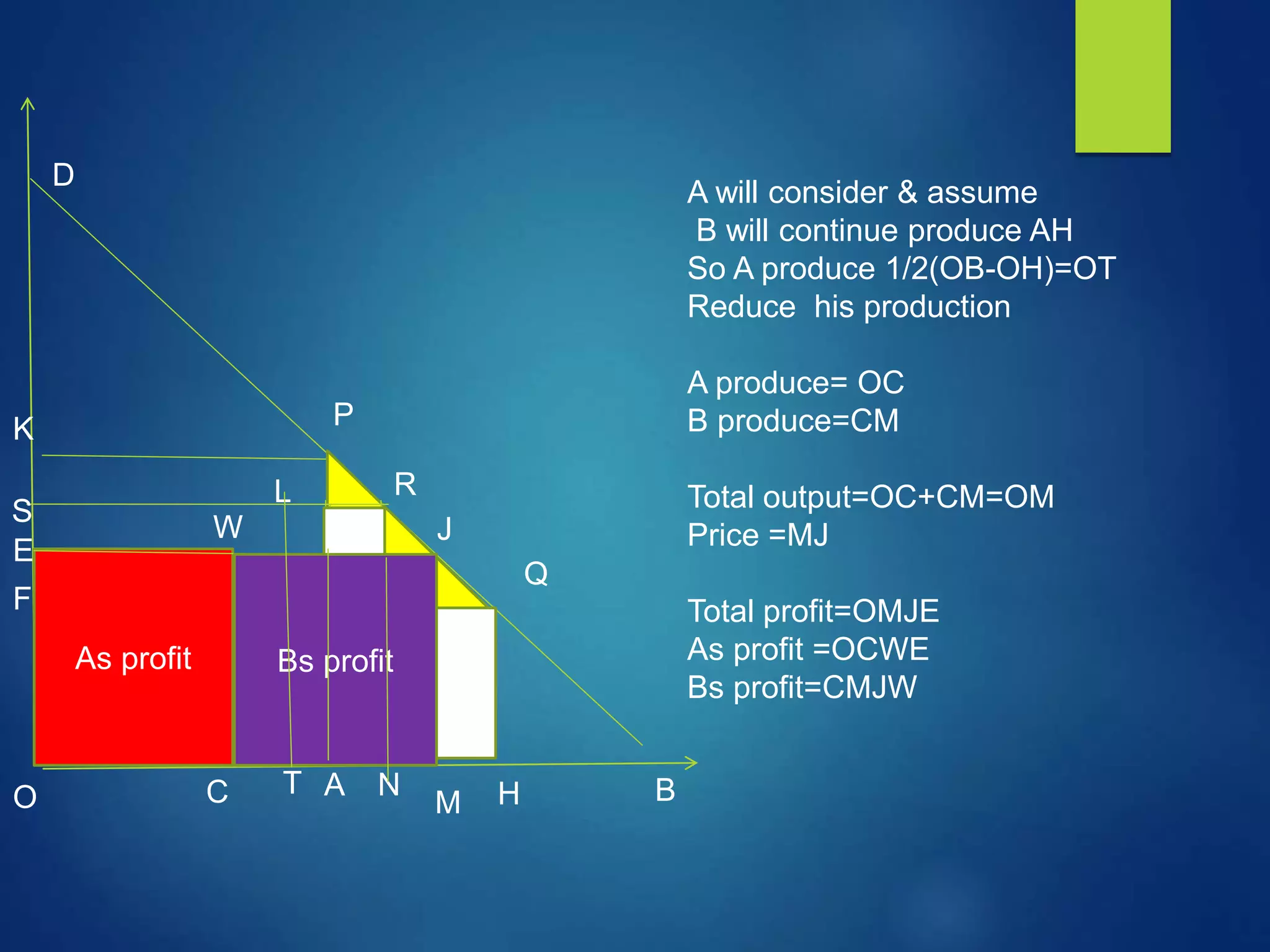
A will consider & assume
B will continue produce AH
So A produce 1/2(OB-OH)=OT
Reduce his production
A produce= OC
B produce=CM
Total output=OC+CM=OM
Price =MJ
Total profit=OMJE
As profit =OCWE
Bs profit=CMJW
As profit
E
J
C
W
Bs profit
M
Throughout the process of adjustment & readjustment each producer
assume that the
Other will keep his output constant at the present level
& then always find his maximum profit by producing output
½(OB-present output of other )
P
Q
D
O A H B
G
K
F
As p
T
R
N
S
L
As profit
E
J
C
W
Bs profit
M
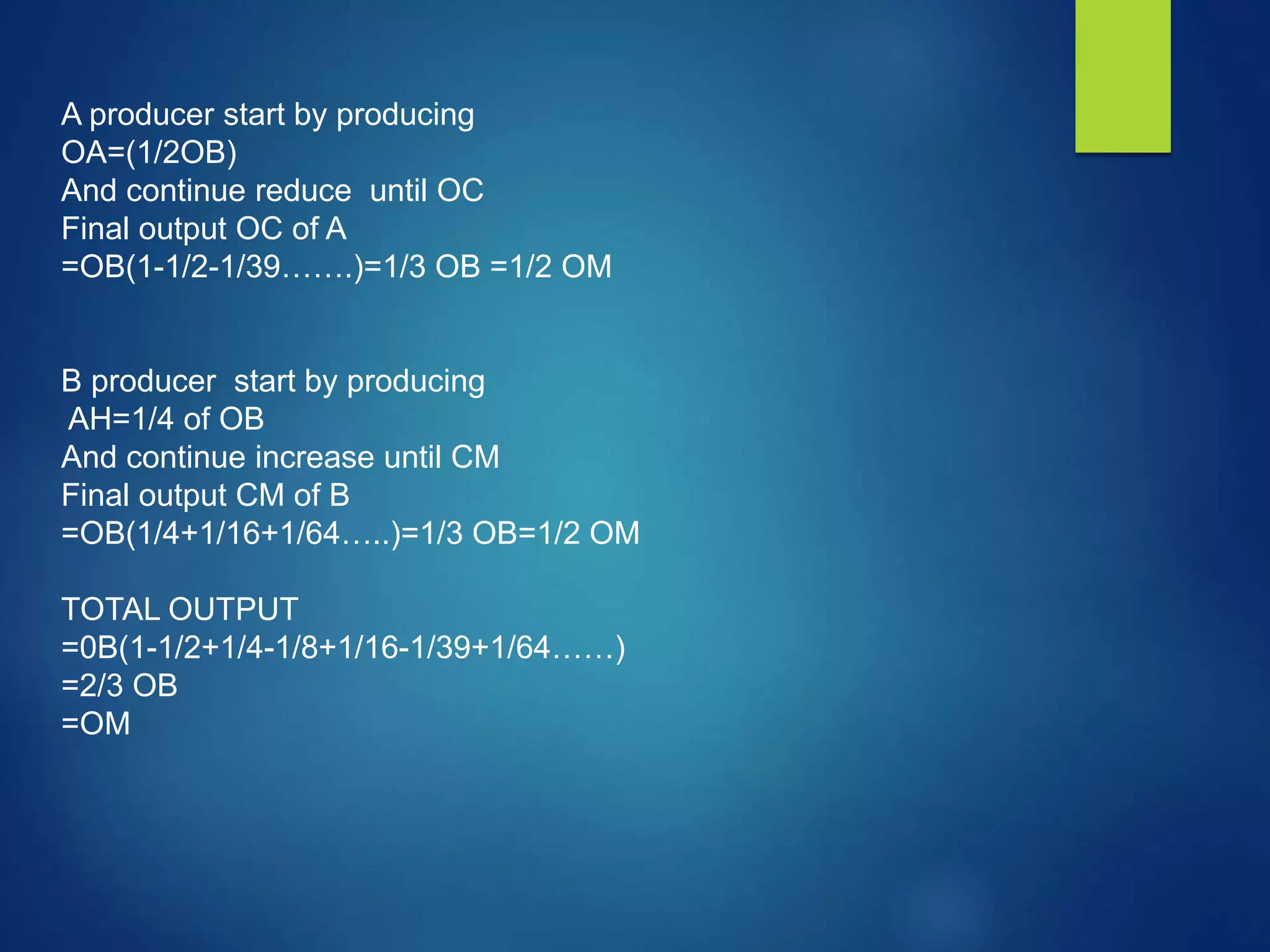
A producer start by producing
OA=(1/2OB)
And continue reduce until OC
Final output OC of A
=OB(1-1/2-1/39…….)=1/3 OB =1/2 OM
B producer start by producing
AH=1/4 of OB
And continue increase until CM
Final output CM of B
=OB(1/4+1/16+1/64…..)=1/3 OB=1/2 OM
TOTAL OUTPUT
=0B(1-1/2+1/4-1/8+1/16-1/39+1/64……)
=2/3 OB
=OM
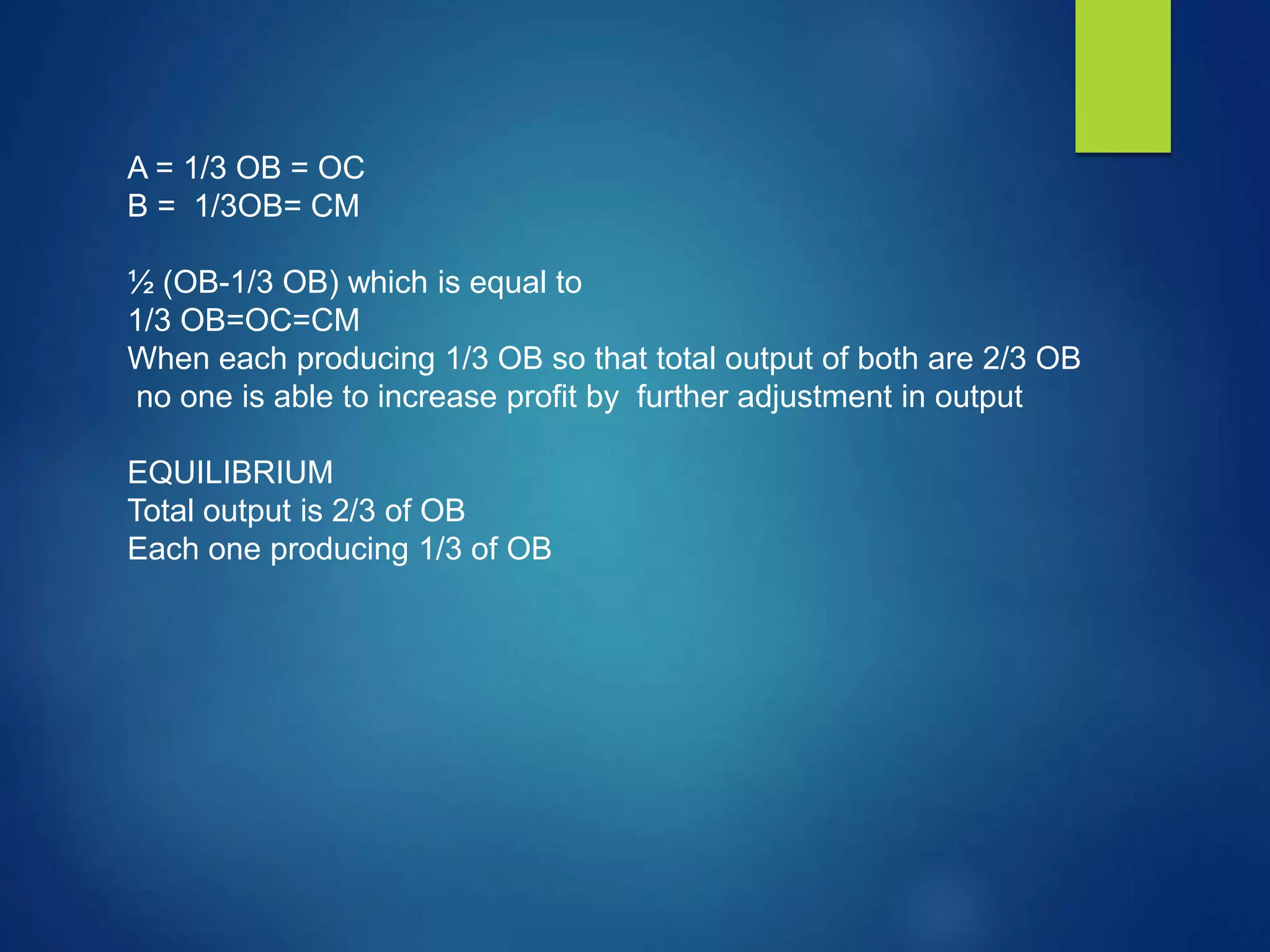
A = 1/3 OB = OC
B = 1/3OB= CM
½ (OB-1/3 OB) which is equal to
1/3 OB=OC=CM
When each producing 1/3 OB so that total output of both are 2/3 OB
no one is able to increase profit by further adjustment in output
EQUILIBRIUM
Total output is 2/3 of OB
Each one producing 1/3 of OB
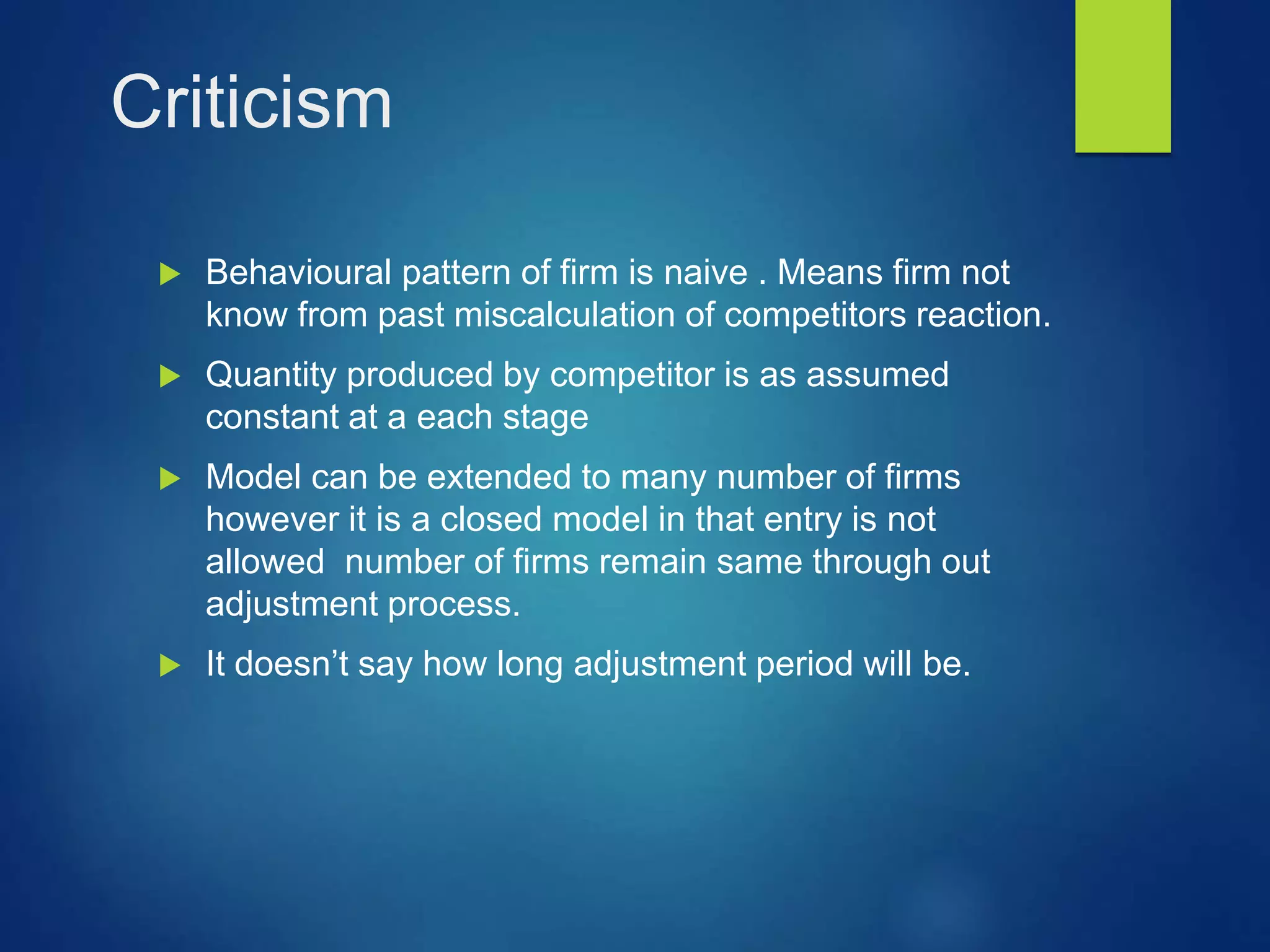
Criticism
 Behavioural pattern of firm is naive . Means firm not
know from past miscalculation of competitors reaction.
 Quantity produced by competitor is as assumed
constant at a each stage
 Model can be extended to many number of firms
however it is a closed model in that entry is not
allowed number of firms remain same through out
adjustment process.
 It doesn’t say how long adjustment period will be.
Thank you

Cournot model

  • 1.
  • 2.
  • 3.
    Market Structure 1) Numberof firms in market 2) Product Differentiation Markets are often described by the degree of concentration Monopoly is one extreme with the highest concentration - one seller Perfect competition is the other extreme with innumerable sellers Oligopoly involves few sellers engaging in strategic competition
  • 4.
    Number of Sellers Degreeof Product Differentiation Many Few One Dominant One Firms produce identical products Perfect Competition Oligopoly with homogeneous products Dominant firm Monopoly Firms produce differentiated products Monopolistic Competition Oligopoly with differentiated products ------------ ------------
  • 5.
  • 6.
    Perfect Competition 1) ManyFirms 2) Homogeneous Products examples: farm commodities like wheat, Pulses
  • 7.
    Monopolistic Competition 1) ManyFirms 2) Differentiated Products Examples: retail trade
  • 8.
    Monopoly 1) One Firm 2)One Product Example : railway , post , electricity, Insurance (government monopoly)
  • 9.
    Oligopoly A) Homogeneous ProductsOligopoly 1) Few Firms 2) Homogeneous Products Examples: steel ,chemical. B) Differentiated Products Oligopoly 1) Few Firms 2) Differentiated Products Examples: automobile , computer
  • 10.
    Oligopoly  Market hasa small number of sellers  Pricing and output decisions by each firm affects the price and output in the industry  Oligopoly models (Cournot, Bertrand) focus on how firms react to each other’s moves
  • 11.
    Oligopoly – Characteristics Product differentiation may or may not exist  Barriers to entry  Small number of firms  Scale economies  Patents  Technology  Name recognition  Strategic action
  • 12.
    Oligopoly  Examples  Automobiles Steel  Aluminum  Petrochemicals  Electrical equipment
  • 13.
    Management Challenges  Strategicactions to deter entry  Threaten to decrease price against new competitors by keeping excess capacity  Rival behavior  Because only a few firms, each must consider how its actions will affect its rivals and in turn how their rivals will react
  • 14.
    Interdependence Your actions affectthe profits of your rivals. Your rivals’ actions affect your profits
  • 15.
    An Example  Youand another firm sell differentiated products such as cars.  How does the quantity demanded for your cars change when you change your price?
  • 16.
    Oligopoly – Equilibrium If one firm decides to cut their price, they must consider what the other firms in the industry will do Could cut price some, the same amount, or more than firm  Could lead to price war and drastic fall in profits for all  Actions and reactions are dynamic, evolving over time
  • 17.
    Oligopoly – Equilibrium Defining Equilibrium  Firms are doing the best they can and have no incentive to change their output or price  All firms assume competitors are taking rival decisions into account  Nash Equilibrium  Each firm is doing the best it can given what its competitors are doing  We will focus on duopoly  Markets in which two firms compete
  • 18.
    Duopoly models  Cournotmodel  Edgeworth model  Chamberlin model  Price leadership model  Bertrand model  Kinked demand curve  Centralized cartel model  Market sharing cartel model
  • 19.
    Cournot model  Developedby French economist  Augustin cournot in 1838.
  • 20.
    Cournot model  Oligopolymodel in which firms produce a homogeneous good, each firm treats the output of its competitors as fixed, and all firms decide simultaneously how much to produce
  • 21.
    Assumptions of CournotModel Four assumptions: 1. there are two firms and no other firms can enter in the market, 2. the firms have identical costs, 3. they sell identical products 4. the firms set their quantities simultaneously.
  • 22.
    O A B D DB = demandcurve Suppose OA=AB max daily output of each producer Total output=OA+AB=OB
  • 23.
    D K O A B P DB= demandcurve OA=daily max output OA= max profit Ma x revenue =OAPK Profit of AAs profit A producer
  • 24.
    P Q D O A H B Bproducer B assume A will produce ½ of OB=OA PB = demand curve for him B produce AH=1/2 AB Total output OA+AH=OH Price fall =HQ Total profit=OHQF Is less than OAPK of 1st condition As profit = OAGF Bs profit =AHQG Profit of A reduced due to AH produced by B Bs profit G K F As profit As profit
  • 25.
    P Q D O A HB G K F As profit As profit A PRODUCER A will consider & assume B will continue produce AH So A produce 1/2(OB-OH)=OT Reduce OA to OT A produce= OT B produce=AH Total output=OT+AH=ON Price =NR Total profit=ONRS As profit =OTLS More than OAGF Bs profit=TNRL More than AHQF T R N S L As profit Bs profit G
  • 26.
    B surprised byreduction of output to OT by A and Also find his share of total profit is less than A So B assume A will continue produce OT And B find his maximum profit by producing output=1/2(OB-O T)=1/2 TB B increase output to ½ TB Producer A consider and find that he can maximize his profit by producing output=1/2 OB-output of B This process of adjustment and readjustment by each producer will continue , A being forced gradually to reduce his output B being able to increase his output gradually until total output OM is produced OM=2/3 OF OB And each producing same amount of output A= OC B=CM OC=CM
  • 27.
    P Q D O A HB G K F As p T R N S L A will consider & assume B will continue produce AH So A produce 1/2(OB-OH)=OT Reduce his production A produce= OC B produce=CM Total output=OC+CM=OM Price =MJ Total profit=OMJE As profit =OCWE Bs profit=CMJW As profit E J C W Bs profit M
  • 28.
    Throughout the processof adjustment & readjustment each producer assume that the Other will keep his output constant at the present level & then always find his maximum profit by producing output ½(OB-present output of other )
  • 29.
    P Q D O A HB G K F As p T R N S L As profit E J C W Bs profit M
  • 30.
    A producer startby producing OA=(1/2OB) And continue reduce until OC Final output OC of A =OB(1-1/2-1/39…….)=1/3 OB =1/2 OM B producer start by producing AH=1/4 of OB And continue increase until CM Final output CM of B =OB(1/4+1/16+1/64…..)=1/3 OB=1/2 OM TOTAL OUTPUT =0B(1-1/2+1/4-1/8+1/16-1/39+1/64……) =2/3 OB =OM
  • 31.
    A = 1/3OB = OC B = 1/3OB= CM ½ (OB-1/3 OB) which is equal to 1/3 OB=OC=CM When each producing 1/3 OB so that total output of both are 2/3 OB no one is able to increase profit by further adjustment in output EQUILIBRIUM Total output is 2/3 of OB Each one producing 1/3 of OB
  • 32.
    Criticism  Behavioural patternof firm is naive . Means firm not know from past miscalculation of competitors reaction.  Quantity produced by competitor is as assumed constant at a each stage  Model can be extended to many number of firms however it is a closed model in that entry is not allowed number of firms remain same through out adjustment process.  It doesn’t say how long adjustment period will be.
  • 33.