Economics – The Labour Market: Wage Determination (11.12.12)
The Labour Market: Wage Determination
Pay in a particular labour market is influenced by a number of factors.
Along with supply & demand, these include the influence of trade unions and professional
organisations, government intervention and esteem.
Demand & Supply:
 The forces of demand & supply play a key role in determining relative wage rates
 Wages paid to a particular occupation will rise following a rise in demand for their
services
 Wages paid to a particular occupations will decrease following a decrease in demand
for their services
Economic Rent & Transfer Earnings:
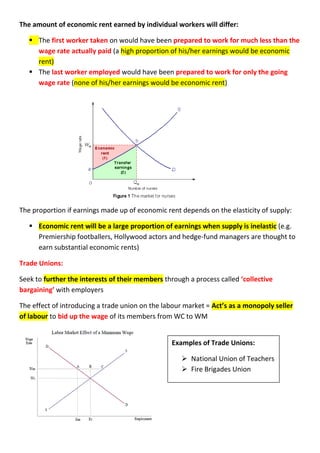
Demand for, and supply of, labour are also important determinants of economic rent and
transfer earnings
Transfer Earnings = what a factor of production can earn in its next best alternative use
(opportunity cost of a factor performing its current role) – In labour market, this is
equivalent to the minimum which has to be paid to keep a worker in his or her current job
Economic Rent = Surplus payment made over and above transfer earnings (total earnings
– transfer earnings)
An Increase in demand for
website designers = rightward
shift of the demand curve (MRP)
Leads to a subsequent rise in
wages W – W1
The amount of economic rent earned by individual workers will differ:
 The first worker taken on would have been prepared to work for much less than the
wage rate actually paid (a high proportion of his/her earnings would be economic
rent)
 The last worker employed would have been prepared to work for only the going
wage rate (none of his/her earnings would be economic rent)
The proportion if earnings made up of economic rent depends on the elasticity of supply:
 Economic rent will be a large proportion of earnings when supply is inelastic (e.g.
Premiership footballers, Hollywood actors and hedge-fund managers are thought to
earn substantial economic rents)
Trade Unions:
Seek to further the interests of their members through a process called ‘collective
bargaining’ with employers
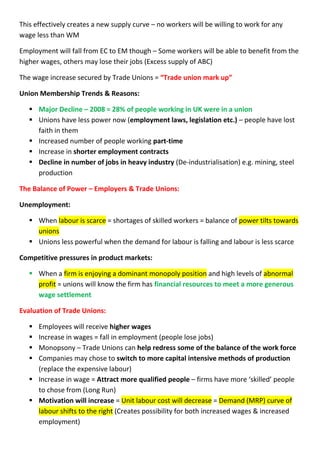
The effect of introducing a trade union on the labour market = Act’s as a monopoly seller
of labour to bid up the wage of its members from WC to WM
Examples of Trade Unions:
 National Union of Teachers
 Fire Brigades Union
This effectively creates a new supply curve – no workers will be willing to work for any
wage less than WM
Employment will fall from EC to EM though – Some workers will be able to benefit from the
higher wages, others may lose their jobs (Excess supply of ABC)
The wage increase secured by Trade Unions = “Trade union mark up”
Union Membership Trends & Reasons:
 Major Decline – 2008 = 28% of people working in UK were in a union
 Unions have less power now (employment laws, legislation etc.) – people have lost
faith in them
 Increased number of people working part-time
 Increase in shorter employment contracts
 Decline in number of jobs in heavy industry (De-industrialisation) e.g. mining, steel
production
The Balance of Power – Employers & Trade Unions:
Unemployment:
 When labour is scarce = shortages of skilled workers = balance of power tilts towards
unions
 Unions less powerful when the demand for labour is falling and labour is less scarce
Competitive pressures in product markets:
 When a firm is enjoying a dominant monopoly position and high levels of abnormal
profit = unions will know the firm has financial resources to meet a more generous
wage settlement
Evaluation of Trade Unions:
 Employees will receive higher wages
 Increase in wages = fall in employment (people lose jobs)
 Monopsony – Trade Unions can help redress some of the balance of the work force
 Companies may chose to switch to more capital intensive methods of production
(replace the expensive labour)
 Increase in wage = Attract more qualified people – firms have more ‘skilled’ people
to chose from (Long Run)
 Motivation will increase = Unit labour cost will decrease = Demand (MRP) curve of
labour shifts to the right (Creates possibility for both increased wages & increased
employment)
 Higher pay = Incentive to work more hours
 Increased incomes = spend more on consumer goods & services = Stimulate AD in
economy = Economic Growth = Demand for labour increases
 Can work with management & employers to improve efficiency and competitiveness
 May prevent the introduction of new technology which would increase productivity
 Reduce profits & employment more than if the labour market was fully competitive
 Act as a distortion of the workings of the labour market
 Their collective bargaining = higher wages = cost-push inflation = worsening of
macroeconomic performance
Monopsony Employer:
In a labour market a monopsonist employer is a firm which is the only buyer of labour
Example: “Company Towns” – Everyone is employed by one company in a town,
Government is the sole employer of soldiers for national defence
Monopsonists are price makers – they dictate the wage rate
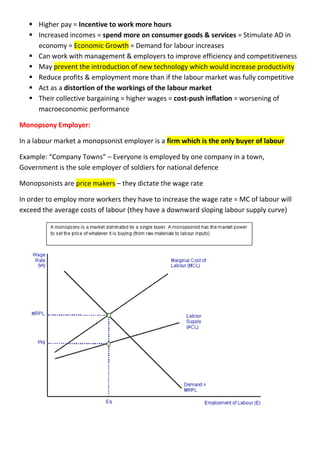
In order to employ more workers they have to increase the wage rate = MC of labour will
exceed the average costs of labour (they have a downward sloping labour supply curve)
In the diagram Eq workers are taken on, but the monopsonist can employ these workers at
an average wage rate of Wq; a pay level below the MRP of Labour
The monopolist is ‘exploiting’ labour by not paying them the full value of their MRP which is
essentially what the labour is ‘worth’
As the monopsonist will face increasing wage rates as it increases employment, it will this
prefer to restrict employment, depressing wages below the free market level
The wage rate is lower and less are employed than if the industry was perfectly competitive
A monopsonist will always operate where MC=MR but will push down the wage rate
Evaluation of Monopsony Power:
 Workers receive lower wage rates = less motivation = decline in productivity
 Less workers employed than under a perfectly competitive situation
 Would encourage the start of up trade unions – monopsonies are very powerful
 Trade unions could have the impact of increasing the wage rate but leading to an XS
of supply and therefore a reduction in the amount of people employed
 The monopsonist will face increasing wage rates as it increases employment – they
would prefer to restrict employment to depress wages (this is not good for the
macro-performance of the economy)
 Could deter people from entering the industry – they understand that they are being
paid below the market rate = shortage of supply of labour in the long-run
 Monopsonies pay a lower wage rate than the market rate = Imperfection in the
market
Minimum Wage Legislation:
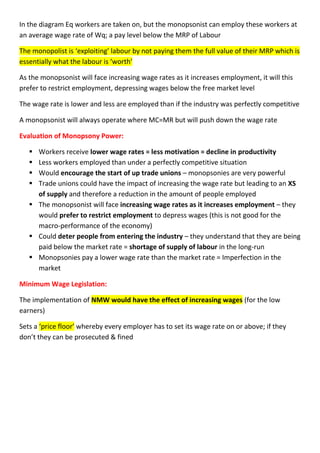
The implementation of NMW would have the effect of increasing wages (for the low
earners)
Sets a ‘price floor’ whereby every employer has to set its wage rate on or above; if they
don’t they can be prosecuted & fined
Evaluation of NMW:
 Increases Unemployment = Government Failure
 Boost staff productivity as they are more motivated
Force some employers to become too uncompetitive = closure of companies
Wage Differentials between particular groups:
Skilled & Unskilled workers:
 Skilled works = receive higher wages (demand is higher and fewer are in supply)
 Skilled workers have higher MRP – their skills generate high output per worker; also
more difficult to substitute skilled labour with capital equipment or unemployed
workers
Male & Female workers:
 Men still receive higher pay than women, despite equal pay legislation
 The average MRP of women = less than that of men
 Men generally have higher qualifications
 A greater percentage of women work in low-paid occupations
 Smaller percentage of women are members of trade unions
 Some women miss out on promotion because of leaving to have children
 Negative discrimination also occurs – some employers undervalue the MRP of female
workers
 Women are less likely to commute – smaller pool of jobs to chose from
 60% of women work in 10 occupations – these are low paid (clerical, cleaning etc.)
 Many female workers are part-time; this does not pay as well
 Women have less work experience – breaks to raise family etc.
NMW increases the pay rate
Reduces the number of people
employed
Leads to an XS supply of labour
Part-time & full-time workers:
 Part-time workers tend to receive lower hourly rates than full-time workers
 The supply of people willing and able to work part time is relatively high in
comparison to demand
 Part-time workers are also less likely to receive training than full time workers =
lower productivity
 Smaller proportions of part-time workers are members of trade unions
Ethnic Origin:
 Workers from ethnic minorities = receive lower wages than white people (on
average)
 A high proportion of work they do is in the catering industry which is relatively low
paid
 The qualifications of ethnic minorities are usually lower than the rest of the
population
 Discrimination is another factor
Discrimination in the labour market:
Discrimination is a cause of market failure...
Occurs when a group of workers or potential workers are treated differently to other
workers in the same job in terms of pay, employment, promotion, training opportunities
and working conditions...
Discrimination can be negative or positive
Negative Discrimination:
When workers of similar ability are treated less favourably than other, and are paid lower
wages because of race, gender, age or disability
Prejudice leads employers to believe that MRP of these groups is lower than it really is
Discrimination predominantly affects the demand curve for labour; there may be impacts
on the supply curve as well though...
 Workers who are refused employment with discriminating firms = look for
employment with firms who do not discriminate
 This will increase the supply of labour to firms who do not discriminate
 Leads to lower wages for groups discriminated against
The costs of negative discrimination:
 Will lead to lower pay for the groups who experience the negative discrimination
 Such groups will find it harder to find work, or may result to taking less demanding
jobs than they are qualified to do
 May also not be considered for promotions
 Firms themselves will have less workers to chose from if they discriminate; will
increase their production costs & damage their international competitiveness –
Higher costs are likely to be passed onto consumers
 Potential economy wide effects as government spending on welfare benefits may
have to be increased to support the incomes of groups discriminated against
 Opportunity costs arise if time & money is spent introducing & monitoring legislation
to end discrimination & tackle social exclusion
Positive Discrimination:
Firms may discriminate in favour of certain groups...
Employers perceive the MRP of a particular group of workers to be higher than it actually
is....
Results in the demand curve being further to the right than it should be; and this some
groups will earn higher wages than others of similar ability
The government may also discriminate positively in order to offset negative discrimination

The labour market wage determination

  • 1.
    Economics – TheLabour Market: Wage Determination (11.12.12) The Labour Market: Wage Determination Pay in a particular labour market is influenced by a number of factors. Along with supply & demand, these include the influence of trade unions and professional organisations, government intervention and esteem. Demand & Supply:  The forces of demand & supply play a key role in determining relative wage rates  Wages paid to a particular occupation will rise following a rise in demand for their services  Wages paid to a particular occupations will decrease following a decrease in demand for their services Economic Rent & Transfer Earnings: Demand for, and supply of, labour are also important determinants of economic rent and transfer earnings Transfer Earnings = what a factor of production can earn in its next best alternative use (opportunity cost of a factor performing its current role) – In labour market, this is equivalent to the minimum which has to be paid to keep a worker in his or her current job Economic Rent = Surplus payment made over and above transfer earnings (total earnings – transfer earnings) An Increase in demand for website designers = rightward shift of the demand curve (MRP) Leads to a subsequent rise in wages W – W1
  • 2.
    The amount ofeconomic rent earned by individual workers will differ:  The first worker taken on would have been prepared to work for much less than the wage rate actually paid (a high proportion of his/her earnings would be economic rent)  The last worker employed would have been prepared to work for only the going wage rate (none of his/her earnings would be economic rent) The proportion if earnings made up of economic rent depends on the elasticity of supply:  Economic rent will be a large proportion of earnings when supply is inelastic (e.g. Premiership footballers, Hollywood actors and hedge-fund managers are thought to earn substantial economic rents) Trade Unions: Seek to further the interests of their members through a process called ‘collective bargaining’ with employers The effect of introducing a trade union on the labour market = Act’s as a monopoly seller of labour to bid up the wage of its members from WC to WM Examples of Trade Unions:  National Union of Teachers  Fire Brigades Union
  • 3.
    This effectively createsa new supply curve – no workers will be willing to work for any wage less than WM Employment will fall from EC to EM though – Some workers will be able to benefit from the higher wages, others may lose their jobs (Excess supply of ABC) The wage increase secured by Trade Unions = “Trade union mark up” Union Membership Trends & Reasons:  Major Decline – 2008 = 28% of people working in UK were in a union  Unions have less power now (employment laws, legislation etc.) – people have lost faith in them  Increased number of people working part-time  Increase in shorter employment contracts  Decline in number of jobs in heavy industry (De-industrialisation) e.g. mining, steel production The Balance of Power – Employers & Trade Unions: Unemployment:  When labour is scarce = shortages of skilled workers = balance of power tilts towards unions  Unions less powerful when the demand for labour is falling and labour is less scarce Competitive pressures in product markets:  When a firm is enjoying a dominant monopoly position and high levels of abnormal profit = unions will know the firm has financial resources to meet a more generous wage settlement Evaluation of Trade Unions:  Employees will receive higher wages  Increase in wages = fall in employment (people lose jobs)  Monopsony – Trade Unions can help redress some of the balance of the work force  Companies may chose to switch to more capital intensive methods of production (replace the expensive labour)  Increase in wage = Attract more qualified people – firms have more ‘skilled’ people to chose from (Long Run)  Motivation will increase = Unit labour cost will decrease = Demand (MRP) curve of labour shifts to the right (Creates possibility for both increased wages & increased employment)
  • 4.
     Higher pay= Incentive to work more hours  Increased incomes = spend more on consumer goods & services = Stimulate AD in economy = Economic Growth = Demand for labour increases  Can work with management & employers to improve efficiency and competitiveness  May prevent the introduction of new technology which would increase productivity  Reduce profits & employment more than if the labour market was fully competitive  Act as a distortion of the workings of the labour market  Their collective bargaining = higher wages = cost-push inflation = worsening of macroeconomic performance Monopsony Employer: In a labour market a monopsonist employer is a firm which is the only buyer of labour Example: “Company Towns” – Everyone is employed by one company in a town, Government is the sole employer of soldiers for national defence Monopsonists are price makers – they dictate the wage rate In order to employ more workers they have to increase the wage rate = MC of labour will exceed the average costs of labour (they have a downward sloping labour supply curve)
  • 5.
    In the diagramEq workers are taken on, but the monopsonist can employ these workers at an average wage rate of Wq; a pay level below the MRP of Labour The monopolist is ‘exploiting’ labour by not paying them the full value of their MRP which is essentially what the labour is ‘worth’ As the monopsonist will face increasing wage rates as it increases employment, it will this prefer to restrict employment, depressing wages below the free market level The wage rate is lower and less are employed than if the industry was perfectly competitive A monopsonist will always operate where MC=MR but will push down the wage rate Evaluation of Monopsony Power:  Workers receive lower wage rates = less motivation = decline in productivity  Less workers employed than under a perfectly competitive situation  Would encourage the start of up trade unions – monopsonies are very powerful  Trade unions could have the impact of increasing the wage rate but leading to an XS of supply and therefore a reduction in the amount of people employed  The monopsonist will face increasing wage rates as it increases employment – they would prefer to restrict employment to depress wages (this is not good for the macro-performance of the economy)  Could deter people from entering the industry – they understand that they are being paid below the market rate = shortage of supply of labour in the long-run  Monopsonies pay a lower wage rate than the market rate = Imperfection in the market Minimum Wage Legislation: The implementation of NMW would have the effect of increasing wages (for the low earners) Sets a ‘price floor’ whereby every employer has to set its wage rate on or above; if they don’t they can be prosecuted & fined
  • 6.
    Evaluation of NMW: Increases Unemployment = Government Failure  Boost staff productivity as they are more motivated Force some employers to become too uncompetitive = closure of companies Wage Differentials between particular groups: Skilled & Unskilled workers:  Skilled works = receive higher wages (demand is higher and fewer are in supply)  Skilled workers have higher MRP – their skills generate high output per worker; also more difficult to substitute skilled labour with capital equipment or unemployed workers Male & Female workers:  Men still receive higher pay than women, despite equal pay legislation  The average MRP of women = less than that of men  Men generally have higher qualifications  A greater percentage of women work in low-paid occupations  Smaller percentage of women are members of trade unions  Some women miss out on promotion because of leaving to have children  Negative discrimination also occurs – some employers undervalue the MRP of female workers  Women are less likely to commute – smaller pool of jobs to chose from  60% of women work in 10 occupations – these are low paid (clerical, cleaning etc.)  Many female workers are part-time; this does not pay as well  Women have less work experience – breaks to raise family etc. NMW increases the pay rate Reduces the number of people employed Leads to an XS supply of labour
  • 7.
    Part-time & full-timeworkers:  Part-time workers tend to receive lower hourly rates than full-time workers  The supply of people willing and able to work part time is relatively high in comparison to demand  Part-time workers are also less likely to receive training than full time workers = lower productivity  Smaller proportions of part-time workers are members of trade unions Ethnic Origin:  Workers from ethnic minorities = receive lower wages than white people (on average)  A high proportion of work they do is in the catering industry which is relatively low paid  The qualifications of ethnic minorities are usually lower than the rest of the population  Discrimination is another factor Discrimination in the labour market: Discrimination is a cause of market failure... Occurs when a group of workers or potential workers are treated differently to other workers in the same job in terms of pay, employment, promotion, training opportunities and working conditions... Discrimination can be negative or positive Negative Discrimination: When workers of similar ability are treated less favourably than other, and are paid lower wages because of race, gender, age or disability Prejudice leads employers to believe that MRP of these groups is lower than it really is Discrimination predominantly affects the demand curve for labour; there may be impacts on the supply curve as well though...  Workers who are refused employment with discriminating firms = look for employment with firms who do not discriminate  This will increase the supply of labour to firms who do not discriminate  Leads to lower wages for groups discriminated against
  • 8.
    The costs ofnegative discrimination:  Will lead to lower pay for the groups who experience the negative discrimination  Such groups will find it harder to find work, or may result to taking less demanding jobs than they are qualified to do  May also not be considered for promotions  Firms themselves will have less workers to chose from if they discriminate; will increase their production costs & damage their international competitiveness – Higher costs are likely to be passed onto consumers  Potential economy wide effects as government spending on welfare benefits may have to be increased to support the incomes of groups discriminated against  Opportunity costs arise if time & money is spent introducing & monitoring legislation to end discrimination & tackle social exclusion Positive Discrimination: Firms may discriminate in favour of certain groups... Employers perceive the MRP of a particular group of workers to be higher than it actually is.... Results in the demand curve being further to the right than it should be; and this some groups will earn higher wages than others of similar ability The government may also discriminate positively in order to offset negative discrimination