What are Public Goods?
Public goods cause market failure due to the problem of missing
markets – the main characteristics of public goods are as follows:
What are Public Goods?
Public goods cause market failure due to the problem of missing
markets – the main characteristics of public goods are as follows:
1. Non-excludability: Benefits derived from pure public goods
cannot be confined solely to those who have paid for it. Non-
payers can enjoy the benefits of consumption at no financial
cost to themselves – economists call this the ‘free-rider’
problem
2. Non-rival consumption: Each party’s enjoyment of the good or
service does not diminish others’ enjoyment– in other words the
marginal cost of supplying a public good to an extra person is
zero. If a public good is supplied to one person, it is available to
all.
3. Non-rejectable: The collective supply of a pure public good for
all means that it cannot be rejected by people, an example is a
national nuclear defence system or major flood defence
projects.
• The nature of public goods is that it is hard to protect property
rights – a reason why the private sector does not provide them
Characteristics of Public Goods
Pure public goods are non-excludable and non-rival in consumption
Sanitation
infrastructure
Flood defence /
tidal barrage
Crime control for
a community
Reduced risk of
disease from
vaccinations
Freely available
knowledge e.g.
online learning
Public service
broadcasting
Public goods
are also
known as
collective
consumption
goods
Characteristics of Public Goods
Pure public goods are non-excludable and non-rival in consumption
Sanitation
infrastructure
Flood defence /
tidal barrage
Crime control for
a community
Reduced risk of
disease from
vaccinations
Freely available
knowledge e.g.
online learning
Public service
broadcasting
Public goods
are also
known as
collective
consumption
goods
Characteristics of Public Goods
Pure public goods are non-excludable and non-rival in consumption
Sanitation
infrastructure
Flood defence /
tidal barrage
Crime control for
a community
Reduced risk of
disease from
vaccinations
Freely available
knowledge e.g.
online learning
Public service
broadcasting
Why
healthcare is
NOT a public
good
Healthcare
has the
characteristics
of a private
good because
is rival and
excludable in
consumption
Public goods
are also
known as
collective
consumption
goods
Quasi Public Goods
• A quasi-public good is a near-public good. It
has some of the characteristics of a public good
• A public good may take on some of the features
of a private good
• Quasi public goods are:
1. Semi-non-rival: up to a point, more
consumers using a park, beach or road do not
reduce the space available for others. But
eventually beaches become crowded as do
parks/leisure facilities. Open-access Wi-Fi
networks become crowded
2. Semi-non-excludable: it is possible but
difficult or costly to exclude non-paying
consumers. E.g. fencing a park or beach and
charging an entrance fee; or building toll
booths on congested road routes
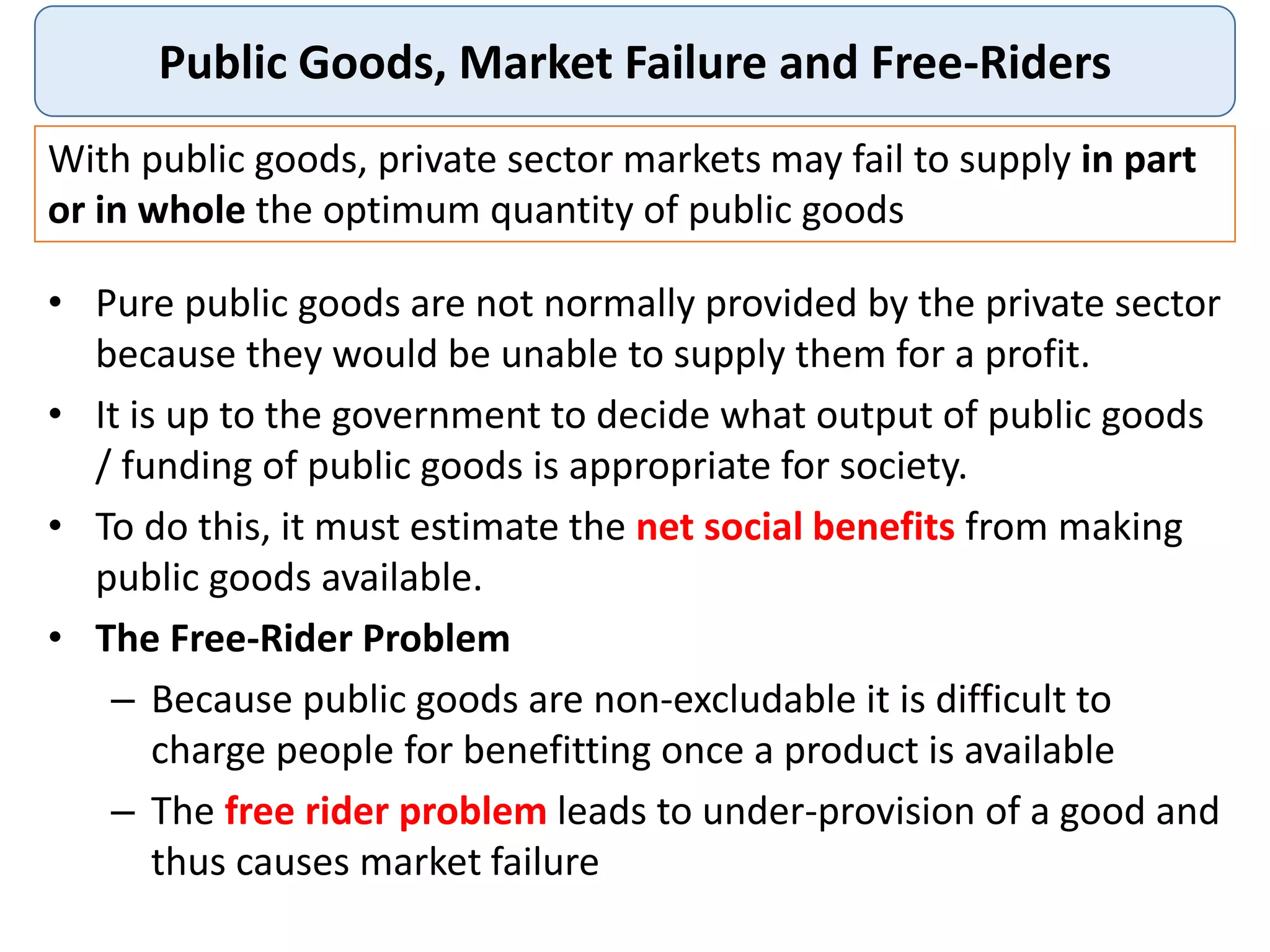
Public Goods, Market Failure and Free-Riders
• Pure public goods are not normally provided by the private sector
because they would be unable to supply them for a profit.
• It is up to the government to decide what output of public goods
/ funding of public goods is appropriate for society.
• To do this, it must estimate the net social benefits from making
public goods available.
• The Free-Rider Problem
– Because public goods are non-excludable it is difficult to
charge people for benefitting once a product is available
– The free rider problem leads to under-provision of a good and
thus causes market failure
With public goods, private sector markets may fail to supply in part
or in whole the optimum quantity of public goods
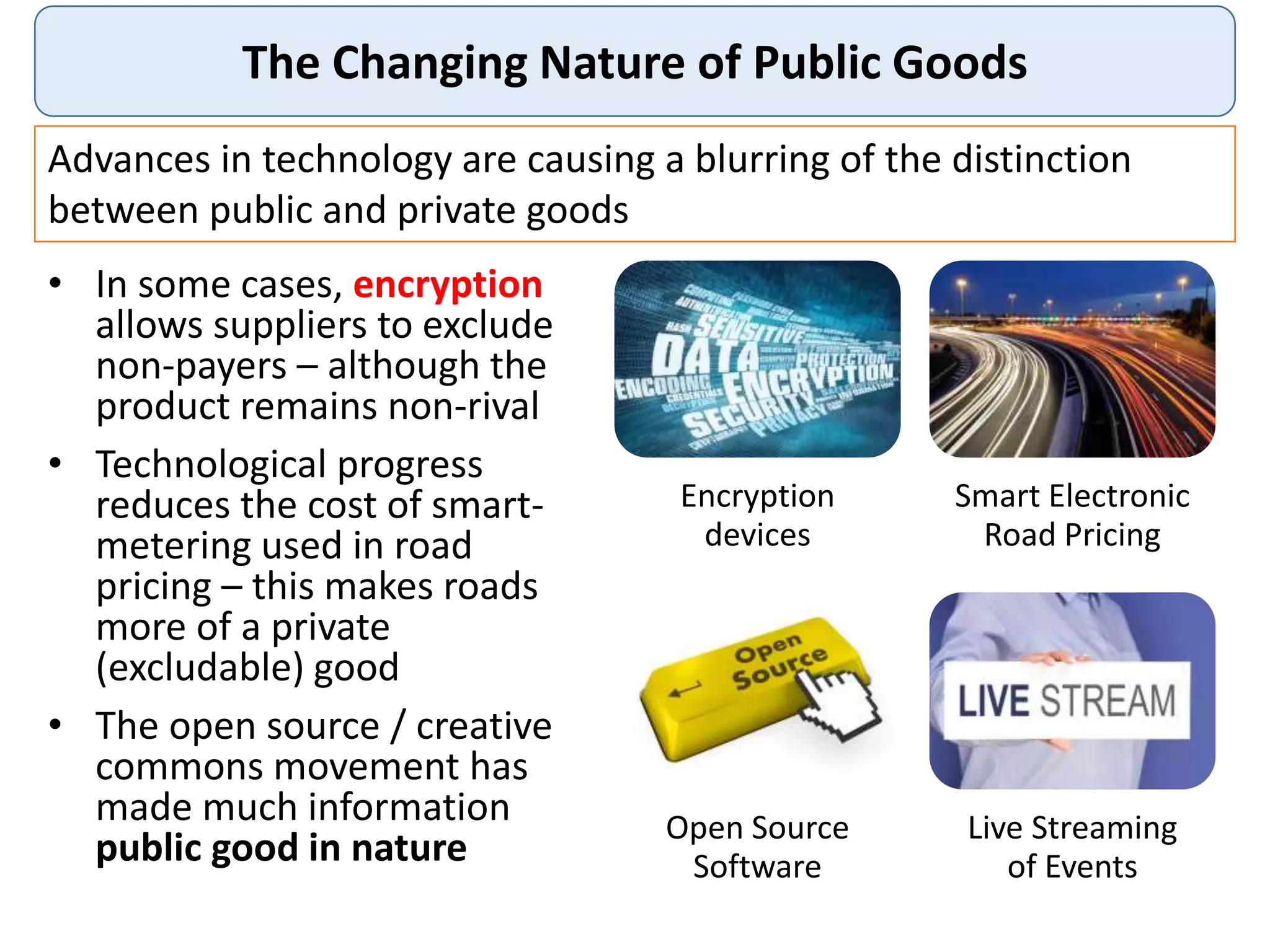
The Changing Nature of Public Goods
Advances in technology are causing a blurring of the distinction
between public and private goods
Encryption
devices
Smart Electronic
Road Pricing
Open Source
Software
Live Streaming
of Events
• In some cases, encryption
allows suppliers to exclude
non-payers – although the
product remains non-rival
• Technological progress
reduces the cost of smart-
metering used in road
pricing – this makes roads
more of a private
(excludable) good
• The open source / creative
commons movement has
made much information
public good in nature
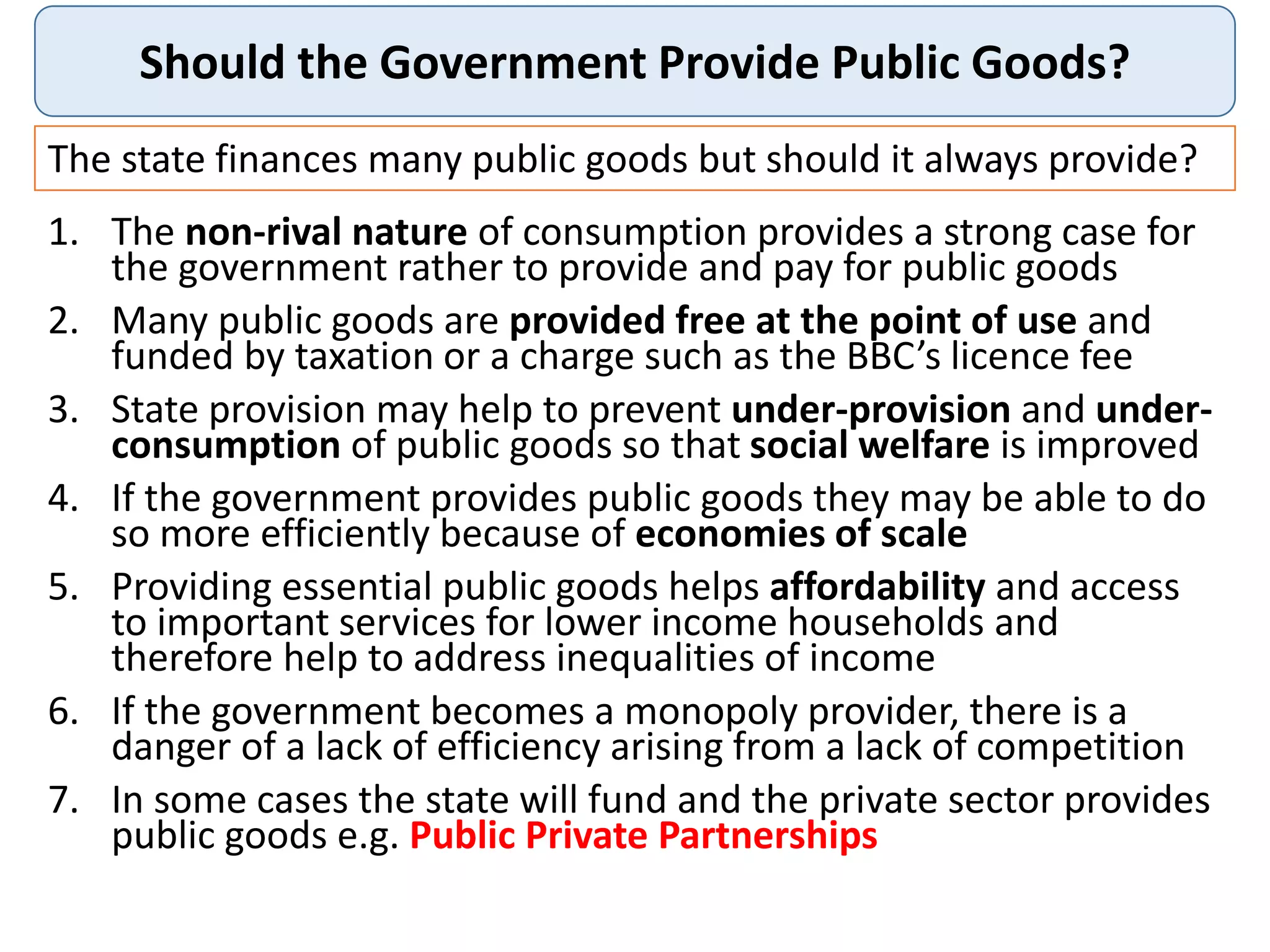
Should the Government Provide Public Goods?
The state finances many public goods but should it always provide?
1. The non-rival nature of consumption provides a strong case for
the government rather to provide and pay for public goods
2. Many public goods are provided free at the point of use and
funded by taxation or a charge such as the BBC’s licence fee
3. State provision may help to prevent under-provision and under-
consumption of public goods so that social welfare is improved
4. If the government provides public goods they may be able to do
so more efficiently because of economies of scale
5. Providing essential public goods helps affordability and access
to important services for lower income households and
therefore help to address inequalities of income
6. If the government becomes a monopoly provider, there is a
danger of a lack of efficiency arising from a lack of competition
7. In some cases the state will fund and the private sector provides
public goods e.g. Public Private Partnerships
Public Goods and Private Goods

Public Goods and Private Goods

  • 2.
    What are PublicGoods? Public goods cause market failure due to the problem of missing markets – the main characteristics of public goods are as follows:
  • 3.
    What are PublicGoods? Public goods cause market failure due to the problem of missing markets – the main characteristics of public goods are as follows: 1. Non-excludability: Benefits derived from pure public goods cannot be confined solely to those who have paid for it. Non- payers can enjoy the benefits of consumption at no financial cost to themselves – economists call this the ‘free-rider’ problem 2. Non-rival consumption: Each party’s enjoyment of the good or service does not diminish others’ enjoyment– in other words the marginal cost of supplying a public good to an extra person is zero. If a public good is supplied to one person, it is available to all. 3. Non-rejectable: The collective supply of a pure public good for all means that it cannot be rejected by people, an example is a national nuclear defence system or major flood defence projects. • The nature of public goods is that it is hard to protect property rights – a reason why the private sector does not provide them
  • 4.
    Characteristics of PublicGoods Pure public goods are non-excludable and non-rival in consumption Sanitation infrastructure Flood defence / tidal barrage Crime control for a community Reduced risk of disease from vaccinations Freely available knowledge e.g. online learning Public service broadcasting Public goods are also known as collective consumption goods
  • 5.
    Characteristics of PublicGoods Pure public goods are non-excludable and non-rival in consumption Sanitation infrastructure Flood defence / tidal barrage Crime control for a community Reduced risk of disease from vaccinations Freely available knowledge e.g. online learning Public service broadcasting Public goods are also known as collective consumption goods
  • 6.
    Characteristics of PublicGoods Pure public goods are non-excludable and non-rival in consumption Sanitation infrastructure Flood defence / tidal barrage Crime control for a community Reduced risk of disease from vaccinations Freely available knowledge e.g. online learning Public service broadcasting Why healthcare is NOT a public good Healthcare has the characteristics of a private good because is rival and excludable in consumption Public goods are also known as collective consumption goods
  • 7.
    Quasi Public Goods •A quasi-public good is a near-public good. It has some of the characteristics of a public good • A public good may take on some of the features of a private good • Quasi public goods are: 1. Semi-non-rival: up to a point, more consumers using a park, beach or road do not reduce the space available for others. But eventually beaches become crowded as do parks/leisure facilities. Open-access Wi-Fi networks become crowded 2. Semi-non-excludable: it is possible but difficult or costly to exclude non-paying consumers. E.g. fencing a park or beach and charging an entrance fee; or building toll booths on congested road routes
  • 8.
    Public Goods, MarketFailure and Free-Riders • Pure public goods are not normally provided by the private sector because they would be unable to supply them for a profit. • It is up to the government to decide what output of public goods / funding of public goods is appropriate for society. • To do this, it must estimate the net social benefits from making public goods available. • The Free-Rider Problem – Because public goods are non-excludable it is difficult to charge people for benefitting once a product is available – The free rider problem leads to under-provision of a good and thus causes market failure With public goods, private sector markets may fail to supply in part or in whole the optimum quantity of public goods
  • 9.
    The Changing Natureof Public Goods Advances in technology are causing a blurring of the distinction between public and private goods Encryption devices Smart Electronic Road Pricing Open Source Software Live Streaming of Events • In some cases, encryption allows suppliers to exclude non-payers – although the product remains non-rival • Technological progress reduces the cost of smart- metering used in road pricing – this makes roads more of a private (excludable) good • The open source / creative commons movement has made much information public good in nature
  • 10.
    Should the GovernmentProvide Public Goods? The state finances many public goods but should it always provide? 1. The non-rival nature of consumption provides a strong case for the government rather to provide and pay for public goods 2. Many public goods are provided free at the point of use and funded by taxation or a charge such as the BBC’s licence fee 3. State provision may help to prevent under-provision and under- consumption of public goods so that social welfare is improved 4. If the government provides public goods they may be able to do so more efficiently because of economies of scale 5. Providing essential public goods helps affordability and access to important services for lower income households and therefore help to address inequalities of income 6. If the government becomes a monopoly provider, there is a danger of a lack of efficiency arising from a lack of competition 7. In some cases the state will fund and the private sector provides public goods e.g. Public Private Partnerships