Negative externalities occur when production or consumption impose costs on third parties not involved in the market transaction. This leads to market failure as prices do not reflect the full social costs. Examples include pollution from factories imposing health costs, and noise pollution from airlines imposing nuisance costs. Taxes or regulations can be used to internalize these external costs and improve economic efficiency by aligning private and social costs. However, determining the appropriate tax level can be difficult and taxes may impact consumer welfare.
Negative Production &Consumption Externalities
Negative externalities occur when production and/or consumption
impose external costs on third parties outside of the market for
which no appropriate compensation is paid.
Negative production externalities Negative consumption externalities
• Air pollution from factories • Fly-tipping of household waste
• Damage to the environment
from industrial ocean fishing
• Effects of passing smoking
• External costs of fertilizers and
pesticides used in farming
• Impact on family life of gambling
and alcohol addiction
• Noise pollution from the airline
industry
• Noise pollution from events such
as sports matches and concerts
3.
Examples of NegativeProduction Externalities
Negative production externalities include pollution generated by a
factory that imposes costs on others
Air pollution
from factories
Pollution from
fertilizers
Industrial waste
Noise pollution Collapsing fish
stocks
Methane
emissions
When
answering
any question
on negative
externalities –
consider
whether the
external costs
are significant
and if so,
whether they
can be
measured
and valued
accurately
4.
World Carbon DioxideEmissions from 2005 to 2014
0
5000
10000
15000
20000
25000
30000
35000
40000
2005 2006 2007 2008 2009 2010 2011 2012 2013 2014
Emissionsinmillionmetrictons
Africa South and Central America Middle East
Europe and Eurasia North America Asia Pacific
5.
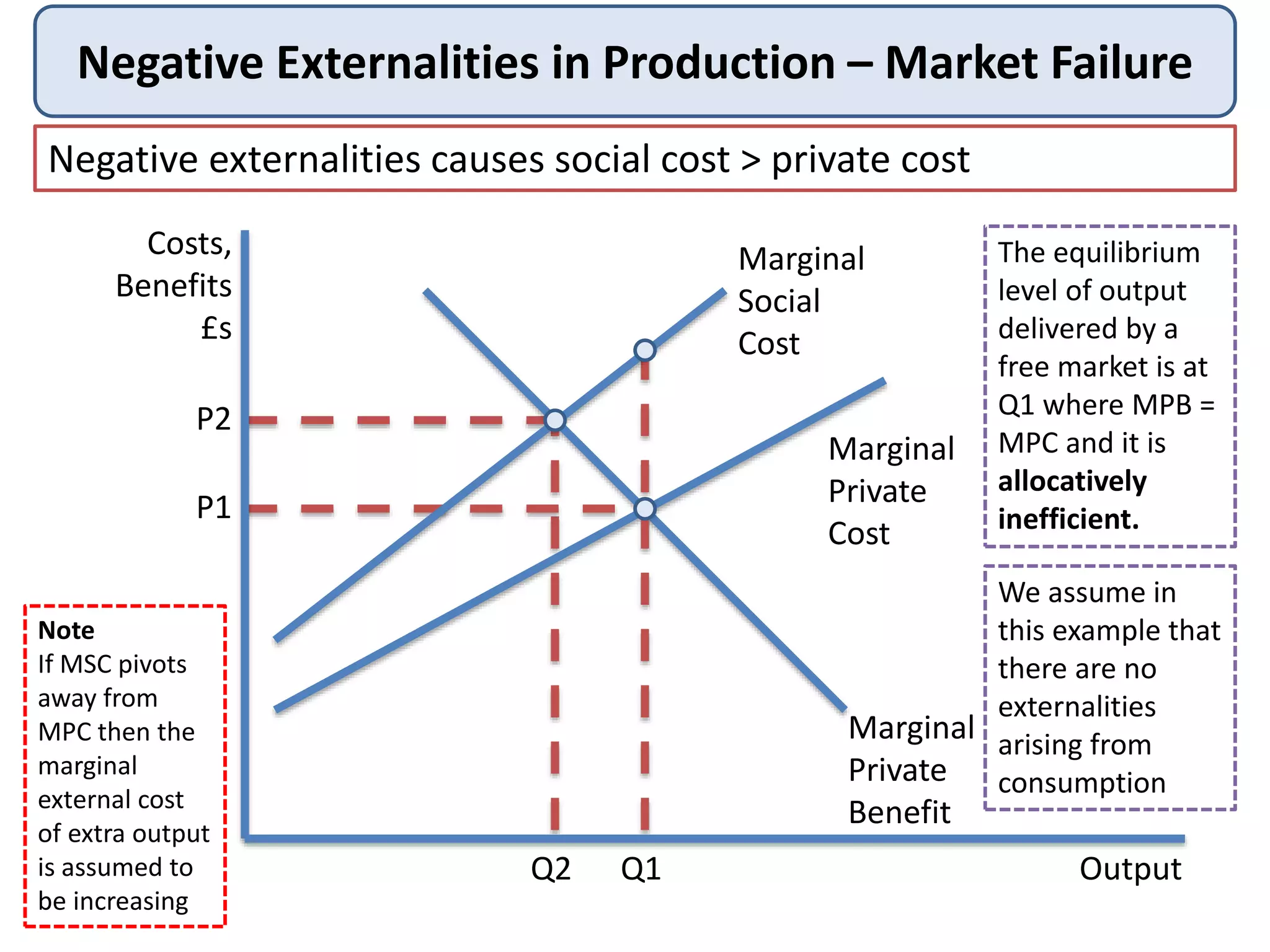
Negative Externalities inProduction – Market Failure
Output
Marginal
Private
Cost
P1
Q1
Marginal
Private
Benefit
Negative externalities causes social cost > private cost
Costs,
Benefits
£s
Marginal
Social
Cost
Q2
P2
The equilibrium
level of output
delivered by a
free market is at
Q1 where MPB =
MPC and it is
allocatively
inefficient.
We assume in
this example that
there are no
externalities
arising from
consumption
Note
If MSC pivots
away from
MPC then the
marginal
external cost
of extra output
is assumed to
be increasing
6.
Negative Externalities –The Social Welfare Loss
Output
Marginal
Private
Cost
P1
Q1
Marginal
Private
Benefit
Market failure happens when prices do not reflect social costs
Costs,
Benefits
£s
Marginal
Social
Cost
Q2
P2 This is the area
of social welfare
loss because the
market output
supplied is
higher than the
social optimum
Note
The
deadweight
loss of social
welfare
happens when
MSC > MPC
7.
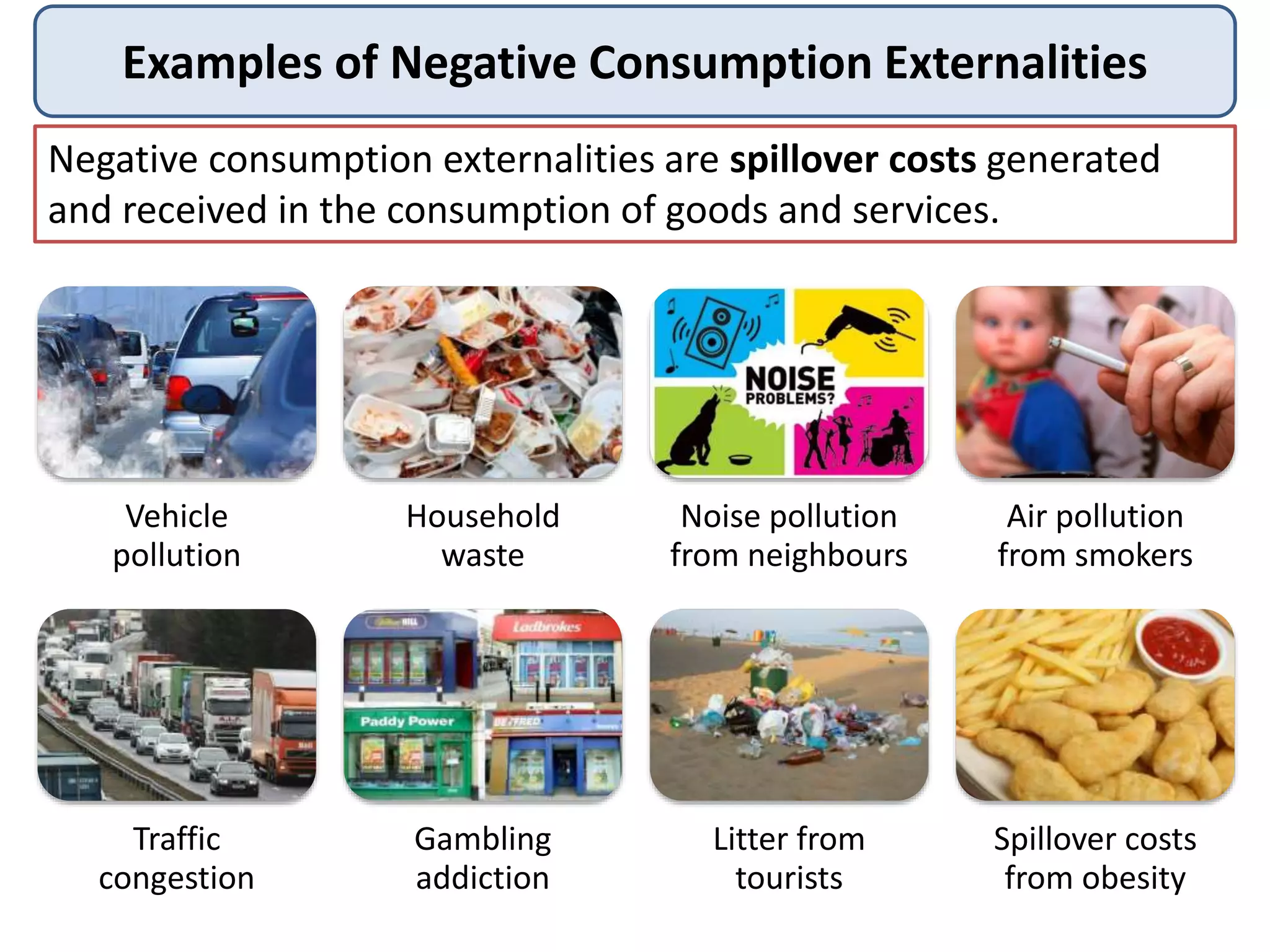
Examples of NegativeConsumption Externalities
Negative consumption externalities are spillover costs generated
and received in the consumption of goods and services.
Vehicle
pollution
Household
waste
Noise pollution
from neighbours
Air pollution
from smokers
Traffic
congestion
Gambling
addiction
Litter from
tourists
Spillover costs
from obesity
8.
Reducing Externalities –The Use of Pollution Taxes
• One approach is to impose a tax.
This is known as “making the
polluter pay”.
• A pollution tax increases the
marginal private cost causing a
fall in demand
• Some economists argue that
revenue from pollution taxes
should be ‘ring-fenced’ and
allocated to projects that protect
or enhance the environment.
• For example, money raised from
a congestion charge might be
allocated towards improving
mass transport services
• Revenue from higher taxes on
cigarettes might be used to fund
better health care programmes.
British Columbia uses a
Carbon Tax
China has raised smoking
taxes
Emissions Trading
Scheme in the EU
Proposed congestion
charge for New Delhi
9.
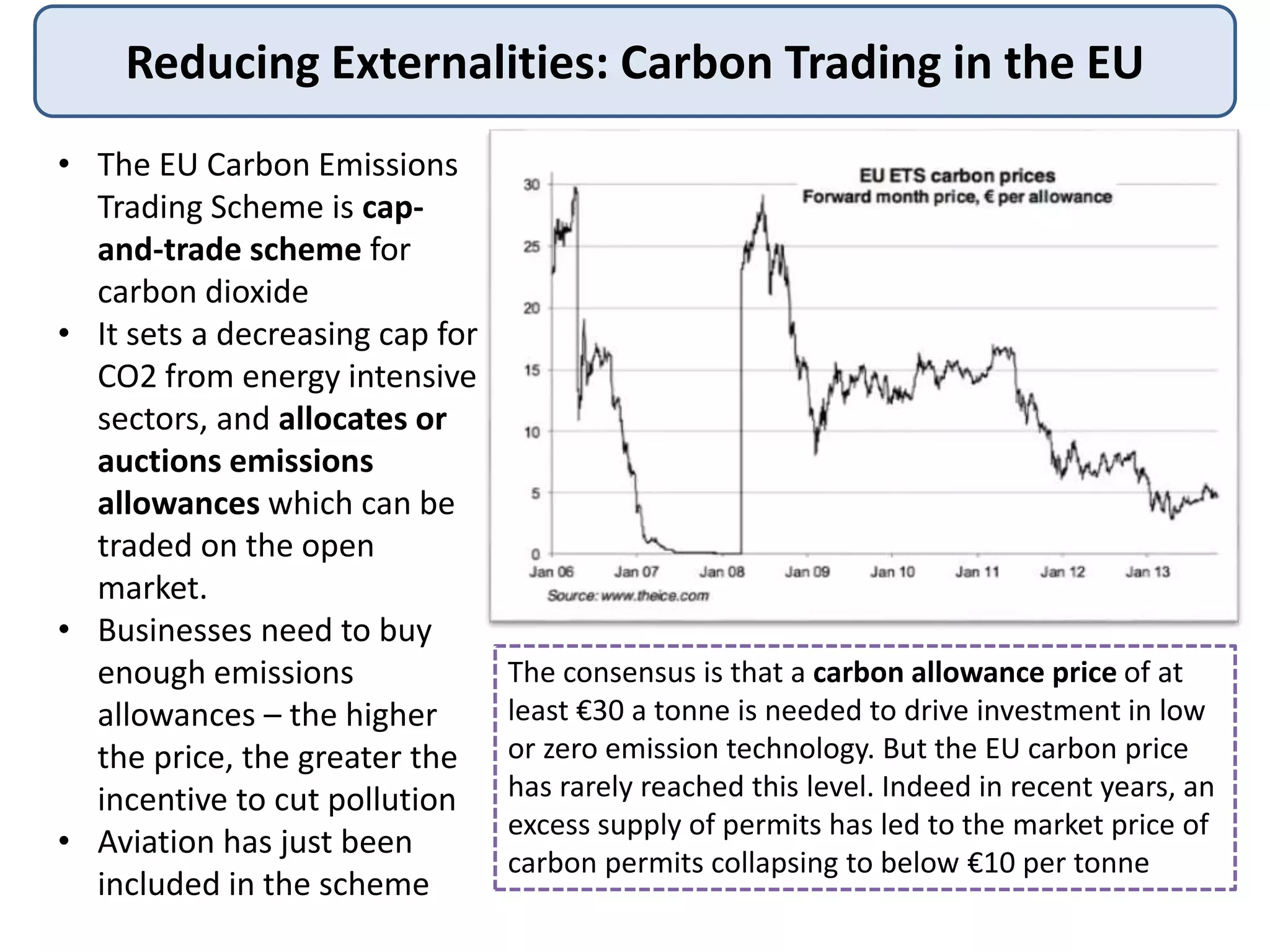
Reducing Externalities: CarbonTrading in the EU
• The EU Carbon Emissions
Trading Scheme is cap-
and-trade scheme for
carbon dioxide
• It sets a decreasing cap for
CO2 from energy intensive
sectors, and allocates or
auctions emissions
allowances which can be
traded on the open
market.
• Businesses need to buy
enough emissions
allowances – the higher
the price, the greater the
incentive to cut pollution
• Aviation has just been
included in the scheme
The consensus is that a carbon allowance price of at
least €30 a tonne is needed to drive investment in low
or zero emission technology. But the EU carbon price
has rarely reached this level. Indeed in recent years, an
excess supply of permits has led to the market price of
carbon permits collapsing to below €10 per tonne
10.
Reducing Externalities: TheUK Carbon Price Floor
• The UK has introduced a Carbon
Price Floor which applies to fossil
fuels used for electricity
generation
• The minimum price for carbon
emissions is designed to provide
a stable carbon price signal as a
way of internalising externalities
• The minimum Carbon Price Floor
started at £16/tCO2 in 2013
• In 2014 the UK government
announced a cap of £18/tCO2
from 2016 until 2020
• Carbon prices within the EU ETS
system have been highly volatile
in recent years
Arguments for a carbon price floor
• Reduces the risks, and thus costs, of
investing in low carbon projects
• Helps to reduce carbon price
volatility – sends signal to polluters
• Makes low carbon electricity more
competitive – boost to renewables
Arguments against a carbon price floor
• Restrict supply of carbon permits to
increase the free market price
• A carbon tax is a better alternative
and raises useful tax revenues
• Price floor set high might damage
international competitiveness
11.
Advantages / Disadvantageof Pollution Taxes
Pros Internalizes the
externality and therefore
makes the polluter pay
Utilizes the price
mechanism to change
incentives and choices
e.g. to reduction pollution
Raises tax revenue which
might then be used to
address other market
failures
Cons Low price elasticity of
demand – tax may not
change behaviour
Risk of tax evasion and
tax avoidance
May hit lower income
families most and cause
some social unrest
12.
Topical Examples ofExternalities in Transport
Congestion
externalities from
vehicles
Noise and air pollution
from aircraft
Damage to sea bed
from freight containers
The expansion of
electric car ownership
and use
Growth of car sharing
apps reduce single-car
usage
Investment in light rail
infrastructure
13.
Evaluation: Problems withEnvironmental Taxes
Pollution taxes can lead to government failure:
1. Assigning the right level of taxation: There are problems in
setting the right tax so that private cost will exactly equate with
the social cost
2. Consumer welfare effects: Producers may pass on a tax to the
consumers if the demand for the good is inelastic and, as
result, the tax may only have a small effect in reducing demand.
Taxes on some de-merit goods (for example cigarettes) may
have a regressive effect on lower-income consumers and lead
to a widening of inequalities in the distribution of income.
3. Employment and investment consequences: If pollution taxes
are raised in one country, producers may shift to countries with
lower taxes. This will not reduce global pollution, and create
problems such as structural unemployment and a loss of
international competitiveness / worsening of the trade balance.
14.
Cutting Emissions FromCars – EU Policies in Action
Regulations on Max CO2
Emissions per km Travelled
A command and
control approach
2015: Max 130gms per
km +penalties for
exceeding
Effective in driving
innovation
Cap on emissions
higher than actual
Max limit might shift
FDI outside the EU
Bringing vehicles into the
Emissions Trading Scheme
Cap on emissions –
“allowances” are
traded
Incentives for
investment in low
carbon technologies
Most efficient
emissions reducers can
sell some allowances
Collapse in prices has
eroded the incentives
for investment
Higher road and fuel taxes
Inelastic demand – fuel
taxes generate
significant revenues
Easy to collect and
adjust the rate
Tax depends on actual
fuel consumption not
theoretical level
But cannot guarantee
target specific
reductions in emissions
15.
Progress in CuttingEmissions From Cars in the UK
171.4
169.4
167.2
164.9
158
149.5
144.2
138.1
133.1
128.3
124.7
120
130
140
150
160
170
180
2004 2005 2006 2007 2008 2009 2010 2011 2012 2013 2014
CO²ing/km
Year
Average carbon dioxide emissions from new cars in the UK between 2004 and 2014 (in
grams per kilometre)
16.
Externalities and GovernmentRegulations - Examples
• Health and Safety at Work Act covering all businesses.
• Renewables Obligation Certificates to encourage the supply of
renewable energy (+ penalties for not meeting targets)
• Councils using by-laws preventing public consumption of alcohol.
• Consumer protection legislation e.g. against dangerous goods
• Laws such as the ban on smoking in public places from July 2007
• The European Union has introduced directives on how durables
such as cars, batteries, fridges freezers should be disposed of
• The EU also imposes increasingly tough rules on carbon emissions
from vehicles which all EU manufacturers must meet
• Speed limits on roads and weight limits for lorries
• Quotas on how much fishing can take place in EU waters
• Bans on sale of certain substances / minimum age of legal sale
• Lowering alcohol limit for drivers – reduced by Scotland in 2014
17.
Evaluating the Impactof Industry Regulations
The case for regulating negative
externalities
Costs / disadvantages of adding
extra regulation of industries
• Regulations act as a spur for
business innovation e.g. to cut
the level of carbon emissions
• High cost of enforcement /
administration of laws /
regulations
• Regulations may be more
effective if demand is
unresponsive to price changes
• Regulations can lead to
unwelcome unintended
consequences / Govt failure
• Regulations can be gradually
toughened each year – this will
help stimulate capital
investment
• The cost of meeting
regulations can discourage
small businesses and lower
competition in markets