

Positive Externalities

          AS Microeconomics
A quick recap on externalities
   An externality exists when the action of one
    agent unavoidably affects the welfare of another
    agent.
   The affected agent may be a consumer, giving
    rise to a consumption externality, or a producer,
    giving rise to a production externality
What are positive externalities?
   Positive externalities create benefits to third parties
   Activities said to generate positive externalities
    include:
       Social returns from investment in education & training
       Benefits from high quality public service broadcasting
       Positive benefits from health care and medical
        research
       Benefits from vaccination and immunization
        programmes
       Flood protection systems & fire safety equipment
       Restored historic buildings and monuments
       Social benefits from protecting environmental
        resources
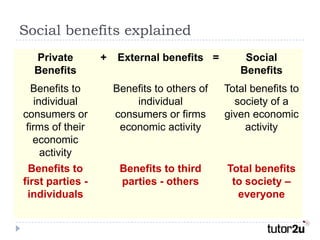
Social benefits
   Where there are positive externalities the social
    benefit of production and/or consumption
    exceeds the private benefit
Social benefits explained
  Private         +   External benefits =         Social
  Benefits                                       Benefits
  Benefits to         Benefits to others of   Total benefits to
    individual            individual            society of a
consumers or          consumers or firms      given economic
 firms of their        economic activity          activity
   economic
      activity
  Benefits to          Benefits to third      Total benefits
first parties -        parties - others        to society –
 individuals                                    everyone
Positive spill-overs
                   Flood protection schemes,
                   immunization and galleries and
                   museums all provide external
                   benefits


                   Left to itself, would the free-
                   market fail to provide sufficient
                   products that yield positive
                   externalities?
Positive externalities from education
and training
   Improved social skills and awareness of citizenship
   Greater long-term contribution to the economy
       Higher productivity
       Diffusion of knowledge and understanding
       Improved employability / reduced risk of structural
        unemployment
   Impact on international competitiveness from an
    improvement in human capital
   All of the above should help to contribute to a higher
    trend rate of growth
   Higher expected earnings might provide increased
    tax revenues for the government
Positive externalities and market failure
Costs
and
Benefit
s                                Marginal
                                 Private Cost =
                                 Marginal
          Consumer               Social Cost
          Surplus
                                 Margin
          Produce                al
          r Surplus
                                 Social
                                 Benefit
                                 Margin
                                 al
                                 Private
                                 Benefit
          Equilibriu   Q1   Q2             Output
          m output
Positive externalities and market failure
Costs                  Gain to
and                    other
Benefit                people
s                                      Marginal
                                       Private Cost =
                                       Marginal
          Consumer                     Social Cost
          Surplus
                                       Margin
          Produce                      al
          r Surplus
                                       Social
                                       Benefit
                                       Margin
                                       al
                                       Private
                                       Benefit
          Equilibriu         Q1   Q2             Output
          m output
Positive externalities and market failure
Costs
and
Benefit
s                                      Marginal
                                       Private Cost =
                                       Marginal
                                       Social Cost
                                       Margin
                                       al
                                       Social
                                       Benefit
                                       Margin
In a free market                       al
consumption will be at Q1              Private
because Demand = Supply                Benefit
(private benefit = private
cost )                       Q1   Q2             Output
Positive externalities and market failure
Costs
and
Benefit
s                                      Marginal
                                       Private Cost =
                                       Marginal
                                       Social Cost
                                       Margin
                                       al
                                       Social
                                       Benefit
                                       Margin
However this is socially               al
inefficient because Social             Private
Cost < Social Benefit.                 Benefit
Therefore there is under
consumption of the           Q1   Q2             Output
positive externality
Positive externalities and market failure
Costs
and
Benefit
s                                    Marginal
                                     Private Cost =
                                     Marginal
                                     Social Cost
                                     Margin
                                     al
                                     Social
                                     Benefit
                                     Margin
Social Efficiency would              al
occur at Q2 where Social             Private
Marginal Cost = Social               Benefit
Marginal Benefit
                           Q1   Q2             Output
Positive externalities and market failure
Costs                          Welfare loss from
and                            the good being
Benefit                        under-consumed
s                                                  Marginal
                                                   Private Cost =
                                                   Marginal
                                                   Social Cost
                                                   Margin
                                                   al
                                                   Social
                                                   Benefit
                                                   Margin
Under-consumption of                               al
products with positive                             Private
externalities leads to a net                       Benefit
loss of social welfare –
shown in the diagram above        Q1        Q2               Output
Encouraging supply to reap social returns
Government intervention options
   Government subsidy either to producer or consumer
       Reduce private cost of consumption or reduce cost of supply
       Lower costs should cause an expansion of demand
       E.g. Student grants and low-cost loans?
       Subsidies to fund free entrance to museums and heritage
        sites
       Providing free vaccines at the point of use
   Command and Control techniques
       Minimum school leaving age
       Compulsory health immunisation programmes
   Improved information flows to potential consumers
       Health awareness programmes
       Goods with positive externalities are often public goods –
        e.g. Investment in reduction programmes for communicable
        diseases
A subsidy to the producer
Costs                         Welfare loss from
and                           the good being
Benefit                       under-consumed
s

                                                  MPC=MSC

                                                            MPC with
                                                            subsidy
                                                        MSB

A producer subsidy would                          MPB
cut the marginal cost of
supplying to the consumer –
a lower price would bring
about an expansion of            Q1        Q2           Output
demand towards the socially
optimal level
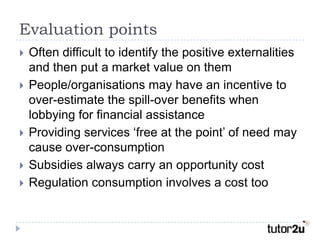
Evaluation points
   Often difficult to identify the positive externalities
    and then put a market value on them
   People/organisations may have an incentive to
    over-estimate the spill-over benefits when
    lobbying for financial assistance
   Providing services ‘free at the point’ of need may
    cause over-consumption
   Subsidies always carry an opportunity cost
   Regulation consumption involves a cost too
Tutor2u


    Keep up-to-date with economics,
         resources, quizzes and
     worksheets for your economics
                course.

Positive xternalities

  • 1.
    Positive Externalities AS Microeconomics
  • 2.
    A quick recapon externalities  An externality exists when the action of one agent unavoidably affects the welfare of another agent.  The affected agent may be a consumer, giving rise to a consumption externality, or a producer, giving rise to a production externality
  • 3.
    What are positiveexternalities?  Positive externalities create benefits to third parties  Activities said to generate positive externalities include:  Social returns from investment in education & training  Benefits from high quality public service broadcasting  Positive benefits from health care and medical research  Benefits from vaccination and immunization programmes  Flood protection systems & fire safety equipment  Restored historic buildings and monuments  Social benefits from protecting environmental resources
  • 4.
    Social benefits  Where there are positive externalities the social benefit of production and/or consumption exceeds the private benefit
  • 5.
    Social benefits explained Private + External benefits = Social Benefits Benefits Benefits to Benefits to others of Total benefits to individual individual society of a consumers or consumers or firms given economic firms of their economic activity activity economic activity Benefits to Benefits to third Total benefits first parties - parties - others to society – individuals everyone
  • 6.
    Positive spill-overs Flood protection schemes, immunization and galleries and museums all provide external benefits Left to itself, would the free- market fail to provide sufficient products that yield positive externalities?
  • 7.
    Positive externalities fromeducation and training  Improved social skills and awareness of citizenship  Greater long-term contribution to the economy  Higher productivity  Diffusion of knowledge and understanding  Improved employability / reduced risk of structural unemployment  Impact on international competitiveness from an improvement in human capital  All of the above should help to contribute to a higher trend rate of growth  Higher expected earnings might provide increased tax revenues for the government
  • 8.
    Positive externalities andmarket failure Costs and Benefit s Marginal Private Cost = Marginal Consumer Social Cost Surplus Margin Produce al r Surplus Social Benefit Margin al Private Benefit Equilibriu Q1 Q2 Output m output
  • 9.
    Positive externalities andmarket failure Costs Gain to and other Benefit people s Marginal Private Cost = Marginal Consumer Social Cost Surplus Margin Produce al r Surplus Social Benefit Margin al Private Benefit Equilibriu Q1 Q2 Output m output
  • 10.
    Positive externalities andmarket failure Costs and Benefit s Marginal Private Cost = Marginal Social Cost Margin al Social Benefit Margin In a free market al consumption will be at Q1 Private because Demand = Supply Benefit (private benefit = private cost ) Q1 Q2 Output
  • 11.
    Positive externalities andmarket failure Costs and Benefit s Marginal Private Cost = Marginal Social Cost Margin al Social Benefit Margin However this is socially al inefficient because Social Private Cost < Social Benefit. Benefit Therefore there is under consumption of the Q1 Q2 Output positive externality
  • 12.
    Positive externalities andmarket failure Costs and Benefit s Marginal Private Cost = Marginal Social Cost Margin al Social Benefit Margin Social Efficiency would al occur at Q2 where Social Private Marginal Cost = Social Benefit Marginal Benefit Q1 Q2 Output
  • 13.
    Positive externalities andmarket failure Costs Welfare loss from and the good being Benefit under-consumed s Marginal Private Cost = Marginal Social Cost Margin al Social Benefit Margin Under-consumption of al products with positive Private externalities leads to a net Benefit loss of social welfare – shown in the diagram above Q1 Q2 Output
  • 14.
    Encouraging supply toreap social returns
  • 15.
    Government intervention options  Government subsidy either to producer or consumer  Reduce private cost of consumption or reduce cost of supply  Lower costs should cause an expansion of demand  E.g. Student grants and low-cost loans?  Subsidies to fund free entrance to museums and heritage sites  Providing free vaccines at the point of use  Command and Control techniques  Minimum school leaving age  Compulsory health immunisation programmes  Improved information flows to potential consumers  Health awareness programmes  Goods with positive externalities are often public goods – e.g. Investment in reduction programmes for communicable diseases
  • 16.
    A subsidy tothe producer Costs Welfare loss from and the good being Benefit under-consumed s MPC=MSC MPC with subsidy MSB A producer subsidy would MPB cut the marginal cost of supplying to the consumer – a lower price would bring about an expansion of Q1 Q2 Output demand towards the socially optimal level
  • 17.
    Evaluation points  Often difficult to identify the positive externalities and then put a market value on them  People/organisations may have an incentive to over-estimate the spill-over benefits when lobbying for financial assistance  Providing services ‘free at the point’ of need may cause over-consumption  Subsidies always carry an opportunity cost  Regulation consumption involves a cost too
  • 18.
    Tutor2u Keep up-to-date with economics, resources, quizzes and worksheets for your economics course.