External, middle and inner Ear Traumas:By Catherine KeruboMl 410
Externalear traumaThe external ear, consisting of the auricle and external auditory canal (EAC), is  generally more vulnerable to physical trauma. The auricle is very vulnerable  to both blunt and sharp trauma.
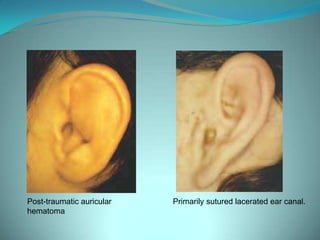
The most common complication from  blunt trauma to the ear is the formation of auricular hematoma. Failureto recognize and treat this condition early usually leads to an ugly deformity of the pinna known as a “cauliflower” ear.
Post-traumatic auricular hematoma        Primarily sutured lacerated ear canal.
EtiologyTympanic Membrane is much more traumatized than the Inner Ear 1.4 - 8.6 per 100,000            -Men> Women           - Children are curious
Classification of TM PerforationsQuadrant Size Marginal vs. Central
Traumatic TM PerforationsCompression Injuries BarotraumaPenetrating Injuries Thermal Injuries Lightning/Electrical Injuries
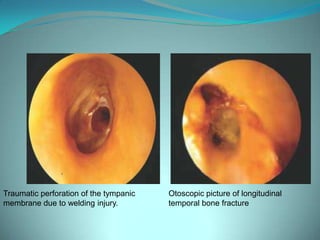
Traumatic perforation of the tympanic membrane due to welding injury.Otoscopic picture of longitudinal temporal bone fracture
Middle Ear TraumaIs usually associated with TM or inner ear trauma unless Iatrogenic Ossiculardiscontinuity Facial Nerve Injury Chorda tympani Nerve Injury Barotraumato Stapes footplate
Inner Ear TraumaBlunt Trauma Penetrating Trauma Barotrauma
Blunt TraumaTemporal Bone Fractures Longitudinal Transverse Oblique
Longitudinal fractures80% of Temporal Bone Fractures Lateral Forces along the petrosquamous suture line 15 20% Facial Nerve involvement 15-EAC laceration
Transverse fractures20% of Temporal Bone Fractures Forces in the Antero - Posterior direction50% Facial Nerve Involvement EAC intact
Penetrating TraumaIncrease in violence and firearms Associated with more dismal outcome More likely to involve intracranial lesions
BarotraumaRapid pressure fluctuations with the inner ear Air travel or SCUBA diving “the bends”
Physical ExaminationBasilar Skull Fractures PeriorbitalEcchymosis (Raccoon’s Eyes)
   Mastoid Ecchymosis (Battle’s Sign)
Hemotympanum
Tuning Fork exam
Pneumatic OtoscopyImagingHRCT MRI Angiography/ MRA
SymptomsHearing Loss Dizziness CSF Otorrhea and RhinorrheaFacial Nerve Injuries
Hearing LossFormal Audiometry vs. Tuning Fork 71% of patients with Temporal Bone Trauma have hearing loss TM Perforations CHL > 40db suspicious for ossicular discontinuityLongitudinal Fractures Conductive or mixed hearing loss
80% of CHL resolve spontaneously Transverse Fractures Sensorineuralhearing loss
Less likely to improveDizzinessOticcapsule fracture, labyrinthine concussion, PerilymphaticFistulaPerilymphatic Fistulas Fluctuating dizziness and/or hearing loss

External, middle and inner ear traumas