Vulvovaginal Infections Review Dr Muhammad El Hennawy Ob/gyn specialist Rass el barr central hospital Dumyatt – EGYPT www.geocities.com/mmhennawy
Vulvovaginitis, vulvitis, and vaginitis   are general terms that refer to the inflammation of the vagina and/or vulva
Normal vaginal flora Many different bacteria usually inhabit the vagina eg Lactobacilli which excrete hydrogen peroxide creating an acidic (low-pH) environment, which is a natural disinfectant that acts to maintain the normal balance of organisms in the vagina  that is hostile to disease bacteria  Any condition that changes the vaginal acidity or disturb the normal bacteria in the  vagina may predispose to an infection .   There is a delicate balance between the two major microorganisms normally found in the vagina of women during their reproductive years. These microorganisms are  Candida albicans  (a type of yeast or fungus) and  Lactobacillus sp .(a bacteria)
Causes   of vulvovaginitis Bacterial  Bacterial vaginosis lactobacillus  vaginitis Chronic purulent vaginitis  causd by  gram-positive cocci  Fungal  Candida vulvovaginitis   cyclic vulvovaginities Parasitic  trichomonal   vulvovaginitis   vulvovaginitis can be caused by low estrogen levels (called " atrophic vaginitis ") or any type of allergic or irritation or injury response from things such as spermicidal products, condoms, soaps, and bubble bath(called “ contact vulvovaginitis ” ).
Chronic purulent vaginitis has been reported which is an exudative vaginitis, with purulent discharge and an elevated vaginal pH due to replacement of normal flora with gram-positive cocci and occasional vaginal spotted rash. Responds to clindamycin cream.
Atrophic Vaginitis Atrophic vaginitis  results from  hypoestrogenemia. Although atrophic vaginitis typically  occurs  after menopause because of  the absolute lack of estrogen   and medication that causes drying of the mucous membranes can exacerbate the problem. Like antihistamines, decongestants, or any other drug with drying potential.  it may  also occur  during pregnancy, lactation,  and other progesterone-dominant states  Symptoms  of atrophic vaginitis include painful intercourse (dyspareunia), dryness, pruritus, and abnormal bleeding. If the urothelium is affected (urogenital atrophy), patients may also report urinary urgency.  The mucosa is pale, and rugae cannot be observed. The vagina is dry and nonpliant. Placement of a speculum may be painful  Treatment  with local(estrogen cream intravaginally every other day  ,  an estrogen-impregnated polymer ring inserted into the vault and remains in  place for 3 months)  or  systemic estrogens reverses the patient's tissue changes and relieves  symptoms Women who cannot or will not use estrogen can obtain symptomatic treatment of atrophy with vaginal lubricants ( K-Y jell ),  water-based emollients  و Oil-based preparations may clog vulvar glands and lead to folliculitis so their use is similarly discouraged
Contact/ irritant/allergic vaginitis   vulvar pruritis, erythema and edema,  but with otherwise normal saline, KOH and Gram stain microscopy,  History of use of hygene sprays or douches, bubble baths or scented toilet tissue it may result from an allergic or chemical reaction to any one of these or similar products  it can be treated by removing the offending substance and prescribing a short course of a corticosteroid
Vulvovaginitis of children the vagina is close to the anus  the vulva lacks the protective labial fat and pubic hair of an adult.  Also, children often have poor personal hygiene. Children with vulvovaginitis may complain of pain, itching, and burning around the vagina; a vaginal discharge; and pain when urinating.  causes of vulvovaginitis in children - bacteria or fungus. Other causes include pinworm, contact irritants, skin diseases, and foreign body.
Lactobacillus Vaginitis Lactobacillus or cytolytic vaginits is one of the  most under-diagnosed   types of vaginitis.  There is frequently a white discharge that may be mistaken for a yeast infection. Itching, irritation and burning of the vagina and vulva are frequent complaints. It is most often present during the 2 weeks before the onset of the menstrual period. Lactobacillus is one of the normal microorganisms found in the vagina, along with yeast. An imbalance in the vagina can result in overgrowth of this microorganism. The diagnosis is made by examination of the discharge under the microscope. Treatment is a baking soda douche which can be made with 2 ounces of baking soda in a quart of warm water. The douche is used every other night for a week and 1-2 times per week thereafter as needed. Placing 2-4 tablespoons of baking soda in 1-2 inches of bath water once or twice daily provides external relief of symptoms. You should also avoid external sources of lactobacilli such as yogurt, discontinue medication to treat yeast, and use non-deodorized pads during your menstrual period.

Bacterial vaginosis (previously known as nonspecific vaginitis ,Hemophilus vaginalis or Corynebacterium vaginale, Gardnerella vaginalis )  It is not caused by a particular organism but there is a change in the balance of normal vaginal bacteria .  very high numbers of bacteria such as  Gardnerella vaginalis ,  Mycoplasmahominis ,  Bacteroides  species, and  Mobiluncus  species. These bacteria can be found at numbers 100 to 1000 times greater than found in the healthy vagina. In contrast,  Lactobacillus  bacteria are in very low numbers or completely absent(Ninety percent of the bacteria found in a healthy vagina belong to the  Lactobacillus  family).  Bacterial vaginosis is not considered a sexually transmitted disease although it can be acquired by sexual intercourse.
vulvovaginal candidiasis," "candidal vaginitis," "monilial infection," or "vaginal yeast infection .   In 80-90% of the cases, is caused by an overgrowth of the yeast Candida Albicans In 10 – 20 % is caused by Candida glabrata or candida tropicalis
recurrent vaginal candidiasis   Some women have four or more attacks per year  Chronic  or recurrent infections may occur. This may be from inadequate treatment or self-reinfection.   Secondary infection may occur. Intense or prolonged scratching may cause the skin of the vulva to become cracked and raw, making it more susceptible to infection.
Cyclic Vulvovaginitis   Cyclic flares with symptom free intervals  Pain worse just before or during  Menses   Pain exacerbated after intercourse (day after)  History of frequent antibiotics  Minimal  Vaginal Discharge   Causes   Eczematous  Candidiasis   Candida hypersensitivity   Management   Clotrimazole   or Terconazole Cream  Acute  Apply qhs for 10 days then  Apply 1/2 applicator Mon-Wed-Fri for 2-4 months  Maintenance  Apply qhs for 5 days before  Menses  each Month  Fluconazole  150 mg  Weekly for 2 months then  Bi-Monthly for 2-4 months then  Monthly prior to Symptom flare  Low-oxalate diet  Oral calcium citrate (Citracal) 200 mg bid
Trichomoniasis   it is  usually  sexually transmitted disease.  This means that the disease is passed from person-to-person only by sexual contact. Trichomoniasis occurs in both men and women and is caused by an infection with the single-celled parasite   Trichomonas vaginalis . in  rare  instances it has been passed through wet towels, washcloths or bathing suits.  Trichomoniasis is primarily an infection of the urogenital tract; the urethra is the most common site of infection in men, and the vagina is the most common site of infection in women.
Risk factors for Vulvovaginitis   Vaginal yeast infections tend to occur more frequently in women who are pregnant, and uncontrolled diabetic, taking birth control pills, or taking antibiotics  or corticosteroids  , previous candida infections, frequent sexual intercourseuse douches, use perfumed feminine hygiene sprays, wear tight clothing (jeans, synthetic underwear, wet bathing suits)   , or use vaginal sponges or an IUD  or have AIDS have AIDS, diet high in sugars and starches. .  Bacterial vaginosis  tend to occur more frequently in women who have using an intrauterine device (IUD), non-white race, prior pregnancy, first sexual activity at an early age, having multiple sexual partners, and having a history of sexually transmitted diseases.
incidence Bacterial vaginosis  40% to 50% of vaginitis during the childbearing years  10% to 41% of women have had it at least once.  20% to 25% of the vaginitis cases are candida vulvovaginitis .  75% of all women get a vaginal yeast infection at least once.  .Trichomoniasis 15-20% of the cases of vaginitis
symptoms   of Vulvovaginitis   Discharge itching  irritation of the labia and vagina  Bad odour vague low abdominal discomfort, or dysuria. (Suprapubic discomfort and urinary urgency and frequency suggest cystitis.)
Bacterial vaginosis .  About 50% of women with BV do not have symptoms  Women may have few symptoms,  while others may have pronounced symptoms.  The main symptom of bacterial vaginosis is a fishy-smelling  is stronger after sexual intercourse and menses,  thin, milky-white or gray vaginal discharge  but mild itching and burning may also be present.
Candida vulvovaginitis itching,  soreness,  painful sexual intercourse or there may be pain on passing urine ,  and a thick, curdy, white (like cottage cheese) vaginal discharge .  Most male partners of women with VVC do not experience any symptoms of the infection However, a transient rash and burning sensation of the penis have been reported after intercourse if condoms were not used. These symptoms are usually self-limiting.
Trichomoniasis Trichomoniasis, like many other STDs, often occurs without any symptoms. When symptoms occur, they usually appear within 4 to 20 days of exposure,  painful urination, painful sexual intercourse, and a yellow-green to gray, sometimes frothy, vaginal discharge. The discharge is  characteristically malodorous smelling In some cases, there may be vaginal soreness, and abnormal bleeding after sex. The symptoms in  men  include a thin, whitish discharge from the penis and painful or difficult urination. However, most men do not experience any symptoms.

Diagnosis (signs) Take a brief sexual history. Ask if partners are experiencing related symptoms  examination  of the introitus may reveal erythema of the vulva and edema of the labia (especially with Candida) Speculum examination  may disclose a diffusely red, inflamed vaginal mucosa, with vaginal discharge either copious, thin, and foul-smelling (characteristic of Trichomonas or anaerobic overgrowth) or thick, white, and cheesy (characteristic of Candida and associated with more intense vulvar pruritis)  Swab  the cervix or urethra to culture for N. gonorrheae  and  swab  the endocervix to test for Chlamydia.  Touch  pH indicator  paper to the vaginal mucus (a pH>4.5 suggests anaerobic vaginosis, but this is only useful if there is no blood or semen to buffer vaginal secretions).  and take  a sample  of the vaginal discharge for microscopic analysis  immediately performed in the doctor's office Laboratory  culture  results should be   available in two to three days  Bimanual examination  should show a non-tender cervix and uterus, without adnexal tenderness or masses or pain on cervical motion.  . Collect  urine  for possible culture and pregnancy tests which may influence treatment
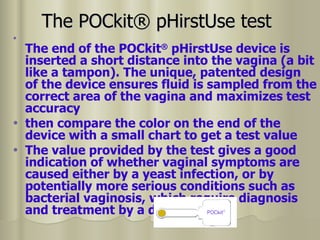
The POCkit® pHirstUse test   The end of the POCkit ®  pHirstUse device is inserted a short distance into the vagina (a bit like a tampon). The unique, patented design of the device ensures fluid is sampled from the correct area of the vagina and maximizes test accuracy then compare the color on the end of the device with a small chart to get a test value The value provided by the test gives a good indication of whether vaginal symptoms are caused either by a yeast infection, or by potentially more serious conditions such as bacterial vaginosis, which require diagnosis and treatment by a doctor
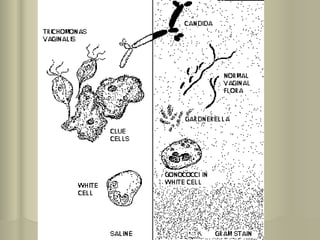
vaginal swab ·  Using a sterile swab, swab the vaginal region and immerse the swab into the vial containing 2 mls of sterile 0.9% Sodium Chloride, NaCl, and label A.  Wet prep : Mix sample in vial and place one drop of the solution onto a slide and examine microscopically using high power (40x) objective for the presence of Trichomonas and clue cells B.  Wet prep with KOH : 1 .Mix sample in vial and place two drops of the solution into a small test tube. 2. Add two drops of 20% KOH with DMSO to the tube. 3. Mix and allow to sit for about 5 minutes until the material has cleared. Additional time may be required for thicker samples. 4. Place one drop on the slide and examine microscopically for the presence of budding yeast and/or pseudohyphae forms. Trichomonas  Scan the entire slide on low power magnification with reduced light for motile Trichomonas.  ·  If motility is observed, switch to high power to positively identify Trichomonas. The flagella or undulating membrane should be visible.  ·  If seen, report as Positive. If motile Trichomonas are not seen, report as Negative. Clue cells  Clue cells are epithelial cells covered with bacteria giving the cell a “furlike” appearance.  Clue cells are reported as: Few, Moderate, or Many on Low power. Yeast  The wet prep with KOH should be used to determine if yeast are present.  Budding yeast and pseudohyphae, if observed, are counted on high power,  Record actual count seen using ranges/HPF. If no yeast is seen, report as no yeast observed.
 
Bacterial vaginosis four signs  for bacterial vaginosis (called "Amsel's criteria")  if three of the following four criteria were present  a thin, milky white discharge that clings to the walls of the vagina,  presence of a fishy odor(a positive amine test ), a vaginal pH of greater than 4.5,  and the presence of "clue cells" in the vagina. Clue cells are vaginal cells that are covered with small bacteria  Those with one or two criteria were classified as having a disturbance of vaginal flora and those with three or more were classified as having BV
Candida vulvovaginitis finding a normal vaginal pH (4 to 4.5)  and the presence of many yeast cells in the sample of vaginal discharge or growth of yeast on laboratory media
Trichomoniasis The labia may be irritated, red and itchy  Speculum examination may disclose a diffusely red, inflamed vaginal mucosa, with vaginal discharge either copious, thin, and foul-smelling  the parasites are found in the vaginal discharge either by microscopic examination or in laboratory cultures  .  Sometimes the infections may be picked up on Pap Smear  . a sample of fluid from the penis may be taken from which the parasite  can be grown in culture in the laboratory
Treatment
Bacterial vaginosis Nonpregnant women who have bacterial vaginosis that is not causing symptoms usually are not treated.  Women with symptoms should be treated daily for one week with the antibiotics metronidazole (Flagyl, Protostat)  or clindamycin (Cleocin) either as pills taken orally or in a gel or cream form put into the vagina  Pregnant women with symptoms should be treated. Some pregnant women without symptoms but who are considered high-risk may benefit from treatment if a test shows BV  in cases of BV that do not respond to drug therapy, treatment of male partners may be   helpfu
Candida vulvovaginitis most often treated by the application of medicated gels, creams, or suppositories applied directly to the vagina  miconazole (Monistat) or clotrimazole (Gyne-Lotrimin) 200mg vaginal suppositories to be inserted qhs x 3d .  . The antifungal drugs used to treat candida vulvovaginitis include oral fluconazole (Diflucan), butoconazole (Femstat), clotrimazole (Gyne-lotrimin, Mycelex), miconazole (Monistat), and ticonazole (Vagistat). Most require only one or a few days of therapy to be effective. In pregnancy, halve the dose and double the course of topical clotrimazole
recurrent vaginal candidiasis Women who have recurrent candida infections may receive treatment for several weeks and then some form of a long-term preventative treatment. for recurrences, which is active against fungi other than Candida albicans, are butoconazole (Femstat) and terconazole (Terazol) one 5 gram applicator of cream qhs for three days and seven days, respectively. Use of cream also allows its soothing application on irritated mucosa .   restoration of the normal ecosystem of the vagina. Proper hygiene, dietary control, and management of stress also are important factors in control of recurrent vaginal infections.
Trichomoniasis treated with either a large, single dose of metronidazole 2000mg once  or with a smaller dose taken twice daily for one week. 500mg bid x 7d .In the first trimester of pregnancy, substitute intravaginal clotrimazole 100mg vaginal suppository qhs x7d, which is less effective, but safer than metronidazole vaginal gel. Metronidazole is contraindicated in the first trimester and controversial thereafter.  Treatment of asymptomatic patients can be be delayed until after delivery.  . Male sexual partners of women with trichomoniasis also must be treated.
Alternative treatment rebalancing the normal vaginal flora  Lactobacillus acidophilus  and  L. bifidus  are recommended, either taken internally or introduced directly into the vagina  uses active-culture yogurt douches to repopulate the vagina with lactobacilli   antibacterial and antifungal actions   .  Garlic ( Allium sativum ), both taken internally and inserted into the vagina (a peeled whole clove wrapped in gauze) .reduce inflammation by  variety of herbs used as douches or in suppository form ( Calendula officinalis )  .acidify the vaginal pH so that unwanted bacteria cannot survive and multiply by A boric acid douche or capsules inserted in the vagina  .For atrophic vaginitis, especially in menopausal women, topical application of progesterone cream  . To support their immune system Echinacea, which has the capacity to enhance immune function .Dietary modification and nutritional supplementation may also be helpful in the treatment
Dietary modification and nutritional supplementation Antioxidant vitamins , including A, C, and E, as well as B complex vitamins, and vitamin D, are recommended. a well-balanced diet  low in fats, sugar, and refined foods  include cheese, alcohol, chocolate, soy sauce, sugar, vinegar, fruits, and any fermented foods  Lactobacillus acidophilus  can be taken orally in the form of acidophilus vogurt, or in capsules or powder. It can also be administered vaginally
Prevention treatments  should not be taken unless the woman had been diagnosed  Douching  should be avoided because it may disturb the balance of organisms in the  vagina  and may spread them higher into the reproductive system.  Avoid  wearing  tight clothing  and wear cotton  underwear .  Thoroughly  dry  oneself after bathing and remove a wet bathing suit promptly.  After a bowel movement,  wipe  from front to back to avoid spreading intestinal bacteria to the vagina. Clean  diaphragms, cervical caps, and spermicide applicators after use.  Use   condoms  to avoid sexually transmitted disease As Trichomonas infection is sexually transmitted,  To prevent rebound Candida vaginitis after antibiotics decimate the normal vaginal flora, or for treatment of mild vaginitis, consider douching with 1%  acetic acid  (half-strength vinegar) to maintain a normal low pH ecology also  Some women find eating one cup of  yogurt  a day when taking antibiotics is helpful to prevent the yeast infections that often follow antibiotic treatment  .  Decreasing the frequency  of sexual intercourse seems to have more of a scientific basis than other standard advice frequently given to decrease vulvovaginal candidiasis has been found among nonpregnant women .
Complications   Bacterial vaginosis (BV) result in  pelvic inflammatory disease that result in infertility and tubal pregnancy increase in adverse outcomes of pregnancy such as  premature labour,premature rupture of membranes, amniotic fluid infection  and low-birth-weight infants   trichomoniasis may increase the risk of transmission of human immunodeficiency virus, and may cause delivery of low-birth-weight or premature infants.
Prognosis a disease with minor symptoms and most women respond well to medications.  It is believed that certain vaginal infections, if left untreated, can lead to more serious conditions such as PID ,  endometritis, postsurgical infections, and spread of the AIDS virus.

vulvo vaginal infection

  • 1.
    Vulvovaginal Infections ReviewDr Muhammad El Hennawy Ob/gyn specialist Rass el barr central hospital Dumyatt – EGYPT www.geocities.com/mmhennawy
  • 2.
    Vulvovaginitis, vulvitis, andvaginitis are general terms that refer to the inflammation of the vagina and/or vulva
  • 3.
    Normal vaginal floraMany different bacteria usually inhabit the vagina eg Lactobacilli which excrete hydrogen peroxide creating an acidic (low-pH) environment, which is a natural disinfectant that acts to maintain the normal balance of organisms in the vagina that is hostile to disease bacteria Any condition that changes the vaginal acidity or disturb the normal bacteria in the vagina may predispose to an infection . There is a delicate balance between the two major microorganisms normally found in the vagina of women during their reproductive years. These microorganisms are Candida albicans (a type of yeast or fungus) and Lactobacillus sp .(a bacteria)
  • 4.
    Causes of vulvovaginitis Bacterial Bacterial vaginosis lactobacillus vaginitis Chronic purulent vaginitis causd by gram-positive cocci Fungal Candida vulvovaginitis cyclic vulvovaginities Parasitic trichomonal vulvovaginitis vulvovaginitis can be caused by low estrogen levels (called " atrophic vaginitis ") or any type of allergic or irritation or injury response from things such as spermicidal products, condoms, soaps, and bubble bath(called “ contact vulvovaginitis ” ).
  • 5.
    Chronic purulent vaginitishas been reported which is an exudative vaginitis, with purulent discharge and an elevated vaginal pH due to replacement of normal flora with gram-positive cocci and occasional vaginal spotted rash. Responds to clindamycin cream.
  • 6.
    Atrophic Vaginitis Atrophicvaginitis results from hypoestrogenemia. Although atrophic vaginitis typically occurs after menopause because of the absolute lack of estrogen and medication that causes drying of the mucous membranes can exacerbate the problem. Like antihistamines, decongestants, or any other drug with drying potential. it may also occur during pregnancy, lactation, and other progesterone-dominant states Symptoms of atrophic vaginitis include painful intercourse (dyspareunia), dryness, pruritus, and abnormal bleeding. If the urothelium is affected (urogenital atrophy), patients may also report urinary urgency. The mucosa is pale, and rugae cannot be observed. The vagina is dry and nonpliant. Placement of a speculum may be painful Treatment with local(estrogen cream intravaginally every other day , an estrogen-impregnated polymer ring inserted into the vault and remains in place for 3 months) or systemic estrogens reverses the patient's tissue changes and relieves symptoms Women who cannot or will not use estrogen can obtain symptomatic treatment of atrophy with vaginal lubricants ( K-Y jell ), water-based emollients و Oil-based preparations may clog vulvar glands and lead to folliculitis so their use is similarly discouraged
  • 7.
    Contact/ irritant/allergic vaginitis vulvar pruritis, erythema and edema, but with otherwise normal saline, KOH and Gram stain microscopy, History of use of hygene sprays or douches, bubble baths or scented toilet tissue it may result from an allergic or chemical reaction to any one of these or similar products it can be treated by removing the offending substance and prescribing a short course of a corticosteroid
  • 8.
    Vulvovaginitis of childrenthe vagina is close to the anus the vulva lacks the protective labial fat and pubic hair of an adult. Also, children often have poor personal hygiene. Children with vulvovaginitis may complain of pain, itching, and burning around the vagina; a vaginal discharge; and pain when urinating. causes of vulvovaginitis in children - bacteria or fungus. Other causes include pinworm, contact irritants, skin diseases, and foreign body.
  • 9.
    Lactobacillus Vaginitis Lactobacillusor cytolytic vaginits is one of the most under-diagnosed types of vaginitis. There is frequently a white discharge that may be mistaken for a yeast infection. Itching, irritation and burning of the vagina and vulva are frequent complaints. It is most often present during the 2 weeks before the onset of the menstrual period. Lactobacillus is one of the normal microorganisms found in the vagina, along with yeast. An imbalance in the vagina can result in overgrowth of this microorganism. The diagnosis is made by examination of the discharge under the microscope. Treatment is a baking soda douche which can be made with 2 ounces of baking soda in a quart of warm water. The douche is used every other night for a week and 1-2 times per week thereafter as needed. Placing 2-4 tablespoons of baking soda in 1-2 inches of bath water once or twice daily provides external relief of symptoms. You should also avoid external sources of lactobacilli such as yogurt, discontinue medication to treat yeast, and use non-deodorized pads during your menstrual period.
  • 10.
    Bacterial vaginosis (previouslyknown as nonspecific vaginitis ,Hemophilus vaginalis or Corynebacterium vaginale, Gardnerella vaginalis ) It is not caused by a particular organism but there is a change in the balance of normal vaginal bacteria . very high numbers of bacteria such as Gardnerella vaginalis , Mycoplasmahominis , Bacteroides species, and Mobiluncus species. These bacteria can be found at numbers 100 to 1000 times greater than found in the healthy vagina. In contrast, Lactobacillus bacteria are in very low numbers or completely absent(Ninety percent of the bacteria found in a healthy vagina belong to the Lactobacillus family). Bacterial vaginosis is not considered a sexually transmitted disease although it can be acquired by sexual intercourse.
  • 11.
    vulvovaginal candidiasis," "candidalvaginitis," "monilial infection," or "vaginal yeast infection . In 80-90% of the cases, is caused by an overgrowth of the yeast Candida Albicans In 10 – 20 % is caused by Candida glabrata or candida tropicalis
  • 12.
    recurrent vaginal candidiasis Some women have four or more attacks per year Chronic or recurrent infections may occur. This may be from inadequate treatment or self-reinfection. Secondary infection may occur. Intense or prolonged scratching may cause the skin of the vulva to become cracked and raw, making it more susceptible to infection.
  • 13.
    Cyclic Vulvovaginitis Cyclic flares with symptom free intervals Pain worse just before or during Menses Pain exacerbated after intercourse (day after) History of frequent antibiotics Minimal Vaginal Discharge Causes Eczematous Candidiasis Candida hypersensitivity Management Clotrimazole or Terconazole Cream Acute Apply qhs for 10 days then Apply 1/2 applicator Mon-Wed-Fri for 2-4 months Maintenance Apply qhs for 5 days before Menses each Month Fluconazole 150 mg Weekly for 2 months then Bi-Monthly for 2-4 months then Monthly prior to Symptom flare Low-oxalate diet Oral calcium citrate (Citracal) 200 mg bid
  • 14.
    Trichomoniasis it is usually sexually transmitted disease. This means that the disease is passed from person-to-person only by sexual contact. Trichomoniasis occurs in both men and women and is caused by an infection with the single-celled parasite Trichomonas vaginalis . in rare instances it has been passed through wet towels, washcloths or bathing suits. Trichomoniasis is primarily an infection of the urogenital tract; the urethra is the most common site of infection in men, and the vagina is the most common site of infection in women.
  • 15.
    Risk factors forVulvovaginitis Vaginal yeast infections tend to occur more frequently in women who are pregnant, and uncontrolled diabetic, taking birth control pills, or taking antibiotics or corticosteroids , previous candida infections, frequent sexual intercourseuse douches, use perfumed feminine hygiene sprays, wear tight clothing (jeans, synthetic underwear, wet bathing suits) , or use vaginal sponges or an IUD or have AIDS have AIDS, diet high in sugars and starches. . Bacterial vaginosis tend to occur more frequently in women who have using an intrauterine device (IUD), non-white race, prior pregnancy, first sexual activity at an early age, having multiple sexual partners, and having a history of sexually transmitted diseases.
  • 16.
    incidence Bacterial vaginosis 40% to 50% of vaginitis during the childbearing years 10% to 41% of women have had it at least once. 20% to 25% of the vaginitis cases are candida vulvovaginitis . 75% of all women get a vaginal yeast infection at least once. .Trichomoniasis 15-20% of the cases of vaginitis
  • 17.
    symptoms of Vulvovaginitis Discharge itching irritation of the labia and vagina Bad odour vague low abdominal discomfort, or dysuria. (Suprapubic discomfort and urinary urgency and frequency suggest cystitis.)
  • 18.
    Bacterial vaginosis . About 50% of women with BV do not have symptoms Women may have few symptoms, while others may have pronounced symptoms. The main symptom of bacterial vaginosis is a fishy-smelling is stronger after sexual intercourse and menses, thin, milky-white or gray vaginal discharge but mild itching and burning may also be present.
  • 19.
    Candida vulvovaginitis itching, soreness, painful sexual intercourse or there may be pain on passing urine , and a thick, curdy, white (like cottage cheese) vaginal discharge . Most male partners of women with VVC do not experience any symptoms of the infection However, a transient rash and burning sensation of the penis have been reported after intercourse if condoms were not used. These symptoms are usually self-limiting.
  • 20.
    Trichomoniasis Trichomoniasis, likemany other STDs, often occurs without any symptoms. When symptoms occur, they usually appear within 4 to 20 days of exposure, painful urination, painful sexual intercourse, and a yellow-green to gray, sometimes frothy, vaginal discharge. The discharge is characteristically malodorous smelling In some cases, there may be vaginal soreness, and abnormal bleeding after sex. The symptoms in men include a thin, whitish discharge from the penis and painful or difficult urination. However, most men do not experience any symptoms.
  • 21.
    Diagnosis (signs) Takea brief sexual history. Ask if partners are experiencing related symptoms examination of the introitus may reveal erythema of the vulva and edema of the labia (especially with Candida) Speculum examination may disclose a diffusely red, inflamed vaginal mucosa, with vaginal discharge either copious, thin, and foul-smelling (characteristic of Trichomonas or anaerobic overgrowth) or thick, white, and cheesy (characteristic of Candida and associated with more intense vulvar pruritis) Swab the cervix or urethra to culture for N. gonorrheae and swab the endocervix to test for Chlamydia. Touch pH indicator paper to the vaginal mucus (a pH>4.5 suggests anaerobic vaginosis, but this is only useful if there is no blood or semen to buffer vaginal secretions). and take a sample of the vaginal discharge for microscopic analysis immediately performed in the doctor's office Laboratory culture results should be available in two to three days Bimanual examination should show a non-tender cervix and uterus, without adnexal tenderness or masses or pain on cervical motion. . Collect urine for possible culture and pregnancy tests which may influence treatment
  • 22.
    The POCkit® pHirstUsetest The end of the POCkit ® pHirstUse device is inserted a short distance into the vagina (a bit like a tampon). The unique, patented design of the device ensures fluid is sampled from the correct area of the vagina and maximizes test accuracy then compare the color on the end of the device with a small chart to get a test value The value provided by the test gives a good indication of whether vaginal symptoms are caused either by a yeast infection, or by potentially more serious conditions such as bacterial vaginosis, which require diagnosis and treatment by a doctor
  • 23.
    vaginal swab · Using a sterile swab, swab the vaginal region and immerse the swab into the vial containing 2 mls of sterile 0.9% Sodium Chloride, NaCl, and label A. Wet prep : Mix sample in vial and place one drop of the solution onto a slide and examine microscopically using high power (40x) objective for the presence of Trichomonas and clue cells B. Wet prep with KOH : 1 .Mix sample in vial and place two drops of the solution into a small test tube. 2. Add two drops of 20% KOH with DMSO to the tube. 3. Mix and allow to sit for about 5 minutes until the material has cleared. Additional time may be required for thicker samples. 4. Place one drop on the slide and examine microscopically for the presence of budding yeast and/or pseudohyphae forms. Trichomonas Scan the entire slide on low power magnification with reduced light for motile Trichomonas. · If motility is observed, switch to high power to positively identify Trichomonas. The flagella or undulating membrane should be visible. · If seen, report as Positive. If motile Trichomonas are not seen, report as Negative. Clue cells Clue cells are epithelial cells covered with bacteria giving the cell a “furlike” appearance. Clue cells are reported as: Few, Moderate, or Many on Low power. Yeast The wet prep with KOH should be used to determine if yeast are present. Budding yeast and pseudohyphae, if observed, are counted on high power, Record actual count seen using ranges/HPF. If no yeast is seen, report as no yeast observed.
  • 24.
  • 25.
    Bacterial vaginosis foursigns for bacterial vaginosis (called "Amsel's criteria") if three of the following four criteria were present a thin, milky white discharge that clings to the walls of the vagina, presence of a fishy odor(a positive amine test ), a vaginal pH of greater than 4.5, and the presence of "clue cells" in the vagina. Clue cells are vaginal cells that are covered with small bacteria Those with one or two criteria were classified as having a disturbance of vaginal flora and those with three or more were classified as having BV
  • 26.
    Candida vulvovaginitis findinga normal vaginal pH (4 to 4.5) and the presence of many yeast cells in the sample of vaginal discharge or growth of yeast on laboratory media
  • 27.
    Trichomoniasis The labiamay be irritated, red and itchy Speculum examination may disclose a diffusely red, inflamed vaginal mucosa, with vaginal discharge either copious, thin, and foul-smelling the parasites are found in the vaginal discharge either by microscopic examination or in laboratory cultures . Sometimes the infections may be picked up on Pap Smear . a sample of fluid from the penis may be taken from which the parasite can be grown in culture in the laboratory
  • 28.
  • 29.
    Bacterial vaginosis Nonpregnantwomen who have bacterial vaginosis that is not causing symptoms usually are not treated. Women with symptoms should be treated daily for one week with the antibiotics metronidazole (Flagyl, Protostat) or clindamycin (Cleocin) either as pills taken orally or in a gel or cream form put into the vagina Pregnant women with symptoms should be treated. Some pregnant women without symptoms but who are considered high-risk may benefit from treatment if a test shows BV in cases of BV that do not respond to drug therapy, treatment of male partners may be helpfu
  • 30.
    Candida vulvovaginitis mostoften treated by the application of medicated gels, creams, or suppositories applied directly to the vagina miconazole (Monistat) or clotrimazole (Gyne-Lotrimin) 200mg vaginal suppositories to be inserted qhs x 3d . . The antifungal drugs used to treat candida vulvovaginitis include oral fluconazole (Diflucan), butoconazole (Femstat), clotrimazole (Gyne-lotrimin, Mycelex), miconazole (Monistat), and ticonazole (Vagistat). Most require only one or a few days of therapy to be effective. In pregnancy, halve the dose and double the course of topical clotrimazole
  • 31.
    recurrent vaginal candidiasisWomen who have recurrent candida infections may receive treatment for several weeks and then some form of a long-term preventative treatment. for recurrences, which is active against fungi other than Candida albicans, are butoconazole (Femstat) and terconazole (Terazol) one 5 gram applicator of cream qhs for three days and seven days, respectively. Use of cream also allows its soothing application on irritated mucosa . restoration of the normal ecosystem of the vagina. Proper hygiene, dietary control, and management of stress also are important factors in control of recurrent vaginal infections.
  • 32.
    Trichomoniasis treated witheither a large, single dose of metronidazole 2000mg once or with a smaller dose taken twice daily for one week. 500mg bid x 7d .In the first trimester of pregnancy, substitute intravaginal clotrimazole 100mg vaginal suppository qhs x7d, which is less effective, but safer than metronidazole vaginal gel. Metronidazole is contraindicated in the first trimester and controversial thereafter. Treatment of asymptomatic patients can be be delayed until after delivery. . Male sexual partners of women with trichomoniasis also must be treated.
  • 33.
    Alternative treatment rebalancingthe normal vaginal flora Lactobacillus acidophilus and L. bifidus are recommended, either taken internally or introduced directly into the vagina uses active-culture yogurt douches to repopulate the vagina with lactobacilli antibacterial and antifungal actions . Garlic ( Allium sativum ), both taken internally and inserted into the vagina (a peeled whole clove wrapped in gauze) .reduce inflammation by variety of herbs used as douches or in suppository form ( Calendula officinalis ) .acidify the vaginal pH so that unwanted bacteria cannot survive and multiply by A boric acid douche or capsules inserted in the vagina .For atrophic vaginitis, especially in menopausal women, topical application of progesterone cream . To support their immune system Echinacea, which has the capacity to enhance immune function .Dietary modification and nutritional supplementation may also be helpful in the treatment
  • 34.
    Dietary modification andnutritional supplementation Antioxidant vitamins , including A, C, and E, as well as B complex vitamins, and vitamin D, are recommended. a well-balanced diet low in fats, sugar, and refined foods include cheese, alcohol, chocolate, soy sauce, sugar, vinegar, fruits, and any fermented foods Lactobacillus acidophilus can be taken orally in the form of acidophilus vogurt, or in capsules or powder. It can also be administered vaginally
  • 35.
    Prevention treatments should not be taken unless the woman had been diagnosed Douching should be avoided because it may disturb the balance of organisms in the vagina and may spread them higher into the reproductive system. Avoid wearing tight clothing and wear cotton underwear . Thoroughly dry oneself after bathing and remove a wet bathing suit promptly. After a bowel movement, wipe from front to back to avoid spreading intestinal bacteria to the vagina. Clean diaphragms, cervical caps, and spermicide applicators after use. Use condoms to avoid sexually transmitted disease As Trichomonas infection is sexually transmitted, To prevent rebound Candida vaginitis after antibiotics decimate the normal vaginal flora, or for treatment of mild vaginitis, consider douching with 1% acetic acid (half-strength vinegar) to maintain a normal low pH ecology also Some women find eating one cup of yogurt a day when taking antibiotics is helpful to prevent the yeast infections that often follow antibiotic treatment . Decreasing the frequency of sexual intercourse seems to have more of a scientific basis than other standard advice frequently given to decrease vulvovaginal candidiasis has been found among nonpregnant women .
  • 36.
    Complications Bacterial vaginosis (BV) result in pelvic inflammatory disease that result in infertility and tubal pregnancy increase in adverse outcomes of pregnancy such as premature labour,premature rupture of membranes, amniotic fluid infection and low-birth-weight infants trichomoniasis may increase the risk of transmission of human immunodeficiency virus, and may cause delivery of low-birth-weight or premature infants.
  • 37.
    Prognosis a diseasewith minor symptoms and most women respond well to medications. It is believed that certain vaginal infections, if left untreated, can lead to more serious conditions such as PID , endometritis, postsurgical infections, and spread of the AIDS virus.