Surgical Abortion David Blair Toub, M.D. Dept. of Obstetrics and Gynecology Pennsylvania Hospital
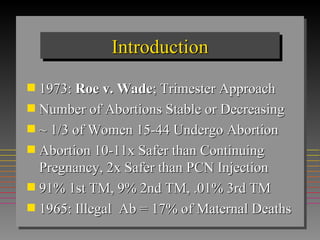
Introduction 1973:  Roe v. Wade ; Trimester Approach Number of Abortions Stable or Decreasing ~ 1/3 of Women 15-44 Undergo Abortion Abortion 10-11x Safer than Continuing Pregnancy, 2x Safer than PCN Injection 91% 1st TM, 9% 2nd TM, .01% 3rd TM 1965: Illegal  Ab = 17% of Maternal Deaths
Introduction Russia  Number of abortions: 1996 - 2 469 000    2000 - 1 962 000 Number of mini-abortion: 1996 - 601 346     2000 - 493 942
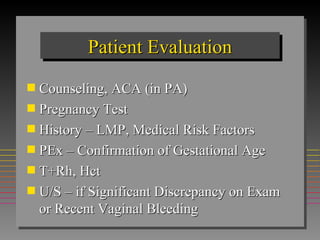
Patient Evaluation Counseling, ACA (in PA) Pregnancy Test History – LMP, Medical Risk Factors PEx – Confirmation of Gestational Age T+Rh, Hct U/S – if Significant Discrepancy on Exam or Recent Vaginal Bleeding
Techniques ≤  14 Weeks: –  Suction Curettage –  Medical Abortion  (≤  56 days LMP) 14-24 Weeks and Beyond: –  Dilatation and Evacuation (D+E) –  Intact D+E (“D+X”) –  Labor Induction Methods (Prostaglandins) –  Amnioinfusion (HS, Urea, Prostaglandins)
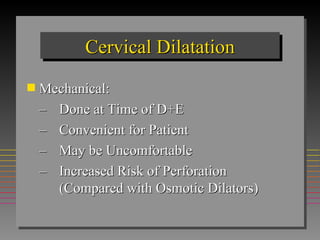
Cervical Dilatation Mechanical:  –  Done at Time of D+E –  Convenient for Patient  –  May be Uncomfortable –  Increased Risk of Perforation  (Compared with Osmotic Dilators)
Cervical Dilatation Osmotic Dilators (e.g. Laminaria) – Increased Time, Inconvenience  – Less Pain, Decreases Perforation Risk Examples:  – Laminaria japonicum, L. digitatum  – Dilapan  – Lamicel  Synthetic
Suction Curettage Office, Clinic or Hospital Setting Local (Paracervical Block) or IV Sedation General Anaesthesia Increases Risk Prophylactic Doxycycline Decreases Endometriitis Risk Rigid or Osmotic Dilators Used “ No-Touch” Technique
Dilatation & Evacuation Avoid Mechanical Dilatation if Feasible Requires Additional Experience and Training Safer than Amnioinfusion in Most Cases when Performed by Experienced Operator Less Emotionally Traumatic for Most Patients (Compared With Labor Induction)
Additional 2nd / 3rd Trimester Methods Labor Induction – PGE Vaginal Suppositories  – Amnioinfusion (Hypertonic Saline,  Urea, Prostaglandins)  – Oxytocin D+X Hysterotomy (Outmoded – Should be Abandoned)
Complications Bleeding Infection Retained POC “ Missed Abortion” Perforation – low risk, high risk variants Hematometra (“postabortal,”  or “re-do” syndrome) Undiagnosed Ectopic Pregnancy
Postabortion Management Bleeding May Occur for 2 Days –2 Weeks Appropriate Contraception May Commence Immediately or Soon Thereafter Significant Pain, Bleeding or Fevers Should Prompt Evaluation Patients Should Follow-up in 2-4 Weeks (UCG May Still Be Positive) If Tissue Sent for Histology – Check Report
Summary Surgical Abortion Is a Safe Procedure Complications,While Infrequent, May Be Serious Since  Roe , There Has Been a Dramatic Reduction in Maternal Mortality From Illegal Abortion Procedures The Need for Abortion May Be Reduced by Appropriate Contraception

DnC

  • 1.
    Surgical Abortion DavidBlair Toub, M.D. Dept. of Obstetrics and Gynecology Pennsylvania Hospital
  • 2.
    Introduction 1973: Roe v. Wade ; Trimester Approach Number of Abortions Stable or Decreasing ~ 1/3 of Women 15-44 Undergo Abortion Abortion 10-11x Safer than Continuing Pregnancy, 2x Safer than PCN Injection 91% 1st TM, 9% 2nd TM, .01% 3rd TM 1965: Illegal Ab = 17% of Maternal Deaths
  • 3.
    Introduction Russia Number of abortions: 1996 - 2 469 000 2000 - 1 962 000 Number of mini-abortion: 1996 - 601 346 2000 - 493 942
  • 4.
    Patient Evaluation Counseling,ACA (in PA) Pregnancy Test History – LMP, Medical Risk Factors PEx – Confirmation of Gestational Age T+Rh, Hct U/S – if Significant Discrepancy on Exam or Recent Vaginal Bleeding
  • 5.
    Techniques ≤ 14 Weeks: – Suction Curettage – Medical Abortion (≤ 56 days LMP) 14-24 Weeks and Beyond: – Dilatation and Evacuation (D+E) – Intact D+E (“D+X”) – Labor Induction Methods (Prostaglandins) – Amnioinfusion (HS, Urea, Prostaglandins)
  • 6.
    Cervical Dilatation Mechanical: – Done at Time of D+E – Convenient for Patient – May be Uncomfortable – Increased Risk of Perforation (Compared with Osmotic Dilators)
  • 7.
    Cervical Dilatation OsmoticDilators (e.g. Laminaria) – Increased Time, Inconvenience – Less Pain, Decreases Perforation Risk Examples: – Laminaria japonicum, L. digitatum – Dilapan – Lamicel Synthetic
  • 8.
    Suction Curettage Office,Clinic or Hospital Setting Local (Paracervical Block) or IV Sedation General Anaesthesia Increases Risk Prophylactic Doxycycline Decreases Endometriitis Risk Rigid or Osmotic Dilators Used “ No-Touch” Technique
  • 9.
    Dilatation & EvacuationAvoid Mechanical Dilatation if Feasible Requires Additional Experience and Training Safer than Amnioinfusion in Most Cases when Performed by Experienced Operator Less Emotionally Traumatic for Most Patients (Compared With Labor Induction)
  • 10.
    Additional 2nd /3rd Trimester Methods Labor Induction – PGE Vaginal Suppositories – Amnioinfusion (Hypertonic Saline, Urea, Prostaglandins) – Oxytocin D+X Hysterotomy (Outmoded – Should be Abandoned)
  • 11.
    Complications Bleeding InfectionRetained POC “ Missed Abortion” Perforation – low risk, high risk variants Hematometra (“postabortal,” or “re-do” syndrome) Undiagnosed Ectopic Pregnancy
  • 12.
    Postabortion Management BleedingMay Occur for 2 Days –2 Weeks Appropriate Contraception May Commence Immediately or Soon Thereafter Significant Pain, Bleeding or Fevers Should Prompt Evaluation Patients Should Follow-up in 2-4 Weeks (UCG May Still Be Positive) If Tissue Sent for Histology – Check Report
  • 13.
    Summary Surgical AbortionIs a Safe Procedure Complications,While Infrequent, May Be Serious Since Roe , There Has Been a Dramatic Reduction in Maternal Mortality From Illegal Abortion Procedures The Need for Abortion May Be Reduced by Appropriate Contraception