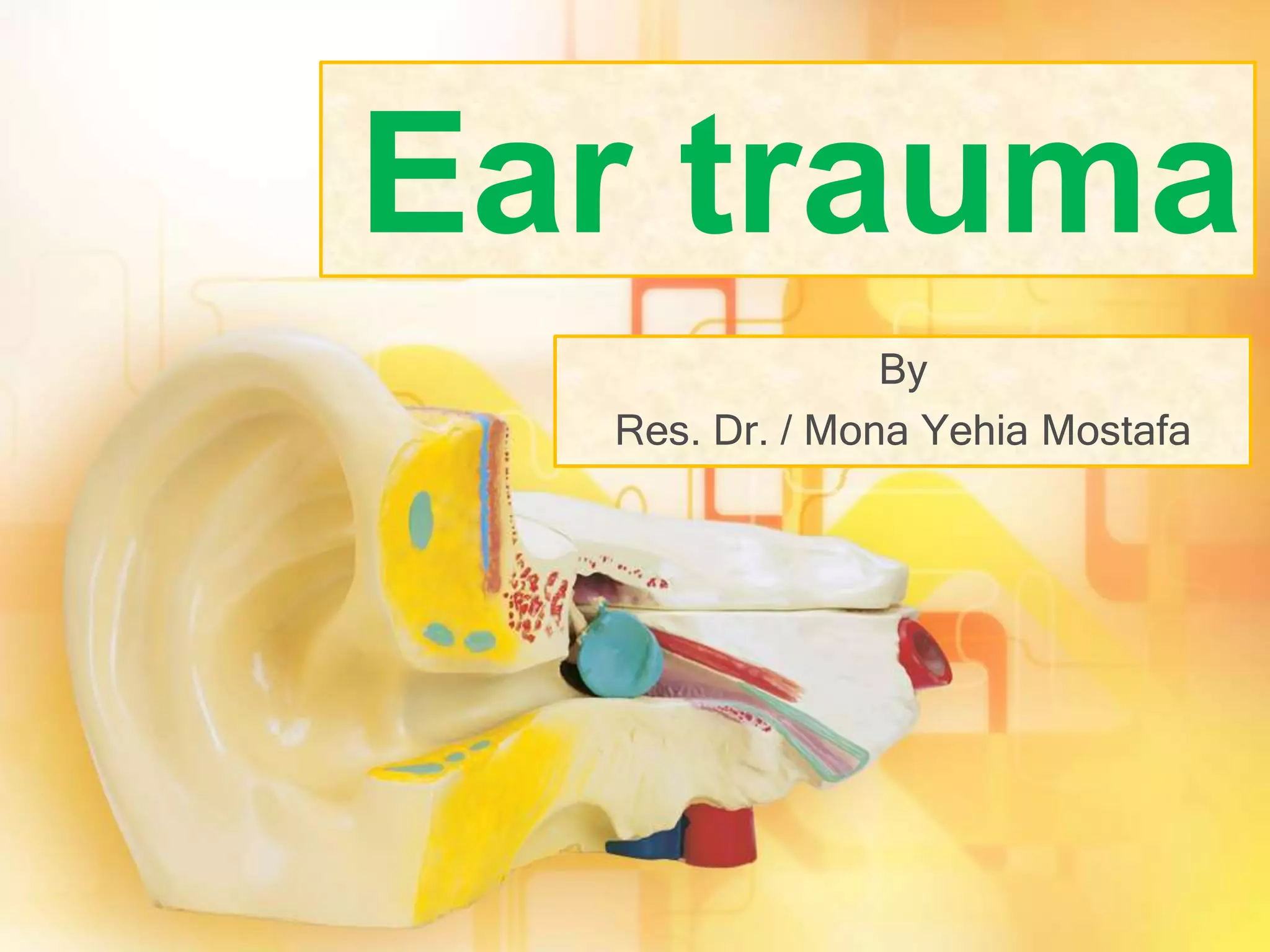
Ear trauma
By
Res. Dr. / Mona Yehia Mostafa
Ear trauma is a common problem in
emergency medicine and may occur
as an outcome of a number of
mechanisms, including exposure to
loud noises
Blast injuries,
chemical exposures,
thermal injuries,
and penetrating or blunt traumas
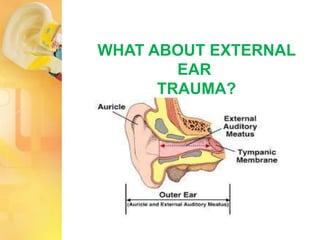
WHAT ABOUT EXTERNAL
EAR
TRAUMA?
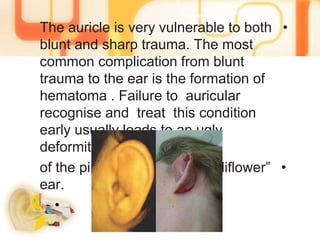
•The auricle is very vulnerable to both
blunt and sharp trauma. The most
common complication from blunt
trauma to the ear is the formation of
auricularhematoma . Failure to
recognise and treat this condition
early usually leads to an ugly
deformity
•of the pinna known as a “cauliflower”
ear.
•
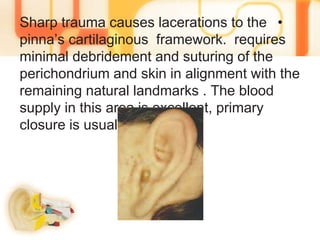
•Sharp trauma causes lacerations to the
pinna’s cartilaginous framework. requires
minimal debridement and suturing of the
perichondrium and skin in alignment with the
remaining natural landmarks . The blood
supply in this area is excellent, primary
closure is usually successful
•The most common trauma to the ear in
children is caused by foreign body (FB)
impaction and from unsuccessful
attempts at removal.
•Types of Soft or round FBs may be
removed by gently inserting an ear
curette or hook and rolling it outward
•sharp or irregular FBs, grasping and
removing them with fine
•alligator forceps remains the best
treatment
•For the correct syringing of impacted wax
•Exposure to extreme outer temperature
produce degrees of thermal injury. First
degree burns and frostbites characterised
by redness and swelling, and highly
sensitive to touch.
•Second-degree thermal injury
accompanied by
•blister formation due to extravasated
extracellular
•fluid.
•Extreme hot or cold causes irreversible
damage to the underlying cartilage,
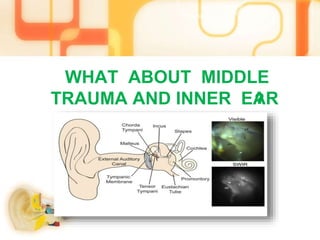
WHAT ABOUT MIDDLE
AND INNER EARTRAUMA
•Rapid changes of external pressure
(airplane flight, diving, or an explosion)
otic barotrauma may occur. Rupture of
•fine blood vessels in the middle ear
causes a collection Of blood on the inner
surface of the TM or middle ear space,
known as the hemotympanum.
•Prophylaxis of barotrauma during airplane
flight depends on proper eustachian tube
function. This can be provided by
repeatedly performing Valsalva
manoeuvres, the use of topical nasal and
•Indirect trauma to the ear due to head
injury, with or without skull fracture, may
cause varying degrees of injury to middle
•ear structures. A TM hemorrhage may
obscure ossicular fractures or disrupt the
ossicular chain .
•Cholesteatoma within the middle ear and
mastoid cavity may occur and are
potentially destructive lesions that can
erode and destroy important structures of
the middle ear, temporal bone, and skull
base.
•Perilymph fistula Head trauma is the
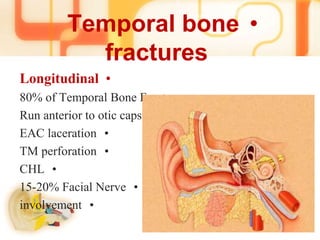
•Temporal bone
fractures
•Longitudinal
•80% of Temporal Bone Fractures
•Run anterior to otic capsule
•EAC laceration
•TM perforation
•CHL
•15-20% Facial Nerve
•involvement
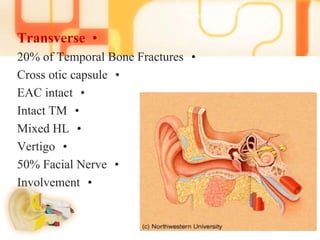
•Transverse
•20% of Temporal Bone Fractures
•Cross otic capsule
•EAC intact
•Intact TM
•Mixed HL
•Vertigo
•50% Facial Nerve
•Involvement
THANK
YOU

Ear trauma

  • 1.
    Ear trauma By Res. Dr./ Mona Yehia Mostafa
  • 2.
    Ear trauma isa common problem in emergency medicine and may occur as an outcome of a number of mechanisms, including exposure to loud noises Blast injuries, chemical exposures, thermal injuries, and penetrating or blunt traumas
  • 3.
  • 4.
    •The auricle isvery vulnerable to both blunt and sharp trauma. The most common complication from blunt trauma to the ear is the formation of auricularhematoma . Failure to recognise and treat this condition early usually leads to an ugly deformity •of the pinna known as a “cauliflower” ear. •
  • 5.
    •Sharp trauma causeslacerations to the pinna’s cartilaginous framework. requires minimal debridement and suturing of the perichondrium and skin in alignment with the remaining natural landmarks . The blood supply in this area is excellent, primary closure is usually successful
  • 6.
    •The most commontrauma to the ear in children is caused by foreign body (FB) impaction and from unsuccessful attempts at removal. •Types of Soft or round FBs may be removed by gently inserting an ear curette or hook and rolling it outward •sharp or irregular FBs, grasping and removing them with fine •alligator forceps remains the best treatment •For the correct syringing of impacted wax
  • 7.
    •Exposure to extremeouter temperature produce degrees of thermal injury. First degree burns and frostbites characterised by redness and swelling, and highly sensitive to touch. •Second-degree thermal injury accompanied by •blister formation due to extravasated extracellular •fluid. •Extreme hot or cold causes irreversible damage to the underlying cartilage,
  • 8.
    WHAT ABOUT MIDDLE ANDINNER EARTRAUMA
  • 9.
    •Rapid changes ofexternal pressure (airplane flight, diving, or an explosion) otic barotrauma may occur. Rupture of •fine blood vessels in the middle ear causes a collection Of blood on the inner surface of the TM or middle ear space, known as the hemotympanum. •Prophylaxis of barotrauma during airplane flight depends on proper eustachian tube function. This can be provided by repeatedly performing Valsalva manoeuvres, the use of topical nasal and
  • 10.
    •Indirect trauma tothe ear due to head injury, with or without skull fracture, may cause varying degrees of injury to middle •ear structures. A TM hemorrhage may obscure ossicular fractures or disrupt the ossicular chain . •Cholesteatoma within the middle ear and mastoid cavity may occur and are potentially destructive lesions that can erode and destroy important structures of the middle ear, temporal bone, and skull base. •Perilymph fistula Head trauma is the
  • 11.
    •Temporal bone fractures •Longitudinal •80% ofTemporal Bone Fractures •Run anterior to otic capsule •EAC laceration •TM perforation •CHL •15-20% Facial Nerve •involvement
  • 12.
    •Transverse •20% of TemporalBone Fractures •Cross otic capsule •EAC intact •Intact TM •Mixed HL •Vertigo •50% Facial Nerve •Involvement
  • 13.