Contemporary Use of the Pessary Indications - Fitting Instructions Milex Products, Inc. Chicago, Illinois 60634-1403 Copyright August 2002  All Rights Reserved
Outline Historical perspective Prevalence of prolapse Staging Types of pessaries Practical care of the pessary
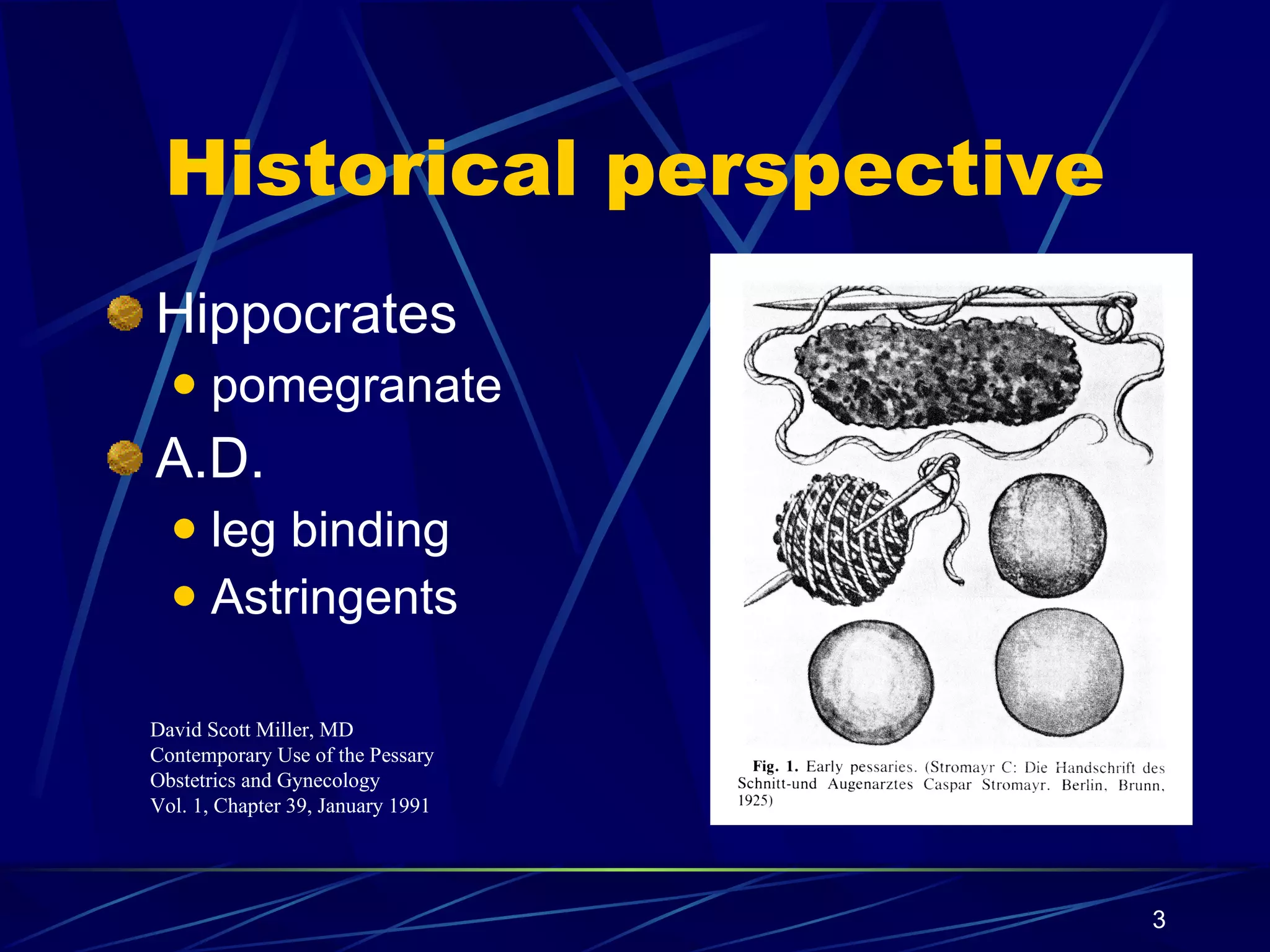
Historical perspective Hippocrates pomegranate A.D. leg binding  Astringents David Scott Miller, MD Contemporary Use of the Pessary Obstetrics and Gynecology Vol. 1, Chapter 39, January 1991
Historical perspective 1500’s vaginal hysterectomy de Carpi--tied string around prolapsed uterus 1800’s uterine malposition Hodge Smith Risser
Uses of Pessaries Genital Prolapse Uterine Vaginal Rectal Bladder Urinary Stress Incontinence Mixed Incontinence Cervical Incompetence Retrodisplacement
Diagnostic Use of Pessaries Dynamic testing – illustrates urethral and bladder function Predictor of Bladder Function After Pelvic Surgery??? Linda Brubaker, Rush Medical College Now Professor and Fellowship Director Female Pelvic Medicine and Reconstructive Surgery Loyola University Medical Center, Chicago, IL) Poster Presentation, October 1996, New Orleans
Types of Prolapse Uterine Vaginal Cystocele Rectocele Enterocele
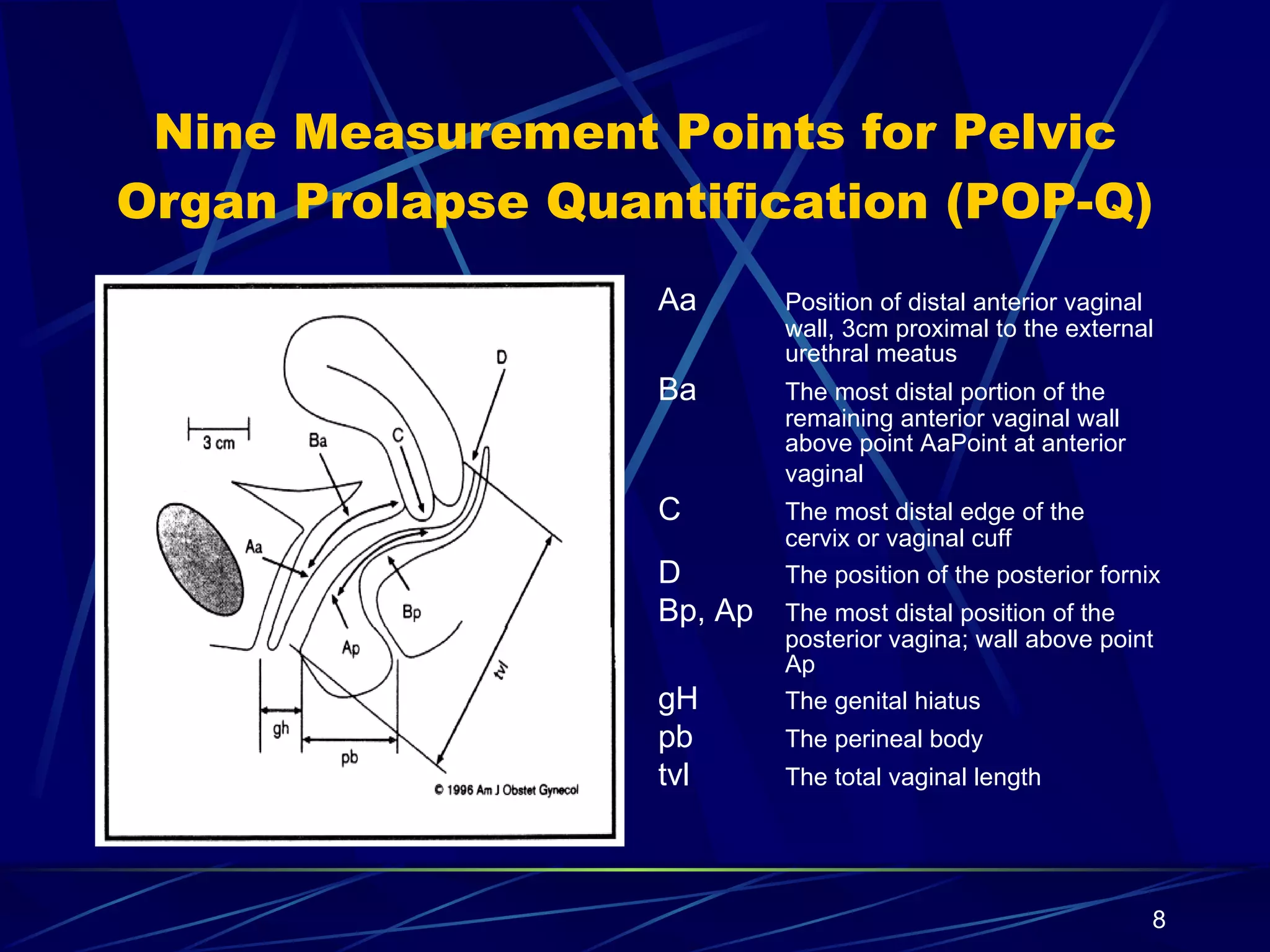
Nine Measurement Points for Pelvic Organ Prolapse Quantification (POP-Q) Aa Position of distal anterior vaginal  wall, 3cm proximal to the external  urethral meatus Ba The most distal portion of the  remaining anterior vaginal wall  above point AaPoint at anterior  vaginal   C  The most distal edge of the  cervix or vaginal cuff D  The position of the posterior fornix Bp, Ap The most distal position of the  posterior vagina; wall above point  Ap gH The genital hiatus pb The perineal body tvl The total vaginal length
Ordinal Staging  of Pelvic Organ Prolapse tvl=total vaginal length Maximal prolapse point protrudes the length of the vagina (2 cm) beyond the hymen. Complete eversion of the vagina +/- cervix ([value >/= + [tvl-2]) IV Maximal prolapse point protrudes beyond 1 cm above hymen but less than 2 cm less than the total vaginal length. (value >+1 but <+(tvl-2)) III Maximal prolapse point protrudes to or beyond 1 cm above hymen but not more than 1 cm below hymen (value >-1 to <+1) II All points are more than 1 cm above hymen (value<-1) I No prolapse: Apex of cervix is at a position above the hymen that equals to or is within +/- 2 cm of vaginal length (value </= (tvl-2)) No prolapse: All points are 3 cm above the hymen (value=-3) 0 Leading Edge of Prolapse: Location of Apex of Vagina or Cervix (Value of Point C or D) Leading edge of Prolapse: Location of the Most Distal Point of the Anterior or Posterior Vaginal Wall (any points Aa, Ap, Ba, Bp) Stage
Vaginal Prolapse Anterior or Posterior Wall Prolapse Results in: Cystocele Rectocele Enterocele
Cystocele Prolapse of Bladder and Anterior Vaginal Wall Incomplete Emptying of Bladder Can Cause UTI
Rectocele Prolapse of Rectum and Posterior Vaginal Wall Incomplete Rectal Emptying
Enterocele Herniation of Small Bowel into Upper Posterior Vaginal Wall
Symptoms of Prolapse 1 st  and 2 nd  Degree Lower back pain Pelvic Pressure and Heaviness Difficulty Controlling Urine and Stool Urinary Urgency
Symptoms of Prolapse 3 rd  and 4 th  Degree Prolapse Blockage of Bladder Neck Urinary Retention Increased Urinary Stress Incontinence Palpable Prolapse Incomplete Emptying of Bowels
Risk Factors - Prolapse Childbirth Repetitive Bearing Down Heavy Lifting or Coughing Family History of Prolapse Hysterectomy Pelvic Surgery or Trauma Menopause – Endopelvic facia failure Obesity
Advantages of Silicone Pessaries Silicone has longer use-Life Silicone can be autoclaved Silicone does not absorb secretions and odors Silicone is an inert material
Uses of Pessaries Uterine Prolapse Procidentia Cystocele, Rectocele, Urethrocele Urinary Stress Incontinence Incompetent Cervix Retroverted Uterus
Pessaries for Uterine Prolapse Ring with or without Support Shaatz Regula 1 st  and 2 nd  Degree Prolapse
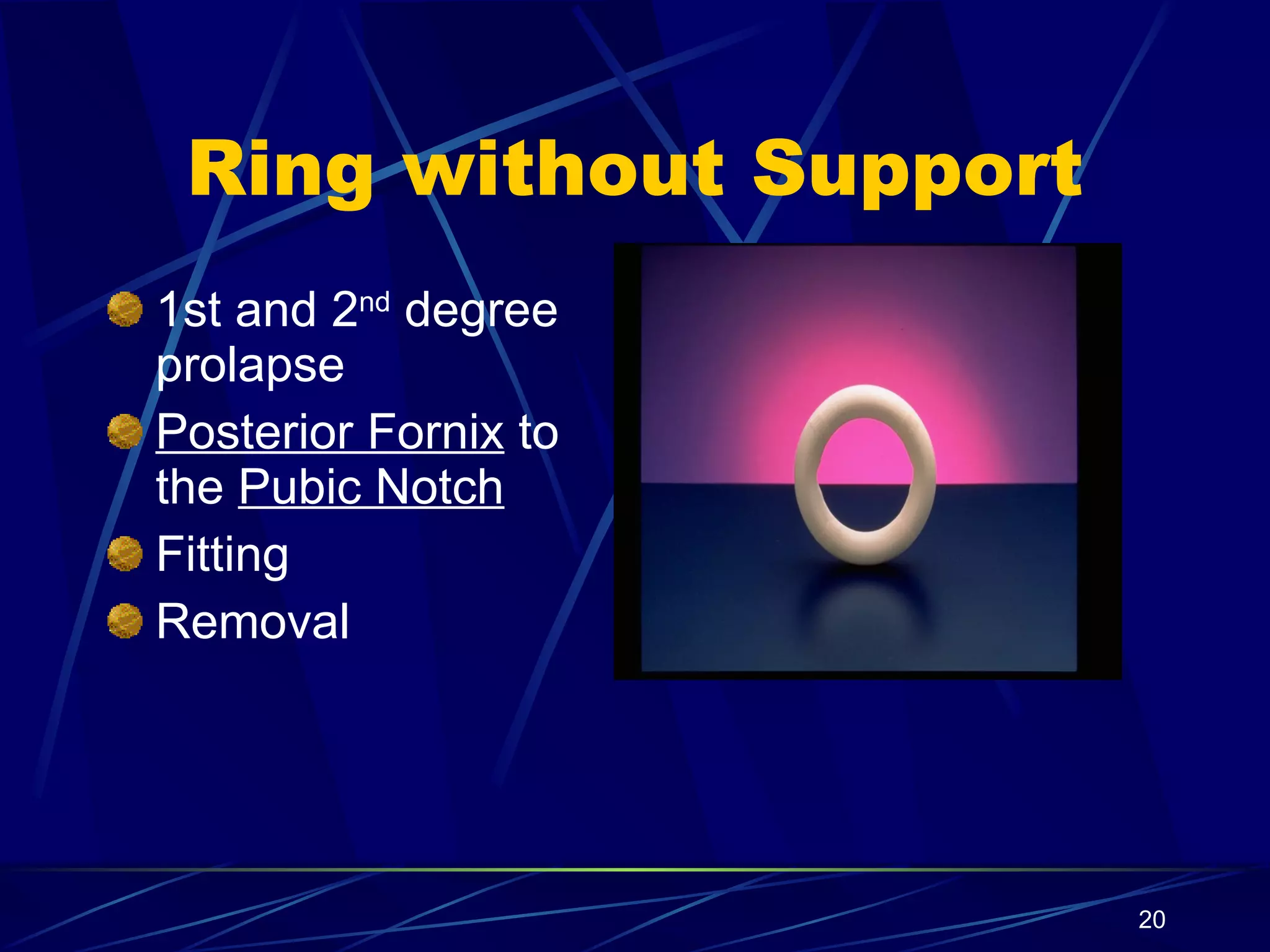
Ring without Support 1st and 2 nd  degree prolapse Posterior Fornix  to the  Pubic Notch Fitting Removal
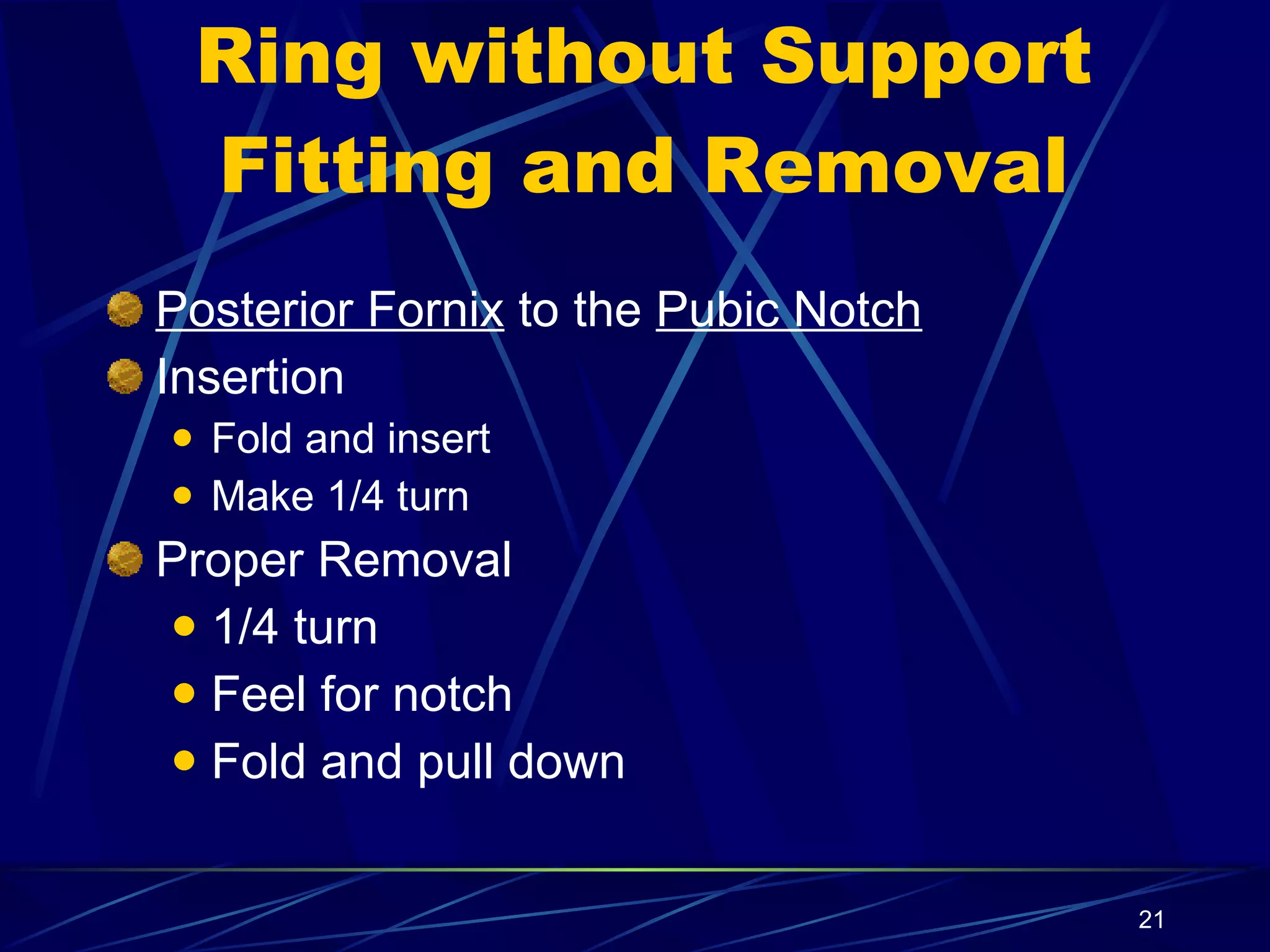
Ring without Support Fitting and Removal Posterior Fornix  to the  Pubic Notch   Insertion Fold and insert Make 1/4 turn Proper Removal 1/4 turn Feel for notch Fold and pull down
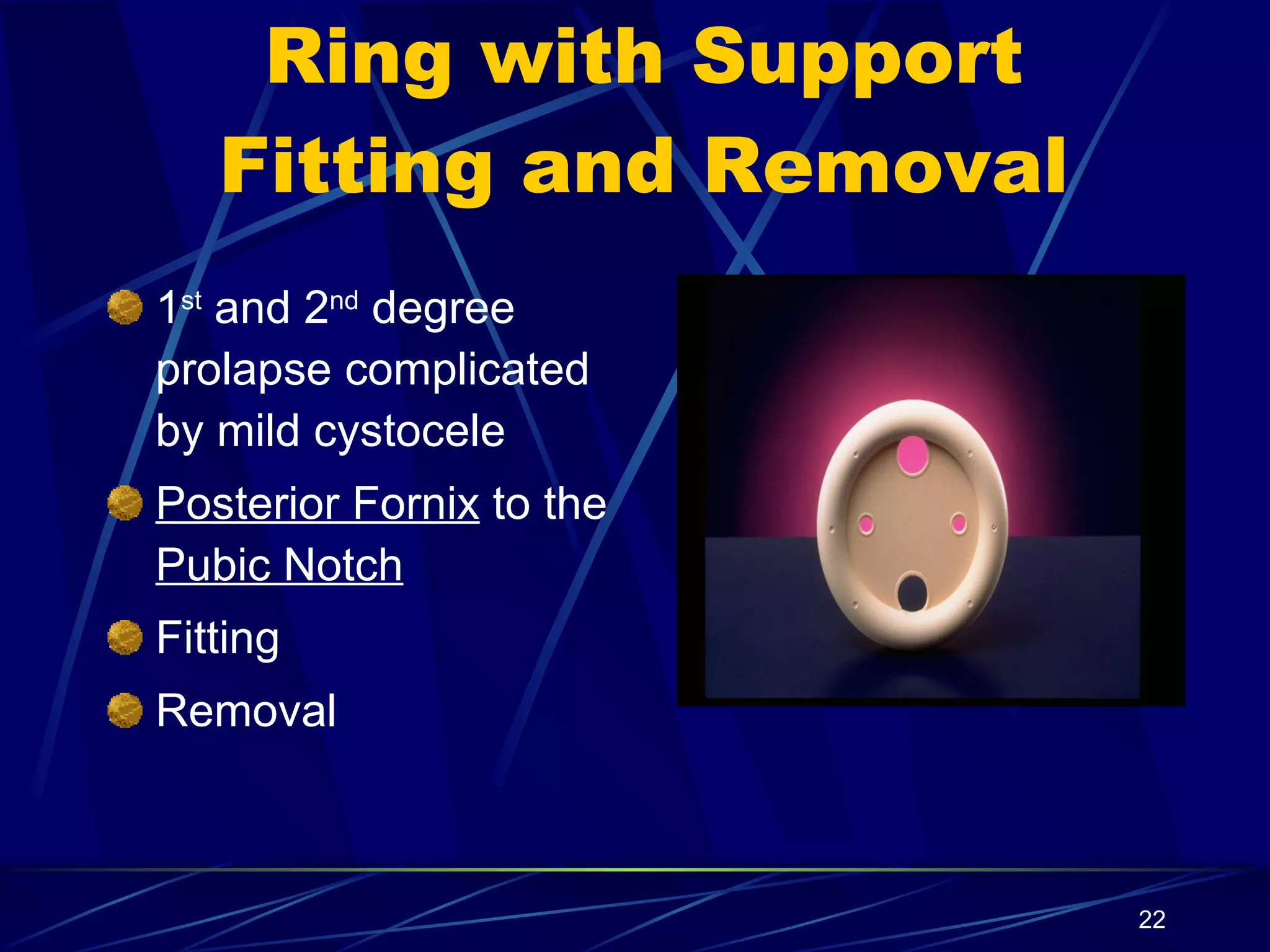
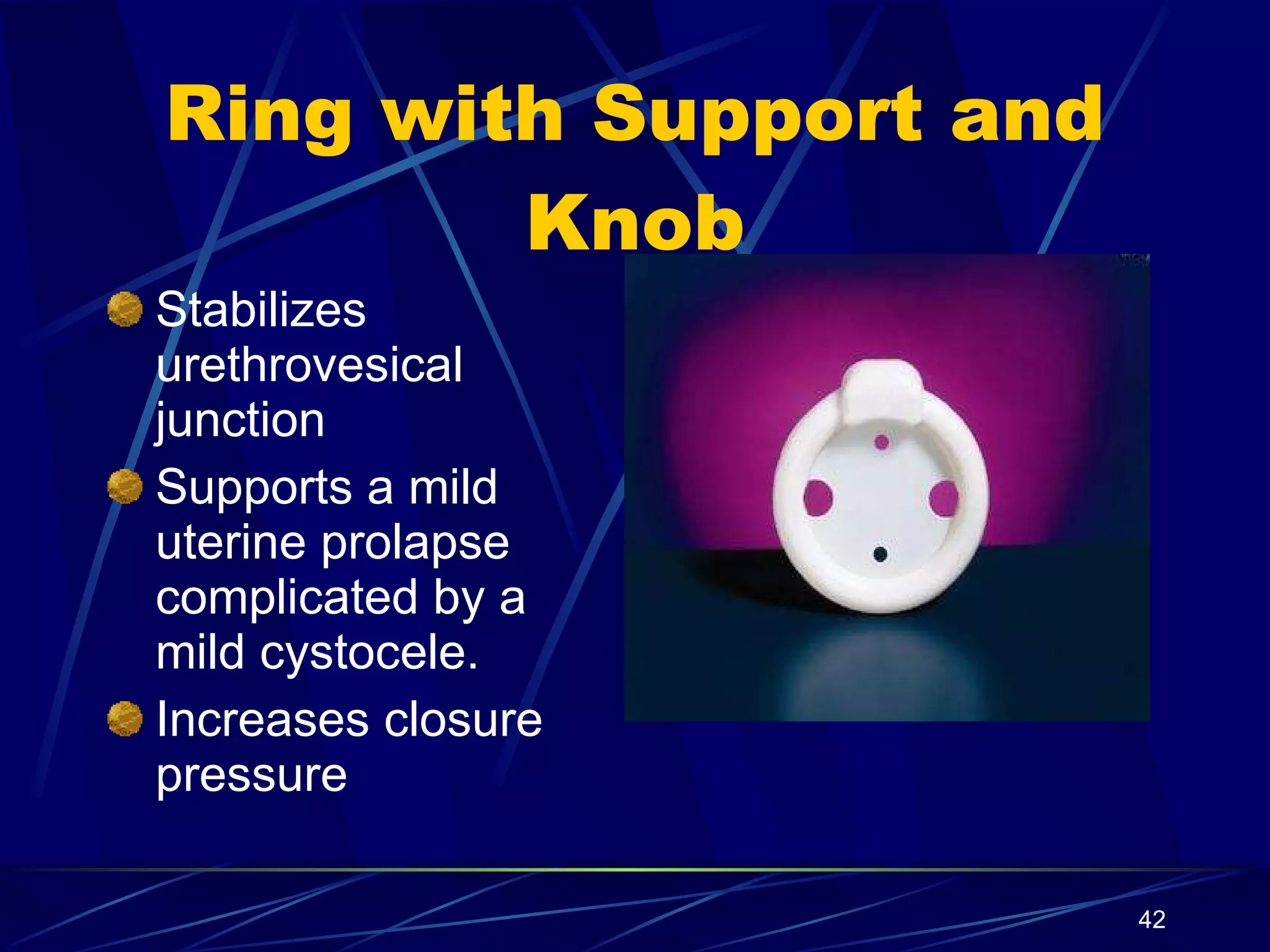
Ring with Support Fitting and Removal 1 st  and 2 nd  degree prolapse complicated by mild cystocele Posterior Fornix  to the  Pubic Notch Fitting Removal
Ring with Support Fitting and Removal Posterior Fornix  to the  Pubic Notch   Insertion Fold and insert Make 1/4 turn Removal 1/4 turn feel for notch and fold and pull down
Shaatz Fits between the Levator Ani Muscles   Fold and insert  Removal - pull down with exam finger and remove
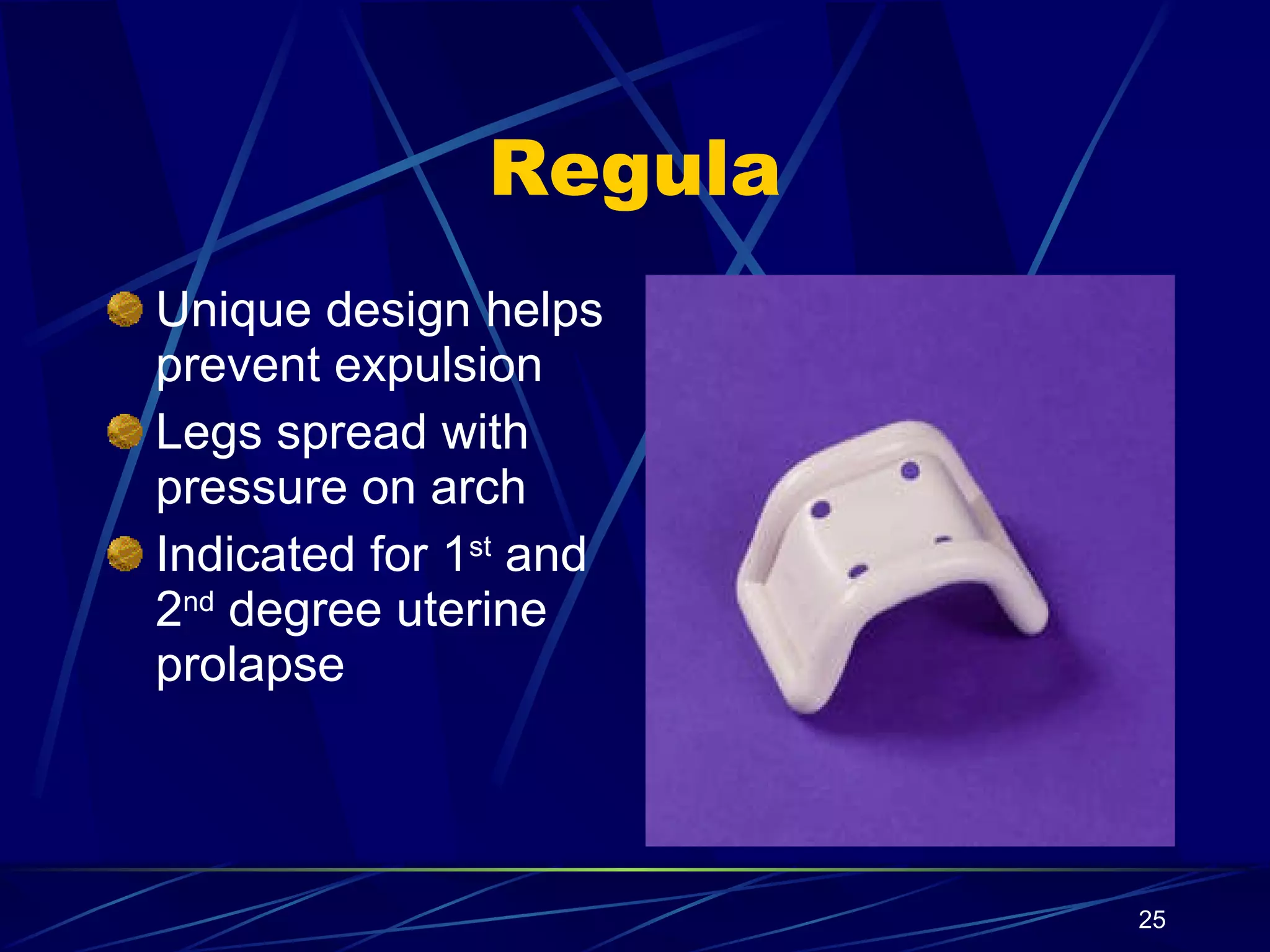
Regula Unique design helps prevent expulsion Legs spread with pressure on arch Indicated for 1 st  and 2 nd  degree uterine prolapse
Regula Fitting and Removal Fold pessary by bringing heels together to insert and remove Arch is positioned so prolapse rests  behind  arch Flanging of heels helps prevent expulsion
Pessaries for Uterine Prolapse 3 rd  and Complete Procidentia Donut Cube Gellhorn Inflatoball
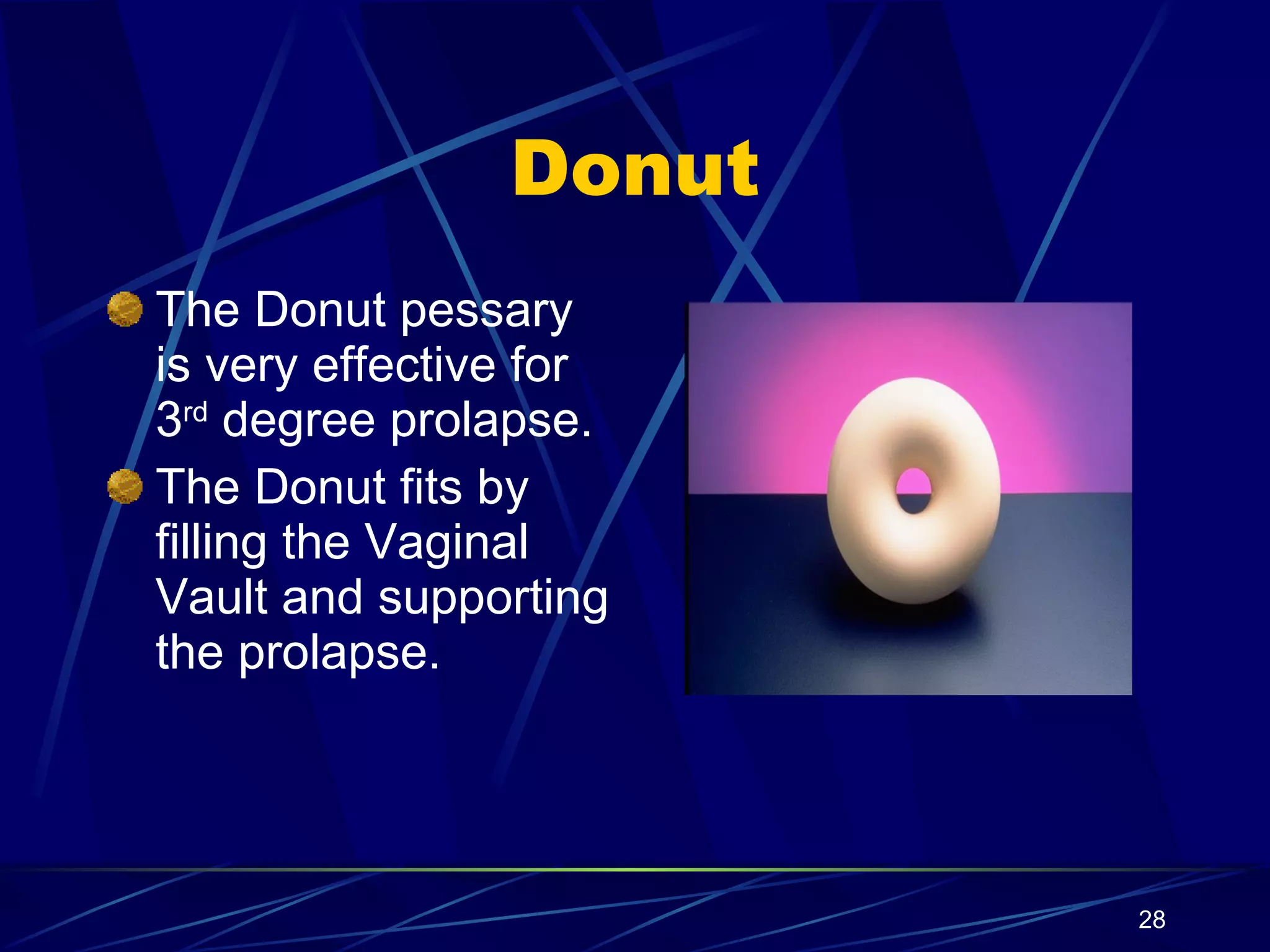
Donut The Donut pessary is very effective for 3 rd  degree prolapse. The Donut fits by filling the Vaginal Vault and supporting the prolapse.
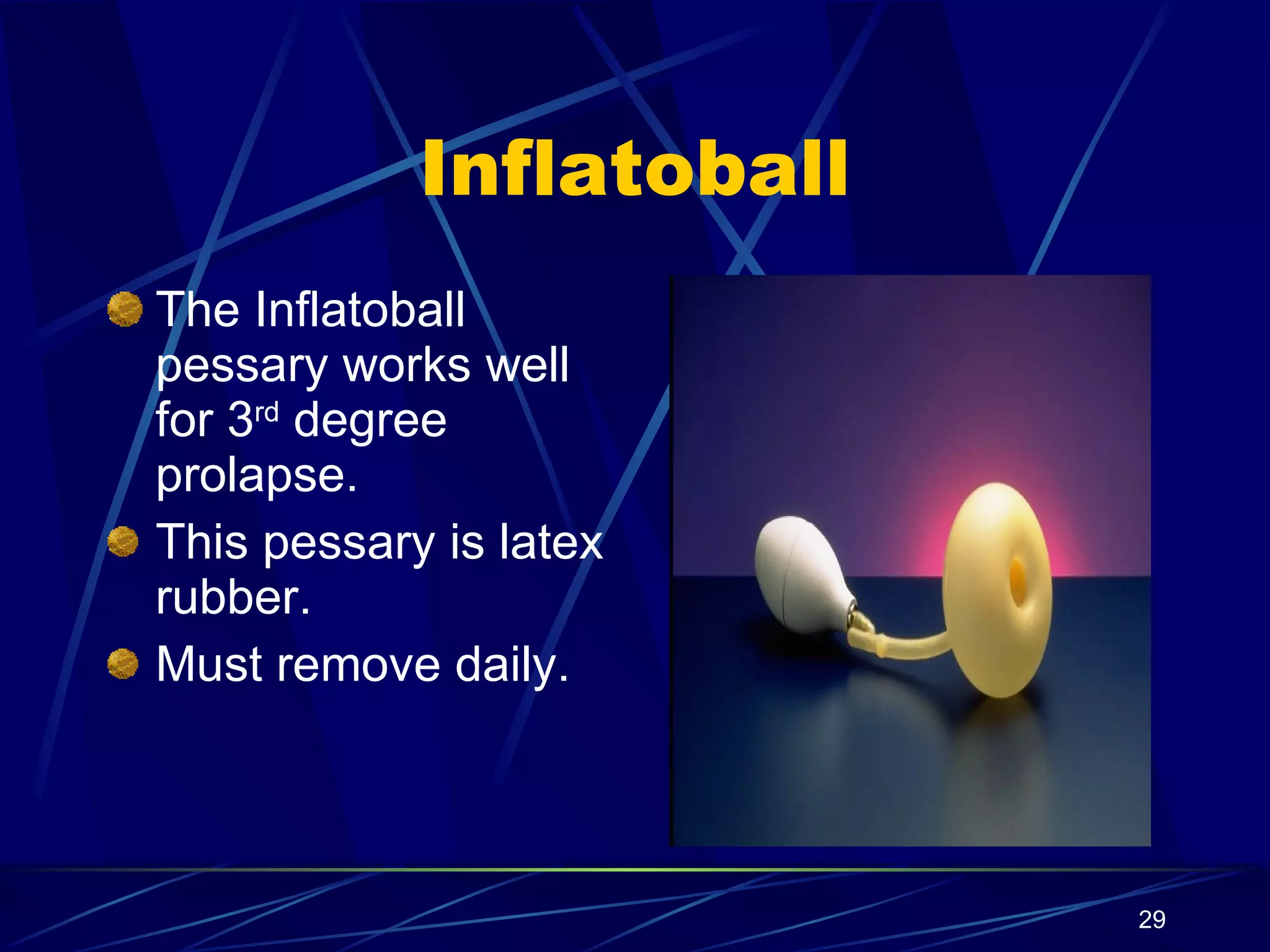
Inflatoball The Inflatoball pessary works well for 3 rd  degree prolapse. This pessary is latex rubber. Must remove daily.
Inflatoball Fitting and Removal Squeeze and insert Pump until firm Over inflation causes bulge Secure tubing inside vaginal vault
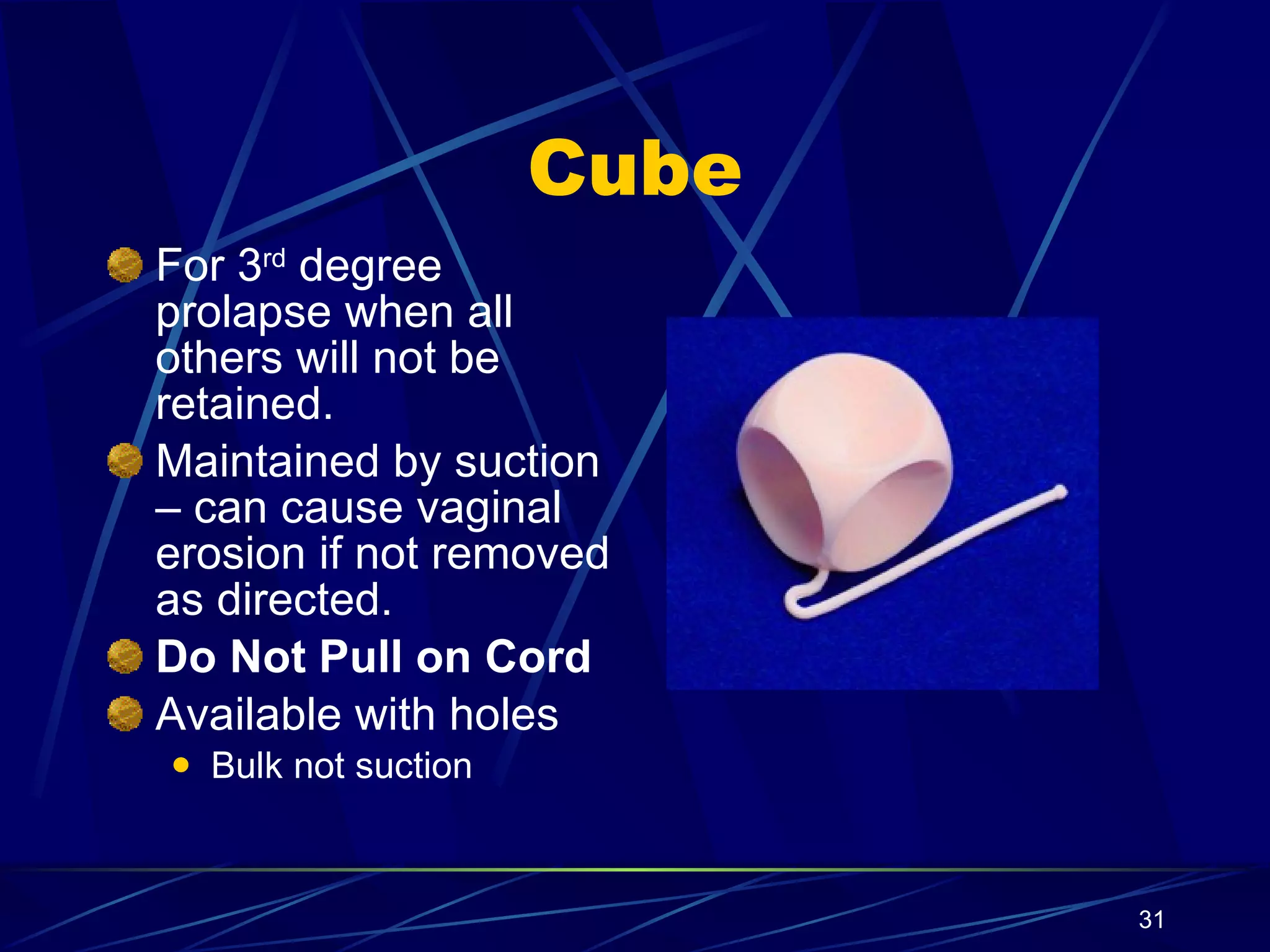
Cube For 3 rd  degree prolapse when all others will not be retained. Maintained by suction – can cause vaginal erosion if not removed as directed. Do Not Pull on Cord Available with holes Bulk not suction
Cube Fitting and Removal Squeeze and insert Break suction Compress to remove Remove daily.  May cause vaginal erosion if not removed as directed.
Tandem-Cube Last Resort
Tandem Cube Fitting and Removal Trimo San on leading edge Larger size pessary inserted first Held by suction Remove daily.  May cause vaginal erosion if not removed as directed.
Gellhorn Three Designs: Silicone Flexible Silicone 95% Rigid Levator Ani Muscles Cervix rests behind disk portion of pessary
Gellhorn Fitting and Removal Trimo San on leading edge Hold parallel to introitus Barber pole twist  Available with short stem Approximately ½ inch shorter
Pessaries   Urinary Stress Incontinence Incontinence Ring Ring with (and without) Support and Knob Incontinence Dish with and without Support Hodge with and without Support Hodge with and without Support and Knob Gehrung with Knob Urinary Stress Incontinence and/or 1 st  and 2 nd  Degree Prolapse
A Word about Mixed Incontinence Best treated by first correcting the anatomical deficiencies causing the SUI. The same anatomic deficiencies causing the SUI are often creating the urgency too. Treat the SUI first – 70 percent cure rate for both SUI and Urge. Rodney Appell, MD Professor of Female Urology and Void Dysfunction,  Baylor College of Medicine Surgical Therapies Favored by Urologists – Sling American Urology Association Annual Meeting, June 2001 Anaheim, Ca
Why Treat Mixed Incontinence with Pessaries? Pessary is good diagnostic tool – urodynamic studies costly. Incontinence pessaries  manually support  and stabilize the urethrovesical junction which the vaginal sling repair does surgically Limiting the use of drugs for mixed incontinence saves the patient money and avoids side effects (dry mouth, constipation, etc.) and serious drug interactions.
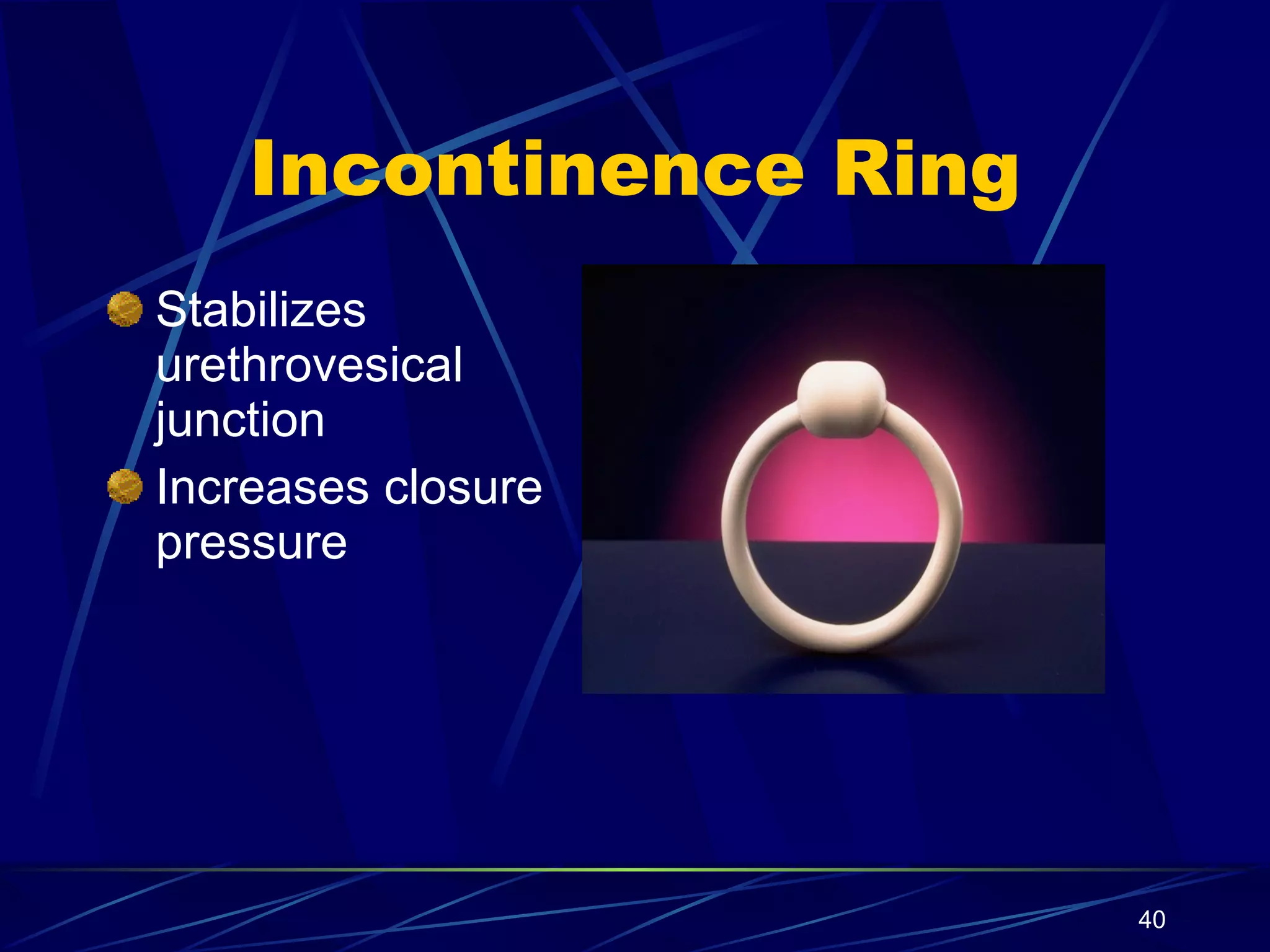
Incontinence Ring Stabilizes urethrovesical junction Increases closure pressure
Incontinence Ring Fitting and Removal Posterior Fornix  to the  Pubic Notch. This pessary is effective for a patient who may have incontinence during exercise.
Ring with Support and Knob Stabilizes urethrovesical junction Supports a mild uterine prolapse complicated by a mild cystocele. Increases closure pressure
Incontinence Dish Stabilizes urethrovesical junction Increases closure pressure Stress Incontinence. Mild Prolapse .
Incontinence Dish Fitting and Removal Posterior Fornix  to the  Pubic Notch.
Incontinence Dish  with Support Urinary Incontinence with 1 st  to 2 nd  degree prolapse complicated by a mild cystocele Increases closure pressure Stabilizes urethrovesical junction
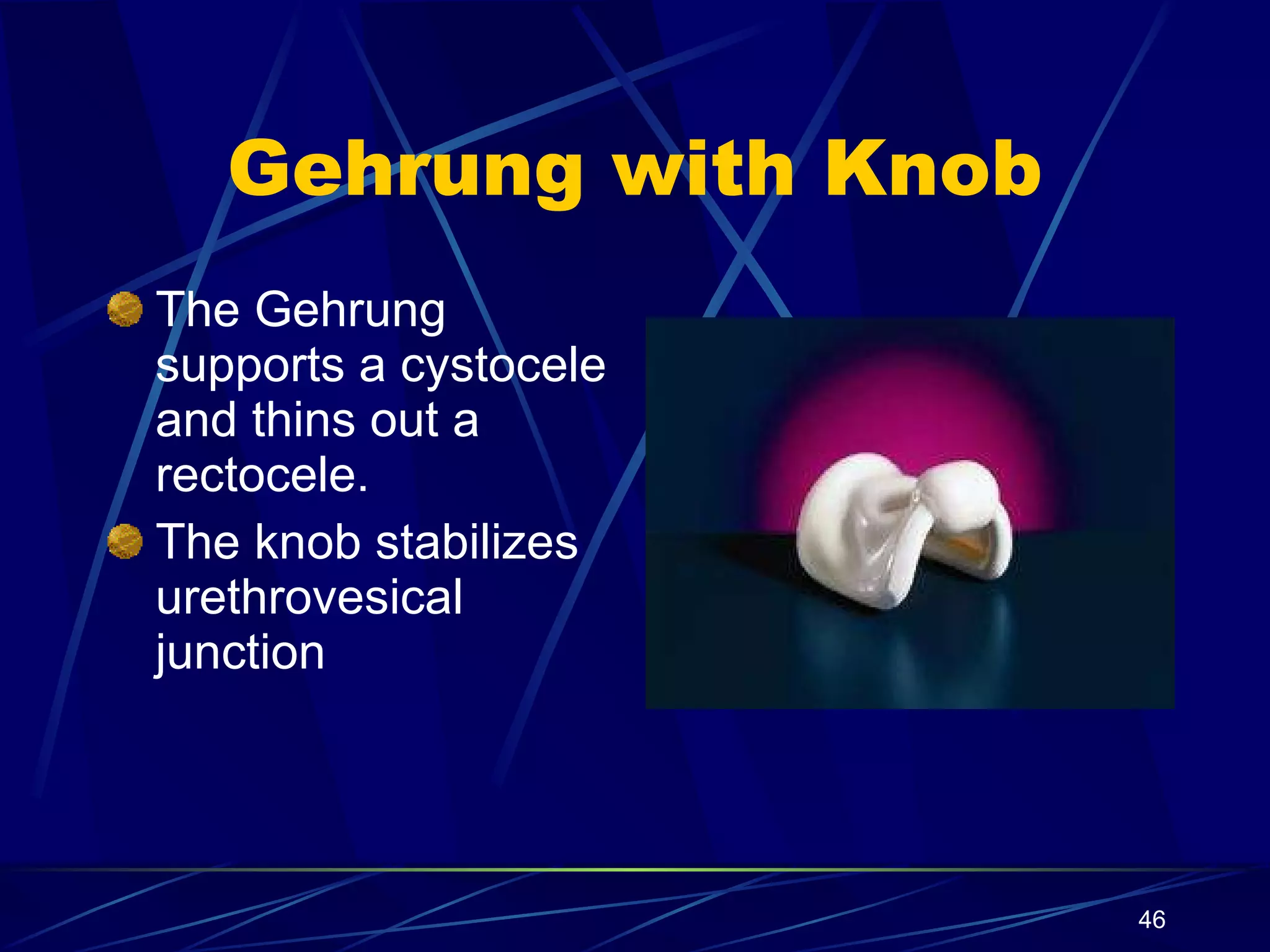
Gehrung with Knob The Gehrung supports a cystocele and thins out a rectocele.  The knob stabilizes urethrovesical junction
Pessaries   Cystocele and Rectocele Gehrung Gehrung with Knob Hodge with Support Ring with Support and Knob Ring with Support Incontinence Dish with Support
Pessaries   Lever Pessaries Hodge with Support Hodge without Support Risser Smith Incompetent Cervix Retrodisplacement
Incompetent Cervix Lever (Hodge) pessary Secures the axis of the cervix in a posterior plane 83% successful in several studies of women at risk of premature cervical dilation Insert at 14 weeks; remove at 38 weeks Cerclage reinforcement – in conjunction with cerclage.
Other Lever Pessaries Hodge with Knob Hodge with Support and Knob Smith Risser
Lever Pessary Fitting and Removal Trimo San on leading edge Must remove before MRI or X-ray
Patient Education and Counseling Discuss Condition Risk Factors Choice of Pessary Follow-Up Care Sexual Activity Need to Change Pessary size or type Art - Not a science
Pessary Fitting Determine type of prolapse and severity Decide on pessary Digital exam to size Finger against pessary to size Have patient bear down Stand, sit, walk, use toilet Re-examine patient in erect position to check if pessary “shifts”
Pessary Follow-Up Care Return in 24 hours for 1 st  exam Return within 3 days for re-exam Return every 4-6 weeks Cube, Inflatoball – remove daily Trimo San ½ applicator 3 times in 1 st  week Twice a week thereafter
Pessaries and MRIs Remove prior to procedure Metal cord Incontinence Ring Smith  Risser Hodge – with or without Support  Hodge – with or without Support  and Knob Gehrung Gehrung with Knob Regula Ring – check for dimples  (Old Metal Style Had No Dimples)
Pessary Follow-Up Care Exam Remove Clean pessary Vaginal exam Re-insert if no contraindications
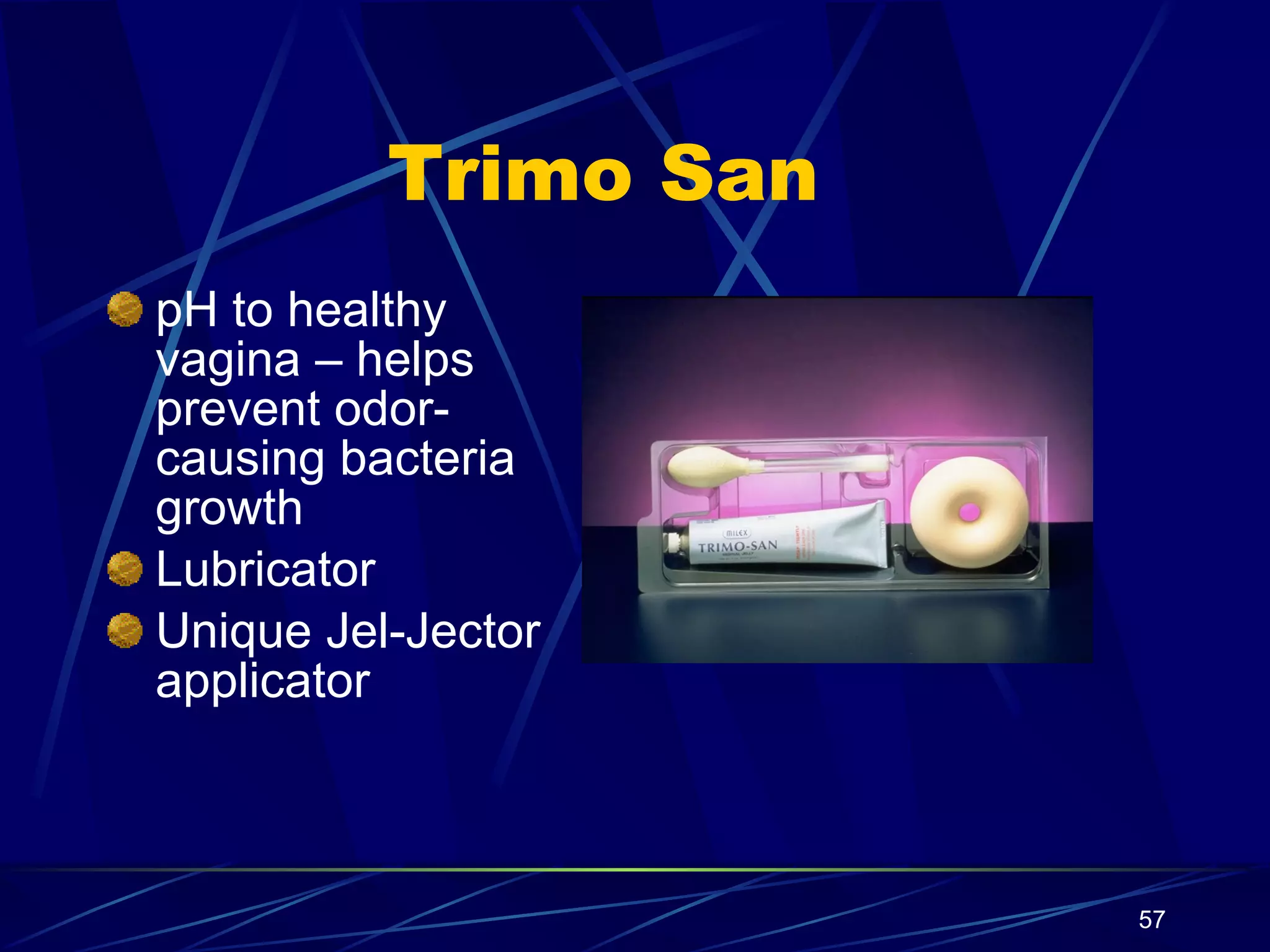
Trimo San pH to healthy vagina – helps prevent odor-causing bacteria growth Lubricator Unique Jel-Jector applicator
Reimbursement New 2001 Medicare Codes A4561 – Pessary Rubber , any type A4562 – Pessary Non-rubber, any type A4560 – Eliminated Silicone Pessary Reimbursement: Approx: $44.00 based on area of the country
Reimbursement Change in Jurisdiction Effective January 1, 2002, jurisdiction for claims processing changes from the DMERC (Durable Medical Equipment Regional Carriers) to the local Medicare intermediary (local carrier). Program Memorandum Carriers, August 22, 2001 Department of Health and Human Services Centers for Medicare and Medicaid Services

Contemporary Use of the Pessary

  • 1.
    Contemporary Use ofthe Pessary Indications - Fitting Instructions Milex Products, Inc. Chicago, Illinois 60634-1403 Copyright August 2002 All Rights Reserved
  • 2.
    Outline Historical perspectivePrevalence of prolapse Staging Types of pessaries Practical care of the pessary
  • 3.
    Historical perspective Hippocratespomegranate A.D. leg binding Astringents David Scott Miller, MD Contemporary Use of the Pessary Obstetrics and Gynecology Vol. 1, Chapter 39, January 1991
  • 4.
    Historical perspective 1500’svaginal hysterectomy de Carpi--tied string around prolapsed uterus 1800’s uterine malposition Hodge Smith Risser
  • 5.
    Uses of PessariesGenital Prolapse Uterine Vaginal Rectal Bladder Urinary Stress Incontinence Mixed Incontinence Cervical Incompetence Retrodisplacement
  • 6.
    Diagnostic Use ofPessaries Dynamic testing – illustrates urethral and bladder function Predictor of Bladder Function After Pelvic Surgery??? Linda Brubaker, Rush Medical College Now Professor and Fellowship Director Female Pelvic Medicine and Reconstructive Surgery Loyola University Medical Center, Chicago, IL) Poster Presentation, October 1996, New Orleans
  • 7.
    Types of ProlapseUterine Vaginal Cystocele Rectocele Enterocele
  • 8.
    Nine Measurement Pointsfor Pelvic Organ Prolapse Quantification (POP-Q) Aa Position of distal anterior vaginal wall, 3cm proximal to the external urethral meatus Ba The most distal portion of the remaining anterior vaginal wall above point AaPoint at anterior vaginal C The most distal edge of the cervix or vaginal cuff D The position of the posterior fornix Bp, Ap The most distal position of the posterior vagina; wall above point Ap gH The genital hiatus pb The perineal body tvl The total vaginal length
  • 9.
    Ordinal Staging of Pelvic Organ Prolapse tvl=total vaginal length Maximal prolapse point protrudes the length of the vagina (2 cm) beyond the hymen. Complete eversion of the vagina +/- cervix ([value >/= + [tvl-2]) IV Maximal prolapse point protrudes beyond 1 cm above hymen but less than 2 cm less than the total vaginal length. (value >+1 but <+(tvl-2)) III Maximal prolapse point protrudes to or beyond 1 cm above hymen but not more than 1 cm below hymen (value >-1 to <+1) II All points are more than 1 cm above hymen (value<-1) I No prolapse: Apex of cervix is at a position above the hymen that equals to or is within +/- 2 cm of vaginal length (value </= (tvl-2)) No prolapse: All points are 3 cm above the hymen (value=-3) 0 Leading Edge of Prolapse: Location of Apex of Vagina or Cervix (Value of Point C or D) Leading edge of Prolapse: Location of the Most Distal Point of the Anterior or Posterior Vaginal Wall (any points Aa, Ap, Ba, Bp) Stage
  • 10.
    Vaginal Prolapse Anterioror Posterior Wall Prolapse Results in: Cystocele Rectocele Enterocele
  • 11.
    Cystocele Prolapse ofBladder and Anterior Vaginal Wall Incomplete Emptying of Bladder Can Cause UTI
  • 12.
    Rectocele Prolapse ofRectum and Posterior Vaginal Wall Incomplete Rectal Emptying
  • 13.
    Enterocele Herniation ofSmall Bowel into Upper Posterior Vaginal Wall
  • 14.
    Symptoms of Prolapse1 st and 2 nd Degree Lower back pain Pelvic Pressure and Heaviness Difficulty Controlling Urine and Stool Urinary Urgency
  • 15.
    Symptoms of Prolapse3 rd and 4 th Degree Prolapse Blockage of Bladder Neck Urinary Retention Increased Urinary Stress Incontinence Palpable Prolapse Incomplete Emptying of Bowels
  • 16.
    Risk Factors -Prolapse Childbirth Repetitive Bearing Down Heavy Lifting or Coughing Family History of Prolapse Hysterectomy Pelvic Surgery or Trauma Menopause – Endopelvic facia failure Obesity
  • 17.
    Advantages of SiliconePessaries Silicone has longer use-Life Silicone can be autoclaved Silicone does not absorb secretions and odors Silicone is an inert material
  • 18.
    Uses of PessariesUterine Prolapse Procidentia Cystocele, Rectocele, Urethrocele Urinary Stress Incontinence Incompetent Cervix Retroverted Uterus
  • 19.
    Pessaries for UterineProlapse Ring with or without Support Shaatz Regula 1 st and 2 nd Degree Prolapse
  • 20.
    Ring without Support1st and 2 nd degree prolapse Posterior Fornix to the Pubic Notch Fitting Removal
  • 21.
    Ring without SupportFitting and Removal Posterior Fornix to the Pubic Notch Insertion Fold and insert Make 1/4 turn Proper Removal 1/4 turn Feel for notch Fold and pull down
  • 22.
    Ring with SupportFitting and Removal 1 st and 2 nd degree prolapse complicated by mild cystocele Posterior Fornix to the Pubic Notch Fitting Removal
  • 23.
    Ring with SupportFitting and Removal Posterior Fornix to the Pubic Notch Insertion Fold and insert Make 1/4 turn Removal 1/4 turn feel for notch and fold and pull down
  • 24.
    Shaatz Fits betweenthe Levator Ani Muscles Fold and insert Removal - pull down with exam finger and remove
  • 25.
    Regula Unique designhelps prevent expulsion Legs spread with pressure on arch Indicated for 1 st and 2 nd degree uterine prolapse
  • 26.
    Regula Fitting andRemoval Fold pessary by bringing heels together to insert and remove Arch is positioned so prolapse rests behind arch Flanging of heels helps prevent expulsion
  • 27.
    Pessaries for UterineProlapse 3 rd and Complete Procidentia Donut Cube Gellhorn Inflatoball
  • 28.
    Donut The Donutpessary is very effective for 3 rd degree prolapse. The Donut fits by filling the Vaginal Vault and supporting the prolapse.
  • 29.
    Inflatoball The Inflatoballpessary works well for 3 rd degree prolapse. This pessary is latex rubber. Must remove daily.
  • 30.
    Inflatoball Fitting andRemoval Squeeze and insert Pump until firm Over inflation causes bulge Secure tubing inside vaginal vault
  • 31.
    Cube For 3rd degree prolapse when all others will not be retained. Maintained by suction – can cause vaginal erosion if not removed as directed. Do Not Pull on Cord Available with holes Bulk not suction
  • 32.
    Cube Fitting andRemoval Squeeze and insert Break suction Compress to remove Remove daily. May cause vaginal erosion if not removed as directed.
  • 33.
  • 34.
    Tandem Cube Fittingand Removal Trimo San on leading edge Larger size pessary inserted first Held by suction Remove daily. May cause vaginal erosion if not removed as directed.
  • 35.
    Gellhorn Three Designs:Silicone Flexible Silicone 95% Rigid Levator Ani Muscles Cervix rests behind disk portion of pessary
  • 36.
    Gellhorn Fitting andRemoval Trimo San on leading edge Hold parallel to introitus Barber pole twist Available with short stem Approximately ½ inch shorter
  • 37.
    Pessaries Urinary Stress Incontinence Incontinence Ring Ring with (and without) Support and Knob Incontinence Dish with and without Support Hodge with and without Support Hodge with and without Support and Knob Gehrung with Knob Urinary Stress Incontinence and/or 1 st and 2 nd Degree Prolapse
  • 38.
    A Word aboutMixed Incontinence Best treated by first correcting the anatomical deficiencies causing the SUI. The same anatomic deficiencies causing the SUI are often creating the urgency too. Treat the SUI first – 70 percent cure rate for both SUI and Urge. Rodney Appell, MD Professor of Female Urology and Void Dysfunction, Baylor College of Medicine Surgical Therapies Favored by Urologists – Sling American Urology Association Annual Meeting, June 2001 Anaheim, Ca
  • 39.
    Why Treat MixedIncontinence with Pessaries? Pessary is good diagnostic tool – urodynamic studies costly. Incontinence pessaries manually support and stabilize the urethrovesical junction which the vaginal sling repair does surgically Limiting the use of drugs for mixed incontinence saves the patient money and avoids side effects (dry mouth, constipation, etc.) and serious drug interactions.
  • 40.
    Incontinence Ring Stabilizesurethrovesical junction Increases closure pressure
  • 41.
    Incontinence Ring Fittingand Removal Posterior Fornix to the Pubic Notch. This pessary is effective for a patient who may have incontinence during exercise.
  • 42.
    Ring with Supportand Knob Stabilizes urethrovesical junction Supports a mild uterine prolapse complicated by a mild cystocele. Increases closure pressure
  • 43.
    Incontinence Dish Stabilizesurethrovesical junction Increases closure pressure Stress Incontinence. Mild Prolapse .
  • 44.
    Incontinence Dish Fittingand Removal Posterior Fornix to the Pubic Notch.
  • 45.
    Incontinence Dish with Support Urinary Incontinence with 1 st to 2 nd degree prolapse complicated by a mild cystocele Increases closure pressure Stabilizes urethrovesical junction
  • 46.
    Gehrung with KnobThe Gehrung supports a cystocele and thins out a rectocele. The knob stabilizes urethrovesical junction
  • 47.
    Pessaries Cystocele and Rectocele Gehrung Gehrung with Knob Hodge with Support Ring with Support and Knob Ring with Support Incontinence Dish with Support
  • 48.
    Pessaries Lever Pessaries Hodge with Support Hodge without Support Risser Smith Incompetent Cervix Retrodisplacement
  • 49.
    Incompetent Cervix Lever(Hodge) pessary Secures the axis of the cervix in a posterior plane 83% successful in several studies of women at risk of premature cervical dilation Insert at 14 weeks; remove at 38 weeks Cerclage reinforcement – in conjunction with cerclage.
  • 50.
    Other Lever PessariesHodge with Knob Hodge with Support and Knob Smith Risser
  • 51.
    Lever Pessary Fittingand Removal Trimo San on leading edge Must remove before MRI or X-ray
  • 52.
    Patient Education andCounseling Discuss Condition Risk Factors Choice of Pessary Follow-Up Care Sexual Activity Need to Change Pessary size or type Art - Not a science
  • 53.
    Pessary Fitting Determinetype of prolapse and severity Decide on pessary Digital exam to size Finger against pessary to size Have patient bear down Stand, sit, walk, use toilet Re-examine patient in erect position to check if pessary “shifts”
  • 54.
    Pessary Follow-Up CareReturn in 24 hours for 1 st exam Return within 3 days for re-exam Return every 4-6 weeks Cube, Inflatoball – remove daily Trimo San ½ applicator 3 times in 1 st week Twice a week thereafter
  • 55.
    Pessaries and MRIsRemove prior to procedure Metal cord Incontinence Ring Smith Risser Hodge – with or without Support Hodge – with or without Support and Knob Gehrung Gehrung with Knob Regula Ring – check for dimples (Old Metal Style Had No Dimples)
  • 56.
    Pessary Follow-Up CareExam Remove Clean pessary Vaginal exam Re-insert if no contraindications
  • 57.
    Trimo San pHto healthy vagina – helps prevent odor-causing bacteria growth Lubricator Unique Jel-Jector applicator
  • 58.
    Reimbursement New 2001Medicare Codes A4561 – Pessary Rubber , any type A4562 – Pessary Non-rubber, any type A4560 – Eliminated Silicone Pessary Reimbursement: Approx: $44.00 based on area of the country
  • 59.
    Reimbursement Change inJurisdiction Effective January 1, 2002, jurisdiction for claims processing changes from the DMERC (Durable Medical Equipment Regional Carriers) to the local Medicare intermediary (local carrier). Program Memorandum Carriers, August 22, 2001 Department of Health and Human Services Centers for Medicare and Medicaid Services