Conductive Hearing Loss
Hadi Nafisi (birjand university of medical sciences)
Hearing loss is a common problem that everyone experiences from time to
time. Most commonly it occurs when flying or traveling up a mountain.
Diminished hearing also may occur during an ear infection. These causes of
hearing loss are usually short-lived. The other extreme is the permanent
sensorineural hearing loss that occurs with aging, which we will all experience
to some degree.
EPIDEMIOLOGY :
Hearing loss is a common chronic impairment, particularly for older adults. In the
Beaver Dam cohort in the United States, the prevalence of hearing loss, defined by
audiometry, increased steadily with age :
● 3 percent ages 21 to 34
● 6 percent ages 35 to 44
● 11 percent ages 45 to 54
● 25 percent ages 55 to 64
● 43 percent ages 65 to 84
Worldwide, estimates from the World Health Organization are that hearing loss
affects 538 million people
CLASSIFICATION :
Hearing loss may be classified into three types:
● Sensorineural
● Conductive
● Mixed loss
Conductive Hearing Loss :
involving any cause that in some way limits the amount of external sound
from gaining access to the inner ear. Examples include cerumen impaction,
middle ear fluid, or ossicular chain fixation (lack of movement of the small
bones of the ear).
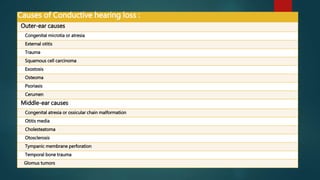
Causes of Conductive hearing loss :
Outer-ear causes
Congenital microtia or atresia
External otitis
Trauma
Squamous cell carcinoma
Exostosis
Osteoma
Psoriasis
Cerumen
Middle-ear causes
Congenital atresia or ossicular chain malformation
Otitis media
Cholesteatoma
Otosclerosis
Tympanic membrane perforation
Temporal bone trauma
Glomus tumors
OUTER EAR CAUSES :
Congenital :
The external auditory canal (EAC) develops from the 8th to the 28th
week of gestation; problems can occur anytime during this
development
al phase. Such as: microtia ,atresia,…
Infection :
Infections may lead to blockage of the EAC due to the accumulation of
debris, edema, or inflammation.
OUTER EAR CAUSES :
Trauma :
Penetrating trauma to the external auditory canal or meatus due to a
bullet, knife, or fracture may cause mild or profound conductive
hearing loss, depending upon the degree of EAC occlusion.
Tumor :
The most common malignant tumor of the EAC is squamous cell
carcinoma. This and other tumors of the EAC, such as basal cell
carcinoma and melanoma, typically cause conductive hearing loss due
to occlusion of the canal.
OUTER EAR CAUSES :
Exostosis :
Exostosis or multiple benign bony growths of the EAC most
commonly occur in individuals who have had repeated
exposure to cold water.
Osteoma :
Osteoma is a solitary bony growth that is most commonly attached to the
tympanosquamous suture line.
Similar to exostoses, osteomas are not treated until they become so large that they
affect hearing by occlusion or repeated infections because debris cannot exit the
EAC.
OUTER EAR CAUSES :
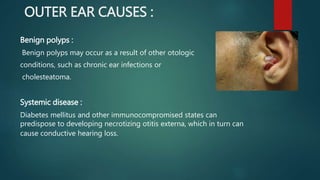
Benign polyps :
Benign polyps may occur as a result of other otologic
conditions, such as chronic ear infections or
cholesteatoma.
Systemic disease :
Diabetes mellitus and other immunocompromised states can
predispose to developing necrotizing otitis externa, which in turn can
cause conductive hearing loss.
OUTER EAR CAUSES :
Dermatologic :
Certain skin diseases, such as psoriasis, may cause scaling and edema of the EAC
and meatus. Treatment is usually with steroid ointments or creams.
Cerumen :
Some patients are not able to clear cerumen on their own or use Q-tips that push
the cerumen down the ear canal. These individuals may need periodic cleaning of
the cerumen to enhance their auditory capabilities.
Middle-ear causes :
Congenital :
Atresia or malformation of the ossicular chain can cause conductive
hearing loss.
Eustachian tube dysfunction :
Eustachian tube dysfunction occurs commonly in the setting of a viral
upper respiratory infection (URI) or sinusitis, and it can also occur with
allergies.
Infection :
Otitis media (OM) is a common childhood disorder that also frequently
occurs in adults
Middle-ear causes :
Tumors :
Malignant tumors such as Langerhans cell histiocytosis (including the Letterer-Siwe
variant) or squamous cell carcinoma may cause conductive hearing loss.
Cholesteatoma :
Cholesteatoma is a growth of desquamated,
stratified,squamous epithelium within
the middle ear space.
Middle-ear causes :
Otosclerosis :
Otosclerosis is a bony overgrowth that involves the footplate of the stapes.
Tympanic membrane perforation :
Conductive hearing loss due to TM perforation is common. The degree of
conductive hearing loss depends upon the size and location of the
perforation. Small perforations and those located in the anterior/inferior
quadrant cause the least amount of conductive hearing loss.
Middle ear barotrauma :
Barotrauma occurs when a patient is exposed to a sudden, large change in
ambient pressure, often during diving or flying.
Diagnostic tests
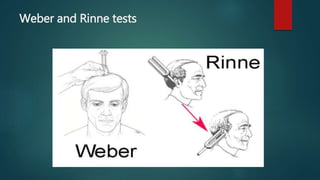
Weber and Rinne tests
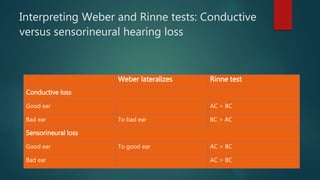
Interpreting Weber and Rinne tests: Conductive
versus sensorineural hearing loss
Weber lateralizes Rinne test
Conductive loss
Good ear AC > BC
Bad ear To bad ear BC > AC
Sensorineural loss
Good ear To good ear AC > BC
Bad ear AC > BC
Pneumoscopy :
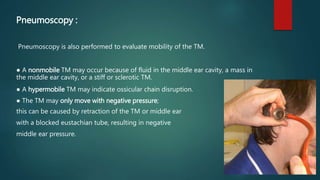
Pneumoscopy is also performed to evaluate mobility of the TM.
● A nonmobile TM may occur because of fluid in the middle ear cavity, a mass in
the middle ear cavity, or a stiff or sclerotic TM.
● A hypermobile TM may indicate ossicular chain disruption.
● The TM may only move with negative pressure;
this can be caused by retraction of the TM or middle ear
with a blocked eustachian tube, resulting in negative
middle ear pressure.
Pure tone, air, and bone conduction testing :
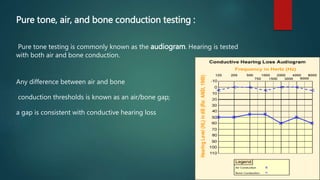
Pure tone testing is commonly known as the audiogram. Hearing is tested
with both air and bone conduction.
Any difference between air and bone
conduction thresholds is known as an air/bone gap;
a gap is consistent with conductive hearing loss
Tympanometry :
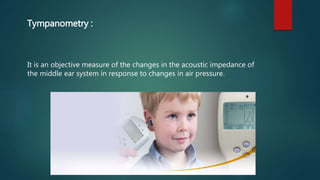
It is an objective measure of the changes in the acoustic impedance of
the middle ear system in response to changes in air pressure.
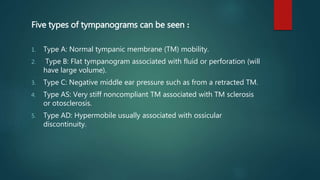
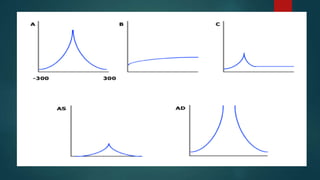
:Five types of tympanograms can be seen
1. Type A: Normal tympanic membrane (TM) mobility.
2. Type B: Flat tympanogram associated with fluid or perforation (will
have large volume).
3. Type C: Negative middle ear pressure such as from a retracted TM.
4. Type AS: Very stiff noncompliant TM associated with TM sclerosis
or otosclerosis.
5. Type AD: Hypermobile usually associated with ossicular
discontinuity.
Conductive hearing loss

Conductive hearing loss

  • 2.
    Conductive Hearing Loss HadiNafisi (birjand university of medical sciences)
  • 3.
    Hearing loss isa common problem that everyone experiences from time to time. Most commonly it occurs when flying or traveling up a mountain. Diminished hearing also may occur during an ear infection. These causes of hearing loss are usually short-lived. The other extreme is the permanent sensorineural hearing loss that occurs with aging, which we will all experience to some degree.
  • 4.
    EPIDEMIOLOGY : Hearing lossis a common chronic impairment, particularly for older adults. In the Beaver Dam cohort in the United States, the prevalence of hearing loss, defined by audiometry, increased steadily with age : ● 3 percent ages 21 to 34 ● 6 percent ages 35 to 44 ● 11 percent ages 45 to 54 ● 25 percent ages 55 to 64 ● 43 percent ages 65 to 84 Worldwide, estimates from the World Health Organization are that hearing loss affects 538 million people
  • 5.
    CLASSIFICATION : Hearing lossmay be classified into three types: ● Sensorineural ● Conductive ● Mixed loss
  • 6.
    Conductive Hearing Loss: involving any cause that in some way limits the amount of external sound from gaining access to the inner ear. Examples include cerumen impaction, middle ear fluid, or ossicular chain fixation (lack of movement of the small bones of the ear).
  • 7.
    Causes of Conductivehearing loss : Outer-ear causes Congenital microtia or atresia External otitis Trauma Squamous cell carcinoma Exostosis Osteoma Psoriasis Cerumen Middle-ear causes Congenital atresia or ossicular chain malformation Otitis media Cholesteatoma Otosclerosis Tympanic membrane perforation Temporal bone trauma Glomus tumors
  • 8.
    OUTER EAR CAUSES: Congenital : The external auditory canal (EAC) develops from the 8th to the 28th week of gestation; problems can occur anytime during this development al phase. Such as: microtia ,atresia,… Infection : Infections may lead to blockage of the EAC due to the accumulation of debris, edema, or inflammation.
  • 9.
    OUTER EAR CAUSES: Trauma : Penetrating trauma to the external auditory canal or meatus due to a bullet, knife, or fracture may cause mild or profound conductive hearing loss, depending upon the degree of EAC occlusion. Tumor : The most common malignant tumor of the EAC is squamous cell carcinoma. This and other tumors of the EAC, such as basal cell carcinoma and melanoma, typically cause conductive hearing loss due to occlusion of the canal.
  • 10.
    OUTER EAR CAUSES: Exostosis : Exostosis or multiple benign bony growths of the EAC most commonly occur in individuals who have had repeated exposure to cold water. Osteoma : Osteoma is a solitary bony growth that is most commonly attached to the tympanosquamous suture line. Similar to exostoses, osteomas are not treated until they become so large that they affect hearing by occlusion or repeated infections because debris cannot exit the EAC.
  • 11.
    OUTER EAR CAUSES: Benign polyps : Benign polyps may occur as a result of other otologic conditions, such as chronic ear infections or cholesteatoma. Systemic disease : Diabetes mellitus and other immunocompromised states can predispose to developing necrotizing otitis externa, which in turn can cause conductive hearing loss.
  • 12.
    OUTER EAR CAUSES: Dermatologic : Certain skin diseases, such as psoriasis, may cause scaling and edema of the EAC and meatus. Treatment is usually with steroid ointments or creams. Cerumen : Some patients are not able to clear cerumen on their own or use Q-tips that push the cerumen down the ear canal. These individuals may need periodic cleaning of the cerumen to enhance their auditory capabilities.
  • 13.
    Middle-ear causes : Congenital: Atresia or malformation of the ossicular chain can cause conductive hearing loss. Eustachian tube dysfunction : Eustachian tube dysfunction occurs commonly in the setting of a viral upper respiratory infection (URI) or sinusitis, and it can also occur with allergies. Infection : Otitis media (OM) is a common childhood disorder that also frequently occurs in adults
  • 14.
    Middle-ear causes : Tumors: Malignant tumors such as Langerhans cell histiocytosis (including the Letterer-Siwe variant) or squamous cell carcinoma may cause conductive hearing loss. Cholesteatoma : Cholesteatoma is a growth of desquamated, stratified,squamous epithelium within the middle ear space.
  • 15.
    Middle-ear causes : Otosclerosis: Otosclerosis is a bony overgrowth that involves the footplate of the stapes. Tympanic membrane perforation : Conductive hearing loss due to TM perforation is common. The degree of conductive hearing loss depends upon the size and location of the perforation. Small perforations and those located in the anterior/inferior quadrant cause the least amount of conductive hearing loss. Middle ear barotrauma : Barotrauma occurs when a patient is exposed to a sudden, large change in ambient pressure, often during diving or flying.
  • 16.
  • 17.
  • 18.
    Interpreting Weber andRinne tests: Conductive versus sensorineural hearing loss Weber lateralizes Rinne test Conductive loss Good ear AC > BC Bad ear To bad ear BC > AC Sensorineural loss Good ear To good ear AC > BC Bad ear AC > BC
  • 19.
    Pneumoscopy : Pneumoscopy isalso performed to evaluate mobility of the TM. ● A nonmobile TM may occur because of fluid in the middle ear cavity, a mass in the middle ear cavity, or a stiff or sclerotic TM. ● A hypermobile TM may indicate ossicular chain disruption. ● The TM may only move with negative pressure; this can be caused by retraction of the TM or middle ear with a blocked eustachian tube, resulting in negative middle ear pressure.
  • 20.
    Pure tone, air,and bone conduction testing : Pure tone testing is commonly known as the audiogram. Hearing is tested with both air and bone conduction. Any difference between air and bone conduction thresholds is known as an air/bone gap; a gap is consistent with conductive hearing loss
  • 21.
    Tympanometry : It isan objective measure of the changes in the acoustic impedance of the middle ear system in response to changes in air pressure.
  • 22.
    :Five types oftympanograms can be seen 1. Type A: Normal tympanic membrane (TM) mobility. 2. Type B: Flat tympanogram associated with fluid or perforation (will have large volume). 3. Type C: Negative middle ear pressure such as from a retracted TM. 4. Type AS: Very stiff noncompliant TM associated with TM sclerosis or otosclerosis. 5. Type AD: Hypermobile usually associated with ossicular discontinuity.