 33 YOF brought in by

EMS after attending a
high school baseball
game, and being struck
behind the right ear by a
flying baseball bat while
sitting in the stands. She
c/o pain behind R ear,
tinnitus, dizziness, and
slurred speech. Denies
LOC, N/V.

 AFVSS
 Gen: WDWN, A&Ox4
 HEENT: NC/AT, PERRL,

EOMi, nml bilat visual
acuity, bilat TMs intact,
right hemotympanum,
right facial motor
weakness, TTP right
mastoid w/o
retroauricular ecchymosis
 Neuro: GCS-14 (Eyes 3),
nml sensation x 4, 5/5
motor strength x 4
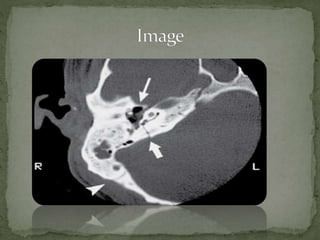
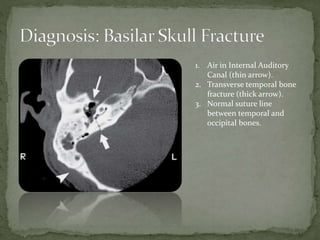
1. Air in Internal Auditory
Canal (thin arrow).
2. Transverse temporal bone
fracture (thick arrow).
3. Normal suture line
between temporal and
occipital bones.
 Non contrast CT head:
 necessary for suspected basilar skull fx.
 r/o TBI, intracranial bleeds

 +/- Prophylactic antibiotics for CSF rhinorrhea/otorrhea:
 should be done in consultation with Neurosurgery/ENT as

most CSF leaks will resolve spontaneously in one week w/o
complications
 if patient presents 1 wk s/p CSF leak with fever, Abx are
warranted, along with meningitis work-up (LP included)
 Broad coverage Abx w good penetration into meninges, eg.
Ceftriaxone, Vancomycin IV
 Tetanus prophylaxis
 Neurosurgery/Otolaryngology consultation
 Signs/symptoms of Basilar Skull Fracture:

Blood in ear canal
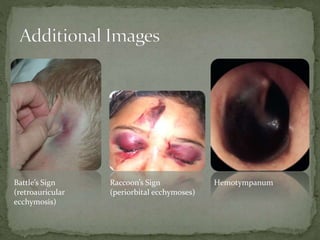
Hemotympanum
Rhinorrhea/Otorrhea
Battle's sign (retroauricular hematoma)
Raccoon sign (periorbital ecchymosis)
 Cranial nerve deficits











Facial paralysis
Decreased auditory acuity
Dizziness/Vertigo
Tinnitus
Nystagmus
 Most basilar skull fractures (BSF) involve petrous portion

of temporal bone, external auditory canal and TM, but may
occur anywhere from cribriform plate to occipital condyle.
 Torn dura leads to otorrhea/rhinorrhea
 May be only sign of basilar skull fracture

 Perform and document thorough HEENT exam

 BSF may be subtle on CT scan
 Look for air/fluid levels in sinuses; pneumocephalus suggests

open fx
 Periorbital and mastoid ecchymoses develop slowly (up to

12-24 hours s/p injury), and often absent in ED.
Battle’s Sign
(retroauricular
ecchymosis)

Raccoon’s Sign
(periorbital ecchymoses)

Hemotympanum
 http://www.Cybermedicine2000.com

 Knoop KJ, Stack LB, Storrow AB, Thurman RJ: The Atlas of






Emergency Medicine, 3rd ed: http://www.accessmedicine.com
Marx: Rosen’s Emergency Medicine, 7th ed. Ch 38: Head Injury
Ratilal B, Costa J, Sampaio C. Antibiotic prophylaxis for
preventing meningitis in patients with basilar skull fractures.
Cochrane Database Syst Rev. 2006 Jan 25;(1):CD004884
Schwartz DT: Emergency Radiology: Case Studies:
http://www.accessemergencymedicine.com
Tintinalli’s Emergency Medicine: A Comprehensive Study Guide,
7th ed. Chapter 254: Head Trauma in Adults and Children

Basilar Skull Fracture

  • 2.
     33 YOFbrought in by EMS after attending a high school baseball game, and being struck behind the right ear by a flying baseball bat while sitting in the stands. She c/o pain behind R ear, tinnitus, dizziness, and slurred speech. Denies LOC, N/V.  AFVSS  Gen: WDWN, A&Ox4  HEENT: NC/AT, PERRL, EOMi, nml bilat visual acuity, bilat TMs intact, right hemotympanum, right facial motor weakness, TTP right mastoid w/o retroauricular ecchymosis  Neuro: GCS-14 (Eyes 3), nml sensation x 4, 5/5 motor strength x 4
  • 4.
    1. Air inInternal Auditory Canal (thin arrow). 2. Transverse temporal bone fracture (thick arrow). 3. Normal suture line between temporal and occipital bones.
  • 5.
     Non contrastCT head:  necessary for suspected basilar skull fx.  r/o TBI, intracranial bleeds  +/- Prophylactic antibiotics for CSF rhinorrhea/otorrhea:  should be done in consultation with Neurosurgery/ENT as most CSF leaks will resolve spontaneously in one week w/o complications  if patient presents 1 wk s/p CSF leak with fever, Abx are warranted, along with meningitis work-up (LP included)  Broad coverage Abx w good penetration into meninges, eg. Ceftriaxone, Vancomycin IV  Tetanus prophylaxis  Neurosurgery/Otolaryngology consultation
  • 6.
     Signs/symptoms ofBasilar Skull Fracture: Blood in ear canal Hemotympanum Rhinorrhea/Otorrhea Battle's sign (retroauricular hematoma) Raccoon sign (periorbital ecchymosis)  Cranial nerve deficits          Facial paralysis Decreased auditory acuity Dizziness/Vertigo Tinnitus Nystagmus
  • 7.
     Most basilarskull fractures (BSF) involve petrous portion of temporal bone, external auditory canal and TM, but may occur anywhere from cribriform plate to occipital condyle.  Torn dura leads to otorrhea/rhinorrhea  May be only sign of basilar skull fracture  Perform and document thorough HEENT exam  BSF may be subtle on CT scan  Look for air/fluid levels in sinuses; pneumocephalus suggests open fx  Periorbital and mastoid ecchymoses develop slowly (up to 12-24 hours s/p injury), and often absent in ED.
  • 8.
  • 9.
     http://www.Cybermedicine2000.com  KnoopKJ, Stack LB, Storrow AB, Thurman RJ: The Atlas of     Emergency Medicine, 3rd ed: http://www.accessmedicine.com Marx: Rosen’s Emergency Medicine, 7th ed. Ch 38: Head Injury Ratilal B, Costa J, Sampaio C. Antibiotic prophylaxis for preventing meningitis in patients with basilar skull fractures. Cochrane Database Syst Rev. 2006 Jan 25;(1):CD004884 Schwartz DT: Emergency Radiology: Case Studies: http://www.accessemergencymedicine.com Tintinalli’s Emergency Medicine: A Comprehensive Study Guide, 7th ed. Chapter 254: Head Trauma in Adults and Children