• Defined as ear pain
or
an earache
or Primary otalgia:
is the pain that originates by a
disease within the ear.
or secondary otalgia: is
the pain that originates by a
disease outside the ear.
• Richly innervated
• Multiple cranial & spinal nerves
• Shared nerve supply with other head &
neck sites
• Inner ear has no sensory supply
Pinna
• Trauma (Laceration &
bites ,tears )
• Hematoma
• Perichondritis
• Infected pre-auricular
sinus
• Frostbite, sunburn
• Neoplasm
External auditory canal
• Impacted wax
• Foreign body
• Keratosis obturans
• Otitis externa
• Malignant otitis externa
• Herpes zoster oticus
• Exostoses
• Neoplasm
Middle Ear
• Bullous myringitis
• Acute otitis media
• Secretory otitis media
• Traumatic perforation
• Hemotympanum
• Otitic barotrauma
• Neoplasm
Mastoid
• Mastoiditis
• Mastoid abscess
• Granulomas
• Neoplasm
Inner ear
• Acoustic trauma
• Noise
• Meniere’s disease
• Vestibular schwannoma
 Normal secretion of
cerumenous and
sebaceous glands
 Excessive secretion,
narrowing of EAC ,stiff
hairs can lead to impaction
 Pain, deafness, tinnitus,
 Removal
• Insect or small objects
• Commonly occurs in children
• Foreign body visible on otoscopic examination
• Treated by removal
• Removal may need sedation
 Staphylococcal Infection of hair follicle of Ext Meatus
 Clinical Features
 Painful swelling in outer 1/3rd of ext auditory canal
 Discomfort aggravated on movement of jaw ,and pinna
 Deafness
 Treatment
 Ear pack of 10% ichthammol glycerin
 systemic antibiotics
 Analgesics
 If abscess formed ,incision and drainage should be done
 Blood Sugar Levels
 Diffuse inflammation of meatal skin
 Etiology
 Hot humid climate
 Swimmers
 Trauma
 Unskilled instrumentation
 Scratching ear canal with hair pin
 Excessive cleaning of ear canal after swimming
 Existing CSOM
 Causative Organisms
 Pseudomonas aeruginosa
 Staph.aureus
 B.proteus
 Clinical features
 Hot burning sensation
 Pain
 Serous or purulent discharge
 Meatal skin is red ,swollen and tender
 Cheesy debris in the deep meatus
 pain elicited by traction of auricle or pressure on tragus
 Treatment
 Aural toilet
 Medicated wicks
 Systemic and Topical antibiotics with steroids
 Analgesics
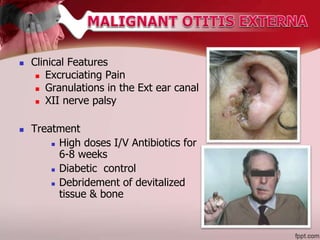
 Progressive infection of meatus, surrounding
soft tissue and skull base
 Causative Organism
 Pseudomonas auroginosa
 Predisposing Factors
 Elderly diabetics
 Immunocompromised
 Clinical Features
 Excruciating Pain
 Granulations in the Ext ear canal
 XII nerve palsy
 Treatment
 High doses I/V Antibiotics for
6-8 weeks
 Diabetic control
 Debridement of devitalized
tissue & bone
 Viral Infection affecting geniculate
ganglion of facial nerve
 Clinical Features
 Severe otalgia
 Vesicular rash on the in pinna or external
auditory canal
 VII Nerve Palsy (Ramsay Hunt Synd.)
 Treatment
 Oral acyclovir
 Fungal Infection of ear canal
 Aspergilus niger, Aspergilus fumigatus, Candida
albicans
 Predisposing Factors
 Hot & Humid climate
 Topical antibiotics drops for CSOM or otitis externa
 Clinical Features
 Itching
 pain
 Discharge with musty color
 On otoscopic examination ,filamentous growth
(black ,blue or green)or white creamy deposit
.
 Treatment
 Aural Toilet
 Antifungal Agents
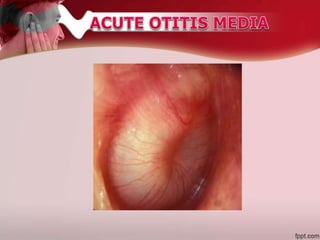
 Acute Infection of middle ear by pyogenic organisms.
 Common in infants and children
 Bacteriology
 Strep.Pneumonae,H INF, Moraxella Catarrhalis
 Predisposing factors
 Any thing interfering with normal function of eustachian
tube
 Clinical Features
 Deafness ,pain ,Fever,Ear discharge
 Red Congested buldging TM
 Small Perforation with ear discharge
 Management
 Antibiotics
 Analgesics and Antipyretics
 Nasal Decongestants
 Systemic,Topical
 Ear Toilet
 Myringotomy
 Tm bulging and Pain Not responding to above
treatment
 Pain onset during descent of airplane or while
diving
 Non suppurative condition due to failure of
Eustachian tube to maintain middle ear pressure
at ambient atmospheric level
 Mechanism
 When atmospheric pressure is higher than middle ear
pressure Eustachian tube gets locked.- -ve pressure
in middle ear - retraction of tympanic membrane-
hyperaemia,transudation and haemorrhage in the
middle ear.
• Clinical features
• Severe earache ,hearing loss,tinnitus
• Tm retracted ,congested or ruptured
• Hemotympanum
 Treatment
 Nasal decongestants
 Antihistamines
 Myringotomy
 Prevention
 Swallow during descent
 Do not sleep during descent
 Auto inflation of tube by valsalva during descent.
• Painful condition occurring
spontaneously and
resolving within several
days .
• Vesicular eruption is seen
on the tympanic membrane
which maybe associated
with bleeding or serous
discharge .
• Probably caused by virus or
mycoplasma pneumonia
 Inflammation of mucosal lining of
antrum and mastoid air cell system.
 Follow acute suppurative otitis media
 Clinical Features:
 Pain behind the ear
 Fever
 Ear Discharge
 Mastoid tenderness
 Sagging of posterosuperior meatal
wall
 Swelling over the mastoid
 Deafness
Management :
 Hospitalization
 Antibiotics
 Myringotomy
 Pus under tension not resolving with medical therapy
 Cortical Mastoidectomy
 Subpreiosteal abscess
 Positive reservoir sign
 No change in symptoms after 48 hrs of medical management
 Complications
 Facial palsy, labrynthitis,intracranial complications.
is an unpleasant sensation localized to an
area separate from the site of the
causative injury or other noxious stimulus
Often, referred pain is caused by nerve
compression or irritation.
In this circumstance, the sensation of pain
will generally be felt in the territory that
the nerve serves (ie,somatic dermatome)
even though the damage originates
elsewhere (ie,visceral tissue).
• CLINICALLY NORMAL
Pinna
External auditory meatus
Tympanic membrane
Mastoid process
Referred earache may be a presenting
symptom of head and neck cancer
Common causes :
• Dental causes(caries ,abscess ,impacted teeth)
• TMJ dysfunction
• Tonsillitis and pharyngitis
• Cervical spine arthritis
Uncommon cause :
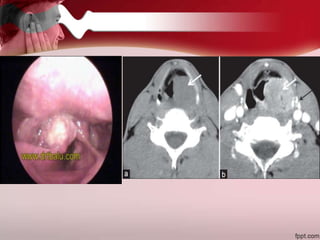
• Tumors (hypopharynx ,larynx ,base of the
tongue ,nassopharynx ,parotid
,esophagus )
• Neuralgias (trigeminal ,glossopharyngeal
,geniculate )
• Temporal arteritis
• Oral ulcers
• Eagles syndrome
Uncommon cause :
• Sinusitis /Nasal polyps
• Thyroiditis
• Parotid gland disorders(mumps ,stone )
• GERD
• Myocardial ischemia
• Psychogenic otalgia
Ear pain can be referred to the ears
in five main ways.
Caused by :
(joint dislocation ,arthritis )
clinical features :
pain around the TMJ
Trismus
Joint sound or crepitus
Tenderness of the joint or associated muscle
Management :
Rest
Soft diet
Moist heat and massage
NSAIDS
Muscle relaxant
Consultation with oral surgeon
Caries tooth
Apical abscess
Impacted molar
Malocclusion
–Recurrent aphthous ulcer is commonest
oral ulcer
–Other causes include trauma ,nutritional
deficiency ,Behcets syndrome and
autoimmune disorders
–Painful locally ,earache
• Tonsillitis is one of the commonest cause of
referred otalgia .
• Post-tonsillectomy referred pain less severe in
children than adult .
• Peritonsiller ,retropharyngeal ,Parapharyngeal
abscess will cause earache too
• Sore throat ,fever ,trismus ,odynophagia are
associated symptoms with ear ache
• Parotid ,hypopharynx ,nassophayrynx ,base of
tongue ,larynx and cervical spine
• Risk factors include smoking ,alcohol use ,age
older than 50 years,radiation exposure
• Associated symptom ( hoarsness,
dysphagia,nasal blockage ,weight loss )
• Trigeminal ,glossopharyngeal and geniculate
(intermedius) neuralgia
• Pain usually brief (seconds) in their sensory
distribution area
• Severe, lancing ,electric – shock- like pain
• May have trigger point
• It is an elongation of the styloid process
• Cause deep ,unremitting pain exacerbated by
swallowing ,yawning ,foreign body sensation
in throat .
• Treated by surgical excision via trans-oral
approach or lateral approach .
• Cause crepitus or neck and ear pain with neck
movements
• Decreased neck range of motion ,tender
spinous processes or Para-spinal muscles
• Pain referred to ear from C2,C3 cervical nerve
root
when no cause to the pain in ears can be found,
it suggest a functional origin.
The patient in such cases should be kept under
observation with periodic re-evaluation.
 History
 Ear symptoms
 Nasal symptoms
 swallowing disorders
 recent trauma
 General Symptoms
 Examination
 General physical examination
 Complete ENT examination
 Rhinoscopy , nasopharyngoscopy , and indirect laryngoscopy.
 Palpation of the neck is important to look for thyroid disease and
1lymphadenopathy
• CBC ,ESR
• PTA
• TYMPANOMETRY
• Pneumatic otoscopy
• X- ray
• FIBEROPTIC NASOPHARYNGOSCOP
• Barium swallow
• Indirect laryngoscopy
• CT scan
• MRI with gadolinium
• Biopsy
• Diagnostic anesthetic blocks and pharyngeal cocainization
Otalgia/earache
Otalgia/earache

Otalgia/earache

  • 2.
    • Defined asear pain or an earache
  • 3.
    or Primary otalgia: isthe pain that originates by a disease within the ear. or secondary otalgia: is the pain that originates by a disease outside the ear.
  • 4.
    • Richly innervated •Multiple cranial & spinal nerves • Shared nerve supply with other head & neck sites • Inner ear has no sensory supply
  • 9.
    Pinna • Trauma (Laceration& bites ,tears ) • Hematoma • Perichondritis • Infected pre-auricular sinus • Frostbite, sunburn • Neoplasm External auditory canal • Impacted wax • Foreign body • Keratosis obturans • Otitis externa • Malignant otitis externa • Herpes zoster oticus • Exostoses • Neoplasm
  • 10.
    Middle Ear • Bullousmyringitis • Acute otitis media • Secretory otitis media • Traumatic perforation • Hemotympanum • Otitic barotrauma • Neoplasm Mastoid • Mastoiditis • Mastoid abscess • Granulomas • Neoplasm Inner ear • Acoustic trauma • Noise • Meniere’s disease • Vestibular schwannoma
  • 11.
     Normal secretionof cerumenous and sebaceous glands  Excessive secretion, narrowing of EAC ,stiff hairs can lead to impaction  Pain, deafness, tinnitus,  Removal
  • 12.
    • Insect orsmall objects • Commonly occurs in children • Foreign body visible on otoscopic examination • Treated by removal • Removal may need sedation
  • 14.
     Staphylococcal Infectionof hair follicle of Ext Meatus  Clinical Features  Painful swelling in outer 1/3rd of ext auditory canal  Discomfort aggravated on movement of jaw ,and pinna  Deafness  Treatment  Ear pack of 10% ichthammol glycerin  systemic antibiotics  Analgesics  If abscess formed ,incision and drainage should be done  Blood Sugar Levels
  • 16.
     Diffuse inflammationof meatal skin  Etiology  Hot humid climate  Swimmers  Trauma  Unskilled instrumentation  Scratching ear canal with hair pin  Excessive cleaning of ear canal after swimming  Existing CSOM  Causative Organisms  Pseudomonas aeruginosa  Staph.aureus  B.proteus
  • 17.
     Clinical features Hot burning sensation  Pain  Serous or purulent discharge  Meatal skin is red ,swollen and tender  Cheesy debris in the deep meatus  pain elicited by traction of auricle or pressure on tragus  Treatment  Aural toilet  Medicated wicks  Systemic and Topical antibiotics with steroids  Analgesics
  • 19.
     Progressive infectionof meatus, surrounding soft tissue and skull base  Causative Organism  Pseudomonas auroginosa  Predisposing Factors  Elderly diabetics  Immunocompromised
  • 20.
     Clinical Features Excruciating Pain  Granulations in the Ext ear canal  XII nerve palsy  Treatment  High doses I/V Antibiotics for 6-8 weeks  Diabetic control  Debridement of devitalized tissue & bone
  • 21.
     Viral Infectionaffecting geniculate ganglion of facial nerve  Clinical Features  Severe otalgia  Vesicular rash on the in pinna or external auditory canal  VII Nerve Palsy (Ramsay Hunt Synd.)  Treatment  Oral acyclovir
  • 23.
     Fungal Infectionof ear canal  Aspergilus niger, Aspergilus fumigatus, Candida albicans  Predisposing Factors  Hot & Humid climate  Topical antibiotics drops for CSOM or otitis externa
  • 24.
     Clinical Features Itching  pain  Discharge with musty color  On otoscopic examination ,filamentous growth (black ,blue or green)or white creamy deposit .  Treatment  Aural Toilet  Antifungal Agents
  • 26.
     Acute Infectionof middle ear by pyogenic organisms.  Common in infants and children  Bacteriology  Strep.Pneumonae,H INF, Moraxella Catarrhalis  Predisposing factors  Any thing interfering with normal function of eustachian tube  Clinical Features  Deafness ,pain ,Fever,Ear discharge  Red Congested buldging TM  Small Perforation with ear discharge
  • 27.
     Management  Antibiotics Analgesics and Antipyretics  Nasal Decongestants  Systemic,Topical  Ear Toilet  Myringotomy  Tm bulging and Pain Not responding to above treatment
  • 29.
     Pain onsetduring descent of airplane or while diving  Non suppurative condition due to failure of Eustachian tube to maintain middle ear pressure at ambient atmospheric level  Mechanism  When atmospheric pressure is higher than middle ear pressure Eustachian tube gets locked.- -ve pressure in middle ear - retraction of tympanic membrane- hyperaemia,transudation and haemorrhage in the middle ear.
  • 30.
    • Clinical features •Severe earache ,hearing loss,tinnitus • Tm retracted ,congested or ruptured • Hemotympanum  Treatment  Nasal decongestants  Antihistamines  Myringotomy  Prevention  Swallow during descent  Do not sleep during descent  Auto inflation of tube by valsalva during descent.
  • 31.
    • Painful conditionoccurring spontaneously and resolving within several days . • Vesicular eruption is seen on the tympanic membrane which maybe associated with bleeding or serous discharge . • Probably caused by virus or mycoplasma pneumonia
  • 32.
     Inflammation ofmucosal lining of antrum and mastoid air cell system.  Follow acute suppurative otitis media  Clinical Features:  Pain behind the ear  Fever  Ear Discharge  Mastoid tenderness  Sagging of posterosuperior meatal wall  Swelling over the mastoid  Deafness
  • 33.
    Management :  Hospitalization Antibiotics  Myringotomy  Pus under tension not resolving with medical therapy  Cortical Mastoidectomy  Subpreiosteal abscess  Positive reservoir sign  No change in symptoms after 48 hrs of medical management  Complications  Facial palsy, labrynthitis,intracranial complications.
  • 34.
    is an unpleasantsensation localized to an area separate from the site of the causative injury or other noxious stimulus
  • 35.
    Often, referred painis caused by nerve compression or irritation. In this circumstance, the sensation of pain will generally be felt in the territory that the nerve serves (ie,somatic dermatome) even though the damage originates elsewhere (ie,visceral tissue).
  • 36.
    • CLINICALLY NORMAL Pinna Externalauditory meatus Tympanic membrane Mastoid process
  • 37.
    Referred earache maybe a presenting symptom of head and neck cancer
  • 38.
    Common causes : •Dental causes(caries ,abscess ,impacted teeth) • TMJ dysfunction • Tonsillitis and pharyngitis • Cervical spine arthritis
  • 39.
    Uncommon cause : •Tumors (hypopharynx ,larynx ,base of the tongue ,nassopharynx ,parotid ,esophagus ) • Neuralgias (trigeminal ,glossopharyngeal ,geniculate ) • Temporal arteritis • Oral ulcers • Eagles syndrome
  • 40.
    Uncommon cause : •Sinusitis /Nasal polyps • Thyroiditis • Parotid gland disorders(mumps ,stone ) • GERD • Myocardial ischemia • Psychogenic otalgia
  • 41.
    Ear pain canbe referred to the ears in five main ways.
  • 43.
    Caused by : (jointdislocation ,arthritis ) clinical features : pain around the TMJ Trismus Joint sound or crepitus Tenderness of the joint or associated muscle Management : Rest Soft diet Moist heat and massage NSAIDS Muscle relaxant Consultation with oral surgeon
  • 44.
  • 45.
    –Recurrent aphthous ulceris commonest oral ulcer –Other causes include trauma ,nutritional deficiency ,Behcets syndrome and autoimmune disorders –Painful locally ,earache
  • 47.
    • Tonsillitis isone of the commonest cause of referred otalgia . • Post-tonsillectomy referred pain less severe in children than adult . • Peritonsiller ,retropharyngeal ,Parapharyngeal abscess will cause earache too • Sore throat ,fever ,trismus ,odynophagia are associated symptoms with ear ache
  • 49.
    • Parotid ,hypopharynx,nassophayrynx ,base of tongue ,larynx and cervical spine • Risk factors include smoking ,alcohol use ,age older than 50 years,radiation exposure • Associated symptom ( hoarsness, dysphagia,nasal blockage ,weight loss )
  • 53.
    • Trigeminal ,glossopharyngealand geniculate (intermedius) neuralgia • Pain usually brief (seconds) in their sensory distribution area • Severe, lancing ,electric – shock- like pain • May have trigger point
  • 54.
    • It isan elongation of the styloid process • Cause deep ,unremitting pain exacerbated by swallowing ,yawning ,foreign body sensation in throat . • Treated by surgical excision via trans-oral approach or lateral approach .
  • 56.
    • Cause crepitusor neck and ear pain with neck movements • Decreased neck range of motion ,tender spinous processes or Para-spinal muscles • Pain referred to ear from C2,C3 cervical nerve root
  • 57.
    when no causeto the pain in ears can be found, it suggest a functional origin. The patient in such cases should be kept under observation with periodic re-evaluation.
  • 58.
     History  Earsymptoms  Nasal symptoms  swallowing disorders  recent trauma  General Symptoms  Examination  General physical examination  Complete ENT examination  Rhinoscopy , nasopharyngoscopy , and indirect laryngoscopy.  Palpation of the neck is important to look for thyroid disease and 1lymphadenopathy
  • 59.
    • CBC ,ESR •PTA • TYMPANOMETRY • Pneumatic otoscopy • X- ray • FIBEROPTIC NASOPHARYNGOSCOP • Barium swallow • Indirect laryngoscopy • CT scan • MRI with gadolinium • Biopsy • Diagnostic anesthetic blocks and pharyngeal cocainization