Carcinoma of Vulva Prof. Surendra Nath Panda, M.S. Department of Obstetrics and Gynecology  M.K.C.G.Medical College Berhampur, Orissa, India
INTRODUCTION Diseases of the vulva in the aggregate constitute only a small fraction of gynaecologic practice  of which  tumours are the most important lesions . Vulva contains a variety of tissues and hence  all types of tumours can occur in the vulva. Many types have been recorded, both benign and malignant .  Vulval malignancies account for about 4% - 5% of all genital malignancies
MALIGNANT TUMOURS OF VULVA I. Epithelial neoplasms of skin and mucosa  A. Invasive Squamous cell carcinoma  1. Keratinizing  2. Non-keratinizing  3. Basaloid carcinoma  4. Verrucous  Carcinoma 5. Warty carcinoma [condylomatous] B. Basal cell carcinoma C. Adenocarcinoma  Histological Classification : - (Jo Ann Benda and Richard Zaino)
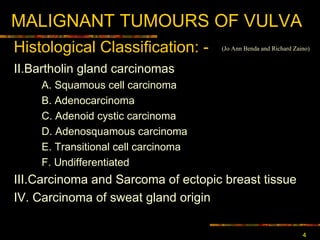
MALIGNANT TUMOURS OF VULVA II.Bartholin gland carcinomas  A. Squamous cell carcinoma  B. Adenocarcinoma  C. Adenoid cystic carcinoma  D. Adenosquamous carcinoma  E. Transitional cell carcinoma  F. Undifferentiated  III.Carcinoma and Sarcoma of ectopic breast tissue IV. Carcinoma of sweat gland origi n Histological Classification : - (Jo Ann Benda and Richard Zaino)
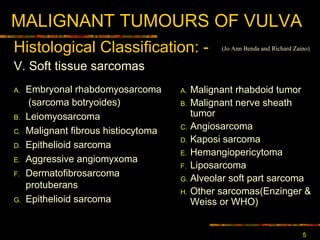
MALIGNANT TUMOURS OF VULVA Embryonal rhabdomyosarcoma  (sarcoma botryoides) Leiomyosarcoma Malignant fibrous histiocytoma Epithelioid sarcoma Aggressive angiomyxoma Dermatofibrosarcoma  p rotuberans Epithelioid sarcoma Histological Classification : - Malignant rhabdoid tumor Malignant nerve sheath tumor Angiosarcoma Kaposi sarcoma Hemangiopericytoma Liposarcoma Alveolar soft part sarcoma Other sarcomas(Enzinger & Weiss or WHO) V. Soft tissue sarcomas (Jo Ann Benda and Richard Zaino)
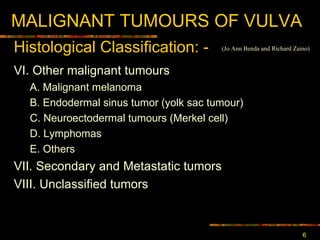
MALIGNANT TUMOURS OF VULVA VI. Other malignant tumours   A. Malignant melanoma B. Endodermal sinus tumor (yolk sac tumour) C. Neuroectodermal tumours (Merkel cell) D. Lymphomas E. Others  VII. Secondary and Metastatic tumors VIII. Unclassified tumors Histological Classification : - (Jo Ann Benda and Richard Zaino)
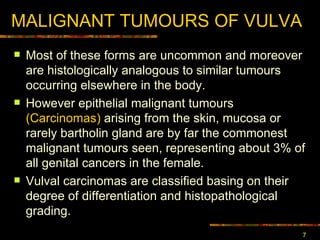
MALIGNANT TUMOURS OF VULVA Most of  these forms are uncommon and moreover are histologically analogous to similar tumours occurring elsewhere in the body.  However epithelial malignant tumours  (Carcinomas)  arising from the skin, mucosa or rarely bartholin gland are by far the commonest malignant tumours seen,  representing about 3% of all genital cancers in the female . Vulval  carcinomas  are classified basing on their degree of differentiation and histopathological grading.
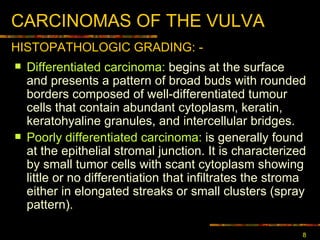
CARCINOMA S  OF THE VULVA Differentiated carcinoma :  begins at the surface and presents a pattern of broad buds with rounded borders composed of well-differentiated tumour cells that contain abundant cytoplasm, keratin, keratohyaline granules, and intercellular bridges.  Poorly differentiated carcinoma :  is generally found at the epithelial stromal junction. It is characterized by small tumor cells with scant cytoplasm showing little or no differentiation that infiltrates the stroma either in elongated streaks or small clusters (spray pattern). HISTOPATHOLOGIC GRAD ING: -
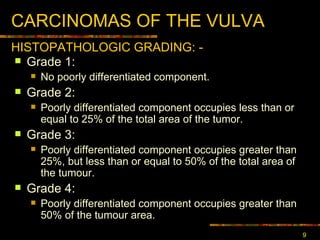
CARCINOMA S  OF THE VULVA Grade 1:  No poorly differentiated component. Grade 2:  Poorly differentiated component occupies less than or equal to 25% of the total area of the tumor. Grade 3:  Poorly differentiated component occupies greater than 25%, but less than or equal to 50% of the total area of the tumour. Grade 4:   Poorly differentiated component occupies greater than 50% of the tumour area. HISTOPATHOLOGIC GRAD ING: -
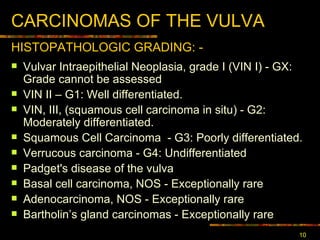
CARCINOMA S  OF THE VULVA Vulvar Intraepithelial Neoplasia ,  grade I  (VIN I) -  GX:   Grade cannot be assessed VIN  II  –  G1: Well differentiated . VIN , III , ( squamous cell carcinoma in situ)  -  G2: Moderately differentiated . Squamous Cell Carcinoma  -  G3: Poorly differentiated . Verrucous carcinoma  -  G4: Undifferentiated Padget's disease of the vulva Basal cell carcinoma, NOS  - Exceptionally rare Adenocarcinoma, NOS  - Exceptionally rare Bartholin’s gland carcinoma s - Exceptionally rare HISTOPATHOLOGIC GRAD ING: -
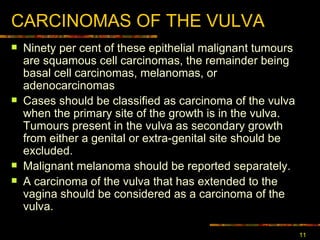
CARCINOMA S  OF THE VULVA Ninety  per cent of these  epithelial  malignant tumours are squamous cell carcinomas , t he remainder being basal cell carcinomas, melanomas, or adenocarcinomas Cases should be classified as carcinoma of the vulva when the primary site of the growth is in the vulva. Tumours present in the vulva as secondary growth from either a genital or extra-genital site should be excluded.  Malignant melanoma should be reported separately.  A carcinoma of the vulva that has extended to the vagina should be considered as a carcinoma of the vulva.
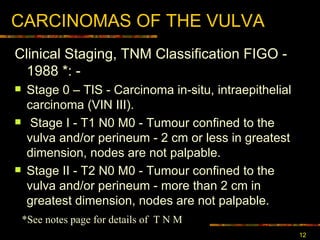
CARCINOMA S  OF THE VULVA Clinical Staging ,  TNM Classification FIGO - 1988  *: - Stage 0  – TIS -  Carcinoma in-situ, intraepithelial carcinoma  (VIN III). Stage I  -  T1 N0 M0  -  Tumour confined to the vulva and/or perineum - 2 cm or less in greatest dimension, nodes are not palpable .   Stage II  -  T2 N0 M0  -  Tumour confined to the vulva and/or perineum - more than 2 cm in greatest dimension, nodes are not palpable . *See notes page for details of  T N M
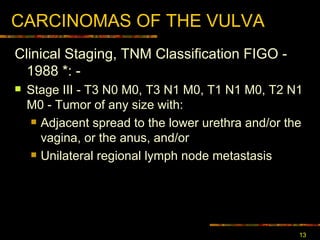
CARCINOMA S  OF THE VULVA Clinical Staging ,  TNM Classification FIGO - 1988  *: - Stage III  -  T3 N0 M0 ,  T3 N1 M0 ,  T1 N1 M0 ,  T2 N1 M0  -  Tumor of any size with: Adjacent spread to the lower urethra and/or the vagina, or the anus, and/or Unilateral regional lymph node metastasis
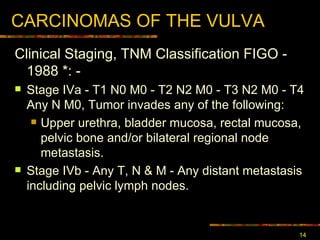
CARCINOMA S  OF THE VULVA Clinical Staging ,  TNM Classification FIGO - 1988  *: - Stage IVa  -  T1 N0 M0  -  T2 N2 M0  -  T3 N2 M0  -  T4 Any N M0 ,  Tumor invades any of the following: Upper urethra, bladder mucosa, rectal mucosa, pelvic bone and/or bilateral regional node metastasis .   Stage IVb  -  Any T ,  N & M  -  Any distant metastasis including pelvic lymph nodes .
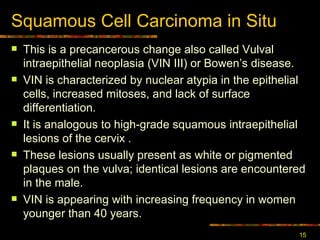
Squamous Cell Carcinoma in Situ This is a  precancerous change also called Vulva l  intraepithelial neoplasia (VIN  III )  or  Bowen ’s  disease. VIN is characterized by nuclear atypia in the epithelial cells, increased mitoses, and lack of surface differentiation.  It is analogous to high-grade squamous intraepithelial lesions of the cervix  . These lesions usually present as white or pigmented plaques on the vulva; identical lesions are encountered in the male.  VIN is appearing with increasing frequency in women younger than 40 years.
Squamous Cell Carcinoma in Situ With or without associated invasive carcinoma, VIN is frequently multicentric, and 10% to 30% are associated with another primary squamous neoplasm in the vagina or cervix.  This association indicates a common etiologic agent. Indeed, 90% of cases of VIN and many associated cancers contain HPV DNA, specifically types 16, 18, and other cancer-associated (high-risk) types. Spontaneous regression of VIN lesions has been reported; the risk of progression to invasive cancer increases in older (older than 45 years) or immunosuppressed women.  Wide local excision is  the appropriate treatment.
Squamous Cell Carcinoma  of Vulva Vulvar squamous cell carcinomas begin as small areas of epithelial thickening that resemble leukoplakia but, in the course of time, progress to create firm, indurated, exophytic tumors or ulcerated, endophytic lesions.  Although vulvar carcinomas are external tumors that are obviously apparent to the patient and the clinician, many are misinterpreted as dermatitis, eczema, or leukoplakia for long periods.  The clinical manifestations evoked are chiefly those of pain, local discomfort, itching, and exudation because superficial secondary infection is common.
Squamous Cell Carcinoma  of Vulva The first group is associated with cancer-related (high-risk) HPV, may be multicentric, and frequently coexists with or is preceded by a classic and easily recognized Vulva l I ntraepithelial Neoplasia (VIN).  A variety of chromosome abnormalities are linked to invasive vulval cancer, some of which may be specific for HPV-positive tumours.  In  terms of etiology, pathogenesis, and clinical presentation, vulvar squamous cell carcinomas may be divided into two general groups.
Squamous Cell Carcinoma  of Vulva The second group of squamous cell carcinomas are associated with squamous cell hyperplasia and lichen sclerosus.  The etiology of this group of carcinomas is unclear, and they are infrequently associated with HPV.  In one scenario, genetic alterations arise in lichen sclerosus or hyperplasia, leading directly to invasion, or  Atypia develops within hyperplasia or lichen sclerosus (differentiated VIN).  These tumours have also been associated with mutations in p53 and appear to have a significantly worse prognosis than HPV-positive tumours do.
Squamous Cell Carcinoma  of Vulva On histologic examination, tumours associated with HPV or VIN frequently exhibit cohesive invasive growth patterns that mimic intraepithelial neoplasia. These "intraepithelial-like" patterns may be well (warty) or poorly differentiated (basaloid). HPV-negative tumours, which at times arise from lichen sclerosus or squamous hyperplasia, typically exhibit an invasive pattern with prominent keratinization .
Squamous Cell Carcinoma  of Vulva Risk of metastatic spread is linked to the size of tumour, depth of invasion, and involvement of lymphatic vessels.  The inguinal,  femoral,  pelvic, iliac, and periaortic lymph nodes are most commonly involved. Ultimately, lymphohematogenous dissemination involves the lungs, liver, and other internal organs.  Patients with lesions less than 2 cm in diameter have a 60% to 80% 5-year survival rate after treatment with one-stage vulvectomy and lymphadenectomy; larger lesions with lymph node involvement yield a less than 10% 5-year survival rate.
Verrucous carcinoma of vulva A n uncommon variant of squamous cell carcinoma with low malignant potential. It may, however, grow very large. These lesions were originally described as occurring in the oral cavity but have also been described involving the vagina, cervix, and vulva.  Clinically, these tumours are very slow growing and carry an excellent prognosis.  The lesion grossly appears cauliflower-like in nature.
Verrucous carcinoma of vulva This rare  variant of squamous cell carcinoma may  also  resemble condyloma acuminatum and present   as a large fungating tumor.  Microscopically, the papillary fronds lack the connective tissue core that characterizes condyloma acuminata.  These features are very similar to those of the giant condylomata  of  Buschke-Loewenstein, possibly representing successive stages of the same pathologic process.
Verrucous carcinoma of vulva Local invasion confirms the malignant nature of the lesion, but it rarely metastasises and can be cured by wide excision. If there are suspicious groin nodes, FNA or excisional biopsy should be carried out.  Usually enlarged nodes  are  caused by inflammatory hypertrophy, but if they do contain metastases, radical vulvectomy and bilateral groin lymph node dissections are indicated. As metastasis to regional lymph nodes is rare, radical local excision is the standard treatment.  However a course of radiotherapy after surgery is usually recommended.
Paget ’ s Disease of Vulva This curious and rare lesion of the vulva, and sometimes the perianal region, is similar in its skin manifestations to Paget disease of the breast.  As a vulvar neoplasm, it manifests as a pruritic red, crusted, sharply demarcated, map like area, occurring usually on the labia majora. It may be accompanied by a palpable submucosal thickening or tumor.
Paget ’ s Disease of Vulva The diagnostic microscopic feature of this lesion is the presence of Paget cells, large tumor cells lying singly or in small clusters within the epidermis and its appendages. These cells are distinguished by a clear separation ("halo") from the surrounding epithelial cells and a finely granular cytoplasm containing periodic acid-Schiff stain-, Alcian blue-, or mucicarmine-positive mucopolysaccharide.  Ultrastructurally, Paget cells display apocrine, eccrine, and keratinocyte differentiation and presumably arise from primitive epithelial progenitor cells.
Paget ’ s Disease of Vulva In contrast to Paget ’s  disease of the nipple, in which 100% of patients show an underlying ductal breast carcinoma, vulvar lesions are most frequently confined to the epidermis of the skin and adjacent hair follicles and sweat glands.  The prognosis of Paget ’s  disease is poor in the uncommon cases with associated carcinoma, but intraepidermal Paget ’s  disease may persist for many years, even decades, without the development of invasion.  However, because Paget ’s  cells often extend into skin appendages and may extend beyond the confines of the grossly visible lesion, they are prone to recurrence. It is considered as nothing more than a variant of VIN
Malignant Melanoma Melanomas of the vulva are rare, representing less than 5% of all vulvar cancers and 2% of all melanomas in women.  Their peak incidence is in the sixth or seventh decade;  T hey tend to have the same biologic and histologic characteristics as melanomas occurring elsewhere and are capable of widespread metastatic dissemination.  Because it is initially confined to the epithelium, melanoma may resemble Paget ’s  disease, both grossly and histologically.
Malignant Melanoma It can usually be differentiated by its uniform reactivity, with immunoperoxidase techniques, with antibodies to S100 protein, absence of reactivity with antibodies to carcinoembryonic antigen, and lack of mucopolysaccharides. Prognosis is linked principally to depth of invasion, with greater than 60% mortality for lesions invading deeper than 1 mm.  Treatment is by wide excision or radical vulvectomy. The overall survival rate is less than 32%, presumably owing to delays in detection and a generally poor prognosis for mucosal melanomas.
Basal cell carcinoma Vulva is a very unusual site for this lesion. When it occurs, its features are similar to rodent ulcer of the face. This is an invasive squamous cell carcinoma, which penetrates into the dermis and deeper tissues. Its spread is slow and it does not metastasizes, Local excision is curative.
Thank You  At the service of women

carcinoma vulva

  • 1.
    Carcinoma of VulvaProf. Surendra Nath Panda, M.S. Department of Obstetrics and Gynecology M.K.C.G.Medical College Berhampur, Orissa, India
  • 2.
    INTRODUCTION Diseases ofthe vulva in the aggregate constitute only a small fraction of gynaecologic practice of which tumours are the most important lesions . Vulva contains a variety of tissues and hence all types of tumours can occur in the vulva. Many types have been recorded, both benign and malignant . Vulval malignancies account for about 4% - 5% of all genital malignancies
  • 3.
    MALIGNANT TUMOURS OFVULVA I. Epithelial neoplasms of skin and mucosa A. Invasive Squamous cell carcinoma 1. Keratinizing 2. Non-keratinizing 3. Basaloid carcinoma 4. Verrucous Carcinoma 5. Warty carcinoma [condylomatous] B. Basal cell carcinoma C. Adenocarcinoma Histological Classification : - (Jo Ann Benda and Richard Zaino)
  • 4.
    MALIGNANT TUMOURS OFVULVA II.Bartholin gland carcinomas A. Squamous cell carcinoma B. Adenocarcinoma C. Adenoid cystic carcinoma D. Adenosquamous carcinoma E. Transitional cell carcinoma F. Undifferentiated III.Carcinoma and Sarcoma of ectopic breast tissue IV. Carcinoma of sweat gland origi n Histological Classification : - (Jo Ann Benda and Richard Zaino)
  • 5.
    MALIGNANT TUMOURS OFVULVA Embryonal rhabdomyosarcoma (sarcoma botryoides) Leiomyosarcoma Malignant fibrous histiocytoma Epithelioid sarcoma Aggressive angiomyxoma Dermatofibrosarcoma p rotuberans Epithelioid sarcoma Histological Classification : - Malignant rhabdoid tumor Malignant nerve sheath tumor Angiosarcoma Kaposi sarcoma Hemangiopericytoma Liposarcoma Alveolar soft part sarcoma Other sarcomas(Enzinger & Weiss or WHO) V. Soft tissue sarcomas (Jo Ann Benda and Richard Zaino)
  • 6.
    MALIGNANT TUMOURS OFVULVA VI. Other malignant tumours A. Malignant melanoma B. Endodermal sinus tumor (yolk sac tumour) C. Neuroectodermal tumours (Merkel cell) D. Lymphomas E. Others VII. Secondary and Metastatic tumors VIII. Unclassified tumors Histological Classification : - (Jo Ann Benda and Richard Zaino)
  • 7.
    MALIGNANT TUMOURS OFVULVA Most of these forms are uncommon and moreover are histologically analogous to similar tumours occurring elsewhere in the body. However epithelial malignant tumours (Carcinomas) arising from the skin, mucosa or rarely bartholin gland are by far the commonest malignant tumours seen, representing about 3% of all genital cancers in the female . Vulval carcinomas are classified basing on their degree of differentiation and histopathological grading.
  • 8.
    CARCINOMA S OF THE VULVA Differentiated carcinoma : begins at the surface and presents a pattern of broad buds with rounded borders composed of well-differentiated tumour cells that contain abundant cytoplasm, keratin, keratohyaline granules, and intercellular bridges. Poorly differentiated carcinoma : is generally found at the epithelial stromal junction. It is characterized by small tumor cells with scant cytoplasm showing little or no differentiation that infiltrates the stroma either in elongated streaks or small clusters (spray pattern). HISTOPATHOLOGIC GRAD ING: -
  • 9.
    CARCINOMA S OF THE VULVA Grade 1: No poorly differentiated component. Grade 2: Poorly differentiated component occupies less than or equal to 25% of the total area of the tumor. Grade 3: Poorly differentiated component occupies greater than 25%, but less than or equal to 50% of the total area of the tumour. Grade 4: Poorly differentiated component occupies greater than 50% of the tumour area. HISTOPATHOLOGIC GRAD ING: -
  • 10.
    CARCINOMA S OF THE VULVA Vulvar Intraepithelial Neoplasia , grade I (VIN I) - GX: Grade cannot be assessed VIN II – G1: Well differentiated . VIN , III , ( squamous cell carcinoma in situ) - G2: Moderately differentiated . Squamous Cell Carcinoma - G3: Poorly differentiated . Verrucous carcinoma - G4: Undifferentiated Padget's disease of the vulva Basal cell carcinoma, NOS - Exceptionally rare Adenocarcinoma, NOS - Exceptionally rare Bartholin’s gland carcinoma s - Exceptionally rare HISTOPATHOLOGIC GRAD ING: -
  • 11.
    CARCINOMA S OF THE VULVA Ninety per cent of these epithelial malignant tumours are squamous cell carcinomas , t he remainder being basal cell carcinomas, melanomas, or adenocarcinomas Cases should be classified as carcinoma of the vulva when the primary site of the growth is in the vulva. Tumours present in the vulva as secondary growth from either a genital or extra-genital site should be excluded. Malignant melanoma should be reported separately. A carcinoma of the vulva that has extended to the vagina should be considered as a carcinoma of the vulva.
  • 12.
    CARCINOMA S OF THE VULVA Clinical Staging , TNM Classification FIGO - 1988 *: - Stage 0 – TIS - Carcinoma in-situ, intraepithelial carcinoma (VIN III). Stage I - T1 N0 M0 - Tumour confined to the vulva and/or perineum - 2 cm or less in greatest dimension, nodes are not palpable . Stage II - T2 N0 M0 - Tumour confined to the vulva and/or perineum - more than 2 cm in greatest dimension, nodes are not palpable . *See notes page for details of T N M
  • 13.
    CARCINOMA S OF THE VULVA Clinical Staging , TNM Classification FIGO - 1988 *: - Stage III - T3 N0 M0 , T3 N1 M0 , T1 N1 M0 , T2 N1 M0 - Tumor of any size with: Adjacent spread to the lower urethra and/or the vagina, or the anus, and/or Unilateral regional lymph node metastasis
  • 14.
    CARCINOMA S OF THE VULVA Clinical Staging , TNM Classification FIGO - 1988 *: - Stage IVa - T1 N0 M0 - T2 N2 M0 - T3 N2 M0 - T4 Any N M0 , Tumor invades any of the following: Upper urethra, bladder mucosa, rectal mucosa, pelvic bone and/or bilateral regional node metastasis . Stage IVb - Any T , N & M - Any distant metastasis including pelvic lymph nodes .
  • 15.
    Squamous Cell Carcinomain Situ This is a precancerous change also called Vulva l intraepithelial neoplasia (VIN III ) or Bowen ’s disease. VIN is characterized by nuclear atypia in the epithelial cells, increased mitoses, and lack of surface differentiation. It is analogous to high-grade squamous intraepithelial lesions of the cervix . These lesions usually present as white or pigmented plaques on the vulva; identical lesions are encountered in the male. VIN is appearing with increasing frequency in women younger than 40 years.
  • 16.
    Squamous Cell Carcinomain Situ With or without associated invasive carcinoma, VIN is frequently multicentric, and 10% to 30% are associated with another primary squamous neoplasm in the vagina or cervix. This association indicates a common etiologic agent. Indeed, 90% of cases of VIN and many associated cancers contain HPV DNA, specifically types 16, 18, and other cancer-associated (high-risk) types. Spontaneous regression of VIN lesions has been reported; the risk of progression to invasive cancer increases in older (older than 45 years) or immunosuppressed women. Wide local excision is the appropriate treatment.
  • 17.
    Squamous Cell Carcinoma of Vulva Vulvar squamous cell carcinomas begin as small areas of epithelial thickening that resemble leukoplakia but, in the course of time, progress to create firm, indurated, exophytic tumors or ulcerated, endophytic lesions. Although vulvar carcinomas are external tumors that are obviously apparent to the patient and the clinician, many are misinterpreted as dermatitis, eczema, or leukoplakia for long periods. The clinical manifestations evoked are chiefly those of pain, local discomfort, itching, and exudation because superficial secondary infection is common.
  • 18.
    Squamous Cell Carcinoma of Vulva The first group is associated with cancer-related (high-risk) HPV, may be multicentric, and frequently coexists with or is preceded by a classic and easily recognized Vulva l I ntraepithelial Neoplasia (VIN). A variety of chromosome abnormalities are linked to invasive vulval cancer, some of which may be specific for HPV-positive tumours. In terms of etiology, pathogenesis, and clinical presentation, vulvar squamous cell carcinomas may be divided into two general groups.
  • 19.
    Squamous Cell Carcinoma of Vulva The second group of squamous cell carcinomas are associated with squamous cell hyperplasia and lichen sclerosus. The etiology of this group of carcinomas is unclear, and they are infrequently associated with HPV. In one scenario, genetic alterations arise in lichen sclerosus or hyperplasia, leading directly to invasion, or Atypia develops within hyperplasia or lichen sclerosus (differentiated VIN). These tumours have also been associated with mutations in p53 and appear to have a significantly worse prognosis than HPV-positive tumours do.
  • 20.
    Squamous Cell Carcinoma of Vulva On histologic examination, tumours associated with HPV or VIN frequently exhibit cohesive invasive growth patterns that mimic intraepithelial neoplasia. These "intraepithelial-like" patterns may be well (warty) or poorly differentiated (basaloid). HPV-negative tumours, which at times arise from lichen sclerosus or squamous hyperplasia, typically exhibit an invasive pattern with prominent keratinization .
  • 21.
    Squamous Cell Carcinoma of Vulva Risk of metastatic spread is linked to the size of tumour, depth of invasion, and involvement of lymphatic vessels. The inguinal, femoral, pelvic, iliac, and periaortic lymph nodes are most commonly involved. Ultimately, lymphohematogenous dissemination involves the lungs, liver, and other internal organs. Patients with lesions less than 2 cm in diameter have a 60% to 80% 5-year survival rate after treatment with one-stage vulvectomy and lymphadenectomy; larger lesions with lymph node involvement yield a less than 10% 5-year survival rate.
  • 22.
    Verrucous carcinoma ofvulva A n uncommon variant of squamous cell carcinoma with low malignant potential. It may, however, grow very large. These lesions were originally described as occurring in the oral cavity but have also been described involving the vagina, cervix, and vulva. Clinically, these tumours are very slow growing and carry an excellent prognosis. The lesion grossly appears cauliflower-like in nature.
  • 23.
    Verrucous carcinoma ofvulva This rare variant of squamous cell carcinoma may also resemble condyloma acuminatum and present as a large fungating tumor. Microscopically, the papillary fronds lack the connective tissue core that characterizes condyloma acuminata. These features are very similar to those of the giant condylomata of Buschke-Loewenstein, possibly representing successive stages of the same pathologic process.
  • 24.
    Verrucous carcinoma ofvulva Local invasion confirms the malignant nature of the lesion, but it rarely metastasises and can be cured by wide excision. If there are suspicious groin nodes, FNA or excisional biopsy should be carried out. Usually enlarged nodes are caused by inflammatory hypertrophy, but if they do contain metastases, radical vulvectomy and bilateral groin lymph node dissections are indicated. As metastasis to regional lymph nodes is rare, radical local excision is the standard treatment. However a course of radiotherapy after surgery is usually recommended.
  • 25.
    Paget ’ sDisease of Vulva This curious and rare lesion of the vulva, and sometimes the perianal region, is similar in its skin manifestations to Paget disease of the breast. As a vulvar neoplasm, it manifests as a pruritic red, crusted, sharply demarcated, map like area, occurring usually on the labia majora. It may be accompanied by a palpable submucosal thickening or tumor.
  • 26.
    Paget ’ sDisease of Vulva The diagnostic microscopic feature of this lesion is the presence of Paget cells, large tumor cells lying singly or in small clusters within the epidermis and its appendages. These cells are distinguished by a clear separation ("halo") from the surrounding epithelial cells and a finely granular cytoplasm containing periodic acid-Schiff stain-, Alcian blue-, or mucicarmine-positive mucopolysaccharide. Ultrastructurally, Paget cells display apocrine, eccrine, and keratinocyte differentiation and presumably arise from primitive epithelial progenitor cells.
  • 27.
    Paget ’ sDisease of Vulva In contrast to Paget ’s disease of the nipple, in which 100% of patients show an underlying ductal breast carcinoma, vulvar lesions are most frequently confined to the epidermis of the skin and adjacent hair follicles and sweat glands. The prognosis of Paget ’s disease is poor in the uncommon cases with associated carcinoma, but intraepidermal Paget ’s disease may persist for many years, even decades, without the development of invasion. However, because Paget ’s cells often extend into skin appendages and may extend beyond the confines of the grossly visible lesion, they are prone to recurrence. It is considered as nothing more than a variant of VIN
  • 28.
    Malignant Melanoma Melanomasof the vulva are rare, representing less than 5% of all vulvar cancers and 2% of all melanomas in women. Their peak incidence is in the sixth or seventh decade; T hey tend to have the same biologic and histologic characteristics as melanomas occurring elsewhere and are capable of widespread metastatic dissemination. Because it is initially confined to the epithelium, melanoma may resemble Paget ’s disease, both grossly and histologically.
  • 29.
    Malignant Melanoma Itcan usually be differentiated by its uniform reactivity, with immunoperoxidase techniques, with antibodies to S100 protein, absence of reactivity with antibodies to carcinoembryonic antigen, and lack of mucopolysaccharides. Prognosis is linked principally to depth of invasion, with greater than 60% mortality for lesions invading deeper than 1 mm. Treatment is by wide excision or radical vulvectomy. The overall survival rate is less than 32%, presumably owing to delays in detection and a generally poor prognosis for mucosal melanomas.
  • 30.
    Basal cell carcinomaVulva is a very unusual site for this lesion. When it occurs, its features are similar to rodent ulcer of the face. This is an invasive squamous cell carcinoma, which penetrates into the dermis and deeper tissues. Its spread is slow and it does not metastasizes, Local excision is curative.
  • 31.
    Thank You At the service of women

Editor's Notes

  • #13 Carcinoma of the Vulva – Clinical Staging - - TNM Classification FIGO - 1988 T, Primary Tumor Tis, Pre-invasive carcinoma (carcinoma in-situ) T 1, Tumor confined to the vulva and/or perineum - 2 cm or less in greatest dimension T 2, Tumor confined to the vulva and/or perineum - more than 2 cm in greatest dimension T 3, Tumor of any size with adjacent spread to the urethra and/or vagina and/or to the anus T 4, Tumor of any size infiltrating the bladder mucosa and/or the rectal mucosa including the upper part of the urethral mucosa and/or fixed to the bone N, Regional lymph nodes N 0, No nodes palpable N 1, Unilateral regional lymph node metastasis N2, Bilateral regional lymph node metastasis M, Distant metastasis M 0, No clinical metastasis M 1, Distant metastasis (including pelvic lymph node metastasis)
  • #14 Carcinoma of the Vulva – Clinical Staging - - TNM Classification FIGO - 1988 T, Primary Tumor - Tis, Pre-invasive carcinoma (carcinoma in-situ) T 1, Tumor confined to the vulva and/or perineum - 2 cm or less in greatest dimension T 2, Tumor confined to the vulva and/or perineum - more than 2 cm in greatest dimension T 3, Tumor of any size with adjacent spread to the urethra and/or vagina and/or to the anus T 4, Tumor of any size infiltrating the bladder mucosa and/or the rectal mucosa including the upper part of the urethral mucosa and/or fixed to the bone N, Regional lymph nodes - N 0, No nodes palpable N 1, Unilateral regional lymph node metastasis N2, Bilateral regional lymph node metastasis M, Distant metastasis - M 0, No clinical metastasis M 1, Distant metastasis (including pelvic lymph node metastasis)
  • #15 Carcinoma of the Vulva – Clinical Staging - - TNM Classification FIGO - 1988 T, Primary Tumor - Tis, Pre-invasive carcinoma (carcinoma in-situ) T 1, Tumor confined to the vulva and/or perineum - 2 cm or less in greatest dimension T 2, Tumor confined to the vulva and/or perineum - more than 2 cm in greatest dimension T 3, Tumor of any size with adjacent spread to the urethra and/or vagina and/or to the anus T 4, Tumor of any size infiltrating the bladder mucosa and/or the rectal mucosa including the upper part of the urethral mucosa and/or fixed to the bone N, Regional lymph nodes - N 0, No nodes palpable N 1, Unilateral regional lymph node metastasis N2, Bilateral regional lymph node metastasis M, Distant metastasis - M 0, No clinical metastasis M 1, Distant metastasis (including pelvic lymph node metastasis)
  • #16 In terms of etiology, pathogenesis, and clinical presentation, vulvar squamous cell carcinomas may be divided into two general groups. The first group is associated with cancer-related (high-risk) HPV, may be multicentric, and frequently coexists with or is preceded by a classic and easily recognized precancerous change called vulvar intraepithelial neoplasia (VIN). This form of VIN is also termed carcinoma in situ or Bowen disease. ] VIN is characterized by nuclear atypia in the epithelial cells, increased mitoses, and lack of surface differentiation. It is analogous to high-grade squamous intraepithelial lesions of the cervix (see under cervix). These lesions usually present as white or pigmented plaques on the vulva; identical lesions are encountered in the male. VIN is appearing with increasing frequency in women younger than 40 years. With or without associated invasive carcinoma, VIN is frequently multicentric, and 10% to 30% are associated with another primary squamous neoplasm in the vagina or cervix. This association indicates a common etiologic agent. Indeed, 90% of cases of VIN and many associated cancers contain HPV DNA, specifically types 16, 18, and other cancer-associated (high-risk) types. ] Spontaneous regression of VIN lesions has been reported; the risk of progression to invasive cancer increases in older (older than 45 years) or immunosuppressed women. The second group of squamous cell carcinomas are associated with squamous cell hyperplasia and lichen sclerosus. The etiology of this group of carcinomas is unclear, and they are infrequently associated with HPV. In one scenario, genetic alterations arise in lichen sclerosus or hyperplasia, leading directly to invasion, or by an intermediate step in which atypia develops within hyperplasia or lichen sclerosus (differentiated VIN). These tumors have also been associated with mutations in p53 and appear to have a significantly worse prognosis than HPV-positive tumors do. A variety of chromosome abnormalities are linked to invasive vulvar cancer, some of which may be specific for HPV-positive tumors.
  • #17 In terms of etiology, pathogenesis, and clinical presentation, vulvar squamous cell carcinomas may be divided into two general groups. The first group is associated with cancer-related (high-risk) HPV, may be multicentric, and frequently coexists with or is preceded by a classic and easily recognized precancerous change called vulvar intraepithelial neoplasia (VIN). This form of VIN is also termed carcinoma in situ or Bowen disease. ] VIN is characterized by nuclear atypia in the epithelial cells, increased mitoses, and lack of surface differentiation. It is analogous to high-grade squamous intraepithelial lesions of the cervix (see under cervix). These lesions usually present as white or pigmented plaques on the vulva; identical lesions are encountered in the male. VIN is appearing with increasing frequency in women younger than 40 years. With or without associated invasive carcinoma, VIN is frequently multicentric, and 10% to 30% are associated with another primary squamous neoplasm in the vagina or cervix. This association indicates a common etiologic agent. Indeed, 90% of cases of VIN and many associated cancers contain HPV DNA, specifically types 16, 18, and other cancer-associated (high-risk) types. ] Spontaneous regression of VIN lesions has been reported; the risk of progression to invasive cancer increases in older (older than 45 years) or immunosuppressed women. The second group of squamous cell carcinomas are associated with squamous cell hyperplasia and lichen sclerosus. The etiology of this group of carcinomas is unclear, and they are infrequently associated with HPV. In one scenario, genetic alterations arise in lichen sclerosus or hyperplasia, leading directly to invasion, or by an intermediate step in which atypia develops within hyperplasia or lichen sclerosus (differentiated VIN). These tumors have also been associated with mutations in p53 and appear to have a significantly worse prognosis than HPV-positive tumors do. A variety of chromosome abnormalities are linked to invasive vulvar cancer, some of which may be specific for HPV-positive tumors.
  • #19 In terms of etiology, pathogenesis, and clinical presentation, vulvar squamous cell carcinomas may be divided into two general groups. The first group is associated with cancer-related (high-risk) HPV, may be multicentric, and frequently coexists with or is preceded by a classic and easily recognized precancerous change called vulvar intraepithelial neoplasia (VIN). This form of VIN is also termed carcinoma in situ or Bowen disease. ] VIN is characterized by nuclear atypia in the epithelial cells, increased mitoses, and lack of surface differentiation. It is analogous to high-grade squamous intraepithelial lesions of the cervix (see under cervix). These lesions usually present as white or pigmented plaques on the vulva; identical lesions are encountered in the male. VIN is appearing with increasing frequency in women younger than 40 years. With or without associated invasive carcinoma, VIN is frequently multicentric, and 10% to 30% are associated with another primary squamous neoplasm in the vagina or cervix. This association indicates a common etiologic agent. Indeed, 90% of cases of VIN and many associated cancers contain HPV DNA, specifically types 16, 18, and other cancer-associated (high-risk) types. ] Spontaneous regression of VIN lesions has been reported; the risk of progression to invasive cancer increases in older (older than 45 years) or immunosuppressed women. The second group of squamous cell carcinomas are associated with squamous cell hyperplasia and lichen sclerosus. The etiology of this group of carcinomas is unclear, and they are infrequently associated with HPV. In one scenario, genetic alterations arise in lichen sclerosus or hyperplasia, leading directly to invasion, or by an intermediate step in which atypia develops within hyperplasia or lichen sclerosus (differentiated VIN). These tumors have also been associated with mutations in p53 and appear to have a significantly worse prognosis than HPV-positive tumors do. A variety of chromosome abnormalities are linked to invasive vulvar cancer, some of which may be specific for HPV-positive tumors.
  • #20 In terms of etiology, pathogenesis, and clinical presentation, vulvar squamous cell carcinomas may be divided into two general groups. The first group is associated with cancer-related (high-risk) HPV, may be multicentric, and frequently coexists with or is preceded by a classic and easily recognized precancerous change called vulvar intraepithelial neoplasia (VIN). This form of VIN is also termed carcinoma in situ or Bowen disease. ] VIN is characterized by nuclear atypia in the epithelial cells, increased mitoses, and lack of surface differentiation. It is analogous to high-grade squamous intraepithelial lesions of the cervix (see under cervix). These lesions usually present as white or pigmented plaques on the vulva; identical lesions are encountered in the male. VIN is appearing with increasing frequency in women younger than 40 years. With or without associated invasive carcinoma, VIN is frequently multicentric, and 10% to 30% are associated with another primary squamous neoplasm in the vagina or cervix. This association indicates a common etiologic agent. Indeed, 90% of cases of VIN and many associated cancers contain HPV DNA, specifically types 16, 18, and other cancer-associated (high-risk) types. ] Spontaneous regression of VIN lesions has been reported; the risk of progression to invasive cancer increases in older (older than 45 years) or immunosuppressed women. The second group of squamous cell carcinomas are associated with squamous cell hyperplasia and lichen sclerosus. The etiology of this group of carcinomas is unclear, and they are infrequently associated with HPV. In one scenario, genetic alterations arise in lichen sclerosus or hyperplasia, leading directly to invasion, or by an intermediate step in which atypia develops within hyperplasia or lichen sclerosus (differentiated VIN). These tumors have also been associated with mutations in p53 and appear to have a significantly worse prognosis than HPV-positive tumors do. A variety of chromosome abnormalities are linked to invasive vulvar cancer, some of which may be specific for HPV-positive tumors.