OTITIS MEDIA WITH EFFUSION

                            (OME)
                                 1


                    DR. SUPREET SINGH NAYYAR, AFMC


www.nayyarENT.com                                    2012
Synonyms
                          2

Serous Otitis Media


Secretory Otitis Media


“Glue Ear”


www.nayyarENT.com              2012
Definition
                              3


    Chronic accumulation of mucus within middle ear
     and sometimes mastoid air cell system
    Time that fluid has to be present for the condition to
     be chronic is usually taken as 12 weeks (Scott Brown)
    Affects children

    Insidious onset

    Sterile effusion in middle ear

    Behind an intact but retracted TM

    With hearing loss


www.nayyarENT.com                                         2012
Epidemiology
                                  4

 First Episode
   50% of all children- before the first birthday
   80% of all children - before the third birthday
 Scott Brown – Prevalence bimodal at 2 & 5 yrs when child first
    attends playgroup school & when goes to primary school
   Above 15 yrs  prevalence 0.6%
   More during winters
   More than a third of consultations to pediatricians each year
   Each episode of ASOM increases odd ratio of developing OME
    by 12
   Chinese children have lower prevalence
   M>F


www.nayyarENT.com                                                  2012
Aetiology
                                5

ET Dysfunction
 Obstruction
      Adenoid hyperplasia
      Tumours (nasopharyngeal carcinoma)
      Palatal defects
      Barotrauma
      Hyperbaric oxygen therapy
      Oedema during radiation therapy
 Spread of Infection
   Chronic adenoiditis
   Chronic rhino-sinusitis
   Chronic tonsillitis
   High prevalence in HIV patients


www.nayyarENT.com                           2012
Aetiology contd.
                              6

Increased Secretions
 Allergy
    Milk
    Cigarette smoke (specially mother smoking)

    GERD


 Infections
   Unresolved AOM

   Viral Infections


www.nayyarENT.com                                 2012
Pathogenesis
                             7

 Eustachian tube dysfunction
   Failure of aeration
   Failure of drainage
 Increased secretion in ME
   Increase in secretory glands


 Spontaneous resolution if
   Drainage via ET restablished
   Perforation of the tympanic membrane


 If both continue  OME


www.nayyarENT.com                          2012
Risk Factors: Host
                             8

    Age < 2 years
    Gender ( Males > Females)
    Race (Caucasian)
    Genetic predisposition
    Sibling with history of OME
    Down’s syndrome, cleft palate, tumors,
       immunodeficiency states
      Poor mastoid pneumatization
      Maxillectomy
      Prolonged intubation
      Cystic fibrosis
www.nayyarENT.com                             2012
Risk Factors: Environment
                           9

 Allergies
 Second hand smoke + wood burning stoves
 Not breastfeeding
 Seasonal - winters
 Attending day care centre with > 4 children
 Low socioeconomic group
 Use of pacifiers


www.nayyarENT.com                               2012
Clinical Features: Symptoms
                            10

 Hearing loss
 Mild otalgia
 Ear fullness
 Tinnitus


 Children
   Delayed Speech

   Poor Academics


www.nayyarENT.com                            2012
Clinical Features: Signs
                               11

 Hearing Loss - TFT
 Otoscopy (sensitivity 85 – 93%)
   Signs of retraction
     Loss of light reflex
     Colour – Yellow/Grey/ Blue
     Stage of retraction
   Signs of Effusion
     Air Bubbles
     Fluid Levels


www.nayyarENT.com                              2012
Clinical Features: Signs
                               12

 Pneumatic Otoscopy
   Used to assess the mobility and position of TM

   Observe TM movement by

     Increasing Pressure in EAM – Siegel’s
     Increasing pressure in ME - Valsalva
   Mobile/ Partially Mobile/ Immobile


www.nayyarENT.com                                    2012
Evaluation
                             13

 Audiometry (sensitivity 92 %)
   Pure Tone Audiometry

   Bilateral Conductive Hearng Loss

     Air-Bone Gap
     20 – 40 dB


www.nayyarENT.com                      2012
Evaluation
                             14

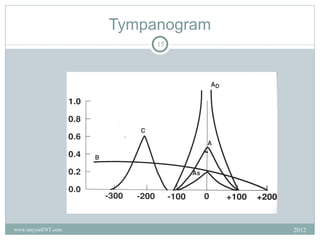
 Tympanometry (sensitivity 96 %)
   Assess compliance of TM

   Mobility of TM on increase/ decrease of pressure in EAM

   Graphic representation

   4 patterns

      A/As/Ad/B/C
   In OME – B & C

 William’s test for ET patency


www.nayyarENT.com                                        2012
Tympanogram
                         15


www.nayyarENT.com                 2012
Newer methods
                           16

 Sonotubometry


 Acoustic reflectometry


www.nayyarENT.com                   2012
Evaluation
                                       17

 Radiology
   Xray Skull Lateral View

     Adenoid Hyperplasia
   Xray Mastoid Schuller’s View

     Clouding
   MRI
          Absence of fluid does not imply an absence of OME, as one-third
           of patients in MRI study had fluid in mastoid, but not in the
           mesotympanum (Kew et al)


www.nayyarENT.com                                                       2012
Nasopharynx evaluation
                              18

 Post rhinoscopy
 Nasopharyngoscopy
 EBV titres (in adults)
   EBV IgA anti VCA

   EBV IgA anti EA


www.nayyarENT.com                            2012
Treatment
                                    19

 Medical Treatment
   Decongestants
        Systemic
           Triaminic Syr 5-10 ml 8 hrly
            • Phenylpropanolamine 12.5 mg/5ml
            • Chlorpheniramine 2 mg/5ml
           Actifed Tab ½ tab BD/ TDS
           Pseudoephedrine 25 mg
           Triprolidine 2.5 mg

        Local
           Nasivion – Oxymetazoline 0.05% drops
           Otrivin – Xylometazoline 0.1% drops


www.nayyarENT.com                                  2012
Treatment
                                       20

 Medical Treatment
   Anti-allergy measures
        Antihistamines – Azelastine 2mg daily x 8 wks proven to be
         beneficial
        Topical Nasal Steroids
      Surface tension lowering agent
          N acetyl cyteine 30 mg tds X 15 days beneficial
      Antibiotics (no long term benefit, can be used for initial 2
       wks)
        Amoxycillin
        Augmentin
      Middle Ear Aeration
        Valsalva Manouevre
        Politzerisation


www.nayyarENT.com                                                     2012
Treatment
                                       21

 Surgical Treatment
   Myringotomy
   Myringotomy with ventillation tubes (improves hearing by 12
    dB)
     Grommet
     T Tubes
   Adenoidectomy (improves hearing by 8 dB)
   Tonsillectomy
   Cortical Matoidectomy (in failure of ventilation tube cases)
   Research methods
        Percutaneous mastoid vent following CM
        CO2 assisted 2 mm circular perforation in AI quadrant for adult OME


www.nayyarENT.com                                                         2012
Ventilation tubes
                                   22

 Longer a tube stays in situ longer it can be
  potentially of benefit
 On other hand, longer a tube is in situ the greater the
  chance of complications
      Infection
      Granulation tissue
      Permanent perforation
      Thinning of TM with possible retraction
 However, in adults T-tubes are justified routinely, as
   in them OME is likely to be persistent over years
   rather than months

www.nayyarENT.com                                      2012
Types
                                    23
 Grommet Stay upto 6 mths
 T tubes stay upto 1-2 yrs
 Materials for tubes
   Silicone
   Teflon
   Stainless steel
   Titanium
   Gold

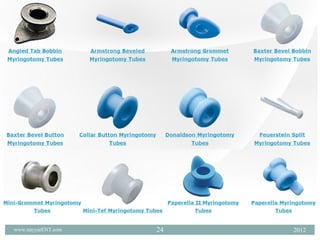
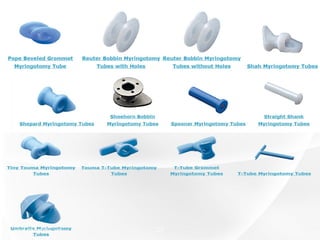
 Few names (see photographs on next slide)
   Shepard
   Armstrong
   Reuter Bobbin
   Goodle

 Can be inserted AI or PI quad
 Stay longer in AI quadrant
 Guttenplan et al. (scott brown)  no difference in radial vs
   circumferential incision
www.nayyarENT.com                                                2012
www.nayyarENT.com   24   2012
www.nayyarENT.com   25   2012
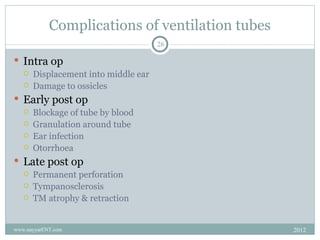
Complications of ventilation tubes
                                      26

 Intra op
      Displacement into middle ear
      Damage to ossicles
 Early post op
      Blockage of tube by blood
      Granulation around tube
      Ear infection
      Otorrhoea
 Late post op
      Permanent perforation
      Tympanosclerosis
      TM atrophy & retraction


www.nayyarENT.com                                2012
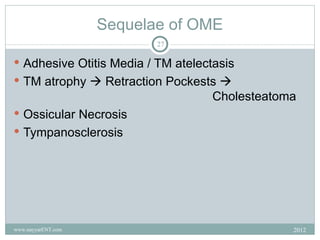
Sequelae of OME
                           27

 Adhesive Otitis Media / TM atelectasis
 TM atrophy  Retraction Pockests 
                                    Cholesteatoma
 Ossicular Necrosis
 Tympanosclerosis


www.nayyarENT.com                               2012
28


                    Thank You


www.nayyarENT.com               2012

Otitis media with effusion ome

  • 1.
    OTITIS MEDIA WITHEFFUSION (OME) 1 DR. SUPREET SINGH NAYYAR, AFMC www.nayyarENT.com 2012
  • 2.
    Synonyms 2 Serous Otitis Media Secretory Otitis Media “Glue Ear” www.nayyarENT.com 2012
  • 3.
    Definition 3  Chronic accumulation of mucus within middle ear and sometimes mastoid air cell system  Time that fluid has to be present for the condition to be chronic is usually taken as 12 weeks (Scott Brown)  Affects children  Insidious onset  Sterile effusion in middle ear  Behind an intact but retracted TM  With hearing loss www.nayyarENT.com 2012
  • 4.
    Epidemiology 4  First Episode  50% of all children- before the first birthday  80% of all children - before the third birthday  Scott Brown – Prevalence bimodal at 2 & 5 yrs when child first attends playgroup school & when goes to primary school  Above 15 yrs  prevalence 0.6%  More during winters  More than a third of consultations to pediatricians each year  Each episode of ASOM increases odd ratio of developing OME by 12  Chinese children have lower prevalence  M>F www.nayyarENT.com 2012
  • 5.
    Aetiology 5 ET Dysfunction  Obstruction  Adenoid hyperplasia  Tumours (nasopharyngeal carcinoma)  Palatal defects  Barotrauma  Hyperbaric oxygen therapy  Oedema during radiation therapy  Spread of Infection  Chronic adenoiditis  Chronic rhino-sinusitis  Chronic tonsillitis  High prevalence in HIV patients www.nayyarENT.com 2012
  • 6.
    Aetiology contd. 6 Increased Secretions  Allergy  Milk  Cigarette smoke (specially mother smoking)  GERD  Infections  Unresolved AOM  Viral Infections www.nayyarENT.com 2012
  • 7.
    Pathogenesis 7  Eustachian tube dysfunction  Failure of aeration  Failure of drainage  Increased secretion in ME  Increase in secretory glands  Spontaneous resolution if  Drainage via ET restablished  Perforation of the tympanic membrane  If both continue  OME www.nayyarENT.com 2012
  • 8.
    Risk Factors: Host 8  Age < 2 years  Gender ( Males > Females)  Race (Caucasian)  Genetic predisposition  Sibling with history of OME  Down’s syndrome, cleft palate, tumors, immunodeficiency states  Poor mastoid pneumatization  Maxillectomy  Prolonged intubation  Cystic fibrosis www.nayyarENT.com 2012
  • 9.
    Risk Factors: Environment 9  Allergies  Second hand smoke + wood burning stoves  Not breastfeeding  Seasonal - winters  Attending day care centre with > 4 children  Low socioeconomic group  Use of pacifiers www.nayyarENT.com 2012
  • 10.
    Clinical Features: Symptoms 10  Hearing loss  Mild otalgia  Ear fullness  Tinnitus  Children  Delayed Speech  Poor Academics www.nayyarENT.com 2012
  • 11.
    Clinical Features: Signs 11  Hearing Loss - TFT  Otoscopy (sensitivity 85 – 93%)  Signs of retraction  Loss of light reflex  Colour – Yellow/Grey/ Blue  Stage of retraction  Signs of Effusion  Air Bubbles  Fluid Levels www.nayyarENT.com 2012
  • 12.
    Clinical Features: Signs 12  Pneumatic Otoscopy  Used to assess the mobility and position of TM  Observe TM movement by  Increasing Pressure in EAM – Siegel’s  Increasing pressure in ME - Valsalva  Mobile/ Partially Mobile/ Immobile www.nayyarENT.com 2012
  • 13.
    Evaluation 13  Audiometry (sensitivity 92 %)  Pure Tone Audiometry  Bilateral Conductive Hearng Loss  Air-Bone Gap  20 – 40 dB www.nayyarENT.com 2012
  • 14.
    Evaluation 14  Tympanometry (sensitivity 96 %)  Assess compliance of TM  Mobility of TM on increase/ decrease of pressure in EAM  Graphic representation  4 patterns  A/As/Ad/B/C  In OME – B & C  William’s test for ET patency www.nayyarENT.com 2012
  • 15.
    Tympanogram 15 www.nayyarENT.com 2012
  • 16.
    Newer methods 16  Sonotubometry  Acoustic reflectometry www.nayyarENT.com 2012
  • 17.
    Evaluation 17  Radiology  Xray Skull Lateral View  Adenoid Hyperplasia  Xray Mastoid Schuller’s View  Clouding  MRI  Absence of fluid does not imply an absence of OME, as one-third of patients in MRI study had fluid in mastoid, but not in the mesotympanum (Kew et al) www.nayyarENT.com 2012
  • 18.
    Nasopharynx evaluation 18  Post rhinoscopy  Nasopharyngoscopy  EBV titres (in adults)  EBV IgA anti VCA  EBV IgA anti EA www.nayyarENT.com 2012
  • 19.
    Treatment 19  Medical Treatment  Decongestants  Systemic  Triaminic Syr 5-10 ml 8 hrly • Phenylpropanolamine 12.5 mg/5ml • Chlorpheniramine 2 mg/5ml  Actifed Tab ½ tab BD/ TDS  Pseudoephedrine 25 mg  Triprolidine 2.5 mg  Local  Nasivion – Oxymetazoline 0.05% drops  Otrivin – Xylometazoline 0.1% drops www.nayyarENT.com 2012
  • 20.
    Treatment 20  Medical Treatment  Anti-allergy measures  Antihistamines – Azelastine 2mg daily x 8 wks proven to be beneficial  Topical Nasal Steroids  Surface tension lowering agent  N acetyl cyteine 30 mg tds X 15 days beneficial  Antibiotics (no long term benefit, can be used for initial 2 wks)  Amoxycillin  Augmentin  Middle Ear Aeration  Valsalva Manouevre  Politzerisation www.nayyarENT.com 2012
  • 21.
    Treatment 21  Surgical Treatment  Myringotomy  Myringotomy with ventillation tubes (improves hearing by 12 dB)  Grommet  T Tubes  Adenoidectomy (improves hearing by 8 dB)  Tonsillectomy  Cortical Matoidectomy (in failure of ventilation tube cases)  Research methods  Percutaneous mastoid vent following CM  CO2 assisted 2 mm circular perforation in AI quadrant for adult OME www.nayyarENT.com 2012
  • 22.
    Ventilation tubes 22  Longer a tube stays in situ longer it can be potentially of benefit  On other hand, longer a tube is in situ the greater the chance of complications  Infection  Granulation tissue  Permanent perforation  Thinning of TM with possible retraction  However, in adults T-tubes are justified routinely, as in them OME is likely to be persistent over years rather than months www.nayyarENT.com 2012
  • 23.
    Types 23  Grommet Stay upto 6 mths  T tubes stay upto 1-2 yrs  Materials for tubes  Silicone  Teflon  Stainless steel  Titanium  Gold  Few names (see photographs on next slide)  Shepard  Armstrong  Reuter Bobbin  Goodle  Can be inserted AI or PI quad  Stay longer in AI quadrant  Guttenplan et al. (scott brown)  no difference in radial vs circumferential incision www.nayyarENT.com 2012
  • 24.
  • 25.
  • 26.
    Complications of ventilationtubes 26  Intra op  Displacement into middle ear  Damage to ossicles  Early post op  Blockage of tube by blood  Granulation around tube  Ear infection  Otorrhoea  Late post op  Permanent perforation  Tympanosclerosis  TM atrophy & retraction www.nayyarENT.com 2012
  • 27.
    Sequelae of OME 27  Adhesive Otitis Media / TM atelectasis  TM atrophy  Retraction Pockests  Cholesteatoma  Ossicular Necrosis  Tympanosclerosis www.nayyarENT.com 2012
  • 28.
    28 Thank You www.nayyarENT.com 2012