OVARIAN TUMOUR - an overview Sachin Maiti  MD,MRCOG,DFFP Research Registrar Wirral Hospital NHS Trust,UK
Epithelial Ovarian Tumour Most common gynaecological Malignancy in developed countries 15/100,000 4000 deaths/year 2/3 present in advanced stage Life time risk of ov ca = 1.5%, dying 1% 90% of ovarian tumours are epithelial origin
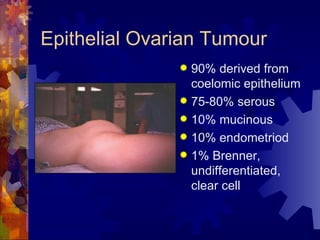
Epithelial Ovarian Tumour 90% derived from coelomic epithelium 75-80% serous 10% mucinous 10% endometriod 1% Brenner, undifferentiated, clear cell
Epithelial Ovarian Tumour Age 56 80-90 > 40 years, 30-40% >60 years 1 in 10 of ovarian tumour malignant <40 y 1 in 3 of ovarian tumour malignant >40 y 1% of ovarian tumours <20 y, 2/3 Germ CT 30% of ovarian tumours malignant in postmenopausal women
Epithelial Ovarian Tumour Prevention:- Pregnancy (RR 0.3-0.4) OCP (RR 0.5) 2 Children and OCP (RR 0.3) Oophorectomy
Epithelial Ovarian Tumour SCREENING:- TVS (1 in 10) Doppler US CA125 TVS+CA125 (1 in 4 laparotomy)
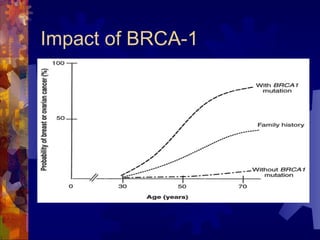
Hereditary Ovarian CA 5-10% BRCA1 & BRCA2 HNPCC AD, mutations Risk of ovarian ca 10years earlier  35-40% risk
Impact of BRCA-1
Differential Diagnosis Benign cyst Endometriosis PID Fibroids Pelvic Kidney Retroperitoneal tumours
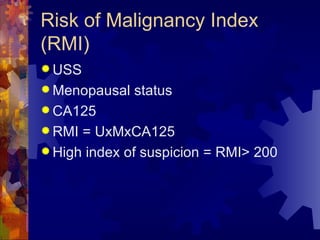
Risk of Malignancy Index (RMI) USS Menopausal status CA125 RMI = UxMxCA125 High index of suspicion = RMI> 200
Investigations History/Examination FBC, LFT, CA125 (CEA) USS/CT Chest X-ray Barium/Gastroscopy (if bowel symptoms) Endometrial sample (PMB)
CA125 Secreted by Mullarian & Coelomic epithelium >30 ku/l in PMW, risk of ov ca 36 fold  >96ku/l in PMW, PPV 96% Stage 1- 50% Stage 2- 60%
Poor prognostic factors High grade Aneuploidy Serous vs Mucinous Lymphatic invasion, Ascitis, positive cyto Clear cell histology Poor performance status Poor biochemical/haematological status
Borderline tumours Low malignant potential Confined to one ovary for long time Good prognosis, 86-90% Age 30-50years Metastatic implants can occur Late recurrence
Aim of Surgery Establish diagnosis Staging Primary Cytoreduction Interval/ Secondary cytoreduction Palliative & salvage surgery Laparoscopy/Aspiration NOT recommended
Treatment Surgery- cytoreduction <1-2cms TAH+BSO+Omental Biopsy+washings Bowel resection if impending obstruction Chemotherapy Stage >1C (>2A)  Carboplatin +Taxol
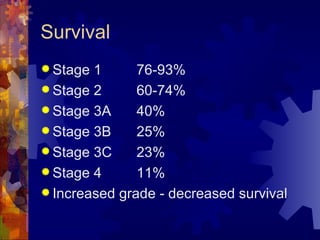
Survival Stage 1 76-93% Stage 2 60-74% Stage 3A 40% Stage 3B 25% Stage 3C 23% Stage 4 11% Increased grade - decreased survival
Non Epithelial Ovarian Tumour Uncommon, 10% of all ovarian ca Germ Cell Tumours Sex Cord Tumours Metastatic Tumours Rare- Sarcomas, Lipoid cell tumours Tumour markers- AFP, HCG, PALP, LDH
Germ Cell Tumours Arise from primordial germ cell 1/10 as common as testicular tumours Most arise from undifferentiated germ cell in ovary 20-30% of all ovarian neoplasia 3% malignant, rapidly growing <20years, 70% Germ CT, 1/3 malignant
Germ cell tumours Dysgerminomas 30-40% Teratomas (Immature/Mature) Monodermal Endodermal Sinus tumour (YST) Embryonal carcinomas Choriocarcinoma Mixed form
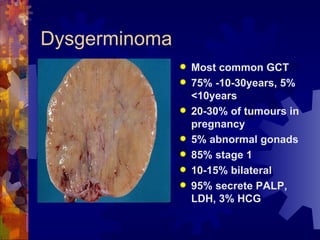
Dysgerminoma Most common GCT 75% -10-30years, 5% <10years 20-30% of tumours in pregnancy 5% abnormal gonads 85% stage 1 10-15% bilateral 95% secrete PALP, LDH, 3% HCG
Dysgerminomas Treatment - Surgery+ Chemotherapy Staging, USO Fertility preservation Stage 1A -surgery alone Stage 1B or higher - surgery+chemo BEP chemo Prognosis- 90-100%,
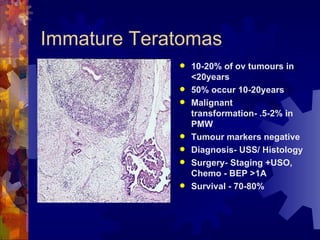
Immature Teratomas 10-20% of ov tumours in <20years 50% occur 10-20years Malignant transformation- .5-2% in PMW Tumour markers negative Diagnosis- USS/ Histology Surgery- Staging +USO, Chemo - BEP >1A Survival - 70-80%
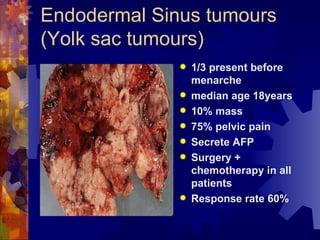
Endodermal Sinus tumours (Yolk sac tumours) 1/3 present before menarche median age 18years 10% mass 75% pelvic pain Secrete AFP Surgery + chemotherapy in all patients  Response rate 60%
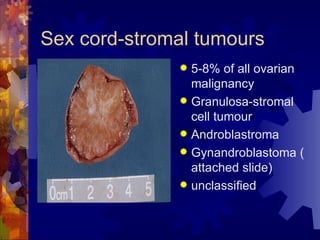
Sex cord-stromal tumours 5-8% of all ovarian malignancy Granulosa-stromal cell tumour Androblastroma Gynandroblastoma ( attached slide) unclassified
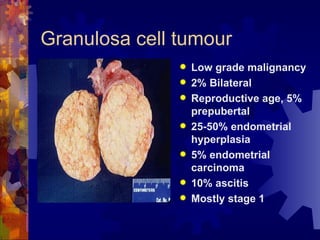
Granulosa cell tumour Low grade malignancy 2% Bilateral Reproductive age, 5% prepubertal 25-50% endometrial hyperplasia 5% endometrial carcinoma 10% ascitis Mostly stage 1
GCT Recurrence 5-30years Haematogenous spread Secrete Inhibin Treatment-Surgery- USO/TAHBSO Chemotherapy no benefit recurrence BEP 90% 10 year survival, 75% 20 year survival
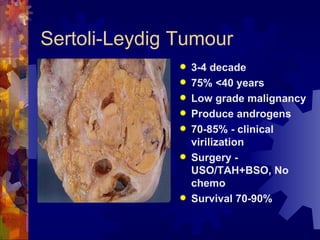
Sertoli-Leydig Tumour 3-4 decade 75% <40 years Low grade malignancy Produce androgens 70-85% - clinical virilization Surgery - USO/TAH+BSO, No chemo Survival 70-90%
Metastatic Tumours 5-6% of ovarian tumours Breast, GIT Tubal 13% Endometrial 5% Breast 24% Krukenburg 30-40% of metastatic ov ca (primary- stomach, colon, breast, biliary T)
Thank you

ovarian tumor

  • 1.
    OVARIAN TUMOUR -an overview Sachin Maiti MD,MRCOG,DFFP Research Registrar Wirral Hospital NHS Trust,UK
  • 2.
    Epithelial Ovarian TumourMost common gynaecological Malignancy in developed countries 15/100,000 4000 deaths/year 2/3 present in advanced stage Life time risk of ov ca = 1.5%, dying 1% 90% of ovarian tumours are epithelial origin
  • 3.
    Epithelial Ovarian Tumour90% derived from coelomic epithelium 75-80% serous 10% mucinous 10% endometriod 1% Brenner, undifferentiated, clear cell
  • 4.
    Epithelial Ovarian TumourAge 56 80-90 > 40 years, 30-40% >60 years 1 in 10 of ovarian tumour malignant <40 y 1 in 3 of ovarian tumour malignant >40 y 1% of ovarian tumours <20 y, 2/3 Germ CT 30% of ovarian tumours malignant in postmenopausal women
  • 5.
    Epithelial Ovarian TumourPrevention:- Pregnancy (RR 0.3-0.4) OCP (RR 0.5) 2 Children and OCP (RR 0.3) Oophorectomy
  • 6.
    Epithelial Ovarian TumourSCREENING:- TVS (1 in 10) Doppler US CA125 TVS+CA125 (1 in 4 laparotomy)
  • 7.
    Hereditary Ovarian CA5-10% BRCA1 & BRCA2 HNPCC AD, mutations Risk of ovarian ca 10years earlier 35-40% risk
  • 8.
  • 9.
    Differential Diagnosis Benigncyst Endometriosis PID Fibroids Pelvic Kidney Retroperitoneal tumours
  • 10.
    Risk of MalignancyIndex (RMI) USS Menopausal status CA125 RMI = UxMxCA125 High index of suspicion = RMI> 200
  • 11.
    Investigations History/Examination FBC,LFT, CA125 (CEA) USS/CT Chest X-ray Barium/Gastroscopy (if bowel symptoms) Endometrial sample (PMB)
  • 12.
    CA125 Secreted byMullarian & Coelomic epithelium >30 ku/l in PMW, risk of ov ca 36 fold >96ku/l in PMW, PPV 96% Stage 1- 50% Stage 2- 60%
  • 13.
    Poor prognostic factorsHigh grade Aneuploidy Serous vs Mucinous Lymphatic invasion, Ascitis, positive cyto Clear cell histology Poor performance status Poor biochemical/haematological status
  • 14.
    Borderline tumours Lowmalignant potential Confined to one ovary for long time Good prognosis, 86-90% Age 30-50years Metastatic implants can occur Late recurrence
  • 15.
    Aim of SurgeryEstablish diagnosis Staging Primary Cytoreduction Interval/ Secondary cytoreduction Palliative & salvage surgery Laparoscopy/Aspiration NOT recommended
  • 16.
    Treatment Surgery- cytoreduction<1-2cms TAH+BSO+Omental Biopsy+washings Bowel resection if impending obstruction Chemotherapy Stage >1C (>2A) Carboplatin +Taxol
  • 17.
    Survival Stage 176-93% Stage 2 60-74% Stage 3A 40% Stage 3B 25% Stage 3C 23% Stage 4 11% Increased grade - decreased survival
  • 18.
    Non Epithelial OvarianTumour Uncommon, 10% of all ovarian ca Germ Cell Tumours Sex Cord Tumours Metastatic Tumours Rare- Sarcomas, Lipoid cell tumours Tumour markers- AFP, HCG, PALP, LDH
  • 19.
    Germ Cell TumoursArise from primordial germ cell 1/10 as common as testicular tumours Most arise from undifferentiated germ cell in ovary 20-30% of all ovarian neoplasia 3% malignant, rapidly growing <20years, 70% Germ CT, 1/3 malignant
  • 20.
    Germ cell tumoursDysgerminomas 30-40% Teratomas (Immature/Mature) Monodermal Endodermal Sinus tumour (YST) Embryonal carcinomas Choriocarcinoma Mixed form
  • 21.
    Dysgerminoma Most commonGCT 75% -10-30years, 5% <10years 20-30% of tumours in pregnancy 5% abnormal gonads 85% stage 1 10-15% bilateral 95% secrete PALP, LDH, 3% HCG
  • 22.
    Dysgerminomas Treatment -Surgery+ Chemotherapy Staging, USO Fertility preservation Stage 1A -surgery alone Stage 1B or higher - surgery+chemo BEP chemo Prognosis- 90-100%,
  • 23.
    Immature Teratomas 10-20%of ov tumours in <20years 50% occur 10-20years Malignant transformation- .5-2% in PMW Tumour markers negative Diagnosis- USS/ Histology Surgery- Staging +USO, Chemo - BEP >1A Survival - 70-80%
  • 24.
    Endodermal Sinus tumours(Yolk sac tumours) 1/3 present before menarche median age 18years 10% mass 75% pelvic pain Secrete AFP Surgery + chemotherapy in all patients Response rate 60%
  • 25.
    Sex cord-stromal tumours5-8% of all ovarian malignancy Granulosa-stromal cell tumour Androblastroma Gynandroblastoma ( attached slide) unclassified
  • 26.
    Granulosa cell tumourLow grade malignancy 2% Bilateral Reproductive age, 5% prepubertal 25-50% endometrial hyperplasia 5% endometrial carcinoma 10% ascitis Mostly stage 1
  • 27.
    GCT Recurrence 5-30yearsHaematogenous spread Secrete Inhibin Treatment-Surgery- USO/TAHBSO Chemotherapy no benefit recurrence BEP 90% 10 year survival, 75% 20 year survival
  • 28.
    Sertoli-Leydig Tumour 3-4decade 75% <40 years Low grade malignancy Produce androgens 70-85% - clinical virilization Surgery - USO/TAH+BSO, No chemo Survival 70-90%
  • 29.
    Metastatic Tumours 5-6%of ovarian tumours Breast, GIT Tubal 13% Endometrial 5% Breast 24% Krukenburg 30-40% of metastatic ov ca (primary- stomach, colon, breast, biliary T)
  • 30.