Solving
Exponential and
Logarithmic
Equations
• By the definition of a function, if u = v and f is
a function, then f(u) = f(v) [remember each input of a
function has one and only one output!]
• So, let’s say we have a function f(x) = b?,
then if u = v then bu = bv for all real #s b>0
• Likewise, if we have a function f(x) = logb?,
if u = v then logbu = logbv for all real #s b>0
• And because exponential and logarithmic
functions are one-to-one (i.e. their inverses
are also functions), then the converse is true:
– If bu = bv then u = v
– If logbu = logbv then u = v
Now, let’s use these
statements, (and all the other
properties for exponents and logarithms),
to solve:
Exponential and Logarithmic
equations
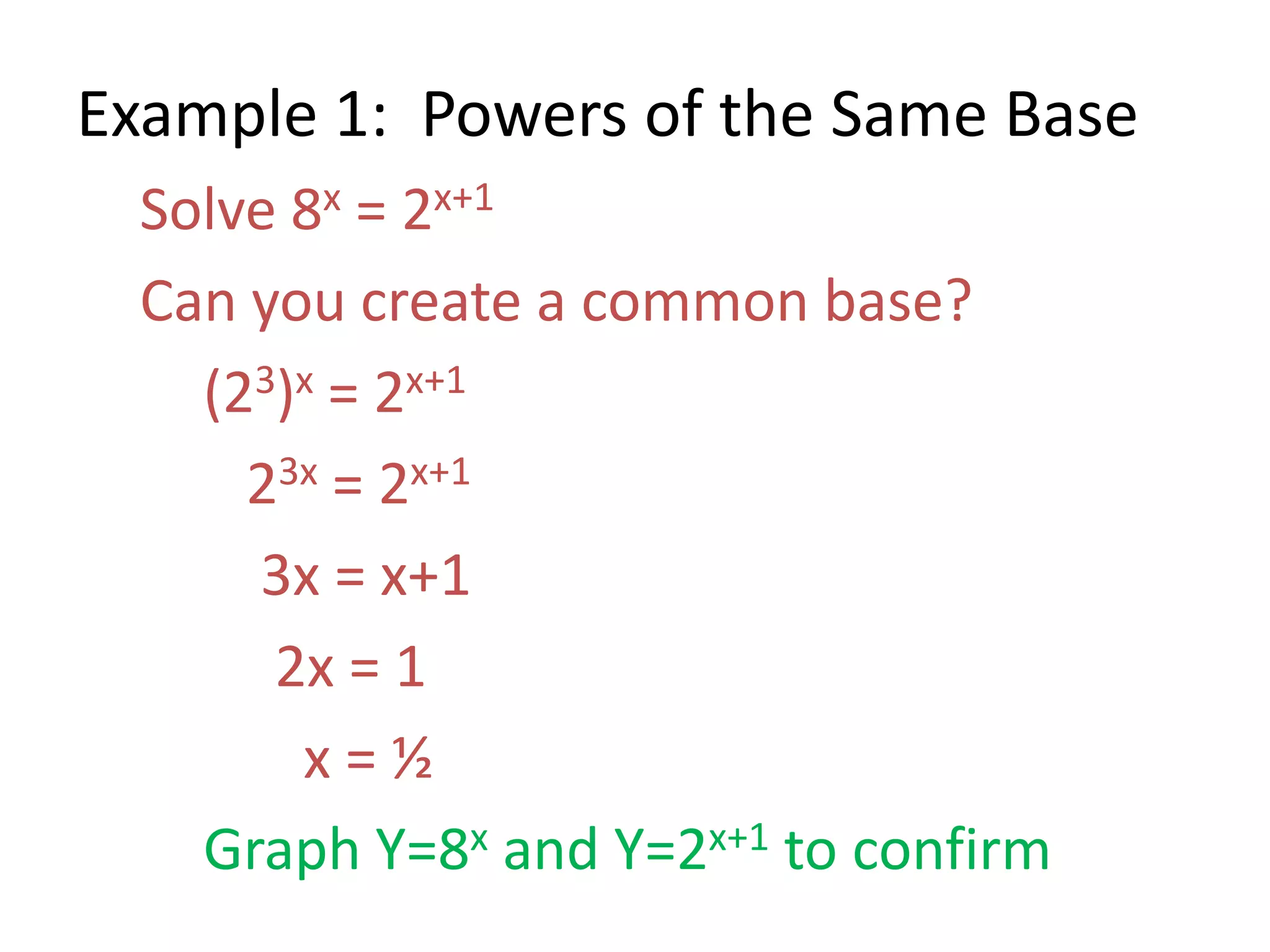
Example 1: Powers of the Same Base
Solve 8x = 2x+1
Can you create a common base?
(23)x = 2x+1
23x = 2x+1
3x = x+1
2x = 1
x = ½
Graph Y=8x and Y=2x+1 to confirm
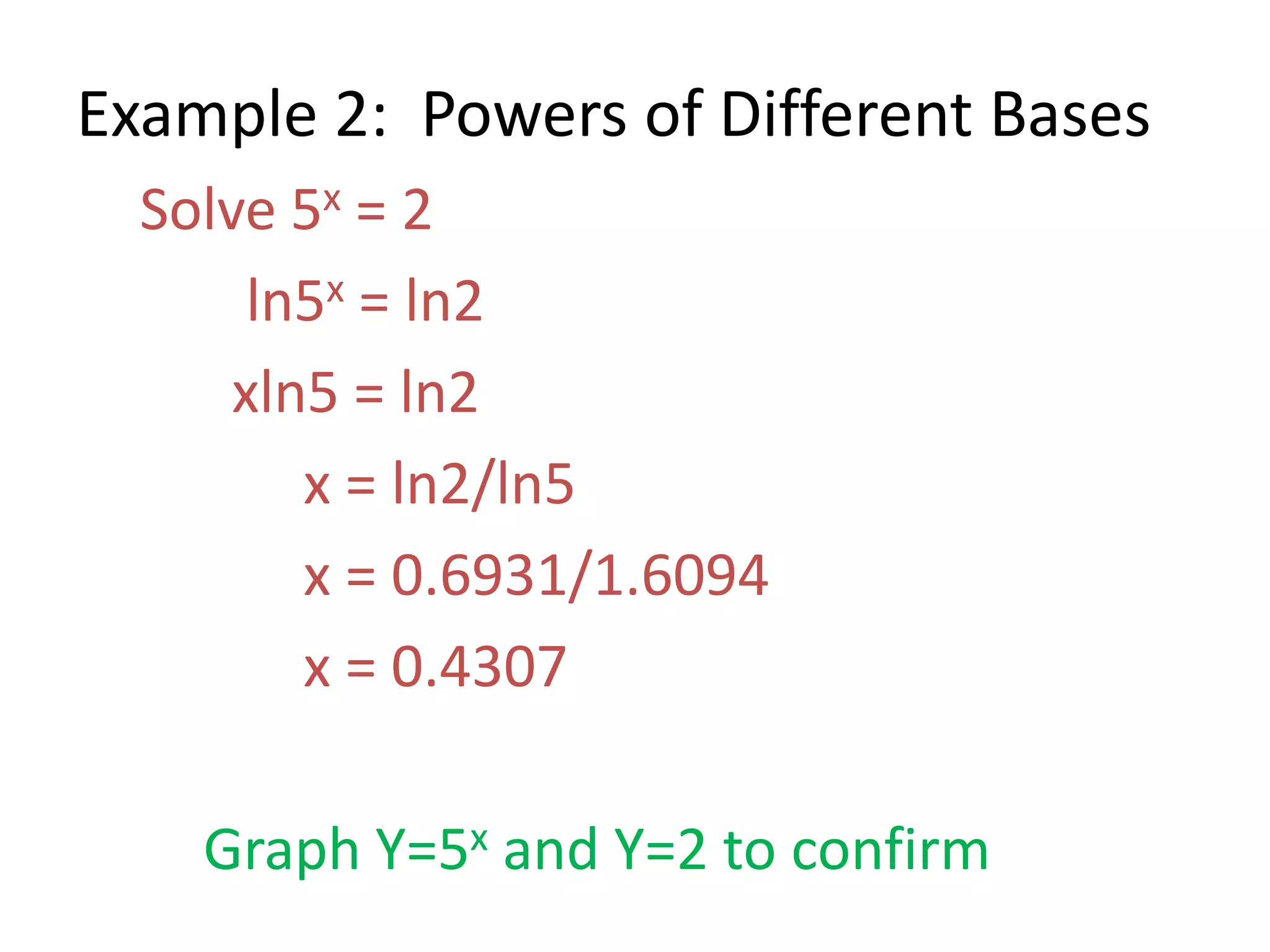
Example 2: Powers of Different Bases
Solve 5x = 2
ln5x = ln2
xln5 = ln2
x = ln2/ln5
x = 0.6931/1.6094
x = 0.4307
Graph Y=5x and Y=2 to confirm
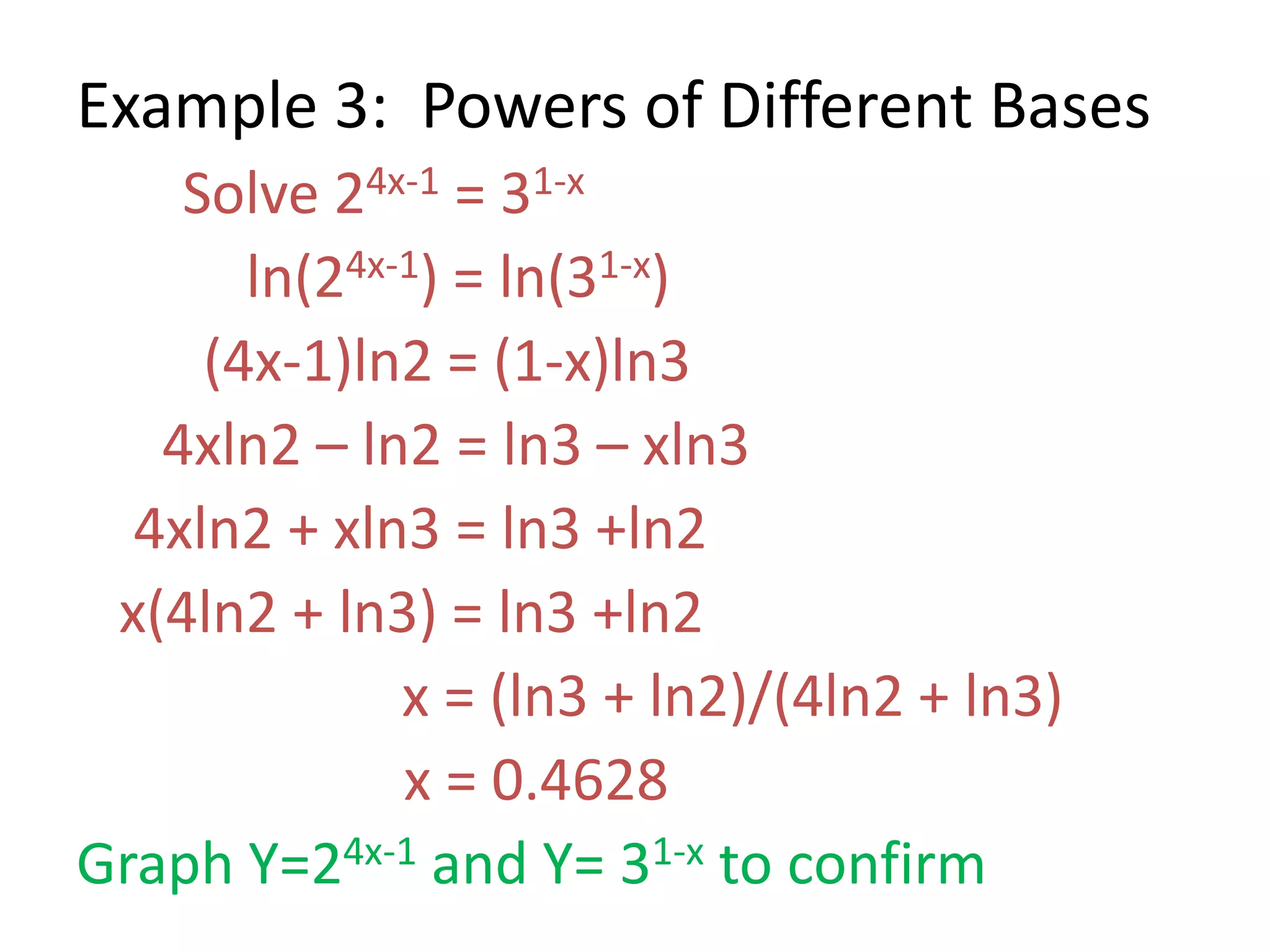
Example 3: Powers of Different Bases
Solve 24x-1 = 31-x
ln(24x-1) = ln(31-x)
(4x-1)ln2 = (1-x)ln3
4xln2 – ln2 = ln3 – xln3
4xln2 + xln3 = ln3 +ln2
x(4ln2 + ln3) = ln3 +ln2
x = (ln3 + ln2)/(4ln2 + ln3)
x = 0.4628
Graph Y=24x-1 and Y= 31-x to confirm
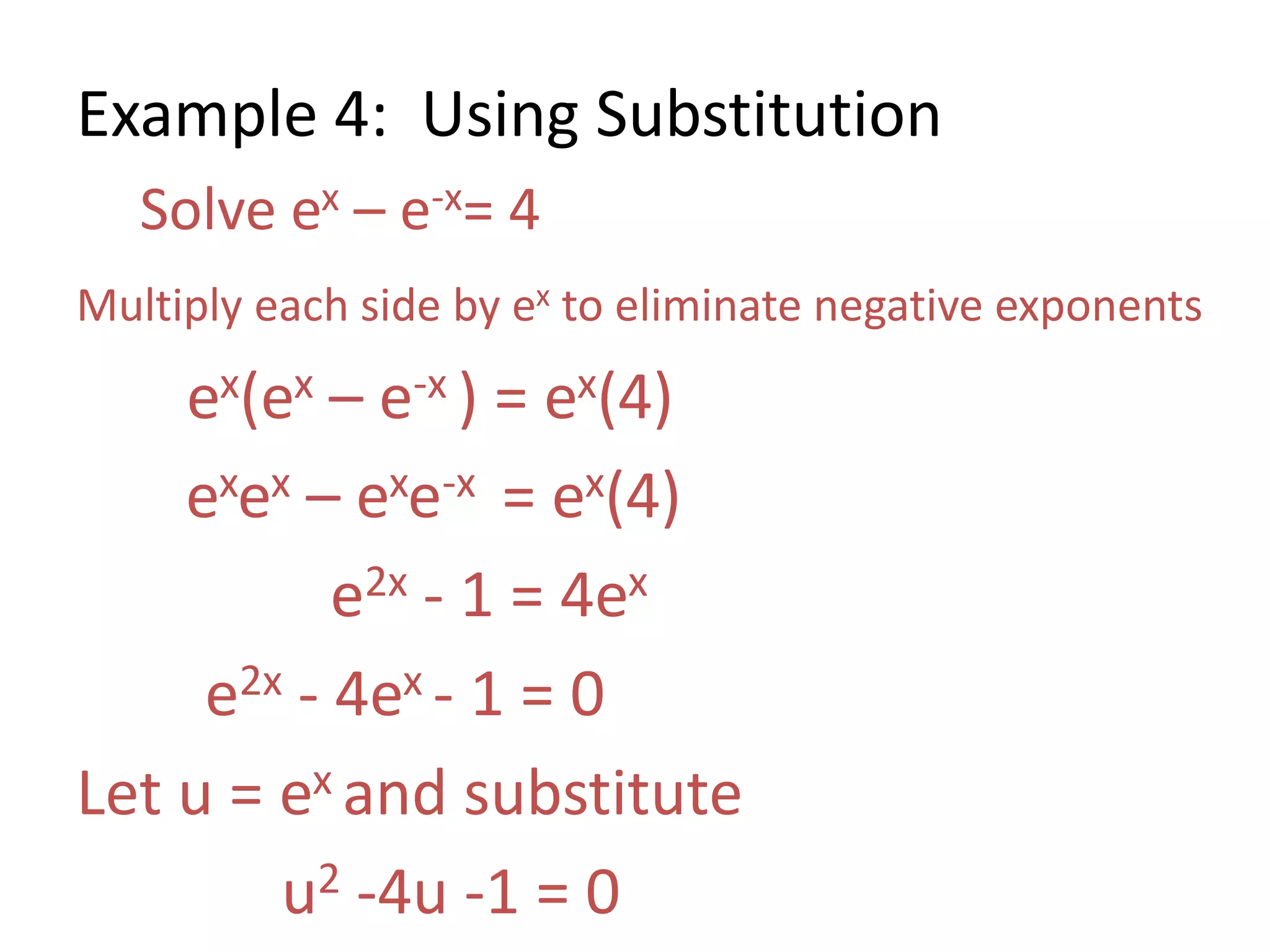
Example 4: Using Substitution
Solve ex – e-x= 4
Multiply each side by ex to eliminate negative exponents
ex(ex – e-x ) = ex(4)
exex – exe-x = ex(4)
e2x - 1 = 4ex
e2x - 4ex - 1 = 0
Let u = ex and substitute
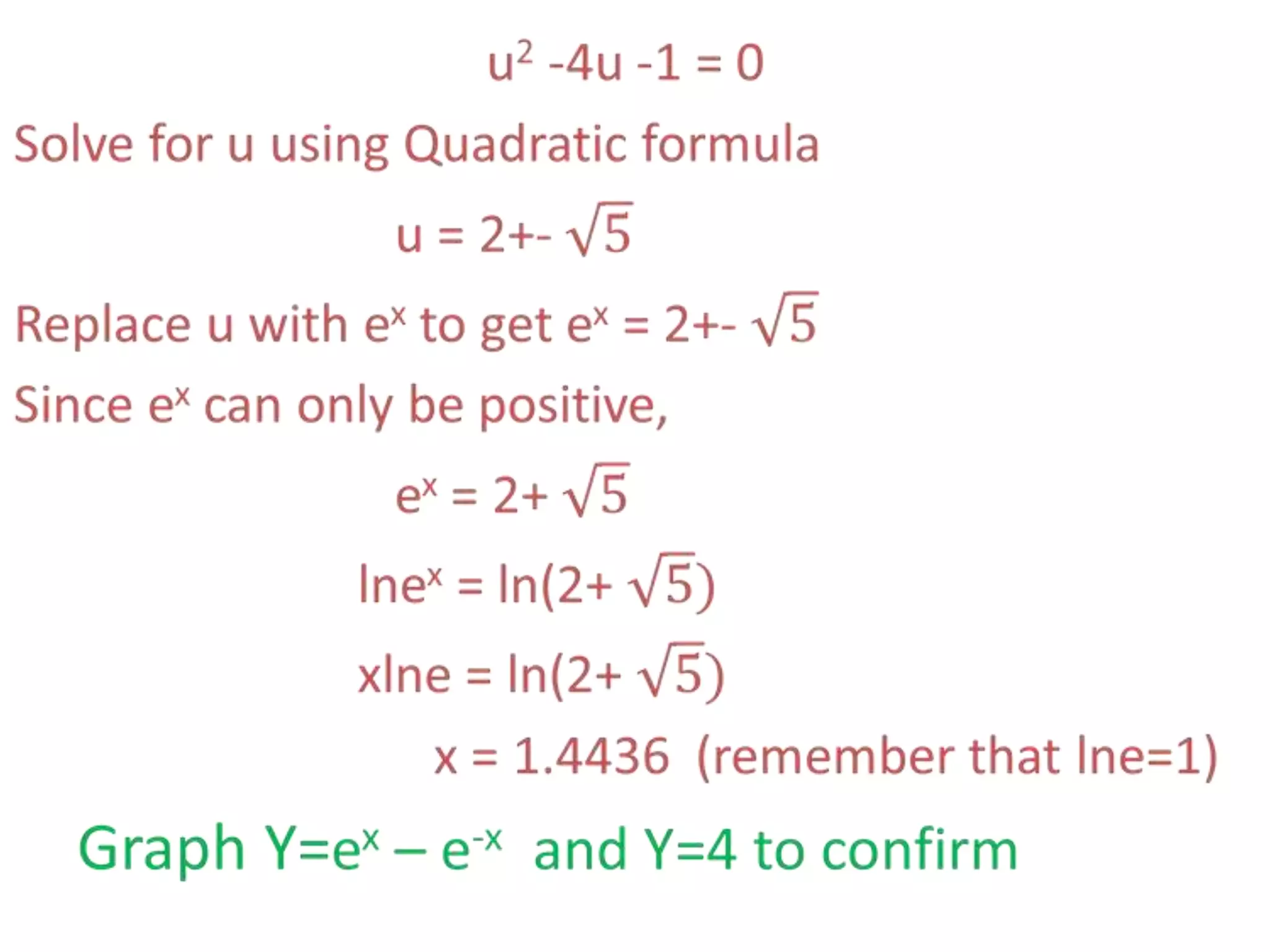
u2 -4u -1 = 0
Now, let’s do the same
thing by solving some real
world applications of
exponential equations
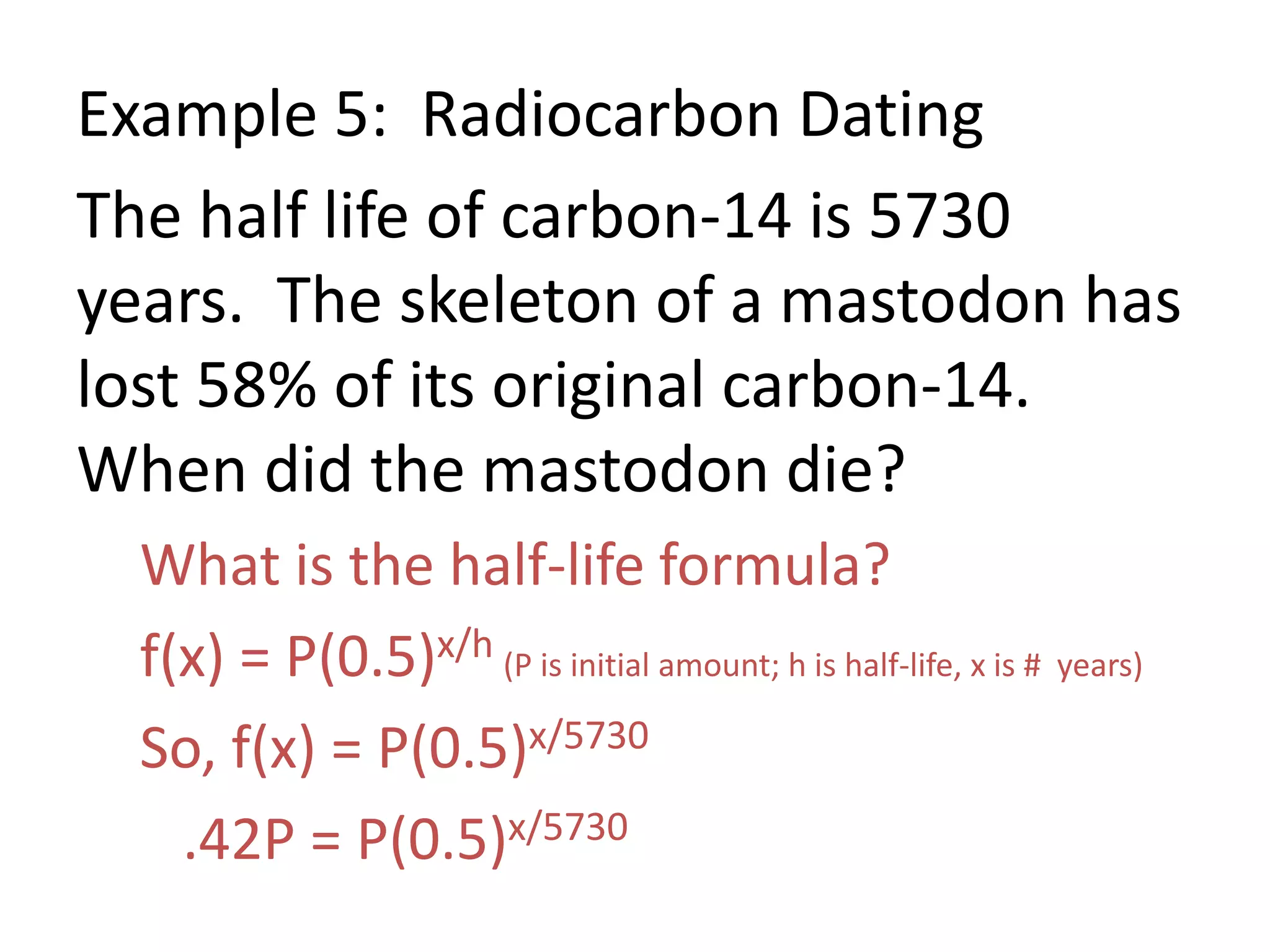
Example 5: Radiocarbon Dating
The half life of carbon-14 is 5730
years. The skeleton of a mastodon has
lost 58% of its original carbon-14.
When did the mastodon die?
What is the half-life formula?
f(x) = P(0.5)x/h (P is initial amount; h is half-life, x is # years)
So, f(x) = P(0.5)x/5730
.42P = P(0.5)x/5730
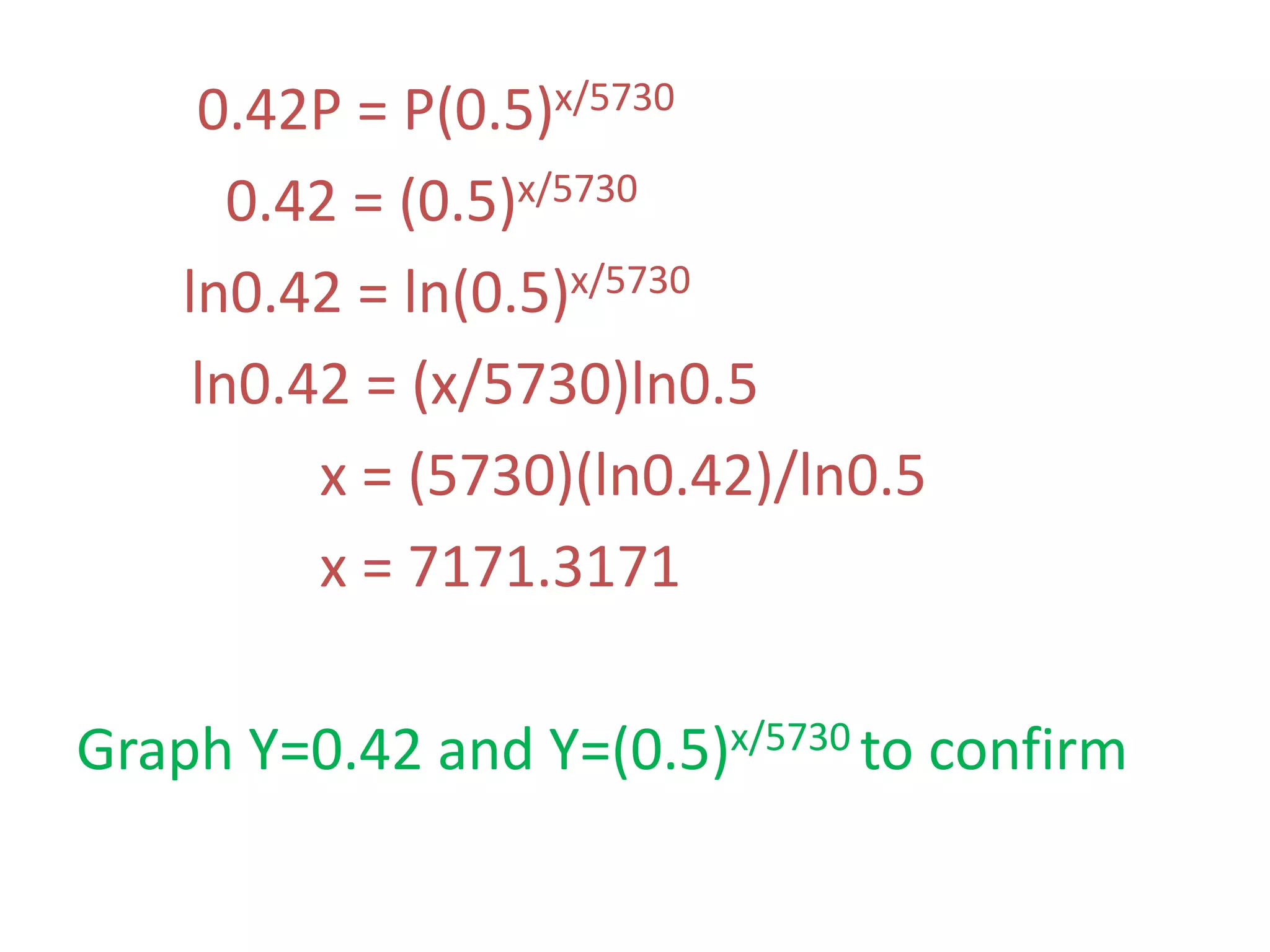
0.42P = P(0.5)x/5730
0.42 = (0.5)x/5730
ln0.42 = ln(0.5)x/5730
ln0.42 = (x/5730)ln0.5
x = (5730)(ln0.42)/ln0.5
x = 7171.3171
Graph Y=0.42 and Y=(0.5)x/5730 to confirm
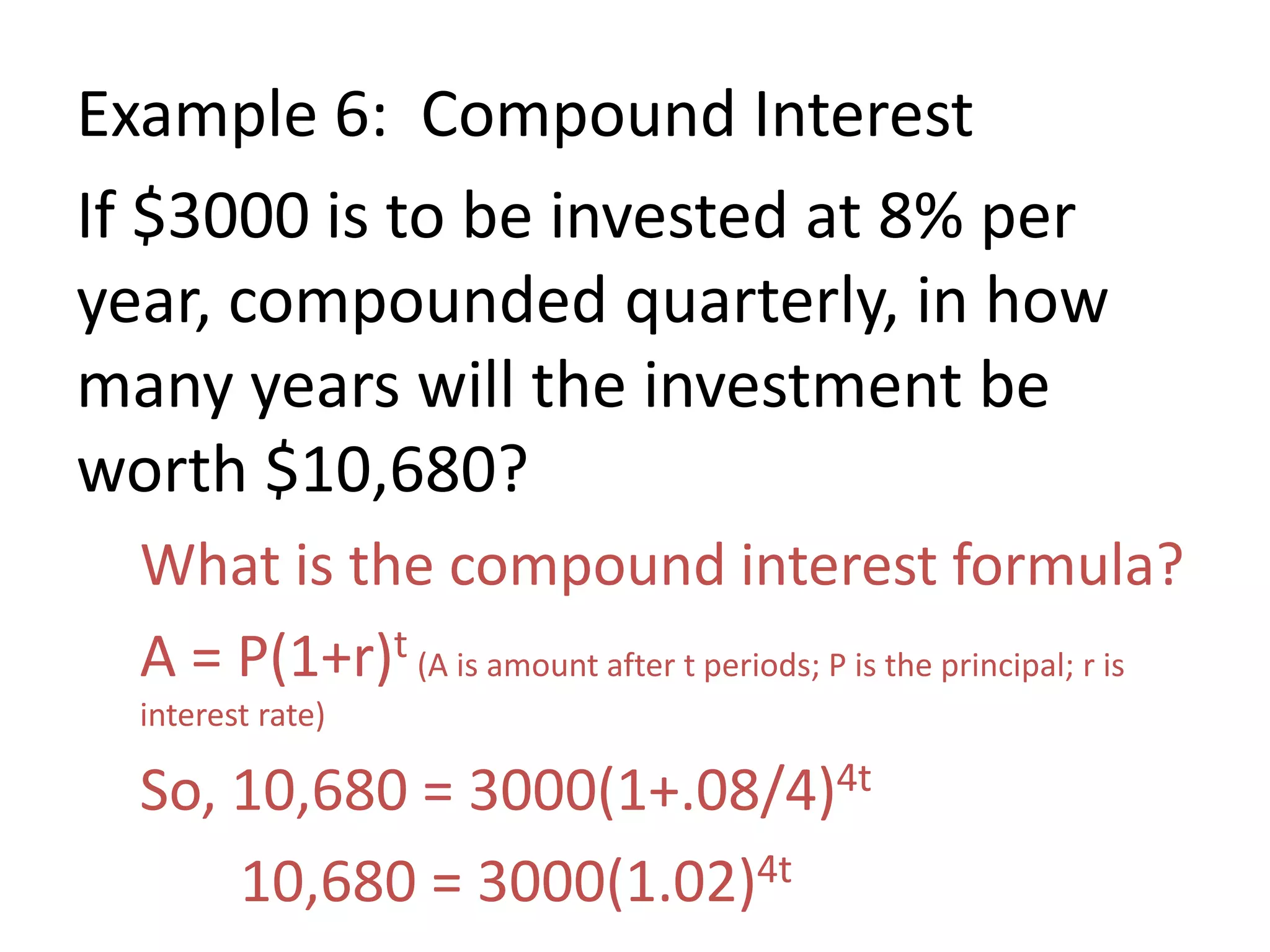
Example 6: Compound Interest
If $3000 is to be invested at 8% per
year, compounded quarterly, in how
many years will the investment be
worth $10,680?
What is the compound interest formula?
A = P(1+r)t (A is amount after t periods; P is the principal; r is
interest rate)
So, 10,680 = 3000(1+.08/4)4t
10,680 = 3000(1.02)4t
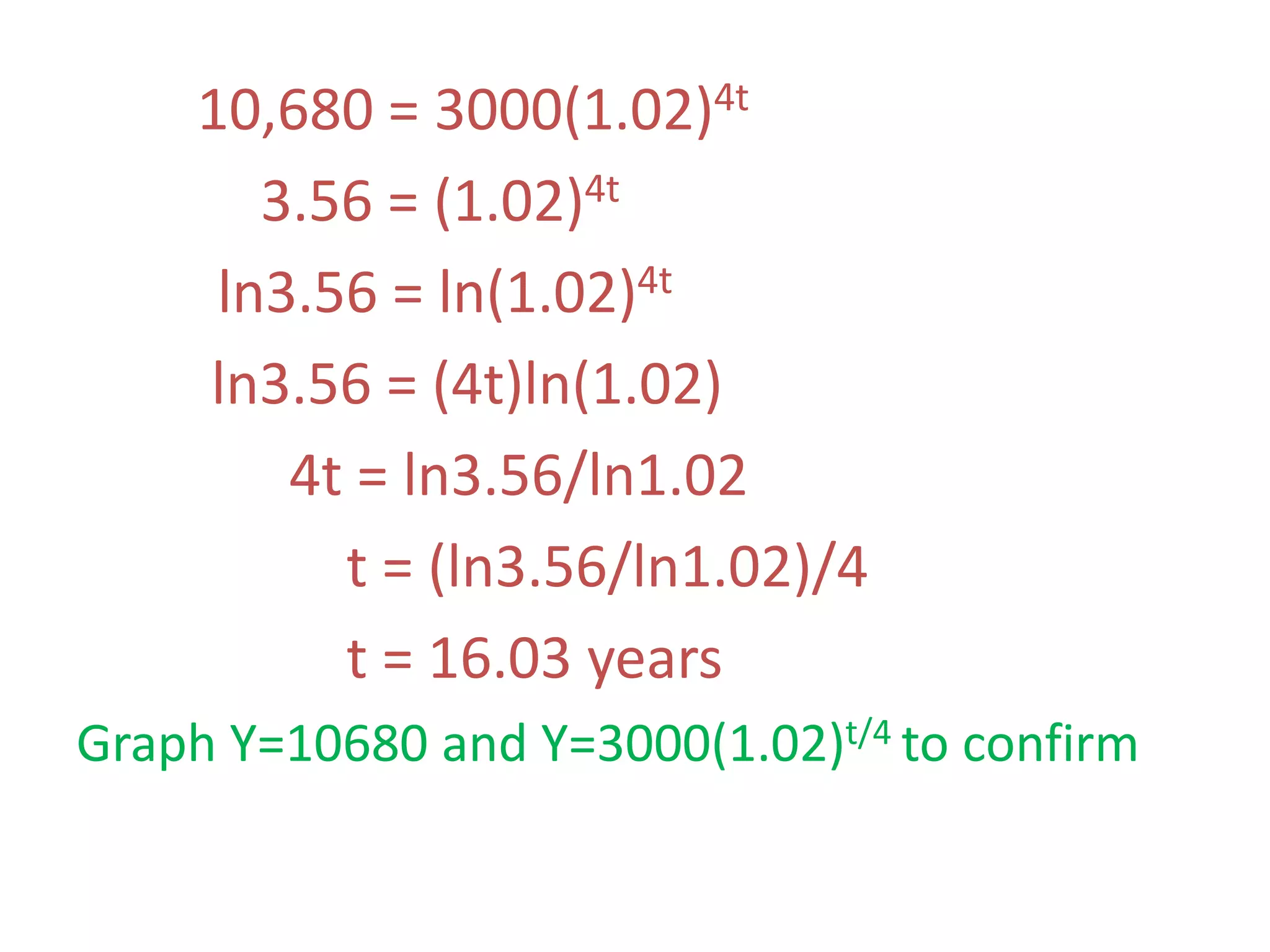
3.56 = (1.02)4t
ln3.56 = ln(1.02)4t
ln3.56 = (4t)ln(1.02)
4t = ln3.56/ln1.02
t = (ln3.56/ln1.02)/4
t = 16.03 years
Graph Y=10680 and Y=3000(1.02)t/4 to confirm
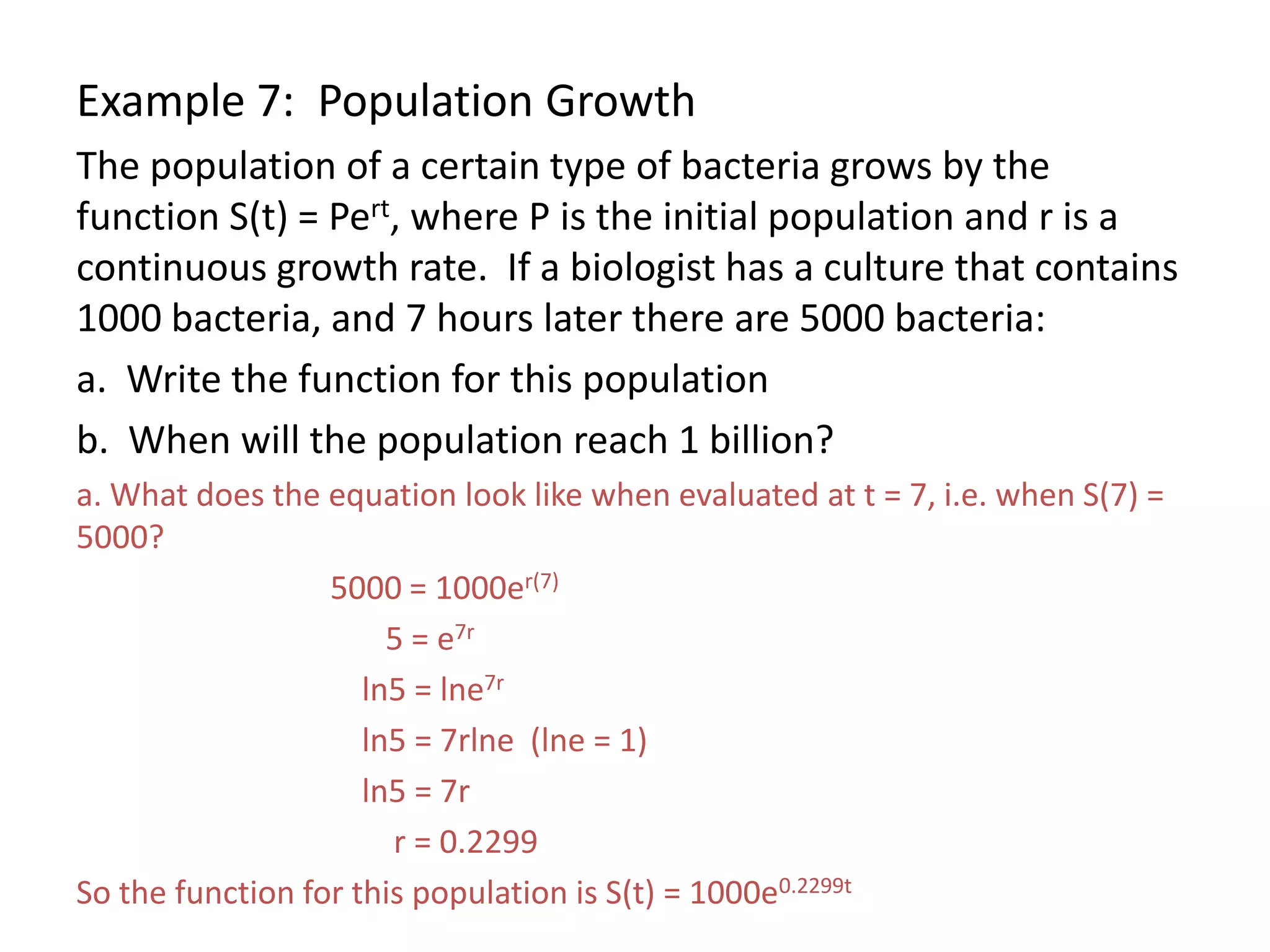
Example 7: Population Growth
The population of a certain type of bacteria grows by the
function S(t) = Pert, where P is the initial population and r is a
continuous growth rate. If a biologist has a culture that contains
1000 bacteria, and 7 hours later there are 5000 bacteria:
a. Write the function for this population
b. When will the population reach 1 billion?
a. What does the equation look like when evaluated at t = 7, i.e. when S(7) =
5000?
5000 = 1000er(7)
5 = e7r
ln5 = lne7r
ln5 = 7rlne (lne = 1)
ln5 = 7r
r = 0.2299
So the function for this population is S(t) = 1000e0.2299t
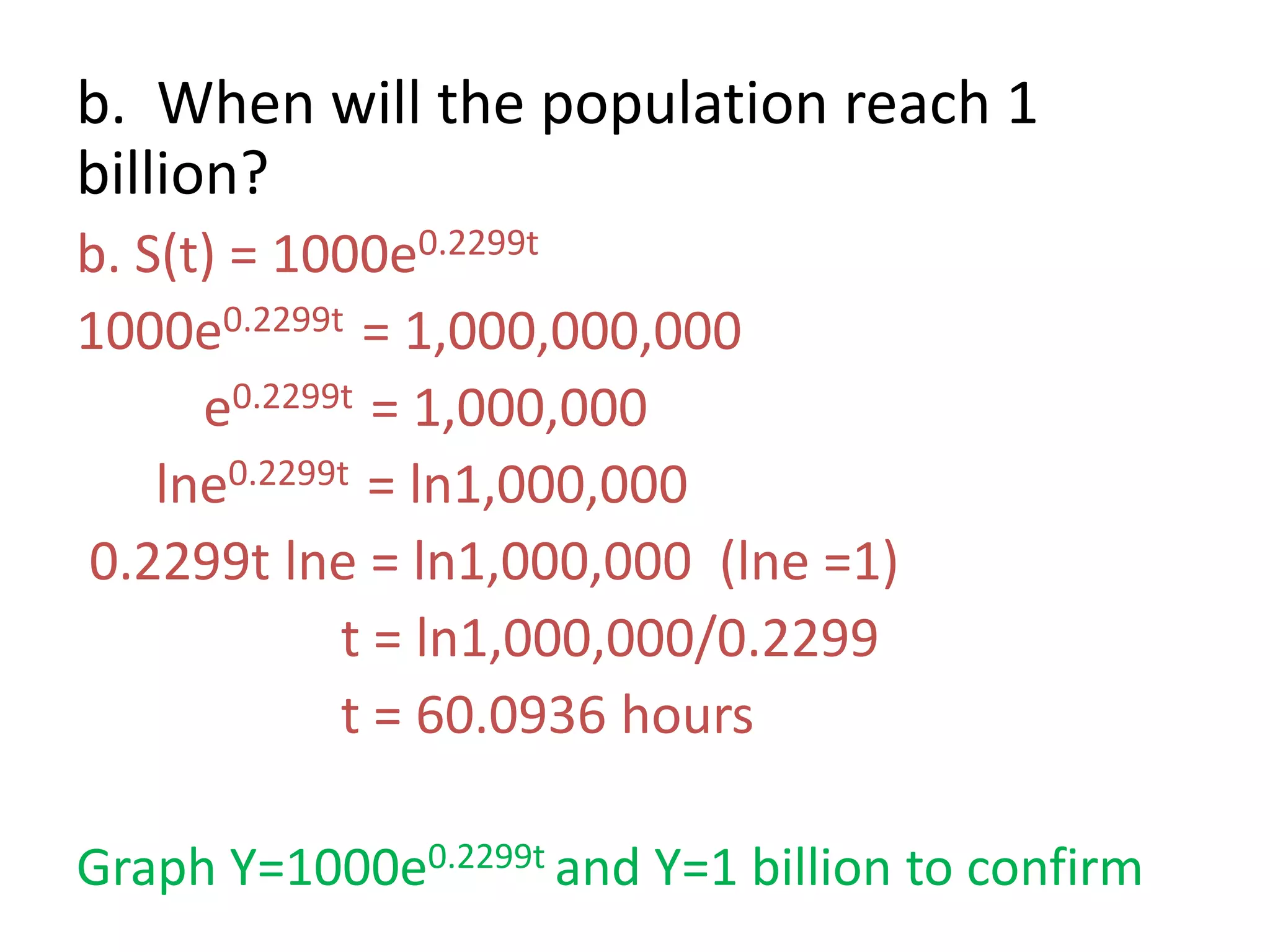
b. When will the population reach 1
billion?
b. S(t) = 1000e0.2299t
1000e0.2299t = 1,000,000,000
e0.2299t = 1,000,000
lne0.2299t = ln1,000,000
0.2299t lne = ln1,000,000 (lne =1)
t = ln1,000,000/0.2299
t = 60.0936 hours
Graph Y=1000e0.2299t and Y=1 billion to confirm
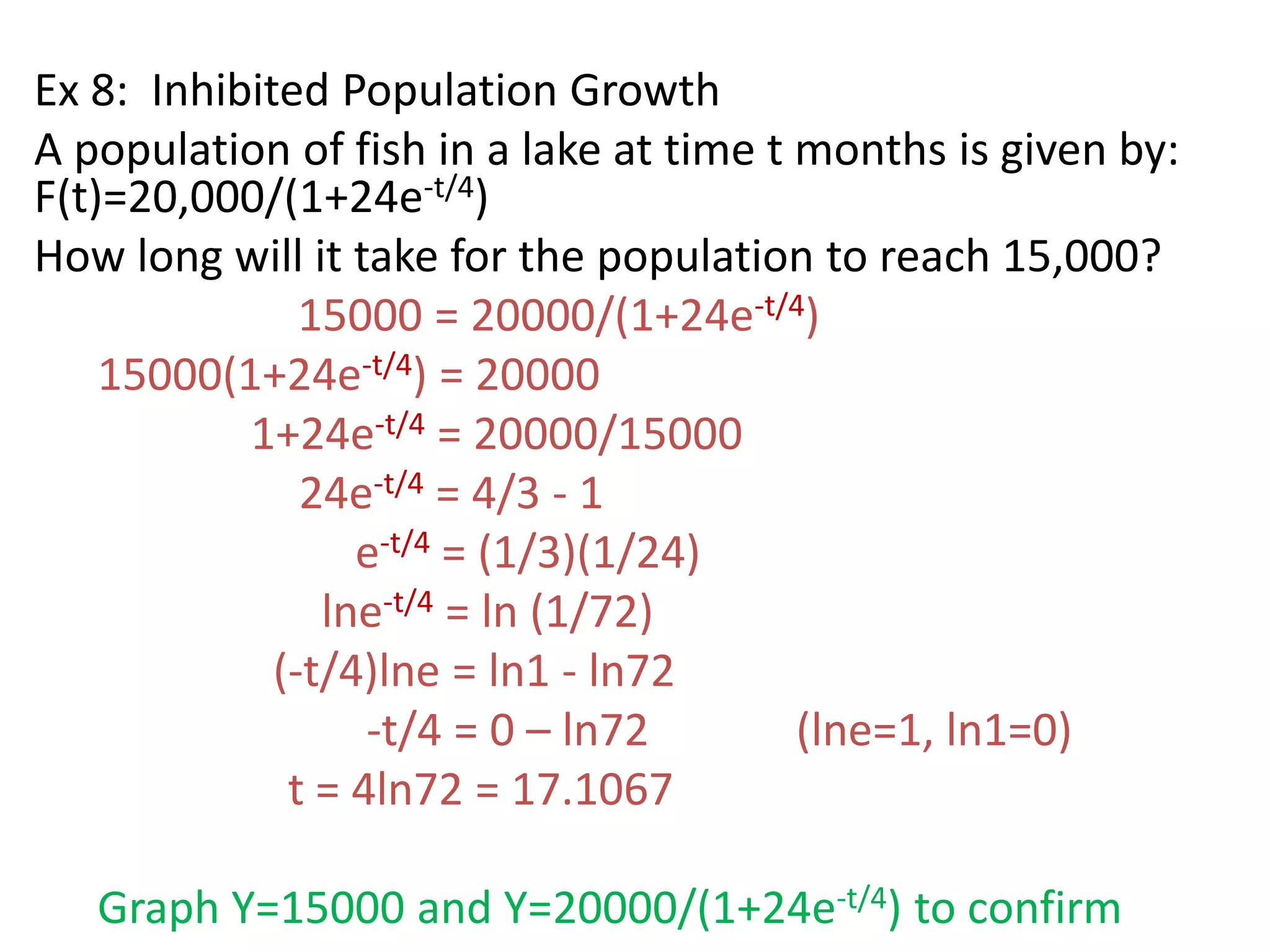
Ex 8: Inhibited Population Growth
A population of fish in a lake at time t months is given by:
F(t)=20,000/(1+24e-t/4)
How long will it take for the population to reach 15,000?
15000 = 20000/(1+24e-t/4)
15000(1+24e-t/4) = 20000
1+24e-t/4 = 20000/15000
24e-t/4 = 4/3 - 1
e-t/4 = (1/3)(1/24)
lne-t/4 = ln (1/72)
(-t/4)lne = ln1 - ln72
-t/4 = 0 – ln72 (lne=1, ln1=0)
t = 4ln72 = 17.1067
Graph Y=15000 and Y=20000/(1+24e-t/4) to confirm
Now, let’s solve some
logarithmic equations
using the properties of
one-to-one functions
to help
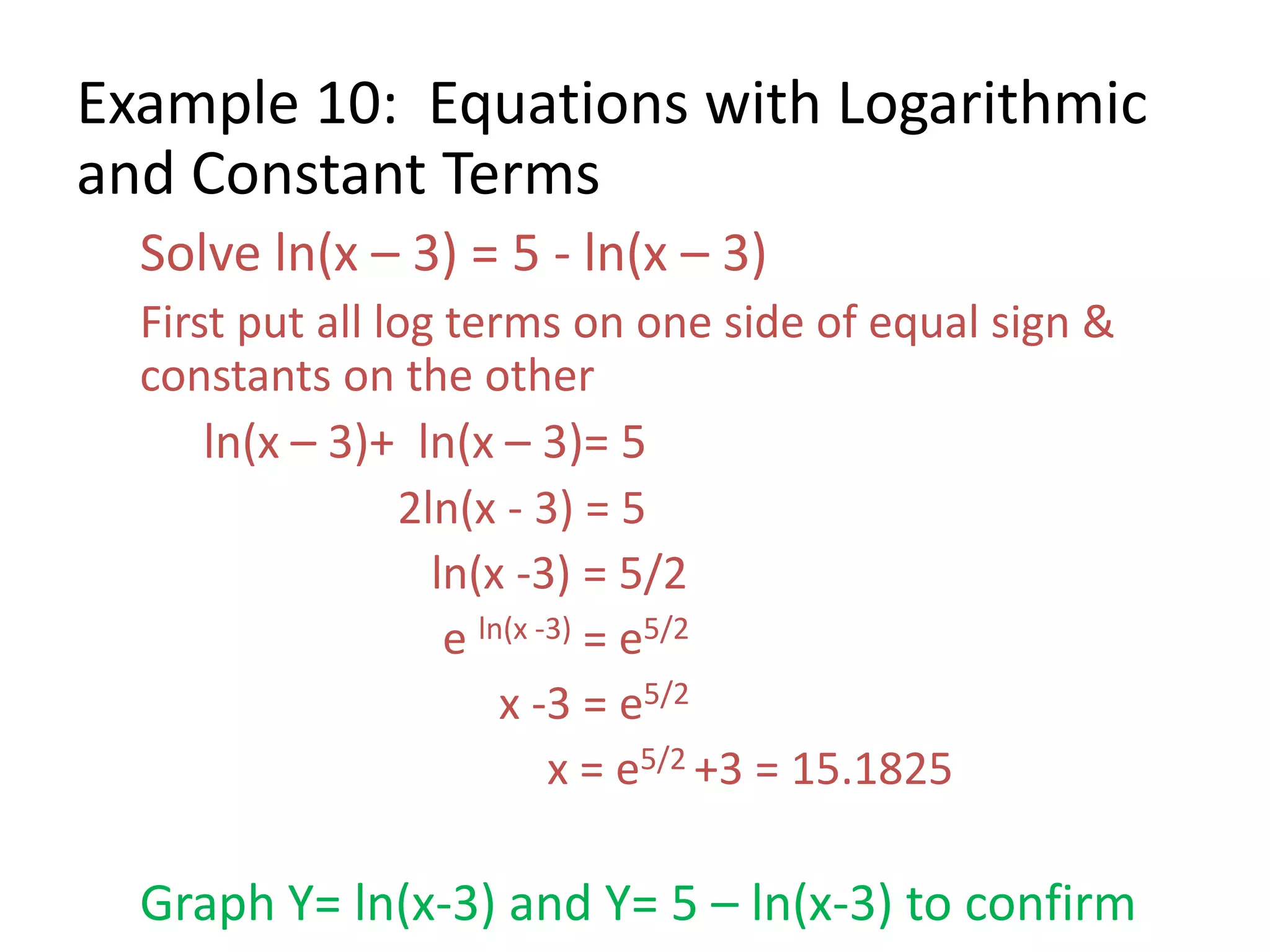
Example 10: Equations with Logarithmic
and Constant Terms
Solve ln(x – 3) = 5 - ln(x – 3)
First put all log terms on one side of equal sign &
constants on the other
ln(x – 3)+ ln(x – 3)= 5
2ln(x - 3) = 5
ln(x -3) = 5/2
e ln(x -3) = e5/2
x -3 = e5/2
x = e5/2 +3 = 15.1825
Graph Y= ln(x-3) and Y= 5 – ln(x-3) to confirm
Example 11: Equations with Logarithmic
and Constant Terms
Solve log(x – 16) = 2 - log(x – 1)
log(x – 16)+ log(x – 1) = 2
log[(x-16)(x-1)] = 2
log(x2 -17x +16) = 2
10 log(x2 -17x +16) = 102
x2 -17x +16 = 100
x2 -17x – 84 = 0
(x +4)(x – 21) = 0
x = -4 and 21, but log(x-16) and log(x-1) are not
defined for x = -4, so only x = 21 is valid
Graph Y= log(x-16) and Y= 2 – log(x-1) to confirm

5.6 solving exponential and logarithmic equations

  • 1.
  • 2.
    • By thedefinition of a function, if u = v and f is a function, then f(u) = f(v) [remember each input of a function has one and only one output!] • So, let’s say we have a function f(x) = b?, then if u = v then bu = bv for all real #s b>0 • Likewise, if we have a function f(x) = logb?, if u = v then logbu = logbv for all real #s b>0 • And because exponential and logarithmic functions are one-to-one (i.e. their inverses are also functions), then the converse is true: – If bu = bv then u = v – If logbu = logbv then u = v
  • 3.
    Now, let’s usethese statements, (and all the other properties for exponents and logarithms), to solve: Exponential and Logarithmic equations
  • 4.
    Example 1: Powersof the Same Base Solve 8x = 2x+1 Can you create a common base? (23)x = 2x+1 23x = 2x+1 3x = x+1 2x = 1 x = ½ Graph Y=8x and Y=2x+1 to confirm
  • 5.
    Example 2: Powersof Different Bases Solve 5x = 2 ln5x = ln2 xln5 = ln2 x = ln2/ln5 x = 0.6931/1.6094 x = 0.4307 Graph Y=5x and Y=2 to confirm
  • 6.
    Example 3: Powersof Different Bases Solve 24x-1 = 31-x ln(24x-1) = ln(31-x) (4x-1)ln2 = (1-x)ln3 4xln2 – ln2 = ln3 – xln3 4xln2 + xln3 = ln3 +ln2 x(4ln2 + ln3) = ln3 +ln2 x = (ln3 + ln2)/(4ln2 + ln3) x = 0.4628 Graph Y=24x-1 and Y= 31-x to confirm
  • 7.
    Example 4: UsingSubstitution Solve ex – e-x= 4 Multiply each side by ex to eliminate negative exponents ex(ex – e-x ) = ex(4) exex – exe-x = ex(4) e2x - 1 = 4ex e2x - 4ex - 1 = 0 Let u = ex and substitute u2 -4u -1 = 0
  • 9.
    Now, let’s dothe same thing by solving some real world applications of exponential equations
  • 10.
    Example 5: RadiocarbonDating The half life of carbon-14 is 5730 years. The skeleton of a mastodon has lost 58% of its original carbon-14. When did the mastodon die? What is the half-life formula? f(x) = P(0.5)x/h (P is initial amount; h is half-life, x is # years) So, f(x) = P(0.5)x/5730 .42P = P(0.5)x/5730
  • 11.
    0.42P = P(0.5)x/5730 0.42= (0.5)x/5730 ln0.42 = ln(0.5)x/5730 ln0.42 = (x/5730)ln0.5 x = (5730)(ln0.42)/ln0.5 x = 7171.3171 Graph Y=0.42 and Y=(0.5)x/5730 to confirm
  • 12.
    Example 6: CompoundInterest If $3000 is to be invested at 8% per year, compounded quarterly, in how many years will the investment be worth $10,680? What is the compound interest formula? A = P(1+r)t (A is amount after t periods; P is the principal; r is interest rate) So, 10,680 = 3000(1+.08/4)4t 10,680 = 3000(1.02)4t
  • 13.
    10,680 = 3000(1.02)4t 3.56= (1.02)4t ln3.56 = ln(1.02)4t ln3.56 = (4t)ln(1.02) 4t = ln3.56/ln1.02 t = (ln3.56/ln1.02)/4 t = 16.03 years Graph Y=10680 and Y=3000(1.02)t/4 to confirm
  • 14.
    Example 7: PopulationGrowth The population of a certain type of bacteria grows by the function S(t) = Pert, where P is the initial population and r is a continuous growth rate. If a biologist has a culture that contains 1000 bacteria, and 7 hours later there are 5000 bacteria: a. Write the function for this population b. When will the population reach 1 billion? a. What does the equation look like when evaluated at t = 7, i.e. when S(7) = 5000? 5000 = 1000er(7) 5 = e7r ln5 = lne7r ln5 = 7rlne (lne = 1) ln5 = 7r r = 0.2299 So the function for this population is S(t) = 1000e0.2299t
  • 15.
    b. When willthe population reach 1 billion? b. S(t) = 1000e0.2299t 1000e0.2299t = 1,000,000,000 e0.2299t = 1,000,000 lne0.2299t = ln1,000,000 0.2299t lne = ln1,000,000 (lne =1) t = ln1,000,000/0.2299 t = 60.0936 hours Graph Y=1000e0.2299t and Y=1 billion to confirm
  • 16.
    Ex 8: InhibitedPopulation Growth A population of fish in a lake at time t months is given by: F(t)=20,000/(1+24e-t/4) How long will it take for the population to reach 15,000? 15000 = 20000/(1+24e-t/4) 15000(1+24e-t/4) = 20000 1+24e-t/4 = 20000/15000 24e-t/4 = 4/3 - 1 e-t/4 = (1/3)(1/24) lne-t/4 = ln (1/72) (-t/4)lne = ln1 - ln72 -t/4 = 0 – ln72 (lne=1, ln1=0) t = 4ln72 = 17.1067 Graph Y=15000 and Y=20000/(1+24e-t/4) to confirm
  • 17.
    Now, let’s solvesome logarithmic equations using the properties of one-to-one functions to help
  • 19.
    Example 10: Equationswith Logarithmic and Constant Terms Solve ln(x – 3) = 5 - ln(x – 3) First put all log terms on one side of equal sign & constants on the other ln(x – 3)+ ln(x – 3)= 5 2ln(x - 3) = 5 ln(x -3) = 5/2 e ln(x -3) = e5/2 x -3 = e5/2 x = e5/2 +3 = 15.1825 Graph Y= ln(x-3) and Y= 5 – ln(x-3) to confirm
  • 20.
    Example 11: Equationswith Logarithmic and Constant Terms Solve log(x – 16) = 2 - log(x – 1) log(x – 16)+ log(x – 1) = 2 log[(x-16)(x-1)] = 2 log(x2 -17x +16) = 2 10 log(x2 -17x +16) = 102 x2 -17x +16 = 100 x2 -17x – 84 = 0 (x +4)(x – 21) = 0 x = -4 and 21, but log(x-16) and log(x-1) are not defined for x = -4, so only x = 21 is valid Graph Y= log(x-16) and Y= 2 – log(x-1) to confirm