Marilou K. Peralta 
Master in Management Engineering 
Pangasinan State University
PRESENTATION CONTENT 
1. What is Experimental Research? 
2. Variables and Threats to 
Experimental Research 
3. Types of Experimental Research 
Designs 
4. Pros & Cons of Experimental 
Research Designs
RESEARCH DESIGN 
The research design is a logical model 
that shows the strategies for sample 
selection, development of measurement 
tools, data collection as well as methods 
of data processing and analysis.
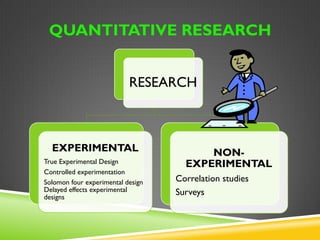
QUANTITATIVE RESEARCH 
RESEARCH 
EXPERIMENTAL 
True Experimental Design 
Controlled experimentation 
Solomon four experimental 
design 
Delayed effects experimental 
designs 
NON-EXPERIMENTAL 
Correlation studies 
Surveys
Quasi-experimental designs 
 One shot study 
 Pretest-posttest design 
 Contrasted groups 
 Time series
EXPERIMENTAL RESEARCH 
It is a systematic and scientific 
approach to research in which the 
researcher manipulates one or more 
variables and controls, and measures 
any change in other variables 
The purpose is to study the cause 
and effect relationship
EXPERIMENTAL RESEARCH 
An experiment is a set of 
observations conducted under 
controlled circumstances in which 
the investigator manipulates 
conditions to ascertain what effects 
such manipulation has on the 
outcome.
REQUIREMENTS OF A GOOD 
EXPERIMENTAL DESIGN 
Requirements of a good experimental 
design 
1. Subjects are randomly assigned to the 
experimental groups (EG) and control 
groups (CG) 
-presence of a comparison group; random 
assignment
2. The independent variable(IV) can 
be manipulated such that any change 
in the dependent variable (DV) is 
attributable to changes in the 
independent variable (manipulable 
IV)
EXPERIMENTAL RESEARCH 
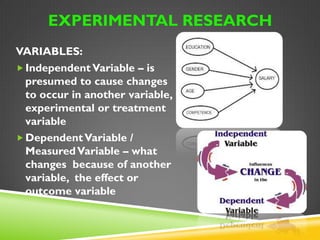
VARIABLES: 
Independent Variable – is 
presumed to cause changes 
to occur in another variable, 
experimental or treatment 
variable 
Dependent Variable / 
Measured Variable – what 
changes because of 
another variable, the effect 
or outcome variable
EXPERIMENTAL RESEARCH 
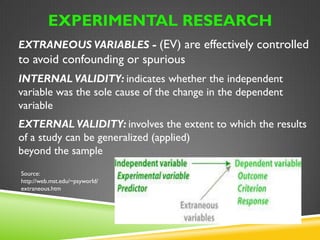
EXTRANEOUS VARIABLES - (EV) are effectively 
controlled to avoid confounding or spurious 
INTERNAL VALIDITY: indicates whether the independent 
variable was the sole cause of the change in the dependent 
variable 
EXTERNAL VALIDITY: involves the extent to which the 
results of a study can be generalized (applied) 
beyond the sample 
Source: 
http://web.mst.edu/~psyworl 
d/extraneous.htm
VALIDITY 
The internal validity of any research 
undertaking is strengthened by the 
correct choice of research design and the 
soundness and appropriateness of 
decisions that pertain to sampling, 
instrumentation, data collection and 
analysis.
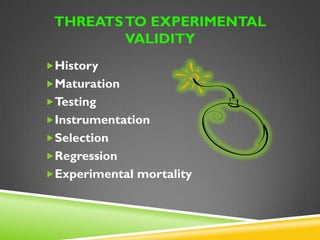
THREATS TO EXPERIMENTAL VALIDITY 
History 
Maturation 
Testing 
Instrumentation 
Selection 
Regression 
Experimental mortality
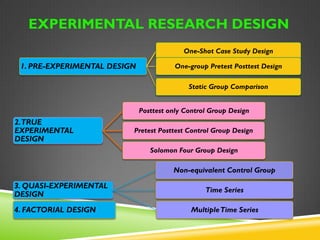
EXPERIMENTAL RESEARCH DESIGN 
1. PRE-EXPERIMENTAL DESIGN 
One-Shot Case Study Design 
One-group Pretest Posttest Design 
Static Group Comparison 
2. TRUE 
EXPERIMENTAL 
DESIGN 
Posttest only Control Group Design 
Pretest Posttest Control Group Design 
Solomon Four Group Design 
3. QUASI-EXPERIMENTAL 
DESIGN 
Non-equivalent Control Group 
Time Series 
4. FACTORIAL DESIGN Multiple Time Series
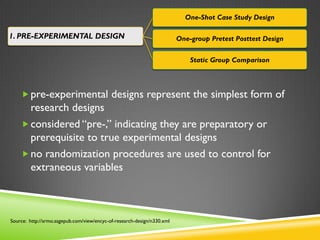
1. PRE-EXPERIMENTAL DESIGN 
One-Shot Case Study Design 
One-group Pretest Posttest Design 
Static Group Comparison 
pre-experimental designs represent the simplest form 
of research designs 
 considered “pre-,” indicating they are preparatory or 
prerequisite to true experimental designs 
no randomization procedures are used to control for 
extraneous variables 
Source: http://srmo.sagepub.com/view/encyc-of-research-design/n330.xml
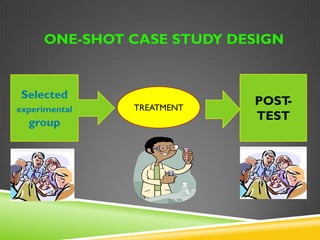
ONE-SHOT CASE STUDY DESIGN 
Selected 
experimental 
group 
TREATMEN 
T 
POST-TEST
ONE-SHOT CASE STUDY DESIGN 
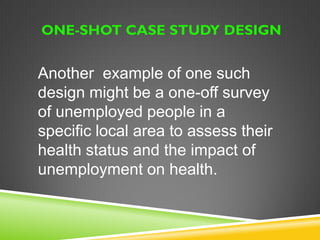
Another example of one such 
design might be a one-off survey 
of unemployed people in a 
specific local area to assess their 
health status and the impact of 
unemployment on health.
ONE-SHOT CASE STUDY DESIGN 
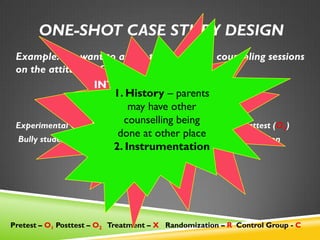
Example: the effects of counseling sessions on the 
attitudes of identified bullies in school. 
Experimental Group Treatment (X) Posttest (O2) 
Bully students Counseling Observation 
Pretest – O1 Posttest – O2 Treatment – X Randomization – R Control Group - C
ONE-SHOT CASE STUDY DESIGN 
Example: You want to assess the effects of counseling 
sessions on the attitudes of identified bullies in school. 
INTERNAL 1. History VALIDITY: 
– 
History, parents Maturation, 
may have 
Testing, other Instrumentation, 
counselling 
Selection, being done Regression, 
at other 
Experimental mortality 
Experimental Group Treatment (X) Posttest (O2) 
Bully students Counseling Observation 
place 
2. Instrumentation 
Pretest – O1 Posttest – O2 Treatment – X Randomization – R Control Group - C
ONE-SHOT CASE STUDY DESIGN 
Example: You want to determine whether praising primary 
school children makes them do better in Mathematics. 
INTERNAL 
VALIDITY: 
History, Maturation, 
Testing, 
Instrumentation, 
Selection, 
Regression, 
Experimental 
mortality 
Selection – possible 
that students 
selected were 
already good in 
Mathematics 
Experimental Group Treatment (X) Posttest (O) 
Primary school children History Praising 
– the school 
Attentiveness/Performance 
had organized a 
motivation course
ONE-GROUP PRETEST-POSTTEST 
DESIGN 
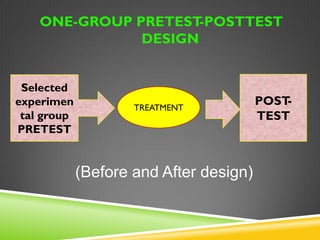
Selected 
experimen 
tal group 
PRETEST 
TREATMEN 
T 
POST-TEST 
(Before and After design)
Another example 
Testing the effectiveness of a DRUG A on 
capacity to recall words 
EG : # words recalled---exposure to DRUG 
A 
-----# words recalled 
CG: # words recalled---no exposure to 
DRUGA -----# words recalled
ONE-GROUP PRETEST-POSTTEST 
DESIGN 
Example: You want to determine whether praising primary 
school children makes them do better in Mathematics. 
Experimental Group Pretest(O1) Treatment (X) 
Posttest(O2) 
Primary school children Praising 
Pretest – O1 Posttest – O2 Treatment – X Random Assignment – R Control Group - 
C
ONE-GROUP PRETEST-POSTTEST 
DESIGN 
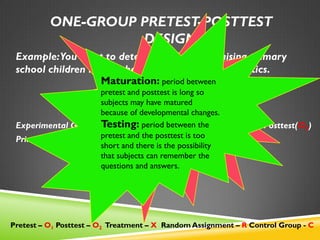
Example: You want to determine whether praising primary 
school children makes them do better in Mathematics. 
Maturation: period between 
pretest and posttest is long so 
subjects may have matured 
because of developmental 
changes. 
Testing: period between the 
pretest and the posttest is too 
short and there is the possibility 
that subjects can remember the 
questions and answers. 
INTERNAL VALIDITY: 
History, Maturation, 
Testing, Instrumentation, 
Selection, Regression, 
Experimental mortality 
Experimental Group Pretest(O1) Treatment (X) 
Posttest(O2) 
Primary school children Praising 
Pretest – O1 Posttest – O2 Treatment – X Random Assignment – R Control Group - 
C
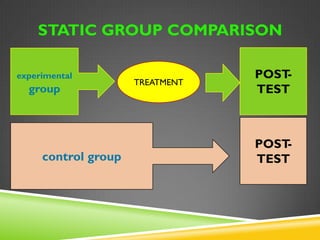
STATIC GROUP COMPARISON 
experimental 
group 
TREATMEN 
T 
POST-TEST 
control group 
POST-TEST
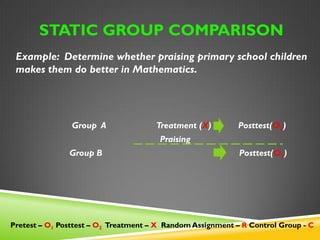
STATIC GROUP COMPARISON 
Example: Determine whether praising primary school 
children makes them do better in Mathematics. 
Group A Treatment (X) Posttest(O2) 
Praising 
Group B Posttest(O2) 
Pretest – O1 Posttest – O2 Treatment – X Random Assignment – R Control Group - 
C
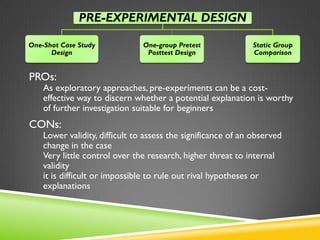
PRE-EXPERIMENTAL 
DESIGN 
One-Shot Case 
Study Design 
One-group 
Pretest Posttest 
Design 
Static Group 
Comparison 
PROs: 
As exploratory approaches, pre-experiments can be a cost-effective 
way to discern whether a potential explanation is 
worthy of further investigation suitable for beginners 
CONs: 
Lower validity, difficult to assess the significance of an 
observed change in the case 
Very little control over the research, higher threat to internal 
validity 
it is difficult or impossible to rule out rival hypotheses or 
explanations
2. TRUE EXPERIMENTAL 
DESIGN 
Posttest only Control Group Design 
Pretest Posttest Control Group Design 
Solomon Four Group Design 
Manipulation – control of independent variable by the researcher 
through treatment/intervention 
Control – the use of control group and extraneous variable 
Randomization – every subjects have equal chance of being 
assigned to experimental and control group 
Random assignment helps ensure that there is no pre-existing 
condition that will influence the variables and mess up the results.
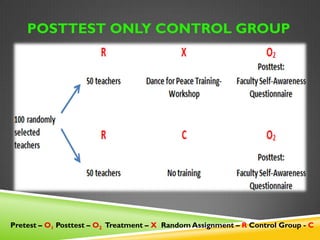
POSTTEST ONLY CONTROL GROUP 
Randomly 
selected 
experimen 
tal group 
TREATMEN 
T 
POST-TEST 
Randomly selected 
control group 
POST-TEST
POSTTEST ONLY CONTROL GROUP 
Pretest – O1 Posttest – O2 Treatment – X Random Assignment – R Control Group - 
C
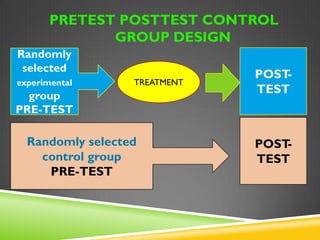
PRETEST POSTTEST CONTROL GROUP 
DESIGN 
Randomly 
selected 
experimental 
group 
PRE-TEST 
TREATMEN 
T 
POST-TEST 
Randomly selected 
control group 
PRE-TEST 
POST-TEST
PRETEST POSTTEST CONTROL 
GROUP DESIGN 
Pretest – O1 Posttest – O2 Treatment – X Random Assignment – R Control Group - 
C
SOLOMON FOUR GROUP DESIGN 
Experimental 
Group A 
PRE-TEST TREATMEN 
T 
POST-TEST 
Experimental 
Group B 
Control Group A 
PRE-TEST 
POST-TEST 
POST-TEST 
POST-TEST 
Control Group B
SOLOMON FOUR GROUP DESIGN 
Pretest – O1 Posttest – O2 Treatment – X Random Assignment – R Control Group - 
C
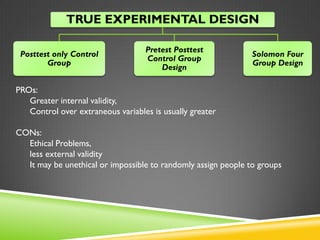
TRUE EXPERIMENTAL DESIGN 
Posttest only 
Control Group 
Pretest Posttest 
Control Group 
Design 
Solomon Four 
Group Design 
PROs: 
Greater internal validity, 
Control over extraneous variables is usually greater 
CONs: 
Ethical Problems, 
less external validity 
It may be unethical or impossible to randomly assign people to groups
3. QUASI-EXPERIMENTAL 
DESIGN 
Non-equivalent Control Group 
Time Series 
Multiple Time Series 
is simply defined as not a true experiment since it does 
not have randomly assigned groups the 
comparison/control group is predetermined to be 
comparable to the treatment group in critical ways. 
Matching, comparing the same participants over time 
and pre-existing groups are used. 
These designs are frequently used when it is not 
logistically feasible or ethical to conduct a randomized 
controlled trial. 
Source: http://education-portal.com/academy/lesson/quasi-experimental-designs-definition-characteristics-types-examples. 
html#lesson
NON-EQUIVALENT CONTROL GROUP 
DESIGN 
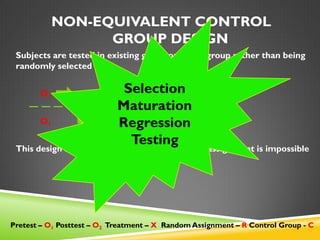
Subjects are tested in existing group or intact group rather than being 
randomly selected 
O1 X O2 
O1 O2 
This design should only be used when random assignment is 
impossible 
Pretest – O1 Posttest – O2 Treatment – X Random Assignment – R Control Group - 
C
NON-EQUIVALENT CONTROL GROUP 
DESIGN 
Subjects are tested in existing group or intact group rather than being 
randomly selected 
Selection 
Maturation 
Regression 
O1 X O2 
O1 O2 
Testing 
This design should only be used when random assignment is 
impossible 
Pretest – O1 Posttest – O2 Treatment – X Random Assignment – R Control Group - 
C
TIME SERIES 
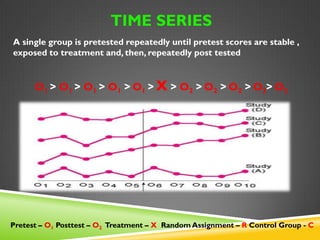
A single group is pretested repeatedly until pretest scores are stable , 
exposed to treatment and, then, repeatedly post tested 
O1 > O1 > O1 > O1 >O1 >X > O2 >O2 >O2 >O2>O2 
Pretest – O1 Posttest – O2 Treatment – X Random Assignment – R Control Group - 
C
QUASI-EXPERIMENTAL DESIGN 
Non-equivalent 
Control Group 
Time Series 
Multiple 
Time Series 
PROs: 
can be very useful in generating results for general trends 
Greater external validity(more like real world conditions) 
Much more feasible given time and logistical constraints 
CONs: 
Without proper randomization, statistical tests can be meaningless 
Not as many variables controlled 
Selection could be biased 
Source: https://explorable.com/quasi-experimental-design
FACTORIAL DESIGN 
Used to examine the effects that the manipulation of at least 2 
independent variables (simultaneously at different levels) has 
upon the dependent variable. 
PROs: more precision on each factor than with single factor experimentation, 
broadening the scope of an experiment, possible to estimate the interaction 
effect 
CONs: could be complex, the experiment can be very large with a number of 
factors each at several levels 
Source: http://www.stat.ncsu.edu/people/nelson/courses/st512/Factorial%20Experiments.pdf
FACTORIAL DESIGN 
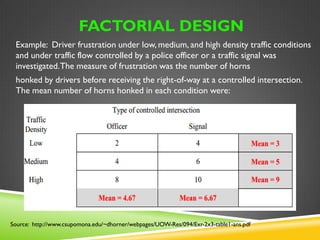
Example: Driver frustration under low, medium, and high density traffic 
conditions and under traffic flow controlled by a police officer or a traffic 
signal was investigated. The measure of frustration was the number of 
horns 
honked by drivers before receiving the right-of-way at a controlled 
intersection. The mean number of horns honked in each condition were: 
Source: http://www.csupomona.edu/~dhorner/webpages/UOW-Res/094/Exr-2x3-table1-ans.pdf
FACTORIAL DESIGN 
Source: http://www.csupomona.edu/~dhorner/webpages/UOW-Res/094/Exr-2x3-table1-ans.pdf
EXPERIMENTAL RESEARCH DESIGN 
1. PRE-EXPERIMENTAL DESIGN 
One-Shot Case Study Design 
One-group Pretest Posttest Design 
Static Group Comparison 
2. TRUE 
EXPERIMENTAL 
DESIGN 
Posttest only Control Group Design 
Pretest Posttest Control Group Design 
Solomon Four Group Design 
3. QUASI-EXPERIMENTAL 
DESIGN 
Non-equivalent Control Group 
Time Series 
4. FACTORIAL DESIGN Multiple Time Series
procedures 
materials 
measures participants
Experimental Research

Experimental Research

  • 1.
    Marilou K. Peralta Master in Management Engineering Pangasinan State University
  • 2.
    PRESENTATION CONTENT 1.What is Experimental Research? 2. Variables and Threats to Experimental Research 3. Types of Experimental Research Designs 4. Pros & Cons of Experimental Research Designs
  • 3.
    RESEARCH DESIGN Theresearch design is a logical model that shows the strategies for sample selection, development of measurement tools, data collection as well as methods of data processing and analysis.
  • 4.
    QUANTITATIVE RESEARCH RESEARCH EXPERIMENTAL True Experimental Design Controlled experimentation Solomon four experimental design Delayed effects experimental designs NON-EXPERIMENTAL Correlation studies Surveys
  • 5.
    Quasi-experimental designs One shot study  Pretest-posttest design  Contrasted groups  Time series
  • 6.
    EXPERIMENTAL RESEARCH Itis a systematic and scientific approach to research in which the researcher manipulates one or more variables and controls, and measures any change in other variables The purpose is to study the cause and effect relationship
  • 7.
    EXPERIMENTAL RESEARCH Anexperiment is a set of observations conducted under controlled circumstances in which the investigator manipulates conditions to ascertain what effects such manipulation has on the outcome.
  • 8.
    REQUIREMENTS OF AGOOD EXPERIMENTAL DESIGN Requirements of a good experimental design 1. Subjects are randomly assigned to the experimental groups (EG) and control groups (CG) -presence of a comparison group; random assignment
  • 9.
    2. The independentvariable(IV) can be manipulated such that any change in the dependent variable (DV) is attributable to changes in the independent variable (manipulable IV)
  • 10.
    EXPERIMENTAL RESEARCH VARIABLES: Independent Variable – is presumed to cause changes to occur in another variable, experimental or treatment variable Dependent Variable / Measured Variable – what changes because of another variable, the effect or outcome variable
  • 11.
    EXPERIMENTAL RESEARCH EXTRANEOUSVARIABLES - (EV) are effectively controlled to avoid confounding or spurious INTERNAL VALIDITY: indicates whether the independent variable was the sole cause of the change in the dependent variable EXTERNAL VALIDITY: involves the extent to which the results of a study can be generalized (applied) beyond the sample Source: http://web.mst.edu/~psyworl d/extraneous.htm
  • 12.
    VALIDITY The internalvalidity of any research undertaking is strengthened by the correct choice of research design and the soundness and appropriateness of decisions that pertain to sampling, instrumentation, data collection and analysis.
  • 13.
    THREATS TO EXPERIMENTALVALIDITY History Maturation Testing Instrumentation Selection Regression Experimental mortality
  • 14.
    EXPERIMENTAL RESEARCH DESIGN 1. PRE-EXPERIMENTAL DESIGN One-Shot Case Study Design One-group Pretest Posttest Design Static Group Comparison 2. TRUE EXPERIMENTAL DESIGN Posttest only Control Group Design Pretest Posttest Control Group Design Solomon Four Group Design 3. QUASI-EXPERIMENTAL DESIGN Non-equivalent Control Group Time Series 4. FACTORIAL DESIGN Multiple Time Series
  • 15.
    1. PRE-EXPERIMENTAL DESIGN One-Shot Case Study Design One-group Pretest Posttest Design Static Group Comparison pre-experimental designs represent the simplest form of research designs  considered “pre-,” indicating they are preparatory or prerequisite to true experimental designs no randomization procedures are used to control for extraneous variables Source: http://srmo.sagepub.com/view/encyc-of-research-design/n330.xml
  • 16.
    ONE-SHOT CASE STUDYDESIGN Selected experimental group TREATMEN T POST-TEST
  • 17.
    ONE-SHOT CASE STUDYDESIGN Another example of one such design might be a one-off survey of unemployed people in a specific local area to assess their health status and the impact of unemployment on health.
  • 18.
    ONE-SHOT CASE STUDYDESIGN Example: the effects of counseling sessions on the attitudes of identified bullies in school. Experimental Group Treatment (X) Posttest (O2) Bully students Counseling Observation Pretest – O1 Posttest – O2 Treatment – X Randomization – R Control Group - C
  • 19.
    ONE-SHOT CASE STUDYDESIGN Example: You want to assess the effects of counseling sessions on the attitudes of identified bullies in school. INTERNAL 1. History VALIDITY: – History, parents Maturation, may have Testing, other Instrumentation, counselling Selection, being done Regression, at other Experimental mortality Experimental Group Treatment (X) Posttest (O2) Bully students Counseling Observation place 2. Instrumentation Pretest – O1 Posttest – O2 Treatment – X Randomization – R Control Group - C
  • 20.
    ONE-SHOT CASE STUDYDESIGN Example: You want to determine whether praising primary school children makes them do better in Mathematics. INTERNAL VALIDITY: History, Maturation, Testing, Instrumentation, Selection, Regression, Experimental mortality Selection – possible that students selected were already good in Mathematics Experimental Group Treatment (X) Posttest (O) Primary school children History Praising – the school Attentiveness/Performance had organized a motivation course
  • 21.
    ONE-GROUP PRETEST-POSTTEST DESIGN Selected experimen tal group PRETEST TREATMEN T POST-TEST (Before and After design)
  • 22.
    Another example Testingthe effectiveness of a DRUG A on capacity to recall words EG : # words recalled---exposure to DRUG A -----# words recalled CG: # words recalled---no exposure to DRUGA -----# words recalled
  • 23.
    ONE-GROUP PRETEST-POSTTEST DESIGN Example: You want to determine whether praising primary school children makes them do better in Mathematics. Experimental Group Pretest(O1) Treatment (X) Posttest(O2) Primary school children Praising Pretest – O1 Posttest – O2 Treatment – X Random Assignment – R Control Group - C
  • 24.
    ONE-GROUP PRETEST-POSTTEST DESIGN Example: You want to determine whether praising primary school children makes them do better in Mathematics. Maturation: period between pretest and posttest is long so subjects may have matured because of developmental changes. Testing: period between the pretest and the posttest is too short and there is the possibility that subjects can remember the questions and answers. INTERNAL VALIDITY: History, Maturation, Testing, Instrumentation, Selection, Regression, Experimental mortality Experimental Group Pretest(O1) Treatment (X) Posttest(O2) Primary school children Praising Pretest – O1 Posttest – O2 Treatment – X Random Assignment – R Control Group - C
  • 25.
    STATIC GROUP COMPARISON experimental group TREATMEN T POST-TEST control group POST-TEST
  • 26.
    STATIC GROUP COMPARISON Example: Determine whether praising primary school children makes them do better in Mathematics. Group A Treatment (X) Posttest(O2) Praising Group B Posttest(O2) Pretest – O1 Posttest – O2 Treatment – X Random Assignment – R Control Group - C
  • 27.
    PRE-EXPERIMENTAL DESIGN One-ShotCase Study Design One-group Pretest Posttest Design Static Group Comparison PROs: As exploratory approaches, pre-experiments can be a cost-effective way to discern whether a potential explanation is worthy of further investigation suitable for beginners CONs: Lower validity, difficult to assess the significance of an observed change in the case Very little control over the research, higher threat to internal validity it is difficult or impossible to rule out rival hypotheses or explanations
  • 28.
    2. TRUE EXPERIMENTAL DESIGN Posttest only Control Group Design Pretest Posttest Control Group Design Solomon Four Group Design Manipulation – control of independent variable by the researcher through treatment/intervention Control – the use of control group and extraneous variable Randomization – every subjects have equal chance of being assigned to experimental and control group Random assignment helps ensure that there is no pre-existing condition that will influence the variables and mess up the results.
  • 29.
    POSTTEST ONLY CONTROLGROUP Randomly selected experimen tal group TREATMEN T POST-TEST Randomly selected control group POST-TEST
  • 30.
    POSTTEST ONLY CONTROLGROUP Pretest – O1 Posttest – O2 Treatment – X Random Assignment – R Control Group - C
  • 31.
    PRETEST POSTTEST CONTROLGROUP DESIGN Randomly selected experimental group PRE-TEST TREATMEN T POST-TEST Randomly selected control group PRE-TEST POST-TEST
  • 32.
    PRETEST POSTTEST CONTROL GROUP DESIGN Pretest – O1 Posttest – O2 Treatment – X Random Assignment – R Control Group - C
  • 33.
    SOLOMON FOUR GROUPDESIGN Experimental Group A PRE-TEST TREATMEN T POST-TEST Experimental Group B Control Group A PRE-TEST POST-TEST POST-TEST POST-TEST Control Group B
  • 34.
    SOLOMON FOUR GROUPDESIGN Pretest – O1 Posttest – O2 Treatment – X Random Assignment – R Control Group - C
  • 35.
    TRUE EXPERIMENTAL DESIGN Posttest only Control Group Pretest Posttest Control Group Design Solomon Four Group Design PROs: Greater internal validity, Control over extraneous variables is usually greater CONs: Ethical Problems, less external validity It may be unethical or impossible to randomly assign people to groups
  • 36.
    3. QUASI-EXPERIMENTAL DESIGN Non-equivalent Control Group Time Series Multiple Time Series is simply defined as not a true experiment since it does not have randomly assigned groups the comparison/control group is predetermined to be comparable to the treatment group in critical ways. Matching, comparing the same participants over time and pre-existing groups are used. These designs are frequently used when it is not logistically feasible or ethical to conduct a randomized controlled trial. Source: http://education-portal.com/academy/lesson/quasi-experimental-designs-definition-characteristics-types-examples. html#lesson
  • 37.
    NON-EQUIVALENT CONTROL GROUP DESIGN Subjects are tested in existing group or intact group rather than being randomly selected O1 X O2 O1 O2 This design should only be used when random assignment is impossible Pretest – O1 Posttest – O2 Treatment – X Random Assignment – R Control Group - C
  • 38.
    NON-EQUIVALENT CONTROL GROUP DESIGN Subjects are tested in existing group or intact group rather than being randomly selected Selection Maturation Regression O1 X O2 O1 O2 Testing This design should only be used when random assignment is impossible Pretest – O1 Posttest – O2 Treatment – X Random Assignment – R Control Group - C
  • 39.
    TIME SERIES Asingle group is pretested repeatedly until pretest scores are stable , exposed to treatment and, then, repeatedly post tested O1 > O1 > O1 > O1 >O1 >X > O2 >O2 >O2 >O2>O2 Pretest – O1 Posttest – O2 Treatment – X Random Assignment – R Control Group - C
  • 40.
    QUASI-EXPERIMENTAL DESIGN Non-equivalent Control Group Time Series Multiple Time Series PROs: can be very useful in generating results for general trends Greater external validity(more like real world conditions) Much more feasible given time and logistical constraints CONs: Without proper randomization, statistical tests can be meaningless Not as many variables controlled Selection could be biased Source: https://explorable.com/quasi-experimental-design
  • 41.
    FACTORIAL DESIGN Usedto examine the effects that the manipulation of at least 2 independent variables (simultaneously at different levels) has upon the dependent variable. PROs: more precision on each factor than with single factor experimentation, broadening the scope of an experiment, possible to estimate the interaction effect CONs: could be complex, the experiment can be very large with a number of factors each at several levels Source: http://www.stat.ncsu.edu/people/nelson/courses/st512/Factorial%20Experiments.pdf
  • 42.
    FACTORIAL DESIGN Example:Driver frustration under low, medium, and high density traffic conditions and under traffic flow controlled by a police officer or a traffic signal was investigated. The measure of frustration was the number of horns honked by drivers before receiving the right-of-way at a controlled intersection. The mean number of horns honked in each condition were: Source: http://www.csupomona.edu/~dhorner/webpages/UOW-Res/094/Exr-2x3-table1-ans.pdf
  • 43.
    FACTORIAL DESIGN Source:http://www.csupomona.edu/~dhorner/webpages/UOW-Res/094/Exr-2x3-table1-ans.pdf
  • 44.
    EXPERIMENTAL RESEARCH DESIGN 1. PRE-EXPERIMENTAL DESIGN One-Shot Case Study Design One-group Pretest Posttest Design Static Group Comparison 2. TRUE EXPERIMENTAL DESIGN Posttest only Control Group Design Pretest Posttest Control Group Design Solomon Four Group Design 3. QUASI-EXPERIMENTAL DESIGN Non-equivalent Control Group Time Series 4. FACTORIAL DESIGN Multiple Time Series
  • 45.