RICHARD C. LOGRO RN,MAN NURSING RESEARCH G4E
DEFINITIONS,NATURE AND SCOPE RESEARCH Is a scientific study or investigation that is pursued to discover facts, revise theories or laws based on new facts and practical application of these ( webster,1992)
Research is derived from the old French word: “ Cerchier” meaning “to seek or search”. The prefix “re” means “again” and signifies replication of the search. “ One seeks extensively for new knowledge in a specific to life situations”
“ Is a formal, systematic and intensive process of analyzing problems through scientific  means for purposes of “ discovery and development of an organized body of knowledge”(Abdellah,1986)
“ Is likewise a systematic collection and analysis of data to illuminate, describe or explain new facts and relationships”( Treece and Treece,1986)
“  A way of dealing with ideas” for purposes of clarifying , verifying and confirming data (Polit and Hungler,1985)
What is Nursing Research Is viewed from two angles, as follow: 1. With nurses as principal investigator, it is research intended to determine the causes  and prevention of diseases, the promotion of health in the growth and development processes, and the rehabilitation of patients for a more productive life.
2. Research on nursing care aims at knowing the health care of individuals and groups and the biological, physiological,social, behavioral and environmental factors that influences health and disease in relation to nursing care
General and Specific Purposes of Research General Purpose To answer questions or solve problems, to observe in order to know, to know in order to predict, to predict in order to practice and prescribe accurately and in a professioonal manner ( Polit and Hungler,1995)
Specific purposes 1. Description- describe a phenomenon that relates to the nursing profession, observe, define, describe and document situations under inquiry
2. Exploration  Observe  and record the phenomenon under inquiry; answers “what” questions on the phenomenon, use sufficient examples to become familiar with the phenomenon for more precise and accurate understanding of this Ex.1. How do nurses react to aggresive patients? 2. Do a patient’s age and sex play any role in his recovery?
3. Explanation Seek clarification of a prevailing situation. It answer questions that ask “ why” a phenomenon occured. “why this happen?” ex. Why do younger children need  more parenting than older children?
4. Prediction and Control  Research anticipates possible psychological and physiological reactions to nursing intervention Prediction-projects a situation or events that could rise from research investigation Control-puts a barrier to hinder or minimize the effects of anticipated outcomes or reactions
Ex. Incidence of Down’s syndrome in infants is expected to increase with the age of the mother PREDICT-(projection of the greater risk of a 40yo woman compared to a 25yo one in bearing child with Down’s syndrome) CONTROL-(partial control of the outcome by educating average women on the risks of child bearing, and offering amniocentesis to women over 35yo)
Ethics in Research There must be voluntary participation on the respondents, who have the following rights which the reseacher is expected to respect The respondents must be free from any physical and psychological exploitation Anonymity and confidentiality
Types of Reseach Experimental Research  The research consciously manipulates or controls situations related to the study, thus interfering with nature. Observations are done under controlled conditions or in a controlled environment Ex. The use of mask to prevent nursery infections
2. Non-experimental The research does not interfere with nature, and the conditions for research are realistic or uncontrolled. Types Basic or library research-this is intended to increase knowledge in science Apllied or Action research-undertaken for practical purposes
Types of Applied Research PROBLEM-SOLVING Make assessment s of needs and problems and generates alternative solutions to problems. Its objective is to improve specific situations through research Ex. How often is it necessary to take TPR?
2. Decision-Making Selects the most feasible course of action from given alternatives to solve the problem. Useful in policy making and in improving the image of nursing as a profession Ex. Should salaries paid to nurse be increased?
3. Developmental Research A research approach used to develop more effective programs, methods and procedures in nursing for more efficient and effective delivery of health care ex. Human Resource and Training Development for nurses Managers
4. Evaluative Research Aims to test the viability, quality or effectiveness of a product, program, method or procedure and answer specific questions on these: ex. To what extent has nursing service been improved?
5. Demonstration Research Shows how an already developed procedure or product can be applied to varied situations Ex. Obtaining baseline data in the prevention of communicable diseases
6. Descriptive Research An analysis of an extremely broad range of phenomena, the results of which is comprehensive presentation and interpretation of statistical tabulations of data yielded by a survey. ex. Absenteeism among staff nurses in X and Y hospitals
7. Explanatory or Correlational Research Discovers how the phenomena under study are related Ex. Correlation between the academic performance of nursing students and their performance as a satff nurse
8. Historical Research  Scientific inquiry into past events Ex. Past trends in nutrition among children
Basic components of research  Chapter 1 background of the study 1. Statement of the Problem 2. Research Objectives 3. Hypothesis 4. Assumption 5. Significance of the study 6. Scope and Limitations 7. Defintion of terms
How to write Chapter 1 Introduction- the introduction of a thesis should contain a discussion of any of the following: Presentation of the problem( what the problem is all about?) The reason or reason why it is necessary to conduct the existence of an unsatisfactory condition Rationale study must be discussed Historical background of the problem A desire to have deeper and clearer understanding of  a situation, circumstances or phenomenon
A desire to find a better way of doing something or of improving a product a desire to discover something Geographical condition of the study locale A link to introduction and the statement of the problem
Guidelines in Selection  of a Research Problem or Topic The research problem or topic must be chosen by the researcher Interest of the researcher Specialization of the researcher The competence of the researcher to tackle Ability of the researcher to finance
Researchable and Manageable a. Data are available and accessible b. Data must meet the standards of accuracy, objectivity and verifiability c. Answers to the specific questions (subproblems) can be found
The hypothesis formulated are testable Equiptment and instruments for research are available  Can be completed within a reasonable period of time It is significant, important and relevant to the present time Results are practical and implementable
Requires original, critical and reflective thinking to solve it Must contribute to the national development goals for the improvement of  the quality of human life Contribute to the fund of human knowledge Show of pave the way for the solution of the problem
Sources of a Nursing Research Problems Clinical Experiences---the nurse’s everyday experiences is a rich source of ideas for research topics Nursing Literature---ideas for studies often come from reading the nursing literature Social Issues---topics are sometimes suggested by global social or political issues of relevance to the health care community
Theories---nursing theories and other related discipline Ideas from external sources---external sources and direct suggestions can be impetus for a research idea
The Research Problem Ways of stating a research problem Problems may be stated in many ways A question and/or several questions A declarative sentence and/or a series of complete statements A combination of both-a statement followed by a series of questions vice versa
Problem stated in a question form  1.1 Single question Who are more proficient at the bedside, the graduates of a diploma program or those of the basic degree program? 1.2 Single question followed by a series of questions What are the common methods of contraception practiced by fifty selected mothers in brgy.Escopa?
Is the selected mothers of a particular method influenced by religion, socio-economic status or education of the parents? What problems do these mothers meet, if any, in the particular method of their choice? What implications does this study have for public health nurses in the area?
2. Problems stated in the form of a declarative sentence 2.1 Single declarative sentence a. To determine whether people who watch television read fewer books b. To identify common problems of Chief Nurses in some government emergency hospitals
2.2 A series of declarative sentences The study attempts to determine: The general food patterns and food intake as well as food choices of families whose mothers had nutrition education background The food groups in which their meals were deficient
3. A declarative sentenced followed by a series of questions- To determine the proper sequence of learning experiences in operating room nursing geared to the needs of students and patients in surgery: What were the needs of the students and patients in surgery? What sequence of learning was provided for students in operating room in particular?
Guideliness in Writing the Title Thesis writer should be guided by the following in the formulation of  his Title: The title is formulated before the start of the research work Must contain the subject matter of the study, the locale of the study,the population involved, and the period when the data were gathered Be broad enough to include all aspects of the subbject matter
Be brief and concise Title contains more than one line, it must be written like an inverted pyramid, all words in capital letters
RESEARCH VARIABLES Are qualities, properties or characteristics of people, things, events or situations under study, which are assessed quatitatively or qualitatively Ex. Height,weight,sex,age,blood type,Bp reading, pre-operative anxiety, among others
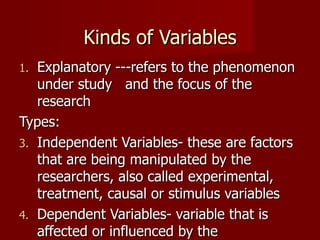
Kinds of Variables Explanatory ---refers to the phenomenon under study  and the focus of the research Types: Independent Variables- these are factors that are being manipulated by the researchers, also called experimental, treatment, causal or stimulus variables Dependent Variables- variable that is affected or influenced by the independent variables
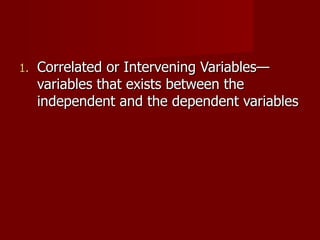
Correlated or Intervening Variables—variables that exists between the independent and the dependent variables
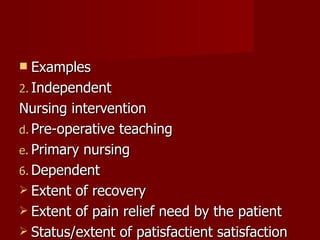
Examples Independent Nursing intervention Pre-operative teaching Primary nursing Dependent  Extent of recovery Extent of pain relief need by the patient Status/extent of patisfactient satisfaction
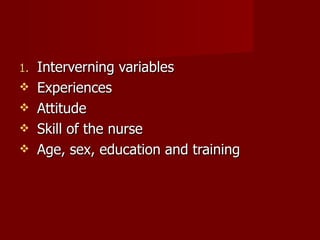
Interverning variables Experiences Attitude Skill of the nurse Age, sex, education and training
2. Extraneous or Exogenous Variables Types: Organismic Variables---these are physiological, psychological and demographic factors that could affect the outcome of the study Ex. Age, sex, civil status, education etc.
2. Environmental Variables—these are economics, anthropological, sociological and physical factors  that influence the phenomenon under study Ex. Climate, home setting and family composition
INDICATORS These are statements of traits, characteristics, trends and practices that define or describe the variables Variables  Indicators 1. Nursing care  levels and categories 2.Nursing educ.  Bacallaureate,old,new 3. Distress  extent of deg.(mild)
3. ABSTRACT VARIABLES Factors that have different values, which are quatitatively measured and statistically tested through the hypothesis Ex. Age- values from 0-100 Bp- 120/80 or 180/110
4. Dichotomous Variables—Factors with only 2 values used in comparative studies and specifically identified in the hypothesis Ex. Smoker-non-smoker 5. Active Variables—factors which the researcher creates/manipulates commonly used in experimental research Ex. Drug type A and B effects on BP
6. Attribute Variables—pre-existing characteristics of the subjects which the reseacher simply observes and measures Ex. The religious background of the nurse affects their attitude toward death and dying
ASSUMPTIONS An assumption is a self evident truth which is based upon a known fact or phenomenon 3 types  Universally Assumption—comes from the knowledge of the researcher and from observed facts related to the problem which are presumed as true on the basis of  observations, experiences, and findings of previous researchers—needs no testing or verification Ex. All human beings need love
2. Study Assumption—confirms the validity of the explanatory variables as serve as basis for formulating the hypothesis of the study Ex. Nursing care influences the recovery of the patients
3. Theory or Research Based Assumption these are assumptions premised on the theories applicable to the field of study. It may come from the findings of  previous researchers and need further confirmation or validation Ex.  Attitudes and behaviors of nurses are affected by the type of disease and severity of manifestations felt by the patient
Characteristics of  Assumption They are universally accepted They are theories applicable to a particular field of study They refer to the findings of previous related researchers
Hypothesis Hypothesis is a tentative conclusion or answer to a specific question raised at the beginning of the investigation. It is an educated guess about the answer to a specific question. Two forms of hypothesis: The OPERATIONAL—stated in affirmative form The NULL—is stated in the negative form
Purpose,Function and importance of hypotheses or Specific question They  the researcher in designing his study: What method Research instrument Sampling design Statistical treatment What data to be gather
2. They serve as bases for determining assumptions They serve as bases for determining the relevance of the data They serve as bases for the explanation or discussion about the data gathered They help or guide the researcher in consolidating his findings and in formulating his conclusions are answers to the hypotheses or specific questions
Definition of Terms TYPES: Conceptual Definition—A universal  definition of a term understood by the people. SOURCES: dictionary and related literature Operational—the researchers own definition of terms as used in as data in her  SOURCES: empirical data, previous studies
3. Difinition from authorative sources—taken from authorities on the subjects or terms Ex. Morale—acc. To Keith, is a state...................
Scope and Delimitations of the Study 1.A brief statement of the general purpose 2. The subject matter and topics studied 3. Locale of the study 4. Population from which the respondents were selected 5. The period of the study
How to write chapter 2 Review of related literature A  literature review  is a body of text that aims to review the critical points of current  knowledge  on a particular topic. Most often associated with science-oriented literature, such as a  thesis , the literature review usually precedes a research proposal,  methodology  and results section. Its ultimate goal is to bring the reader up to date with current literature on a topic and forms the basis for another goal, such as future research that may be needed in the area.
A good literature review is characterized by: a logical flow of ideas; current and relevant references with consistent, appropriate referencing style; proper use of  terminology ; and an unbiased and comprehensive view of the previous research on the topic.
According to Cooper (1988) "a literature review uses as its database reports of primary or original scholarship, and does not report new primary scholarship itself.  The primary reports used in the literature may be verbal, but in the vast majority of cases reports are written documents. The types of scholarship may be empirical, theoretical, critical/analytic, or methodological in nature.  Second a literature review seeks to describe, summarize, evaluate, clarify and/or integrate the content of primary reports".
ALL cited literature was written and published in the past, so use past tense to refer to the findings of these studies.  An article published in 1995 was written in 1994 or even earlier.  Do not use first names   when referring to the authors of studies you cite. People who use them rarely are consistent in their use of such names.  Use only last names in the body of the manuscript. In the references list, use last names and initials. This approach reduces attention to the gender of the author, thereby attenuating discrimination on irrelevant dimensions.
Can be just a simple summary of the sources, but it usually has an organizational pattern and combines both summary and synthesis. Summary: a recap of the important information of the source. Synthesis: a re-organization, or a reshuffling of that information.
Preparing Scholarly Reviews of the Literature 1.Searching-Finding what you need and avoiding An avalanche of irrelevant references. 2.Assessing-Determining whether their findings & conclusions should be relied upon or are likely to be misleading
3.Integrating- To make the best assessment of what is known about the topic, to identify promising future research, to improve conceptual frameworks for research, and determine advantages and disadvantages of previously used  methodologies.
Ask yourself these questions: What is the  specific thesis ,  problem , or  research question  that my literature review helps to define? Reminder:  Read generally for an overview of your overall research area before defining your topic precisely.
What  type  of literature review am I conducting? Am I looking at issues of theory? Methodology? What is the  scope  of my literature review? What types of publications am I using? (e.g. journals, government documents, popular media)? What discipline am I working in (e.g., nursing, psychology, sociology, medicine)?
Reminder:  Define the limits of the review. Too broad a topic will overwhelm you with material; too narrow a topic might mean that you will overlook related work or not fins enough material when you conduct your search.
Too broad:  Health and literacy Too narrow:  The reading skills of Filipino women literacy learners living with HIV/AIDS victims in Luzon Just right:  How does learners’ health effect learning outcomes in the Filipino Literacy Program (FLP)? How good was my  information seeking ?  Has my search been wide enough to ensure I’ve found all relevant material? Has it been narrow enough to exclude irrelevant material? Is the number of sources I’ve used appropriate for the length of my paper?
Ways to cite related literature Throughout the body of your paper (primarily the Intro and Discussion), whenever you refer to outside sources of information, you must cite the sources from which you drew information. The simplest way to do this is to  parenthetically  give the author's last name and the year of publication, e.g., (Clarke 2001). When citing information from another's publication, be sure to report the  relevant  aspects of the work clearly and succinctly, IN YOUR OWN WORDS. Provide a reference to the work as soon as possible after giving the information.
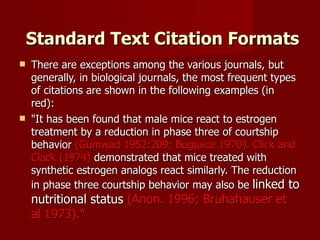
  Standard Text Citation Formats There are exceptions among the various journals, but generally, in biological journals, the most frequent types of citations are shown in the following examples (in red): "It has been found that male mice react to estrogen treatment by a reduction in phase three of courtship behavior  (Gumwad 1952:209; Bugjuice 1970). Click and Clack (1974)  demonstrated that mice treated with synthetic estrogen analogs react similarly. The reduction in phase three courtship behavior may also be  linked to nutritional status  (Anon. 1996; Bruhahauser et al 1973)."
Typically,  only the last name of the author(s) and the year of publication are given,e.g.,  Bugjuice 1970 . Your Literature Cited section will contain the complete reference, and the reader can look it up there.  Notice that the  reference to the book   has a page number  (Gumwad 1952: 209 ).  This is to facilitate a reader's finding the reference in a long publication such as a book (not done for journal articles). The paper by Bugjuice (1970) is short, and if readers want to find the referenced information, they would not have as much trouble.
For  two author papers , give both authors' last names  (e.g., Click and Clack 1974).  Articles with more than two authors are cited by the first authors last name followed "and others" or "et al.", and then the year.  When a book, paper, or article has  no identifiable author , cite it as  Anon. Year, e.g.,  (Anon. 1996)   (Anon. is the abbreviation for anonymous)
If you want  reference a paper found in another article , do so as follows:  (Driblick 1923,  in  Oobleck 1978).  A  string of citations  should be separated by semicolons, e.g.,  (Gumwad 1952:209; Bugjuice 1970; Bruhahauser et al 1973).  Finally, you should note the  placement of the period  AFTER the parenthetical citation - the citation, too, is part of a sentence,e.g., "...courtship behavior  (Gumwad 1952:209; Bugjuice 1970). "
Finally, you should note the  placement of the period  AFTER  the parenthetical citation - the citation, too, is part of a sentence,e.g., "...courtship behavior  (Gumwad 1952:209; Bugjuice 1970) ."
Thesis:  Theses and dissertatons should be cited as follows: Mortimer, R. 1975. A study of hormonal regulation of body temperature and consequences for reproductive success in the common house mouse ( Mus   musculus ) in Nome, Alaska. Masters Thesis, University of Alaska, Anchorage. 83 p.
World Wide Web/Internet source citations [REVISED] : WWW citation should be done with caution since so much is posted without peer review. When necessary, report the complete URL in the text including the site author's name: ".....(Gumwad, B. http://www.csu.edu/~gumwad/hormones/onlinepubs.html)" Internet sources  should  be included in your Literature Cited section.
Personal Communications: Suppose some of the information cited above was not gained from the Gumwad and Bugjuice publications, but rather in a personal conversation with or letter from an expert on the subject, Dr. Cynthia Mousse. When you have talked with, or written to someone, and gained some information or data that are not published, you should give credit to that person in the following way: "It has been found that male mice .... phase three of courtship behavior (C. Mousse, pers. comm.)." No date is entered for a personal communication, nor will it be entered in your Literature Cited section. However, the source is usually thanked in your Acknowledgments for their contribution.
Plagiarism  (use of others words, ideas, images, etc. without citation) is not to be tolerated and can be easily avoided by adequately referencing any and all information you use from other sources.  In the strictest sense, plagiarism is representation of the work of others as being  your  work.  Paraphrasing other's words too closely may be construed as plagiarism in some circumstances. In journal style papers there is virtually no circumstance in which the findings of someone else cannot be expressed in your own words with a proper citation of the source.
  Some basic rules applicable to all formats indexed by author name(s) : All   citation   entries  are listed in  alphabetical  order based the  first author's  last  name ;  If the same author(s) are cited for more than one paper  having the same order of authors' names , the papers should be listed in  chronological sequence  by year of publication.  Authors' names MUST be listed in the citation in the same order as in the article.
Bugjuice, B., Timm, T. and R. Cratchet. 1990. The role of estrogen in mouse  xxxxcourtship behavior changes as mice age. J Physiol 62(6):1130-1142. Cratchet, R., Bugjuice, B.and T. Timm. 1994. Estrogen, schmestrogen!: Mouse  xxxx( Mus   musculus ) as a dietary alternative for humans. J Nutrition 33(6):113 -114.
If the same author(s) are cited for two or more papers published within the  same   year,  place a small case letter after the year to denote the sequence in which you referred to them. For example:  Bugjuice, B. 1970a. Physiological effects of estrogen on mouse courtship behavior.  ....x.J Physiol 40(2):140-145. Bugjuice, B. 1970b. Physiological effects of estrogen analogs: Insincere courtship  xxxxbehavior in female mice. J Physiol 40(8):1240-1247.
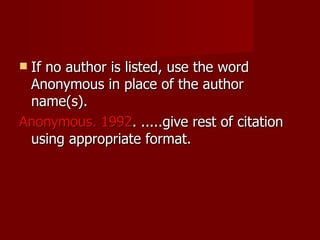
If no author is listed, use the word Anonymous in place of the author name(s).  Anonymous. 1992 . .....give rest of citation using appropriate format.
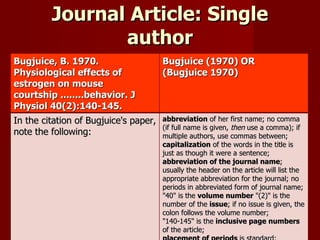
Journal Article: Single author Bugjuice, B. 1970. Physiological effects of estrogen on mouse courtship ........behavior. J Physiol 40(2):140-145. Bugjuice (1970) OR (Bugjuice 1970) In the citation of Bugjuice's paper, note the following: abbreviation  of her first name; no comma (if full name is given,  then  use a comma); if multiple authors, use commas between;  capitalization  of the words in the title is just as though it were a sentence;  abbreviation of the journal name ; usually the header on the article will list the appropriate abbreviation for the journal; no periods in abbreviated form of journal name;  "40" is the  volume number  "(2)" is the number of the  issue ; if no issue is given, the colon follows the volume number;  "140-145" is the  inclusive page numbers  of the article;  placement of periods  is standard;  indentation of the second line (and all subsequent lines)  in the citation. This applies to all citations.
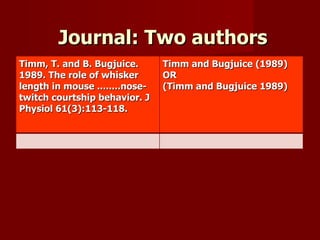
  Journal: Two authors Timm, T. and B. Bugjuice. 1989. The role of whisker length in mouse ........nose-twitch courtship behavior. J Physiol 61(3):113-118. Timm and Bugjuice (1989) OR (Timm and Bugjuice 1989)
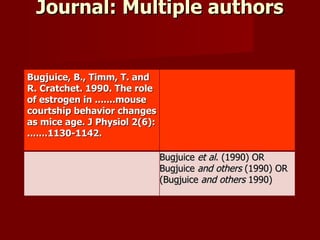
Journal: Multiple authors Bugjuice, B., Timm, T. and R. Cratchet. 1990. The role of estrogen in .......mouse courtship behavior changes as mice age. J Physiol 2(6): .......1130-1142. Bugjuice  et al . (1990) OR Bugjuice  and others  (1990) OR (Bugjuice  and others  1990)  
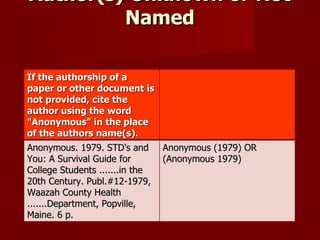
Author(s) Unknown or Not Named If the authorship of a paper or other document is not provided, cite the author using the word "Anonymous" in the place of the authors name(s). Anonymous. 1979. STD's and You: A Survival Guide for College Students .......in the 20th Century. Publ.#12-1979, Waazah County Health .......Department, Popville, Maine. 6 p. Anonymous (1979) OR (Anonymous 1979)
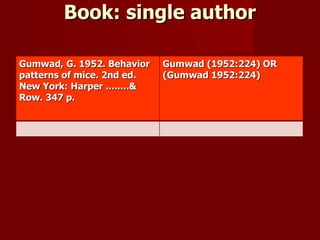
Book: single author Gumwad, G. 1952. Behavior patterns of mice. 2nd ed. New York: Harper ........& Row. 347 p. Gumwad (1952:224) OR (Gumwad 1952:224)
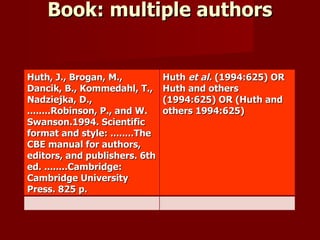
Book: multiple authors Huth, J., Brogan, M., Dancik, B., Kommedahl, T., Nadziejka, D., ........Robinson, P., and W. Swanson.1994. Scientific format and style: ........The CBE manual for authors, editors, and publishers. 6th ed. ........Cambridge: Cambridge University Press. 825 p. Huth  et al.  (1994:625) OR Huth and others (1994:625) OR (Huth and others 1994:625)
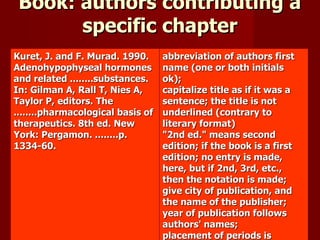
Book: authors contributing a specific chapter Kuret, J. and F. Murad. 1990. Adenohypophyseal hormones and related ........substances. In: Gilman A, Rall T, Nies A, Taylor P, editors. The ........pharmacological basis of therapeutics. 8th ed. New York: Pergamon. ........p. 1334-60. abbreviation of authors first name (one or both initials ok);  capitalize title as if it was a sentence; the title is not underlined (contrary to literary format)  "2nd ed." means second edition; if the book is a first edition; no entry is made, here, but if 2nd, 3rd, etc., then the notation is made;  give city of publication, and the name of the publisher;  year of publication follows authors' names;  placement of periods is standard;  indentation of all lines after the first.  Kuret and Murad (1990:1334-60) OR (Kuret and Murad 1990:1334-60)

Nursing Research Lec. Copy

  • 1.
    RICHARD C. LOGRORN,MAN NURSING RESEARCH G4E
  • 2.
    DEFINITIONS,NATURE AND SCOPERESEARCH Is a scientific study or investigation that is pursued to discover facts, revise theories or laws based on new facts and practical application of these ( webster,1992)
  • 3.
    Research is derivedfrom the old French word: “ Cerchier” meaning “to seek or search”. The prefix “re” means “again” and signifies replication of the search. “ One seeks extensively for new knowledge in a specific to life situations”
  • 4.
    “ Is aformal, systematic and intensive process of analyzing problems through scientific means for purposes of “ discovery and development of an organized body of knowledge”(Abdellah,1986)
  • 5.
    “ Is likewisea systematic collection and analysis of data to illuminate, describe or explain new facts and relationships”( Treece and Treece,1986)
  • 6.
    “ Away of dealing with ideas” for purposes of clarifying , verifying and confirming data (Polit and Hungler,1985)
  • 7.
    What is NursingResearch Is viewed from two angles, as follow: 1. With nurses as principal investigator, it is research intended to determine the causes and prevention of diseases, the promotion of health in the growth and development processes, and the rehabilitation of patients for a more productive life.
  • 8.
    2. Research onnursing care aims at knowing the health care of individuals and groups and the biological, physiological,social, behavioral and environmental factors that influences health and disease in relation to nursing care
  • 9.
    General and SpecificPurposes of Research General Purpose To answer questions or solve problems, to observe in order to know, to know in order to predict, to predict in order to practice and prescribe accurately and in a professioonal manner ( Polit and Hungler,1995)
  • 10.
    Specific purposes 1.Description- describe a phenomenon that relates to the nursing profession, observe, define, describe and document situations under inquiry
  • 11.
    2. Exploration Observe and record the phenomenon under inquiry; answers “what” questions on the phenomenon, use sufficient examples to become familiar with the phenomenon for more precise and accurate understanding of this Ex.1. How do nurses react to aggresive patients? 2. Do a patient’s age and sex play any role in his recovery?
  • 12.
    3. Explanation Seekclarification of a prevailing situation. It answer questions that ask “ why” a phenomenon occured. “why this happen?” ex. Why do younger children need more parenting than older children?
  • 13.
    4. Prediction andControl Research anticipates possible psychological and physiological reactions to nursing intervention Prediction-projects a situation or events that could rise from research investigation Control-puts a barrier to hinder or minimize the effects of anticipated outcomes or reactions
  • 14.
    Ex. Incidence ofDown’s syndrome in infants is expected to increase with the age of the mother PREDICT-(projection of the greater risk of a 40yo woman compared to a 25yo one in bearing child with Down’s syndrome) CONTROL-(partial control of the outcome by educating average women on the risks of child bearing, and offering amniocentesis to women over 35yo)
  • 15.
    Ethics in ResearchThere must be voluntary participation on the respondents, who have the following rights which the reseacher is expected to respect The respondents must be free from any physical and psychological exploitation Anonymity and confidentiality
  • 16.
    Types of ReseachExperimental Research The research consciously manipulates or controls situations related to the study, thus interfering with nature. Observations are done under controlled conditions or in a controlled environment Ex. The use of mask to prevent nursery infections
  • 17.
    2. Non-experimental Theresearch does not interfere with nature, and the conditions for research are realistic or uncontrolled. Types Basic or library research-this is intended to increase knowledge in science Apllied or Action research-undertaken for practical purposes
  • 18.
    Types of AppliedResearch PROBLEM-SOLVING Make assessment s of needs and problems and generates alternative solutions to problems. Its objective is to improve specific situations through research Ex. How often is it necessary to take TPR?
  • 19.
    2. Decision-Making Selectsthe most feasible course of action from given alternatives to solve the problem. Useful in policy making and in improving the image of nursing as a profession Ex. Should salaries paid to nurse be increased?
  • 20.
    3. Developmental ResearchA research approach used to develop more effective programs, methods and procedures in nursing for more efficient and effective delivery of health care ex. Human Resource and Training Development for nurses Managers
  • 21.
    4. Evaluative ResearchAims to test the viability, quality or effectiveness of a product, program, method or procedure and answer specific questions on these: ex. To what extent has nursing service been improved?
  • 22.
    5. Demonstration ResearchShows how an already developed procedure or product can be applied to varied situations Ex. Obtaining baseline data in the prevention of communicable diseases
  • 23.
    6. Descriptive ResearchAn analysis of an extremely broad range of phenomena, the results of which is comprehensive presentation and interpretation of statistical tabulations of data yielded by a survey. ex. Absenteeism among staff nurses in X and Y hospitals
  • 24.
    7. Explanatory orCorrelational Research Discovers how the phenomena under study are related Ex. Correlation between the academic performance of nursing students and their performance as a satff nurse
  • 25.
    8. Historical Research Scientific inquiry into past events Ex. Past trends in nutrition among children
  • 26.
    Basic components ofresearch Chapter 1 background of the study 1. Statement of the Problem 2. Research Objectives 3. Hypothesis 4. Assumption 5. Significance of the study 6. Scope and Limitations 7. Defintion of terms
  • 27.
    How to writeChapter 1 Introduction- the introduction of a thesis should contain a discussion of any of the following: Presentation of the problem( what the problem is all about?) The reason or reason why it is necessary to conduct the existence of an unsatisfactory condition Rationale study must be discussed Historical background of the problem A desire to have deeper and clearer understanding of a situation, circumstances or phenomenon
  • 28.
    A desire tofind a better way of doing something or of improving a product a desire to discover something Geographical condition of the study locale A link to introduction and the statement of the problem
  • 29.
    Guidelines in Selection of a Research Problem or Topic The research problem or topic must be chosen by the researcher Interest of the researcher Specialization of the researcher The competence of the researcher to tackle Ability of the researcher to finance
  • 30.
    Researchable and Manageablea. Data are available and accessible b. Data must meet the standards of accuracy, objectivity and verifiability c. Answers to the specific questions (subproblems) can be found
  • 31.
    The hypothesis formulatedare testable Equiptment and instruments for research are available Can be completed within a reasonable period of time It is significant, important and relevant to the present time Results are practical and implementable
  • 32.
    Requires original, criticaland reflective thinking to solve it Must contribute to the national development goals for the improvement of the quality of human life Contribute to the fund of human knowledge Show of pave the way for the solution of the problem
  • 33.
    Sources of aNursing Research Problems Clinical Experiences---the nurse’s everyday experiences is a rich source of ideas for research topics Nursing Literature---ideas for studies often come from reading the nursing literature Social Issues---topics are sometimes suggested by global social or political issues of relevance to the health care community
  • 34.
    Theories---nursing theories andother related discipline Ideas from external sources---external sources and direct suggestions can be impetus for a research idea
  • 35.
    The Research ProblemWays of stating a research problem Problems may be stated in many ways A question and/or several questions A declarative sentence and/or a series of complete statements A combination of both-a statement followed by a series of questions vice versa
  • 36.
    Problem stated ina question form 1.1 Single question Who are more proficient at the bedside, the graduates of a diploma program or those of the basic degree program? 1.2 Single question followed by a series of questions What are the common methods of contraception practiced by fifty selected mothers in brgy.Escopa?
  • 37.
    Is the selectedmothers of a particular method influenced by religion, socio-economic status or education of the parents? What problems do these mothers meet, if any, in the particular method of their choice? What implications does this study have for public health nurses in the area?
  • 38.
    2. Problems statedin the form of a declarative sentence 2.1 Single declarative sentence a. To determine whether people who watch television read fewer books b. To identify common problems of Chief Nurses in some government emergency hospitals
  • 39.
    2.2 A seriesof declarative sentences The study attempts to determine: The general food patterns and food intake as well as food choices of families whose mothers had nutrition education background The food groups in which their meals were deficient
  • 40.
    3. A declarativesentenced followed by a series of questions- To determine the proper sequence of learning experiences in operating room nursing geared to the needs of students and patients in surgery: What were the needs of the students and patients in surgery? What sequence of learning was provided for students in operating room in particular?
  • 41.
    Guideliness in Writingthe Title Thesis writer should be guided by the following in the formulation of his Title: The title is formulated before the start of the research work Must contain the subject matter of the study, the locale of the study,the population involved, and the period when the data were gathered Be broad enough to include all aspects of the subbject matter
  • 42.
    Be brief andconcise Title contains more than one line, it must be written like an inverted pyramid, all words in capital letters
  • 43.
    RESEARCH VARIABLES Arequalities, properties or characteristics of people, things, events or situations under study, which are assessed quatitatively or qualitatively Ex. Height,weight,sex,age,blood type,Bp reading, pre-operative anxiety, among others
  • 44.
    Kinds of VariablesExplanatory ---refers to the phenomenon under study and the focus of the research Types: Independent Variables- these are factors that are being manipulated by the researchers, also called experimental, treatment, causal or stimulus variables Dependent Variables- variable that is affected or influenced by the independent variables
  • 45.
    Correlated or InterveningVariables—variables that exists between the independent and the dependent variables
  • 46.
    Examples Independent Nursingintervention Pre-operative teaching Primary nursing Dependent Extent of recovery Extent of pain relief need by the patient Status/extent of patisfactient satisfaction
  • 47.
    Interverning variables ExperiencesAttitude Skill of the nurse Age, sex, education and training
  • 48.
    2. Extraneous orExogenous Variables Types: Organismic Variables---these are physiological, psychological and demographic factors that could affect the outcome of the study Ex. Age, sex, civil status, education etc.
  • 49.
    2. Environmental Variables—theseare economics, anthropological, sociological and physical factors that influence the phenomenon under study Ex. Climate, home setting and family composition
  • 50.
    INDICATORS These arestatements of traits, characteristics, trends and practices that define or describe the variables Variables Indicators 1. Nursing care levels and categories 2.Nursing educ. Bacallaureate,old,new 3. Distress extent of deg.(mild)
  • 51.
    3. ABSTRACT VARIABLESFactors that have different values, which are quatitatively measured and statistically tested through the hypothesis Ex. Age- values from 0-100 Bp- 120/80 or 180/110
  • 52.
    4. Dichotomous Variables—Factorswith only 2 values used in comparative studies and specifically identified in the hypothesis Ex. Smoker-non-smoker 5. Active Variables—factors which the researcher creates/manipulates commonly used in experimental research Ex. Drug type A and B effects on BP
  • 53.
    6. Attribute Variables—pre-existingcharacteristics of the subjects which the reseacher simply observes and measures Ex. The religious background of the nurse affects their attitude toward death and dying
  • 54.
    ASSUMPTIONS An assumptionis a self evident truth which is based upon a known fact or phenomenon 3 types Universally Assumption—comes from the knowledge of the researcher and from observed facts related to the problem which are presumed as true on the basis of observations, experiences, and findings of previous researchers—needs no testing or verification Ex. All human beings need love
  • 55.
    2. Study Assumption—confirmsthe validity of the explanatory variables as serve as basis for formulating the hypothesis of the study Ex. Nursing care influences the recovery of the patients
  • 56.
    3. Theory orResearch Based Assumption these are assumptions premised on the theories applicable to the field of study. It may come from the findings of previous researchers and need further confirmation or validation Ex. Attitudes and behaviors of nurses are affected by the type of disease and severity of manifestations felt by the patient
  • 57.
    Characteristics of Assumption They are universally accepted They are theories applicable to a particular field of study They refer to the findings of previous related researchers
  • 58.
    Hypothesis Hypothesis isa tentative conclusion or answer to a specific question raised at the beginning of the investigation. It is an educated guess about the answer to a specific question. Two forms of hypothesis: The OPERATIONAL—stated in affirmative form The NULL—is stated in the negative form
  • 59.
    Purpose,Function and importanceof hypotheses or Specific question They the researcher in designing his study: What method Research instrument Sampling design Statistical treatment What data to be gather
  • 60.
    2. They serveas bases for determining assumptions They serve as bases for determining the relevance of the data They serve as bases for the explanation or discussion about the data gathered They help or guide the researcher in consolidating his findings and in formulating his conclusions are answers to the hypotheses or specific questions
  • 61.
    Definition of TermsTYPES: Conceptual Definition—A universal definition of a term understood by the people. SOURCES: dictionary and related literature Operational—the researchers own definition of terms as used in as data in her SOURCES: empirical data, previous studies
  • 62.
    3. Difinition fromauthorative sources—taken from authorities on the subjects or terms Ex. Morale—acc. To Keith, is a state...................
  • 63.
    Scope and Delimitationsof the Study 1.A brief statement of the general purpose 2. The subject matter and topics studied 3. Locale of the study 4. Population from which the respondents were selected 5. The period of the study
  • 64.
    How to writechapter 2 Review of related literature A literature review is a body of text that aims to review the critical points of current knowledge on a particular topic. Most often associated with science-oriented literature, such as a thesis , the literature review usually precedes a research proposal, methodology and results section. Its ultimate goal is to bring the reader up to date with current literature on a topic and forms the basis for another goal, such as future research that may be needed in the area.
  • 65.
    A good literaturereview is characterized by: a logical flow of ideas; current and relevant references with consistent, appropriate referencing style; proper use of terminology ; and an unbiased and comprehensive view of the previous research on the topic.
  • 66.
    According to Cooper(1988) "a literature review uses as its database reports of primary or original scholarship, and does not report new primary scholarship itself. The primary reports used in the literature may be verbal, but in the vast majority of cases reports are written documents. The types of scholarship may be empirical, theoretical, critical/analytic, or methodological in nature. Second a literature review seeks to describe, summarize, evaluate, clarify and/or integrate the content of primary reports".
  • 67.
    ALL cited literaturewas written and published in the past, so use past tense to refer to the findings of these studies. An article published in 1995 was written in 1994 or even earlier. Do not use first names when referring to the authors of studies you cite. People who use them rarely are consistent in their use of such names. Use only last names in the body of the manuscript. In the references list, use last names and initials. This approach reduces attention to the gender of the author, thereby attenuating discrimination on irrelevant dimensions.
  • 68.
    Can be justa simple summary of the sources, but it usually has an organizational pattern and combines both summary and synthesis. Summary: a recap of the important information of the source. Synthesis: a re-organization, or a reshuffling of that information.
  • 69.
    Preparing Scholarly Reviewsof the Literature 1.Searching-Finding what you need and avoiding An avalanche of irrelevant references. 2.Assessing-Determining whether their findings & conclusions should be relied upon or are likely to be misleading
  • 70.
    3.Integrating- To makethe best assessment of what is known about the topic, to identify promising future research, to improve conceptual frameworks for research, and determine advantages and disadvantages of previously used methodologies.
  • 71.
    Ask yourself thesequestions: What is the specific thesis , problem , or research question that my literature review helps to define? Reminder: Read generally for an overview of your overall research area before defining your topic precisely.
  • 72.
    What type of literature review am I conducting? Am I looking at issues of theory? Methodology? What is the scope of my literature review? What types of publications am I using? (e.g. journals, government documents, popular media)? What discipline am I working in (e.g., nursing, psychology, sociology, medicine)?
  • 73.
    Reminder: Definethe limits of the review. Too broad a topic will overwhelm you with material; too narrow a topic might mean that you will overlook related work or not fins enough material when you conduct your search.
  • 74.
    Too broad: Health and literacy Too narrow: The reading skills of Filipino women literacy learners living with HIV/AIDS victims in Luzon Just right: How does learners’ health effect learning outcomes in the Filipino Literacy Program (FLP)? How good was my information seeking ? Has my search been wide enough to ensure I’ve found all relevant material? Has it been narrow enough to exclude irrelevant material? Is the number of sources I’ve used appropriate for the length of my paper?
  • 75.
    Ways to citerelated literature Throughout the body of your paper (primarily the Intro and Discussion), whenever you refer to outside sources of information, you must cite the sources from which you drew information. The simplest way to do this is to parenthetically give the author's last name and the year of publication, e.g., (Clarke 2001). When citing information from another's publication, be sure to report the relevant aspects of the work clearly and succinctly, IN YOUR OWN WORDS. Provide a reference to the work as soon as possible after giving the information.
  • 76.
    StandardText Citation Formats There are exceptions among the various journals, but generally, in biological journals, the most frequent types of citations are shown in the following examples (in red): "It has been found that male mice react to estrogen treatment by a reduction in phase three of courtship behavior (Gumwad 1952:209; Bugjuice 1970). Click and Clack (1974) demonstrated that mice treated with synthetic estrogen analogs react similarly. The reduction in phase three courtship behavior may also be linked to nutritional status (Anon. 1996; Bruhahauser et al 1973)."
  • 77.
    Typically, onlythe last name of the author(s) and the year of publication are given,e.g., Bugjuice 1970 . Your Literature Cited section will contain the complete reference, and the reader can look it up there. Notice that the reference to the book has a page number (Gumwad 1952: 209 ). This is to facilitate a reader's finding the reference in a long publication such as a book (not done for journal articles). The paper by Bugjuice (1970) is short, and if readers want to find the referenced information, they would not have as much trouble.
  • 78.
    For twoauthor papers , give both authors' last names (e.g., Click and Clack 1974). Articles with more than two authors are cited by the first authors last name followed "and others" or "et al.", and then the year. When a book, paper, or article has no identifiable author , cite it as Anon. Year, e.g., (Anon. 1996) (Anon. is the abbreviation for anonymous)
  • 79.
    If you want reference a paper found in another article , do so as follows: (Driblick 1923, in Oobleck 1978). A string of citations should be separated by semicolons, e.g., (Gumwad 1952:209; Bugjuice 1970; Bruhahauser et al 1973). Finally, you should note the placement of the period AFTER the parenthetical citation - the citation, too, is part of a sentence,e.g., "...courtship behavior (Gumwad 1952:209; Bugjuice 1970). "
  • 80.
    Finally, you shouldnote the placement of the period AFTER the parenthetical citation - the citation, too, is part of a sentence,e.g., "...courtship behavior (Gumwad 1952:209; Bugjuice 1970) ."
  • 81.
    Thesis: Thesesand dissertatons should be cited as follows: Mortimer, R. 1975. A study of hormonal regulation of body temperature and consequences for reproductive success in the common house mouse ( Mus musculus ) in Nome, Alaska. Masters Thesis, University of Alaska, Anchorage. 83 p.
  • 82.
    World Wide Web/Internetsource citations [REVISED] : WWW citation should be done with caution since so much is posted without peer review. When necessary, report the complete URL in the text including the site author's name: ".....(Gumwad, B. http://www.csu.edu/~gumwad/hormones/onlinepubs.html)" Internet sources should be included in your Literature Cited section.
  • 83.
    Personal Communications: Supposesome of the information cited above was not gained from the Gumwad and Bugjuice publications, but rather in a personal conversation with or letter from an expert on the subject, Dr. Cynthia Mousse. When you have talked with, or written to someone, and gained some information or data that are not published, you should give credit to that person in the following way: "It has been found that male mice .... phase three of courtship behavior (C. Mousse, pers. comm.)." No date is entered for a personal communication, nor will it be entered in your Literature Cited section. However, the source is usually thanked in your Acknowledgments for their contribution.
  • 84.
    Plagiarism (useof others words, ideas, images, etc. without citation) is not to be tolerated and can be easily avoided by adequately referencing any and all information you use from other sources. In the strictest sense, plagiarism is representation of the work of others as being your work. Paraphrasing other's words too closely may be construed as plagiarism in some circumstances. In journal style papers there is virtually no circumstance in which the findings of someone else cannot be expressed in your own words with a proper citation of the source.
  • 85.
    Somebasic rules applicable to all formats indexed by author name(s) : All citation entries are listed in alphabetical order based the first author's last name ; If the same author(s) are cited for more than one paper having the same order of authors' names , the papers should be listed in chronological sequence by year of publication. Authors' names MUST be listed in the citation in the same order as in the article.
  • 86.
    Bugjuice, B., Timm,T. and R. Cratchet. 1990. The role of estrogen in mouse xxxxcourtship behavior changes as mice age. J Physiol 62(6):1130-1142. Cratchet, R., Bugjuice, B.and T. Timm. 1994. Estrogen, schmestrogen!: Mouse xxxx( Mus musculus ) as a dietary alternative for humans. J Nutrition 33(6):113 -114.
  • 87.
    If the sameauthor(s) are cited for two or more papers published within the same year, place a small case letter after the year to denote the sequence in which you referred to them. For example: Bugjuice, B. 1970a. Physiological effects of estrogen on mouse courtship behavior. ....x.J Physiol 40(2):140-145. Bugjuice, B. 1970b. Physiological effects of estrogen analogs: Insincere courtship xxxxbehavior in female mice. J Physiol 40(8):1240-1247.
  • 88.
    If no authoris listed, use the word Anonymous in place of the author name(s). Anonymous. 1992 . .....give rest of citation using appropriate format.
  • 89.
    Journal Article: Singleauthor Bugjuice, B. 1970. Physiological effects of estrogen on mouse courtship ........behavior. J Physiol 40(2):140-145. Bugjuice (1970) OR (Bugjuice 1970) In the citation of Bugjuice's paper, note the following: abbreviation of her first name; no comma (if full name is given, then use a comma); if multiple authors, use commas between; capitalization of the words in the title is just as though it were a sentence; abbreviation of the journal name ; usually the header on the article will list the appropriate abbreviation for the journal; no periods in abbreviated form of journal name; "40" is the volume number "(2)" is the number of the issue ; if no issue is given, the colon follows the volume number; "140-145" is the inclusive page numbers of the article; placement of periods is standard; indentation of the second line (and all subsequent lines) in the citation. This applies to all citations.
  • 90.
    Journal:Two authors Timm, T. and B. Bugjuice. 1989. The role of whisker length in mouse ........nose-twitch courtship behavior. J Physiol 61(3):113-118. Timm and Bugjuice (1989) OR (Timm and Bugjuice 1989)
  • 91.
    Journal: Multiple authorsBugjuice, B., Timm, T. and R. Cratchet. 1990. The role of estrogen in .......mouse courtship behavior changes as mice age. J Physiol 2(6): .......1130-1142. Bugjuice et al . (1990) OR Bugjuice and others (1990) OR (Bugjuice and others 1990)  
  • 92.
    Author(s) Unknown orNot Named If the authorship of a paper or other document is not provided, cite the author using the word "Anonymous" in the place of the authors name(s). Anonymous. 1979. STD's and You: A Survival Guide for College Students .......in the 20th Century. Publ.#12-1979, Waazah County Health .......Department, Popville, Maine. 6 p. Anonymous (1979) OR (Anonymous 1979)
  • 93.
    Book: single authorGumwad, G. 1952. Behavior patterns of mice. 2nd ed. New York: Harper ........& Row. 347 p. Gumwad (1952:224) OR (Gumwad 1952:224)
  • 94.
    Book: multiple authorsHuth, J., Brogan, M., Dancik, B., Kommedahl, T., Nadziejka, D., ........Robinson, P., and W. Swanson.1994. Scientific format and style: ........The CBE manual for authors, editors, and publishers. 6th ed. ........Cambridge: Cambridge University Press. 825 p. Huth et al. (1994:625) OR Huth and others (1994:625) OR (Huth and others 1994:625)
  • 95.
    Book: authors contributinga specific chapter Kuret, J. and F. Murad. 1990. Adenohypophyseal hormones and related ........substances. In: Gilman A, Rall T, Nies A, Taylor P, editors. The ........pharmacological basis of therapeutics. 8th ed. New York: Pergamon. ........p. 1334-60. abbreviation of authors first name (one or both initials ok); capitalize title as if it was a sentence; the title is not underlined (contrary to literary format) "2nd ed." means second edition; if the book is a first edition; no entry is made, here, but if 2nd, 3rd, etc., then the notation is made; give city of publication, and the name of the publisher; year of publication follows authors' names; placement of periods is standard; indentation of all lines after the first. Kuret and Murad (1990:1334-60) OR (Kuret and Murad 1990:1334-60)