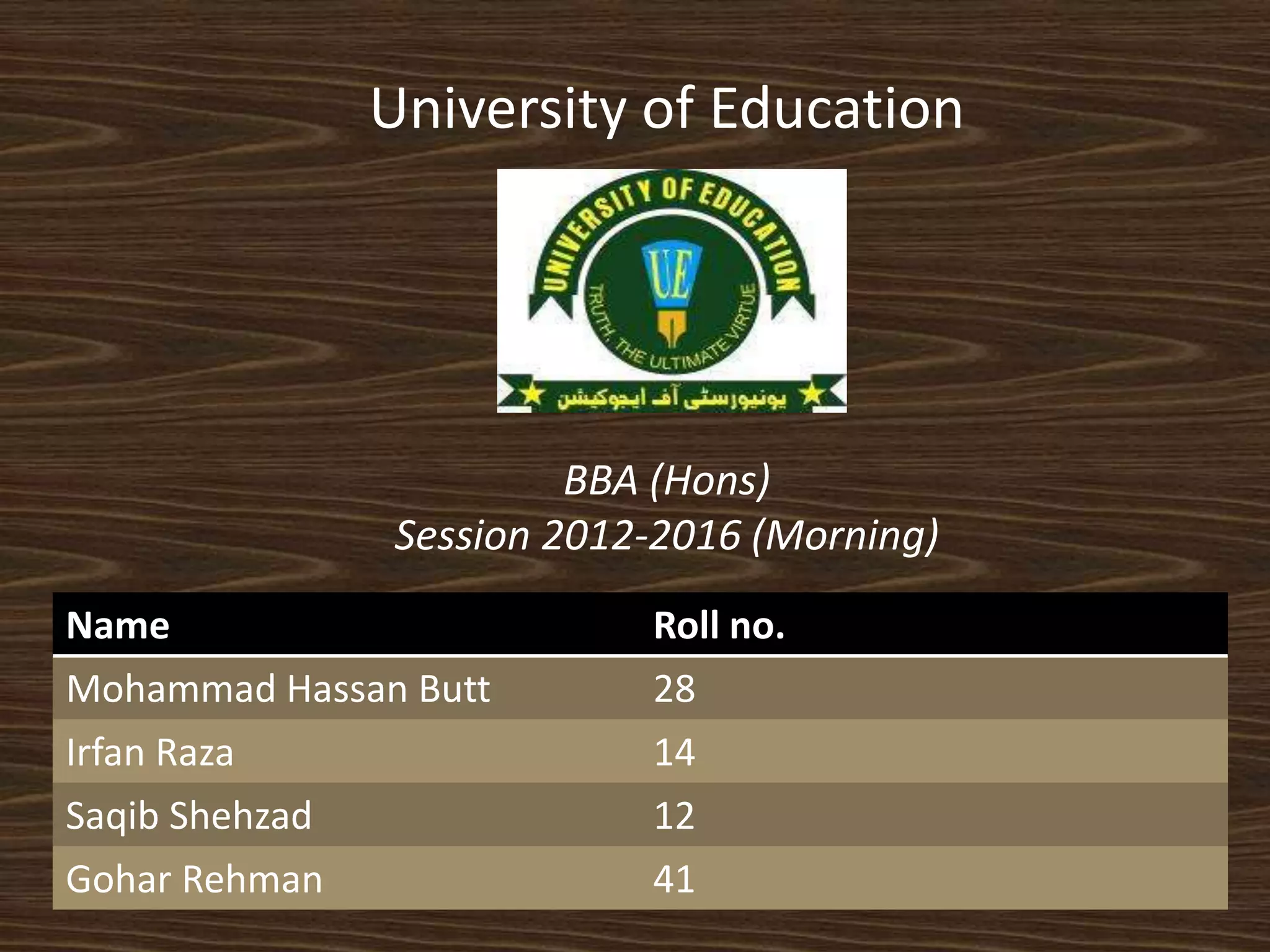
University of Education 
BBA (Hons) 
Session 2012-2016 (Morning) 
Name Roll no. 
Mohammad Hassan Butt 28 
Irfan Raza 14 
Saqib Shehzad 12 
Gohar Rehman 41
Quantitative Research Qualitative Research 
 A type of educational 
research in which the 
researcher decides what 
to study. 
 A type of educational 
research in which the 
researcher relies on the 
views of the participants.
Quantitative Research Qualitative Research 
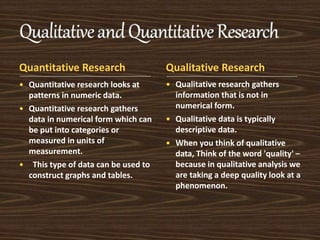
 Quantitative research looks at 
patterns in numeric data. 
 Quantitative research gathers 
data in numerical form which can 
be put into categories or 
measured in units of 
measurement. 
 This type of data can be used to 
construct graphs and tables. 
 Qualitative research gathers 
information that is not in 
numerical form. 
 Qualitative data is typically 
descriptive data. 
 When you think of qualitative 
data, Think of the word 'quality' – 
because in qualitative analysis we 
are taking a deep quality look at a 
phenomenon.
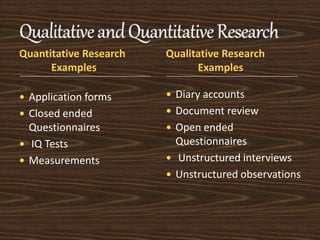
Quantitative Research 
Examples 
Qualitative Research 
Examples 
 Application forms 
 Closed ended 
Questionnaires 
 IQ Tests 
 Measurements 
 Diary accounts 
 Document review 
 Open ended 
Questionnaires 
 Unstructured interviews 
 Unstructured observations
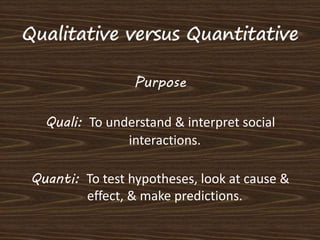
Purpose 
Quali: To understand & interpret social 
interactions. 
Quanti: To test hypotheses, look at cause & 
effect, & make predictions.
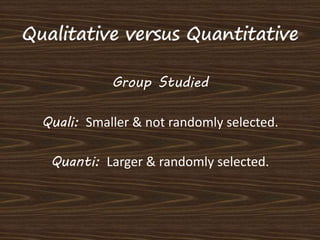
Group Studied 
Quali: Smaller & not randomly selected. 
Quanti: Larger & randomly selected.
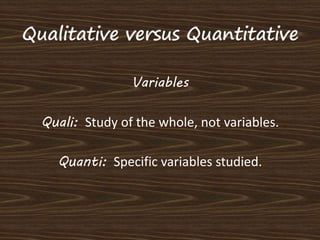
Variables 
Quali: Study of the whole, not variables. 
Quanti: Specific variables studied.
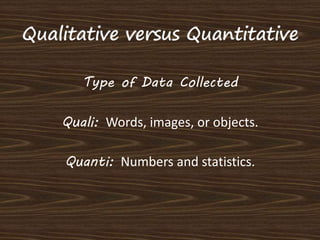
Type of Data Collected 
Quali: Words, images, or objects. 
Quanti: Numbers and statistics.
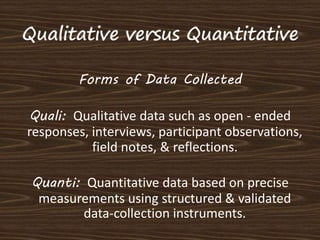
Forms of Data Collected 
Quali: Qualitative data such as open - ended 
responses, interviews, participant observations, 
field notes, & reflections. 
Quanti: Quantitative data based on precise 
measurements using structured & validated 
data-collection instruments.
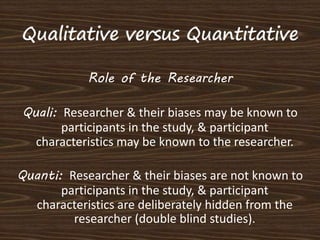
Role of the Researcher 
Quali: Researcher & their biases may be known to 
participants in the study, & participant 
characteristics may be known to the researcher. 
Quanti: Researcher & their biases are not known to 
participants in the study, & participant 
characteristics are deliberately hidden from the 
researcher (double blind studies).
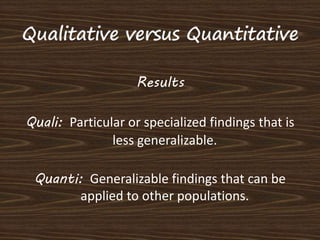
Results 
Quali: Particular or specialized findings that is 
less generalizable. 
Quanti: Generalizable findings that can be 
applied to other populations.
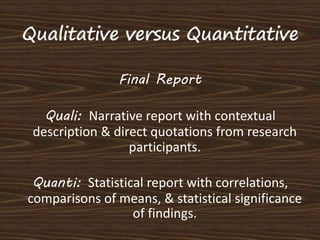
Final Report 
Quali: Narrative report with contextual 
description & direct quotations from research 
participants. 
Quanti: Statistical report with correlations, 
comparisons of means, & statistical significance 
of findings.
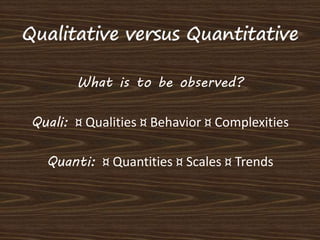
What is to be observed? 
Quali: ¤ Qualities ¤ Behavior ¤ Complexities 
Quanti: ¤ Quantities ¤ Scales ¤ Trends
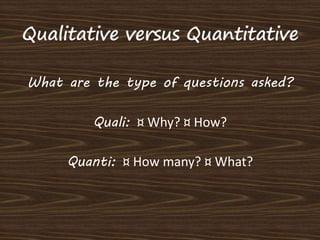
What are the type of questions asked? 
Quali: ¤ Why? ¤ How? 
Quanti: ¤ How many? ¤ What?
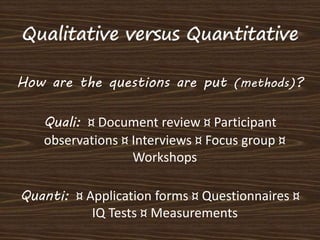
How are the questions are put (methods)? 
Quali: ¤ Document review ¤ Participant 
observations ¤ Interviews ¤ Focus group ¤ 
Workshops 
Quanti: ¤ Application forms ¤ Questionnaires ¤ 
IQ Tests ¤ Measurements
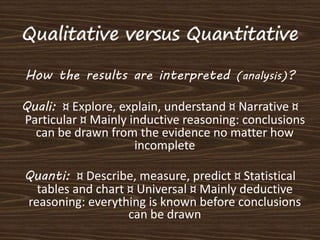
How the results are interpreted (analysis)? 
Quali: ¤ Explore, explain, understand ¤ Narrative ¤ 
Particular ¤ Mainly inductive reasoning: conclusions 
can be drawn from the evidence no matter how 
incomplete 
Quanti: ¤ Describe, measure, predict ¤ Statistical 
tables and chart ¤ Universal ¤ Mainly deductive 
reasoning: everything is known before conclusions 
can be drawn
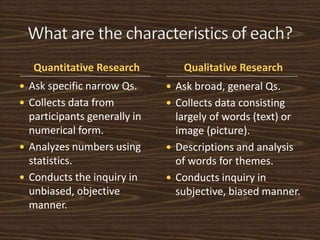
Quantitative Research Qualitative Research 
 Ask broad, general Qs. 
 Collects data consisting 
largely of words (text) or 
image (picture). 
 Descriptions and analysis 
of words for themes. 
 Conducts inquiry in 
subjective, biased manner. 
 Ask specific narrow Qs. 
 Collects data from 
participants generally in 
numerical form. 
 Analyzes numbers using 
statistics. 
 Conducts the inquiry in 
unbiased, objective 
manner.
Quantitative Research Qualitative Research 
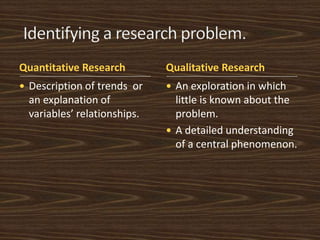
 Description of trends or 
an explanation of 
variables’ relationships. 
 An exploration in which 
little is known about the 
problem. 
 A detailed understanding 
of a central phenomenon.
Quantitative Research Qualitative Research 
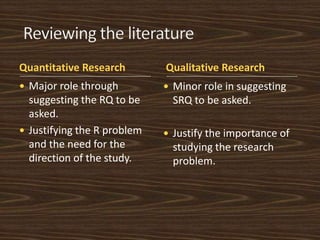
 Major role through 
suggesting the RQ to be 
asked. 
 Justifying the R problem 
and the need for the 
direction of the study. 
 Minor role in suggesting 
SRQ to be asked. 
 Justify the importance of 
studying the research 
problem.
Quantitative Research Qualitative Research 
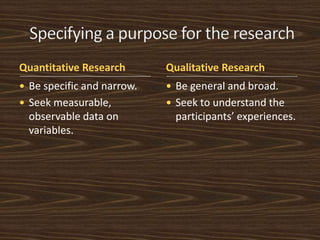
 Be specific and narrow. 
 Seek measurable, 
observable data on 
variables. 
 Be general and broad. 
 Seek to understand the 
participants’ experiences.
Quantitative Research Qualitative Research 
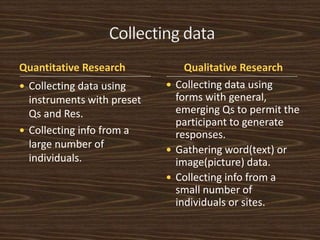
 Collecting data using 
instruments with preset 
Qs and Res. 
 Collecting info from a 
large number of 
individuals. 
 Collecting data using 
forms with general, 
emerging Qs to permit the 
participant to generate 
responses. 
 Gathering word(text) or 
image(picture) data. 
 Collecting info from a 
small number of 
individuals or sites.
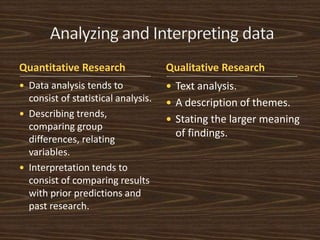
Quantitative Research Qualitative Research 
 Data analysis tends to 
consist of statistical analysis. 
 Describing trends, 
comparing group 
differences, relating 
variables. 
 Interpretation tends to 
consist of comparing results 
with prior predictions and 
past research. 
 Text analysis. 
 A description of themes. 
 Stating the larger meaning 
of findings.
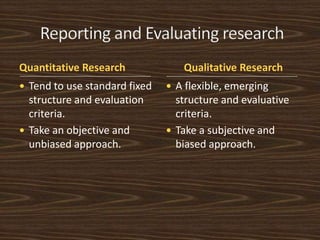
Quantitative Research Qualitative Research 
 Tend to use standard fixed 
structure and evaluation 
criteria. 
 Take an objective and 
unbiased approach. 
 A flexible, emerging 
structure and evaluative 
criteria. 
 Take a subjective and 
biased approach.
E N D 
Thanks!

Quantitative and Qualitative Research

  • 1.
    University of Education BBA (Hons) Session 2012-2016 (Morning) Name Roll no. Mohammad Hassan Butt 28 Irfan Raza 14 Saqib Shehzad 12 Gohar Rehman 41
  • 3.
    Quantitative Research QualitativeResearch  A type of educational research in which the researcher decides what to study.  A type of educational research in which the researcher relies on the views of the participants.
  • 4.
    Quantitative Research QualitativeResearch  Quantitative research looks at patterns in numeric data.  Quantitative research gathers data in numerical form which can be put into categories or measured in units of measurement.  This type of data can be used to construct graphs and tables.  Qualitative research gathers information that is not in numerical form.  Qualitative data is typically descriptive data.  When you think of qualitative data, Think of the word 'quality' – because in qualitative analysis we are taking a deep quality look at a phenomenon.
  • 5.
    Quantitative Research Examples Qualitative Research Examples  Application forms  Closed ended Questionnaires  IQ Tests  Measurements  Diary accounts  Document review  Open ended Questionnaires  Unstructured interviews  Unstructured observations
  • 6.
    Purpose Quali: Tounderstand & interpret social interactions. Quanti: To test hypotheses, look at cause & effect, & make predictions.
  • 7.
    Group Studied Quali:Smaller & not randomly selected. Quanti: Larger & randomly selected.
  • 8.
    Variables Quali: Studyof the whole, not variables. Quanti: Specific variables studied.
  • 9.
    Type of DataCollected Quali: Words, images, or objects. Quanti: Numbers and statistics.
  • 10.
    Forms of DataCollected Quali: Qualitative data such as open - ended responses, interviews, participant observations, field notes, & reflections. Quanti: Quantitative data based on precise measurements using structured & validated data-collection instruments.
  • 11.
    Role of theResearcher Quali: Researcher & their biases may be known to participants in the study, & participant characteristics may be known to the researcher. Quanti: Researcher & their biases are not known to participants in the study, & participant characteristics are deliberately hidden from the researcher (double blind studies).
  • 12.
    Results Quali: Particularor specialized findings that is less generalizable. Quanti: Generalizable findings that can be applied to other populations.
  • 13.
    Final Report Quali:Narrative report with contextual description & direct quotations from research participants. Quanti: Statistical report with correlations, comparisons of means, & statistical significance of findings.
  • 14.
    What is tobe observed? Quali: ¤ Qualities ¤ Behavior ¤ Complexities Quanti: ¤ Quantities ¤ Scales ¤ Trends
  • 15.
    What are thetype of questions asked? Quali: ¤ Why? ¤ How? Quanti: ¤ How many? ¤ What?
  • 16.
    How are thequestions are put (methods)? Quali: ¤ Document review ¤ Participant observations ¤ Interviews ¤ Focus group ¤ Workshops Quanti: ¤ Application forms ¤ Questionnaires ¤ IQ Tests ¤ Measurements
  • 17.
    How the resultsare interpreted (analysis)? Quali: ¤ Explore, explain, understand ¤ Narrative ¤ Particular ¤ Mainly inductive reasoning: conclusions can be drawn from the evidence no matter how incomplete Quanti: ¤ Describe, measure, predict ¤ Statistical tables and chart ¤ Universal ¤ Mainly deductive reasoning: everything is known before conclusions can be drawn
  • 18.
    Quantitative Research QualitativeResearch  Ask broad, general Qs.  Collects data consisting largely of words (text) or image (picture).  Descriptions and analysis of words for themes.  Conducts inquiry in subjective, biased manner.  Ask specific narrow Qs.  Collects data from participants generally in numerical form.  Analyzes numbers using statistics.  Conducts the inquiry in unbiased, objective manner.
  • 20.
    Quantitative Research QualitativeResearch  Description of trends or an explanation of variables’ relationships.  An exploration in which little is known about the problem.  A detailed understanding of a central phenomenon.
  • 21.
    Quantitative Research QualitativeResearch  Major role through suggesting the RQ to be asked.  Justifying the R problem and the need for the direction of the study.  Minor role in suggesting SRQ to be asked.  Justify the importance of studying the research problem.
  • 22.
    Quantitative Research QualitativeResearch  Be specific and narrow.  Seek measurable, observable data on variables.  Be general and broad.  Seek to understand the participants’ experiences.
  • 23.
    Quantitative Research QualitativeResearch  Collecting data using instruments with preset Qs and Res.  Collecting info from a large number of individuals.  Collecting data using forms with general, emerging Qs to permit the participant to generate responses.  Gathering word(text) or image(picture) data.  Collecting info from a small number of individuals or sites.
  • 24.
    Quantitative Research QualitativeResearch  Data analysis tends to consist of statistical analysis.  Describing trends, comparing group differences, relating variables.  Interpretation tends to consist of comparing results with prior predictions and past research.  Text analysis.  A description of themes.  Stating the larger meaning of findings.
  • 25.
    Quantitative Research QualitativeResearch  Tend to use standard fixed structure and evaluation criteria.  Take an objective and unbiased approach.  A flexible, emerging structure and evaluative criteria.  Take a subjective and biased approach.
  • 26.
    E N D Thanks!