Causal Research Design:
Experimentation
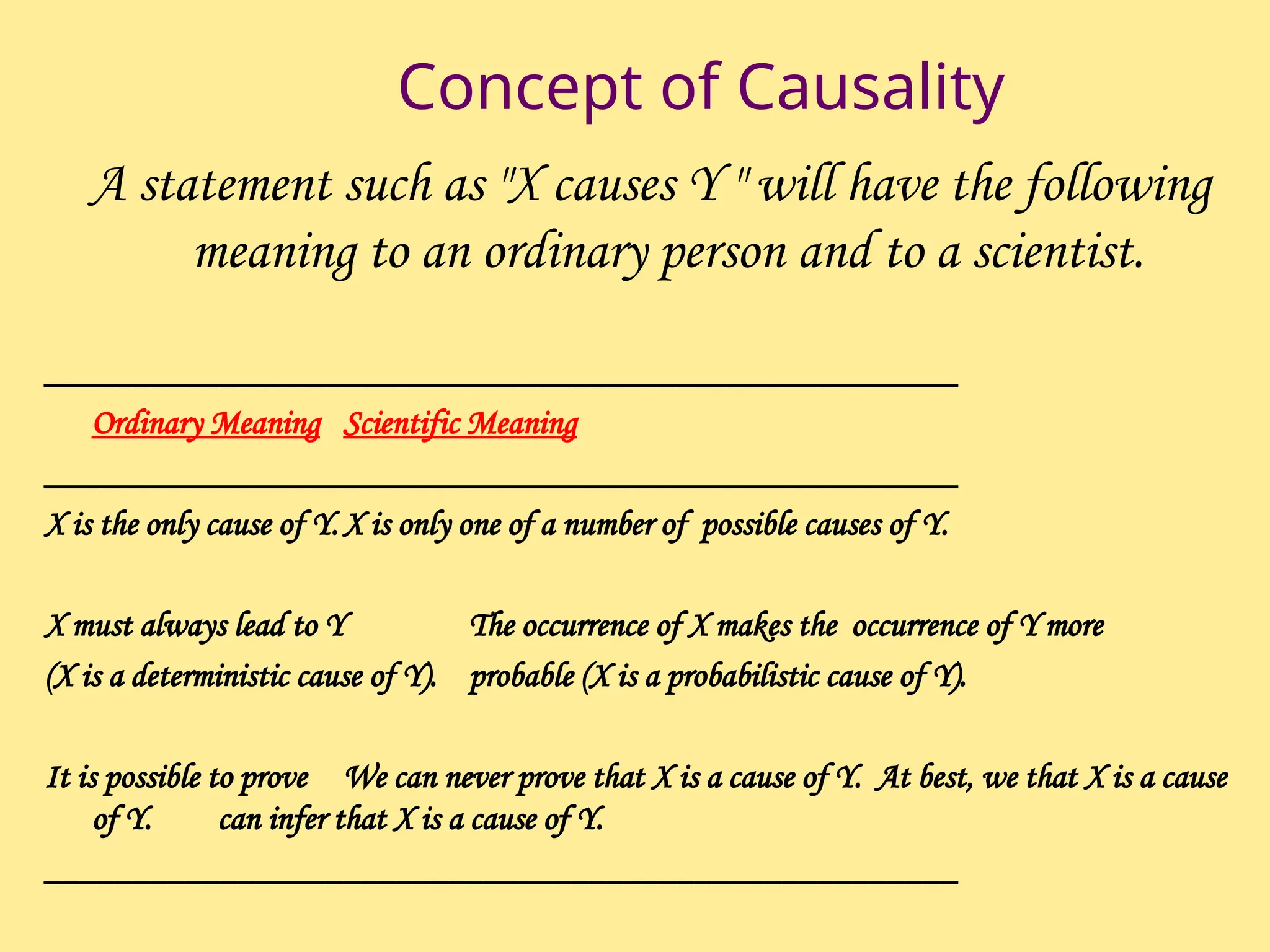
Concept of Causality
A statement such as "X causes Y " will have the following
meaning to an ordinary person and to a scientist.
____________________________________________________
Ordinary Meaning Scientific Meaning
____________________________________________________
X is the only cause of Y.X is only one of a number of possible causes of Y.
X must always lead to Y The occurrence of X makes the occurrence of Y more
(X is a deterministic cause of Y). probable (X is a probabilistic cause of Y).
It is possible to prove We can never prove that X is a cause of Y. At best, we that X is a cause
of Y. can infer that X is a cause of Y.
____________________________________________________
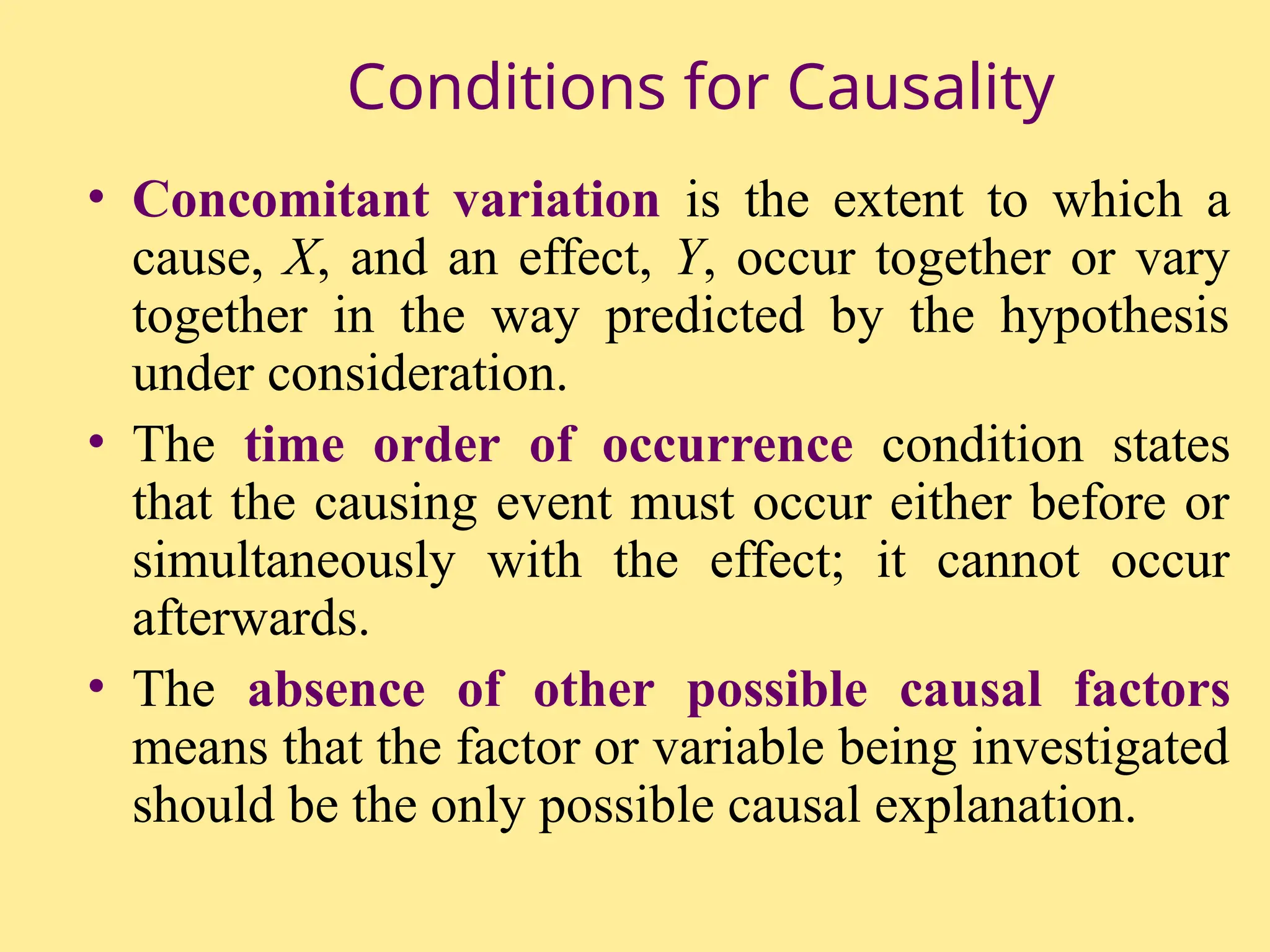
Conditions for Causality
• Concomitant variation is the extent to which a
cause, X, and an effect, Y, occur together or vary
together in the way predicted by the hypothesis
under consideration.
• The time order of occurrence condition states
that the causing event must occur either before or
simultaneously with the effect; it cannot occur
afterwards.
• The absence of other possible causal factors
means that the factor or variable being investigated
should be the only possible causal explanation.
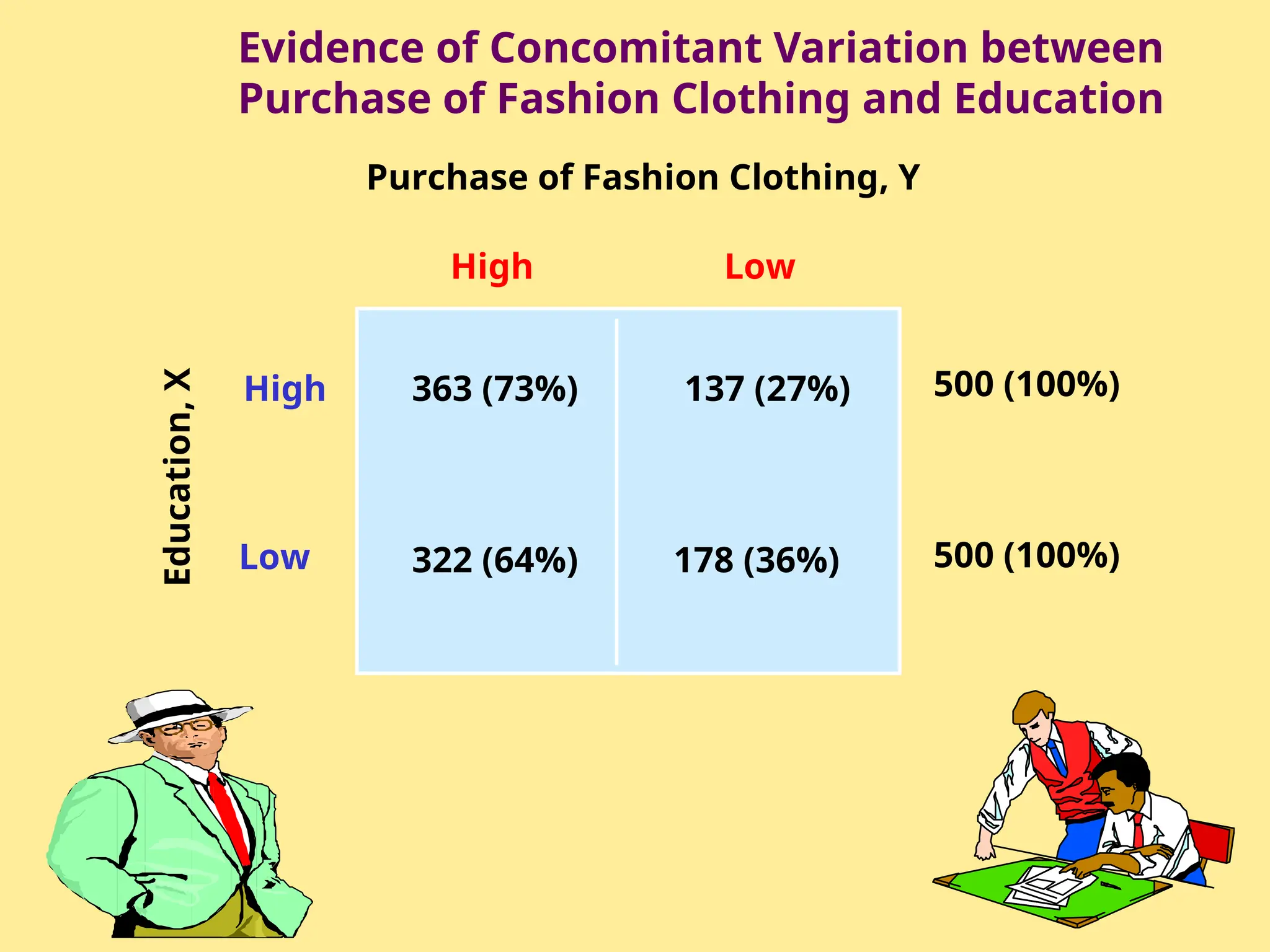
Evidence of Concomitant Variation between
Purchase of Fashion Clothing and Education
High
High Low
363 (73%) 137 (27%)
322 (64%) 178 (36%)
Purchase of Fashion Clothing, Y
500 (100%)
500 (100%)
Low
Education,
X
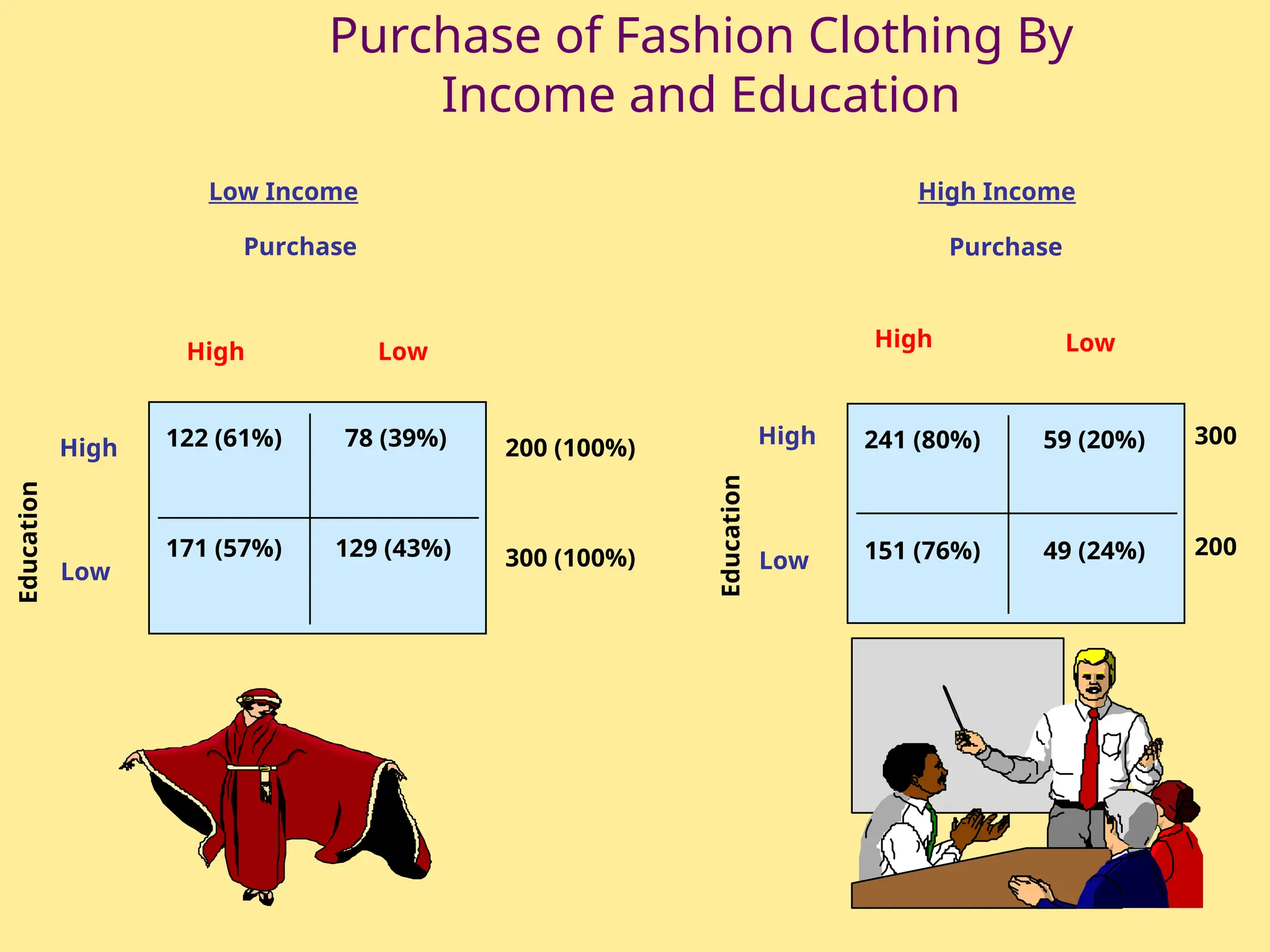
Purchase of Fashion Clothing By
Income and Education
Low Income
Purchase
High Low
High
Low
Education
200 (100%)
300 (100%)
122 (61%)
171 (57%)
78 (39%)
129 (43%)
300
200
High Income
Purchase
High
High
Low
Low
241 (80%)
151 (76%)
59 (20%)
49 (24%)
Education
Definitions and Concepts
• Independent variables are variables or alternatives that are
manipulated and whose effects are measured and compared, e.g.,
price levels.
• Test units are individuals, organizations, or other entities whose
response to the independent variables or treatments is being
examined, e.g., consumers or stores.
• Dependent variables are the variables which measure the effect of
the independent variables on the test units, e.g., sales, profits, and
market shares.
• Extraneous variables are all variables other than the independent
variables that affect the response of the test units, e.g., store size,
store location, and competitive effort.
• Experiment is the process of manipulating one or more
independent variables and measuring their effect on one or more
dependent variables, while controlling for the extraneous variables.
Experimental Design
An experimental design is a set of procedures
specifying
• the test units and how these units are to be divided into
homogeneous subsamples,
• what independent variables or treatments are to be
manipulated,
• what dependent variables are to be measured, and
• how the extraneous variables are to be controlled.
Validity in Experimentation
• Internal validity refers to whether the manipulation of
the independent variables or treatments actually caused
the observed effects on the dependent variables.
Control of extraneous variables is a necessary condition
for establishing internal validity.
• External validity refers to whether the cause-and-
effect relationships found in the experiment can be
generalized. To what populations, settings, times,
independent variables and dependent variables can the
results be projected?
Extraneous Variables
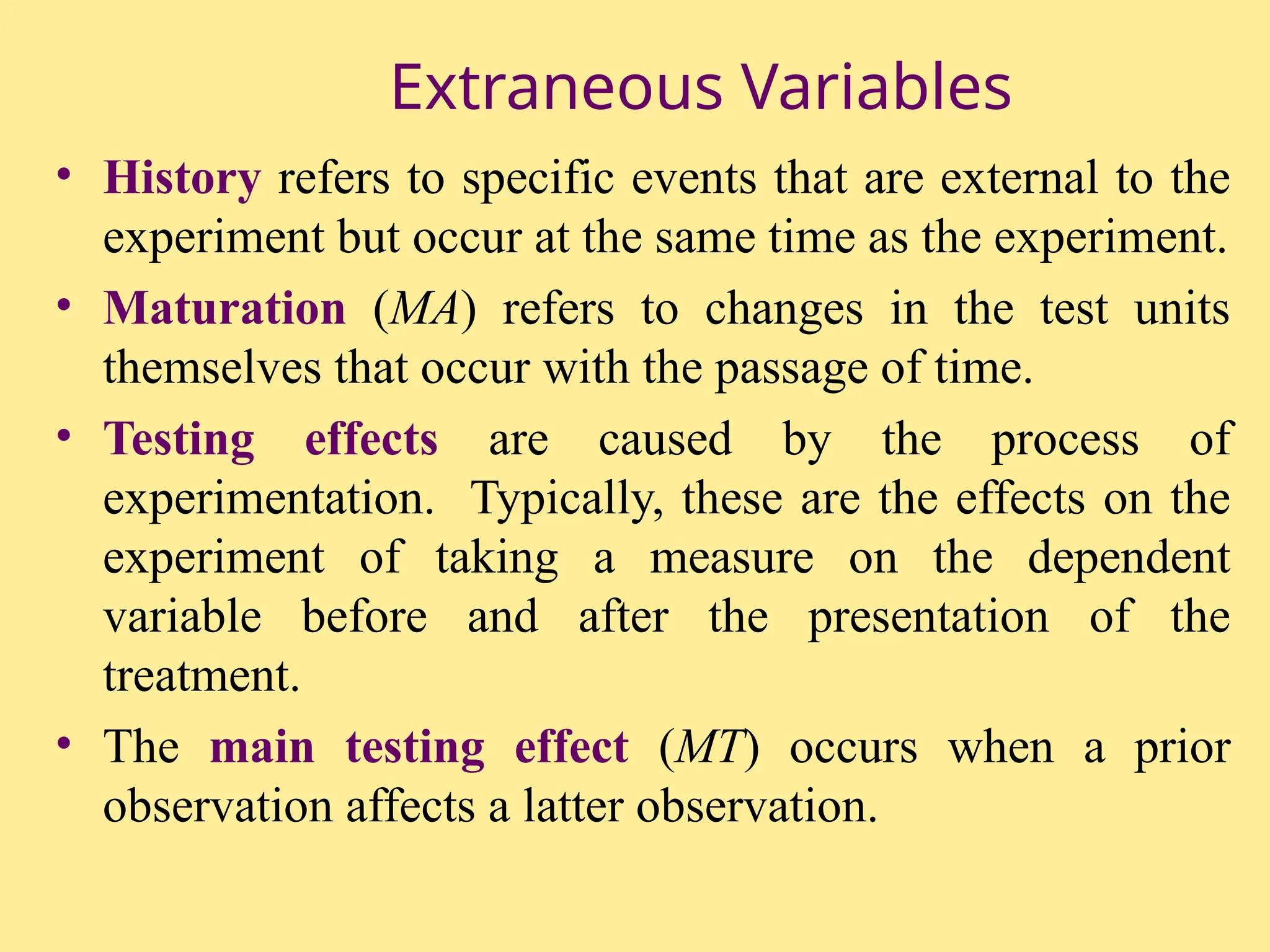
• History refers to specific events that are external to the
experiment but occur at the same time as the experiment.
• Maturation (MA) refers to changes in the test units
themselves that occur with the passage of time.
• Testing effects are caused by the process of
experimentation. Typically, these are the effects on the
experiment of taking a measure on the dependent
variable before and after the presentation of the
treatment.
• The main testing effect (MT) occurs when a prior
observation affects a latter observation.
Extraneous Variables
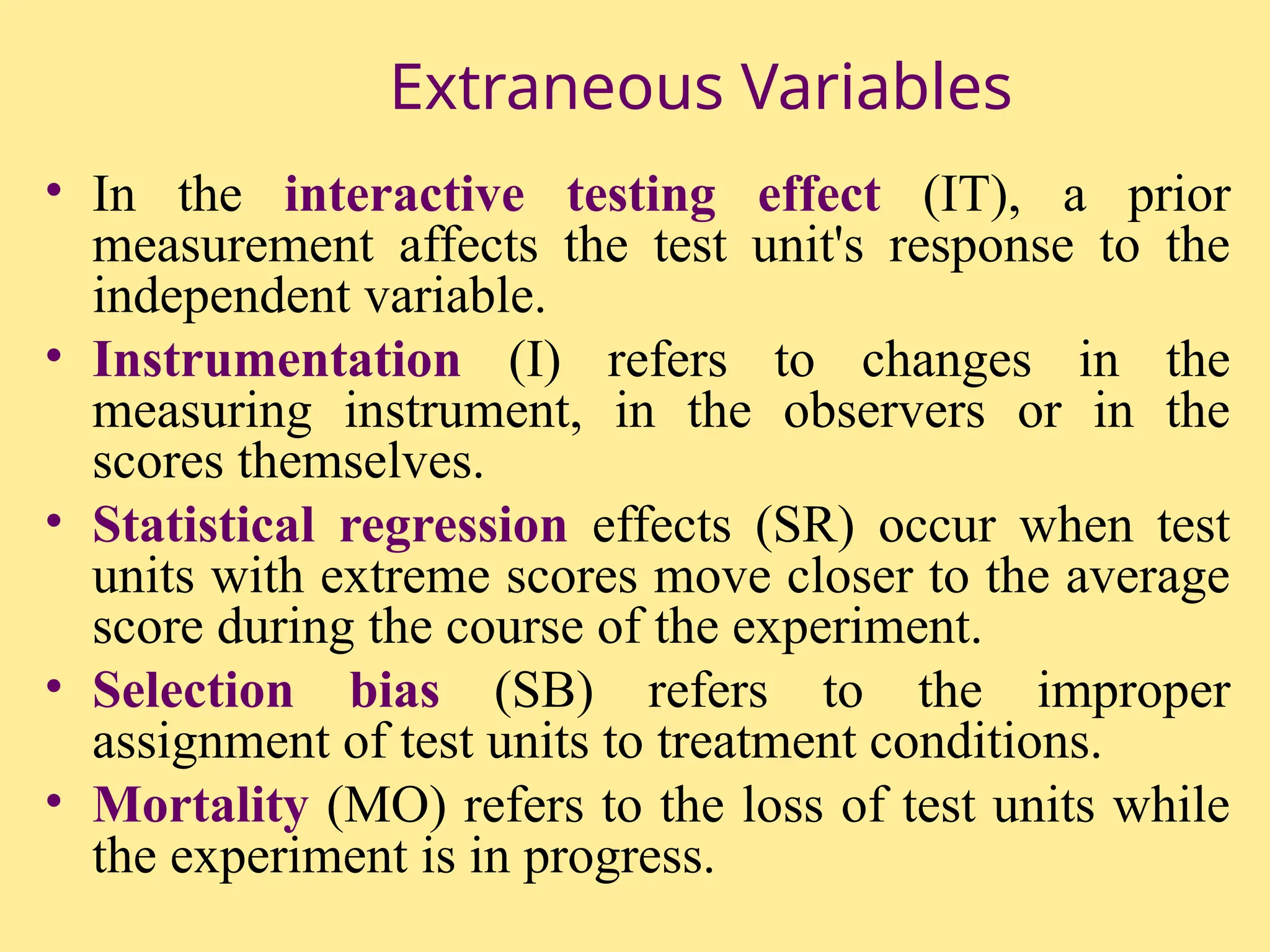
• In the interactive testing effect (IT), a prior
measurement affects the test unit's response to the
independent variable.
• Instrumentation (I) refers to changes in the
measuring instrument, in the observers or in the
scores themselves.
• Statistical regression effects (SR) occur when test
units with extreme scores move closer to the average
score during the course of the experiment.
• Selection bias (SB) refers to the improper
assignment of test units to treatment conditions.
• Mortality (MO) refers to the loss of test units while
the experiment is in progress.
Controlling Extraneous Variables
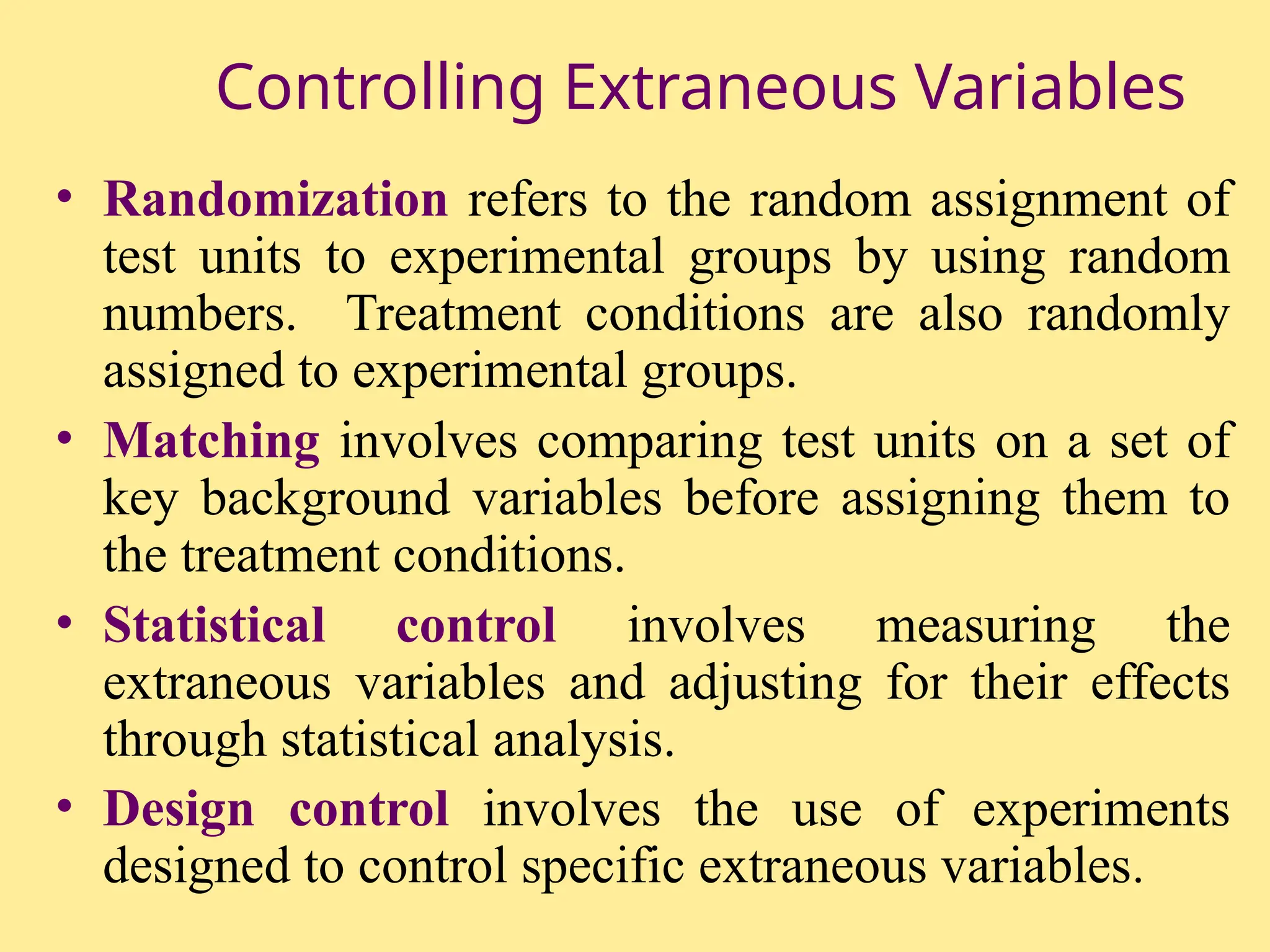
• Randomization refers to the random assignment of
test units to experimental groups by using random
numbers. Treatment conditions are also randomly
assigned to experimental groups.
• Matching involves comparing test units on a set of
key background variables before assigning them to
the treatment conditions.
• Statistical control involves measuring the
extraneous variables and adjusting for their effects
through statistical analysis.
• Design control involves the use of experiments
designed to control specific extraneous variables.
A Classification of Experimental
Designs
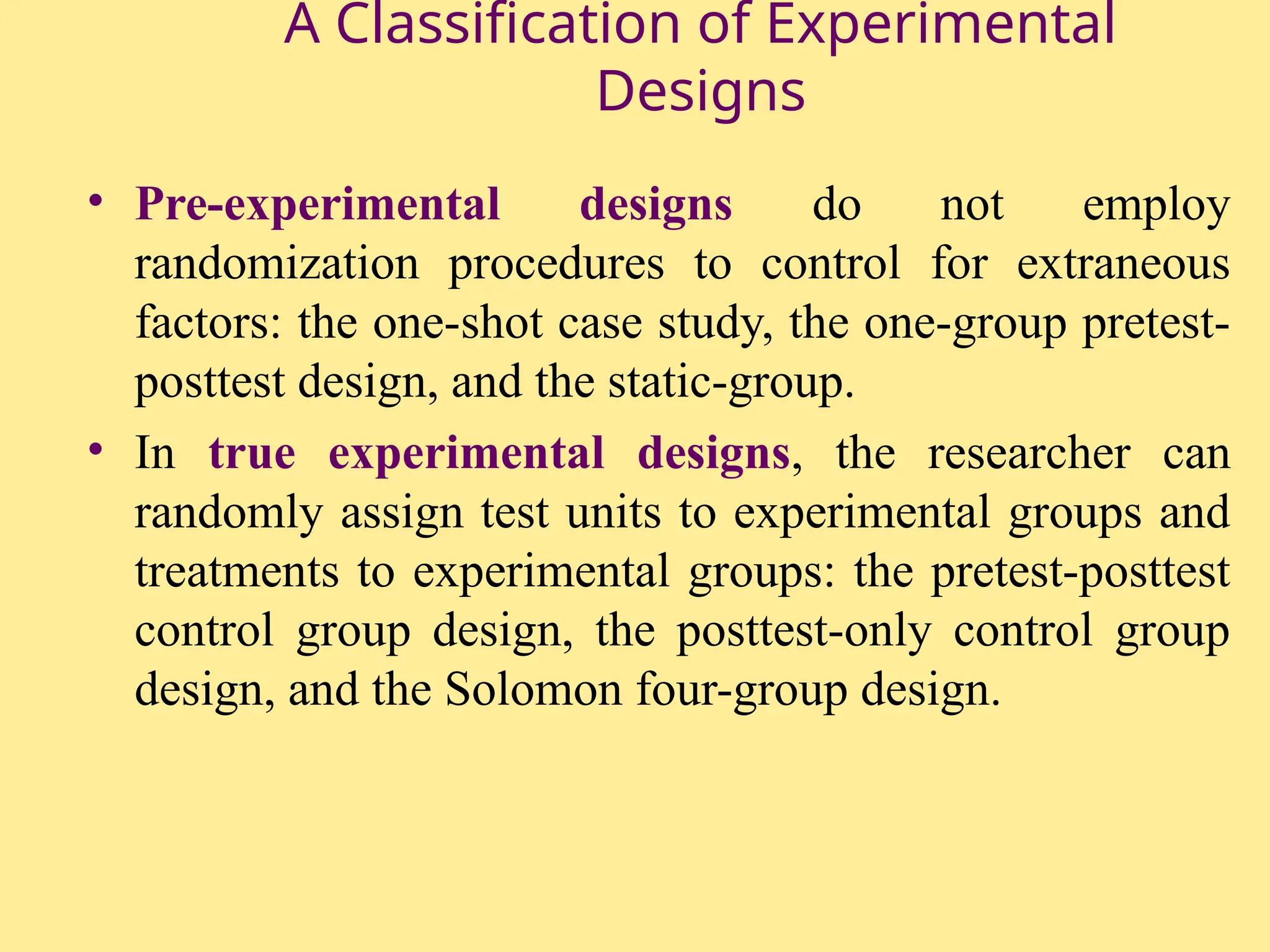
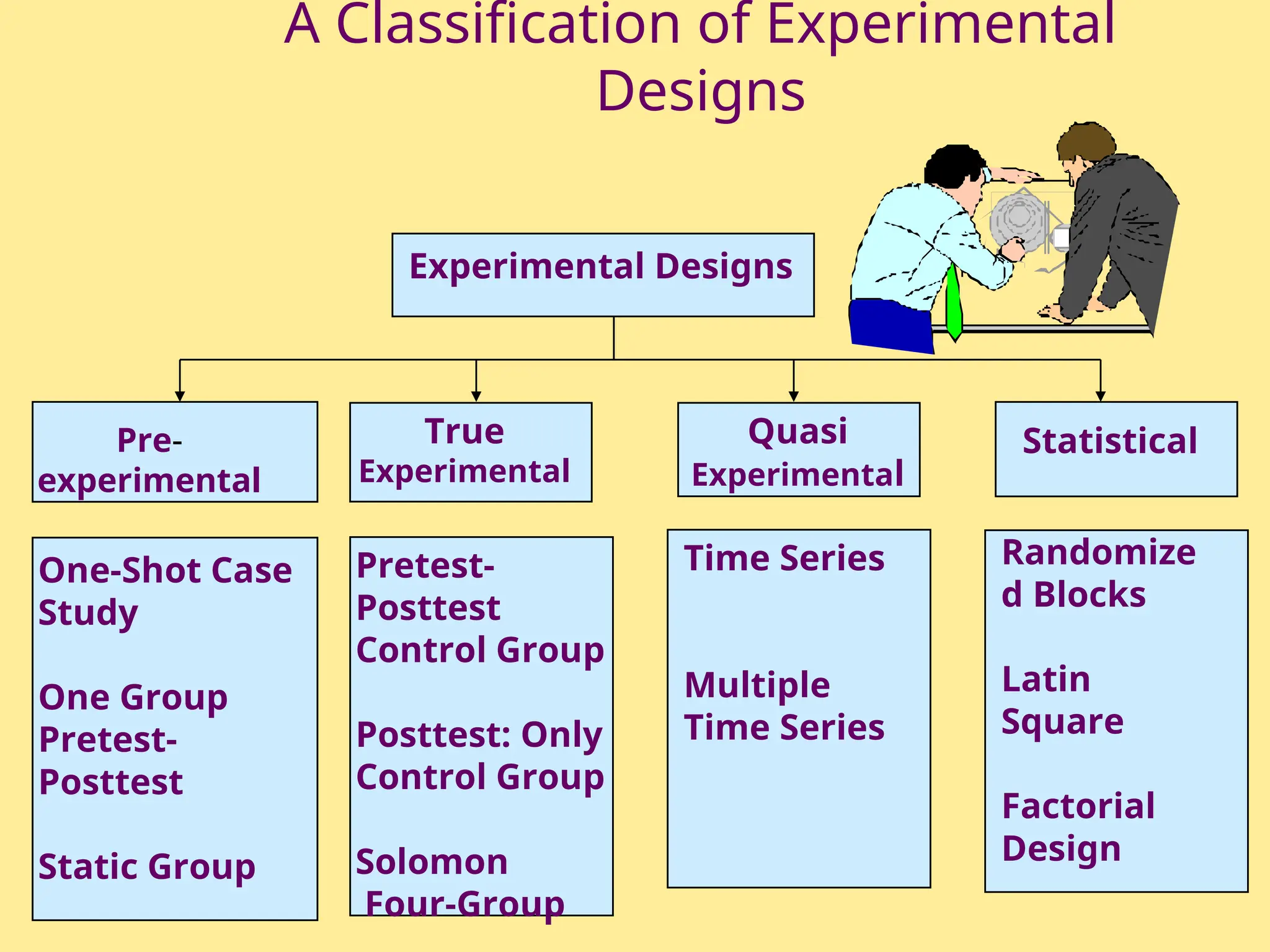
• Pre-experimental designs do not employ
randomization procedures to control for extraneous
factors: the one-shot case study, the one-group pretest-
posttest design, and the static-group.
• In true experimental designs, the researcher can
randomly assign test units to experimental groups and
treatments to experimental groups: the pretest-posttest
control group design, the posttest-only control group
design, and the Solomon four-group design.
A Classification of Experimental
Designs
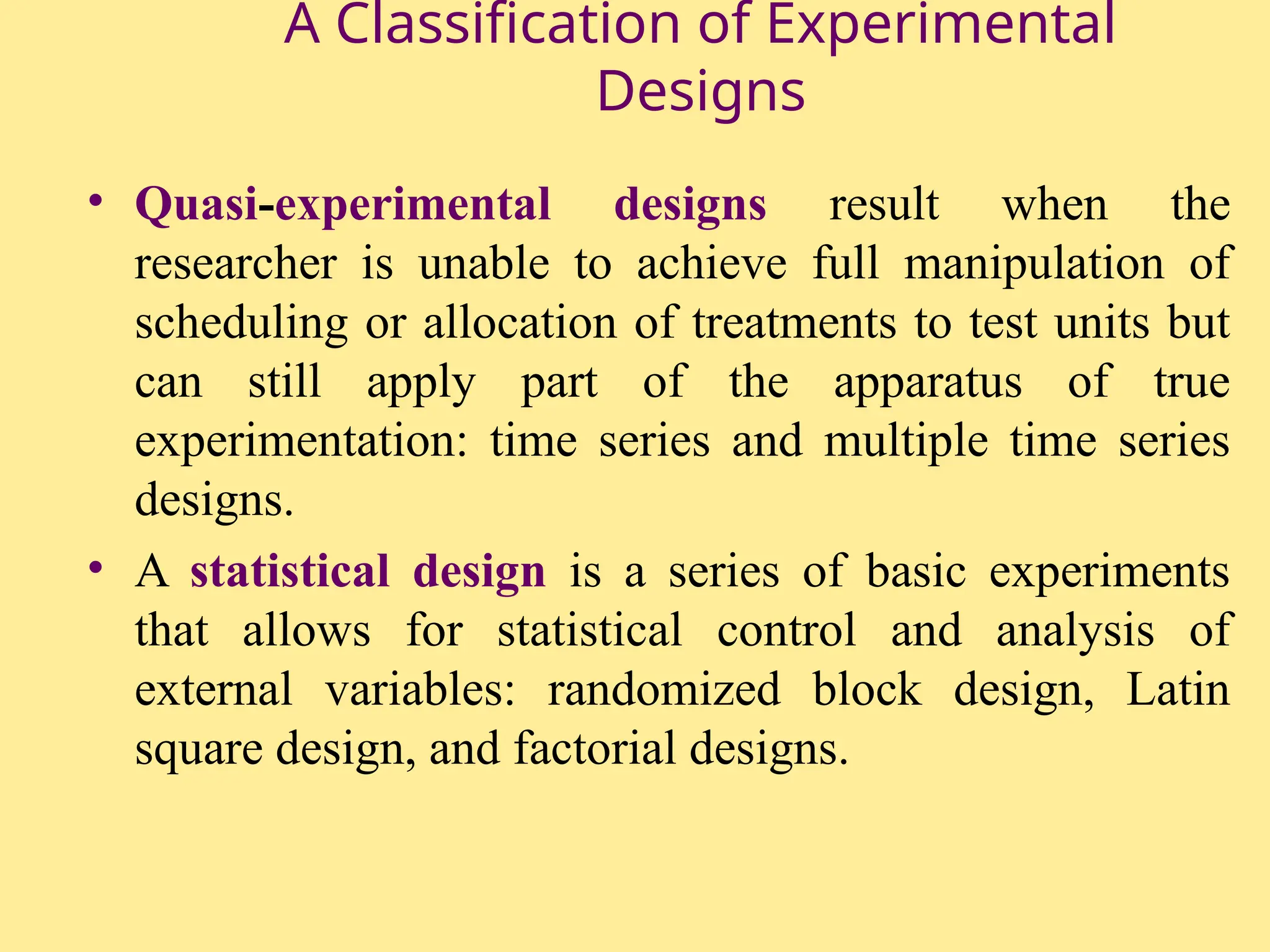
• Quasi-experimental designs result when the
researcher is unable to achieve full manipulation of
scheduling or allocation of treatments to test units but
can still apply part of the apparatus of true
experimentation: time series and multiple time series
designs.
• A statistical design is a series of basic experiments
that allows for statistical control and analysis of
external variables: randomized block design, Latin
square design, and factorial designs.
A Classification of Experimental
Designs
Pre-
experimental
One-Shot Case
Study
One Group
Pretest-
Posttest
Static Group
True
Experimental
Pretest-
Posttest
Control Group
Posttest: Only
Control Group
Solomon
Four-Group
Quasi
Experimental
Time Series
Multiple
Time Series
Statistical
Randomize
d Blocks
Latin
Square
Factorial
Design
Experimental Designs
One-Shot Case Study
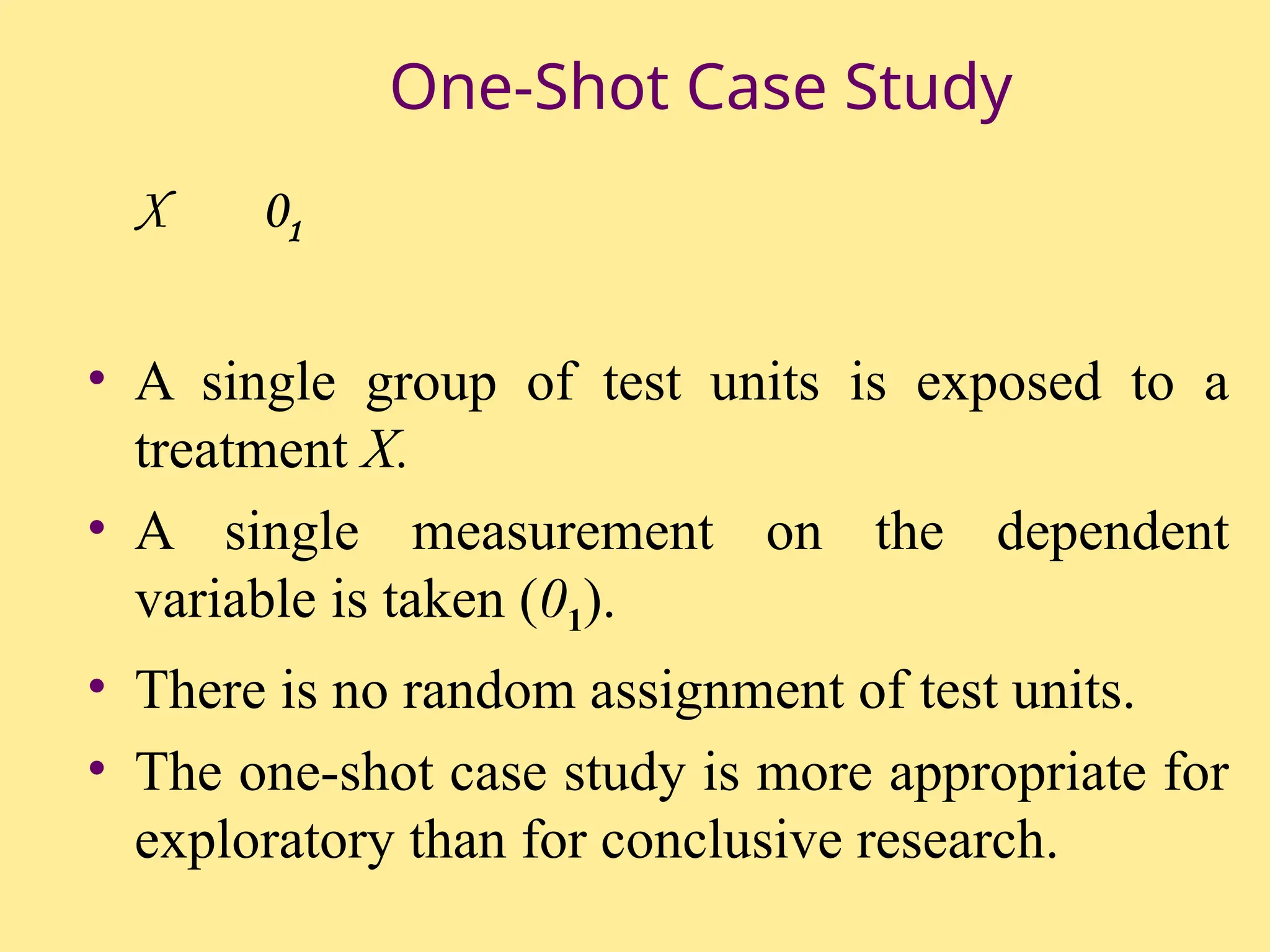
X 01
• A single group of test units is exposed to a
treatment X.
• A single measurement on the dependent
variable is taken (01).
• There is no random assignment of test units.
• The one-shot case study is more appropriate for
exploratory than for conclusive research.
One-Group Pretest-Posttest Design
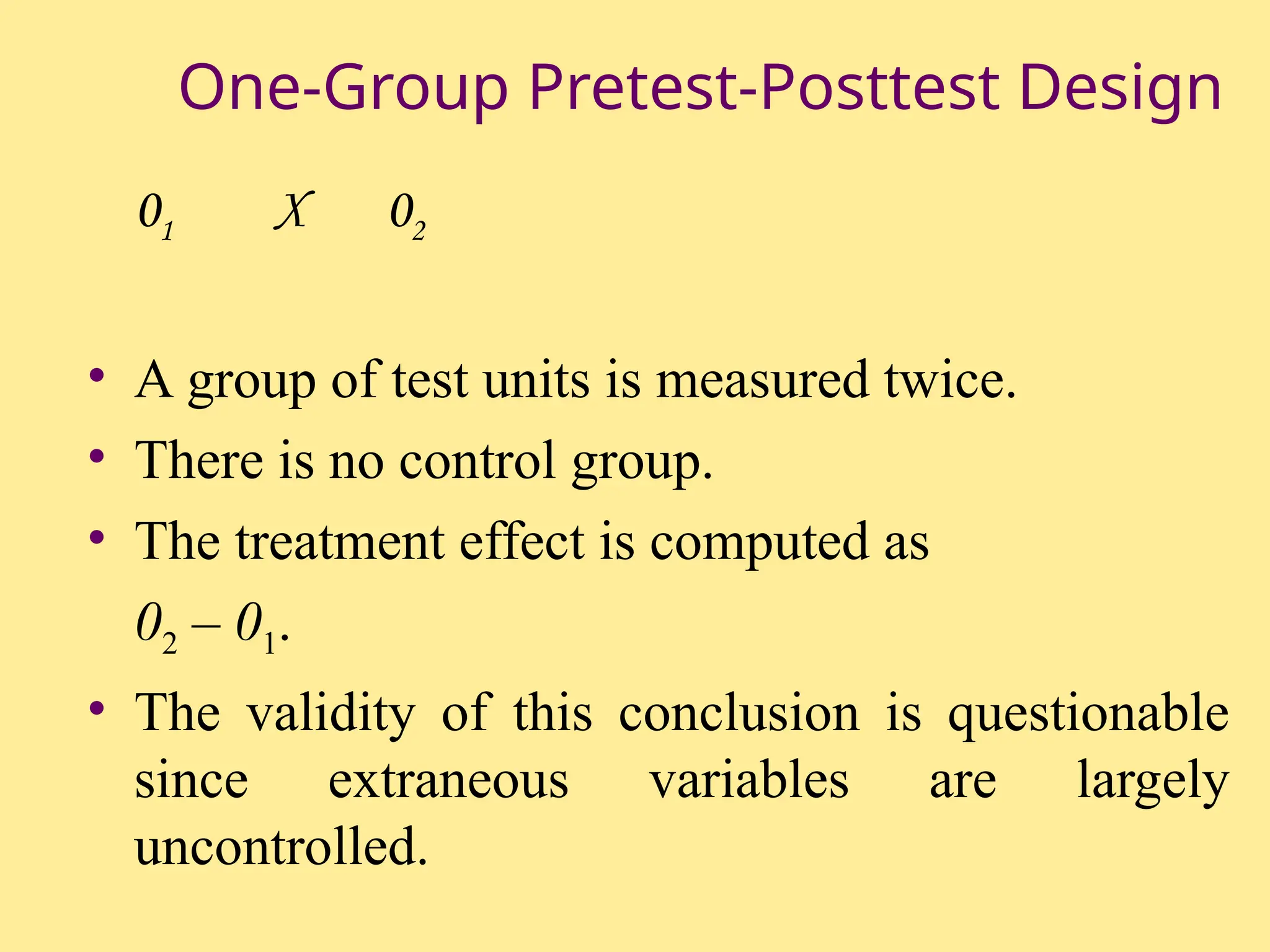
01 X 02
• A group of test units is measured twice.
• There is no control group.
• The treatment effect is computed as
02 – 01.
• The validity of this conclusion is questionable
since extraneous variables are largely
uncontrolled.
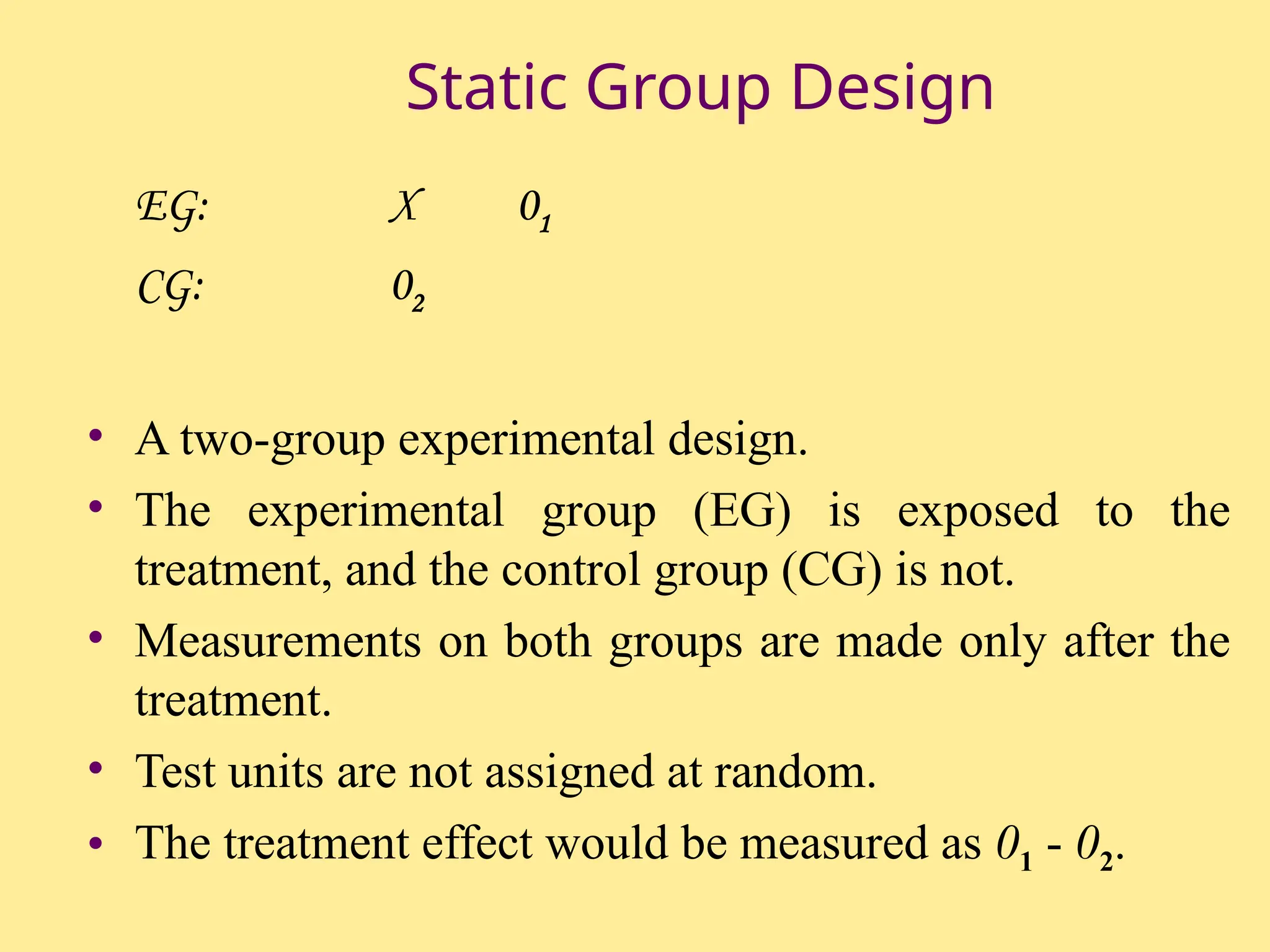
Static Group Design
EG: X 01
CG: 02
• A two-group experimental design.
• The experimental group (EG) is exposed to the
treatment, and the control group (CG) is not.
• Measurements on both groups are made only after the
treatment.
• Test units are not assigned at random.
• The treatment effect would be measured as 01 - 02.
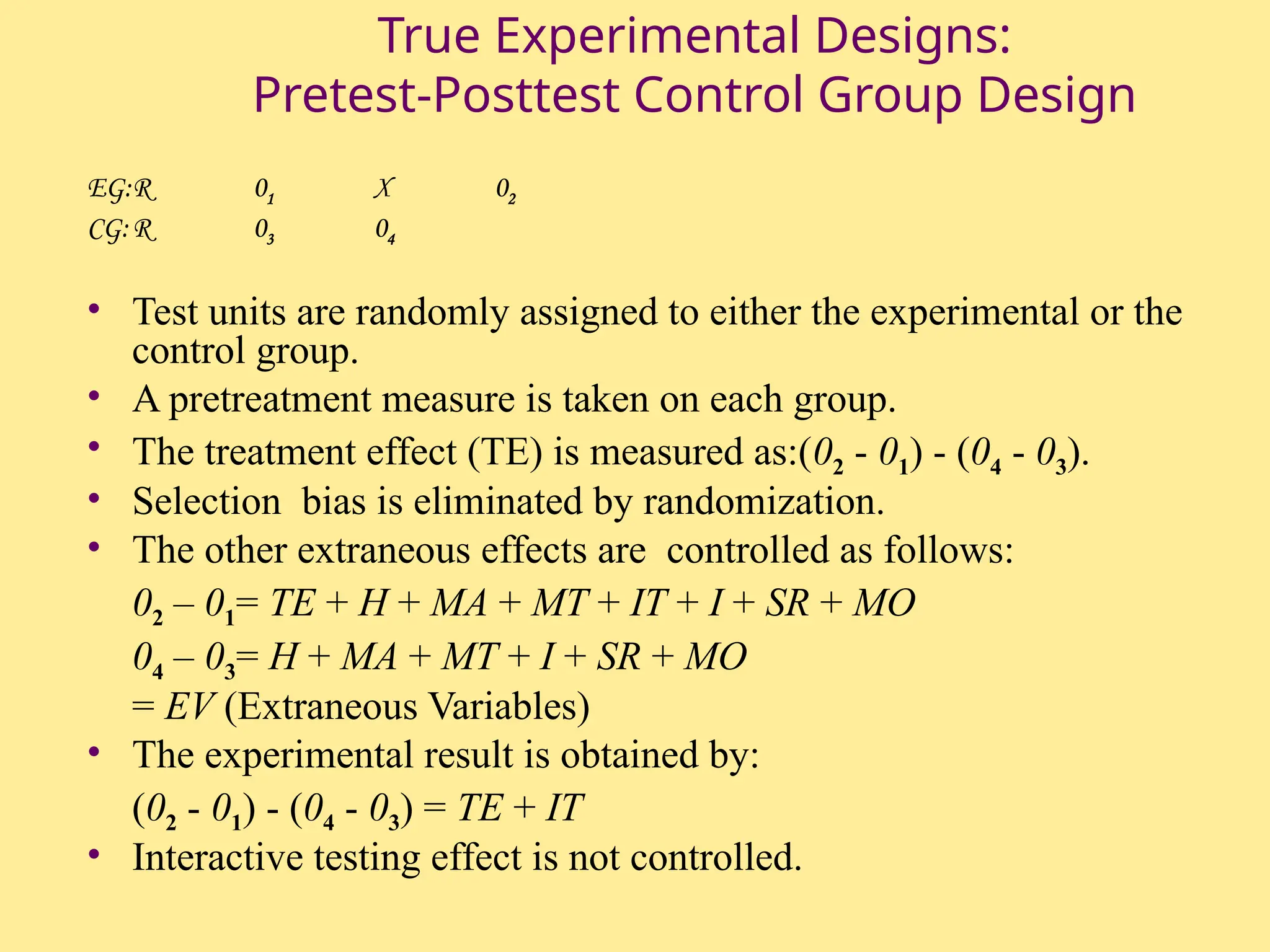
True Experimental Designs:
Pretest-Posttest Control Group Design
EG:R 01 X 02
CG:R 03 04
• Test units are randomly assigned to either the experimental or the
control group.
• A pretreatment measure is taken on each group.
• The treatment effect (TE) is measured as:(02 - 01) - (04 - 03).
• Selection bias is eliminated by randomization.
• The other extraneous effects are controlled as follows:
02 – 01= TE + H + MA + MT + IT + I + SR + MO
04 – 03= H + MA + MT + I + SR + MO
= EV (Extraneous Variables)
• The experimental result is obtained by:
(02 - 01) - (04 - 03) = TE + IT
• Interactive testing effect is not controlled.
Example
• Sample of respondents would be selected at random
• Half of them would be random assigned to the
experimental group
• Other half would form the control group
• Respondents, in both the groups would be administered
a questionnaire to obtain a pretest measurement on
attitudes towards the brand
• Only the respondents in the expt. Group would be
exposed to the TV program containing the test
commercial.
• Thus a questionnaire would be administered to
respondents in both groups to obtain posttest measures
on attitudes towards the brand
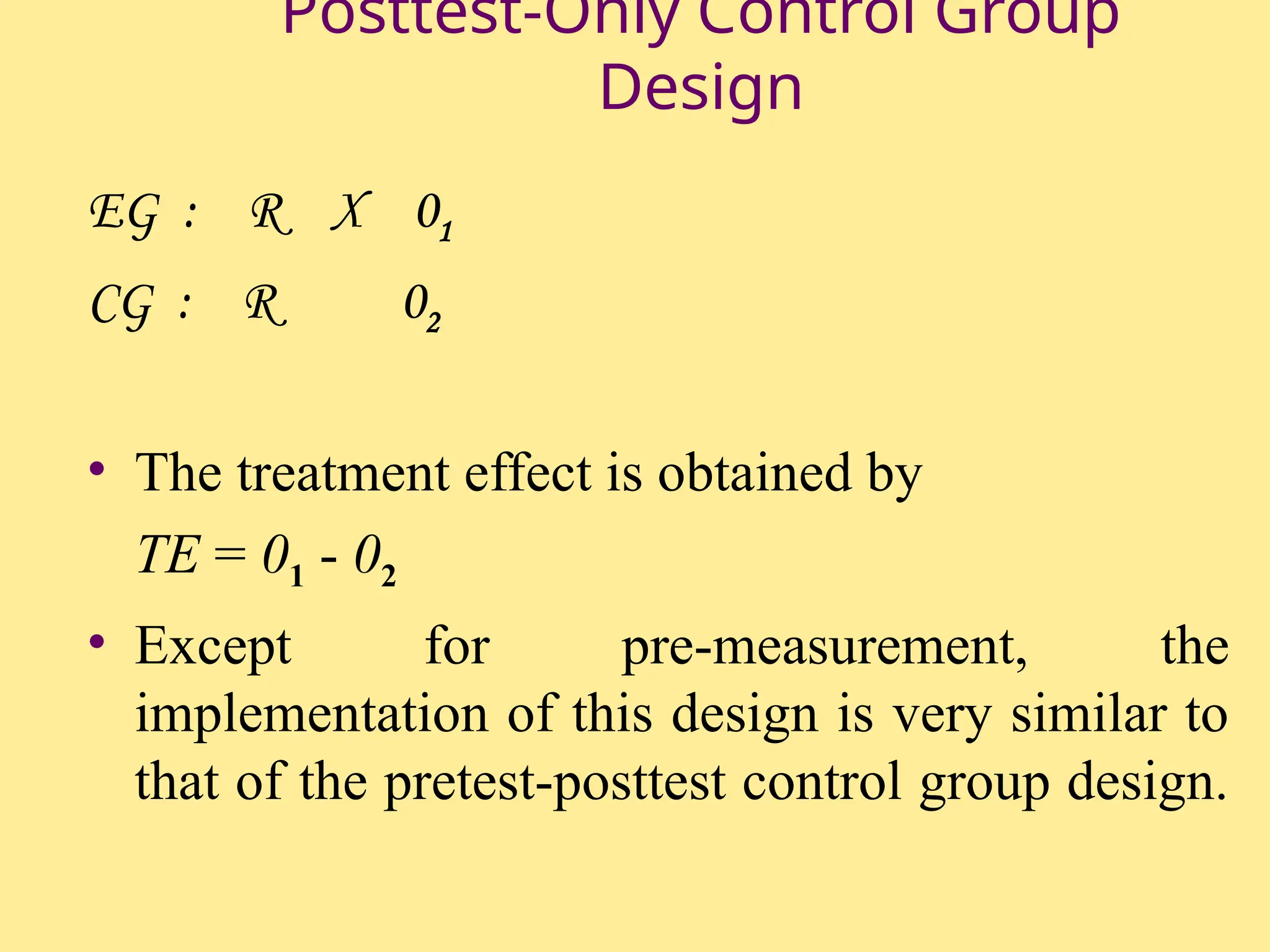
Posttest-Only Control Group
Design
EG : R X 01
CG : R 02
• The treatment effect is obtained by
TE = 01 - 02
• Except for pre-measurement, the
implementation of this design is very similar to
that of the pretest-posttest control group design.
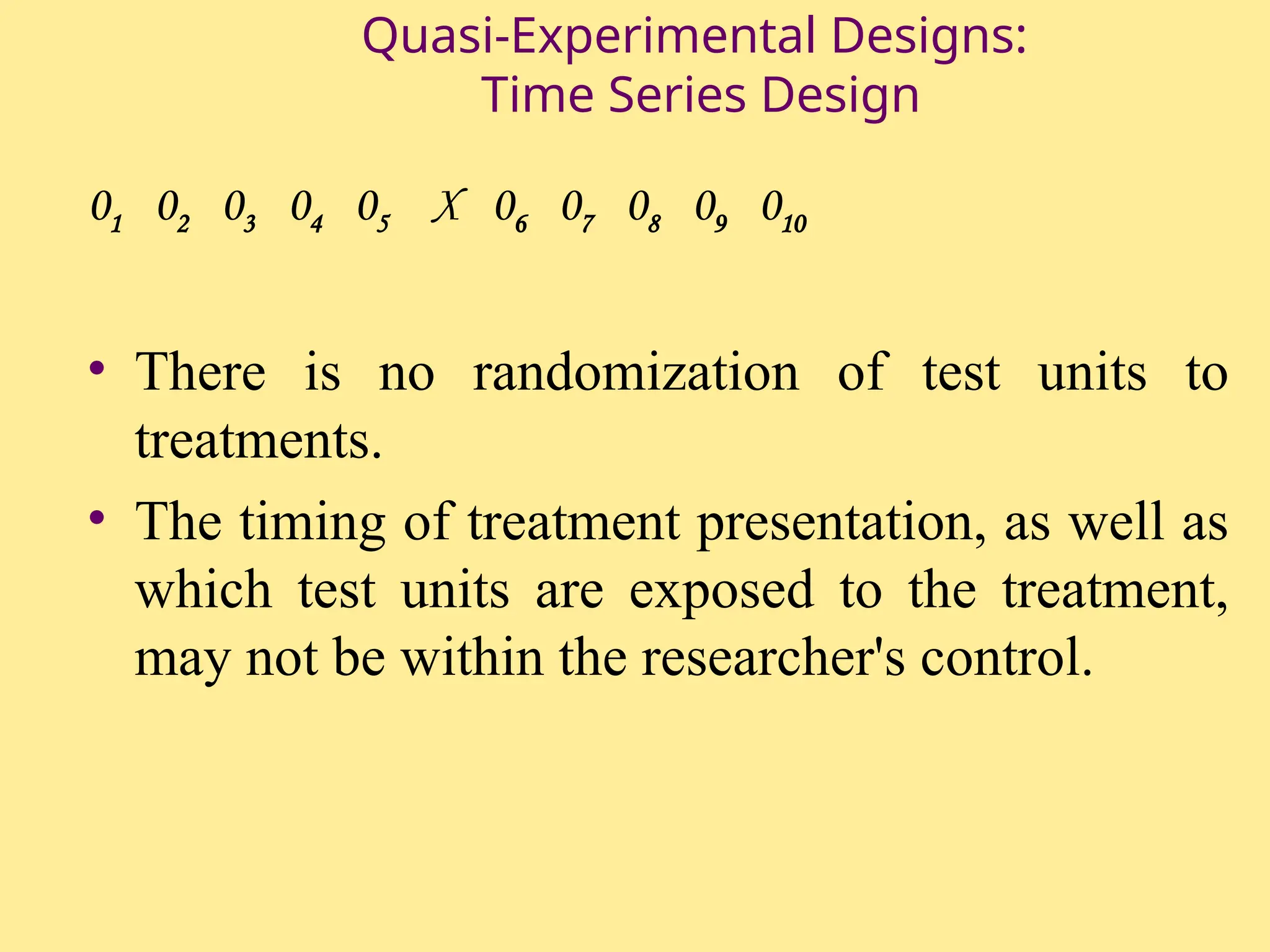
Quasi-Experimental Designs:
Time Series Design
01 02 03 04 05 X 06 07 08 09 010
• There is no randomization of test units to
treatments.
• The timing of treatment presentation, as well as
which test units are exposed to the treatment,
may not be within the researcher's control.
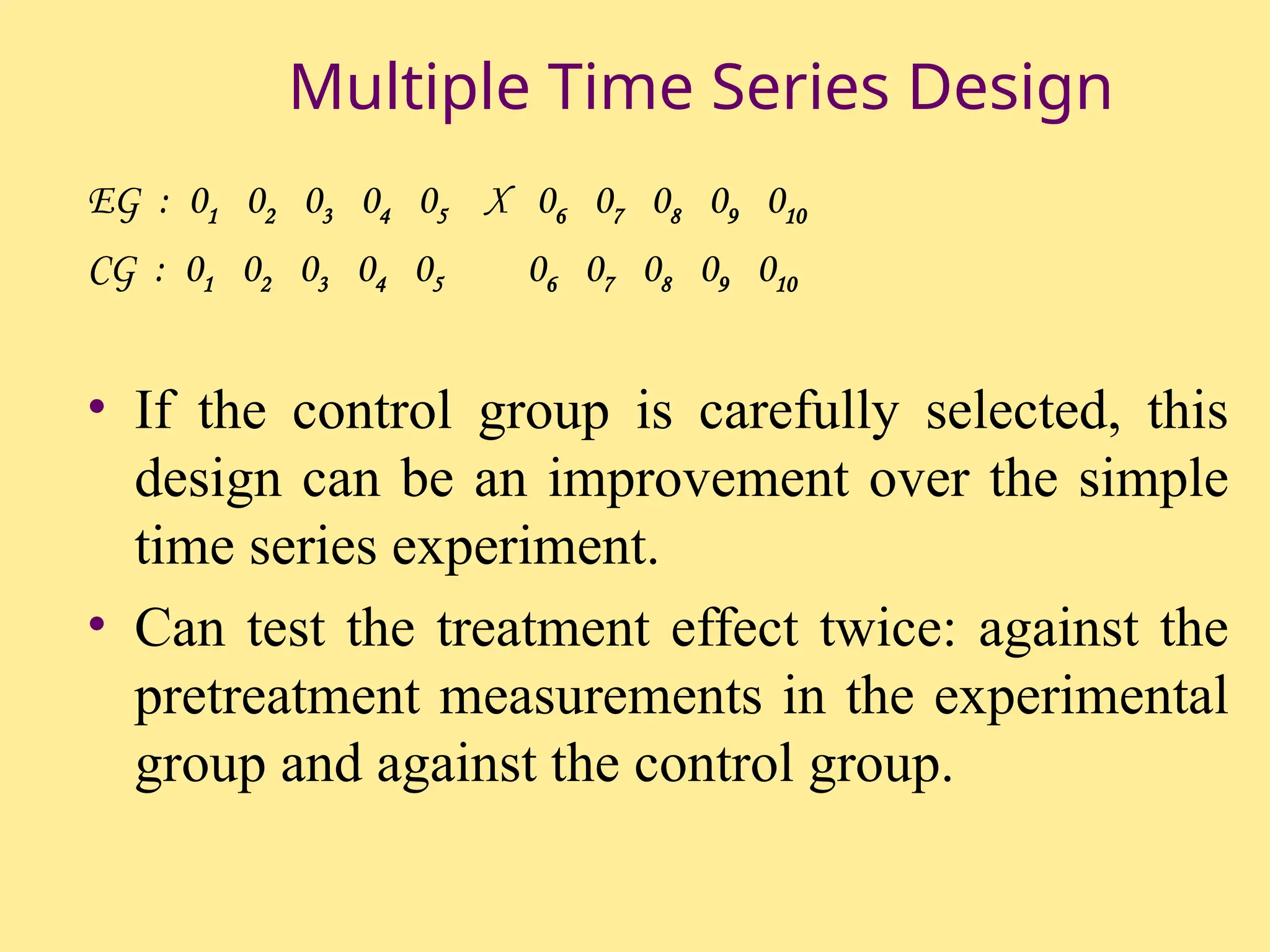
Multiple Time Series Design
EG : 01 02 03 04 05 X 06 07 08 09 010
CG : 01 02 03 04 05 06 07 08 09 010
• If the control group is carefully selected, this
design can be an improvement over the simple
time series experiment.
• Can test the treatment effect twice: against the
pretreatment measurements in the experimental
group and against the control group.
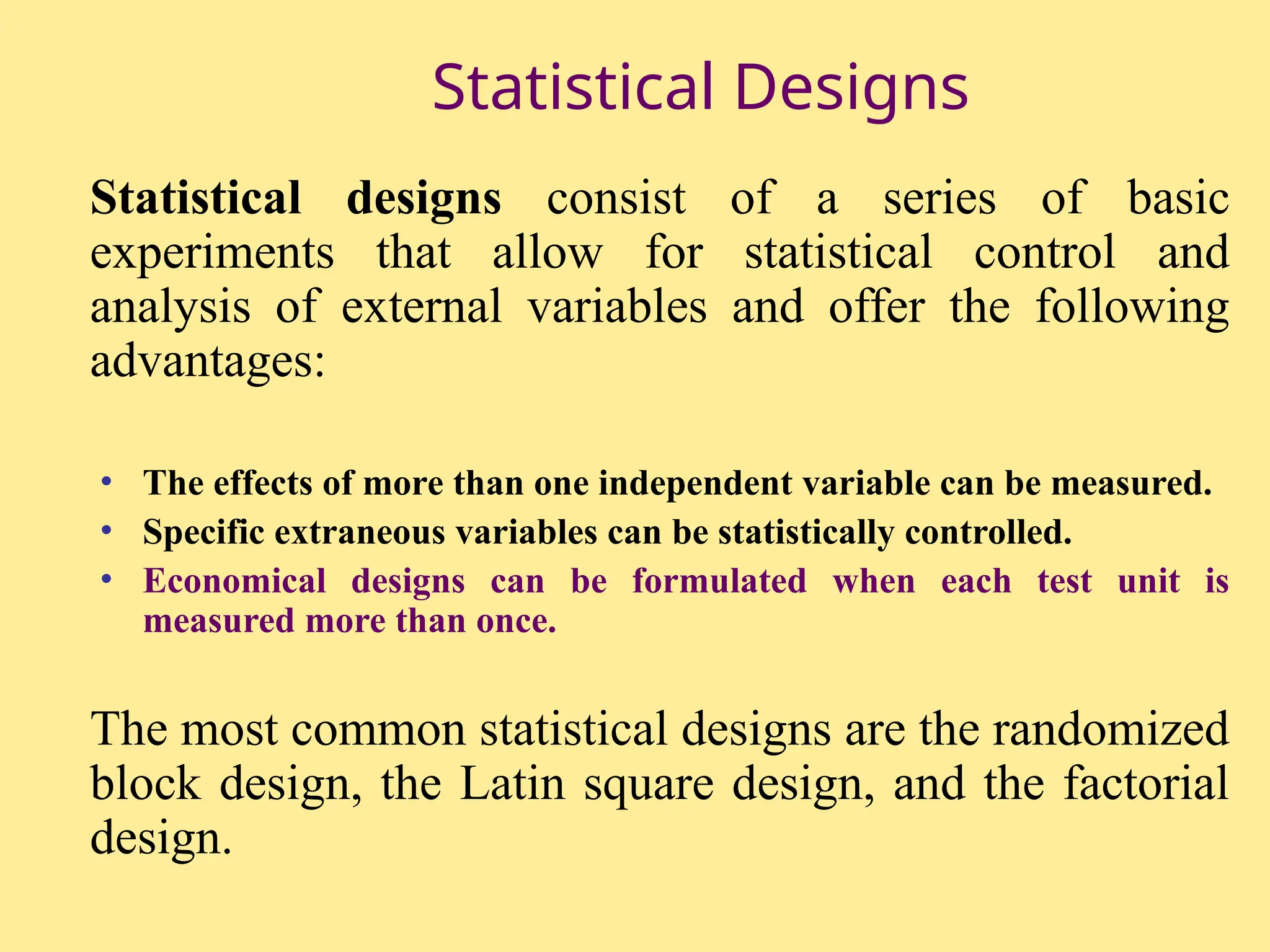
Statistical Designs
Statistical designs consist of a series of basic
experiments that allow for statistical control and
analysis of external variables and offer the following
advantages:
• The effects of more than one independent variable can be measured.
• Specific extraneous variables can be statistically controlled.
• Economical designs can be formulated when each test unit is
measured more than once.
The most common statistical designs are the randomized
block design, the Latin square design, and the factorial
design.
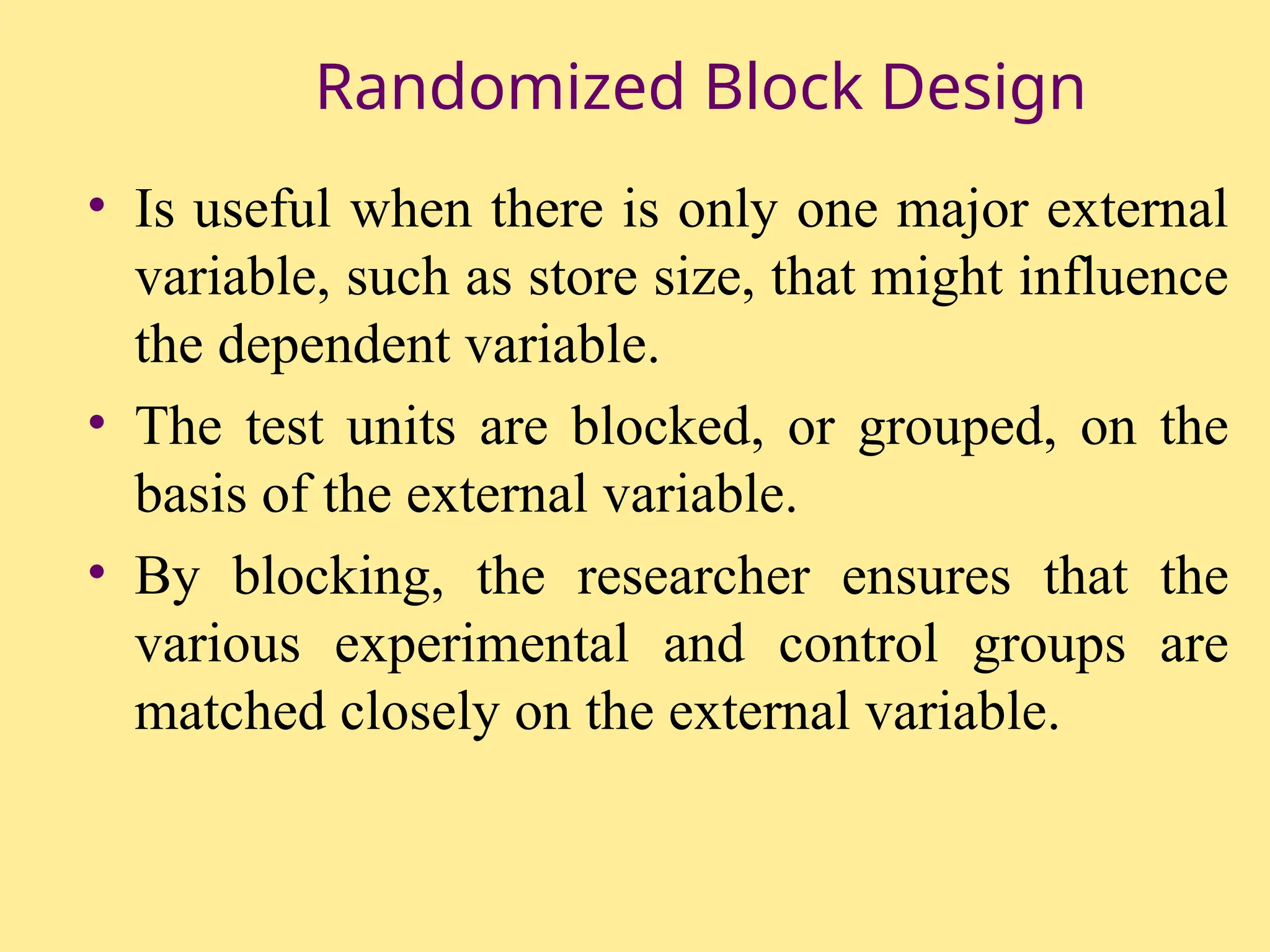
Randomized Block Design
• Is useful when there is only one major external
variable, such as store size, that might influence
the dependent variable.
• The test units are blocked, or grouped, on the
basis of the external variable.
• By blocking, the researcher ensures that the
various experimental and control groups are
matched closely on the external variable.
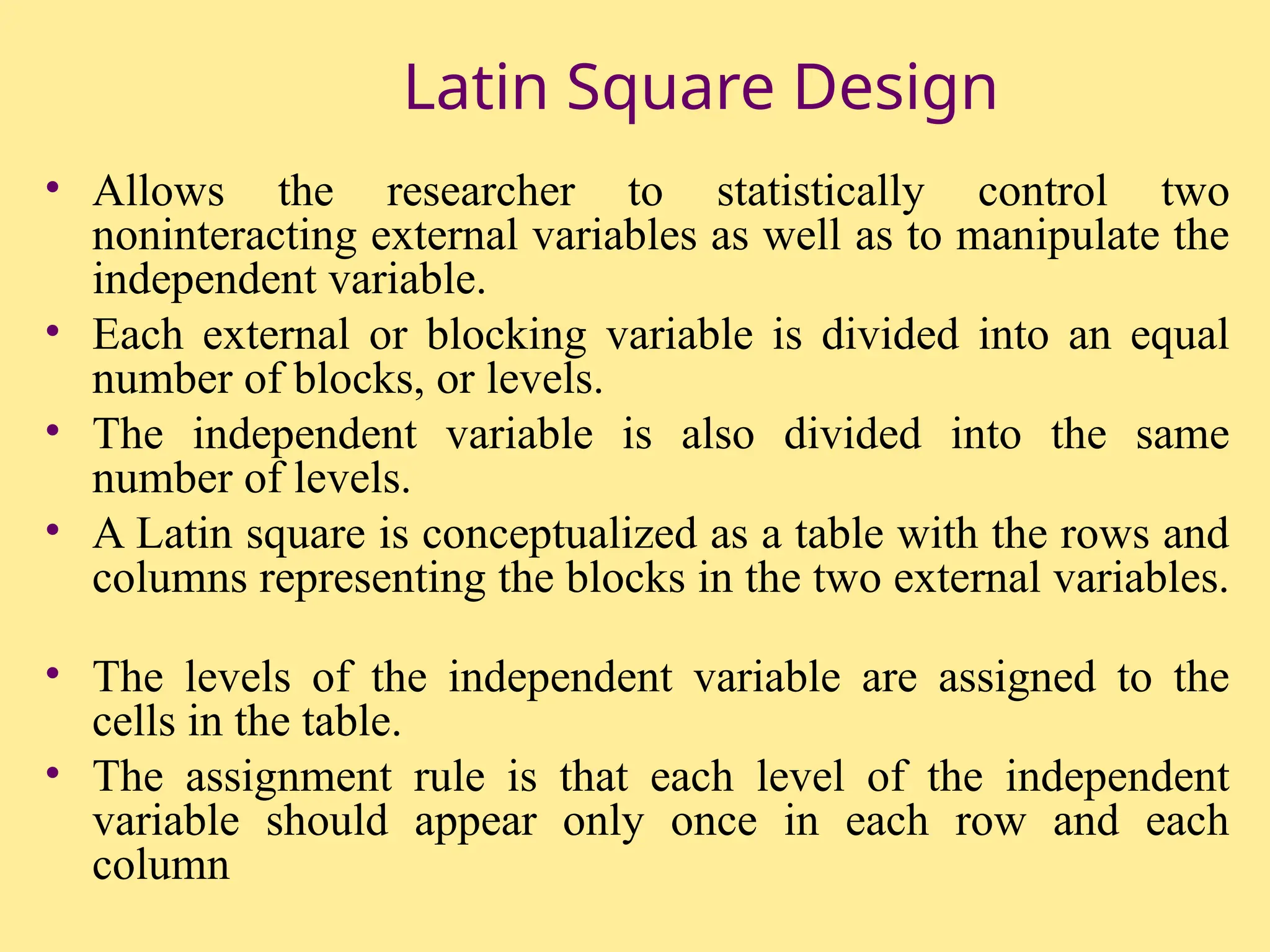
Latin Square Design
• Allows the researcher to statistically control two
noninteracting external variables as well as to manipulate the
independent variable.
• Each external or blocking variable is divided into an equal
number of blocks, or levels.
• The independent variable is also divided into the same
number of levels.
• A Latin square is conceptualized as a table with the rows and
columns representing the blocks in the two external variables.
• The levels of the independent variable are assigned to the
cells in the table.
• The assignment rule is that each level of the independent
variable should appear only once in each row and each
column
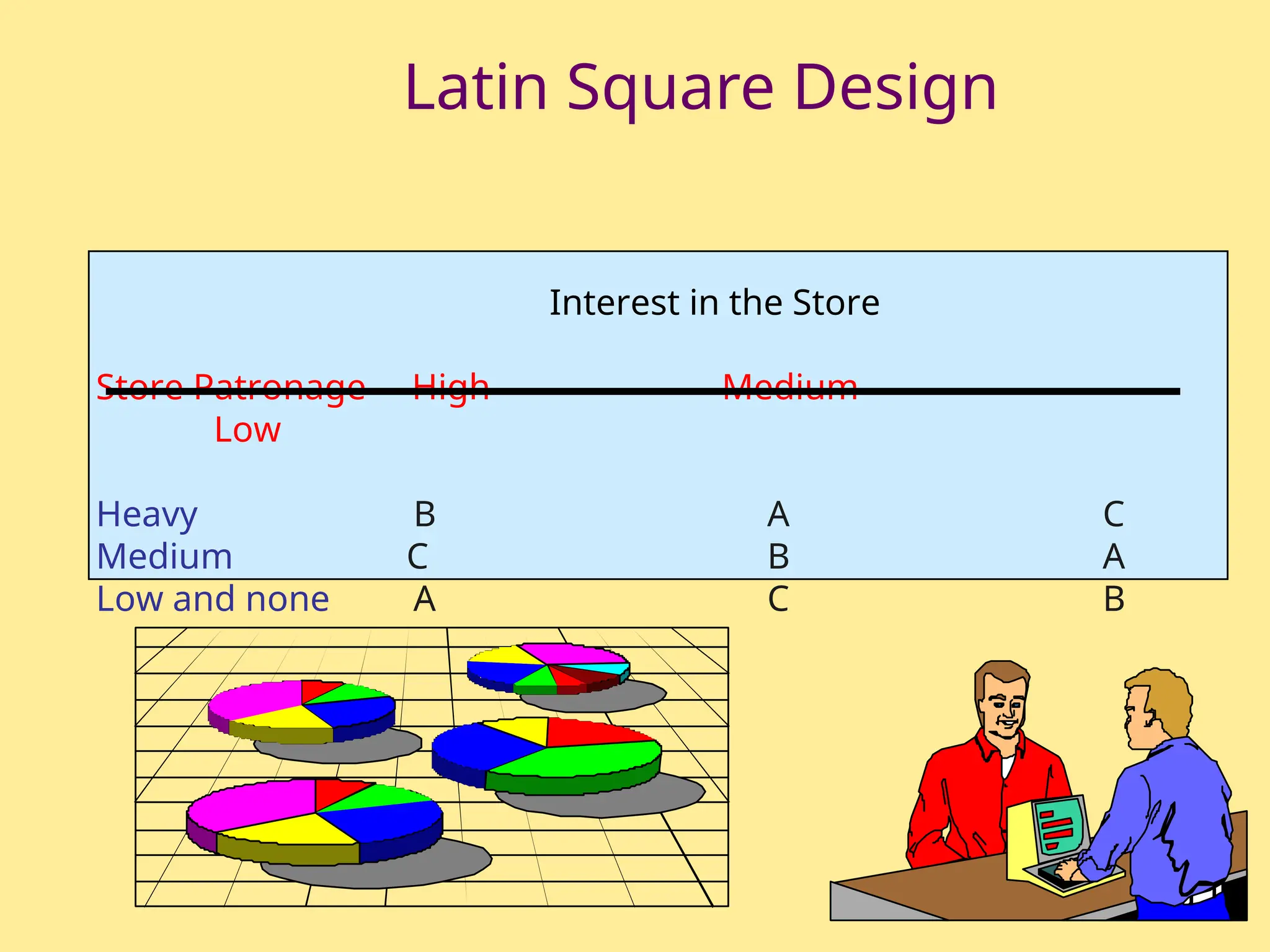
Latin Square Design
Interest in the Store
Store Patronage High Medium
Low
Heavy B A C
Medium C B A
Low and none A C B
Factorial Design
• Is used to measure the effects of two or more
independent variables at various levels.
• Allows for interactions between variables
• Interaction is said to take place when the
simultaneous effect of two or more variables is
different from the sum of their separate effects
• In a two-factor design, each level of one
variable represents a row and each level of
another variable represents a column.
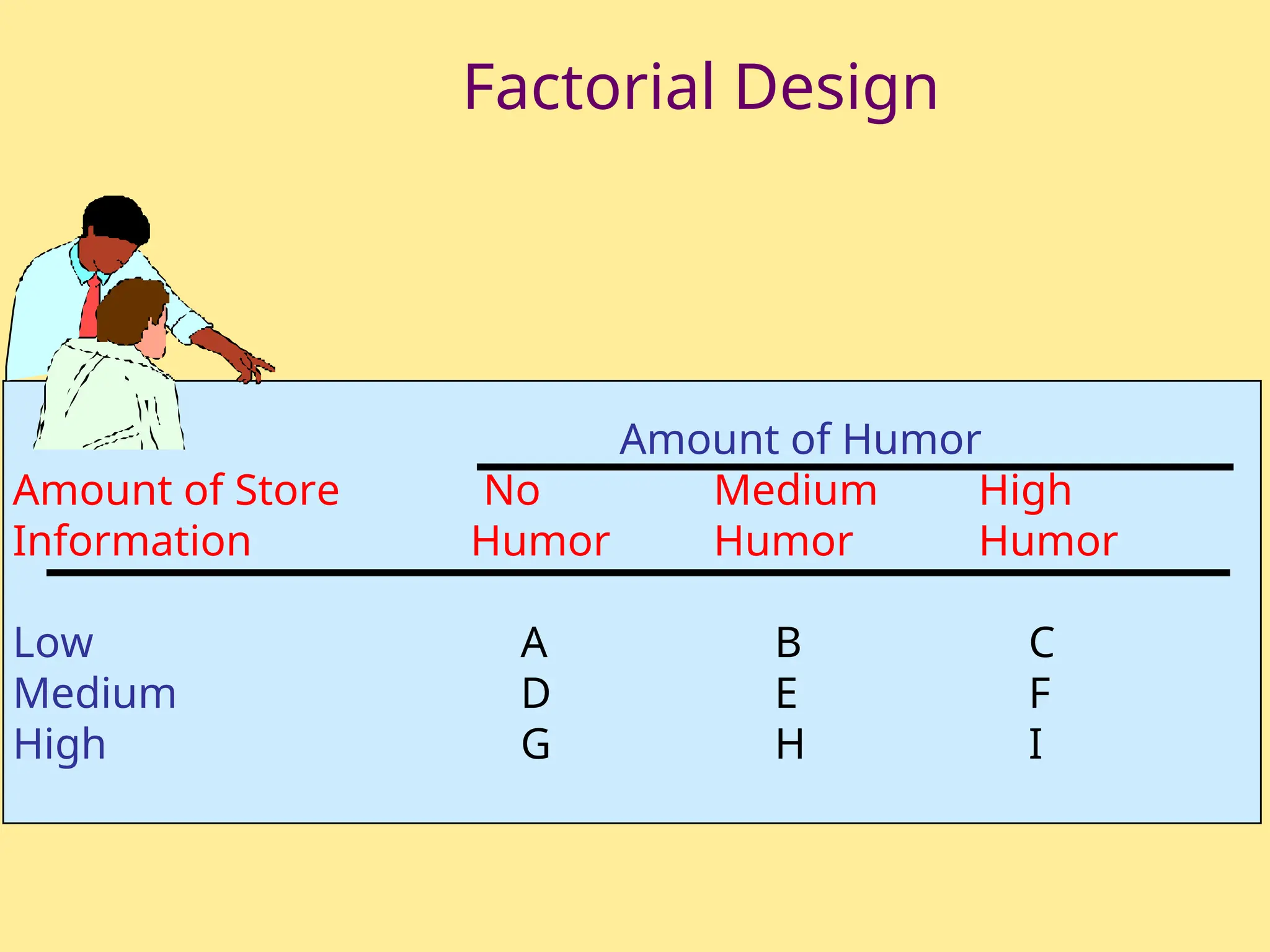
Factorial Design
Amount of Humor
Amount of Store No Medium High
Information Humor Humor Humor
Low A B C
Medium D E F
High G H I
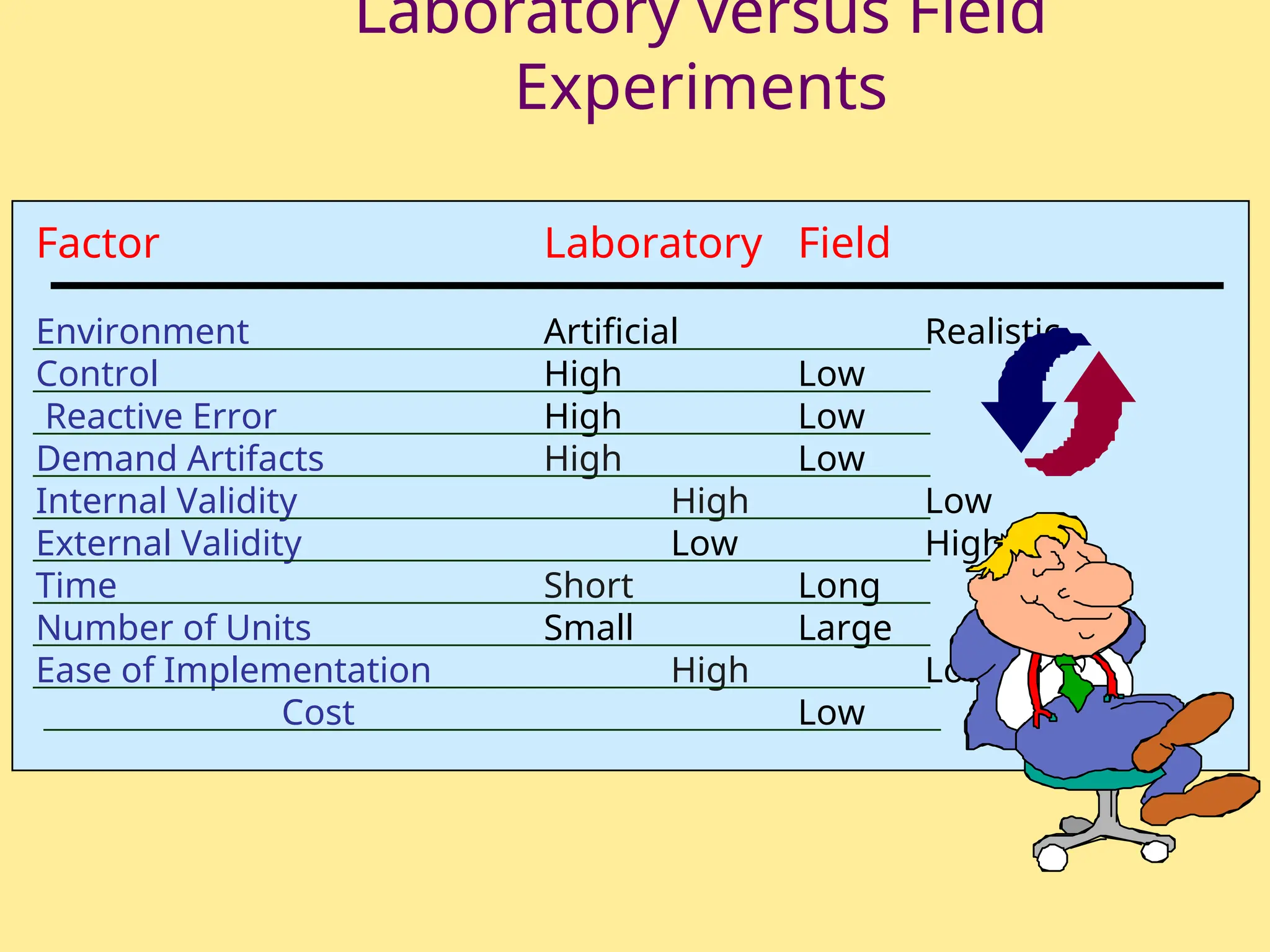
Laboratory versus Field
Experiments
Factor Laboratory Field
Environment Artificial Realistic
Control High Low
Reactive Error High Low
Demand Artifacts High Low
Internal Validity High Low
External Validity Low High
Time Short Long
Number of Units Small Large
Ease of Implementation High Low
Cost Low High
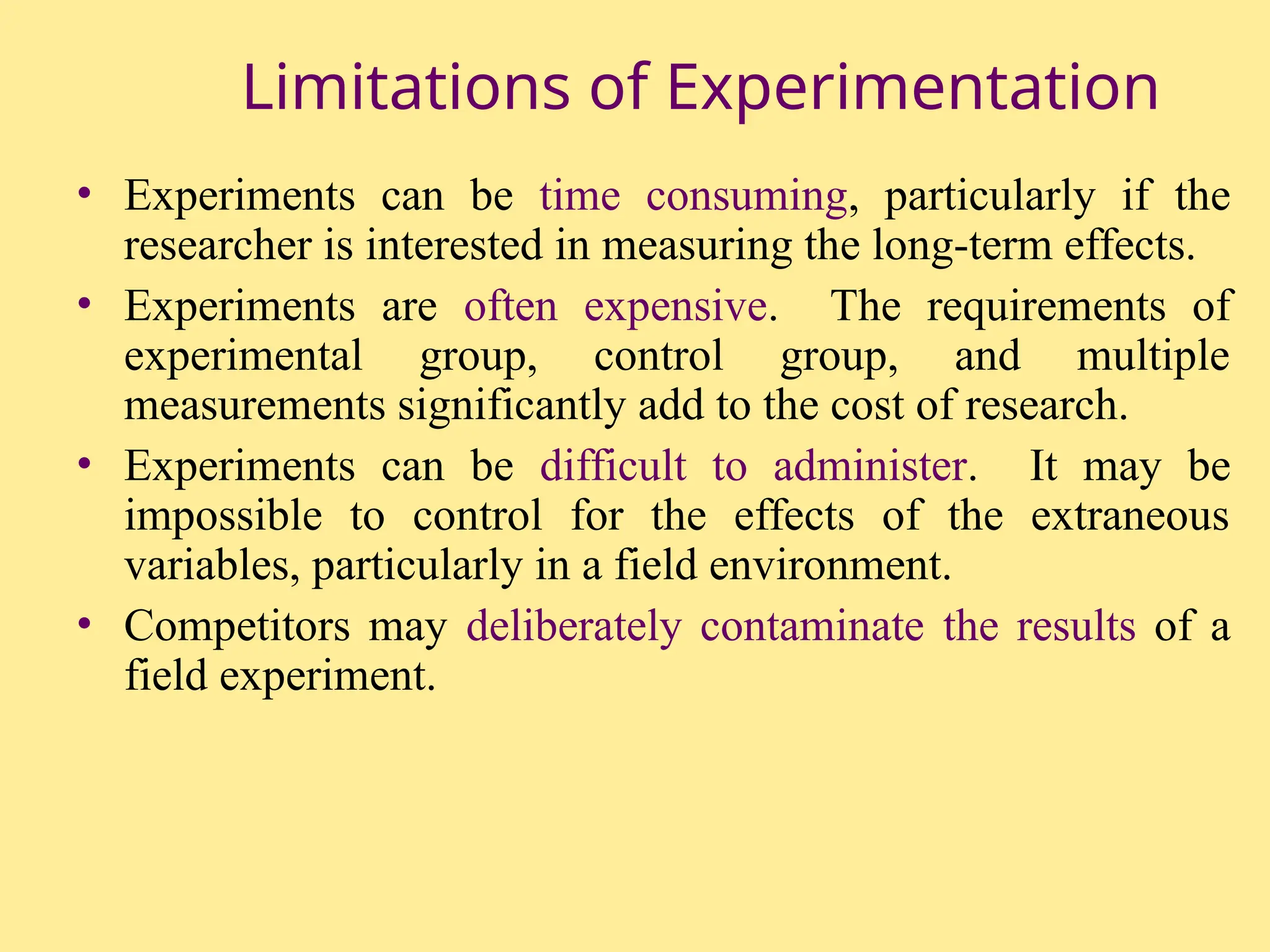
Limitations of Experimentation
• Experiments can be time consuming, particularly if the
researcher is interested in measuring the long-term effects.
• Experiments are often expensive. The requirements of
experimental group, control group, and multiple
measurements significantly add to the cost of research.
• Experiments can be difficult to administer. It may be
impossible to control for the effects of the extraneous
variables, particularly in a field environment.
• Competitors may deliberately contaminate the results of a
field experiment.
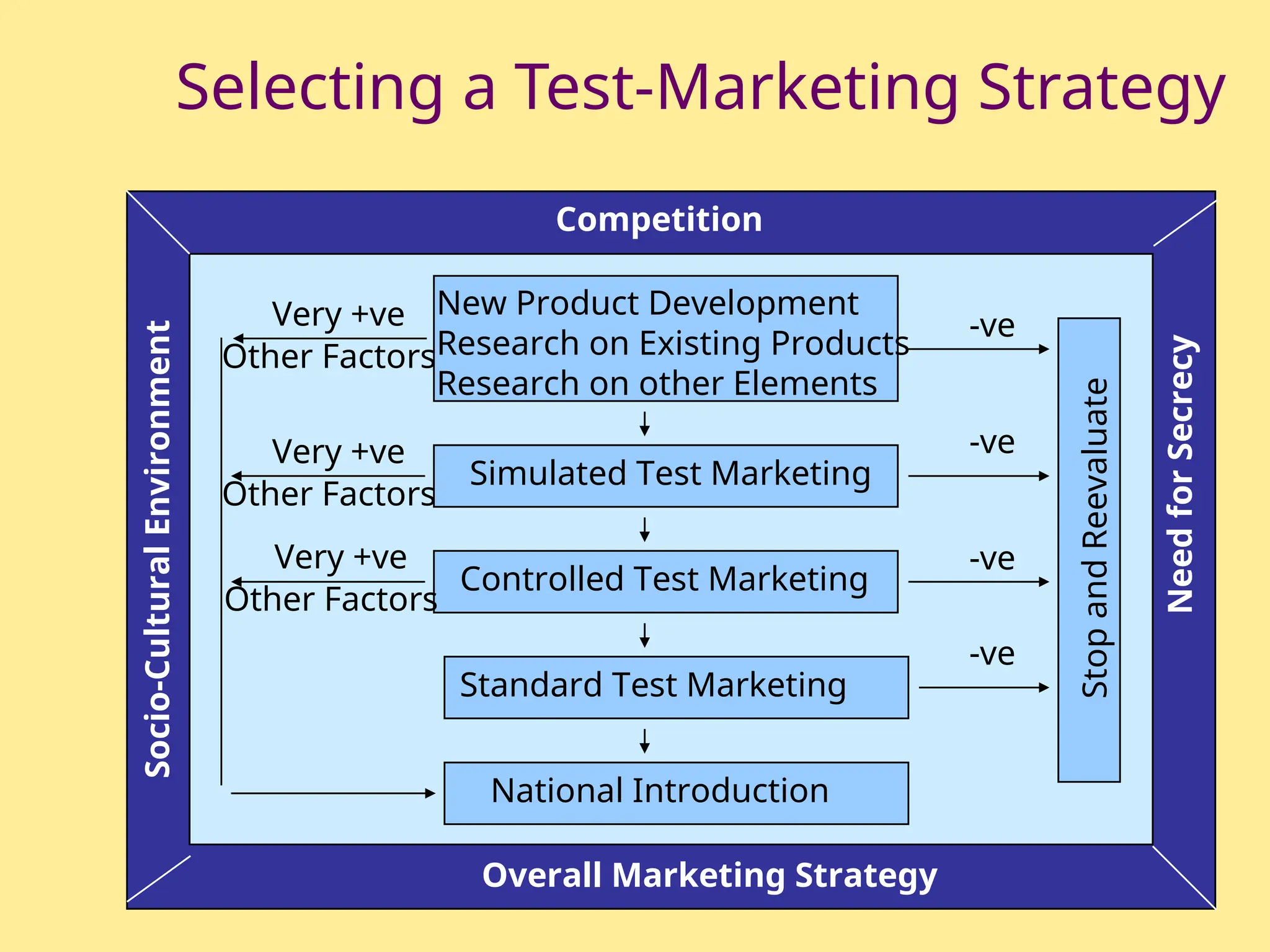
Competition
Overall Marketing Strategy
Socio-Cultural
Environment
Need
for
Secrecy
New Product Development
Research on Existing Products
Research on other Elements
Simulated Test Marketing
Controlled Test Marketing
Standard Test Marketing
National Introduction
Stop
and
Reevaluate
-ve
-ve
-ve
-ve
Very +ve
Other Factors
Very +ve
Other Factors
Very +ve
Other Factors
Selecting a Test-Marketing Strategy
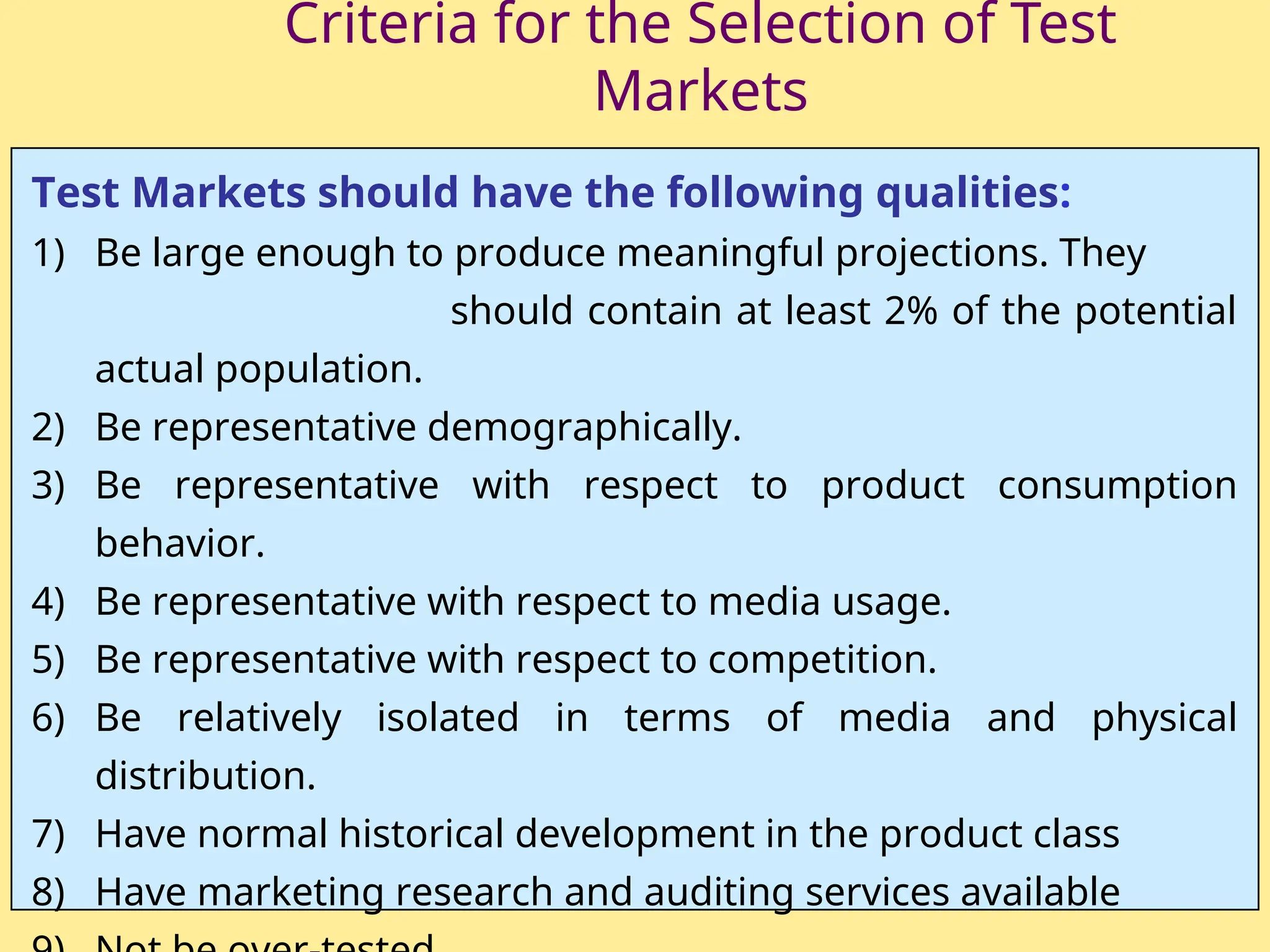
Criteria for the Selection of Test
Markets
Test Markets should have the following qualities:
1) Be large enough to produce meaningful projections. They
should contain at least 2% of the potential
actual population.
2) Be representative demographically.
3) Be representative with respect to product consumption
behavior.
4) Be representative with respect to media usage.
5) Be representative with respect to competition.
6) Be relatively isolated in terms of media and physical
distribution.
7) Have normal historical development in the product class
8) Have marketing research and auditing services available

Experimental Research Design topic for students

  • 1.
  • 2.
    Concept of Causality Astatement such as "X causes Y " will have the following meaning to an ordinary person and to a scientist. ____________________________________________________ Ordinary Meaning Scientific Meaning ____________________________________________________ X is the only cause of Y.X is only one of a number of possible causes of Y. X must always lead to Y The occurrence of X makes the occurrence of Y more (X is a deterministic cause of Y). probable (X is a probabilistic cause of Y). It is possible to prove We can never prove that X is a cause of Y. At best, we that X is a cause of Y. can infer that X is a cause of Y. ____________________________________________________
  • 3.
    Conditions for Causality •Concomitant variation is the extent to which a cause, X, and an effect, Y, occur together or vary together in the way predicted by the hypothesis under consideration. • The time order of occurrence condition states that the causing event must occur either before or simultaneously with the effect; it cannot occur afterwards. • The absence of other possible causal factors means that the factor or variable being investigated should be the only possible causal explanation.
  • 4.
    Evidence of ConcomitantVariation between Purchase of Fashion Clothing and Education High High Low 363 (73%) 137 (27%) 322 (64%) 178 (36%) Purchase of Fashion Clothing, Y 500 (100%) 500 (100%) Low Education, X
  • 5.
    Purchase of FashionClothing By Income and Education Low Income Purchase High Low High Low Education 200 (100%) 300 (100%) 122 (61%) 171 (57%) 78 (39%) 129 (43%) 300 200 High Income Purchase High High Low Low 241 (80%) 151 (76%) 59 (20%) 49 (24%) Education
  • 6.
    Definitions and Concepts •Independent variables are variables or alternatives that are manipulated and whose effects are measured and compared, e.g., price levels. • Test units are individuals, organizations, or other entities whose response to the independent variables or treatments is being examined, e.g., consumers or stores. • Dependent variables are the variables which measure the effect of the independent variables on the test units, e.g., sales, profits, and market shares. • Extraneous variables are all variables other than the independent variables that affect the response of the test units, e.g., store size, store location, and competitive effort. • Experiment is the process of manipulating one or more independent variables and measuring their effect on one or more dependent variables, while controlling for the extraneous variables.
  • 7.
    Experimental Design An experimentaldesign is a set of procedures specifying • the test units and how these units are to be divided into homogeneous subsamples, • what independent variables or treatments are to be manipulated, • what dependent variables are to be measured, and • how the extraneous variables are to be controlled.
  • 8.
    Validity in Experimentation •Internal validity refers to whether the manipulation of the independent variables or treatments actually caused the observed effects on the dependent variables. Control of extraneous variables is a necessary condition for establishing internal validity. • External validity refers to whether the cause-and- effect relationships found in the experiment can be generalized. To what populations, settings, times, independent variables and dependent variables can the results be projected?
  • 9.
    Extraneous Variables • Historyrefers to specific events that are external to the experiment but occur at the same time as the experiment. • Maturation (MA) refers to changes in the test units themselves that occur with the passage of time. • Testing effects are caused by the process of experimentation. Typically, these are the effects on the experiment of taking a measure on the dependent variable before and after the presentation of the treatment. • The main testing effect (MT) occurs when a prior observation affects a latter observation.
  • 10.
    Extraneous Variables • Inthe interactive testing effect (IT), a prior measurement affects the test unit's response to the independent variable. • Instrumentation (I) refers to changes in the measuring instrument, in the observers or in the scores themselves. • Statistical regression effects (SR) occur when test units with extreme scores move closer to the average score during the course of the experiment. • Selection bias (SB) refers to the improper assignment of test units to treatment conditions. • Mortality (MO) refers to the loss of test units while the experiment is in progress.
  • 11.
    Controlling Extraneous Variables •Randomization refers to the random assignment of test units to experimental groups by using random numbers. Treatment conditions are also randomly assigned to experimental groups. • Matching involves comparing test units on a set of key background variables before assigning them to the treatment conditions. • Statistical control involves measuring the extraneous variables and adjusting for their effects through statistical analysis. • Design control involves the use of experiments designed to control specific extraneous variables.
  • 12.
    A Classification ofExperimental Designs • Pre-experimental designs do not employ randomization procedures to control for extraneous factors: the one-shot case study, the one-group pretest- posttest design, and the static-group. • In true experimental designs, the researcher can randomly assign test units to experimental groups and treatments to experimental groups: the pretest-posttest control group design, the posttest-only control group design, and the Solomon four-group design.
  • 13.
    A Classification ofExperimental Designs • Quasi-experimental designs result when the researcher is unable to achieve full manipulation of scheduling or allocation of treatments to test units but can still apply part of the apparatus of true experimentation: time series and multiple time series designs. • A statistical design is a series of basic experiments that allows for statistical control and analysis of external variables: randomized block design, Latin square design, and factorial designs.
  • 14.
    A Classification ofExperimental Designs Pre- experimental One-Shot Case Study One Group Pretest- Posttest Static Group True Experimental Pretest- Posttest Control Group Posttest: Only Control Group Solomon Four-Group Quasi Experimental Time Series Multiple Time Series Statistical Randomize d Blocks Latin Square Factorial Design Experimental Designs
  • 15.
    One-Shot Case Study X01 • A single group of test units is exposed to a treatment X. • A single measurement on the dependent variable is taken (01). • There is no random assignment of test units. • The one-shot case study is more appropriate for exploratory than for conclusive research.
  • 16.
    One-Group Pretest-Posttest Design 01X 02 • A group of test units is measured twice. • There is no control group. • The treatment effect is computed as 02 – 01. • The validity of this conclusion is questionable since extraneous variables are largely uncontrolled.
  • 17.
    Static Group Design EG:X 01 CG: 02 • A two-group experimental design. • The experimental group (EG) is exposed to the treatment, and the control group (CG) is not. • Measurements on both groups are made only after the treatment. • Test units are not assigned at random. • The treatment effect would be measured as 01 - 02.
  • 18.
    True Experimental Designs: Pretest-PosttestControl Group Design EG:R 01 X 02 CG:R 03 04 • Test units are randomly assigned to either the experimental or the control group. • A pretreatment measure is taken on each group. • The treatment effect (TE) is measured as:(02 - 01) - (04 - 03). • Selection bias is eliminated by randomization. • The other extraneous effects are controlled as follows: 02 – 01= TE + H + MA + MT + IT + I + SR + MO 04 – 03= H + MA + MT + I + SR + MO = EV (Extraneous Variables) • The experimental result is obtained by: (02 - 01) - (04 - 03) = TE + IT • Interactive testing effect is not controlled.
  • 19.
    Example • Sample ofrespondents would be selected at random • Half of them would be random assigned to the experimental group • Other half would form the control group • Respondents, in both the groups would be administered a questionnaire to obtain a pretest measurement on attitudes towards the brand • Only the respondents in the expt. Group would be exposed to the TV program containing the test commercial. • Thus a questionnaire would be administered to respondents in both groups to obtain posttest measures on attitudes towards the brand
  • 20.
    Posttest-Only Control Group Design EG: R X 01 CG : R 02 • The treatment effect is obtained by TE = 01 - 02 • Except for pre-measurement, the implementation of this design is very similar to that of the pretest-posttest control group design.
  • 21.
    Quasi-Experimental Designs: Time SeriesDesign 01 02 03 04 05 X 06 07 08 09 010 • There is no randomization of test units to treatments. • The timing of treatment presentation, as well as which test units are exposed to the treatment, may not be within the researcher's control.
  • 22.
    Multiple Time SeriesDesign EG : 01 02 03 04 05 X 06 07 08 09 010 CG : 01 02 03 04 05 06 07 08 09 010 • If the control group is carefully selected, this design can be an improvement over the simple time series experiment. • Can test the treatment effect twice: against the pretreatment measurements in the experimental group and against the control group.
  • 23.
    Statistical Designs Statistical designsconsist of a series of basic experiments that allow for statistical control and analysis of external variables and offer the following advantages: • The effects of more than one independent variable can be measured. • Specific extraneous variables can be statistically controlled. • Economical designs can be formulated when each test unit is measured more than once. The most common statistical designs are the randomized block design, the Latin square design, and the factorial design.
  • 24.
    Randomized Block Design •Is useful when there is only one major external variable, such as store size, that might influence the dependent variable. • The test units are blocked, or grouped, on the basis of the external variable. • By blocking, the researcher ensures that the various experimental and control groups are matched closely on the external variable.
  • 25.
    Latin Square Design •Allows the researcher to statistically control two noninteracting external variables as well as to manipulate the independent variable. • Each external or blocking variable is divided into an equal number of blocks, or levels. • The independent variable is also divided into the same number of levels. • A Latin square is conceptualized as a table with the rows and columns representing the blocks in the two external variables. • The levels of the independent variable are assigned to the cells in the table. • The assignment rule is that each level of the independent variable should appear only once in each row and each column
  • 26.
    Latin Square Design Interestin the Store Store Patronage High Medium Low Heavy B A C Medium C B A Low and none A C B
  • 27.
    Factorial Design • Isused to measure the effects of two or more independent variables at various levels. • Allows for interactions between variables • Interaction is said to take place when the simultaneous effect of two or more variables is different from the sum of their separate effects • In a two-factor design, each level of one variable represents a row and each level of another variable represents a column.
  • 28.
    Factorial Design Amount ofHumor Amount of Store No Medium High Information Humor Humor Humor Low A B C Medium D E F High G H I
  • 29.
    Laboratory versus Field Experiments FactorLaboratory Field Environment Artificial Realistic Control High Low Reactive Error High Low Demand Artifacts High Low Internal Validity High Low External Validity Low High Time Short Long Number of Units Small Large Ease of Implementation High Low Cost Low High
  • 30.
    Limitations of Experimentation •Experiments can be time consuming, particularly if the researcher is interested in measuring the long-term effects. • Experiments are often expensive. The requirements of experimental group, control group, and multiple measurements significantly add to the cost of research. • Experiments can be difficult to administer. It may be impossible to control for the effects of the extraneous variables, particularly in a field environment. • Competitors may deliberately contaminate the results of a field experiment.
  • 31.
    Competition Overall Marketing Strategy Socio-Cultural Environment Need for Secrecy NewProduct Development Research on Existing Products Research on other Elements Simulated Test Marketing Controlled Test Marketing Standard Test Marketing National Introduction Stop and Reevaluate -ve -ve -ve -ve Very +ve Other Factors Very +ve Other Factors Very +ve Other Factors Selecting a Test-Marketing Strategy
  • 32.
    Criteria for theSelection of Test Markets Test Markets should have the following qualities: 1) Be large enough to produce meaningful projections. They should contain at least 2% of the potential actual population. 2) Be representative demographically. 3) Be representative with respect to product consumption behavior. 4) Be representative with respect to media usage. 5) Be representative with respect to competition. 6) Be relatively isolated in terms of media and physical distribution. 7) Have normal historical development in the product class 8) Have marketing research and auditing services available