Inbreeding and
Inbreeding Depression
BY PROF. T. V. RATHOD
INTRODUCTION
• Inbreeding is a form of mating system in sexual organism.
• It implies mating together of individual that are close to each
other by ancestral or pedigree relationship.
• When the individuals are closely related E. g Full sib was mating,
half sib mating.
• The highest degree of inbreeding is achieved by selfing.
• The chief effect of inbreeding is to increase homozygosity in
the progeny, which is proportionate to the degree of inbreeding.
• Cross – pollinated and asexually reproducing species are highly
heterozygous in nature.
• These species show a severe reduction in fertility and vigour
due to inbreeding (inbreeding depression).
• It contrast to this hybridization between unrelated strains
leads to an increased vigour and fertility (hybrid vigour or
heterosis).
• These two aspects are of great significance in breeding of these
species.
• In fact heterosis and inbreeding depression may be considered
as the two opposite sides of the same coin.
INTRODUCTION CONT…
Inbreeding Depression:
• It refers to decrease in fitness and vigour due to
inbreeding or it may be defined as the reduction or
loss in vigour and fertility as a result of inbreeding.
• The most revealing impact of inbreeding is the loss
of vigour and the physiological efficiency of an
organism characterised by reduction in size and
fecundity.
• For example selfing reduces heterozygosity, by a
factor ½ in each generation.
• In fact the dwgree of inbreeding in any generation
is equal to the degree of homozygosity in that
generation.
• Inbreeding depression results due to fixation of unfavourable
recessive genes in F2, while in heterosis the unfavourable
recessive genes of one line (parent) are covered by favourable
dominant genes of other parent.
• Man has recognised inbreeding depression for a long time.
• In many species marriage between closely related ancestries
have been prohibited.
• In hindu society perhaps presents the extreme example, where
marriages between individual related by ancestry is prohibited.
Inbreeding Depression Cont…
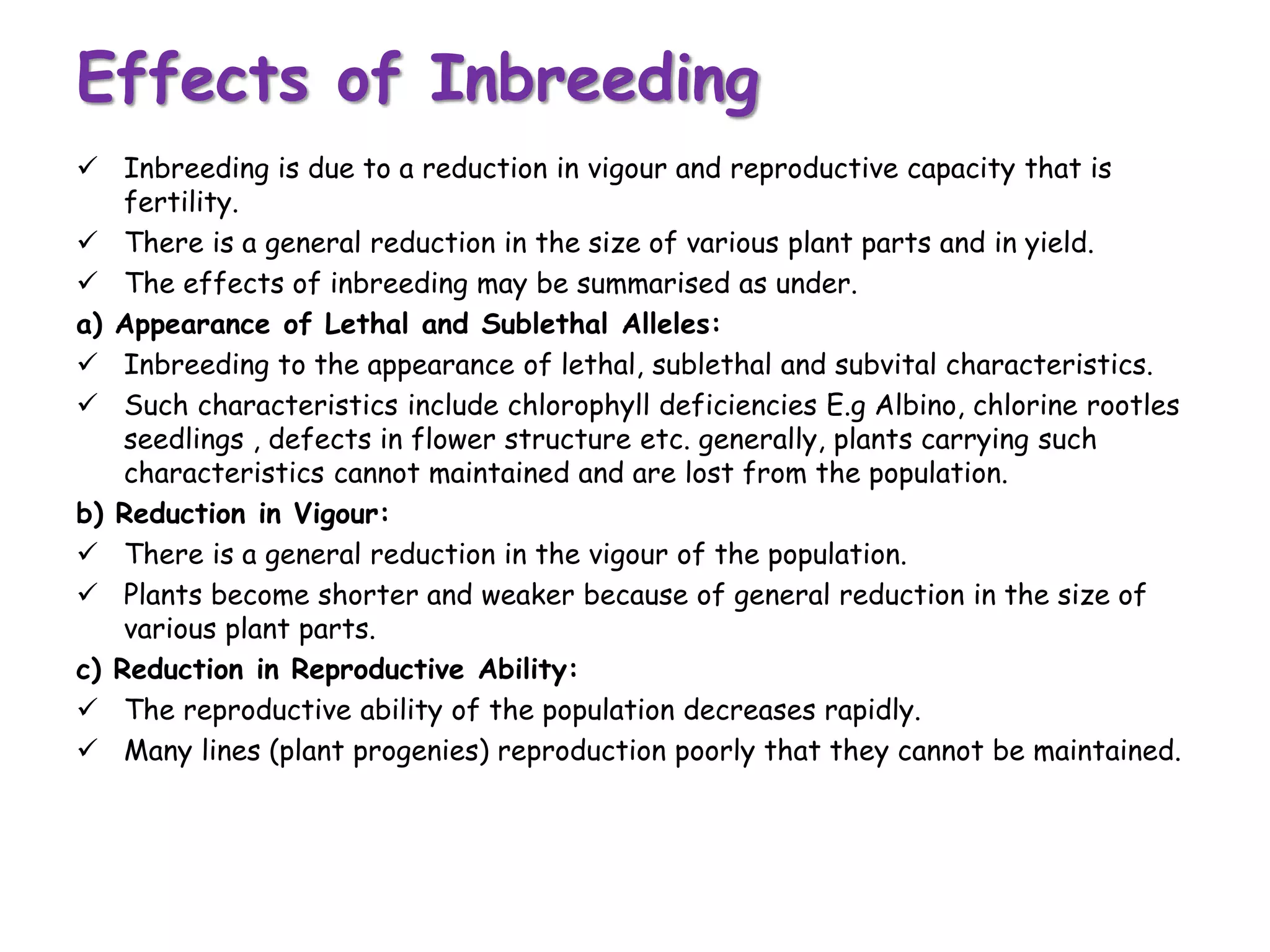
Effects of Inbreeding
 Inbreeding is due to a reduction in vigour and reproductive capacity that is
fertility.
 There is a general reduction in the size of various plant parts and in yield.
 The effects of inbreeding may be summarised as under.
a) Appearance of Lethal and Sublethal Alleles:
 Inbreeding to the appearance of lethal, sublethal and subvital characteristics.
 Such characteristics include chlorophyll deficiencies E.g Albino, chlorine rootles
seedlings , defects in flower structure etc. generally, plants carrying such
characteristics cannot maintained and are lost from the population.
b) Reduction in Vigour:
 There is a general reduction in the vigour of the population.
 Plants become shorter and weaker because of general reduction in the size of
various plant parts.
c) Reduction in Reproductive Ability:
 The reproductive ability of the population decreases rapidly.
 Many lines (plant progenies) reproduction poorly that they cannot be maintained.
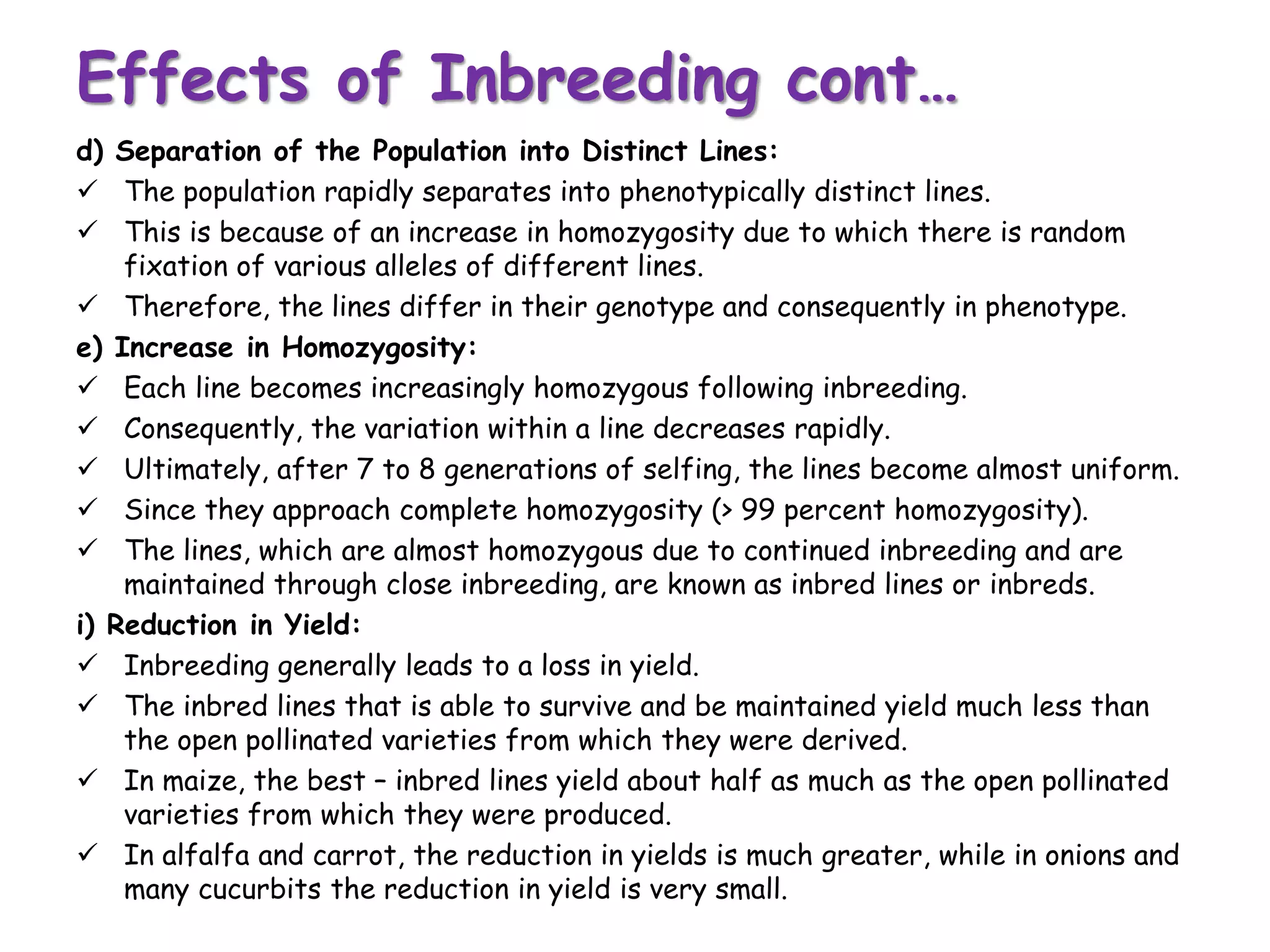
d) Separation of the Population into Distinct Lines:
 The population rapidly separates into phenotypically distinct lines.
 This is because of an increase in homozygosity due to which there is random
fixation of various alleles of different lines.
 Therefore, the lines differ in their genotype and consequently in phenotype.
e) Increase in Homozygosity:
 Each line becomes increasingly homozygous following inbreeding.
 Consequently, the variation within a line decreases rapidly.
 Ultimately, after 7 to 8 generations of selfing, the lines become almost uniform.
 Since they approach complete homozygosity (> 99 percent homozygosity).
 The lines, which are almost homozygous due to continued inbreeding and are
maintained through close inbreeding, are known as inbred lines or inbreds.
i) Reduction in Yield:
 Inbreeding generally leads to a loss in yield.
 The inbred lines that is able to survive and be maintained yield much less than
the open pollinated varieties from which they were derived.
 In maize, the best – inbred lines yield about half as much as the open pollinated
varieties from which they were produced.
 In alfalfa and carrot, the reduction in yields is much greater, while in onions and
many cucurbits the reduction in yield is very small.
Effects of Inbreeding cont…
Degree of Inbreeding Depression
• The various plant species differ considerably in their responses
to inbreeding.
• Inbreeding depression may range from very high to very low or
may even be absent into the following four broad categories.
1) High inbreeding depression,
2) Moderate inbreeding depression,
3) Low inbreeding depression, and
4) Absence of inbreeding depression.
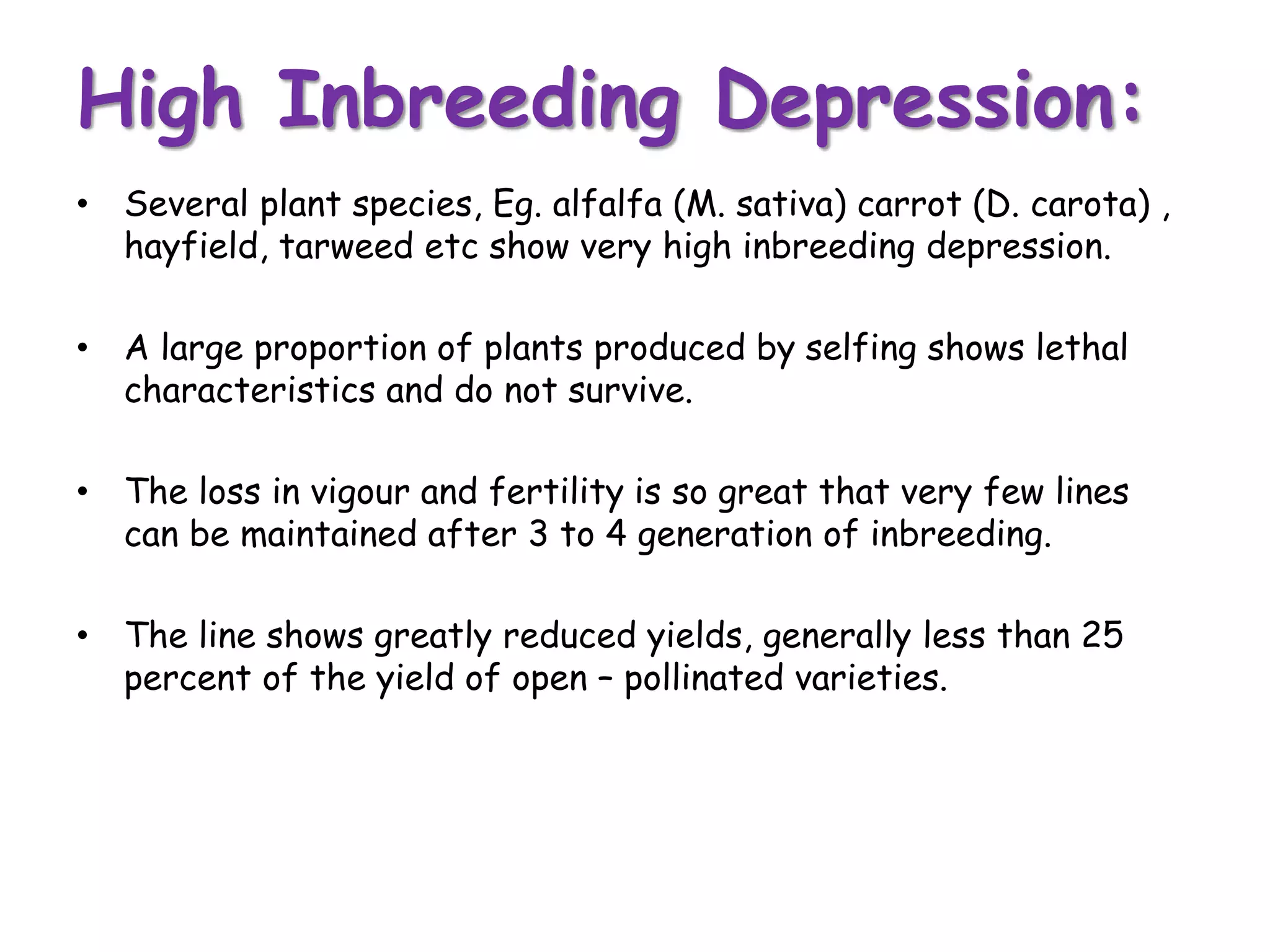
High Inbreeding Depression:
• Several plant species, Eg. alfalfa (M. sativa) carrot (D. carota) ,
hayfield, tarweed etc show very high inbreeding depression.
• A large proportion of plants produced by selfing shows lethal
characteristics and do not survive.
• The loss in vigour and fertility is so great that very few lines
can be maintained after 3 to 4 generation of inbreeding.
• The line shows greatly reduced yields, generally less than 25
percent of the yield of open – pollinated varieties.
Moderate Inbreeding Depression:
• Many crops species, such as maize, jowar, bajara etc. shows
moderate inbreeding depression.
• Many lethal and sublethal types appear in the selfed progeny,
but a substantial proportion of the population can be maintained
under self- pollination.
• There is appreciable reduction in fertility and many line
reproduce so poorly that they are lost.
• However, a large number of inbred lines can be obtained, which
yield upto 50 percent of the open- pollinated varieties.
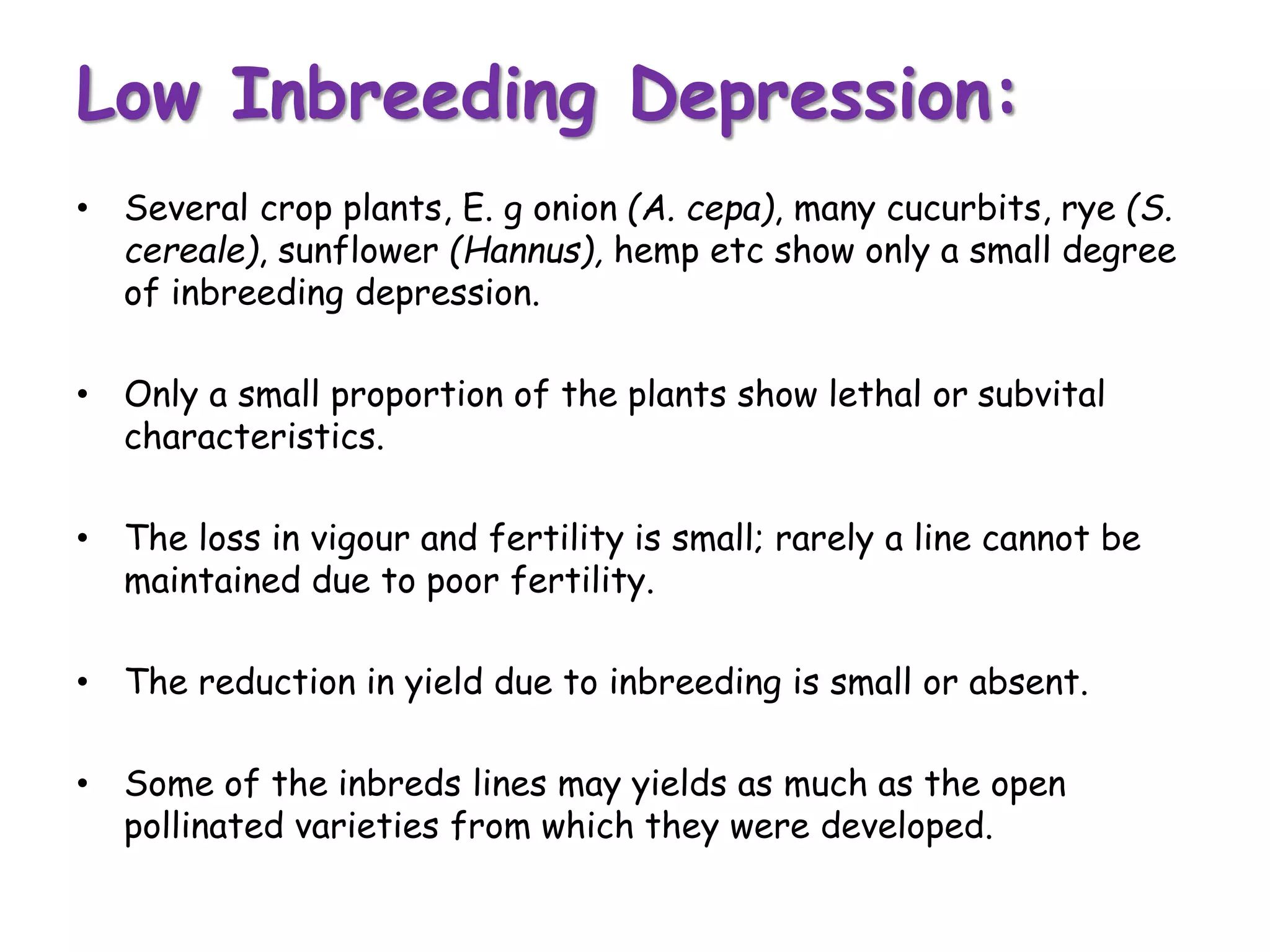
Low Inbreeding Depression:
• Several crop plants, E. g onion (A. cepa), many cucurbits, rye (S.
cereale), sunflower (Hannus), hemp etc show only a small degree
of inbreeding depression.
• Only a small proportion of the plants show lethal or subvital
characteristics.
• The loss in vigour and fertility is small; rarely a line cannot be
maintained due to poor fertility.
• The reduction in yield due to inbreeding is small or absent.
• Some of the inbreds lines may yields as much as the open
pollinated varieties from which they were developed.
Lack of inbreeding Depression:
• The self- pollinated species do not show inbreeding depression
although they do not show heterosis.
• It is because their species reproduce by self – fertilization and
as a result, have developed homozygous balance.
• In cost of the cross- pollinated species exhibit heterozygous
balance.
Homozygous and Heterozygous Balance
• The concepts of homozygous and heterozygous balance were advanced
by Mather to explain the varied responses of different species to
inbreeding.
• The species that reproduce by cross- fertilization are highly
heterozygous.
• These species carry a large number of lethal, subvital and other
unfavourable recessive genes, which are of little value to the species.
• The sum total of these unfavourable genes constitutes genetic load of
these species.
• The harmful effects of such recessive alleles are masked by their
dominant allele as result of which they are retained in population.
• The population, therefore, develops a genetic organisation, which favours
heterozygosity as a result , homozygosity leads to detrimental effects.
• This type of genetic organisation in known as heterozygous balance, because it
promoted heterozygosity.
• The self fertilized species are naturally homozygous.
• They have no genetic load and are prompty eliminated (from the population).
• These species therefore develop a genetic organisation, which is adapted to
homozygosity i.e which does not produce undesirable effects in the homozygous
state.
• This type of genetic organisation is known as homozygous balance.
• The self – pollinated species are believed to have evolved from cross fertilized
species.
Homozygous and Heterozygous Balance
• It has been suggested that the self- fertilized species retain sufficient
heterozygous balance to show the beneficial effects of out crossing i.e
heterosis.
• The cross- fertilized species that is generally grown in very small
populations’ e. g Cucurbits would show some degree of homozygosity due to
inbreeding.
• This would leads to the development of homozygous balance in such cross
fertilized species.
• The homozygous and heterozygous balances are concepts of genetic
organisation of populations.
• These concepts are neither very clear nor very specific in terms of the
physical bases of this genetic organisation of the types of gene combination
involved.
Homozygous and Heterozygous Balance
THANK YOU

Inbreeding & Inbreeding depression in Plants

  • 1.
  • 2.
    INTRODUCTION • Inbreeding isa form of mating system in sexual organism. • It implies mating together of individual that are close to each other by ancestral or pedigree relationship. • When the individuals are closely related E. g Full sib was mating, half sib mating. • The highest degree of inbreeding is achieved by selfing. • The chief effect of inbreeding is to increase homozygosity in the progeny, which is proportionate to the degree of inbreeding. • Cross – pollinated and asexually reproducing species are highly heterozygous in nature.
  • 3.
    • These speciesshow a severe reduction in fertility and vigour due to inbreeding (inbreeding depression). • It contrast to this hybridization between unrelated strains leads to an increased vigour and fertility (hybrid vigour or heterosis). • These two aspects are of great significance in breeding of these species. • In fact heterosis and inbreeding depression may be considered as the two opposite sides of the same coin. INTRODUCTION CONT…
  • 4.
    Inbreeding Depression: • Itrefers to decrease in fitness and vigour due to inbreeding or it may be defined as the reduction or loss in vigour and fertility as a result of inbreeding. • The most revealing impact of inbreeding is the loss of vigour and the physiological efficiency of an organism characterised by reduction in size and fecundity. • For example selfing reduces heterozygosity, by a factor ½ in each generation. • In fact the dwgree of inbreeding in any generation is equal to the degree of homozygosity in that generation.
  • 5.
    • Inbreeding depressionresults due to fixation of unfavourable recessive genes in F2, while in heterosis the unfavourable recessive genes of one line (parent) are covered by favourable dominant genes of other parent. • Man has recognised inbreeding depression for a long time. • In many species marriage between closely related ancestries have been prohibited. • In hindu society perhaps presents the extreme example, where marriages between individual related by ancestry is prohibited. Inbreeding Depression Cont…
  • 6.
    Effects of Inbreeding Inbreeding is due to a reduction in vigour and reproductive capacity that is fertility.  There is a general reduction in the size of various plant parts and in yield.  The effects of inbreeding may be summarised as under. a) Appearance of Lethal and Sublethal Alleles:  Inbreeding to the appearance of lethal, sublethal and subvital characteristics.  Such characteristics include chlorophyll deficiencies E.g Albino, chlorine rootles seedlings , defects in flower structure etc. generally, plants carrying such characteristics cannot maintained and are lost from the population. b) Reduction in Vigour:  There is a general reduction in the vigour of the population.  Plants become shorter and weaker because of general reduction in the size of various plant parts. c) Reduction in Reproductive Ability:  The reproductive ability of the population decreases rapidly.  Many lines (plant progenies) reproduction poorly that they cannot be maintained.
  • 7.
    d) Separation ofthe Population into Distinct Lines:  The population rapidly separates into phenotypically distinct lines.  This is because of an increase in homozygosity due to which there is random fixation of various alleles of different lines.  Therefore, the lines differ in their genotype and consequently in phenotype. e) Increase in Homozygosity:  Each line becomes increasingly homozygous following inbreeding.  Consequently, the variation within a line decreases rapidly.  Ultimately, after 7 to 8 generations of selfing, the lines become almost uniform.  Since they approach complete homozygosity (> 99 percent homozygosity).  The lines, which are almost homozygous due to continued inbreeding and are maintained through close inbreeding, are known as inbred lines or inbreds. i) Reduction in Yield:  Inbreeding generally leads to a loss in yield.  The inbred lines that is able to survive and be maintained yield much less than the open pollinated varieties from which they were derived.  In maize, the best – inbred lines yield about half as much as the open pollinated varieties from which they were produced.  In alfalfa and carrot, the reduction in yields is much greater, while in onions and many cucurbits the reduction in yield is very small. Effects of Inbreeding cont…
  • 8.
    Degree of InbreedingDepression • The various plant species differ considerably in their responses to inbreeding. • Inbreeding depression may range from very high to very low or may even be absent into the following four broad categories. 1) High inbreeding depression, 2) Moderate inbreeding depression, 3) Low inbreeding depression, and 4) Absence of inbreeding depression.
  • 9.
    High Inbreeding Depression: •Several plant species, Eg. alfalfa (M. sativa) carrot (D. carota) , hayfield, tarweed etc show very high inbreeding depression. • A large proportion of plants produced by selfing shows lethal characteristics and do not survive. • The loss in vigour and fertility is so great that very few lines can be maintained after 3 to 4 generation of inbreeding. • The line shows greatly reduced yields, generally less than 25 percent of the yield of open – pollinated varieties.
  • 10.
    Moderate Inbreeding Depression: •Many crops species, such as maize, jowar, bajara etc. shows moderate inbreeding depression. • Many lethal and sublethal types appear in the selfed progeny, but a substantial proportion of the population can be maintained under self- pollination. • There is appreciable reduction in fertility and many line reproduce so poorly that they are lost. • However, a large number of inbred lines can be obtained, which yield upto 50 percent of the open- pollinated varieties.
  • 11.
    Low Inbreeding Depression: •Several crop plants, E. g onion (A. cepa), many cucurbits, rye (S. cereale), sunflower (Hannus), hemp etc show only a small degree of inbreeding depression. • Only a small proportion of the plants show lethal or subvital characteristics. • The loss in vigour and fertility is small; rarely a line cannot be maintained due to poor fertility. • The reduction in yield due to inbreeding is small or absent. • Some of the inbreds lines may yields as much as the open pollinated varieties from which they were developed.
  • 12.
    Lack of inbreedingDepression: • The self- pollinated species do not show inbreeding depression although they do not show heterosis. • It is because their species reproduce by self – fertilization and as a result, have developed homozygous balance. • In cost of the cross- pollinated species exhibit heterozygous balance.
  • 13.
    Homozygous and HeterozygousBalance • The concepts of homozygous and heterozygous balance were advanced by Mather to explain the varied responses of different species to inbreeding. • The species that reproduce by cross- fertilization are highly heterozygous. • These species carry a large number of lethal, subvital and other unfavourable recessive genes, which are of little value to the species. • The sum total of these unfavourable genes constitutes genetic load of these species. • The harmful effects of such recessive alleles are masked by their dominant allele as result of which they are retained in population.
  • 14.
    • The population,therefore, develops a genetic organisation, which favours heterozygosity as a result , homozygosity leads to detrimental effects. • This type of genetic organisation in known as heterozygous balance, because it promoted heterozygosity. • The self fertilized species are naturally homozygous. • They have no genetic load and are prompty eliminated (from the population). • These species therefore develop a genetic organisation, which is adapted to homozygosity i.e which does not produce undesirable effects in the homozygous state. • This type of genetic organisation is known as homozygous balance. • The self – pollinated species are believed to have evolved from cross fertilized species. Homozygous and Heterozygous Balance
  • 15.
    • It hasbeen suggested that the self- fertilized species retain sufficient heterozygous balance to show the beneficial effects of out crossing i.e heterosis. • The cross- fertilized species that is generally grown in very small populations’ e. g Cucurbits would show some degree of homozygosity due to inbreeding. • This would leads to the development of homozygous balance in such cross fertilized species. • The homozygous and heterozygous balances are concepts of genetic organisation of populations. • These concepts are neither very clear nor very specific in terms of the physical bases of this genetic organisation of the types of gene combination involved. Homozygous and Heterozygous Balance
  • 16.