Unit 6 Lesson 2 Evidence of Evolution 
Copyright © Houghton Mifflin Harcourt Publishing Company
Unit 6 Lesson 2 Evidence of Evolution 
Indiana Standards 
• 8.3.6 Observe anatomical structures of a variety 
of organisms and describe their similarities and 
differences. Use the data collected to organize the 
organisms into groups and predict their 
relatedness. 
Copyright © Houghton Mifflin Harcourt Publishing Company
Unit 6 Lesson 2 Evidence of Evolution 
Fossil Hunt 
How do fossils form? 
• Evidence that organisms have changed over time 
can be found in amber, ice, or sedimentary rock. 
• The most basic principle of dating rocks and the 
remains of organism is “the deeper it is, the older 
it is.” 
Copyright © Houghton Mifflin Harcourt Publishing Company
How do fossils form? 
• Many fossils form in sedimentary rock. 
• Fossils are the remains or imprints of once-living 
organisms. 
• Fossils form when a dead organism is covered by 
a layer of sediment or mud. Over time, more 
sediment settles on top of the organism. 
• Minerals in the sediment replace the body’s 
material, and the minerals harden over time. 
Copyright © Houghton Mifflin Harcourt Publishing Company 
Unit 6 Lesson 2 Evidence of Evolution
How do fossils show change over time? 
• All of the fossils that have been discovered make 
up the fossil record. 
• By examining the fossil record, scientists learn 
about the history of life on Earth. 
• There are gaps in the fossil record in which a fossil 
has not been discovered. 
Copyright © Houghton Mifflin Harcourt Publishing Company 
Unit 6 Lesson 2 Evidence of Evolution
How do fossils show change over time? 
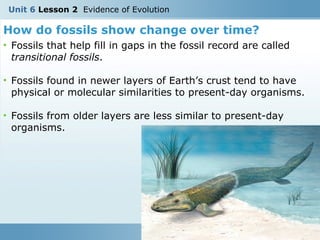
• Fossils that help fill in gaps in the fossil record are called 
transitional fossils. 
• Fossils found in newer layers of Earth’s crust tend to have 
physical or molecular similarities to present-day organisms. 
• Fossils from older layers are less similar to present-day 
organisms. 
Copyright © Houghton Mifflin Harcourt Publishing Company 
Unit 6 Lesson 2 Evidence of Evolution
Unit 6 Lesson 2 Evidence of Evolution 
More clues … 
What other evidence supports evolution? 
• Many fields of study support evidence that modern 
species and extinct species share an ancestor. 
• A common ancestor is the most recent species 
from which two different species have evolved. 
• Structural data, DNA, developmental patterns, 
and fossils all support the theory that populations 
change over time. 
Copyright © Houghton Mifflin Harcourt Publishing Company
What other evidence supports evolution? 
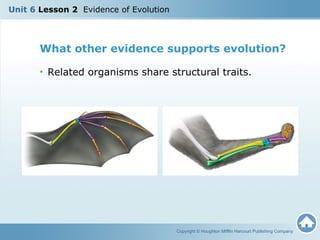
• Related organisms share structural traits. 
Copyright © Houghton Mifflin Harcourt Publishing Company 
Unit 6 Lesson 2 Evidence of Evolution
What other evidence supports evolution? 
• Scientists can compare the DNA from many 
organisms. 
• Similar genetic information stored in DNA gives 
evidence that two species most likely share a 
common ancestor. 
• If organisms develop in similar ways as embryos, 
it is likely that they share a common ancestor. The 
study of development is called embryology. 
Copyright © Houghton Mifflin Harcourt Publishing Company 
Unit 6 Lesson 2 Evidence of Evolution
What other evidence supports evolution? 
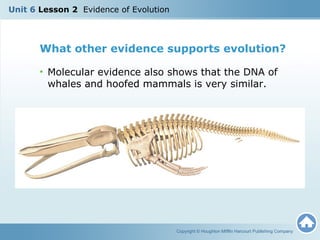
• Molecular evidence also shows that the DNA of 
whales and hoofed mammals is very similar. 
Copyright © Houghton Mifflin Harcourt Publishing Company 
Unit 6 Lesson 2 Evidence of Evolution
How do we know organisms are related? 
• Fossils give evidence for how certain species 
changed gradually over time. 
• Fossils and DNA evidence support the hypothesis 
that modern whales evolved from hoofed 
mammals that lived on land. 
• Scientists have examined transitional characters 
of extinct species to see how changes happened. 
Copyright © Houghton Mifflin Harcourt Publishing Company 
Unit 6 Lesson 2 Evidence of Evolution
How do we know organisms are related? 
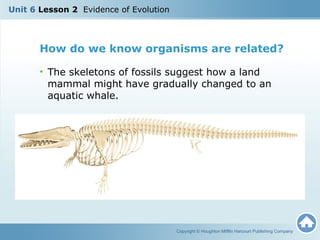
• The skeletons of fossils suggest how a land 
mammal might have gradually changed to an 
aquatic whale. 
Copyright © Houghton Mifflin Harcourt Publishing Company 
Unit 6 Lesson 2 Evidence of Evolution

U6 L2 Evidence of Evolution

  • 1.
    Unit 6 Lesson2 Evidence of Evolution Copyright © Houghton Mifflin Harcourt Publishing Company
  • 2.
    Unit 6 Lesson2 Evidence of Evolution Indiana Standards • 8.3.6 Observe anatomical structures of a variety of organisms and describe their similarities and differences. Use the data collected to organize the organisms into groups and predict their relatedness. Copyright © Houghton Mifflin Harcourt Publishing Company
  • 3.
    Unit 6 Lesson2 Evidence of Evolution Fossil Hunt How do fossils form? • Evidence that organisms have changed over time can be found in amber, ice, or sedimentary rock. • The most basic principle of dating rocks and the remains of organism is “the deeper it is, the older it is.” Copyright © Houghton Mifflin Harcourt Publishing Company
  • 4.
    How do fossilsform? • Many fossils form in sedimentary rock. • Fossils are the remains or imprints of once-living organisms. • Fossils form when a dead organism is covered by a layer of sediment or mud. Over time, more sediment settles on top of the organism. • Minerals in the sediment replace the body’s material, and the minerals harden over time. Copyright © Houghton Mifflin Harcourt Publishing Company Unit 6 Lesson 2 Evidence of Evolution
  • 5.
    How do fossilsshow change over time? • All of the fossils that have been discovered make up the fossil record. • By examining the fossil record, scientists learn about the history of life on Earth. • There are gaps in the fossil record in which a fossil has not been discovered. Copyright © Houghton Mifflin Harcourt Publishing Company Unit 6 Lesson 2 Evidence of Evolution
  • 6.
    How do fossilsshow change over time? • Fossils that help fill in gaps in the fossil record are called transitional fossils. • Fossils found in newer layers of Earth’s crust tend to have physical or molecular similarities to present-day organisms. • Fossils from older layers are less similar to present-day organisms. Copyright © Houghton Mifflin Harcourt Publishing Company Unit 6 Lesson 2 Evidence of Evolution
  • 7.
    Unit 6 Lesson2 Evidence of Evolution More clues … What other evidence supports evolution? • Many fields of study support evidence that modern species and extinct species share an ancestor. • A common ancestor is the most recent species from which two different species have evolved. • Structural data, DNA, developmental patterns, and fossils all support the theory that populations change over time. Copyright © Houghton Mifflin Harcourt Publishing Company
  • 8.
    What other evidencesupports evolution? • Related organisms share structural traits. Copyright © Houghton Mifflin Harcourt Publishing Company Unit 6 Lesson 2 Evidence of Evolution
  • 9.
    What other evidencesupports evolution? • Scientists can compare the DNA from many organisms. • Similar genetic information stored in DNA gives evidence that two species most likely share a common ancestor. • If organisms develop in similar ways as embryos, it is likely that they share a common ancestor. The study of development is called embryology. Copyright © Houghton Mifflin Harcourt Publishing Company Unit 6 Lesson 2 Evidence of Evolution
  • 10.
    What other evidencesupports evolution? • Molecular evidence also shows that the DNA of whales and hoofed mammals is very similar. Copyright © Houghton Mifflin Harcourt Publishing Company Unit 6 Lesson 2 Evidence of Evolution
  • 11.
    How do weknow organisms are related? • Fossils give evidence for how certain species changed gradually over time. • Fossils and DNA evidence support the hypothesis that modern whales evolved from hoofed mammals that lived on land. • Scientists have examined transitional characters of extinct species to see how changes happened. Copyright © Houghton Mifflin Harcourt Publishing Company Unit 6 Lesson 2 Evidence of Evolution
  • 12.
    How do weknow organisms are related? • The skeletons of fossils suggest how a land mammal might have gradually changed to an aquatic whale. Copyright © Houghton Mifflin Harcourt Publishing Company Unit 6 Lesson 2 Evidence of Evolution