KEMENTERIAN PELAJARAN MALAYSIA 
Self Access Learning Module 
IICCT LLiitteerraccyy fforr 
SSeeccondarryy SScchooll 
Prrogrrammee 
Ethics In Using 
Computer 
CURRICULUM DEVELOPMENT DIVISION 
MINISTRY OF EDUCATION MALAYSIA
ICTL For Secondary School – Computer Lab Manegement 
MODULE 1 
Ethics In Using 
Computer 
Curriculum Development Division 
Ministry of Education Malaysia 
1
ICTL For Secondary School – Computer Lab Manegement 
1. Name of Module : Ethics in using computer 
2. Learning Outcomes: The students should be able to: 
a. state the ethics of computer usage 
b. define the meaning of copyright. 
c. state the effects of copyright violation. 
d. list at least 3 unethical use of computers 
e. state the effects of unethical use of computers 
f. define the meaning of plagiarism 
g. state the effects of plagiarism 
2 
3. Knowledge and Skills 
1. Explaining the ethics of computer usage 
4. Module Summary: At the end of the module, students should be able to explain 
the ethics of computer usage, and give their opinions on copyright and plagiarism. 
Activity 1 : Notes on Ethics in using computers 
Activity 2 : Exercises on Ethics and Copyright 
Activity 3 : Notes on Plagiarism 
Activity 4 : Exercises on Plagiarism 
.
ICTL For Secondary School – Computer Lab Manegement 
3 
Activity 1 
3. Ethics in using computer 
Have you ever asked for permission to download materials from the internet such as 
music, articles, graphic and other material. If you have, you are following the computer 
code of conducts. There are many web sites with restriction where the public is allowed 
to use their material. Users may have to pay royalty (fee) to the owner or quote the 
website in their assignment or project, in order to be able to use this material. 
Examples of ethical computer code of conducts include: 
• sending warning about viruses to other computer users 
• asking permission before sending any business advertisements to others 
• using information with authorization 
Ethics in general 
1. We often see pirated CDs, software and VCD being sold at the night market. Buying 
pirated software is an example of unethical activity in computer ethic. 
2. A guideline is needed to stop the current technology products from being exploited 
for example copying originals CDs and selling them as pirated software, this 
unethical behavior can be controlled by the code of conducts. 
3. Under the Malaysia Copyright act 1987, any individual charge with piracy will be fine 
up to 10,000 for each copy or up to 5 years imprisonment or both. 
4. Computer ethics is a system of moral standards or values used as a guideline for 
computer users.
ICTL For Secondary School – Computer Lab Manegement 
Ten important instructions of computer ethics 
The United States Institute of Computer Ethics has come out with 10 instructions of 
Computer Ethics as follows: 
a. You shall not use a computer to harm other people. 
b. You shall not interfere with other people’s computer work. 
c. You shall not use a computer to steal 
d. You shall not copy or use software for which you have not paid illegally. 
e. You shall not use other people’s computer resources without 
permission or proper compensation. 
f. You shall not look around in other people’s computer files. 
g. You shall not use a computer to give false identity. 
h. You shall not correct other people’s ideas or works. 
i. You shall think about the social effects of the program you 
are writing or the system you are designing. 
j. You shall always use a computer in ways that ensure consideration 
and respect for your fellow friends. 
4
ICTL For Secondary School – Computer Lab Manegement 
3.1 Copyright 
What Is Copyright? 
Copyright is the legal right given to the owner of a copyright to prevent others from 
copying an artistic works, literary, dramatic or music work. Only the copyright owner 
has the legal right to reproduce the work in any form and has the right to sue others 
who copy or distribute unauthorized work without the copyright owner’s permission. 
The owner of copyright has the special right to do and authorize the following: 
• To reproduce the work; 
• To prepare copied works based upon the work; 
• To distribute copies of the work to the public by sale or transfer of 
ownership, or by rental, lease, or lending; 
• To disallow other persons from using the work without permission; 
• To carry out the work publicly. 
Copyright protection in Malaysia is governed by the Copyright Act 1987. There is no 
system of registration for copyright in Malaysia. A work that is eligible is protected 
automatically upon fulfillment of the following conditions:- 
• sufficient effort has been expected to make the work original in 
5 
character; 
• the work has been written down, recorded or reduced to a material 
form; 
• the author is qualified person or the work is made in Malaysia or the work is first 
published in Malaysia 
Copyright symbol 
Abbreviated as (c) or ©.
ICTL For Secondary School – Computer Lab Manegement 
Copyright violation (Breaking of copyright law) 
A person who does not own the copyright, and without license from the owner or 
does not have permission in any of the following acts has broken the copyright law. 
• Use resources only for academic assignments and official education and research 
and not reproduced in any material form to the public. 
• Resources are not to be used for business purposes or private gain. 
• Changing of system settings is not allowed. 
• Respect and abide by all copyright laws. 
• Downloading, installation, or removal of software or hardware is not allowed. 
• E-mail messages should be brief, occasional and should indicate the sender’s true 
6 
identity. 
• Send no obscene or harassing messages in any format in violation of any 
applicable law. 
• Respect the rights and property of others by not accessing other members’ data. 
• No one should purposely attempt to weaken the system security or disturb the 
system performance through “hacking” .
ICTL For Secondary School – Computer Lab Manegement 
7 
3.2 Unethical use of computers 
1. Have you copied materials from the internet and claims that it is your own and submit 
them as an assignment? If you have, you are reaching the computer code of 
conducts (manners). In other word, you are breaking the law of intellectual property 
by stealing someone else’s idea. Intellectual property refers to any products of 
human intellect that is unique and has a value in the market place. This covers ideas, 
inventions, unique names, computer program codes and many more. 
2. Examples of unethical computer code of conducts include: 
a) modifying certain information on the internet, affecting the accuracy of the 
information 
b) selling information to other parties without the owner’s permission 
c) using information without permission. 
d) involvement in stealing software 
e) invasion of privacy 
3. With the advancement of ICT, it is easy for anyone to get back your information from 
the Internet. You may not realize that when you fill a form on the Internet, your 
information may be exposed and stolen. 
4. Hacking is unethical. For example, Kevin David Mitnick was a famous hacker. He 
accessed computers without authorization. He deprived the privacy of many 
individuals by hacking into network of a few companies. He also managed to get 
important data unethically for his own usage.
ICTL For Secondary School – Computer Lab Manegement 
8 
Activity 2 
Exercise 1 
Instruction : Answer the questions below. 
Questions: 
1. What is the meaning of computer ethics ? 
2. State the 10 instructions in computer ethics ? 
Exercise 2 
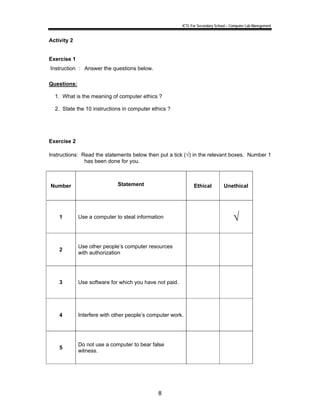
Instructions: Read the statements below then put a tick (√) in the relevant boxes. Number 1 
has been done for you. 
Number Statement 
Ethical Unethical 
1 
Use a computer to steal information √ 
2 
Use other people’s computer resources 
with authorization 
3 
Use software for which you have not paid. 
4 
Interfere with other people’s computer work. 
5 
Do not use a computer to bear false 
witness.
ICTL For Secondary School – Computer Lab Manegement 
Exercise 3 
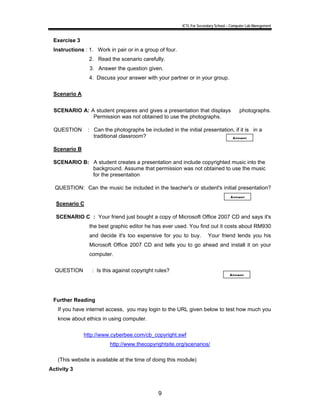
Instructions : 1. Work in pair or in a group of four. 
2. Read the scenario carefully. 
3. Answer the question given. 
4. Discuss your answer with your partner or in your group. 
9 
Scenario A 
SCENARIO A: A student prepares and gives a presentation that displays photographs. 
Permission was not obtained to use the photographs. 
QUESTION : Can the photographs be included in the initial presentation, if it is in a 
traditional classroom? 
Scenario B 
SCENARIO B: A student creates a presentation and include copyrighted music into the 
background. Assume that permission was not obtained to use the music 
for the presentation 
QUESTION: Can the music be included in the teacher's or student's initial presentation? 
Scenario C 
SCENARIO C : Your friend just bought a copy of Microsoft Office 2007 CD and says it's 
the best graphic editor he has ever used. You find out it costs about RM930 
and decide it's too expensive for you to buy. Your friend lends you his 
Microsoft Office 2007 CD and tells you to go ahead and install it on your 
computer. 
QUESTION : Is this against copyright rules? 
Further Reading 
If you have internet access, you may login to the URL given below to test how much you 
know about ethics in using computer. 
http://www.cyberbee.com/cb_copyright.swf 
http://www.thecopyrightsite.org/scenarios/ 
(This website is available at the time of doing this module) 
Activity 3 
Answer 
Answer 
Answer
ICTL For Secondary School – Computer Lab Manegement 
10 
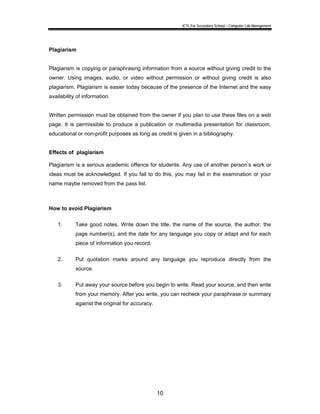
Plagiarism 
Plagiarism is copying or paraphrasing information from a source without giving credit to the 
owner. Using images, audio, or video without permission or without giving credit is also 
plagiarism. Plagiarism is easier today because of the presence of the Internet and the easy 
availability of information. 
Written permission must be obtained from the owner if you plan to use these files on a web 
page. It is permissible to produce a publication or multimedia presentation for classroom, 
educational or non-profit purposes as long as credit is given in a bibliography. 
Effects of plagiarism 
Plagiarism is a serious academic offence for students. Any use of another person’s work or 
ideas must be acknowledged. If you fail to do this, you may fail in the examination or your 
name maybe removed from the pass list. 
How to avoid Plagiarism 
1. Take good notes. Write down the title, the name of the source, the author, the 
page number(s), and the date for any language you copy or adapt and for each 
piece of information you record. 
2. Put quotation marks around any language you reproduce directly from the 
source. 
3. Put away your source before you begin to write. Read your source, and then write 
from your memory. After you write, you can recheck your paraphrase or summary 
against the original for accuracy.
ICTL For Secondary School – Computer Lab Manegement 
11 
Activity 4 
Exercise 3 
1. What is Plagiarism? 
________________________________________________________________ 
______________________________________________________ 
2. List out two points to avoid Plagiarism. 
________________________________________________________________ 
______________________________________________________ 
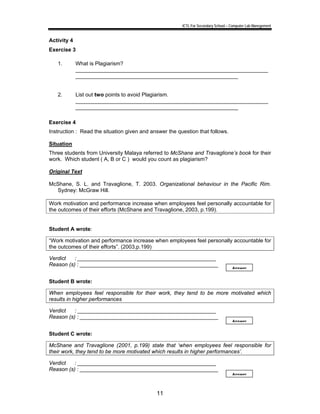
Exercise 4 
Instruction : Read the situation given and answer the question that follows. 
Situation 
Three students from University Malaya referred to McShane and Travaglione’s book for their 
work. Which student ( A, B or C ) would you count as plagiarism? 
Original Text 
McShane, S. L. and Travaglione, T. 2003. Organizational behaviour in the Pacific Rim. 
Sydney: McGraw Hill. 
Work motivation and performance increase when employees feel personally accountable for 
the outcomes of their efforts (McShane and Travaglione, 2003, p.199). 
Student A wrote: 
“Work motivation and performance increase when employees feel personally accountable for 
the outcomes of their efforts”. (2003,p.199) 
Verdict : ______________________________________________ 
Reason (s) : ______________________________________________ 
Answer 
Student B wrote: 
When employees feel responsible for their work, they tend to be more motivated which 
results in higher performances 
Verdict : ______________________________________________ 
Reason (s) : ______________________________________________ 
Answer 
Student C wrote: 
McShane and Travaglione (2001, p.199) state that ‘when employees feel responsible for 
their work, they tend to be more motivated which results in higher performances’. 
Verdict : ______________________________________________ 
Reason (s) : ______________________________________________ 
Answer
ICTL For Secondary School – Computer Lab Manegement 
12 
Further Reading 
If you have internet access, login to the URL given below to test how much you know 
about plagiarism. 
http://amow.boardofstudies.nsw.edu.au/downloads/mods_quiz.pdf.html 
(This website is available at the time of doing this module)
ICTL For Secondary School – Computer Lab Manegement 
13 
References : 
Computer Whizzkid (2003) Sri Lanka: NCC education 
http://cpsr.org/issues/ethics/cei/ 
http://en.wikipedia.org/wiki/Computer_ethics 
http://etiquette.wikia.com/wiki/Netiquette 
http://plato.stanford.edu/entries/ethics-computer/ 
http://www.cmpe.boun.edu.tr/~say/c150/intro/lit10.html 
http://www.spscc.ctc.edu/AUP/ethics_in_labs.html 
http://www.unmc.edu/library/reference/copyright.html 
http://www.usg.edu/legal/copyright/ 
http://copyright.gov/cires/circ1.html 
http://www.copyrightkids.org 
http://www.boiseschools.org/cybersafe/ethics.html 
http:// webopedia.com/TERM/c/copyright.html

Ethics in using computer

  • 1.
    KEMENTERIAN PELAJARAN MALAYSIA Self Access Learning Module IICCT LLiitteerraccyy fforr SSeeccondarryy SScchooll Prrogrrammee Ethics In Using Computer CURRICULUM DEVELOPMENT DIVISION MINISTRY OF EDUCATION MALAYSIA
  • 2.
    ICTL For SecondarySchool – Computer Lab Manegement MODULE 1 Ethics In Using Computer Curriculum Development Division Ministry of Education Malaysia 1
  • 3.
    ICTL For SecondarySchool – Computer Lab Manegement 1. Name of Module : Ethics in using computer 2. Learning Outcomes: The students should be able to: a. state the ethics of computer usage b. define the meaning of copyright. c. state the effects of copyright violation. d. list at least 3 unethical use of computers e. state the effects of unethical use of computers f. define the meaning of plagiarism g. state the effects of plagiarism 2 3. Knowledge and Skills 1. Explaining the ethics of computer usage 4. Module Summary: At the end of the module, students should be able to explain the ethics of computer usage, and give their opinions on copyright and plagiarism. Activity 1 : Notes on Ethics in using computers Activity 2 : Exercises on Ethics and Copyright Activity 3 : Notes on Plagiarism Activity 4 : Exercises on Plagiarism .
  • 4.
    ICTL For SecondarySchool – Computer Lab Manegement 3 Activity 1 3. Ethics in using computer Have you ever asked for permission to download materials from the internet such as music, articles, graphic and other material. If you have, you are following the computer code of conducts. There are many web sites with restriction where the public is allowed to use their material. Users may have to pay royalty (fee) to the owner or quote the website in their assignment or project, in order to be able to use this material. Examples of ethical computer code of conducts include: • sending warning about viruses to other computer users • asking permission before sending any business advertisements to others • using information with authorization Ethics in general 1. We often see pirated CDs, software and VCD being sold at the night market. Buying pirated software is an example of unethical activity in computer ethic. 2. A guideline is needed to stop the current technology products from being exploited for example copying originals CDs and selling them as pirated software, this unethical behavior can be controlled by the code of conducts. 3. Under the Malaysia Copyright act 1987, any individual charge with piracy will be fine up to 10,000 for each copy or up to 5 years imprisonment or both. 4. Computer ethics is a system of moral standards or values used as a guideline for computer users.
  • 5.
    ICTL For SecondarySchool – Computer Lab Manegement Ten important instructions of computer ethics The United States Institute of Computer Ethics has come out with 10 instructions of Computer Ethics as follows: a. You shall not use a computer to harm other people. b. You shall not interfere with other people’s computer work. c. You shall not use a computer to steal d. You shall not copy or use software for which you have not paid illegally. e. You shall not use other people’s computer resources without permission or proper compensation. f. You shall not look around in other people’s computer files. g. You shall not use a computer to give false identity. h. You shall not correct other people’s ideas or works. i. You shall think about the social effects of the program you are writing or the system you are designing. j. You shall always use a computer in ways that ensure consideration and respect for your fellow friends. 4
  • 6.
    ICTL For SecondarySchool – Computer Lab Manegement 3.1 Copyright What Is Copyright? Copyright is the legal right given to the owner of a copyright to prevent others from copying an artistic works, literary, dramatic or music work. Only the copyright owner has the legal right to reproduce the work in any form and has the right to sue others who copy or distribute unauthorized work without the copyright owner’s permission. The owner of copyright has the special right to do and authorize the following: • To reproduce the work; • To prepare copied works based upon the work; • To distribute copies of the work to the public by sale or transfer of ownership, or by rental, lease, or lending; • To disallow other persons from using the work without permission; • To carry out the work publicly. Copyright protection in Malaysia is governed by the Copyright Act 1987. There is no system of registration for copyright in Malaysia. A work that is eligible is protected automatically upon fulfillment of the following conditions:- • sufficient effort has been expected to make the work original in 5 character; • the work has been written down, recorded or reduced to a material form; • the author is qualified person or the work is made in Malaysia or the work is first published in Malaysia Copyright symbol Abbreviated as (c) or ©.
  • 7.
    ICTL For SecondarySchool – Computer Lab Manegement Copyright violation (Breaking of copyright law) A person who does not own the copyright, and without license from the owner or does not have permission in any of the following acts has broken the copyright law. • Use resources only for academic assignments and official education and research and not reproduced in any material form to the public. • Resources are not to be used for business purposes or private gain. • Changing of system settings is not allowed. • Respect and abide by all copyright laws. • Downloading, installation, or removal of software or hardware is not allowed. • E-mail messages should be brief, occasional and should indicate the sender’s true 6 identity. • Send no obscene or harassing messages in any format in violation of any applicable law. • Respect the rights and property of others by not accessing other members’ data. • No one should purposely attempt to weaken the system security or disturb the system performance through “hacking” .
  • 8.
    ICTL For SecondarySchool – Computer Lab Manegement 7 3.2 Unethical use of computers 1. Have you copied materials from the internet and claims that it is your own and submit them as an assignment? If you have, you are reaching the computer code of conducts (manners). In other word, you are breaking the law of intellectual property by stealing someone else’s idea. Intellectual property refers to any products of human intellect that is unique and has a value in the market place. This covers ideas, inventions, unique names, computer program codes and many more. 2. Examples of unethical computer code of conducts include: a) modifying certain information on the internet, affecting the accuracy of the information b) selling information to other parties without the owner’s permission c) using information without permission. d) involvement in stealing software e) invasion of privacy 3. With the advancement of ICT, it is easy for anyone to get back your information from the Internet. You may not realize that when you fill a form on the Internet, your information may be exposed and stolen. 4. Hacking is unethical. For example, Kevin David Mitnick was a famous hacker. He accessed computers without authorization. He deprived the privacy of many individuals by hacking into network of a few companies. He also managed to get important data unethically for his own usage.
  • 9.
    ICTL For SecondarySchool – Computer Lab Manegement 8 Activity 2 Exercise 1 Instruction : Answer the questions below. Questions: 1. What is the meaning of computer ethics ? 2. State the 10 instructions in computer ethics ? Exercise 2 Instructions: Read the statements below then put a tick (√) in the relevant boxes. Number 1 has been done for you. Number Statement Ethical Unethical 1 Use a computer to steal information √ 2 Use other people’s computer resources with authorization 3 Use software for which you have not paid. 4 Interfere with other people’s computer work. 5 Do not use a computer to bear false witness.
  • 10.
    ICTL For SecondarySchool – Computer Lab Manegement Exercise 3 Instructions : 1. Work in pair or in a group of four. 2. Read the scenario carefully. 3. Answer the question given. 4. Discuss your answer with your partner or in your group. 9 Scenario A SCENARIO A: A student prepares and gives a presentation that displays photographs. Permission was not obtained to use the photographs. QUESTION : Can the photographs be included in the initial presentation, if it is in a traditional classroom? Scenario B SCENARIO B: A student creates a presentation and include copyrighted music into the background. Assume that permission was not obtained to use the music for the presentation QUESTION: Can the music be included in the teacher's or student's initial presentation? Scenario C SCENARIO C : Your friend just bought a copy of Microsoft Office 2007 CD and says it's the best graphic editor he has ever used. You find out it costs about RM930 and decide it's too expensive for you to buy. Your friend lends you his Microsoft Office 2007 CD and tells you to go ahead and install it on your computer. QUESTION : Is this against copyright rules? Further Reading If you have internet access, you may login to the URL given below to test how much you know about ethics in using computer. http://www.cyberbee.com/cb_copyright.swf http://www.thecopyrightsite.org/scenarios/ (This website is available at the time of doing this module) Activity 3 Answer Answer Answer
  • 11.
    ICTL For SecondarySchool – Computer Lab Manegement 10 Plagiarism Plagiarism is copying or paraphrasing information from a source without giving credit to the owner. Using images, audio, or video without permission or without giving credit is also plagiarism. Plagiarism is easier today because of the presence of the Internet and the easy availability of information. Written permission must be obtained from the owner if you plan to use these files on a web page. It is permissible to produce a publication or multimedia presentation for classroom, educational or non-profit purposes as long as credit is given in a bibliography. Effects of plagiarism Plagiarism is a serious academic offence for students. Any use of another person’s work or ideas must be acknowledged. If you fail to do this, you may fail in the examination or your name maybe removed from the pass list. How to avoid Plagiarism 1. Take good notes. Write down the title, the name of the source, the author, the page number(s), and the date for any language you copy or adapt and for each piece of information you record. 2. Put quotation marks around any language you reproduce directly from the source. 3. Put away your source before you begin to write. Read your source, and then write from your memory. After you write, you can recheck your paraphrase or summary against the original for accuracy.
  • 12.
    ICTL For SecondarySchool – Computer Lab Manegement 11 Activity 4 Exercise 3 1. What is Plagiarism? ________________________________________________________________ ______________________________________________________ 2. List out two points to avoid Plagiarism. ________________________________________________________________ ______________________________________________________ Exercise 4 Instruction : Read the situation given and answer the question that follows. Situation Three students from University Malaya referred to McShane and Travaglione’s book for their work. Which student ( A, B or C ) would you count as plagiarism? Original Text McShane, S. L. and Travaglione, T. 2003. Organizational behaviour in the Pacific Rim. Sydney: McGraw Hill. Work motivation and performance increase when employees feel personally accountable for the outcomes of their efforts (McShane and Travaglione, 2003, p.199). Student A wrote: “Work motivation and performance increase when employees feel personally accountable for the outcomes of their efforts”. (2003,p.199) Verdict : ______________________________________________ Reason (s) : ______________________________________________ Answer Student B wrote: When employees feel responsible for their work, they tend to be more motivated which results in higher performances Verdict : ______________________________________________ Reason (s) : ______________________________________________ Answer Student C wrote: McShane and Travaglione (2001, p.199) state that ‘when employees feel responsible for their work, they tend to be more motivated which results in higher performances’. Verdict : ______________________________________________ Reason (s) : ______________________________________________ Answer
  • 13.
    ICTL For SecondarySchool – Computer Lab Manegement 12 Further Reading If you have internet access, login to the URL given below to test how much you know about plagiarism. http://amow.boardofstudies.nsw.edu.au/downloads/mods_quiz.pdf.html (This website is available at the time of doing this module)
  • 14.
    ICTL For SecondarySchool – Computer Lab Manegement 13 References : Computer Whizzkid (2003) Sri Lanka: NCC education http://cpsr.org/issues/ethics/cei/ http://en.wikipedia.org/wiki/Computer_ethics http://etiquette.wikia.com/wiki/Netiquette http://plato.stanford.edu/entries/ethics-computer/ http://www.cmpe.boun.edu.tr/~say/c150/intro/lit10.html http://www.spscc.ctc.edu/AUP/ethics_in_labs.html http://www.unmc.edu/library/reference/copyright.html http://www.usg.edu/legal/copyright/ http://copyright.gov/cires/circ1.html http://www.copyrightkids.org http://www.boiseschools.org/cybersafe/ethics.html http:// webopedia.com/TERM/c/copyright.html