ACLC COLLEGE OF ORMOC
PRINCIPLES
C O M P U T E R E T H I C S
MODULE 2
main.20002197@cnu.edu.ph
BRIDGING DIGITAL ADVANCEMENT. EMBRACING RESPONSIBLE DEVELOPMENT
ERRON F. NICOL, LPT, MAED-ECE
INTRODUCTION
Ethics is a set of moral principles
that govern the behavior of a
group or individual.
Likewise, computer ethics is set
of moral principles that regulate
the use of computers.
For example, while it is easy to duplicate copyrighted
electronic or digital content, computer ethics would
suggest that it is wrong to do so without the author's
approval.
And while it may be possible to access someone's personal
information on a computer system, computer ethics would
advise that such an action is unethical.
Some common issues of computer ethics include intellectual
property rights such as copyrighted electronic content, privacy
concerns, and how computers affect society.
Common Issues of Computer Ethics
intellectual
You have certainly heard the word
property before: it is generally used to
mean a possession, or more specifically,
something to which the owner has legal
rights.
You might have also encountered the
phrase intellectual property. This term has
become more commonplace during the
past few years, especially in the context of
computer ethics. But what exactly does it
refer to?
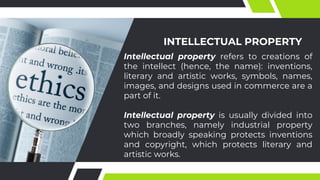
INTELLECTUAL PROPERTY
Intellectual property refers to creations of
the intellect (hence, the name): inventions,
literary and artistic works, symbols, names,
images, and designs used in commerce are a
part of it.
Intellectual property is usually divided into
two branches, namely industrial property
which broadly speaking protects inventions
and copyright, which protects literary and
artistic works.
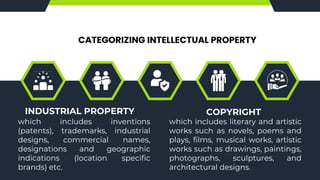
CATEGORIZING INTELLECTUAL PROPERTY
INDUSTRIAL PROPERTY
which includes inventions
(patents), trademarks, industrial
designs, commercial names,
designations and geographic
indications (location specific
brands) etc.
COPYRIGHT
which includes literary and artistic
works such as novels, poems and
plays, films, musical works, artistic
works such as drawings, paintings,
photographs, sculptures, and
architectural designs.
copyright on INTERNET
But what of works made available to the
public on the Internet? Are they at all
protected by copyright? Once again, yes!
For works made available over a
communications network (such as the
Internet), the copyright protects original
authorship.
copyright on INTERNET
But, according to the Copyright Law, it
does not protect ideas, procedures,
systems, or methods of operation. This
means that once such an online work has
been made public, nothing in the
copyright laws prevents others from
developing another work based on similar
principles, or ideas.
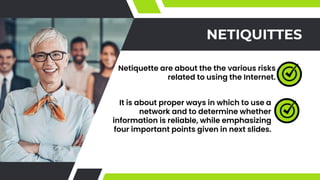
NETIQUITTES
Netiquette are about the the various risks
related to using the Internet.
It is about proper ways in which to use a
network and to determine whether
information is reliable, while emphasizing
four important points given in next slides.
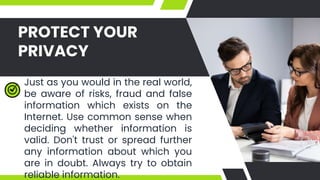
PROTECT YOUR
PRIVACY
Just as you would in the real world,
be aware of risks, fraud and false
information which exists on the
Internet. Use common sense when
deciding whether information is
valid. Don't trust or spread further
any information about which you
are in doubt. Always try to obtain
reliable information.
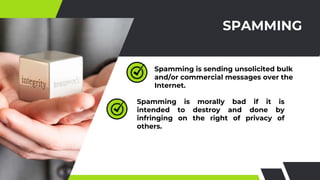
SPAMMING
Spamming is sending unsolicited bulk
and/or commercial messages over the
Internet.
Spamming is morally bad if it is
intended to destroy and done by
infringing on the right of privacy of
others.
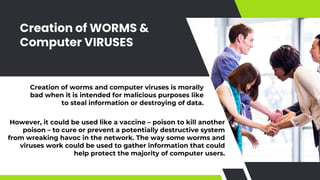
Creation of WORMS &
Computer VIRUSES
Creation of worms and computer viruses is morally
bad when it is intended for malicious purposes like
to steal information or destroying of data.
However, it could be used like a vaccine – poison to kill another
poison – to cure or prevent a potentially destructive system
from wreaking havoc in the network. The way some worms and
viruses work could be used to gather information that could
help protect the majority of computer users.
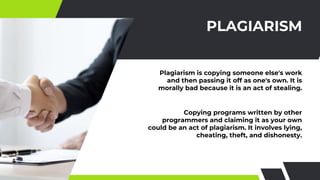
PLAGIARISM
Plagiarism is copying someone else's work
and then passing it off as one's own. It is
morally bad because it is an act of stealing.
Copying programs written by other
programmers and claiming it as your own
could be an act of plagiarism. It involves lying,
cheating, theft, and dishonesty.
FILE PRIVACY
Any computer document produced either by an
individual in his private home or in his office
should remain private. No one has should open
any document unless authorized by the individual
who created the file himself.
COMPUTER ETHICAL
HACKING
An ethical hacker is usually employed
by an organization who trusts him or
her to attempt to penetrate networks
and/or computer systems, using the
same methods as a hacker, for the
purpose of finding and fixing computer
security vulnerabilities.
ACLC COLLEGE ORMOC
THANK YOU
F O R Y O U R A T T E N T I O N
MODULE 2
main.20002197@cnu.edu.ph
ERRON F. NICOL, LPT, MAED-ECE
BRIDGING DIGITAL ADVANCEMENT. EMBRACING RESPONSIBLE DEVELOPMENT

Principles of computer ethics Module 2.pptx

  • 1.
    ACLC COLLEGE OFORMOC PRINCIPLES C O M P U T E R E T H I C S MODULE 2 main.20002197@cnu.edu.ph BRIDGING DIGITAL ADVANCEMENT. EMBRACING RESPONSIBLE DEVELOPMENT ERRON F. NICOL, LPT, MAED-ECE
  • 2.
    INTRODUCTION Ethics is aset of moral principles that govern the behavior of a group or individual. Likewise, computer ethics is set of moral principles that regulate the use of computers.
  • 3.
    For example, whileit is easy to duplicate copyrighted electronic or digital content, computer ethics would suggest that it is wrong to do so without the author's approval. And while it may be possible to access someone's personal information on a computer system, computer ethics would advise that such an action is unethical. Some common issues of computer ethics include intellectual property rights such as copyrighted electronic content, privacy concerns, and how computers affect society. Common Issues of Computer Ethics
  • 4.
    intellectual You have certainlyheard the word property before: it is generally used to mean a possession, or more specifically, something to which the owner has legal rights. You might have also encountered the phrase intellectual property. This term has become more commonplace during the past few years, especially in the context of computer ethics. But what exactly does it refer to?
  • 5.
    INTELLECTUAL PROPERTY Intellectual propertyrefers to creations of the intellect (hence, the name): inventions, literary and artistic works, symbols, names, images, and designs used in commerce are a part of it. Intellectual property is usually divided into two branches, namely industrial property which broadly speaking protects inventions and copyright, which protects literary and artistic works.
  • 6.
    CATEGORIZING INTELLECTUAL PROPERTY INDUSTRIALPROPERTY which includes inventions (patents), trademarks, industrial designs, commercial names, designations and geographic indications (location specific brands) etc. COPYRIGHT which includes literary and artistic works such as novels, poems and plays, films, musical works, artistic works such as drawings, paintings, photographs, sculptures, and architectural designs.
  • 7.
    copyright on INTERNET Butwhat of works made available to the public on the Internet? Are they at all protected by copyright? Once again, yes! For works made available over a communications network (such as the Internet), the copyright protects original authorship.
  • 8.
    copyright on INTERNET But,according to the Copyright Law, it does not protect ideas, procedures, systems, or methods of operation. This means that once such an online work has been made public, nothing in the copyright laws prevents others from developing another work based on similar principles, or ideas.
  • 9.
    NETIQUITTES Netiquette are aboutthe the various risks related to using the Internet. It is about proper ways in which to use a network and to determine whether information is reliable, while emphasizing four important points given in next slides.
  • 10.
    PROTECT YOUR PRIVACY Just asyou would in the real world, be aware of risks, fraud and false information which exists on the Internet. Use common sense when deciding whether information is valid. Don't trust or spread further any information about which you are in doubt. Always try to obtain reliable information.
  • 11.
    SPAMMING Spamming is sendingunsolicited bulk and/or commercial messages over the Internet. Spamming is morally bad if it is intended to destroy and done by infringing on the right of privacy of others.
  • 12.
    Creation of WORMS& Computer VIRUSES Creation of worms and computer viruses is morally bad when it is intended for malicious purposes like to steal information or destroying of data. However, it could be used like a vaccine – poison to kill another poison – to cure or prevent a potentially destructive system from wreaking havoc in the network. The way some worms and viruses work could be used to gather information that could help protect the majority of computer users.
  • 13.
    PLAGIARISM Plagiarism is copyingsomeone else's work and then passing it off as one's own. It is morally bad because it is an act of stealing. Copying programs written by other programmers and claiming it as your own could be an act of plagiarism. It involves lying, cheating, theft, and dishonesty.
  • 14.
    FILE PRIVACY Any computerdocument produced either by an individual in his private home or in his office should remain private. No one has should open any document unless authorized by the individual who created the file himself.
  • 15.
    COMPUTER ETHICAL HACKING An ethicalhacker is usually employed by an organization who trusts him or her to attempt to penetrate networks and/or computer systems, using the same methods as a hacker, for the purpose of finding and fixing computer security vulnerabilities.
  • 16.
    ACLC COLLEGE ORMOC THANKYOU F O R Y O U R A T T E N T I O N MODULE 2 main.20002197@cnu.edu.ph ERRON F. NICOL, LPT, MAED-ECE BRIDGING DIGITAL ADVANCEMENT. EMBRACING RESPONSIBLE DEVELOPMENT