Computer Ethics
      Presentation by
       Nadine Fray
         INF 103
   PROF Mortoza Abdullah
        May 3 2012
Table of contents

   1. A brief history of computer
    and internet
   2. The meaning of Ethics
   3. The distinction between law
    and Ethics
   4.The subject of Ethics
   5.computer Ethics as a unique
    kind of Ethics
   6.chapter summary
Ethics?

    Ethic refers to the standards and rules
     that "should" be followed and it helps us
     to regulate our conduct in a group or with
     a set of individuals. Since the term
     Ethics is a relative term, it is branched
     under philosophy, which states how
     users of World Wide Web should make
     decisions regarding their conduct.
 Computer ethics is
  a new branch of
  ethics that is
  growing and
  changing rapidly as
  computer
  technology also
  grows and
  develops.
The Ten Commandments On Computer Ethics


          1. Thou shalt not use a computer to harm other people.
      2. Thou shalt not interfere with other people's computer work.
     3. Thou shalt not snoop around in other people's computer files.
                 4. Thou shalt not use a computer to steal.
          5. Thou shalt not use a computer to bear false witness.
6. Thou shalt not copy or use proprietary software for which you have not
                                    paid.
     7. Thou shalt not use other people's computer resources without
                  authorization or proper compensation.
     8. Thou shalt not appropriate other people's intellectual output.
9. Thou shalt think about the social consequences of the program you are
                 writing or the system you are designing.
 10. Thou shalt always use a computer in ways that ensure consideration
                    and respect for your fellow humans
Computers are often far more
efficient than humans in performing
many tasks. In the industrialized
world many workers already have
been replaced by computerized
devices -- bank tellers, auto workers,
telephone operators, typists, graphic
artists, security guards, assembly-
line workers, and on and on. Even
professionals like medical doctors,
lawyers, teachers, accountants and
psychologists are finding that
computers can perform many of
their traditional professional duties
quite effectively.
Why do we need computer ethics?

 The growth of the WWW has created several
               novel legal issues
The existence of new questions that older laws
                cannot answer
 Traditional laws are outdated/anachronistic
                 in this world
  a more coherent body of law is needed to
       govern Internet and computers
Cyber Ethics
• the most common problem isn't hacking (illegally
  accessing Web sites) or cracking (vandalizing
  Web sites); It's the unauthorized downloading of
  games and software.
• the average hacker is likely to be a teenager and
  given that most homes now have at least one
  computer
Code of Ethics
   Information stored on the computer should be treated
    as seriously as written or spoken word.
   Privacy should not be violated. In case of academic
    use, it is known plagiarism.
   Information from public viewing should not be
    modified or deleted or inaccessible since these are
    considered as destructive acts.
   Intrusive software such as "worms" and "viruses"
    which are destructive to the computer system is also
    illegal.
   Congesting somebody’s system with a lot of unwanted
    information is also unethical.
   Sending obscene and crude messages through mail or
    chat is also forbidden.
   Sending sexually explicit content, message or pictures
    is also forbidden.
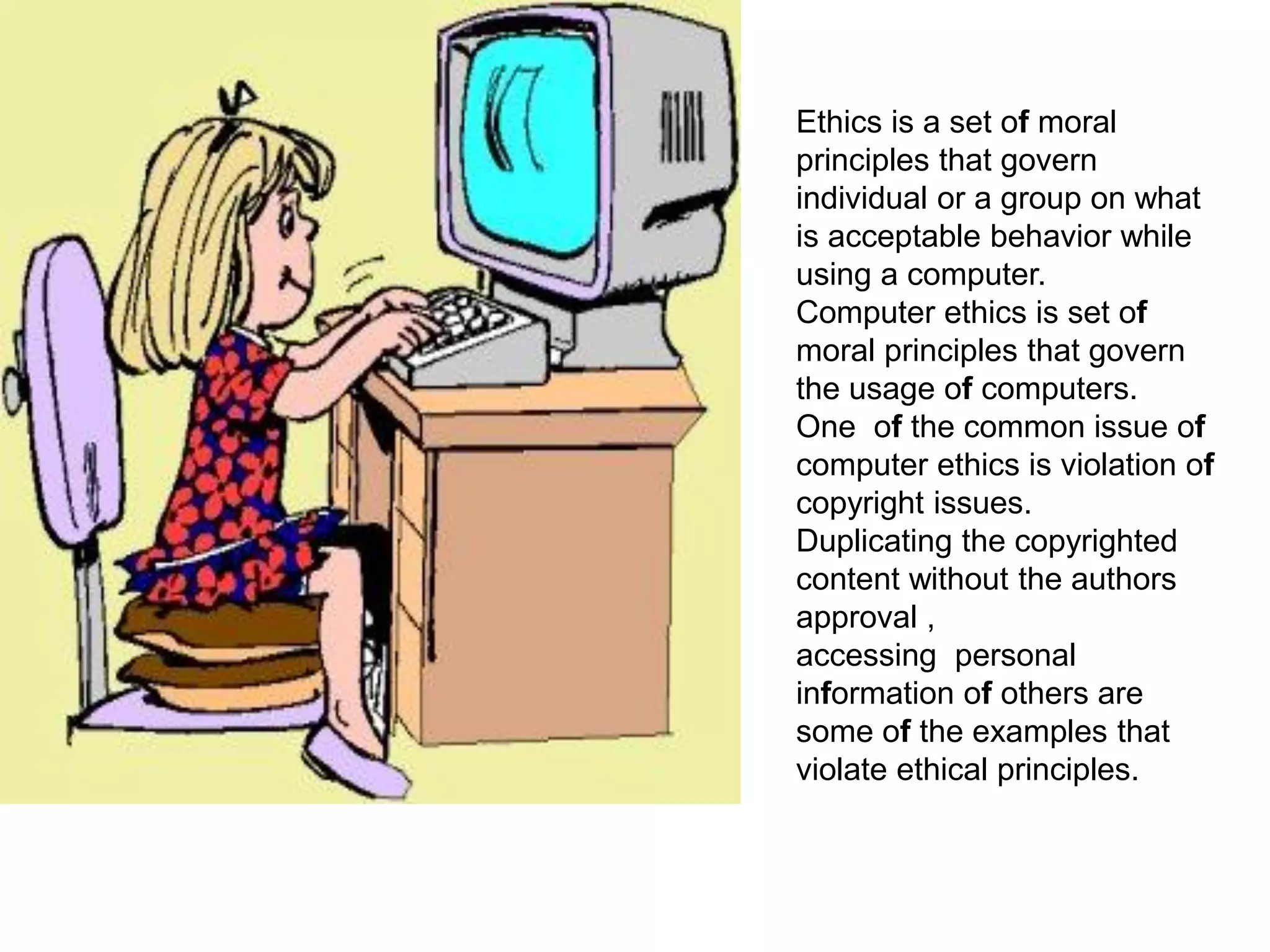
Ethics is a set of moral
principles that govern
individual or a group on what
is acceptable behavior while
using a computer.
Computer ethics is set of
moral principles that govern
the usage of computers.
One of the common issue of
computer ethics is violation of
copyright issues.
Duplicating the copyrighted
content without the authors
approval ,
accessing personal
information of others are
some of the examples that
violate ethical principles.
Ethical rules for computer users

    Do not use computer to harm other users.
     Do not use computers to steal other's information.
     Do not access files without the permission of owner.
     Do not copy copyrighted software's without the authors permission.
     Always respect copyright laws and policies.
     Respect the privacy of others, just as you expect the same from
    others.
     Do not use other user's computer resources with out their permission.
     Use Internet ethically.
     Complain about illegal communication and activities, if found, to
    Internet service Providers and local law enforcement authorities.
     Users are responsible for safeguarding their User Id and passwords.
    They should not write them on paper or anywhere else for
    remembrance.
     Users should not intentionally use the computers to retrieve or modify
    the information of others which may include password information, files
    etc.
References
• Stanford Encyclopedia Of Philosophy
• Computers Professionals For Social
  Responsibility
• Computer Ethics - code of ethics in
  computing
• Computer Ethics — Information Security
  Education and Awareness

Nfwordle

  • 1.
    Computer Ethics Presentation by Nadine Fray INF 103 PROF Mortoza Abdullah May 3 2012
  • 2.
    Table of contents  1. A brief history of computer and internet  2. The meaning of Ethics  3. The distinction between law and Ethics  4.The subject of Ethics  5.computer Ethics as a unique kind of Ethics  6.chapter summary
  • 3.
    Ethics?  Ethic refers to the standards and rules that "should" be followed and it helps us to regulate our conduct in a group or with a set of individuals. Since the term Ethics is a relative term, it is branched under philosophy, which states how users of World Wide Web should make decisions regarding their conduct.
  • 4.
     Computer ethicsis a new branch of ethics that is growing and changing rapidly as computer technology also grows and develops.
  • 5.
    The Ten CommandmentsOn Computer Ethics 1. Thou shalt not use a computer to harm other people. 2. Thou shalt not interfere with other people's computer work. 3. Thou shalt not snoop around in other people's computer files. 4. Thou shalt not use a computer to steal. 5. Thou shalt not use a computer to bear false witness. 6. Thou shalt not copy or use proprietary software for which you have not paid. 7. Thou shalt not use other people's computer resources without authorization or proper compensation. 8. Thou shalt not appropriate other people's intellectual output. 9. Thou shalt think about the social consequences of the program you are writing or the system you are designing. 10. Thou shalt always use a computer in ways that ensure consideration and respect for your fellow humans
  • 6.
    Computers are oftenfar more efficient than humans in performing many tasks. In the industrialized world many workers already have been replaced by computerized devices -- bank tellers, auto workers, telephone operators, typists, graphic artists, security guards, assembly- line workers, and on and on. Even professionals like medical doctors, lawyers, teachers, accountants and psychologists are finding that computers can perform many of their traditional professional duties quite effectively.
  • 7.
    Why do weneed computer ethics? The growth of the WWW has created several novel legal issues The existence of new questions that older laws cannot answer Traditional laws are outdated/anachronistic in this world a more coherent body of law is needed to govern Internet and computers
  • 8.
    Cyber Ethics • themost common problem isn't hacking (illegally accessing Web sites) or cracking (vandalizing Web sites); It's the unauthorized downloading of games and software. • the average hacker is likely to be a teenager and given that most homes now have at least one computer
  • 9.
    Code of Ethics  Information stored on the computer should be treated as seriously as written or spoken word.  Privacy should not be violated. In case of academic use, it is known plagiarism.  Information from public viewing should not be modified or deleted or inaccessible since these are considered as destructive acts.  Intrusive software such as "worms" and "viruses" which are destructive to the computer system is also illegal.  Congesting somebody’s system with a lot of unwanted information is also unethical.  Sending obscene and crude messages through mail or chat is also forbidden.  Sending sexually explicit content, message or pictures is also forbidden.
  • 10.
    Ethics is aset of moral principles that govern individual or a group on what is acceptable behavior while using a computer. Computer ethics is set of moral principles that govern the usage of computers. One of the common issue of computer ethics is violation of copyright issues. Duplicating the copyrighted content without the authors approval , accessing personal information of others are some of the examples that violate ethical principles.
  • 11.
    Ethical rules forcomputer users  Do not use computer to harm other users.  Do not use computers to steal other's information.  Do not access files without the permission of owner.  Do not copy copyrighted software's without the authors permission.  Always respect copyright laws and policies.  Respect the privacy of others, just as you expect the same from others.  Do not use other user's computer resources with out their permission.  Use Internet ethically.  Complain about illegal communication and activities, if found, to Internet service Providers and local law enforcement authorities.  Users are responsible for safeguarding their User Id and passwords. They should not write them on paper or anywhere else for remembrance.  Users should not intentionally use the computers to retrieve or modify the information of others which may include password information, files etc.
  • 12.
    References • Stanford EncyclopediaOf Philosophy • Computers Professionals For Social Responsibility • Computer Ethics - code of ethics in computing • Computer Ethics — Information Security Education and Awareness