COMPUTER ETHICS
PRESENTED BY GROUP
C
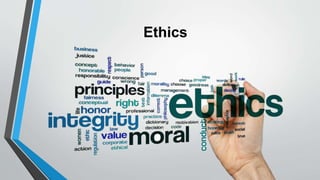
Ethics
Computer Ethics
• Principles of using computer
• Decisions regarding :
Profession
Social Conduct
Areas of Computer Ethics
•Intellectual Property
•Netiquettes
•Day to Day Ethics
Intellectual Property
Categories:
•Industrial Property
•Copyright
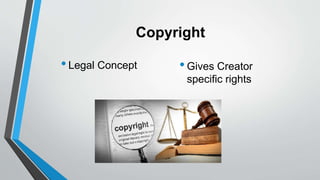
Copyright
•Legal Concept •Gives Creator
specific rights
What can you do with Copyright?
Reproduce it
Prepare derivative works
Distribute copies of it to the public
Display work publicly
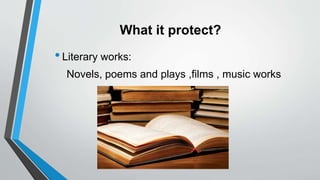
What it protect?
•Literary works:
Novels, poems and plays ,films , music works
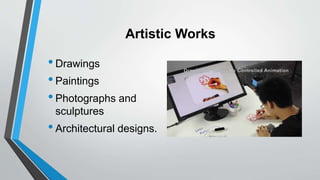
Artistic Works
•Drawings
•Paintings
•Photographs and
sculptures
•Architectural designs.
What it cannot protect?
•Ideas
•Procedures
•Method of operations
Copyright on Internet
NETIQUETTES
•Refers to Internet
Etiquette
•Good manners in online
communication
Types of netiquettes
•Netiquettes Basics
•Netiquettes of Sending
•Netiquettes of Replying
•Confidential Netiquette
NETIQUETTES BASICS
•Help the beginners
•Remember emotions of
others
•Learn before about that
which you want to ask
Netiquettes of sending
•Write content in effective
way
•Describe what you want to
say
•Discuss to related topic
•Use less copied content
Netiquettes of replying
•Learn basic
communication
•Check received
information
•Refer past communication
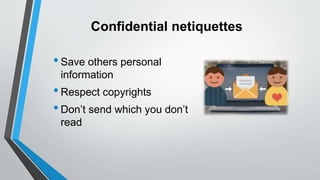
Confidential netiquettes
•Save others personal
information
•Respect copyrights
•Don’t send which you don’t
read
Key points
• Avoid using CAPS
• Use your point of view
• Reread your content
• Use simple and easy language
• Take care of emotions and self
respect
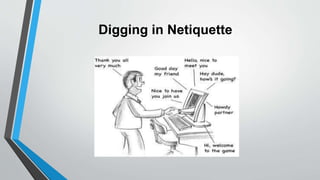
Digging in Netiquette
Real people exist behind the computers
• Remember the human
• Respect other people’s
privacy
• Share expert knowledge
• Be forgiving other
people’s mistake
• Don’t misuse your
power
Protect your Privacy
• Using antivirus
• Post sensibly and
responsibly
• Dealing with emails from
unknown source
• Shop only from secured
website
• Secure password
Help make the network better
• Be a good listener
• Develop a positive attitude
• Collaborate to serve
others
• Be sincere and authentic
• Prove your trustworthiness
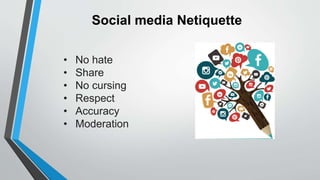
Social media Netiquette
• No hate
• Share
• No cursing
• Respect
• Accuracy
• Moderation
Benefits of Netiquette
• Increases self confidence
• Develops leadership skills
• Promote respect for self
and others
• Improves company image
• Able to respect other
privacy
• Improve company image
Day to Day ethics
Software Piracy
• Reproduce copy
• Giving No credit to the Author.
• Heaving licensed copy of the
software
• Make a backup copy of the
original.
• Backup copy cannot be use.
• Except the original package fail or
destroy.
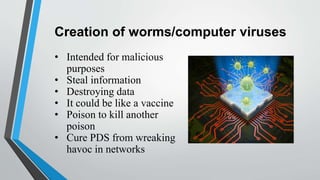
Creation of worms/computer viruses
• Intended for malicious
purposes
• Steal information
• Destroying data
• It could be like a vaccine
• Poison to kill another
poison
• Cure PDS from wreaking
havoc in networks
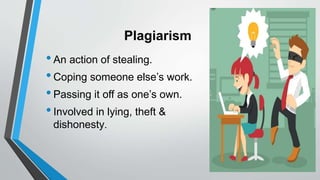
Plagiarism
•An action of stealing.
•Coping someone else’s work.
•Passing it off as one’s own.
•Involved in lying, theft &
dishonesty.
Types of Plagiarism
 Direct Plagiarism
 Self Plagiarism
 Mosaic Plagiarism
 Accidental Plagiarism
Hacking
It is used to access security
systems :
• To crack passwords.
• To break it.
• To improve it.
Types of Hacking
There are different types of hacking :
1. Black Hat
2. White Hat
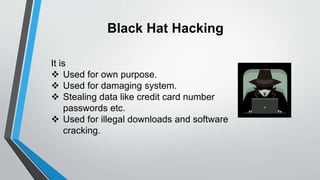
Black Hat Hacking
It is
 Used for own purpose.
 Used for damaging system.
 Stealing data like credit card number
passwords etc.
 Used for illegal downloads and software
cracking.
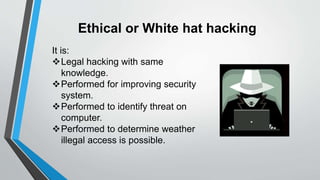
Ethical or White hat hacking
It is:
Legal hacking with same
knowledge.
Performed for improving security
system.
Performed to identify threat on
computer.
Performed to determine weather
illegal access is possible.
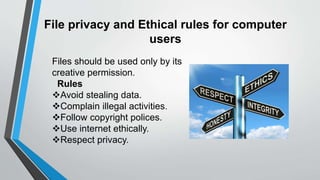
File privacy and Ethical rules for computer
users
Files should be used only by its
creative permission.

Rules
Avoid stealing data.
Complain illegal activities.
Follow copyright polices.
Use internet ethically.
Respect privacy.
Conclusion
We should
Not open untrusted sites.
Follow ethical rules.
Improve firewall and antivirus
software.
ANY QUESTION

Computer Ethics