Done by
Dr. Nawras Mahir
Farhan
Epistaxis - Introduction
• One of the most frequent causes of bleeding.
About 5-10% of population experience an
episode of epistaxis each year
• Epistaxis : is bleeding from nose , through
Ant. Or Post. Nares
• The origin of blood : from nose, nasopharynx,
paranasal sinuses or Ant. Cranial fossa .
Local Causes of Epistaxis
• Idiopathic 85%
• Nasal trauma (nose
picking, foreign bodies,
fracture nasal bone
• inflammatory : Allergic,
chronic or infectious
rhinitis Or sinusitis
• Iatrogenic : surgery or
Medications (topical)
• Neoplasms of the nose or
sinuses
• Tumors of the
nasopharynx especially
Nasopharyngeal
Angiofibroma
• Vascular malformation
Systemic Causes of Epistaxis
• Anticoagulants : Aspirin , Warfrin
• Systemic arterial hypertension
• Hereditary hemorrhagic telangectasias
• Blood diseases and coagulopathies :
Thrombocytopenia, ITP, Leukemia,
Hemophilia OR Platelet dysfunction
• Hepatorenal diseases
Nasal Blood Supply
* A. INTERNAL carotid a. system
via opthalmic a. (ant.&post. Ethmoidal
a.)
Supply the roof of nasal cavity
* B. EXTERNAL carotid a. system
-Via internal maxillary branches)
-Sphenopalatine a. is the major a. of
nasal cavity . Supply the rest of the nasal
(terminal cavity
Nasal Blood Supply
LITTLE`S AREA:
•Is higly vascularized
area at anteroinferior
aspect of septum
(confluence of arteries) :
•Supplied by :
-Shenoplalatine a.
- superior labial a.
- ant. Ethmoidal a.
- greater palatine a.
LOCATION of Epistaxis
•ANTERIOR :
account for 70% of epistaxis and primarily at
LITTLE`S AREA
•POSTERIOR :
Less common and may be associated more with
hypertension & atherosclerosis …. Most often occur
post. To the middle turbinate (sphenopalatine a.
branch )
CLINICAL APPROACH
History & Assessment
•Make sure that the patient is not in shock
• Remember ABC
• Determine :
-Duration
- quantity
- hypovolemia symptoms
- previous Hx. Of epistaxis
- predisposing medical condition
- potentially contributing medication
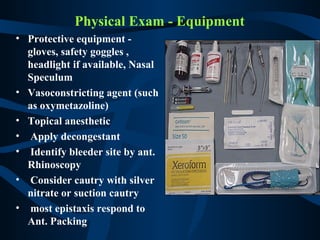
Physical Exam - Equipment
• Protective equipment -
gloves, safety goggles ,
headlight if available, Nasal
Speculum
• Vasoconstricting agent (such
as oxymetazoline)
• Topical anesthetic
• Apply decongestant
• Identify bleeder site by ant.
Rhinoscopy
• Consider cautry with silver
nitrate or suction cautry
• most epistaxis respond to
Ant. Packing
NASAL PACKING
ANTERIOR PACKING
*Formed expandable sponges are
very effective &Available in many
shapes, sizes and some are soaked
with antibacterial properties
* Traditional Ant. Pack : by applying 1/2 inch Gauze
which is. Coated with
•topical antibiotic ointment prior to placement
NASAL PACKING
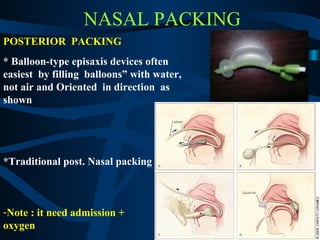
POSTERIOR PACKING
* Balloon-type episaxis devices often
easiest by filling balloons” with water,
not air and Oriented in direction as
shown
*Traditional post. Nasal packing
-Note : it need admission +
oxygen
GENERAL NOTES
- Pack remain in place 3-5days
- pain medication is essential
- patient should receive AB covering staph. Aureus
(toxic shock)
- ELDERLY patient necessitate ICU observation ,
oximetry & oxygen
- if no site found so x-ray and CT to rule out occuled
malignancy
Surgical managment
•Submucosal resection
• A nt. & post. Ethmoidal a. ligation
• Internal maxillary a. ligation
• External carotid a. ligation
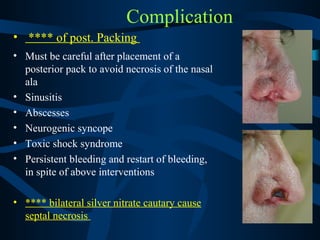
Complication
• **** of post. Packing
• Must be careful after placement of a
posterior pack to avoid necrosis of the nasal
ala
• Sinusitis
• Abscesses
• Neurogenic syncope
• Toxic shock syndrome
• Persistent bleeding and restart of bleeding,
in spite of above interventions
• **** bilateral silver nitrate cautary cause
septal necrosis
THANK YOU

Epistaxis

  • 1.
    Done by Dr. NawrasMahir Farhan
  • 2.
    Epistaxis - Introduction •One of the most frequent causes of bleeding. About 5-10% of population experience an episode of epistaxis each year • Epistaxis : is bleeding from nose , through Ant. Or Post. Nares • The origin of blood : from nose, nasopharynx, paranasal sinuses or Ant. Cranial fossa .
  • 3.
    Local Causes ofEpistaxis • Idiopathic 85% • Nasal trauma (nose picking, foreign bodies, fracture nasal bone • inflammatory : Allergic, chronic or infectious rhinitis Or sinusitis • Iatrogenic : surgery or Medications (topical) • Neoplasms of the nose or sinuses • Tumors of the nasopharynx especially Nasopharyngeal Angiofibroma • Vascular malformation
  • 4.
    Systemic Causes ofEpistaxis • Anticoagulants : Aspirin , Warfrin • Systemic arterial hypertension • Hereditary hemorrhagic telangectasias • Blood diseases and coagulopathies : Thrombocytopenia, ITP, Leukemia, Hemophilia OR Platelet dysfunction • Hepatorenal diseases
  • 5.
    Nasal Blood Supply *A. INTERNAL carotid a. system via opthalmic a. (ant.&post. Ethmoidal a.) Supply the roof of nasal cavity * B. EXTERNAL carotid a. system -Via internal maxillary branches) -Sphenopalatine a. is the major a. of nasal cavity . Supply the rest of the nasal (terminal cavity
  • 6.
    Nasal Blood Supply LITTLE`SAREA: •Is higly vascularized area at anteroinferior aspect of septum (confluence of arteries) : •Supplied by : -Shenoplalatine a. - superior labial a. - ant. Ethmoidal a. - greater palatine a.
  • 7.
    LOCATION of Epistaxis •ANTERIOR: account for 70% of epistaxis and primarily at LITTLE`S AREA •POSTERIOR : Less common and may be associated more with hypertension & atherosclerosis …. Most often occur post. To the middle turbinate (sphenopalatine a. branch )
  • 8.
    CLINICAL APPROACH History &Assessment •Make sure that the patient is not in shock • Remember ABC • Determine : -Duration - quantity - hypovolemia symptoms - previous Hx. Of epistaxis - predisposing medical condition - potentially contributing medication
  • 9.
    Physical Exam -Equipment • Protective equipment - gloves, safety goggles , headlight if available, Nasal Speculum • Vasoconstricting agent (such as oxymetazoline) • Topical anesthetic • Apply decongestant • Identify bleeder site by ant. Rhinoscopy • Consider cautry with silver nitrate or suction cautry • most epistaxis respond to Ant. Packing
  • 10.
    NASAL PACKING ANTERIOR PACKING *Formedexpandable sponges are very effective &Available in many shapes, sizes and some are soaked with antibacterial properties * Traditional Ant. Pack : by applying 1/2 inch Gauze which is. Coated with •topical antibiotic ointment prior to placement
  • 11.
    NASAL PACKING POSTERIOR PACKING *Balloon-type episaxis devices often easiest by filling balloons” with water, not air and Oriented in direction as shown *Traditional post. Nasal packing -Note : it need admission + oxygen
  • 12.
    GENERAL NOTES - Packremain in place 3-5days - pain medication is essential - patient should receive AB covering staph. Aureus (toxic shock) - ELDERLY patient necessitate ICU observation , oximetry & oxygen - if no site found so x-ray and CT to rule out occuled malignancy
  • 13.
    Surgical managment •Submucosal resection •A nt. & post. Ethmoidal a. ligation • Internal maxillary a. ligation • External carotid a. ligation
  • 14.
    Complication • **** ofpost. Packing • Must be careful after placement of a posterior pack to avoid necrosis of the nasal ala • Sinusitis • Abscesses • Neurogenic syncope • Toxic shock syndrome • Persistent bleeding and restart of bleeding, in spite of above interventions • **** bilateral silver nitrate cautary cause septal necrosis
  • 15.