 Definition of epistaxis
 Vasculatures of the nose
 Pathophysiology
 Etiology
 management
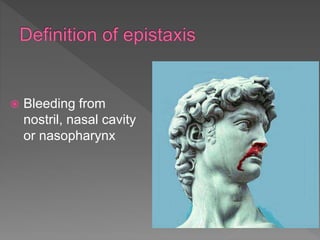
 Bleeding from
nostril, nasal cavity
or nasopharynx
 Fairly common and is
seen in all age Groups
 Epistaxis is a sign ,
NOT a disease
 It should never be
treated as a harmless
event.
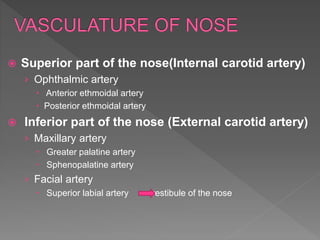
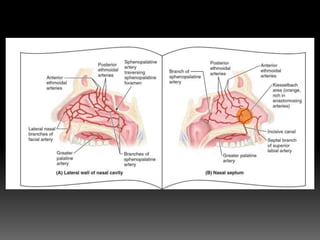
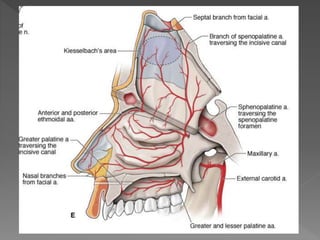
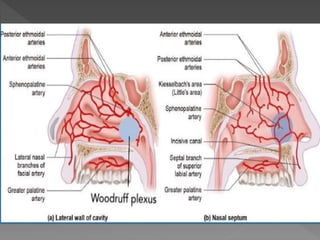
 Superior part of the nose(Internal carotid artery)
› Ophthalmic artery
 Anterior ethmoidal artery
 Posterior ethmoidal artery
 Inferior part of the nose (External carotid artery)
› Maxillary artery
 Greater palatine artery
 Sphenopalatine artery
› Facial artery
 Superior labial artery vestibule of the nose
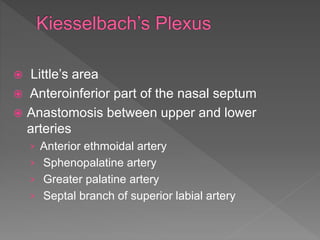
 Little’s area
 Anteroinferior part of the nasal septum
 Anastomosis between upper and lower
arteries
› Anterior ethmoidal artery
› Sphenopalatine artery
› Greater palatine artery
› Septal branch of superior labial artery
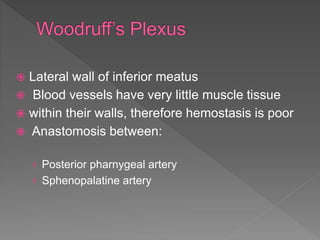
 Lateral wall of inferior meatus
 Blood vessels have very little muscle tissue
 within their walls, therefore hemostasis is poor
 Anastomosis between:
› Posterior pharnygeal artery
› Sphenopalatine artery
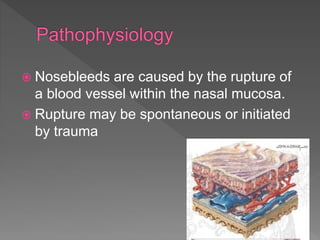
 Nosebleeds are caused by the rupture of
a blood vessel within the nasal mucosa.
 Rupture may be spontaneous or initiated
by trauma
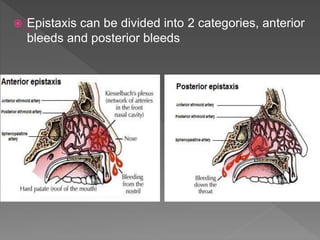
 Epistaxis can be divided into 2 categories, anterior
bleeds and posterior bleeds
 There are multiple causes of epistaxis
which can be divided into local, systemic,
environmental, and medication induced
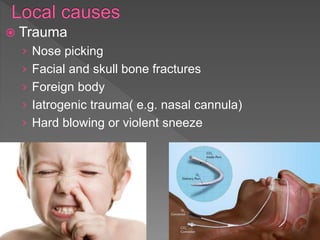
 Trauma
› Nose picking
› Facial and skull bone fractures
› Foreign body
› Iatrogenic trauma( e.g. nasal cannula)
› Hard blowing or violent sneeze
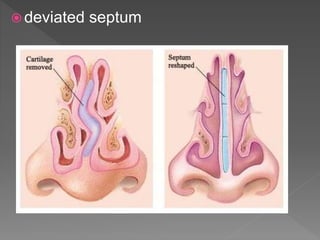
 deviated septum
 Inflammation/infection
› Bacterial, viral, and allergic rhinosinusitis.
 Tumors
› Benign- e.g. Nasopharyngeal Angiofibroma
Malignant –e.g. Squamous Cell Carcinoma
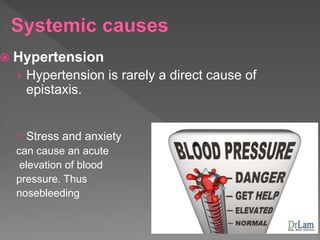
 Hypertension
› Hypertension is rarely a direct cause of
epistaxis.
› Stress and anxiety
can cause an acute
elevation of blood
pressure. Thus
nosebleeding
 Vascular abnormalities
E.g.Arteriosclerotic vascular disease
 coagulopathies
› Congenital- eg.Hemophilia
› Acquired-
 Hepatic cirrhosis
 Thrombocytopenia
 Vitamin K deficiency
 Anticoagulant therapy
 Dry air
 Cold weather
 allergies
Winter is
coming!!
 Anticoagulant(blood-thinning) medications
 Nonsteroidal anti-inflammatory drugs
 nasal drugs such as antihistamines and
corticosteroids
 The cause of epistaxis is not always readily
identifiable.
 In any case of epistaxis , it is important to know :
› Mode of onset
› Duration and frequency of bleeding
› Amount of blood loss
› Side of nose from where bleeding is occurring
› Type of bleeding
› History of medical aliment ( hypertension , leukemia ..)
› Any history of drug intake ( analgesic , anticoagulants and aspirin )
❖ First aid and resuscitation
❖ Cauterization
❖ Nasal packing
❖ Surgical intervention
❖ Prevention
 Address ABC
 Little’s area- pinching the nose with thumb and
index ginger for about 5 minutes- compression
of vessels.
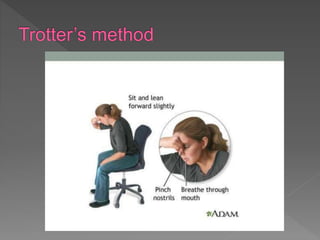
 Trotter’s method : patient is made to sit, leaning
a little forward over a basin to spit any blood,
and breathe quietly from mouth- cold
compresses should be applied to nose to
cause reflex vasoconstriction.
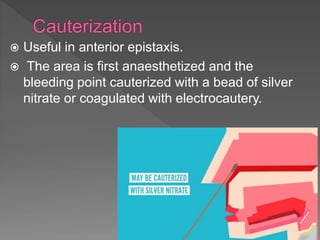
 Useful in anterior epistaxis.
 The area is first anaesthetized and the
bleeding point cauterized with a bead of silver
nitrate or coagulated with electrocautery.
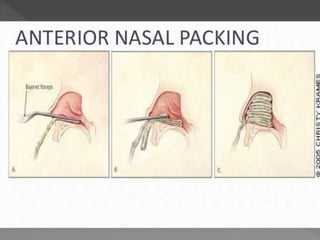
 If bleeding is profuse and/or the site of
bleeding is difficult to localize, anterior
packing is done.
 For this, a ribbon gauze soaked with liquid
paraffin is used.
 About 1 meter gauze (2.5 cm wide in adults
and 12 mm in children) is required for each
nasal cavity.
 Pack can be removed after 24 hours if
bleeding has stopped.
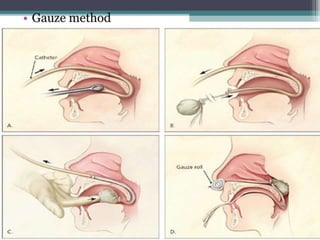
 It is required for patients bleeding posteriorly into
the throat.
 This procedure is used if bleeding doesn't stop
after anterior packing
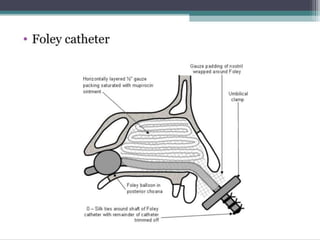
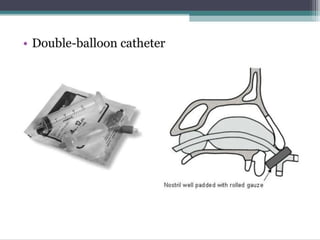
 Can be carried through different instrument
Gauze
Foley catheter
Double-balloon catheter
 • Indications:
› Bleeding continues despite adequate
packing and resuscitation
› Nasal anomaly (septal deviation)
› Patient’s refusal or intolerance to
packing
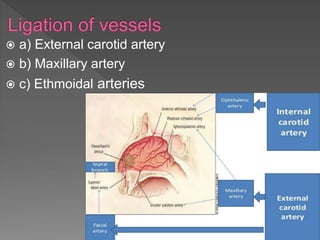
 a) External carotid artery
 b) Maxillary artery
 c) Ethmoidal arteries
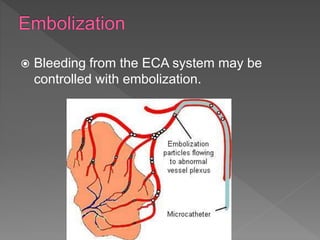
 Bleeding from the ECA system may be
controlled with embolization.
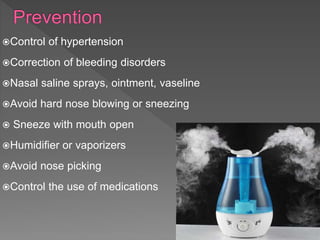
Control of hypertension
Correction of bleeding disorders
Nasal saline sprays, ointment, vaseline
Avoid hard nose blowing or sneezing
 Sneeze with mouth open
Humidifier or vaporizers
Avoid nose picking
Control the use of medications
Epistaxis

Epistaxis

  • 2.
     Definition ofepistaxis  Vasculatures of the nose  Pathophysiology  Etiology  management
  • 3.
     Bleeding from nostril,nasal cavity or nasopharynx
  • 4.
     Fairly commonand is seen in all age Groups  Epistaxis is a sign , NOT a disease  It should never be treated as a harmless event.
  • 5.
     Superior partof the nose(Internal carotid artery) › Ophthalmic artery  Anterior ethmoidal artery  Posterior ethmoidal artery  Inferior part of the nose (External carotid artery) › Maxillary artery  Greater palatine artery  Sphenopalatine artery › Facial artery  Superior labial artery vestibule of the nose
  • 8.
     Little’s area Anteroinferior part of the nasal septum  Anastomosis between upper and lower arteries › Anterior ethmoidal artery › Sphenopalatine artery › Greater palatine artery › Septal branch of superior labial artery
  • 9.
     Lateral wallof inferior meatus  Blood vessels have very little muscle tissue  within their walls, therefore hemostasis is poor  Anastomosis between: › Posterior pharnygeal artery › Sphenopalatine artery
  • 11.
     Nosebleeds arecaused by the rupture of a blood vessel within the nasal mucosa.  Rupture may be spontaneous or initiated by trauma
  • 12.
     Epistaxis canbe divided into 2 categories, anterior bleeds and posterior bleeds
  • 13.
     There aremultiple causes of epistaxis which can be divided into local, systemic, environmental, and medication induced
  • 14.
     Trauma › Nosepicking › Facial and skull bone fractures › Foreign body › Iatrogenic trauma( e.g. nasal cannula) › Hard blowing or violent sneeze
  • 15.
  • 16.
     Inflammation/infection › Bacterial,viral, and allergic rhinosinusitis.  Tumors › Benign- e.g. Nasopharyngeal Angiofibroma Malignant –e.g. Squamous Cell Carcinoma
  • 17.
     Hypertension › Hypertensionis rarely a direct cause of epistaxis. › Stress and anxiety can cause an acute elevation of blood pressure. Thus nosebleeding
  • 18.
     Vascular abnormalities E.g.Arterioscleroticvascular disease  coagulopathies › Congenital- eg.Hemophilia › Acquired-  Hepatic cirrhosis  Thrombocytopenia  Vitamin K deficiency  Anticoagulant therapy
  • 19.
     Dry air Cold weather  allergies Winter is coming!!
  • 20.
     Anticoagulant(blood-thinning) medications Nonsteroidal anti-inflammatory drugs  nasal drugs such as antihistamines and corticosteroids
  • 21.
     The causeof epistaxis is not always readily identifiable.
  • 22.
     In anycase of epistaxis , it is important to know : › Mode of onset › Duration and frequency of bleeding › Amount of blood loss › Side of nose from where bleeding is occurring › Type of bleeding › History of medical aliment ( hypertension , leukemia ..) › Any history of drug intake ( analgesic , anticoagulants and aspirin )
  • 23.
    ❖ First aidand resuscitation ❖ Cauterization ❖ Nasal packing ❖ Surgical intervention ❖ Prevention
  • 24.
     Address ABC Little’s area- pinching the nose with thumb and index ginger for about 5 minutes- compression of vessels.  Trotter’s method : patient is made to sit, leaning a little forward over a basin to spit any blood, and breathe quietly from mouth- cold compresses should be applied to nose to cause reflex vasoconstriction.
  • 26.
     Useful inanterior epistaxis.  The area is first anaesthetized and the bleeding point cauterized with a bead of silver nitrate or coagulated with electrocautery.
  • 27.
     If bleedingis profuse and/or the site of bleeding is difficult to localize, anterior packing is done.  For this, a ribbon gauze soaked with liquid paraffin is used.  About 1 meter gauze (2.5 cm wide in adults and 12 mm in children) is required for each nasal cavity.  Pack can be removed after 24 hours if bleeding has stopped.
  • 29.
     It isrequired for patients bleeding posteriorly into the throat.  This procedure is used if bleeding doesn't stop after anterior packing  Can be carried through different instrument Gauze Foley catheter Double-balloon catheter
  • 33.
     • Indications: ›Bleeding continues despite adequate packing and resuscitation › Nasal anomaly (septal deviation) › Patient’s refusal or intolerance to packing
  • 34.
     a) Externalcarotid artery  b) Maxillary artery  c) Ethmoidal arteries
  • 35.
     Bleeding fromthe ECA system may be controlled with embolization.
  • 36.
    Control of hypertension Correctionof bleeding disorders Nasal saline sprays, ointment, vaseline Avoid hard nose blowing or sneezing  Sneeze with mouth open Humidifier or vaporizers Avoid nose picking Control the use of medications

Editor's Notes

  • #5 They may be scary, but they rarely indicate a serious medical problem  It is rarely life threatening but may cause significant concern, especially among parents of small children. [2] Most nosebleeds are benign, self-limiting, and spontaneous,
  • #12 An increase in the patient's blood pressure can increase the length of the episode. Anticoagulant medications, as well as disorders of blood clotting, can also increase the bleeding time In general, nosebleeds are not a symptom or result of high blood pressure. It is possible, but rare, that severe high blood pressure may worsen or prolong bleeding if you have a nosebleed.
  • #13 Epistaxis can be divided into 2 categories, anterior bleeds and posterior bleeds, on the basis of the site where the bleeding originates  A posterior source (Woodruff's plexus(presents a greater risk of airway compromise, aspiration of blood, and greater difficulty controlling bleeding
  • #15 Self-induced trauma from repeated nasal picking can cause anterior septal mucosal ulceration and bleeding. relating to illness caused by medical examination or treatment b physician . Iatrogenic rhinoplasty, nasal cannula Trauma . Nose picking . Facial and skull bone fractures . Foreign body . Iatrogenic trauma . Hard blowing, violent sneeze Septal deviations (deviated nasal septum) and spurs may disrupt the normal nasal airflow, leading to dryness and epistaxis. Benign and malignant tumors can manifest as epistaxis. Affected patients may also present with signs and symptoms of nasal obstruction and sinusitis, often unilateral.
  • #16 Infective rhinitis
  • #18 In general, nosebleeds are not a symptom or result of high blood pressure. It is possible, but rare, that severe high blood pressure may worsen or prolong bleeding if you have a nosebleed. Hypertension, however, is rarely a direct cause of epistaxis. More commonly, epistaxis and the associated anxiety cause an acute elevation of blood pressure. Therapy, therefore, should be focused on controlling hemorrhage and reducing anxiety as primary means of blood pressure reduction. Haemophilea __coagulopathy
  • #19 Eg. Hereditary hemorrhagic telangiectasia Other vascular abnormalities that predispose to epistaxis include vascular neoplasms, aneurysms, Congenital coagulopathies should be suspected in individuals with a positive family history, easy bruising, or prolonged bleeding from minor trauma or surgery.  Acquired coagulopathies can be primary (due to the diseases) or secondary (due to their treatments). Among the more common acquired coagulopathies are thrombocytopenia and liver disease with its consequential reduction in coagulation factors. Even in the absence of liver disease, alcoholism has also been associated with coagulopathy and epistaxis. Oral anticoagulants predispose to epistaxis.
  • #20 Low humidity may lead to mucosal irritation. Epistaxis is more prevalent in dry climates and during cold weather due to the dehumidification of the nasal mucosa by home heating systems. Allergy cause irritation to the mucosa Allergic Rhinitis
  • #21 Topical nasal drugs such as antihistamines and corticosteroids may cause mucosal irritation. Especially when applied directly to the nasal septum instead of the lateral walls, they may cause mild epistaxis. Medications such as nonsteroidal anti-inflammatory drugs (NSAIDs) are also frequently involved. warfarin,
  • #22  Approximately 10% of patients with epistaxis have no identifiable causes even after a thorough evaluation
  • #25 Neck should not be hyperextended to prevent blood flow into the stomach or possible aspiration • Trotter’s triad @ Blood in mouth should not be swallowed @ Mouth breathing @ Direct pressure over the cartilaginous part of the nose @ 5 – 10 minutes is usually sufficient • Gauze moistened with epinephrine may be placed to promote vasoconstriction
  • #31 Its required for patients bleeding posteriorly into the throat.A postnasal pack is first prepared by tying three silk ties to a piece of gauze rolled into the shape of cone. A rubber catheter is passed through the nose and its end brought out from the mouth.Ends of the silk threads tied to it and catheter withdrawal from nose.Pack which follows the silk thread, is now guided into nasopharynx with the index finger. Anterior nasal cavity is now packed and silk thread tied over the dental roll.The third silk thread is cut shorts and allowed to hang in the oropharynx, it helps in easy removal of the pack later.Patient requires postnasal pack should always be hospitalized.
  • #34 Packing failure can be caused by inadequate placement resulting either from lack of patient cooperation (especially in the pediatric age group) or from anatomic factors (eg, deviated septum).
  • #35 The choice of the specific vessel or vessels to be ligated depends on the location of the epistaxis If bleeding occurs high in the nasal vault, consider ligation of the anterior ethmoidal artery, the posterior ethmoidal artery, or both Arterial ligation ▫ External carotid artery ▫ Internal maxillary artery transorally or transnasally ▫ Ethmoidal arteries ▫ Most commonly ligated vessel is SPHENOPALATINE ARTERY •
  • #36 , either as a primary modality in poor surgical candidates or as a second-line treatment in those for whom surgery has failed