MESOPOTEMIA
(land between rivers )
The cradle of civilization
 Royal Library of Ashurbanipal,
 named after Ashurbanipal, the last greatking of the Neo-
Assyrian Empire, is a collection of thousands of clay
tabletsand fragments containing texts of all kinds(legislation
, medicine ,litruture …etc ) from the 7th century BC.
library consists of approximately 30,000 tablets and
writing boards
The tablets were often organized according to the shape
and contents of the texts.
For more info
https://en.wikipedia.org/wiki/Library_of_Ashurbanipal
Tablet containing part of
theEpic of Gilgamesh (Tablet
11 depicting the Deluge), now
part of the holdings of the
British Museum
Royal Library of Ashurbanipal
Statue of
Ashurbanipal
6000 BC: First settlements of Nineveh
705 BC became the capital of Assyrian empire .
HATRA
HATRA
The statue of "The Lady of Hatra" at the ancient city of Hatra in the desert area in northwest
Iraq between Mosul and Samarra, where the Hellenistic and Roman architecture blend with
eastern decorative features. - See
Hatra was probably built in the 3rd or 2nd
century BC by the Seleucid Empire. as a
Areligious and trading center
On 7 March 2015, various sources including Iraqi
officials reported that the militant group Islamic State
of Iraq and the Levant (ISIL) had begundemolishing the
ruins of Hatra.[1][2] Video released by ISIL the next .
month showed destruction of the monuments
MORE INFO. : https://en.wikipedia.org/wiki/Hatra
HATRA
ISHTAR GATE
The Ishtar Gate was the eighth gate to the inner
city of Babylon. It was constructed in about 575 BC
by order of KingNebuchadnezzar II
The gate was covered in lapis lazuli, a
deep-blue semi-precious stone that was
revered in antiquity due to its vibrancy.
These blue glazed bricks would have given
the façade a jewel-like shine. Through the
gate ran the Processional Way, which was
lined with walls showing about 120 lions,
bulls, dragons and flowers on enameled
yellow and black glazed bricks,
symbolizing the goddess Ishtar.
 MORE INFO :
https://en.wikipedia.org/wiki/Ishtar_Gate
Code of Hammurabi
The Code of Hammurabi is a well-
preserved Babylonian law code of
ancientMesopotamia, dating back to about
1754 BC. It is one of the oldest deciphered
writings of significant length in the world.
T he Code consists of 282 laws, with scaled
punishments, adjusting "an eye for an eye, a
tooth for a tooth" as graded depending on
social status, of slave versus free man.
More info
https://en.wikipedia.org/wiki/Code_of_Ham
murabi
Hanging Gardens of Babylon
The Hanging Gardens of Babylon were one of the Seven Wonders
of the Ancient World, and the only one whose location has not been
definitely established.
The Hanging Gardens were a distinctive feature of ancient
Babylon. They were a great source of pride to the people, and were
often described in accounts written by visitors to the city. Possibly
built by King Nebuchadnezzar II in 600 BC, the gardens are believed
to have been a remarkable feat of engineering: an ascending series
of tiered gardens containing all manner of trees, shrubs, and vines.
The gardens were said to have looked like a large green mountain
constructed of mud bricks, rising from the center of the city.
According to one legend, Nebuchadnezzar II built the Hanging
Gardens for his Median wife, Queen Amytis, because she missed
the green hills and valleys of her homeland. He also built a grand
palace that came to be known as 'The Marvel of the Mankind'.
More info . :
https://en.wikipedia.org/wiki/Hanging_Gardens_of_Babylon
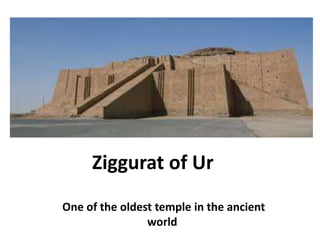
Ziggurat of Ur
One of the oldest temple in the ancient
world
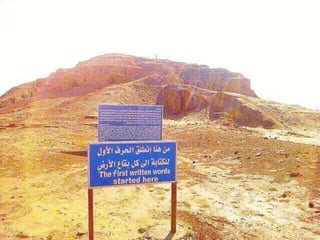
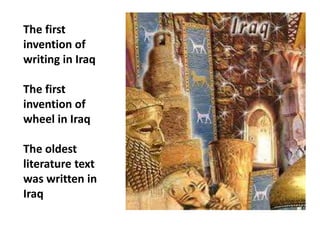
The first
invention of
writing in Iraq
The first
invention of
wheel in Iraq
The oldest
literature text
was written in
Iraq
The Great Mosque of Samarra was, for a
time, the largest mosque in the world;.
its minaret, the Malwiya Tower, is a
spiralling cone 52 meters high and 33
meters wide with a spiral ramp.[
he reign of al-Mutawakkil had a great
effect on the appearance of the city, for he
seems to have been a lover of architecture.
More info . :
The Great Mosque of Samarra
https://en.wikipedia.org/wiki/Great_Mosque_
of_Samarra
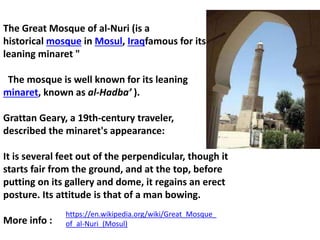
The Great Mosque of al-Nuri (is a
historical mosque in Mosul, Iraqfamous for its
leaning minaret "
The mosque is well known for its leaning
minaret, known as al-Hadba’ ).
Grattan Geary, a 19th-century traveler,
described the minaret's appearance:
It is several feet out of the perpendicular, though it
starts fair from the ground, and at the top, before
putting on its gallery and dome, it regains an erect
posture. Its attitude is that of a man bowing.
More info :
https://en.wikipedia.org/wiki/Great_Mosque_
of_al-Nuri_(Mosul)
It was the premises of one of the oldest Islamic institutions of
higher learning in the world, Its library had an initial collection
of 80,000 volumes,
Mustansiriya Madrasah
•Imam Husayn shrine (an important figure
in Islam)
•The minaret and Qubbet covered with gold
• the inner shrine covered with silver and
gold
• with huge pure crystal chandeliers
Mesopotamia

Mesopotamia

  • 2.
    MESOPOTEMIA (land between rivers) The cradle of civilization
  • 3.
     Royal Libraryof Ashurbanipal,  named after Ashurbanipal, the last greatking of the Neo- Assyrian Empire, is a collection of thousands of clay tabletsand fragments containing texts of all kinds(legislation , medicine ,litruture …etc ) from the 7th century BC. library consists of approximately 30,000 tablets and writing boards The tablets were often organized according to the shape and contents of the texts. For more info https://en.wikipedia.org/wiki/Library_of_Ashurbanipal
  • 4.
    Tablet containing partof theEpic of Gilgamesh (Tablet 11 depicting the Deluge), now part of the holdings of the British Museum Royal Library of Ashurbanipal Statue of Ashurbanipal
  • 5.
    6000 BC: Firstsettlements of Nineveh 705 BC became the capital of Assyrian empire .
  • 6.
  • 7.
    HATRA The statue of"The Lady of Hatra" at the ancient city of Hatra in the desert area in northwest Iraq between Mosul and Samarra, where the Hellenistic and Roman architecture blend with eastern decorative features. - See
  • 8.
    Hatra was probablybuilt in the 3rd or 2nd century BC by the Seleucid Empire. as a Areligious and trading center On 7 March 2015, various sources including Iraqi officials reported that the militant group Islamic State of Iraq and the Levant (ISIL) had begundemolishing the ruins of Hatra.[1][2] Video released by ISIL the next . month showed destruction of the monuments MORE INFO. : https://en.wikipedia.org/wiki/Hatra HATRA
  • 9.
  • 10.
    The Ishtar Gatewas the eighth gate to the inner city of Babylon. It was constructed in about 575 BC by order of KingNebuchadnezzar II The gate was covered in lapis lazuli, a deep-blue semi-precious stone that was revered in antiquity due to its vibrancy. These blue glazed bricks would have given the façade a jewel-like shine. Through the gate ran the Processional Way, which was lined with walls showing about 120 lions, bulls, dragons and flowers on enameled yellow and black glazed bricks, symbolizing the goddess Ishtar.  MORE INFO : https://en.wikipedia.org/wiki/Ishtar_Gate
  • 11.
    Code of Hammurabi TheCode of Hammurabi is a well- preserved Babylonian law code of ancientMesopotamia, dating back to about 1754 BC. It is one of the oldest deciphered writings of significant length in the world. T he Code consists of 282 laws, with scaled punishments, adjusting "an eye for an eye, a tooth for a tooth" as graded depending on social status, of slave versus free man. More info https://en.wikipedia.org/wiki/Code_of_Ham murabi
  • 12.
  • 13.
    The Hanging Gardensof Babylon were one of the Seven Wonders of the Ancient World, and the only one whose location has not been definitely established. The Hanging Gardens were a distinctive feature of ancient Babylon. They were a great source of pride to the people, and were often described in accounts written by visitors to the city. Possibly built by King Nebuchadnezzar II in 600 BC, the gardens are believed to have been a remarkable feat of engineering: an ascending series of tiered gardens containing all manner of trees, shrubs, and vines. The gardens were said to have looked like a large green mountain constructed of mud bricks, rising from the center of the city. According to one legend, Nebuchadnezzar II built the Hanging Gardens for his Median wife, Queen Amytis, because she missed the green hills and valleys of her homeland. He also built a grand palace that came to be known as 'The Marvel of the Mankind'. More info . : https://en.wikipedia.org/wiki/Hanging_Gardens_of_Babylon
  • 14.
    Ziggurat of Ur Oneof the oldest temple in the ancient world
  • 15.
    The first invention of writingin Iraq The first invention of wheel in Iraq The oldest literature text was written in Iraq
  • 16.
    The Great Mosqueof Samarra was, for a time, the largest mosque in the world;. its minaret, the Malwiya Tower, is a spiralling cone 52 meters high and 33 meters wide with a spiral ramp.[ he reign of al-Mutawakkil had a great effect on the appearance of the city, for he seems to have been a lover of architecture. More info . : The Great Mosque of Samarra https://en.wikipedia.org/wiki/Great_Mosque_ of_Samarra
  • 17.
    The Great Mosqueof al-Nuri (is a historical mosque in Mosul, Iraqfamous for its leaning minaret " The mosque is well known for its leaning minaret, known as al-Hadba’ ). Grattan Geary, a 19th-century traveler, described the minaret's appearance: It is several feet out of the perpendicular, though it starts fair from the ground, and at the top, before putting on its gallery and dome, it regains an erect posture. Its attitude is that of a man bowing. More info : https://en.wikipedia.org/wiki/Great_Mosque_ of_al-Nuri_(Mosul)
  • 18.
    It was thepremises of one of the oldest Islamic institutions of higher learning in the world, Its library had an initial collection of 80,000 volumes, Mustansiriya Madrasah
  • 19.
    •Imam Husayn shrine(an important figure in Islam) •The minaret and Qubbet covered with gold • the inner shrine covered with silver and gold • with huge pure crystal chandeliers